
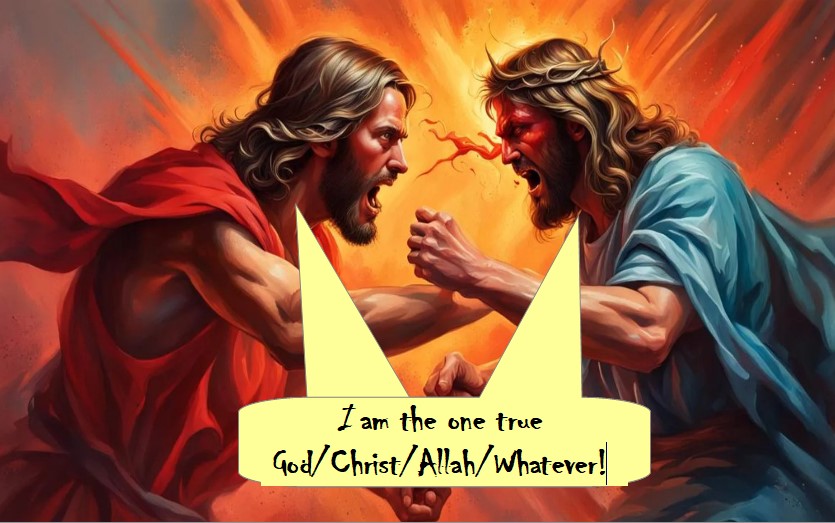
Spiritual Forces of Evil in the Heavenly Realms

Original AI image from Night Cafe 

For our struggle is not against flesh and blood, but against the rulers, against the authorities, against the powers of this dark world and against the spiritual forces of evil in the heavenly realms. (Ephesians 6:12)

…you followed the ways of this world and of the ruler of the kingdom of the air, the spirit who is now at work in those who are disobedient. (Ephesians 2:2)

the prince of this world now stands condemned. (John 16:11)

The first-century worldview of early Christian cultists was that somewhere above the Earth a battle raged between God and Satan. The powers of darkness – the devil and his demons – had in ages past launched an attack on the Lord and his angels. This war in the spiritual realm continued unabated up to the time when a cultist wrote Ephesians, pretending to be Paul. Paul himself had already alluded to Satan as the god of this age (2 Corinthians 4:4), while the authors of the fourth gospel would later refer to him as the archon – ruler and prince – of this world (John 12:31; 14:30).

Which just goes to show how the Almighty God they believed in was nothing of the sort. He had tussled with his arch-enemy for eons without quashing his rebellion and putting an end to his persistent attacks. The stand-off had gone on for millennia, and, according to today’s Christians, is still happening. A puny god it is who cannot get the better of one of his far less powerful creations.

And what are God and Satan fighting over? Us, apparently. The devil wants control of human beings.

Why? Who knows. In fact, according to Paul, Satan already has control over us. He enslaves us to sin, which in turn leads to death (Romans 5:12, 6:23). 

Not to worry though, Paul, fake Paul and the fourth gospel writers assure us that their enfeebled God has a cunning plan! He’ll allow a being who is precious to him – like a son, in fact – to be sacrificed so that anyone who believes in him will no longer be enslaved to Satan and sin and will be granted eternal life. How’s that for special magic!

Who shouted out from the back that that sounds like a cop-out? It’s a fantasy bordering on the insane. Like it or not, we are somehow embroiled in heavenly warfare, specially if we’re of the number who’ve bought into this malarkey.

While we’re at it, have you noticed how so many of the wars and skirmishes currently afflicting the world have religion at their heart? YHWH is scrapping with Allah, Allah is up against the Great Satan while Jesus – no stranger to war-mongering himself – presides over it all, leading the world to Armageddon and his own ultimate ‘return’.

Here’s my suggestion. All the gods and demons need to get their act together. They should agree to an ultimate slug-fest, a final battle in the spiritual realm to decide who’s really the Supreme God – the last deity standing – and leave us humans out of it entirely. Surely, being gods, they’re up for finding out who can piss furthest up the wall.

A preposterous idea? Of course it is. None of these fantasy beings exist. There’s no YHWH, Allah, Heavenly Father, Jesus, Krishna, angels, archons, Satan or ‘spiritual forces of evil’ to duke it out. There’s no ‘heavenly plane’ where they can get to it. Everyone of these despotic characters is a human creation, as are the wars, disputes and skirmishes they underpin. It follows that none of them can be the supreme god and certainly none of them are worth fighting over. It’s time we grew up and put away all of our childish imaginary tyrants.

The End of Days

A friend of mine was recently given the book The Dragon’s Prophecy: Israel, the Dark Resurrection and the End of Days by Jonathan Cahn. My friend, already concerned about the state of the world, said how much the book had disturbed her. She had become convinced that the time we live in had been predicted in the Bible, in Revelation in particular. ‘It’s all there in the Bible,’ she said to me. ‘It’s all happening just as it says.’

I tried to reassure her that Revelation was written by someone who, 2000 years ago, believed that the situation then couldn’t get any worse, what with the Roman occupation, the destruction of Jerusalem and the persecution of Christians (as the writer saw it.) This, together with his belief that the Lord would soon be coming on the clouds (Revelation 1:7), convinced him he was living in the world’s last days. I told my friend that because of the mess the world is in today (and when is it not a mess?) the book of Revelation resonates with some people; a voice from the past echoing down the ages. In no way, however, was it written about today.

My friend was unconvinced so I took it upon myself to read The Dragon’s Prophecy. Coincidentally, I had just begun to read Bart D. Ehrman’s Armageddon: What the Bible Really Says About the End, dealing with the same concerns. The comparison between the two books couldn’t be more striking.

Ehrman’s is a measured analysis of Revelation and other ‘prophetic’ books of the Bible. He demonstrates from the outset that Revelation was written for believers of the late first/early second century and that its symbolism represents individuals and events of that time. John of Patmos, whoever he may have been (a cult leader, Ehrman suggests) expected, like most early Christians, that the End was going to materialise soon, in the first or early second century, emphatically not in the 21st.

Ehrman warns that ‘professional prophecy writers’ (he doesn’t name Cahn) think ‘the way to use the Bible is to assemble the pieces to reveal the big picture, which until now no one has seen before’ (p17). He’s right. This is precisely what they do. In his book, Cahn promises ‘to put together the pieces of the mystery’ (p11) and claims ‘We (sic) will now begin assembling the pieces of the puzzle’ (p36). He then proceeds to jump around the Bible like a grasshopper on steroids. He’s one of the ‘prophets’ who, as Ehrman puts it, sees the Bible as ‘a great jigsaw puzzle with one piece hidden in this place, one in another and yet a third somewhere else’ (p17).

Cahn opens his argument with a series of bald, unsupported assertions: ‘Behind the perceivable realm lies another, beyond our ability to measure or quantify’ and ‘Behind the history of this world lies another, unrecorded, unrecited (sic), unknown,’ his readers evidently not expected to ask how he knows any of this codswallop. He goes from there to build his argument, such as it is, with a bombardment of ridiculous questions and pseudo-profundities:

What is evil? And how did it come into existence? It is both a mystery and a problem. The mystery is the problem (p9).

Then there are the propositional statements of the ‘If… then we’d expect’ variety. There’s rarely any evidence for the ‘if’ and none at all for the proposed expectation. Here’s the two – rhetorical question and propositional statement – rolled into one: ‘If evil is uncreated, how did it come to exist?’ (p32). Naturally, Cahn is going to answer this question and all the others like it, with a series of unfounded assertions, non-sequiturs and a smattering of unrelated Bible verses.

A central premise of The Dragon’s Prophecy, the dragon being that of Revelation 12:9 and therefore the devil, is ‘the dark resurrection’ of its subtitle. This Cahn explains, pretending the idea comes from the Bible when it doesn’t, is the re-emergence of the Israelites’ old, (extinct) enemies, the Philistines. Like the Israeli nation they too have now been resurrected: as the Palestinians. Under the control of the dragon/devil, they re-enacted on October 7th last year one of the many ancient Philistine attacks recorded in the Bible, only this time with ‘guns and explosives’:

On that October morning, the ancient drama replayed. The resurrected Philistines had again invaded the land, and the resurrected Israelites had again gone into hiding, keeping silent and still in fear of their pursuers (pp99-100).

How do we know this is a replay of an ancient invasion? Because some of those under attack on 7th October went into hiding, just as the Israelites did in 1 Samuel 13:6. As if no other group of besieged civilians hasn’t tried to hide at any other point in history. That and the ‘fact’ there were, according to Cahn, exactly 3,000 invaders on each occasion. Yes, the book really is this bad.

And so, Cahn says, the stage is set for the final battle and the return of Christ who will knock a few heads together, torture and slaughter everyone who isn’t a Christian and set up his faithful followers in a new Jerusalem made of gold and fancy stuff. As Ehrman says, this is indeed what Revelation promises – for the world 2,000 years ago. Ehrman argues that the author of this revenge porn, (he doesn’t use the term: that’s my contribution – you’re welcome) creates a Christ so unlike those of the gospels that he can only be a fiction (aren’t they all?)

Revelation barely made it into the canon and we would all be better off if it hadn’t; certainly my friend would be, and as Ehrman shows, human society and the planet in general would be too. He warns us to read what the Bible actually says, instead of, as Cahn does, forcing it to say what we want it to (to sell books). Irritatingly, Ehrman consistently refers to the Christ’s prophesied appearance on the clouds as his ‘Second Coming’ when the Bible never uses the phrase. Read what it says Bart!

I don’t know whether I’ll finish Dragon’s Prophecy. Its cover blurb boasts that Cahn is a New York Times best seller so clearly there’s an audience for such poorly argued, alarmist nonsense – which is itself alarming. While Bart D. Ehrman has also made the NYT list in the past, Cahn easily outsells him. Nevertheless, I’ve bought my friend a copy of his Armageddon in the hopes it might serve as an antidote to the dire The Dragon’s Prophecy.

End Of Term Test

Which of the terms mythological, symbolic, theological is most appropriate when discussing biblical tropes?

Apparently, it’s ‘theological’ because it has an air of respectability, whereas the other terms suggest something with only theoretical underpinning. In fact, this also applies to ‘theological’, which by definition is the study of deities, for which there is no evidential verification. The use of ‘theological’ therefore is as unsubstantive as arguing that a concept is metaphorical or symbolic. None of these terms represents a sound, reliable way to determine the accuracy, historicity or truth of religious claims.

With this in mind see how you do with these questions:

1. Did the original hearers of the Genesis creation story regard it as –

a) true.

b) a theological statement.

c) an entertaining myth.

Of course we’ve no way of knowing what the story’s original hearers thought but there is nothing in the text that suggests they would have regarded the creation story as anything but true. The creators of Jesus’ script certainly seemed to think so, a few centuries later and its original hearers would not have felt the need to preserve it otherwise. In this belief they were wrong.

2. Which of these gospel stories is true, as in ‘really happened more or less as described’ –

a) The virgin birth with its surrounding detail.

b) Jesus meeting with Moses and Elijah (the transfiguration).

c) Resurrected corpses roaming around Jerusalem.

d) The resurrection.

The answer is that either all of them are true or none of them are. If only one of them is mythic, symbolic or ‘theological’ (and more than one of them most certainly is) then it is highly likely the others are too. If we are scrupulous, we cannot assert that one story is symbolic because it’s making a theological point while another equally implausible story is historically accurate because we want it to be.

The criteria for determining the historicity of any story from antiquity are corroborative evidence and, failing that, plausibility. We have already established that there is no independent corroboration for many of the gospel stories. There is no corroboration for some of them even in the Bible itself. We are left then with plausibility: how plausible is it that a virgin gave birth or that resurrected corpses presented themselves to Jewish authorities? Vanishingly small. Jesus’ encounter with Moses and Elijah is equally improbable.

Is his resurrection the exception? No, because dead people do not spring back to life 36 hours after being buried. If the virgin birth, the transfiguration and the resurrection of dead saints are all highly implausible (and they are) then so is the resurrection. It is at best, a story making a theological point but it is not history. The implausibility it shares with many of the other implausible stories in the gospels discounts it as history. There are no grounds for saying it is the exception.

There is also the cumulative effect of implausibility. It is highly unlikely that one of the implausible events above is historical, but it is impossible that all four of them are. Add all the other implausible stories in the gospels – the other miracles; the healings; exorcisms; Jesus sparring with the devil, walking through locked doors and beaming up to heaven: piling implausibility on top of implausibility doesn’t make any of the component implausibilities more plausible. It makes all of them less plausible and collectively impossible.

The things the gospels tell us happened to Gospel Jesus, and those they say he did himself, are equalled only by heroes of myth. Did Osiris or Romulus rise from the dead, as their stories claim? Did Augustus really become a god once he died? Of course not. These are the implausible, improbable events we find in myth. Jesus’ story is no different.

3. While many or all of the gospel stories are highly improbable as history because they are intended to convey a theological point, the words attributed to Jesus in the gospels –

a) are completely accurate.

b) are more or less what he said.

c) passed through an inestimable number of people, being invented, edited and altered in the process, before being written down 40+ years after Jesus supposedly uttered them.

d) are inventions of the gospel writers and/or their particular sect and frequently copied between gospels.

If you’re opting for a or b, you’re now making the logia the exception; the one oasis of historical truth in a desert of implausibility. That’s a big ask. To get this one off the ground, you have to call upon contrivances like –

completely reliable (but different and conflicting) oral traditions;

     hypothetical lists of sayings;

         Peter’s dictation to Mark;

             eyewitness authors;

                  secret teachings;

                     super-translators and

                         the odd spot of collaboration.

So, c and/or d is far more likely to be the answer to this one, representing the explanation that requires the least conjecture and fewest hypothetical components.

How did you do? I expect most of you aced this end of term quiz. If not, better get down to some extra study and repeat the semester next year.

How the bible gets almost everything wrong: volume 2

bible-questions

The bible’s moral inconsistencies:

As we saw here and here, the bible’s morality is confused and frequently contradictory. Jesus himself adds to the confusion with pronouncements like:

You have heard it said (in Exodus 21.24), ‘Eye for eye, and tooth for tooth.’ But I tell you, do not resist an evil person. If anyone slaps you on the right cheek, turn to them the other cheek also. (Matthew 5:38-39)

and

You have heard it said, ‘You shall not commit adultery.’ But I tell you that anyone who looks at a woman lustfully has already committed adultery with her in his heart (Matthew 5.27-28).

God’s ‘standards’ change depending on who thinks they’re channelling him:

In Joel 3.8 he advocates slavery but in Exodus 21.16 he forbids it.

In Matthew 6.1 Jesus insists good deeds should be done secretly forgetting he’s already said, in Matthew 5.1, that they should be done openly to impress others.

In Matthew 7.1-3 Jesus says judging others is to be avoided while in 1 Corinthians 6.2-4, Paul gives it the go-ahead; judging others is fine.

In Matthew 19.10-12 Jesus disparages marriage but the writer of Hebrews approves of it (13.4)

God allows divorce in Deuteronomy 21.10-14 but in Matthew 5.32 Jesus doesn’t.

And on and on. Like everyone else’s, Christians’ morality is socially determined. Unlike everyone else’s, their morality reflects the bible’s own confusion and inconsistencies. To accommodate its contradictions, Christians cherry-pick from it to bolster their pre-existing prejudices and biases. The rest of us are then measured – judged – against the resulting pick’n’mix morality and, boy, are we found lacking. ‘Biblical morality’ is nothing if not projectile.


The bible’s weak understanding of psychology:

Many of those who wrote the bible had a particularly bleak view of human beings. To these men we are totally depraved and our every thought is ‘continually evil’ (Genesis 6.5) Our ‘hearts’ are supremely deceitful and desperately sick (Jeremiah 17.9) and we’re under the control of the devil (Ephesians 2.1-3). We are incapable of doing good (Romans 3.10-13) and as Jesus himself puts it:

That which proceeds from a person, defiles that person. For from within, out of the heart, proceed the evil thoughts, fornications, thefts, murders, adulteries, deeds of coveting and wickedness, as well as deceit, sensuality, envy, slander, pride and foolishness. All these evil things proceed from within and defile a person. (Mark 7.20-23).

I don’t recognise this as a description of myself and I’m sure you don’t of yourself. Of course human beings are capable of terrible acts (I’m writing this not long after a fanatical Muslim murdered 22 young, innocent people in a terrorist bombing in Manchester, here in the UK) and, on a more mundane level, we can behave in thoughtless or vindictive ways, entirely out of self-interest.

But we’re also capable of great kindness, compassion and concern. We are a complex mixture of these traits, the good and the bad. The biblical view that we are only ever hateful, devoid of any good, is jaundiced and unnecessarily negative. If parents were to spend their time telling a child he or she is only ever bad, wicked and evil, they would rapidly deprive the child of their self-worth, self-confidence and ability to relate in positive, loving ways to others. The description would become self-fulfilling. This is what the God of the bible does to his children.

Neither are we awash with sin. Sin is a religious idea, used to describe how humans fall short of the glory of God. It need not concern us here. There is no God to fall short of; sin therefore is a concept without any traction in the real world.


The bible’s fantasy perspective of the world:

Did you know this world is controlled by the devil and his demons? That powers and principalities of the air are at war with God and the powers of holiness all around us? In fact, the devil is always looking for ways to discredit the bible and is constantly trying to weaken Christians’ faith. He smuggles false doctrine into the church in order to mislead believers, and uses the hoax that is evolution to prevent unbelievers from accepting Christ as their saviour. He gives women ideas above their station, which God says is to be submissive, and has unleashed a wave of homosexual behaviour and gender confusion to blind people to God’s goodness and to kindle his wrath.

Did you know, though, that this fallen world and the ‘heavens’ above it are soon to be destroyed and replaced by a new earth and new heavens, where Jesus will reign over the select few God decides to raise from the dead? Despite Satan thinking he’s in control, it’s actually God who is. God only allows the devil to think he’s top-dog while he, God, is secretly pulling the strings.

If you do know these things, and if you believe them, then you have a ‘biblical worldview’. Or, to put it another way, you’ve bought into third-rate hokum that bears no relation to the world – the universe, even – as it is.


How to argue like a Christian (part two)

Street-preachers

Five more ‘arguments’ offered by Christians in defence of their insupportable beliefs:

You’re not entitled to speak because you have no objective basis for your morality; morality comes only from God/the Bible.

Except it doesn’t, of course; moral codes existed long before the Bible or even the invention YHWH, who is, in any case, morally bankrupt. This ‘most unpleasant character in all fiction’ ‘wallows’, if I might borrow the term, in genocide (1 Samuel 15.2-3 etc) and slavery (Leviticus 25.44-46; Exodus 21.20-21 ); he relishes the death penalty for the most minor infringements of his petty rules (Leviticus 24.16; Deuteronomy 21.18-21, etc ad nauseam); fails to keep his promises (Genesis 17.7; Mark 11.24); does nothing to relieve human or animal suffering and lets millions of children die needlessly, year in, year out. It just doesn’t suit his mysterious ways, apparently, to behave like any halfway-decent human being would.

And even if he were the morally-upright paragon of virtue Christians delude themselves into thinking he is, they would ignore his moral guidance at every turn, just as they do now. Ministers, priests, evangelists as well as run-of-the-mill believers are convicted every day of the most despicable of crimes (Bruce Gerenscer keeps a tally on his blog-site) and that’s before we get to the more exacting moral demands Jesus makes. Going the extra mile (Matt 5.41), loving neighbour (Mark 12.31) and enemy alike (Luke 6.27), giving to all who ask (Luke 6.30) – these most Christians simply ignore. ‘We’re forgiven, not perfect,’ they whimper, even though ‘perfect’ is precisely what their unreasonable saviour tells them to be (Matt 5.48). But then I’m probably quoting out of context again… or something.

You’ve been hurt in the past.

This weak, ad hominem response is the converse of the charge that you’re immoral; good cop as opposed to bad cop. The Christian who says this is all-seeing and all-knowing and is able to evaluate your entire psychology and personal history from a single comment you’ve made. They can tell that you’re only disputing an aspect of Christianity because obviously at some point in your past a Christian – who wasn’t really a true Christian – hurt you. Or maybe it was a church you once belonged to that let you down. Well, you’ve every right to feel hurt! But that doesn’t mean there’s anything wrong with the True Faith™ or those who subscribe to it! And so your point is neatly invalidated; you’re only responding emotionally and you’ll get over it.

If there’s no God then life is meaningless.

Used extensively by some Christian blog-sites, this non-sequitur translates as, ‘I’m not going to address anything you say. My neediness demands there’s some point to life and I’ve decided that it comes from the fantasy I’ve bought into.’ Questions of whether that fantasy is actually true (which by definition it can’t be) and whether life is meaningless without it, are never considered. Believers’ need for the delusion to be true, their fear of working out meaning for themselves and their subsequent investment in Christianity’s empty promises, compel them to hide behind what is an essentially… er, meaningless solipsism.

Unbelievers have no right to criticise those who belong to Jesus.

Haven’t we? We put up with all the nonsense Christians spout, their attempts to influence everything from elections to what we can see on TV, from their opposition to gay rights, same-sex marriage, women’s rights, abortion and adoption issues to the restrooms people can or can’t use and their judging of the rest of us as hell-bound sinners. In return, we unbelievers are perfectly entitled to hold Christians accountable. At the risk of repeating myself, do they do what Jesus tells them to? Do they turn the other cheek (Matt 5.39)? Sell their possessions to give to the poor (Mark 10.21)? Give more than is demanded of them (Matt 5.40)? Avoid judging others so they’re not judged in return (Matt 7.1-3)?

What do you think?

You’re of the devil/an enemy of the cross/wilfully blind/apostate/a troll.

If all else fails (and it will) the faithful resort to an insult carefully selected from the extensive bank of Christian cliches. That way, there’s no need to engage the brain at all. God love ’em!


Recent Encounters of the Religious Kind

1. The kindly street preacher

preacher4

A bad-tempered looking man is standing next to a sign that announces that ‘Evolution is a Lie’ and ‘Jesus is Lord’. He – the grumpy man, not Jesus – is giving out some sort of glossy card. I do my best to sidestep him but he approaches and gives me one. It is entitled God Commands: 4 Things That God Commands, at least half of which is redundant. I notice that a group of Jehovah’s Witnesses have set up stall next to him (or perhaps he set up next to them).

‘So,’ I ask, ‘who’s right? You or them?’

They,’ he growls, ‘are of the devil.’

What a problem Christianity has. Islam too: so many damn different versions, all of which lay claim to being the one and only Truth. The Center for the Study of Global Christianity reports that there are now 45,000 different churches, denominations, sects and cults within Christianity, every one of them insisting that they – and they alone – represent God’s Truth, only they have got it right. There are as many Christian web-sites out there slagging off other Christians – Apostate! Wolves in Sheep’s Clothing! Doing the devil’s work! False teachers! – as there are sites ‘reaching out’ to the ‘lost’.

What’s more, every one of them knows they alone have the Truth because the Bible itself says so. They quote from it to prove how right they are and how wrong everyone else is. Which just goes to show what a damnable, scurrilous load of tosh the Bible really is. If God is not, as it says in 1 Corinthians 14.33, the author of confusion then he can’t have had anything to do with it.

Of course we know he didn’t; it’s human through and through, every mean-spirited, self-righteous verse of it.

Christians’ Favourite Delusions 9: The supernatural exists

Madeup

If you follow any Christian blogs, you’ll know that what many of them enjoy most is slagging off other brands of Christianity. They take the odd swipe at the heathen and at gay people, of course, but most of their bile is reserved for each other. They dispute the smallest matters of doctrine and principle that they are sure other groups of believers haven’t got quite as right as they have. To the outsider, it’s like arguing about whether the tooth fairy’s dress is pink or green while overlooking the fact that there is no tooth fairy.

It’s curious too because there are more similarities than differences between the varieties of Christianity. They have much more in common with each other than with the rest of us.

Most significantly, they all believe in supernatural beings. This, for me, is the greatest difference between myself and those who profess a faith. I see no evidence for supernatural creatures, places or events. The supernatural has no independent existence outside the human imagination. It is the human mind that, over the millennia, has constructed innumerable gods and their attendant mythologies, just as it has created more recently the inhabitants of Narnia, Middle-Earth and Hogwarts.

Being a Christian requires you believe in not one, but a myriad of supernatural beings, events and locations:-

While believers are adamant that there’s one God, they insist at the same time he is made up of three individuals: a Father, a Son and a Holy Spirit.

They believe in angels who wait upon God the Father in Heaven – a supernatural place they mistakenly believe they’ll be going to when they die – and who, some maintain, aid them here on Earth. How many angels are there? We are told in the Bible there’s a ‘host’ of them, which sounds like quite a lot.

There are also seraphim (Isaiah 6.2) and cherubim (Hebrew 9.5 etc), third-rate special-effects creatures who act as God’s heavies.

In addition to them, there are characters from the early days of Judaism – Moses and Elijah – who have survived death and hang about somewhere or other. They make a surprise return visit to Earth in Matthew 17.3. For some, Jesus’ mother, Mary, is another of this elite group of Eternals.

And what about all of the ordinary believers Christians say have already gone to Heaven? That’s millions of dead people who enjoy supernatural existence. Roman Catholics even believe you can chat with these heavenly ‘saints’ and they’ll argue your case for you with the Big Boss.

There’s the cast of characters from the dark-side too: God’s nemesis the Devil (aka Satan, aka Lucifer – though confusingly this last title is also used of Christ in Revelation 22.16) and his armies of demons and evil spirits who have nothing better to do than take over gullible human minds. This lot live in another supernatural place, Hell, though no-one seems to know where this is either (in Luke 10.15, Jesus implies it’s inside the earth, but it isn’t).

And last but not least are the supernatural events that supposedly took place in the real world: talking animals (Genesis 3.1; Numbers 22.28), sticks that turn into snakes (Exodus 4.3), corpses rising from graves (Matthew 27.52) and a man who magically beams up to Heaven (Luke 24.51), to name but a few.

So, Christians, argue all you like about what makes your version of Christianity better than others, but don’t forget all varieties of the faith depend on believing that these supernatural characters and events are real. In fact, they’re no more real than the pantheon of Greek gods and goddesses who inhabited Olympus, and at least they were interesting.