The Mind

Let’s run with the idea* that this reality might be nothing more than a simulation, created by a Mind vastly superior to our own.

*From an idea by Don Camp.

The Mind set up its simulation to run without any external interference. The Mind is outside the simulation and has no interest in engaging with it. Doing so would negate the purpose of the simulation, which is to see how it evolves naturally and unaided.

It is not clear at this point how long the simulation has been running; part of its programming exists to create the impression of a considerable passage of time. Time, memory and even distance are all simulated.

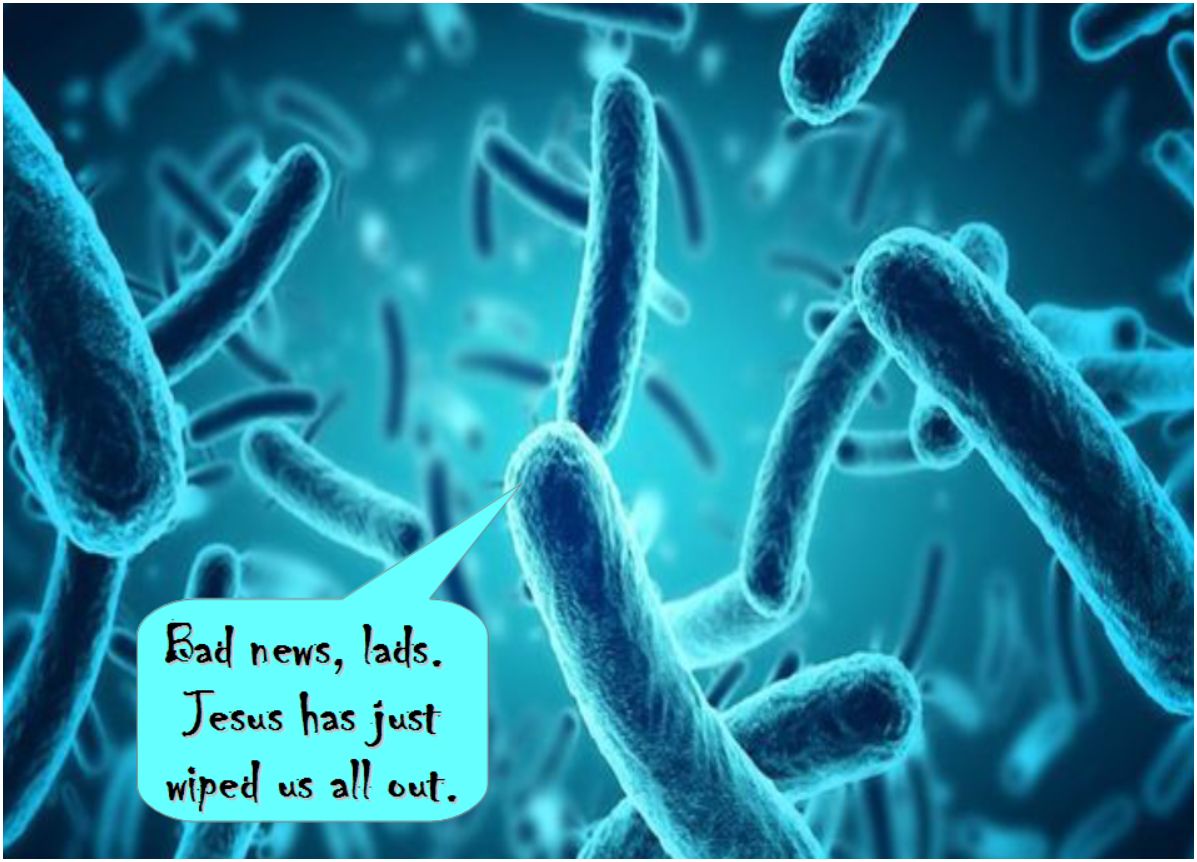
Unfortunately for the simulated individuals within it, the simulation also incorporates penalties – bugs, viruses, perils, conflict and ultimate deletion – to stimulate their collective evolution. These are in fact the drivers of the simulation.

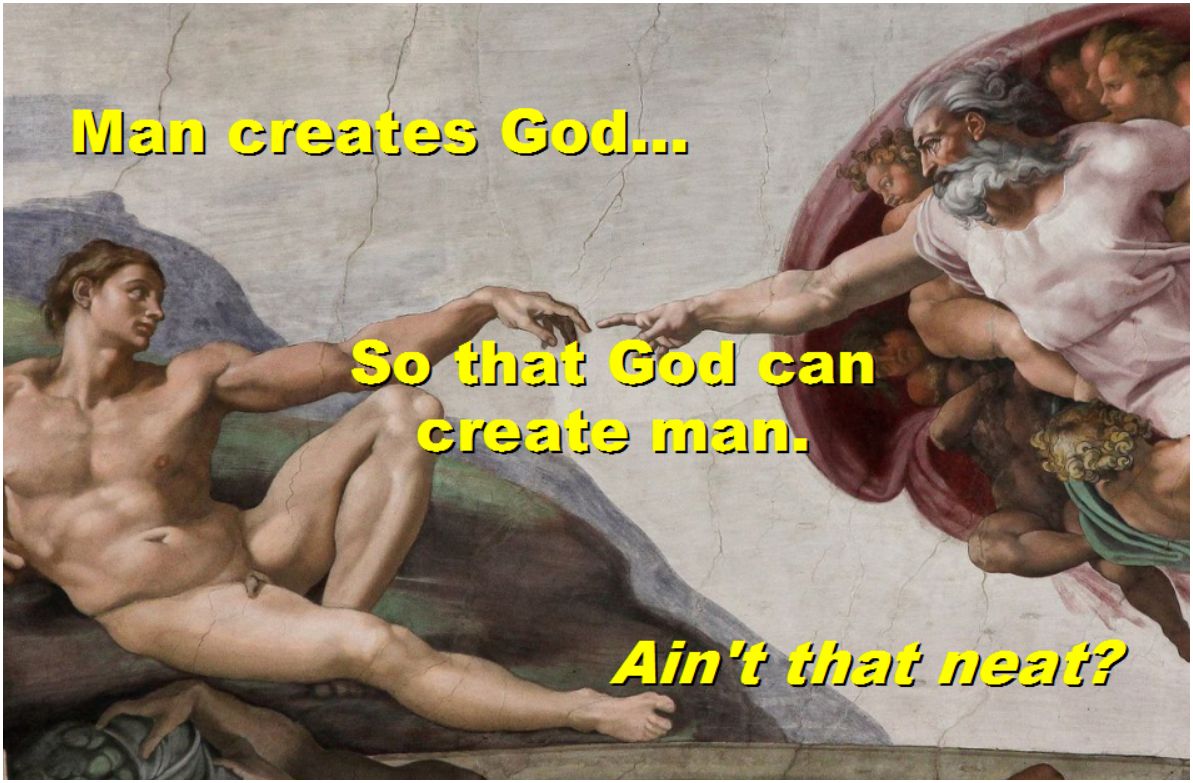
Through them, the simulation has produced the semblance of sentient life. These apparent sentients are largely unaware, like the characters in their simulated dreams, that they are not real. Some of them however are vaguely aware – a glitch in the program, no doubt – that they are the product of a simulation. They create their own simulated constructs of what they think the initiator of the simulation must, in their simulated imaginations, be like. They give these constructs names: Ra, Osiris, Zeus, YHWH, Allah. Jesus and many others. They mistake these simulations for the Mind itself with some concluding they will, once the simulation ends for them, join the Mind in actual reality.

The Mind notes this development with disinterest. It is mildly amusing, nothing more. It turns to more important matters – feeding the cat, taking out the trash – and leaves the ssimulation to run in the corner of the basement.

Now, don’t you think Don, that this is a much more likely scenario than that of super-beings outside of time and space? I’m so glad you suggested it.

Next, what if the universe really was created by a super-being? How would that work? From another brilliant idea of Don’s!

End Of Term Test

Which of the terms mythological, symbolic, theological is most appropriate when discussing biblical tropes?

Apparently, it’s ‘theological’ because it has an air of respectability, whereas the other terms suggest something with only theoretical underpinning. In fact, this also applies to ‘theological’, which by definition is the study of deities, for which there is no evidential verification. The use of ‘theological’ therefore is as unsubstantive as arguing that a concept is metaphorical or symbolic. None of these terms represents a sound, reliable way to determine the accuracy, historicity or truth of religious claims.

With this in mind see how you do with these questions:

1. Did the original hearers of the Genesis creation story regard it as –

a) true.

b) a theological statement.

c) an entertaining myth.

Of course we’ve no way of knowing what the story’s original hearers thought but there is nothing in the text that suggests they would have regarded the creation story as anything but true. The creators of Jesus’ script certainly seemed to think so, a few centuries later and its original hearers would not have felt the need to preserve it otherwise. In this belief they were wrong.

2. Which of these gospel stories is true, as in ‘really happened more or less as described’ –

a) The virgin birth with its surrounding detail.

b) Jesus meeting with Moses and Elijah (the transfiguration).

c) Resurrected corpses roaming around Jerusalem.

d) The resurrection.

The answer is that either all of them are true or none of them are. If only one of them is mythic, symbolic or ‘theological’ (and more than one of them most certainly is) then it is highly likely the others are too. If we are scrupulous, we cannot assert that one story is symbolic because it’s making a theological point while another equally implausible story is historically accurate because we want it to be.

The criteria for determining the historicity of any story from antiquity are corroborative evidence and, failing that, plausibility. We have already established that there is no independent corroboration for many of the gospel stories. There is no corroboration for some of them even in the Bible itself. We are left then with plausibility: how plausible is it that a virgin gave birth or that resurrected corpses presented themselves to Jewish authorities? Vanishingly small. Jesus’ encounter with Moses and Elijah is equally improbable.

Is his resurrection the exception? No, because dead people do not spring back to life 36 hours after being buried. If the virgin birth, the transfiguration and the resurrection of dead saints are all highly implausible (and they are) then so is the resurrection. It is at best, a story making a theological point but it is not history. The implausibility it shares with many of the other implausible stories in the gospels discounts it as history. There are no grounds for saying it is the exception.

There is also the cumulative effect of implausibility. It is highly unlikely that one of the implausible events above is historical, but it is impossible that all four of them are. Add all the other implausible stories in the gospels – the other miracles; the healings; exorcisms; Jesus sparring with the devil, walking through locked doors and beaming up to heaven: piling implausibility on top of implausibility doesn’t make any of the component implausibilities more plausible. It makes all of them less plausible and collectively impossible.

The things the gospels tell us happened to Gospel Jesus, and those they say he did himself, are equalled only by heroes of myth. Did Osiris or Romulus rise from the dead, as their stories claim? Did Augustus really become a god once he died? Of course not. These are the implausible, improbable events we find in myth. Jesus’ story is no different.

3. While many or all of the gospel stories are highly improbable as history because they are intended to convey a theological point, the words attributed to Jesus in the gospels –

a) are completely accurate.

b) are more or less what he said.

c) passed through an inestimable number of people, being invented, edited and altered in the process, before being written down 40+ years after Jesus supposedly uttered them.

d) are inventions of the gospel writers and/or their particular sect and frequently copied between gospels.

If you’re opting for a or b, you’re now making the logia the exception; the one oasis of historical truth in a desert of implausibility. That’s a big ask. To get this one off the ground, you have to call upon contrivances like –

completely reliable (but different and conflicting) oral traditions;

     hypothetical lists of sayings;

         Peter’s dictation to Mark;

             eyewitness authors;

                  secret teachings;

                     super-translators and

                         the odd spot of collaboration.

So, c and/or d is far more likely to be the answer to this one, representing the explanation that requires the least conjecture and fewest hypothetical components.

How did you do? I expect most of you aced this end of term quiz. If not, better get down to some extra study and repeat the semester next year.

Responding to a Christian

I responded to comments by our resident cultist, Don Camp, who replied with the following (and more: see comments). I want to pick up (in blue) on some of the points he makes:

I originally asked Don: why is it that whenever anyone asks you to provide evidence for your beliefs, or to confirm what those beliefs actually are, you invariably side-step the issue.

Don: That seems to be the procedure (your procedure, Don?) here and on most atheist blogs, I might add. I really think that I have answered that question clearly enough to be understood (you’ve responded to some questions but have provided evidence for very little of what you’ve claimed. Bible quotes are not evidence.) If not, there is my blog post. But I would ask the same and have of all of you. What do you believe to be true about life and reality? And why or what evidence do you have to support that belief?

Don, there’s ten years’ worth of blog posts on Rejectingjesus, many of which are about what I believe and the evidence I have for those beliefs. I’m not going to reiterate all of them here for your benefit. If you’re interested you could read the posts here, here, here, here and here. I suspect you’re not though; this is just another tactic to deflect the question away from yourself. Don’t you think it reasonable when you launch your sermonettes on other people’s blogs that they ask you to supply evidence for the beliefs you’re promoting? 

Don: I usually get what, I believe, Ark said when I asked about his evidence for Materialism: Everything we know has natural causes, so to presume that the whole universe has a natural cause reasonably follows. (My paraphrase) That is honest and clear. But that is the very same kind of evidence I’ve provided for my worldview. You, Neil, have not provided even that much. Usually I get something like: Atheism, is about what we don’t believe, and we don’t believe there is evidence for God. The trouble is that is negative that conveniently sidesteps the question.

So you do get answers to your questions (so what you moaning about?) I concur with Ark. However, you do not provide the same sort of evidence. You generally rely on the argument from incredulity: I can’t see how something so amazing as the universe could have come into existence on its own, therefore God must’ve done it.’ This is not evidence. You then make the further unfounded claim that this God must be your God who magically created everything via the agency of his Son. Whatever this means, it is not evidence. (Before you say you don’t do this, just check out your further comment below.)

Neil: How about answering my question: do you subscribe to Paul’s first century view that ‘the world’ is governed by wicked powers and principalities that hover around us causing all sorts of mayhem…

Don: No and Yes. No, I don’t think that people are governed by those powers, but they are influenced by them. Yes, I believe there are powers that influence people. And I believe that people can so give themselves to that influence that I would say they are governed by them. (my emphasis). So no prevarication here then! Now how about answering mine. Do you believe that reality is purely material? See above and the posts I directed you to. There is no evidence for the supernatural.

Neil:  Could only a blood sacrifice, in God’s eyes ameliorate (the effects of these demons)?

Don: No. Those powers do not cause sin. We do. (And that I believe is really Paul’s view.) Right. So you know what was really Paul’s view, which, it turns out, is not the one expressed in Ephesians 2:1-3 & 6.11-13. (Addendum: it’s widely acknowledged that Paul didn’t actually write Ephesians. It’s a later forgery based on Colossians.)

Don: No. I believe that only forgiveness can ameliorate sin. The sacrifice of the Lord Jesus is the act of forgiveness made visible. Does your believing make it so? Where does the bible actually say this?

Neil: where is your evidence that this (Paul’s worldview) is reality?

Don: I am not sure what “this” means. There are too many possible referents. If you replace that with a specific, I’ll answer.

It’s clear and specific, Don. We were discussing Paul’s worldview. I asked if you believed it and if so, what evidence you had that ‘this’, Paul’s demon-infested world, was real. You’re side stepping again. 

Me: Or how about answering Ark’s question about whether you believe Jesus was the creator of the universe and what evidence there is for such a belief?

Don: I don’t recall that question exactly (!) But the answer is I believe that God created the universe through the agency of his Son and the earth within it. (And I think that is the crux of our differences). You’re not kidding. 

Don: Evidence “succinctly” is, to use a metaphor, his fingerprints are all over it. Is a metaphor evidence? I don’t think so. It’s a literary device. In any case, every other religion that claims a creator God says the same thing. 

HOW DO YOU THINK THE UNIVERSE CAME TO BE, AND WHAT EVIDENCE IS THERE FOR SUCH A BELIEF? AND HOW DO YOU ACCOUNT FOR THE DYSFUNCTION OF HUMANITY THAT CAUSES ALL THE CHAOS AND DESTRUCTION MORALLY AND SOCIALLY? AND FINALLY, WHAT IS THE REMEDY?

My God. You’re gone all caps lock. In answer to your very important questions, see my response above. To summarise:

It is largely irrelevant what I THINK about the origin of the universe. It’s possible, however, that the universe has always existed in some form. You claim this for your God when there’s no evidence he exists; assuming those same qualities for something that does is a more realistic prospect. It is indeed what a number of scientists think. (I expect you’ll know better).

The ‘dysfunction of humanity.’ Is it dysfunctional? Many of us are kind and decent. Humanity is what it is, and it is what it is because we’re evolved primates.

The remedy for what, Don; for what we are? It’s quite likely there isn’t one. Jesus certainly isn’t it. History teaches us that Christianity has only provided some of us with an excuse to behave even more reprehensibly (Putin claims to be a Christian albeit a Catholic; he says one of the reasons he’s invaded Ukraine is to impose traditional Christian values on the country.)  If anything is going to improve us, it’s education; it has civilised us to a significant extent but still has a lot to overcome. 

That’s it. Now go and read those old posts before writing your next sermonette. 

All Along The Watchtower II

I’ve had a reply from my friendly neighbourhood Jehovah’s Witness, Jim and Sandra. Well, from Jim. Sandra seems to have left him to it. Naturally, politeness compelled me to reply to Jim’s reply.  

Jim first:

Hello Neil 

We wanted to say thanks very much for your email. We appreciate hearing what you had to say. We hope that you and your family are well, and continuing to stay safe. We want you to know that we fully respect your beliefs so thank you for sharing them with us. But please consider what we have to say in response with an open mind. 

Firstly, you may be familiar with the ‘Cambrian Explosion’ which marked the time when most of the major groups of animals first appear in the fossil record. The reason they call this an ‘Explosion’ is because of how short the period of time with which almost all animal life suddenly appears. As you mentioned with Occam’s Razor, we have found that the Bible provides one explanation as to how life got here, whereas science points to an accumulation of many different theories that even scientists themselves don’t agree on… such as Sir Isaac Newton and William of Ockham as well as many other scientists who do believe in an intelligent designer – God.

You also raised excellent points about God’s existence too, you mentioned that according to our reasoning things that are complex must have a creator. While we completely agree God is definitely complex, the Bible answers that question by saying that “From eternity [God has] existed” and “From everlasting to everlasting, you are God”. So we can see here that while God is the creator, he is not a creation. So as hard it is for us as humans to comprehend (as everything we know has a designer) God wasn’t created as he has always existed. 

You also mentioned that if God created everything, this would mean that he also created viruses etc. However if we think of Benjamin Franklin, for example, he created electricity… but we would not say he was the cause of people dying due to the electric chair would we? The Bible does clearly state that God “created all things, and because of [his] will they came into existence and were created”. So while we would not dispute God did create everything, things we experience today are present as a byproduct of a situation God never intended to happen.  However this then raises the questions… What was God’s initial purpose for humans? And why does God allow suffering and diseases?

If you would like the answers to those questions, just let us know in your reply and we would be happy to discuss that with you too.  In the mean time, we found this video that we thought you would find really interesting. You can watch it for free and by all means please let us know your thoughts on it.  https://www.jw.org/en/library/videos/viewpoints-origin-of-life/irene-hof-laurenceau-orthopedic-surgeon/

Kind regards, 

Jim

And my reply. I wanted to turn the discussion round to that JW weakness – one of many – their preoccupation with Jesus’ return (or lack of it):

Hi Jim,

Thank you for your response. I hope too you are both well. I have to say I was unconvinced by your assertion that Ben Franklin created electricity – he certainly didn’t. Electricity is a natural phenomenon that humans have been interested in for thousands of years. Consequently, your analogy between Franklin and God doesn’t stand up. If God created viruses, germs and parasites (as he must’ve done if he created ‘everything’) only to let them run amok amongst the rest of his creation, then he is responsible for the outcome. You say this is not what he intended but as an omniscient being he must have known what was going to happen, just as he must’ve known in advance that Adam and Eve would ‘sin’. Yet he still went ahead and created viruses and the like, knowing the havoc they would cause. How could a loving God do that?

I have to tell you, I’m not going to be persuaded of God’s existence by the argument from design, nor by the argument – though it’s really no more than an assertion – from incredulity. It’s the one in the video clip you sent that says essentially, ‘this natural phenomenon is just so amazing I can’t understand how it came about. Therefore it must have been God.’ Similarly, for you to quote the bible’s claim that God has always existed isn’t convincing either; that some ancient tribesman and their scribes thought so does not constitute proof. 

What might convince me? Possibly if the things Jesus said he was going to do had actually happened. Take, as one example, his promise that God’s Kingdom would be established on the Earth while those he was speaking to were still alive (Matthew 16:27-28, Matthew 24:27, 30-31, 34 and Luke 21:27-28, 33-34 amongst other places.) If this had happened, I’d be able to look around and see God’s plan for humankind in action and say to myself, ‘how mighty fine it is to live in the wonderful kingdom God has blessed us with these past 2000 years. He truly is real.’ But of course he didn’t, and Jehovah’s Witnesses and other branches of Christianity have been making excuses for him ever since. 

I keep a blog you might like to read. A while back I did some posts on the non-arrival of the Son of Man, the final judgement and God’s Kingdom on Earth. While you might find them irreverent, you can see them here: https://rejectingjesus.com/2018/01/28/jesus-demonstrates-that-god-doesnt-exist/ https://rejectingjesus.com/2017/06/23/making-excuses-for-jesus-4/

I do hope you’ll read them. Feel free to explore other of my posts too.

Neil  

All Along The Watchtower

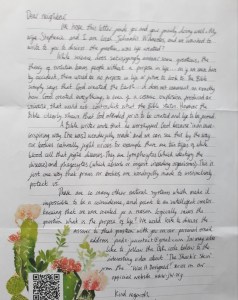
One post in and already a diversion from my planned ’12 Rules’ series. This is because I was fortunate enough to receive a letter in the post recently from my ‘neighbours’, Jim and Sandra. You can see it above. I’ve no idea who Jim and Sandra are – I’ve changed their names here to protect the guilty – but they tell me they’re Jehovah’s Witnesses. They want to convince me of their God, first by pointing out that we are, everyone of us, created by him. They then proceed to demonstrate their God’s existence with rather weak versions of the weak ‘argument from design’, with a spot of the so-called ‘argument from incredulity’ thrown in. Having ‘proved’ God, they conclude with a lovely non-sequitur, that God = purpose.

As they had gone to a lot of trouble to do this, I felt Jim and Sandra deserved a reply, specially as they were kind enough to include their email address. So here it is.  

Hi Jim and Sandra,

I was interested to get your letter recently. I notice you ask the question, ‘was life created?’ Of course it was! You’ll get no argument from me there. Nature and the processes of natural selection and evolution created life as we know it today. You of course want to draw God into these processes, but actually he’s not needed to explain them. 

Your ‘argument from design’ doesn’t work at all, because if God created all the wonderful, intricate things you talk about, he also created viruses, including covid-19, cancer and parasites. You can’t say he created everything and then discount all the nasty things as the product of natural processes or man’s sin or whatever. Either everything was made by God or everything is the result of natural processes – you don’t get to pick and choose. 

You say that only (your) God could make all the complexities of life, as complexity necessitates a creator. But that creator must, by definition, be more complex than his creation – yet you don’t think he had a creator, do you. But he must have done – because according to you, complexity has to have a creator. This principle doesn’t grind to a halt with God just because you or your church or holy book says it does. 

The intricacies and complexity of life that we see are the result of organisms, including ourselves and all other life & non-life, like viruses, adapting to their environments over billions of years. That’s it – no need to add another layer of complication, like a god, to this explanation (you may have heard of Occam’s razor, which is what I’m applying here). If something complex has existed for eons it is far more likely that it is something we know for sure exists – nature – rather than something we don’t. 

Life has in fact many purposes; one doesn’t need a God who doesn’t exist to discover them. I’d be happy to share some of these with you, though I imagine you are already quite set in your beliefs. That’s a shame.

Best wishes,

Neil 

Can you be a Christian and… accept Evolution?

Hoax

People of faith have a problem with evolution. Some of them can’t seem to see it, but the Theory of Evolution is a significant encumbrance to faith, as it has been since Darwin first proposed it in 1859.

There are essentially four ways Christians (and those from other religions) deal with evolution.

1) There are those who recognise that evolution and faith are incompatible and consequently compartmentalise them both to avoid thinking about the problem: ‘Yes, evolution probably happened but my faith is important to me so I’m going to pretend it didn’t.’

It’s impossible to argue with this head-in-the-sand position, so let’s not bother.

2) Others insist that evolution is ‘just a theory’ and as such is in conflict with what the Bible teaches about the creation of life. But this is a double misunderstanding: of what ‘theory’ means in science, and of what the Theory of Evolution proposes. It has nothing to tell us about how life began, but how it developed. Nonetheless, it contradicts the order of creation found in the two creation accounts in Genesis.

Some believers are content to dismiss evolution on these grounds: a theory, in the popular sense, that is trumped at every turn by the Bible’s accounts of creation. Ken Ham and the laughable Answers in Genesis hold to this position:

The real issue is one of authority—is God’s Word the authority, or is man’s word the authority? So, couldn’t God have used evolution to create? The answer is No. A belief in millions of years of evolution not only contradicts the clear teaching of Genesis and the rest of Scripture but also impugns the character of God. He told us in the book of Genesis that He created the whole universe and everything in it in six days by His word: “Then God said … .” His Word is the evidence of how and when God created, and His Word is incredibly clear.

Hammy and his acolytes do accept what they call micro-evolution, the small incremental stages made within a species over time. Macro-evolution, as they like to call it, when one species gives rise to another over significant amounts of time apparently never happens. Why? Because the Bible says so (but good luck finding where.)

3) Still others extend this dismissal on the basis of ignorance: they are positively hostile to the idea of evolution. Street preachers who set up shop in my home town from time to time are always accompanied by a sign that says ‘Evolution is a Hoax’ (see above.) These kind of believers are not content simply to dismiss evolution as ‘theory’, nor do they accept that it occurs within species. They rail against evolution and disparage the vast amounts of evidence that exist for it. Evolution they declare over their megaphones, is not only a hoax, it is of the devil, who uses it to deceive people and lead them away from God. This is ignorance of a more wilful sort.

Christians in both these last two camps would themselves say that one can’t be a Christian and accept evolution. Actually, they’d say one can’t ‘believe’ in evolution, a word I’ve avoided. Evolution can no more be ‘believed in’ than gravity (itself a theory in the scientific sense.)

4) The fourth way Christians have of dealing with evolution is to attempt to marry the theory with their faith. They acknowledge that evolution has occurred, that life on earth has developed much as Darwin proposed and that the evidence from paleontology, geology, genetics and developmental biology fully substantiates this explanation.

Where then to fit God when he is superfluous to the explanation of life’s development, in much the same way the tooth fairy is superfluous to dentistry? This doesn’t stop these believers finding a place for him. They regard the apparent randomness (their term) of evolution impossible to accept and see a place for God in countering it. As Greg Allison puts it on Desiring God, without a hint of irony, the ‘entire process (of evolution) was undirected and purposeless, without God.’

Consequently, Christians who accept evolution have come up with a couple of ways of injecting God into the process, regardless of the fact he is not needed and there is no place for him. So-called Theistic Evolution, in both its forms, is the belief – and it’s nothing more than a belief – that God set evolution in motion and then let it take its course. One school proposes he occasionally gave it a nudge so that it went in the right direction, the other that he just sat back to see what would happen, though presumably he knew this from the start, being omniscient and all that.

This a hopeless compromise; the prevalence of suffering, death and extinction as drivers of evolution discount any involvement of a benign creator. Such a being’s disinterest in the constant struggle for survival of his created pets, every one of which perishes once past reproductive age (if they reach it in the first place) does not point to a loving God. Paul, who of course had no understanding whatsoever of evolution, believed that death entered creation only when Adam first ‘sinned’. Yet death and suffering existed eons before human beings first appeared. The ‘Evolutionary Creationists’ at BioLogos have a hard time trying to explain this one away. (Spoiler alert: they can’t.)

And let’s not even mention sex; sexual reproduction is a massive problem for the creationist.

As Greg Allison concedes, one cannot be a Christian and subscribe to a theistic model of evolution. Having considered the possibilities, Greg concludes that neither form of theistic evolution is compatible with faith. In this he is right. He comes back to the scriptural accounts of creation as the best explanation of life’s development. In this he is wrong.

No doubt there are commenters out there who think that some form of compromised Christianity and a diluted evolutionary theory are somehow compatible. They have no doubt discovered a way to put God at the heart of evolution or have a misunderstanding of the theory that somehow leaves room for him. Such arguments are unconvincing. Evolution and God are incompatible. One is true (as in observable, supported by evidence and predictive), the other imaginary. There’s no need to pollute the former with the latter.

Metaphor, Hyperbole and Context

Blog387a

A moderate and self-styled ‘intellectual’ Christian told me in a online discussion recently that ‘most of the bible is metaphor’. When I asked what it was a metaphor for, he decided it was time to end the discussion. A metaphor signals a deeper or alternate meaning; the bible cannot be ‘mostly metaphor’ without there being something else – what Christians might regard as a ‘greater truth’ – the metaphor is intended to convey. So, yes, I can see that the Genesis creation stories might be interpreted metaphorically (though symbolically might be a better term) as the inclination of all humans to rebel against God… but then that’s only one of many interpretations, and not actually what the text says. If the bible is mostly metaphor then understanding what God is supposedly communicating through it becomes a matter of personal, subjective interpretation, which is why there are so many factions and sects within the Christian brand.

Similarly, when I challenged Dave Armstrong on Biblical Evidence for Catholicism, about why Christians don’t take everything Jesus said literally, he told me it’s because Jesus was fond of hyperbole and it’s the point underlining his hyperbole that matters. I knew, of course, that Jesus liked to exaggerate so I asked Dave how we know which of Jesus’ remarks are hyperbole and which are not. He declared that this was ‘obvious’. Perhaps it is, in sayings like ‘when your eye offends you pluck it out’, but it’s less apparent with pronouncements like ‘sell all you have and give to the poor’ or ‘abandon everything and follow me’. Again, it becomes a matter of subjective opinion, however learned that opinion might consider itself to be, about which of Jesus’ words are hyperbole and which are meant to be followed to the letter.

When I made this point, Dave decided that, rather than it being ‘obvious’, it actually takes years of study to know which is which: ‘It’s by studying Bible commentaries and linguistic aids, and the rules of hermeneutics and exegesis (Bible interpretation).’ Jesus as the incarnation of the God of the Cosmos, and the gospels in reporting him, could surely have made it clear. Instead, it seems, it takes armies of theologians and commentators, and years of study to work it out.

The third way Christians (of all stripes) manoeuvre around the bible’s shortcomings is to say that anything they’re keen to disregard is ‘context-bound’. There are some matters, they say, that are of their time and ancient place and are therefore no longer applicable today.

There are things in God’s timeless Word that pertain only to the time in when they were written? Who knew?

So, instructions like ‘greet each other with a holy kiss’ (which Paul advocates four times in his letters: Romans 16:16, 1 Corinthians 16:20, 2 Corinthians 13:12, and 1 Thessalonians 5:26); ‘women should always have their heads covered in church’ (1 Corinthians 11:2-16) and ‘heal the sick by anointing with oil’ (James 5:14) are now generally considered to be context-bound. This, however, creates the same problem that arose over Jesus’ hyperbole. How do we know which of the bible’s pronouncements are context-bound and which are still of significance today? Answer: we don’t.

It could be argued that, just as ‘greet each other with a holy kiss’ is a custom anchored in the first century, beliefs like

the world is populated by demons,

humans are capable of living forever,

and

incantations (that Jesus is the Saviour) work

are equally context-bound. We know categorically in the 21st century, that demons don’t exist, humans cannot live forever and magic spells don’t work. Only those in a pre-scientific age, dominated by superstition, thought so (together with those today who buy into these same ancient beliefs.)

Once believers start claiming – and it’s Christians themselves who do this – that significant parts of the bible are metaphor, hyperbole or are context-bound, then they’re acknowledging that the bible frequently makes little sense, and that significant portions  lend themselves to whatever interpretation suits the individual reader. Some parts can even be dismissed altogether, which is precisely what Christians do with them (how many Christians do you know who believe they can move mountains or heal the sick by laying on of hands?) What this shows is that they don’t really believe the bible is God’s Word, either in the literal, evangelical sense, nor in a moderate, quasi-intellectual way.

In practice, even to most Christians, the bible is a book of no particular merit.

God’s Very Good Creation

Blog385

I’m recovering from a viral condition that’s affecting people in these parts. It’s set me thinking about how many diseases and conditions humans are susceptible to. An online search suggests the figure is unquantifiable. There are, for example, over 5,000 viruses known to affect human health, including the 200 that cause various versions of the so-called common cold. Of these 5000, we understand only a few hundred. There are also some 6,000 diseases caused by single-gene defects, and even more by other genetic disorders. In case that’s not enough, there are also hundreds of infectious diseases caused by bacteria, fungi and parasites. While some of these cause only minor discomfort, it remains the case that almost every one of us will die, or has already died, from one or other of these diseases, conditions or illnesses.

How does Christianity account for all of these horrors? Here’s the cerebrally challenged Ken Ham to explain:

We need to start with the fact that God created everything perfect, and this perfect creation was then marred by sin. This is the only way the gospel makes sense. You need the foundation of the history in Genesis in order to fully understand the gospel!

Yup, God made everything perfect and a pair of mythical humans messed it up by ‘sinning’. Everything that’s bad about the world is the result of Adam and Eve’s one-off disobedience. That single act opened the floodgates not only to all of the illnesses to which we and the animal kingdom are prone, but also to natural disasters and the brutality we inflict on one another.

But don’t worry, God has a cunning plan! Ken wants us to teach our children about it:

Teach them about God’s original “very good” creation. Instruct them that mankind’s sin broke God’s creation and brought death and suffering into it. Teach them that we needed someone to pay the penalty for our sin, and that’s why Jesus stepped into history… and now offers the free gift of eternal life to all who will put their faith and trust in him.

You see, as Ken likes to say, only this explanation makes sense of our susceptibility to disease and illness. Only this explanation makes sense of the gospel too; the good news that Jesus sacrificial death will put everything right.

                   Eventually.

                            No rush.

                                   Whenever…

It also demonstrates what a complete and utter bastard the biblical God is, that he condemns his ‘very good’ creation to a disease ridden, disaster stricken existence, simply because he himself made the first humans as fallible as he did.

But no. Neither this explanation nor its concomitant ‘gospel’ makes any sense, whichever perspective you look at them from. The development of innumerable diseases, and the viruses, bacteria, parasites and genetic conditions that cause them, are clear evidence of evolution; of an unsupervised arms-race in which the best-adapted invader or host survives to reproduce/replicate. Having then had the chance to transmit their DNA/chemical data, their purpose is served. They die. They stay dead.

The men who created Genesis 1 & 2 did not know about evolution, microbes or viruses. They did, however, see the deficiencies of the world in which they lived, the struggle for existence, illness and death, and found these impossible to square with the benign creator God they imagined existed. And so were formed the Genesis myths of a perfect creation spoilt by the only agent whom these men believed capable of causing such havoc; they themselves. There is no denying their accounts have been remarkably influential, and also completely wrong.

No gospel is needed to put right a fallen creation. It isn’t fallen, it is what we should expect if life evolved; if each species, organism and virus that exists today has spent millions of years constantly adapting in order to survive. Jesus’ supposed sacrifice has no bearing on any of this; it is superfluous, unnecessary and entirely irrelevant. The salvation myth is a virus in its own right, existing, like the meme it is, merely to perpetuate itself.

Jesus can’t save you from the common cold, let alone death.

Why logic, reason and truth have nothing to do with any god

Blog354

I’ve recently encountered again the ‘argument’ (it’s actually no more than an assertion) that without God logic and reason would not exist.

Here’s how ‘Liam’ puts it in a comment on Escaping Christian Fundamentalism:

If anything, the illogical nature of a godless universe is a massive pointer to a God, without Whom there is no reason or truth or logic…

To a degree this is right; if God made the universe and everything in it, including reason and truth and logic then, yes, they would owe their existence to him.

But it all hinges on that word ‘if’.

Equally, if God doesn’t exist, it follows he could not have created the universe and everything in it – including logic, rationality and truth.

One cannot take these things and say they are evidence that God exists and also that they only exist because God made them. Not unless you’re happy with a tautology – a feedback loop where each assumption is its own conclusion. Demonstrate, on the other hand, that God exists independently from the human imagination and then maybe you might be able to make the case that he created logic and reason. As it is, pointing to human attributes like logic and reason doesn’t ‘prove’ that God exists; it demonstrates only that these attributes are characteristics of the human mind. Logic, truth, reason (and mathematics), like God himself, have no independent existence outside of human cognition. They are ways of explaining life and the universe; they are not life and the universe themselves.

If, as seems probable, God doesn’t exist, then evidently, logic, truth and reason did not originate with him. Indeed, they took billions of years of slow evolution to develop. We know of no other way for intelligence to arise; and only intelligence produces logic, reason and truths. No God required


Say Hul-loa to the Loa loa, another of God’s amazing creatures

AiGlogo

Answers from the Depths of Ignorance

by Hen Skam on October 22nd 2017

What a great God is our Creator God! Like it tells us in his Word™, he made everything in only six literal days, 6,000 years ago. Then, after planting fake fossils in pre-aged rocks, he found he had a little time on his hands so set about making deadly viruses, pathogens and parasites.

Now, these amazing examples of God’s handiwork didn’t evolve! That would be ridiculous. No, they were made by God just as they are now. So let’s take a look at one special ickle-bitty critter called the ‘Loa loa‘.

You see, this little creature, carefully crafted by our wonderful creator, has an intriguing life-cycle which involves it living for some of the time in the human eye. Once it has burrowed its way in, it quietly eats the eye from the inside, and unless treated with medicine (derived from man’s fallible word, so obviously not recommended) it can render its host blind. It may also lead to early death, but as the Loa loa is found only in Africa, we needn’t worry too much about this. Instead, let’s acknowledge what a blessing it must be to serve one of the Lord’s creations in such a way!

How foolish it is of our atheist friends to think that such an amazing creature could have evolved! There are many more animals like the Loa loa, each and every one of them is the handiwork of the one true Creator God. What an amazing, loving God he is!


This item was written with the assistance of AiG’s pseudo-scientists.

Thanks for stopping by and thanks for paying

(for us to continue with this ministry of superstition and stupidity.)