The Gospel of Hatred

nasty

You might have seen the disturbing BBC documentary America’s Hate Preachers this week, featuring hunky Steven Anderson, pastor of Faithful Word Baptist Church’ in Tempe, Arizona, and chunky street preacher Ruben Israel (above). If not, it’s available here for the next few months (and also, I understand, on YouTube, but of course I couldn’t possibly endorse that.)

Both Men of God™ claim they’re preaching the gospel, which is strange when all they have to offer is bile, hatred and self-aggrandisment. Anderson actually says at the end of the programme that he does what he does – mainly reviling gay people – because he wants to ‘do something big with (his) life.’ Maybe that’s what the gospel is – bile and hatred mixed with self-promotion. There’s nothing of the good news attributed to Jesus or Paul’s ‘love-is-all’ message in the vitriol spewed forth by these two sorry individuals and their various acolytes.

The gospel they preach and the Jesus they convey is spiteful, judgemental and unforgiving. Who knows, maybe that’s what he was. But if you claim to believe in Jesus, all you self-righteous souls, all you grandstanding screwballs, then fine, so long as you do as he tells you: sell all you have and give to the poor; hate your father and mother; remain unmarried; tend to the sick, the needy and the imprisoned; give to anyone who asks; turn the other cheek, go the extra mile and be perfect. Do you do these things? Are you faithful to these words? If not, then you don’t really believe in him either.

People like Anderson and Israel take what little good there is in the Bible and poison it all the more with their own prejudices, their own putrification, their own sour self-hatred. This is the fruit we see in them and in others like them, which would also be fine if they kept it to themselves. But they can’t. They are compelled to try to infect the rest of us with their nasty perversion of a gospel.


The stuff Christians say… God Gave Us Free-will

freewill

Did he really? He doesn’t mention it in his ineffable, infallible, inerrant Word and you’d think he would when it’s so important. It’s a favourite cliché of Christians whenever they’re challenged about why God has let the world get in such a mess, why he allows children to die, why there are hurricanes and earthquakes, that kind of thing. These are all, they like to tell us, the result of humans using the ‘free-will’ God gave them to make the wrong choices – which are anything that’s not God himself. When that happens, he deserts us, abandoning any idea of a duty of care. But that’s not his fault – oh, no – it’s ours for using the free-will he gave us… freely.

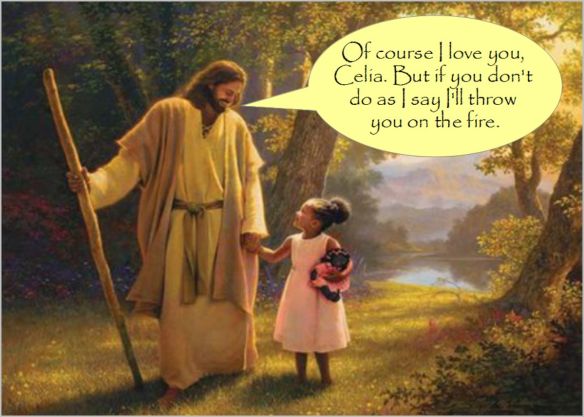
So even though we have free-will, we’re in big trouble if we use it any other than the way God thinks we should. Of all the options available to us, only one is any good; there are so many penalties for choosing anything other than him. It’s as if he says to us, ‘obey me or I’ll abandon you, make everything shit and ultimately torture you’. And you’d be right to ask how this is in any way ‘free’ will. Imagine a human father saying, ‘Now, kids, choose to do as I say or else I’ll throw you on the fire.’ Would children presented with a choice of this kind really be ‘free’ to make their decision?

Still, apparently we are, and wouldn’t you know it, we choose the wrong things. This might have something to do with there being far more ‘wrong’ things than ‘right’ ones, but that’s how God has set things up and who are we to point out the inconsistency of his mysterious way?

More than this, God has handicapped us by making us ‘slaves of sin’ and ‘servants to corruption’ (John 8.34 & 2 Peter 2.19) which naturally disposes us to use our free-will in such a way that almost always leads to the wrong decisions. How about that? Not only does he say ‘obey me or I’ll abandon you, make everything shit and ultimately torture you’, God has given us up to our base desires and so impaired our ability to make the ‘right’ choices.

Ultimately, the idea of ‘free-will’ is a Gordian knot created by Christians, who, finding themselves unable to explain why a loving God would allow everything to be far from perfect, added it to their already shaky theology. But free-will isn’t scriptural; as we’ve seen, the Bible teaches that God does the choosing not us. Nor does it stand up to  scrutiny in the real world. Science tells us that free-will doesn’t exist, it’s an illusion. Our subconscious mind makes our decisions before informing our conscious mind of what these are. This means our decision-making is neither free – our subconscious mind is shaped and constrained by environment, genes and upbringing – nor the product of our conscious mind, our ‘will’.

Still, this is of little interest to Christians who cling tenaciously and blindly to the notion of ‘free-will’. They’ve made the right decision by opting for God and in so doing have surrendered the free-will they otherwise insist is crucial in explaining the state of the world. They’re not going to need it in heaven, I don’t suppose, sitting around praising God all day long. Given though that they’ve made the right decision, why is it the world continues to be such a muddle? Why is life for believers not noticeably better than for the rest of us? Why are they as subject to life’s tragedies and calamities – cancer, disease, death – just the same as the rest of us? Shouldn’t their free-will decision nullify the disasterous effects of rejecting God so that we can see some overall improvement in the state of the world, or at the very least in the lives of God’s Chosen themselves? Why doesn’t it? What good is ‘free-will’ which, even when exercised in the ‘right’ way, appears to make no difference at all?

God’s Election

church4

As we saw in the previous post, the Bible tells us that God chose his ‘Elect’* before the creation of the world (Ephesians 1.4-6). Which begs the questions –

1: On what basis did God select the favoured few untold aeons before they were born? Did he decide by looking at their dress sense, as Jesus’ parable in Matthew 22.1-14 suggests? I guess it must be, given the Bible is the ‘literal’ word of God.

Or did God assess ahead of time just how righteous his Chosen would turn out to be? In Matthew 25.31-46 Jesus says righteousness is the yard stick (though naturally Christians don’t believe him because Paul says something different).

Or did God decide in advance – Paul says he ‘foreknew’ – who would repent and turn to Jesus, free-will be damned? Maybe, but then Jesus suggests that not everyone who does even this will make it into God’s Kingdom (Matthew 22.1-14).

What a bummer! Looks like God’s decision is/was purely arbitrary. You make it, or not, on the whim of a capricious monster.

2: What’s the point of evangelism? If God chose who was going to have eternal life/enter the Kingdom/live in Heaven before the creation of the world, then there can be absolutely no need for anyone to tell anyone else about Jesus, sin and salvation. Why? Because it makes no difference; God’s Chosen will remain his Chosen, as they were long before they were born, and he’ll be sure to rescue them once they die. Those who haven’t been pre-selected will stay lost and will go to Hell whether or not they’ve heard or responded to the gospel.

‘But how will the unsaved Chosen hear the message if we don’t tell them?’ ask our zealous evangelical friends, still not getting the point. Jesus, lads! The Chosen don’t need to hear the gospel: God – has – already – chosen – them. They will go to Heaven, live in the Kingdom or whatever, regardless of your efforts. You and your evangelism are superfluous.

3: How can you be sure, if you’re a Christian, that you’re of the ‘Elect’ and so destined for Eternal Life? Yes, you’ve chosen Jesus – but has he chosen you? How can you know? Your own sense of righteousness, your faith, self-sacrifice and adherence to sound doctrine (whatever that is) are no guide to whether or not you’ve made the grade. Only God knows that, and he’s not telling.

Not yet, anyway, so you’d best make sure you’re buried in your very best clothes, just in case.

* Jesus is made to call the chosen few ‘the Elect’ in Matt 24.22, 24 & 31; Mark 13.20, 22 & 27 and Luke 18.7.

God’s Chosen Ones

chosen The God of the Bible is not the God of Reason that Answers in Genesis, William Lane Craig, Tim Keller, Silence of Mind and others tell us he is. None of the evidence, some of which we’ve reviewed, supports the supposition. That’s because the God of Reason, like all gods, is a construct of the human mind. In much the same way as Yahweh was a reflection of irrationality, this God is a reflection of our rationality. He could not – and did not – exist before the Enlightenment, before Rationalism itself and the new understanding of mathematics, science and philosophy.

As appealing as his apologists try to make him, the God of Reason is demonstrably not the God of the Bible, who is defined by impulsive, destructive passions. No, he’s not the tempestuous Yahweh, nor is he the daddy-god Jesus imagined (who is just Yahweh with a few rough edges knocked off), nor the God of blood-sacrifice and atonement beloved of Paul. He is, like all those inventions, a fabrication of our own making. For Christians who are drawn to him, he is a false god. But then, aren’t they all?

Whichever version of the Christian God Christians choose to worship, however, they’ve got it wrong. They don’t choose to believe in him or to follow Jesus or whatever. Not at all; he chooses them (or not as the case may be.) Now known as Calvinism, the idea that God earmarked a select few to be his best mates right back at the dawn of time – while disregarding others who might want to be but aren’t on the guest list – is right there in the Bible. Paul first:

For those God foreknew he also predestined to be conformed to the image of his Son, that he might be the firstborn among many brothers and sisters. And those he predestined, he also called; those he called, he also justified; those he justified, he also glorified (Romans 8:29-30; see also 1 Thessalonians 1.4)

The idea is picked up by one of Paul’s imitators in the forged letter to the Ephesians:

For he chose us in him before the creation of the world to be holy and blameless in his sight. In love he predestined us to be adopted as his sons through Jesus Christ, in accordance with his pleasure and will—to the praise of his glorious grace, which he has freely given us in the One he loves. (Ephesians 1.4-6)

The same sort of time-loop paradox also finds its way into the gospels. In Matthew 22.1-14, Jesus tells a parable involving a man who has been asked to a Royal Banquet (i.e. the Kingdom of God) only for the King (Jesus) to take offence at the way he’s dressed. For this heinous crime he is bound hand and foot and unceremoniously thrown out. Jesus concludes his cheery tale with the aphorism, ‘Many are called but few are chosen.’

So much for ‘free will’, a notion that’s alien to the Bible in any case. If I were a Christian, which thank God I’m not, I’d really want some answers to the questions this bizarre idea throws up. We’ll take a look at what these are next time.

Picture shows Tim Keller, John Sentamu (Archbishop of York), ‘Pastor’ Rick Warren and ‘Pastor’ Steve Furtick. Chosen by God, every one. And some kids he couldn’t care less about.


Smash! Kill! Destroy!

handsofgod

So how has the great God of Reason done so far?

We’re still not out of Genesis and he’s –

Trashed his entire creation just because a couple who didn’t know how touchy he is managed to upset him;

Destroyed two towns and almost everyone in them because he found the locals offensive;

Drowned everyone in existence (except for an old piss-head and his family) because – you guessed it – they offended him;

Engineered a spot of child-abuse;

Decided the best way for people to show him they’re his bestest buddies is to have them disfigure their genitals.

Now, honestly, Christians, how can you say any of this is rational or logical, reasonable or considered? Your God’s response to everything is Smash! Kill! Mutilate! Destroy! – never as a last resort, always as his first reaction. He’s the Hulk, Godzilla and ISIS all rolled into one. Not once does he apply reason or logic. Smash! Kill! Mutilate! Destroy! And not only in Genesis but throughout the Old Testament:

His chums want the land occupied by other tribes? Smash! Kill! Destroy!

They don’t show him enough love? Smash! Kill! Destroy!

They break one or other of his mostly petty rules? Smash! Kill! Destroy!

They offend him in some remarkably trivial way (collecting sticks, teasing a bald bloke, doing sex wrong)? Smash! Kill! Destroy!

Over and over again.

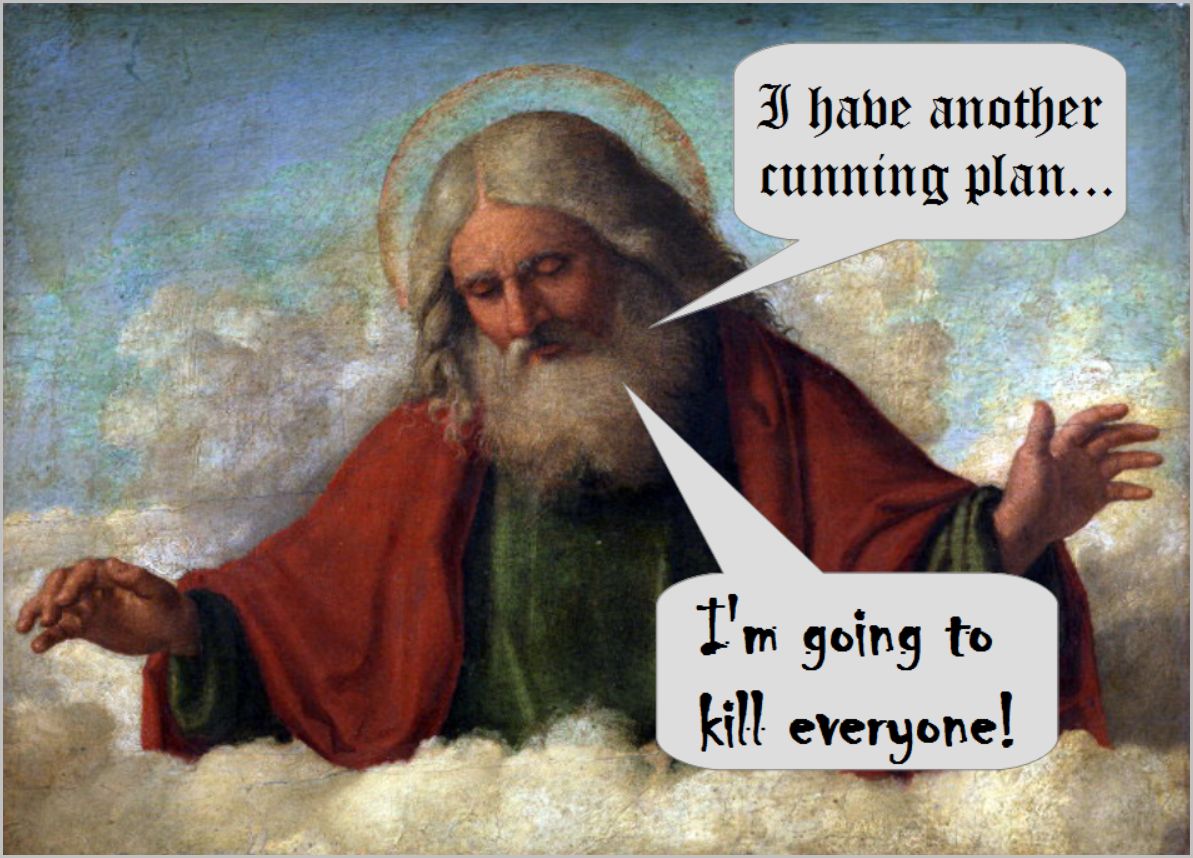
Until, at last, he has another big idea! Another Master Plan! The Master Plan to end all Master Plans! (His fourth at least.) And guess what? It’s all Smash! Kill! Destroy! Especially Kill! This is a dude who really can’t think outside the box.

Here’s how it goes: the Lord gives up on his previous Master Plan, which he’d told some selected desert marauders was forever and ever, and decides its time to have another go at sorting out mankind that he helped screw-up in the first place. His idea this time is to come to Earth himself as a sort of clone, which he creates by raping a young woman, just like all the other gods of old. When he grows up this clone/avatar tells everyone how God wants them to behave so they don’t upset the version still in Heaven quite so much. The clone then gets himself murdered at the hands of the very people he’s come to visit – the same ones the Lord promised to take care of forever and ever in his previous Master Plan – which magically allows anyone who repeats a special incantation to join an exclusive club. Everyone else he plans to torture and murder for all eternity, because that’s what he likes doing best. Of course, the version of himself he sends to Earth won’t actually make any of this clear – that’ll be left to someone else to make up afterwards – but, in the best illusion yet, he’ll come back to life before beaming up to Heaven to cosy up to his other self, the one preoccupied with death, destruction and mutilation.

This time it’s foolproof: a well-thought through, logical, rational and reasonable plan.

Except… not really. It’s bullshit. There’s no reasoning here, just a lot of stuff made up as people went along. None of it makes sense. The copy seems to have no idea what’s going on and certainly no inkling that his death has cosmic significance. On top of that, no-one really knows how the magic works – everyone who mentions it has a different idea – and the record of it all is scrappily cobbled together donkeys’ years after it all was supposed to have happened. Still, the main thing is it all involves a lot of killing – the clone first; then the poor sap manipulated into ‘betraying’ him; a couple who don’t want to give away all their belongings; some of the dudes who believe the magic is for real then, after they’ve really pissed off the Romans, lots more of them and finally, once the nutjobs get the upper hand, loads and loads of other people – which must really have pleased the God of Death Reason.

If this is the best he can do, then we’re in trouble deep. If our ability to reason comes from him, as Christians claim, it’s no wonder we can be irrational, illogical, unreasonable and unreasoning. Which of course is why he is, because he’s a reflection of the beings  that created him – us. Human emotions and cognitive capabilities came first and were projected onto the gods we created, including, eventually, the monotheistic monster, Yahweh. It was he primitive tribesmen decided must be responsible for natural disasters and the brevity and brutality of life. Such things had to be punishments, hadn’t they? And if punishments, then there had to be One doing the punishing. One who must be appeased if he was ever to stop. Hence sacrifices, behaving in ways that might please him, killing those who don’t, worship. All futile, like pleading with one’s own reflection in a mirror.

The God created by this kind of thinking only reflected back at his makers the worst of themselves; jealousy, anger, intolerance, belligerence, petulance, vengefulness and violence. Hardly ever Reason. 

And so does he still.

 

The God of Reason strikes again!

planWe’ve been looking at how well The God of Reason™ fares in the reasoning stakes. Is he as logical, rational and reasoned as his self-appointed representatives on Earth say he is? Is he logical, rational and reasoned at all? He didn’t do so well in the set-up, those wacky creation stories at the start of Genesis. There’s nothing reasoned or rational about his behaviour there. So how does he do further down the line? Does his intelligence evolve or does he make like Donald Trump for the rest of eternity? (Spoiler alert…)

Having willfully allowed everything to deteriorate into chaos, God is upset again when his abandoned human creation doesn’t behave as he wants them to. Evidently he couldn’t see this coming, so he decides the most rational thing to is to drown everyone and everything, with the exception of a family left over from an earlier myth by the Babylonians and a floating zoo. Everyone else, every baby, every child, every pregnant woman, every living thing – from the smallest insect on four legs to brachiosaurs and the cutest lickle kittens – he murders in cold water.

After he’s annihilated them all, Yahweh is dismayed when Noah gets pissed and romps around naked in front of his son, who is called Ken Ham (can’t blame him for not seeing that coming) and he realises this plan hasn’t worked out either. Now where, in all of these larks, is rationality? More nul points for the great God of Reason and his ability to think things through.

Yahweh’s next cunning plan involves persuading a bloke who’s a few brain cells short of a pastry case himself to murder his own son and burn his body. Yahweh tells him this will be such fun. But then, at the last minute, just when the kid is trussed up on a pyre with his old man ready to plunge the knife into him, God sends a messenger to call the whole thing off. Turns it was no more than a test. Never mind the trauma to the kid and the damage to his relationship with his father, this was the only logical way for Yahweh to see if ol’ Abe was one of the good guys.

He follows it up with another great plan; he promises he’ll look after Abe and his descendants till the end of time, so long as – wait for it – they all slice off the end of their penises. Now, come on – that’s a well thought through scheme if ever there was one.

Isn’t it?  

God wants you to beg

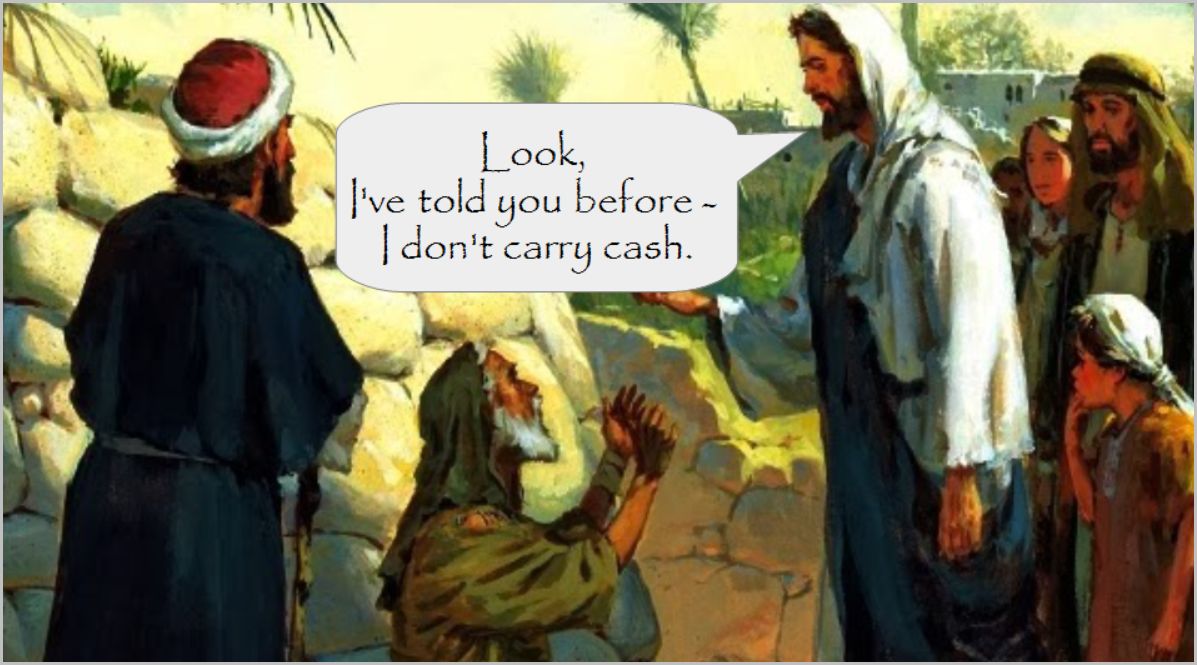
beggar2 What do God and the Queen have in common?

Neither of them do money. Famously, Queen Elizabeth II never carries cash. It’s not like she’s ever going to find herself out of milk so that she has to dash to shop for some. Even if she did, she wouldn’t be expected to pay for it. So she doesn’t need to bother with money.

Same with God. He’s less likely to run out of milk, it’s true, but he does lots of important work in the world and a bit like the Queen, who is funded in large part by the British tax payer, he expects everyone else to cough up what’s needed.

Though he’s a God of abundance who supplies whatever is asked of him, he just can’t bring himself to do money. We know this because those humans who work for him here on earth constantly have to beg other people for it. When they’re busy getting his Word™ out to those who don’t have a Bible of their own, the Lord refuses to pay a penny. Likewise, he declines to assist the brave souls who work tirelessly protecting one-man-one-woman marriage, which, as they tell us, was all his idea in the first place. Nor does he support building Noah’s Arks theme parks ($18 million in tax perks helped with that one), church maintenance (tithes anyone?), helping the persecuted or feeding the hungry. He’ll do all he can to help, naturally, just so long as he doesn’t have to put his hands in his pockets and get them grubby handling cash.

No, what all these noble causes need they have to raise themselves, which is why every single Christian enterprise begs for money, not from God who they know won’t help, but from fellow human beings. ‘Search your heart,’ they tell the gullible, ‘and ask the Lord what he would have you give us.’ Could this the same God of whom Paul says, “He is able to make every blessing of yours overflow for you, so that in every situation you will always have all you need for any good work” (2 Corinthians 9.8)? It surely could. And this being so, why, when he specifically directs his people to create projects that will make his Kingdom a reality, does the money not come pouring in to the point where it ‘overflows’? God being God could make it happen supernaturally or, if that’s a little too ostentatious, by more mundane means. But he doesn’t, hence all the begging.

Like his love, God’s provision is met only through other human beings, be it money, food, love or, most importantly of all, spreading the Word™. You have to wonder, when he finds himself incapable of supporting even his own causes – and they are his own causes because those who operate them on his behalf tell us so – whether he has the remotest interest in any of them.

Which might just be because it’s all a delusion.

The Lord really wants you to support the efforts of this site. Send cash only in a plain brown envelope and he will surely bless you.


Idiotic Stuff Jesus Said

JC&ManJust what did Jesus say? The Jesus Seminar and other scholars* conclude that only about 18% of the words attributed to him in the gospels are authentically his. They reach this conclusion because so much of what Jesus ‘said’ – 82% of his utterances – is demonstrably derived from elsewhere.

There were four major sources for his words, which I’ll discuss briefly here, providing an example of each. Bear in mind also that whatever the derivation of Jesus’ words, those we have today have been subject to, in their earliest days, an unreliable oral tradition, repeated copying and deliberate and accidental alteration. The earliest surviving ‘words of Jesus’ (a few fragments of the fourth gospel) date to a century after he lived.

1. The early church created a good deal of the Jesus narrative, making him say what was important to them. For example, ‘take, eat, this is my body,’ and ‘take, drink, this is my blood that is shed for you,’ is clearly a post-crucifixion perspective. While it appears in arguably the most Jewish of the gospels (Matthew’s) the idea of drinking blood, even symbolically, would have been, and remains, anathema to Jews, whose scriptures forbid it (Leviticus 17.10 -16). Jesus was an orthodox Jew; it was the Hellenised Paul who transplanted the pagan ritual into nascent Christianity. He relates in 1 Corinthians 11.23-26, written about 15 years before the first gospel, how his wholly imaginary ‘Christ’ told him of this bizarre activity. Once established in the early church, Jesus then had to be made to endorse it and it was written back into the gospels.

2. The gospel writers (or others) invented dialogue for him. His entire conversation with Pilate, for example, is invented not once but four times, the encounter being rendered differently in all four gospels. It is probable that the entire scenario is fiction, given the likelihood the excessively cruel Roman governor would even entertain the idea of questioning a seditious nobody himself. And then there’s the ‘I am’ statements of John’s Jesus that I considered here.

3. The gospel writers altered difficult sayings into something more palatable. For example, in Matthew 15.24 Jesus says he was ‘sent only to the lost sheep of Israel’ (my italics). By the end of the same gospel, as well as in Luke and John, this has become a commandment to ‘make disciples of all nations, baptising them in the name of the Father, the Son and the Holy Spirit’ (Matthew 28.19). So which was it? Was the message exclusively for Jews or was it for all? It suited early churches, filled with non-Jews, that the gospel was for everyone, just as Paul had argued. Jesus’ words to the contrary – even if they were sufficiently widely known to have had to be included in Matthew’s original account – needed to be amended. Who amended them and when we shall never know, but it was certainly after the idea of the Trinity had taken hold.

4. Statements Jesus actually made. The Jesus Seminar regards as authentic sayings such as:

If anyone strikes you on the right cheek, turn the other also (Matthew 5.39)

If anyone wants to sue you and take your coat, give your cloak as well (Matthew 5.40)

Love your enemies (Luke 6.27)

Blessed are you who are poor for yours is the Kingdom of God (Luke 6.20) [changed in Matthew’s gospel to the less radical ‘poor in spirit’!]

If anyone forces you to go one mile, go also the second mile (Matthew 5.41)

As inspiring as these might initially appear, they actually mean very little; they’re either prophecies that didn’t come to pass, impractical moral expectations or pseudo-spiritual homilies. And how much of this advice, these admonitions, do today’s Christians follow? You’d be hard pushed to find many that do. After all, following Jesus doesn’t entail doing what he says.

* I have used Robert W. Funk et al‘s The Five Gospels (HarperOne, 1997), Simon Loveday’s The Bible For Grown-Ups (Iconbooks, 2016) and Mark Allan Powell’s rather less impartial The Jesus Debate (Lion, 1998) for this post

Recent Encounters of the Religious Kind

3. Prophecy Fulfilled

DB&JC

Back in January I predicted that David Bowie’s demise would lead to his apotheosis. And so it comes to pass.

First there’s this, from the Guardian‘s Suzanne Moore:

The theory that it was in fact, David Bowie’s presence in the universe that was holding everything together is one I find hard to resist, given how awful everything has been of late…

Second is Paul Morley’s new Bowie biography, the cleverly titled The Age of Bowie: How David Bowie Made a World of Difference, with its abundance of publicity including Radio 4’s broadcast ‘book of the week’. It is probably worth a look if you’re at all interested in the Thin White Duke and his various incarnations.

Two aspects of the biography stand out: first, Morley’s admission that he’s had to invent some details of Bowie’s life because either there is a lack of information – about his pre-fame period, for example – or, there are too many contradictory reports of certain events (often from Bowie himself) – or, a biography is so much more interesting when ‘facts’ are reorganised, again as Mr Bowie himself was wont to do when it suited him.

Second, the tone is uncritical to the point of sycophancy. Morley’s evident respect and admiration for Bowie translate into an adulation that elevates the late star to a priestly, semi-divine status. Within the first few pages Bowie is described as someone who manipulates time (xii); has a voice that pierces straight to the heart (p2); possesses the wisdom of the ages (p8); is capable of rearranging others’ minds (p8); can recreate the cosmic order (p8); symbolises the future (p8); dramatically splits reality wide open and penetrates time itself (p9); hunts for kindred spirits ready to surrender to his ways (p11); is obsessed with the deeper truths of existence (p14) and is a kind of teacher (p15) who proclaimed, ‘look how amazing this is. I am never, ever going to die’ (p20). Bowie would surely have been amused by most of these claims.

Written only a matter of months, perhaps weeks, after the singer’s death, in a time when, after his initial success in the 1970s, his every word, note, movement, metamorphosis, transformation, declaration and pronouncement was seized upon, broadcast and preserved for posterity, it is remarkable how much of the biography has to be constructed. Remarkable too how much it reflects Morley’s own experience of Bowie, how he writes about his Bowie, or series of Bowies.

Imagine if he were writing this same biography 40 or more years from now, with no personal or direct experience of the Bowie phenomenon, when no-one who had first-hand experience of it was alive, or if they were, had to rely on shaky memories of events that had happened – or maybe not – in their youth. How much more would the author have had to invent, even if he had access to archive material, about the impact the subject had, the effect of his music, his presence, his vision(s), his theatricality, his changes, his highs, his lows, his philosophy, his influence, the contribution he made to popular music and to art, the difference he made to ordinary individuals’ lives…

Now: imagine there are no reliable archives; no recordings, no film, no contemporaneous newspaper reports. Imagine too the author is not a twenty-first century journalist and musician, but has, like all those around him, including his audience, little or no scientific understanding of the world. Rather, he has a mind-set dominated by God, angels and devils, and is prone to superstition and the possibility people can and do rise from the dead. How much more readily would the half-forgotten charismatic of this ‘biography’ be elevated to god-like status. How much more miraculous the behaviour attributed to him. How much more a priest and saviour than any modern day icon.

And so the gospels came to be.

Recent Encounters of the Religious Kind

1. The kindly street preacher

preacher4

A bad-tempered looking man is standing next to a sign that announces that ‘Evolution is a Lie’ and ‘Jesus is Lord’. He – the grumpy man, not Jesus – is giving out some sort of glossy card. I do my best to sidestep him but he approaches and gives me one. It is entitled God Commands: 4 Things That God Commands, at least half of which is redundant. I notice that a group of Jehovah’s Witnesses have set up stall next to him (or perhaps he set up next to them).

‘So,’ I ask, ‘who’s right? You or them?’

They,’ he growls, ‘are of the devil.’

What a problem Christianity has. Islam too: so many damn different versions, all of which lay claim to being the one and only Truth. The Center for the Study of Global Christianity reports that there are now 45,000 different churches, denominations, sects and cults within Christianity, every one of them insisting that they – and they alone – represent God’s Truth, only they have got it right. There are as many Christian web-sites out there slagging off other Christians – Apostate! Wolves in Sheep’s Clothing! Doing the devil’s work! False teachers! – as there are sites ‘reaching out’ to the ‘lost’.

What’s more, every one of them knows they alone have the Truth because the Bible itself says so. They quote from it to prove how right they are and how wrong everyone else is. Which just goes to show what a damnable, scurrilous load of tosh the Bible really is. If God is not, as it says in 1 Corinthians 14.33, the author of confusion then he can’t have had anything to do with it.

Of course we know he didn’t; it’s human through and through, every mean-spirited, self-righteous verse of it.