Where is the love?

ExecutionThe picture above has shocked and affected me deeply. It shows a man about to be thrown to his death from a high building in Iraq. According to the original news source, a large crowd was gathered below to watch him fall and then die as he hit the ground many metres below. Another man was then killed in the same way. This happened within the last couple of days; the photo, along with some others, was released by IS on Friday.

The men’s ‘crime’ was that they were deemed to be gay. The method of execution is that prescribed by the Koran.

Religion – in this case Shari’a Islam – lies behind and motivates behaviour of such profound inhumanity. It could be argued too that this is part of the culture in which these people live and as such, must be respected. Really? So what is ‘cultured’ about murdering people?

I’ve been asked recently whether I shouldn’t respect the right of people to hold religious views. But how can I – or anyone in a civilised society – accept the right of others to believe that, simply because someone’s perceived sexuality ‘offends’ an imaginary god, that person should die? And not only that, but that they merit a sentence of such barbarity?

I can’t respect such views, nor anyone’s ‘right’ to hold them; they will, inevitably, act upon them, just as we see here.

There are Christians too who support the death penalty for homosexuals (for example, here, here, here, here and here). Well, you men of God, this is what it looks like, though I guess your preferred method of execution would be to stone them to death, just as your own ‘holy’ book advocates (Leviticus 18.22, 20.13).

No respect is due to people who behave like this towards others, nor to the religions that ‘inspire’ them. Bullies who believe fellow human-beings should be executed because of who they are, and thugs who justify murder because it’s done in the name of an invented deity, are not worthy of anyone’s respect.

Where is the international outcry about this? The solidarity? The politicians linking arms? The advocacy of the civilised world?

Je suis découragé.


Thank you, Nick, for your question and to Joe.My.God.

Answers to this year’s all-new Christmas Quiz

saving-christmas-posterGod save us all from this, this Christmas time.

1. Where does the word ‘Christmas’ come from?
The answer is b, the name comes from the Catholic Mass held on the supposed date of Jesus’ birth. So all you anti-Catholic Christians need to find a new name for it fast.

2. When was Christ born?
a) is the answer here: Christ wasn’t born. Maybe Jesus was, but ‘the Christ’ is an invention of later Christians (Paul, for example, in Romans 8.3 and John’s gospel, written up to a century after Jesus lived.) The Christ is a mythic, supernatural being who’s always existed. He bears little relation to the itinerant Jewish preacher Yeshua who wasn’t born on 25th December or in the year 0.

3. Which gospel writers didn’t think the nativity story worth including in their accounts?
Mark and John (b & c) don’t bother including it. Did they not know it? The two gospels that do have bits of the story – Luke and Matthew – contradict each other.

4. How well attested are the events surrounding the birth in historical documents of the time?
a) Not at all. You’d have thought the Romans, who were pretty good at keeping records (lots of which have survived) would have noted Herod’s massacre of little boys or the appearance of a new, magic star in the sky – they were, after all, a superstitious lot. Not even Josephus, who, in the late first century, acknowledges the existence of Christians, sees fit to mention any of it.

5. Following the miraculous events of Jesus’ birth, what did Mary do?
According to Luke 2.19, she treasured them in her heart. However, the answer is c) because only a few verses further on, she hasn’t a clue about what her son is up to (Luke 2.48). Later still, she is part of the family’s efforts to ‘restrain him’ (Mark 3.21 & 31). Why, on these occasions, doesn’t she recall his miraculous beginning and think, ‘oh yes, I remember now. He behaves like a lunatic because he’s the son of the Most High.’ She certainly didn’t write down the details of his miraculous birth for later use in the gospels. No-one did. On account of them not really happening. Just sayin’.

6. How many times does Jesus refer to his miraculous birth?
a) Never. Strange that.

7. How many times does the rest of the New Testament refer to Jesus’ miraculous birth?
c) Never, even more strangely. Evidently the story hadn’t been invented when the rest of the New Testament was written.

8. When did Christians first start celebrating Christmas?
a) hundreds of years later.

9. Which of these Christmas traditions originate in the Bible?
None of them. Despite what Kirk Cameron might think, Christmas trees, kissing under the mistletoe and giving presents all have pagan origins. The giving of gifts did not come about because the wise men did it first. The tradition pre-dates Christianity.

10. Which of these groups has benefited the most from Jesus’ birth?
Yes, you’re right; none of them. Not women, not black people and not LGBT people. Christianity has a history of oppressing all three groups.

Speaking of which…
11. What does Pastor Steven Anderson want for Christmas?
c) he’d like to see the execution of all homosexuals so that AIDS – which, as far as the reverend understands it (I use the term loosely) only gay people get – might be wiped out. Peace and joy to you too, Stevie.

12. How will Christians celebrate Christmas this year?
The answer is a, b and c: by fighting the War On Christmas, putting the Christ back into Christmas and by telling us that Jesus is the Reason for the Season. Just like they do every year. As you can see, Kirk Cameron’s disaster of a movie, Saving Christmas, has two of these blessed clichés on its promotional poster alone.

So how did you do?
If you scored –
between 10-12: well done. Betcha don’t believe in Santa Claus either.
Between 7-10: your cynicism needs a little work. Order my book for Christmas – it’ll help.
Between 4-6: oh dear. You’re new around here, aren’t you. There’s hope for you though, so stick around. Oh yeah, and order my book for Christmas – it’ll definitely help.
Between 1-3: Like Christmas, you are in need of saving, my friend. May the scales fall from your eyes this holiday period. Amen.

No True Christian

WeekendA favourite response of Christians to any criticism is, ‘it doesn’t apply to me. I’m not that sort of Christian. The people who do or believe or think those things are not true Christians.’ This the ‘no true-Scotsman‘ fallacy.

  • You get it when you point out how God’s People™ agitate in Africa and Europe to deprive LGBT people of rights, protection and safety (unless of course you’re talking to a Christian who thinks this is a loving thing to do.)
  • You get it when you challenge Christians about Westboro baptist church’s activities, (the latest of which is claiming that Ebola is God’s punishment for Obama, which must be why he’s smiting poverty-stricken Africans.)
  • You get it when you mention those Christians who believe mumbo-jumbo that’s slightly different from theirs.
  • You get it when you ask them about any of the other deplorable things Christians do in Jesus’ name.

‘These other people are not true Christians,’ they say. ‘Their theology isn’t the same as mine; they’re misinterpreting the Bible; I wouldn’t do those kind of things; you’re picking out extremists.’

And do you know, Christians, those very people you say are not true Christians would say the same about you.

So what defines a Christian? Isn’t it that you accept Jesus Christ as your Lord and Saviour, profess him as such, and avail yourself of the salvation you think he offers?

Indeed it is. And it’s precisely this that you have in common with the Westboro baptist church, with those who peddle the absurd, with those who seek to damage LGBT people, with those who use their positions to abuse others and those with different ideas about what being a Christian is really all about.

You and they have bought into the same fantasy: they, like you, have accepted Jesus; they, like you, have his Holy Spirit in their hearts. That they do things you don’t approve of, or regard as embarrassing or despicable, doesn’t alter that fact. You’re all in it together; they represent Jesus just as much as you do; are as much a part of the ‘bride of Christ’ as you are. The zealots, extremists and wackos are your brothers and sisters in Christ, and if you’re right about Jesus being your Saviour – which of course you’re not; I’m being generous here – you’re going to be spending all of eternity with them.

So time to knock the ‘no true Christian’ excuse on the head – it’s going to be so embarrassing for you when you get to heaven.

Is This It?

AlphaI was disappointed that my local church, when advertising the Alpha Course this year, didn’t use its usual poster. You know the one – and if you don’t it’s like the one above – that asks ‘Is this it?’, meaning both, ‘Is this all there is to life?’ and ‘Is this life all there is?’ Every year, I so much want to answer the question by scrawling ‘Yes’ on the bottom of the poster. I don’t, of course, because I’m too law-abiding to deface someone else’s property. But ‘yes’ really is the answer to the question ‘Is this it?’ and to the other two questions it suggests. This life is all there is. What you make of it is also ‘all there is’ (so better make the most of it).

Of course, the Alpha Course and Christians in general want to persuade you that this life isn’t all there is, that a better life awaits you after death. They want to tell you too that there’s a life that’s better than the one you’re currently living, however interesting, challenging, fulfilling or unhappy that might be. All you have to do to have this better life – and have it last forever – is to give yourself to Jesus. Oh, yes, and sign up for the Alpha Course too, of course.

Will your life really get better if you decide to believe in a mythical figure who magically sacrificed himself to himself to save you from yourself? It might, but not because you’ll have bought into this particular delusion. If it happens at all, life will be better because you’ll have become a member of a community (a church) and will enjoy the support of others who share the delusion. It might seem better too because your church will tell you what to think about particular issues – morality, abortion, homosexuality, evolution, for example – and you will be freed, should you want to be, from the burden of thinking for yourself.

But your life will not assume any cosmic significance, because nothing human beings do, say or believe ever has cosmic significance. Humans, whatever your church or the Alpha Course tells you, simply do not have cosmic significance. So, your decision to follow Christ won’t mean you’ll live forever (because, however much they might wish it, human beings don’t live forever.) It will not transform you into a ‘spiritual creature’; won’t make you beloved of the Creator of the universe; won’t transform you into the likeness of the mythical Christ. You will not have a hot-line to either the Creator nor to this Christ and so you won’t find them answering your prayers. You will not be part of any cosmic battle between God and the devil. You will not have God’s Son or the Son’s Spirit (which is it, Christians?) coming to make their home in you. You will no more be living in the End Times than you were before your conversion and the world will, though you will fail to recognise it, make even less sense than it does now.

What Christianity offers is pure fantasy, the same sort of fantasy that Mormons, Muslims, Moonies and all manner of other religious believers claim as their Truth. The only difference between your fantasy and theirs will be in the detail. Of course, as a Christian you’ll be told that your set of superstitions is the real and only Truth and that all of the others are false (or the lies of the devil, or whatever.) But in reality, yours will be just as absurd, just as impossible, just as disconnected from reality as theirs. And, what’s more, you’ll go on facing the same problems, the same joys, the same pain, the same short lifespan and the same opportunities that your culture offers you, that you’ve always had.

So give the Alpha Course a miss. Give Christianity a miss. Give all religion a miss. Give anything that tells you this life isn’t all there is a miss too, because this IS all there is. And thank God for that.

What did you do today, God?

Duck

What have you achieved today? I finished some illustrations for a children’s book a friend has written. It’s a minor accomplishment, of course, but one I like to think hasn’t added to the sum total of suffering and misery in the world (though you might want to disagree.) There’s every chance that whatever you’ve done today has been productive and positive too. That is, unless you also happen to be a deity.

What are God’s accomplishments today? What has the Omnipotent, Omniscient and All-loving God achieved in the last twenty-four hours?

Has he, for example, eliminated Ebola, Aids or cancer, or even helped those sinful human beings who strive to develop cures for these terrible diseases (which we would be right in thinking God himself created in the first place)? Erm, no. He hasn’t. Ebola, Aids and cancer are still with us today, their cure and prevention a little closer only because of human endeavour.

Has he prevented any further brutal murders by those who claim to operate in his (alternate) name? Has he rushed to the assistance of Christians being persecuted in Syria and Iraq? Erm… that’s another no. You’d think he might, wouldn’t you, given that his own people are among the persecuted, but no. And given that ‘gentle and compassionate’ relief worker, Alan Henning, has today been beheaded by Islamic extremists, you’d be right to wonder just where God is. What does he spend his days doing?

Did he, then, decide that today was the day he’d let us know which of his many manifestations is the real him – Yahweh? Allah? Shiva? Ra? One of the myriad others? None of the above? No, he didn’t do that either. He left us in our ignorance about which of the many religions, groups and sects has got it right about him. He couldn’t find the time today to tell us who it is that worships the real him, and who it is who’s deceived. Just as he couldn’t for all of the days that have so far made up recorded time.

Maybe, however, he hasn’t had time to do this because he’s been too busy sustaining the universe; you know, winding up gravity and giving the Earth those little pushes it needs to make it spin. But of course, the universe doesn’t work like this. It needs no external power source to keep it going. Even if it was God who set the ‘laws of physics’ in motion at the beginning of everything (it wasn’t), they have been self-sustaining ever since. So, no, he hasn’t the excuse that he spends his days making sure everything is ticking over nicely.

Does he spend them instead empowering believers to move mountains, heal the sick, raise the dead and perform miracles even better than those of his ‘son’, just like he had Jesus promise? Not so’s you’d notice. In fact, not at all.

Oh dear. We really are running out of possible things for God to do. Despite the sometimes desperate state of the world, perhaps all of his time is taken up finding parking spaces for Christians and sorting out their career prospects. Perhaps he’s too busy directing the thoughts and words of his ‘chosen instruments’ (see my previous post) so they can express their hatred for non-Christians and gay people. Or maybe all of his energies go into inspiring those Holy Spirit led church services that ‘bless’ Christians but are no more than human emotion run riot. Alternatively, maybe he just spends his time being offended by everything and everybody. If these are his accomplishments over the last twenty-four hours, then, given all the things he could have been doing, doesn’t it all seem rather pathetic? This is all he can manage?

Of course not. All of the triviality, and all of the brutality, attributed to him is entirely human in origin and manifestation; the beheadings, the euphoria, the offence, the vitriol. All part of the self-delusion that is ‘faith’. There is no God doing all these things, no God who manifests himself in the operation of the universe, in human suffering or the pleasures and happy coincidences of life.

It’s possible, I suppose, that there is a god somewhere, one without any interest in human beings and life here on Earth, but then he’d be even more irrelevant than the impotent gods we’ve invented for ourselves.

As Ariane Sherin famously said, ‘There’s probably no God’, with the ‘probably’ looking ever more redundant.

Idiotic Stuff Jesus Said 6: The ‘I Am’ sayings

CampLet’s be clear from the outset here; Jesus never actually made any of the seven ‘I am’ claims put into his mouth in John’s gospel. You know the ones: ‘I am the Way, the Truth and the Life’, ‘I am the True Vine’, ‘the Good Shepherd’, ‘the Light of the World’ and so on. So it is a little unfair to lump them with all the idiotic things it’s more likely Jesus did say (see previous posts.)

How do we know he didn’t say them? Lots of reasons. Firstly, they’re not in the other three gospels all of which were written earlier than John’s, and are therefore closer to the time Jesus lived (though the earliest, Mark’s gospel, was probably put together thirty to forty years after Jesus lived.) If Jesus had really made all those grand ‘I am’ claims, wouldn’t the other gospel writers have recorded them too? Yet none of them mentions even one.

Secondly, in the synoptic gospels – Matthew, Mark and Luke – Jesus has a different message from the one given to him in John’s gospel. The earlier gospels have Jesus talk about himself only very rarely. Instead, he goes on at length about the coming of the Kingdom of God (or Heaven) and how y’all better get ready for it ’cause it’s a-coming soon. Was he wrong about that one! On the odd occasion he does refer to himself in the synoptic gospels, he often does it in a sort of coded way, calling himself ‘the son of man’. He hardly ever uses ‘I’, let alone makes grandiose claims about himself.

Thirdly, all three of the synoptic gospels rely on earlier sources, now lost to us, and none of those has Jesus make ‘I am’ statements either. How do we know? Because, again, they’re not there in any of the three accounts – Matthew, Mark or Luke – that are built up from them. Significantly, one of these sources is an early record of Jesus’ sayings; that’s a ‘sayings gospel’ that doesn’t relate any ‘I am’ sayings.

Fourthly, John’s gospel is late – at least sixty years after JC’s death and also after Paul’s supernatural Christianity had gained a foothold among the gullible. The Jesus of John’s gospel is a reworked version, more in-line with the ‘Christ’ that Paul preached and much less like the Jewish peasant who had lived and preached the Kingdom of God. Despite what Christians claim, John’s gospel is not another eye-witness report (none of the gospels is) that differs only in minor details from the other three accounts. It is total reworking of the story, with its central figure transformed into a sort of divine Superman, and the idea of the coming Kingdom relegated to a single mention. This change of agenda renders the fourth gospel utterly unreliable as an historical record of anything the earthly Jesus might have said.

Fifthly, Christians claim John’s gospel differs from the others because in it Jesus reveals special, secret truths about himself to ‘the disciple whom he loved’, traditionally the John whom the gospel is named after. But again, the problem with this explanation is that the synoptic gospels don’t mention Jesus favouring one particular disciple over the others (unless it’s Simon Peter). In these, John, a loud, brash fisherman, plays only a minor role. Why don’t the synoptics refer to the special, more intimate relationship that John’s gospel refers to? Largely because there wasn’t one – not until the fourth gospel came to be written and ‘John’, who led the community that produced it, wanted to bump up his part.

So, idiotic as it would have been for an itinerant Jewish preacher and ‘prophet’, whose mission ended in failure, to make these claims about himself, Jesus never did. He didn’t say he was ‘the Way, the Truth and the Life’. Or ‘the Vine’. Or ‘the Good Shepherd’. These are claims made for him long after he lived, by people who were persuaded by a snake-oil salesman that a God-man had mystically ‘saved’ them. They ‘re-imagined’ Jesus, sayings and all, to fit their idea of what he must have been like – and John’s gospel was born.

Its Jesus, if he was being honest, should really have said, ‘I Am… nothing but Pure Invention.’

Let’s Suppose…

This article originally appeared as a guest post on Bruce Gerenscer’s U.S. blog, ‘The Way Forward’ a couple of months back. Bruce has since had to close his blog and as a result the article became inaccessible. I’ve rescued it, my little lost sheep among a hundred, and present it here for your delight and delectation. Or something.

While on ‘The Way Forward, the post generated quite a few comments from Bruce’s readers. Feel free to respond to it here in like manner – and indeed to any other posts. All comments, spam excluded, are published whether agreeing or disagreeing with what I have to say.

BlessedLet’s, for the sake of argument, suppose that Christians could prove that the universe was created by a supernatural agent.

Let’s further suppose that they could demonstrate conclusively that this supernatural agent is none other than their very own God, as opposed to, say, Allah or Atum or Marduk.

And then let’s say they are able to show us, with sundry proofs, that an itinerant Jewish preacher, generally known by the Greek name, Jesus – though he was never called that by those who knew him – was somehow a manifestation of this God on Earth.

Then let’s say we grant them, although it doesn’t seem it from reading Jesus’ story in the synoptic gospels (Mark, Matthew and Luke, all written between forty and sixty years after this man lived) that his death somehow or other bridged the gap between humanity and this very touchy deity.

And then let us suppose that, although he never met Jesus but only had some sort of hallucination about him, the man Paul was right to say that through magically invoking Jesus’ name, people could be reunited with God and completely remade.

Let’s further grant them that, although their book about Jesus and Paul doesn’t actually say so in so many words, they really are going to go and live in Heaven when they die.

Assuming all of this is true – even though Christians are unable to demonstrate even the first of these propositions (the one about the universe being made by a supernatural being) – why is it they disregard and otherwise ignore most of what their god-man, Jesus, tells them about how they should live their lives?

Why are they, for example, so cavalier about forgiving others when he says in order to be forgiven they must first forgive those who have offended them? (Matthew 6.14-15)

Why are they so harsh in their judgements of others when he tells them that how they judge others will be how they themselves will be judged? (Matthew 7.1-2 & Matthew 25.34-46)

Why are they so lacking in compassion, when he says the amount of compassion they’ll receive is directly related to the amount they show others? (Matthew 5.7 & Luke 6.38)

Why are they so vociferous in their condemnation of others when they should be dealing with their own ‘sins’ first? (Luke 6:42)

Why do so many of them fail to serve others sacrificially, without expectation of reward and with no ulterior motive? (Mark 9.35 & 10.43-44)

Why are they not known for selling their possessions, giving to all who ask and going the extra mile? (Luke 12.32, Matthew 19.21, Luke 6.38 & Matthew 5.41)

Why do they not turn the other cheek, bless and pray for those who abuse them, and treat others like they want to be treated themselves? (Luke 6.28-29 & Matthew 7.12)

Why do they not love their neighbour as themselves, and their enemies too? (Matthew 22.39 & Matthew 5.44)

Shouldn’t they be doing these things, and more, as if their eternal lives depended on it? Especially when Jesus says their eternal lives do depend on it (Matthew 25.37-40). Shouldn’t they be just so much more radical than they actually are, changing the world by serving others? (Matthew 25.34-40)

Yes, they should, but they’re not, and they never have. Deep down, they know that Jesus is too extreme, too demanding. They make excuses for themselves; he doesn’t really mean the things he says; he speaks in metaphor and uses hyperbole (specially when he’s saying something they don’t like the sound of) and they invoke the bumper-sticker theology of ‘we’re not perfect, just forgiven’, even when ‘perfect’ is the very thing Jesus tells them they must be (Matthew 5.48).

The only reasonable conclusion we can draw from all of this is that Christians don’t really believe the man they call God and Saviour. Their actions, or lack of them, speak far louder than their words. It’s so much easier to claim Paul’s magical incantation, looking heavenward and damning the rest of us, than it is to do what Jesus demands. Who cares what Jesus said anyway. What did he know?

The Great Escape

EscapingSometimes I miss my religion. I miss my days of thinking I knew what life was all about, of living in accordance with God’s will, of believing I was in a relationship with Jesus. It was comfortable and secure, and maybe a little bit anxiety inducing too: what was God telling me to sort out in my life now? What sin had I not confessed? How had I let him down this time?

My faith defined my life for me, set its parameters, told me what to believe about other aspects of life – like the role of men and the place of women, parenthood, abortion, homosexuality, evolution, the end of the world (always coming soon! You need to be ready for it!) – and defined my values. God would guide me when making decisions in life, which may be why I made so many bad ones, and even gave me a special set of spiritual words with which to talk about him. I don’t mean speaking in tongues, though there was that, but words like ‘saved’, ‘redeemed’, ‘born again’, ‘witness’ ‘rapture’, ‘seeking the Lord’. (Now there’s a blog post; the surrealism of Christian-speak.)

There was an entire sub-culture to enjoy too; Christian music (some of it – certainly not all of it – as good as anything in the ‘world’), hymns and choruses to sing, devotional books, Bible study notes to tell you what the scriptures really meant, magazines (Buzz, anyone?), conventions like Spring Harvest and Filey where you could go for a spiritual charge (buzz, anyone?) and hear what the Lord had to say to his people – usually that he expected more of them. Church too, of course, which was the means of reinforcing collective beliefs and ensuring conformity, and where there were friends and some really genuine people (some difficult people too, but they probably weren’t ‘real’ Christians.)

Most of all I miss the cosy, fuzzy feeling that came from being a Christian. This was generated by the sure and certain knowledge that I was saved and Jesus loved me. However things might appear, God was in control; everything happened for a reason, which he knew about even if I didn’t. What’s more, and best of all, he would welcome me and everyone else who was genuinely born-again into Heaven when we died. What more could I want?

How about:

  • a healthy dose of reality;
  • shedding a false persona to be the person I was meant to be;
  • using my brain to have views and values of my own;
  • recognising that the Bible is wrong about so much;
  • understanding we have relationships with living people not long dead ‘prophets’;
  • coming to terms with the fact that there’s no-one out there listening to our every thought and answering our prayers;
  • embracing the fact that life is gloriously random and messy;
  • accepting myself and everyone else as they are (also random and messy);
  • knowing this life is all there is, and
  • enjoying everything it makes possible.

Would I change any of this to return to the delusional comfort and stability of Faith? Certainly not. Any belief system that puts mythical beings ahead of real people and espouses principles that its adherents would kill or die for, is, I now see, inherently wicked. As we witness each and every day now, all of the world’s major religions – including Christianity – are inclined towards the heartless extremism that belief in the supernatural engenders. I want nothing to do with them, other than speaking out against them whenever and wherever possible.


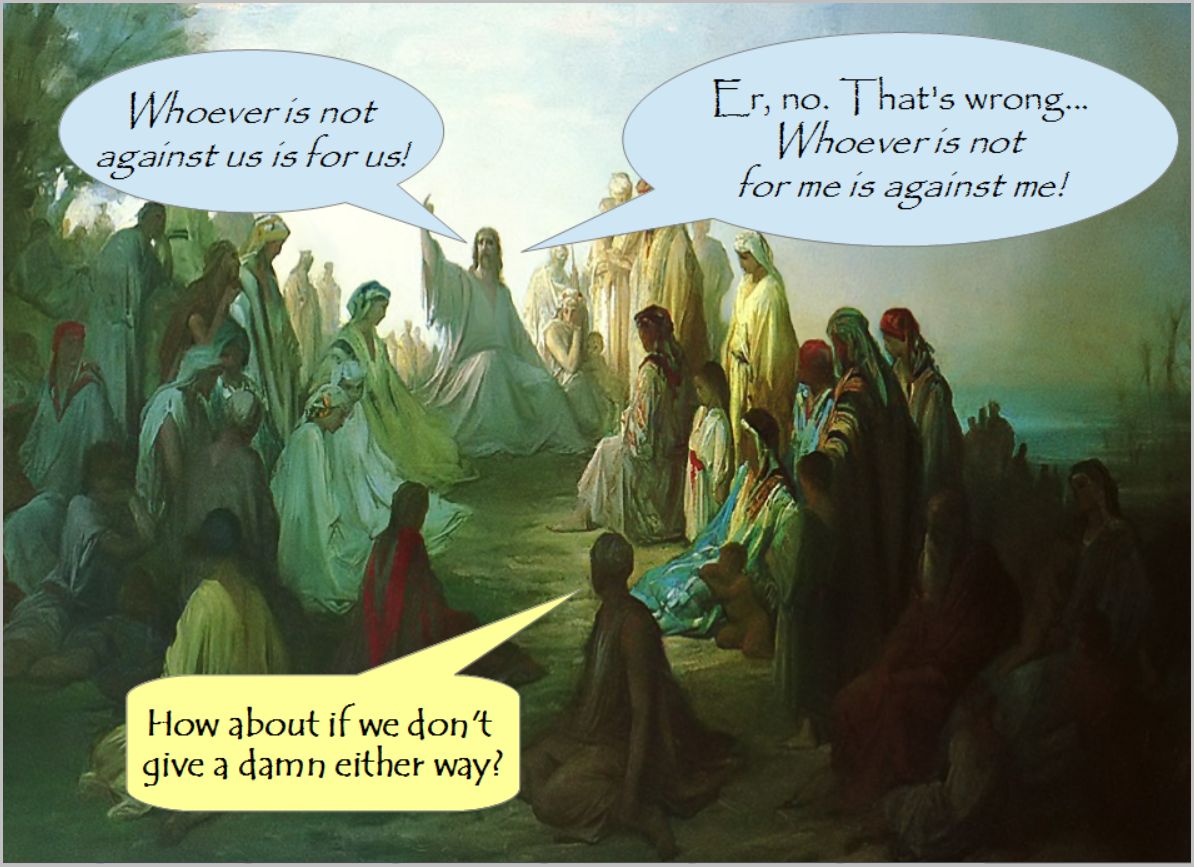
Idiotic Stuff Jesus Said 3: Whoever Is Not With Me Is Against Me

ForUsJesus is reported as saying both that ‘Whoever is not against us is for us’ (Mark 9.40)
and ‘Whoever is not with me is against me’ (Luke 11.23). What he doesn’t seem to realise is that these two statements, each ridiculous in its own right (there is always the third option of not caring either way), mean exactly the opposite of each another. The first is inclusive and relatively friendly. The second is hostile and exclusive; it says, in effect, ‘If you don’t give me your unquestioning devotion you are my enemy.’

This is not the claim of a fully-realised divine being, but of a paranoid megalomaniac. As with much of what he said – or is reported as saying (which is not the same thing) – Jesus reveals himself to be very human; flawed and completely egotistical.

He sets up, as all cult leaders do (and, indeed, as all human groups have a tendency to do) an ‘Us and Them’. Elsewhere, Jesus describes Insiders and Outsiders, with all the rustic charm of a first-century peasant, as the sheep and the goats (Matthew 25.32). It’s still a favourite pastime of Christians to segregate themselves and others into these two categories. They do it with real sophistication these days, of course (I mean, ‘sheep and goats’… c’mon) but it still comes down to Us and Them:

If you’re a mainstream evangelical you’re Saved, while those who don’t subscribe to your brand of Christianity are Lost or Of This World.

If you’re a Bible-believing fundamentalist you’re Regenerate but others are Unregenerate (or Degenerate).

If you’re a Jehovah’s Witness you’re one of the True Church; other believers are part of a False Christianity.

If you belong to the cult formerly known as the Children of God, you’re of The Family and everyone else is part of The System.

If you’re a Roman Catholic you’re the Only True Christians, while all others are Damned.

and so on, throughout all of the 34,000 different Christian sects and denominations.

It is an essential part of the Christian faith to regard yourself as belonging to the only True Church. Everyone else – from those who don’t buy into religion at all to every other faith group – is wrong. They’re an enemy of Jesus because, not being for him or with him in quite the right way (your way) they are, according to the warped logic he expresses here, against him.

The so-called Prince Of Peace proudly declares that he came to bring strife and division into the world (Luke 12.51), which, to this day, remains his greatest achievement. His idiotic words about being either for or against him have proven to be a gift to every sect, cult and church that has ever existed.

The fool says in his heart…

Celia2If you get into a discussion with Christians about their faith and you tell them, often reluctantly because you just know where it’s going to lead, that you don’t share their belief in a deity on account of there being no evidence for one outside of the human imagination, it isn’t long – if they haven’t done so already – before they start quoting ‘scripture’ at you.

Among their favourite verses, along with ‘For God so loved the world…’ (John 3.16) and ‘for a man to lie with a man… is an abomination’ (Leviticus 20.13) is Psalm 14.1: ‘The fool hath said in his heart there is no God’. And having cited it, they stand back in smug triumph, having put you firmly in your place and clinched the argument.

But the Bible would say this, wouldn’t it? It’s in its interest, and in the interest of those who wrote it and believe in it, to rubbish those who don’t buy into its fallacies. Christians who quote this verse, and others, are wilfully refusing to accept that you don’t recognise the ‘authority’ of their magic book. What they are really saying is, ‘You don’t believe in my God or the Bible, but I’m going to use it anyway to ‘prove’ my point.’

Why do they do this? Can they not see the futility of it? It’s like my quoting from ‘Twas The Night Before Christmas to demonstrate that, whether they like it or not, Santa Claus is watching over them to see if they’re naughty or nice. But referencing one make-believe source does not prove the existence of another. You have to believe in Santa Claus to begin with, as children often do, to believe the poem is an accurate account of his activities. So it is with the Bible. It only has significance if you already believe that God exists. It won’t of itself convince you that he does.

The Koran has its own ‘the fool hath said in his heart’ verses. Loads of them. Christians might like to consider whether a Muslim telling them ‘the vilest of animals in Allah’s sight are those who disbelieve’ (Q8:55) would persuade them that Allah is the one true God, and that they’re idiots for thinking otherwise. It wouldn’t, of course, so perhaps they’d kindly stop wasting their own time, and ours, doing the same to atheists.

The best response to a believer who tells you ‘the fool hath said in his heart there is no God’?

‘If even a fool can see it, why can’t you?’