This week in the wacky world of religion…

AtrocitiesBecause my invisible super-being is better than yours, this week I’ve:

murdered you at prayer;

beheaded you as an infidel;

denied you an education;

raped your girls and young women;

committed brutal acts of terrorism;

denigrated LGBT people;

flogged you and imprisoned you.

…And all because of my invisible super-being. Isn’t he wonderful?

As for me, I’m just glad I don’t have an imaginary god if this is the kind of thing he tells his followers to get up to.

Good For Nothing

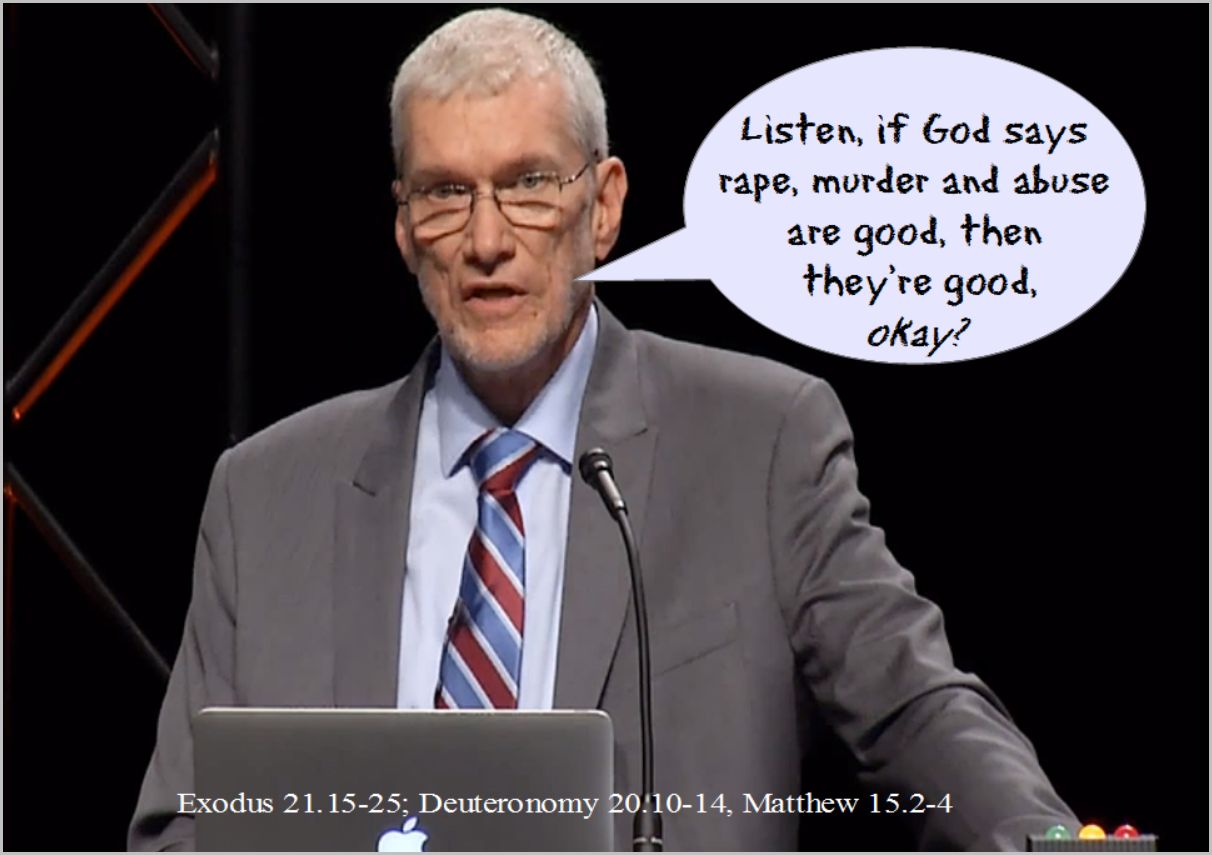
HamWhere does morality come from? Ken Ham of Answers In Genesis says it can only come from (his) God. Atheists have no grounds for morality, he claims, because, without a God to tell them, they’ve no way of knowing the difference between right and wrong .

As usual, Ham is being creative with the truth. Clearly atheists are as capable of being moral as anyone else. Equally and also evidently, Christians and other brands of believers are capable of deplorable immorality. Hardly a week goes by without more reports of Christians abusing, cheating, lying and killing in Jesus’ name.

Why do Christians act so despicably when, supposedly, they have God’s Spirit inside them – that’s the God from whom all morality flows, according to Ken Ham. Why doesn’t his indwelling Spirit guide Christians so that they always behave morally, or even just considerately?

I don’t have the answer. Perhaps Ken Ham or some other knowledgeable Christian can tell us.

No, morality doesn’t derive from any god. It has evolved, inevitably and like much of our behaviour, from our being social animals. Living in close proximity with other humans has meant we have developed ways of behaving that take these others into account, as well as the repercussions of our behaviour on ourselves.* The principle of treating others as we ourselves would like to be treated is very old – much older than Christianity.

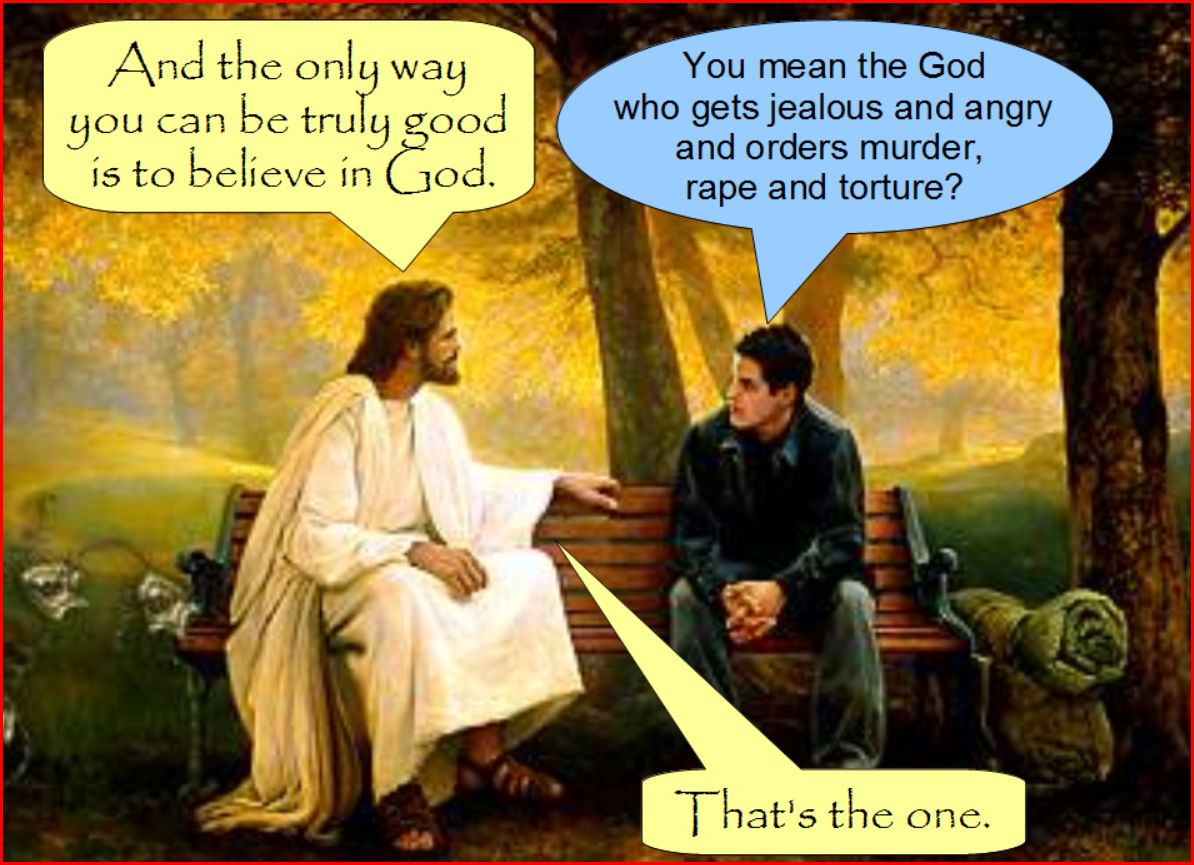
Morality, though, is not absolute and is far from infallible. Non-believers, like the religious, make mistakes and don’t always treat others as they should. But the fact they behave well most of the time is evidence that behaving morally has nothing to do with a god, especially not the capricious, murderous psychopath of the Abrahamic religions.

Ken Ham’s position, and that of other religionists who tell us we have no grounds for morality without such a god, is as offensive as it is absurd.


* There are innumerable books that consider our moral evolution; you might like to try Frans De Waal’s Primates and Philosophers; How Morality Evolved or Christopher Boehms’s Moral Origins.


What did you do today, God?

Duck

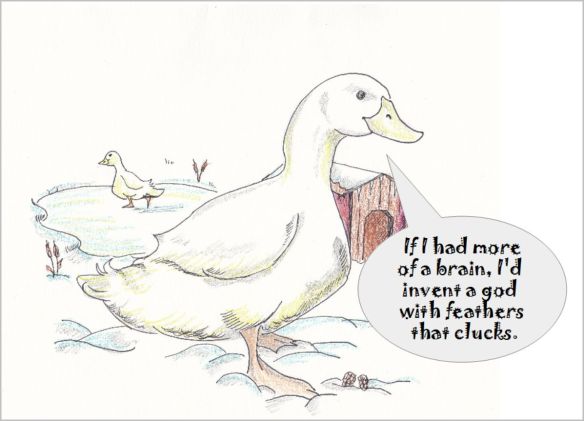
What have you achieved today? I finished some illustrations for a children’s book a friend has written. It’s a minor accomplishment, of course, but one I like to think hasn’t added to the sum total of suffering and misery in the world (though you might want to disagree.) There’s every chance that whatever you’ve done today has been productive and positive too. That is, unless you also happen to be a deity.

What are God’s accomplishments today? What has the Omnipotent, Omniscient and All-loving God achieved in the last twenty-four hours?

Has he, for example, eliminated Ebola, Aids or cancer, or even helped those sinful human beings who strive to develop cures for these terrible diseases (which we would be right in thinking God himself created in the first place)? Erm, no. He hasn’t. Ebola, Aids and cancer are still with us today, their cure and prevention a little closer only because of human endeavour.

Has he prevented any further brutal murders by those who claim to operate in his (alternate) name? Has he rushed to the assistance of Christians being persecuted in Syria and Iraq? Erm… that’s another no. You’d think he might, wouldn’t you, given that his own people are among the persecuted, but no. And given that ‘gentle and compassionate’ relief worker, Alan Henning, has today been beheaded by Islamic extremists, you’d be right to wonder just where God is. What does he spend his days doing?

Did he, then, decide that today was the day he’d let us know which of his many manifestations is the real him – Yahweh? Allah? Shiva? Ra? One of the myriad others? None of the above? No, he didn’t do that either. He left us in our ignorance about which of the many religions, groups and sects has got it right about him. He couldn’t find the time today to tell us who it is that worships the real him, and who it is who’s deceived. Just as he couldn’t for all of the days that have so far made up recorded time.

Maybe, however, he hasn’t had time to do this because he’s been too busy sustaining the universe; you know, winding up gravity and giving the Earth those little pushes it needs to make it spin. But of course, the universe doesn’t work like this. It needs no external power source to keep it going. Even if it was God who set the ‘laws of physics’ in motion at the beginning of everything (it wasn’t), they have been self-sustaining ever since. So, no, he hasn’t the excuse that he spends his days making sure everything is ticking over nicely.

Does he spend them instead empowering believers to move mountains, heal the sick, raise the dead and perform miracles even better than those of his ‘son’, just like he had Jesus promise? Not so’s you’d notice. In fact, not at all.

Oh dear. We really are running out of possible things for God to do. Despite the sometimes desperate state of the world, perhaps all of his time is taken up finding parking spaces for Christians and sorting out their career prospects. Perhaps he’s too busy directing the thoughts and words of his ‘chosen instruments’ (see my previous post) so they can express their hatred for non-Christians and gay people. Or maybe all of his energies go into inspiring those Holy Spirit led church services that ‘bless’ Christians but are no more than human emotion run riot. Alternatively, maybe he just spends his time being offended by everything and everybody. If these are his accomplishments over the last twenty-four hours, then, given all the things he could have been doing, doesn’t it all seem rather pathetic? This is all he can manage?

Of course not. All of the triviality, and all of the brutality, attributed to him is entirely human in origin and manifestation; the beheadings, the euphoria, the offence, the vitriol. All part of the self-delusion that is ‘faith’. There is no God doing all these things, no God who manifests himself in the operation of the universe, in human suffering or the pleasures and happy coincidences of life.

It’s possible, I suppose, that there is a god somewhere, one without any interest in human beings and life here on Earth, but then he’d be even more irrelevant than the impotent gods we’ve invented for ourselves.

As Ariane Sherin famously said, ‘There’s probably no God’, with the ‘probably’ looking ever more redundant.

Our touchy Loving Father is pissed off (again)

DoctorIn 1665, the great plague overtook London and killed about a sixth of its population. The church and other authorities believed the plague was a punishment from God for the sins of those who lived in the city.

Such a view is understandable among people who lived in a pre-scientific era (just) and had no other way of explaining natural phenomena other than from a religious perspective. Their ignorance is perhaps forgiveable.

Speed forward to 2014 and the outbreak of the Ebola virus in Liberia and other parts of Africa. Ebola causes an incurable disease with a 90% fatality rate. And guess what? Those of arrested development, whose thinking is still stuck in the seventeenth century, attribute it to God. More than that, they predict a plague on a scale next to which the 1665 plague looks like little more than a minor skin irritation. And all because of the sins of other people (naturally). According to Liberian church leaders:

God is angry with Liberia. Ebola is a plague. Liberians have to pray and seek God’s forgiveness over the corruption and immoral acts (such as homosexualism, etc.) that continue to penetrate our society. As Christians, we must repent and seek God’s forgiveness.

The usual suspects – atheists, secularists, those pesky homosexuals, pornography, abortionists and women who have abortions – are bringing the judgement of God to Africa, and far more importantly, according to American evangelical leaders, to America itself. There’s an even a lunatic fringe there who welcome it:

Everybody who stands up and embraces sodomy, BE THOU CURSED WITH EBOLA! Cursed be ye for embracing this!’

rants Harlem Pastor James Manning.

As ever God’s judgement, if that’s what we’re dealing with, will be indiscriminate. It will strike down the weak, the elderly, the vulnerable, and, yes, Christian missionaries (the two American medics who have contracted the disease are just that.) Because God’s like that; when he’s in his Hulk-smash mode, he doesn’t care who gets in his way.

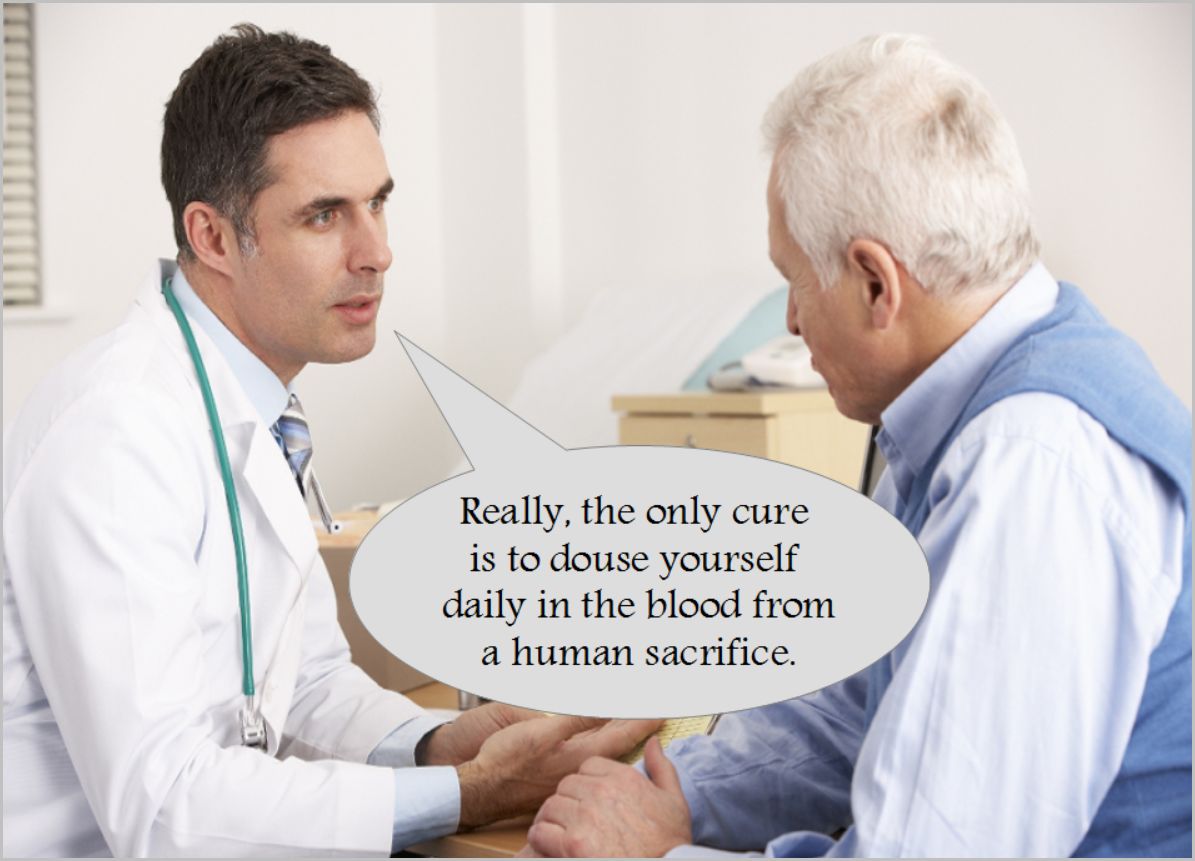
There is a cure though. Just as the scientifically illiterate in 1665 thought prayer would spare them from the plague, the way to survive the coming Ebola pandemic is, according to Pastor Rick Wiles, to be covered in the blood of Jesus:

Now this Ebola epidemic could become a global pandemic and that’s another name for plague. It may be the great attitude adjustment that I believe is coming. Ebola could solve America’s problems with atheism, homosexuality, sexual promiscuity, pornography, and abortion…
If Ebola becomes a global plague, you better make sure the blood of Jesus is upon you. You better make sure you been marked by the angels so that you are protected by God. If not, you may be a candidate to meet the Grim Reaper.

Yes, only true believers who have the blood of a long dead Jewish preacher ‘upon’ them, and angels hovering over their heads, will survive the coming plague (so those Christian missionaries are safe after all – they needn’t bother with the medical care they’re currently receiving back in the States).

This isn’t even seventeenth century thinking; it’s straight from the bronze age.

Will there be a world-wide Ebola plague? It seems unlikely, but who knows; life is more precarious than we sometimes like to admit. If there is, it won’t be because a vengeful, pissed-off God is inflicting it on us… because there’s no such entity. Nor is there a nice, loving, daddy God either – but then he doesn’t figure in this particular scenario anyway.

In spite of what the Bible promises (James 5.14-15), there’s no supernatural protection from Ebola, nor from any other disease. The poor souls who died of the plague in seventeenth century England found that out the hard way. Praying to God and sloshing about in the blood of Jesus, metaphorically or otherwise, protects no-one.

Meet the new boss, same as the old boss

PersecuteThe Reverend Andrew White, vicar of the Anglican church in Baghdad, was interviewed on BBC Radio 4 this morning about the persecution of Christians in Iraq. Undoubtedly, appalling things are being done to these people – beheadings, torture, theft of their possessions – just because of what they believe. The Sunni Muslim militia doing the persecuting are routinely referred to in the UK media as ‘Islamists’ or ‘extremists’, in a vain PC attempt to distinguish and distance them from other of Mohammed’s followers. Whatever we call them though, men, women and children who follow a different long-dead prophet are suffering at their hands.

It is a sad fact that whichever religious group holds the reins of power, it persecutes those who hold different beliefs. History is replete with examples and because Christianity has, for most of the last 2000 years, held the whip hand, it is Christians – the church – that has invariably meted out the persecution. And still does.

There are Christians today who, in God’s name, think that atheists, women and homosexuals should be supressed, denied their rights, deported and even imprisoned. In the West, God’s gentle people (‘Christianists’? ‘Extremists’?) tend not to get their way, but in countries where Christianity still holds sway, they do. Christians persecute minorities, in Uganda, Nigeria, the Gambia, Cameroon and elsewhere, as they themselves are persecuted in predominantly Muslim countries. It’s all so terribly human, as they eagerly jettison the command to treat others as they themselves would like to be treated in favour of a ‘holiness’ that drives them to deprive their victims of life and liberty. Christians have been and are no better than the fanatics who turn on them when the boot is on the other foot.

Perhaps they don’t go in for beheadings quite so much these days, though there are still Christians who advocate stoning as a preferred method of purging society of sinners. Others take it upon themselves to campaign against the human rights of those they’ve taken a dislike to. Recently, the Family Foundation of Virginia announced a forty day fast that it thinks will impress God enough he’ll destroy same-sex marriage in the States. It’s a fast with a difference though – those taking part can eat during it: ‘We are asking the entire Body of Christ to join us for this fast,’ the group says. ‘Giving up physical food isn’t necessary – but feeding on the spiritual food provided is vital.’

I don’t know about you, but I always understood that fasting meant doing without food. A fast isn’t a fast otherwise.

This laughable nonsense beautifully encapsulates religious belief; take on the outer aspects of a faith, including its language and its rituals, and reinterpret them in whatever way suits you. That way, showing the love the saviour commands means treating others with contempt; fasting to get God to do what you want really means filling your belly; following Jesus means ignoring most of what he said and doing what you like.

It’s all so empty, so human, so meaningless – so very hypocritical. If only it weren’t quite so dangerous for those on the outside.

Christians’ Favourite Delusions 14: You can’t prove God doesn’t exist

Santa-JehovahThere’s a difference between ‘proving’ something – technically this can only be done in mathematics and, arguably, the law – and ‘demonstrating’ it. Atheists can’t ‘prove’ God doesn’t exist, any more than believers can prove he does. But it is relatively easy to demonstrate how unlikely it is that there’s a God. We can apply the scientific method. Science doesn’t ‘prove’ either – it demonstrates the likelihood of something being the case by looking at the evidence and determining from it whether a phenomenon is probable or improbable.

This is in fact what Christians (and Muslims and Hindus and Jews) do when they decide whether the tooth fairy, Santa Claus and Zeus exist; from the evidence they conclude, quite rightly, that it’s highly improbable.

What believers don’t do, though atheists do, is apply the same test to their own god. They say, ‘well of course these other supernatural beings don’t exist. There’s no evidence for them whatsoever. But as for my God, well, I’m not going to apply the same rigour. I know he exists because, erm, I believe in him, I have faith.’

But faith and belief are not evidence. Warm fuzzy feelings are not evidence of God. Books written by ancient tribesmen and other superstitious people aren’t either. Even the universe itself is not evidence, when its existence can be explained without recourse to him. Similarly the development of life on Earth and human beings themselves; all are better explained by other means, none of which require God.

It is fairly safe to conclude as a result that the reason they don’t require him is because he wasn’t involved. And he wasn’t involved because he doesn’t exist, in just the same way Santa Claus wasn’t involved when you received your Christmas presents this week. This may not be the ‘proof’ Christians and others would like, but it does demonstrate, more than adequately, the improbability of God’s existence.

Christians’ Favourite Delusions 11: God is ours

preacher3

Apparently, you surrender any right to talk about or comment on God when you’re an atheist. Or so Christians would have it. ‘If you don’t believe in God, why don’t you just shut up about him? Why does it bother you that others believe?’ is the sort of line they take. You’ll find it in the comments on this blog and other sites that are critical of faith.

Like so much else, Christians are wrong about who can have an opinion about God. Unbelievers have as much right as believers, of whatever persuasion, to express views on the God-concept. It’s fair game for everyone.

So why do I bother? Six reasons.

1) I gave Jesus the best years of my life. Well, not really ‘Jesus’ because you can’t give anything to someone who’s been dead these past two millennia – but I was a Christian for twenty plus years and I complied with what the church and the Bible told me. It was a mistake; I denied myself, as I was told to do (in Matthew 16.24) and wasn’t able to be who I really am. I’m so much happier without being told what that should be.

2) I find the persistent proselytising by Christians to be thoroughly objectionable. It’s almost impossible to walk through the town centre where I live without being told by some street-preacher or other that without Jesus we’re all bound for Hell and that ‘evolution is lie’. (One of these claims is, that’s for sure.) If you get too near, a confederate will thrust a tract into your hand, replete with Bible quotations, spelling mistakes and dodgy grammar. And should you manage to avoid these particular desperadoes, you’ll then have to watch you don’t fall over the stands of Jehovah’s Witness literature, ‘manned’ by smiling ladies who think their brand of superstition is the truth.

3) Christians’ treatment of gay people is generally deplorable. ‘Hate the sin but love the sinner’ is the line frequently trotted out, even though it’s entirely unbiblical.  They may claim to love gay people but it’s a hollow claim when ‘in love’ Christians condemn gay people as sinners of the worst sort; ‘abominations’ is the word used in their holy book (and some Christians use worse language than this). Because of what the Bible says, many believers seek to deny same-sex couples the right to marry and resist attempts to grant them the same rights as everyone else. Christians insult us all by calling this love.

4) Christians’ uncritical adherence to superstition is incomprehensible. There are innumerable Christian web-sites, some of which I read (purely for research purposes, you understand) that are, variously, sources of hilarity and despair in equal measure. There has to be some counter-balance to the irrationality and evangelistic fervour of these sites and thankfully there is. Hopefully this blog makes some small contribution.

5) However much they preach at the rest of us, Christians fail to do as their saviour commands them. They think they’re ‘saved’ through St Paul’s magic formula but ignore everything Jesus says is required of them (see previous posts and my book Why Christians Don’t Do What Jesus Tells Them To …And What They Believe Instead.) It’s all specks and logs, to paraphrase JC himself; Christians enjoy pointing out everyone else’s sinfulness – and arguing about doctrine, of course – while blatantly ignoring Jesus’ commands. I feel obliged to point this out.

6) If, through this blog, I can lead people to question their beliefs, help them reflect critically on what they are told by church leaders and very selective reading of ‘God’s Word’, encourage them to think rationally about their belief in supernatural beings and, most of all, if I can be instrumental in rescuing one person from the Jesus cult, then I’ll be more than happy.

That’s why I bother.

Christians’ Favourite Delusions 8: Atheists can never be moral or happy

moral

Christians regularly exercise these dishonest sound-bytes; here, here and here, for example.

There’s no need to argue with them. All we need to do is look at the evidence:

Good, moral atheists

Immoral Christians

Happy atheists

Miserable Christians

(click all of the above for examples)

If it’s true that only those with a direct line to God can be good and happy, then we shouldn’t see any of these categories. Christians should be supremely happy all, or at least most, of the time – St Paul says that believers are characterised by love, joy, peace, kindness and generosity (Galatians 5.22) – but they’re not. They should be moral and good all the time too – after all, Jesus commands them to be ‘perfect’ and tells them how to achieve it (Matthew 5.43-48) – but they’re not.

According to Christians moral, happy atheists shouldn’t exist. And yet they do. Christians, when they achieve it, are only good and only happy because they think God is watching over their shoulder. When atheists are good and happy it’s because they can be.