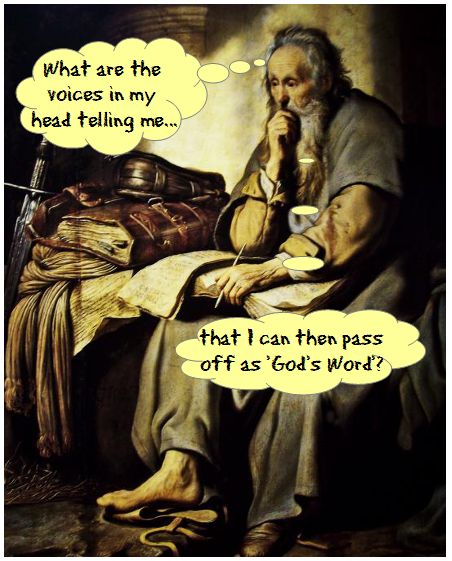
Mystic Revelations

What do the three ‘great’ Abrahamic religions have in common?

They all started with visions, hallucinations, dreams and mystic revelations. They’re not only based on these but owe their very existence to encounters with the supernatural that took place entirely within people’s heads. This of course is if they happened at all; many of these encounters with angels and God’s revelations take place in stories that have all the characteristics of myth or legend. Even so, they reveal much about the primitive state of mind (still around today) that believed God frequently revealed himself to, and in the minds of, chosen individuals.

First, the grand-daddy of the Abrahamic religions, Judaism: 

When Abram was 99 years old, YHWH appeared to him. He said to Abram, “I am El Shadday. Live in my presence with integrity. I will give you my promise, and I will give you very many descendants.” Immediately, Abram bowed with his face touching the ground, and again Elohim spoke to him, My promise is still with you. You will become the father of many nations. So your name will no longer be Abram [Exalted Father] but Abraham [Father of Many] because I have made you a father of many nations. I will give you many descendants. Many nations and kings will come from you. I will make my promise to you and your descendants for generations to come as an everlasting promise. I will be your Elohim and the God of your descendants. (Genesis 17)

Then Moses:

The Angel of YHWH appeared to (Moses) in a flame of fire from the midst of a bush. So he looked, and behold, the bush was burning with fire, but the bush was not consumed.

Then Moses said, “I will now turn aside and see this great sight, why the bush does not burn.”

So when YHWH saw that he turned aside to look, Elohim called to him from the midst of the bush and said, “Moses, Moses!” And he said, “Here I am.” (Exodus 3)

Notice how the inner voice goes from being that of ‘the angel of YHWH’ to YHWH himself (or one of his aliases). The entire scenario is preposterous of course, as is the Abraham episode before it. I’ve omitted the other occasions YHWH is said to appear to Abraham, including the infamous Genesis 22, where YHWH instructs Abraham to sacrifice his son. These stories are legends written, created from whole cloth, centuries after Abraham purportedly lived. He, like the later Moses, is almost certainly mythical, a character created to represent the beginnings of the Jewish faith. Even his names are symbolic. In truth, no one knows how Judaism began.

Onto Christianity:

The angel said to (Mary), “Don’t be afraid, Mary; God has shown you his grace. Listen! You will become pregnant and give birth to a son, and you will name him Jesus. He will be great and will be called the Son of the Most High. The Lord God will give him the throne of King David, his ancestor. He will rule over the people of Jacob forever, and his kingdom will never end.” (Luke 1)

Did this happen? If you believe angels exist then possibly, but we know they do not. We also know that this is myth. However, Luke wanted his readers to know that Jesus’ birth was miraculous so invented a story in which Mary encounters a heavenly being. The gospel writer anchors the divinity of Jesus to an implausible event which at best can only be a young woman’s vision (though it most certainly isn’t.)

The same is true of the resurrection appearances. Here’s Matthew 28:1-8:

Now after the Sabbath, as it began to dawn toward the first day of the week, Mary Magdalene and the other Mary came to look at the grave. And behold, a severe earthquake had occurred, for an angel of the Lord descended from heaven and came and rolled away the stone and sat upon it. And his appearance was like lightning, and his clothing as white as snow. The guards shook for fear of him and became like dead men. The angel said to the women, “Do not be afraid; for I know that you are looking for Jesus who has been crucified. He is not here, for He has risen, just as He said.”

More angels (they multiply in later gospels); again at best, though still highly improbable, the angel(s), if seen at all, can only be a vision or an hallucination (or mistaken identity.)

Onto the only first hand account of an encounter with the divine that the bible includes, Paul’s:

God was pleased to reveal His Son in me so that I might preach Him among the Gentiles… I want you to know, brothers and sisters, that the gospel I preached is not of human origin. I did not receive it from any man, nor was I taught it; rather, I received it by revelation from Jesus Christ. (Galatians 1)

I know a man in Christ who fourteen years ago—whether in the body I do not know, or out of the body I do not know, God knows—such a man was caught up to the third heaven. And I know how such a man—whether in the body or apart from the body I do not know, God knows— was caught up into Paradise and heard inexpressible words, which a man is not permitted to speak. (2 Corinthians)

This is all there is. This is the extent Paul talks about his heavenly encounters. In Galatians he admits that God revealing whatever it was he revealed was ‘in’ him, that is, in his own head. The bizarre tale he relates in 2 Corinthians reads like an hallucination (Paul says he doesn’t know whether it was in the body or out of it) which is all it could’ve been; there is no paradise or ‘third heaven’.

And finally, there’s Mohammed:

while I was sleeping last night, the keys of the treasures of the earth were brought to me till they were put in my hand.”… 

The angel came to him and asked him to read. The Prophet replied, “I do not know how to read. The Prophet added, “The angel caught me (forcefully) and pressed me so hard that I could not bear it any more. (Sahih Bukhari 6998)

Encounters with heavenly beings in dreams, ‘revelations’, visions, hallucinations and invented stories: these are central to Judaism, Christianity and Islam. The religions would not exist without them. Written as myth long after they supposedly occurred or referred to obliquely by those who claim to have experienced them, they are the products of fevered pre-scientific minds.

Post-script: I’ve searched in vain for Darwin’s admission that an angel revealed the process of evolution to him. I can only find his collection of evidence, his scientific observations and his careful analysis of his findings. Likewise Mendeleev who calculated the existence of elements that were at the time unknown. Likewise Crick, Watson and Franklin who discovered the structure of DNA. Strangely, none of these people relied on visions, dreams or divine revelations in uncovering truths about reality.

The New New Testament

With the New Testament books in their traditional sequence, it’s easy to conclude that there was first a remarkable individual who travelled around Galilee proclaiming the arrival of his Father God’s kingdom on Earth. He demonstrated great wisdom and compassion before being crucified by the Romans at the behest of the Jewish authorities. The first four books of the existing New Testament tell us so; that all of this happened first and all that follows occurred afterwards as a consequence of the events the gospels describe.

But, put the gospels where they belong in the chronological arrangement of the New Testament, and the events of the gospels do not happen first. Paul does:

I acknowledge that in putting the books in their correct order in my previous post, I cheated when I made the first the work of the very earliest cultists. No such book exists (no, it’s not Q and even if it were, we don’t have it). The earliest Christian beliefs are largely lost to us. All we know is that some individuals had visions of the Messiah. Paul tells us so in 1 Corinthians 15:5:

He (first) appeared to Cephas, and then to the Twelve.

These visions undoubtedly mark the beginnings of the cult. It later finds a convert in the Hellenized Jew Paul who he has his own vision(s). That these are visions and not an encounter with an actual person is clear from Paul’s declarations in Galatians 1:15-17 and 2 Corinthians 12. He stresses in Galatians that what he knows of the Messiah (‘Christ’ in Greek) comes not from any human source but from what this Christ has revealed to him in his own head: the revelations he’s fond of referring to. These, he says, showed him the importance of the Christ’s sacrifice, the crucifixion being the only Jesus event he’s interested in. Nowhere in his seven letters (1 Thessalonians to Philippians) does he mention anything a Galilean said, did or had done to him, apart from the crucifixion, which is mentioned without any historical detail. Paul’s interpretation of the crucifixion is devoid of Romans, the Sanhedrin, Gethsemane, Judas, Pilate, the scourging and cross carrying, Golgotha, the centurion, grieving disciples and empty tomb. Paul appears not to know anything specific about the event he obsesses over. Who can blame him when these details had yet to be invented?

Paul also has it revealed to him, or so he says, that this heavenly saviour will soon be coming down to the Earth to raise the dead, rescue the faithful who yet live and usher in God’s new golden age (1 Corinthians 15:52; 1 Thessalonians 4:16). It is an idea that permeates the rest of the New Testament writings.  

Paul’s faith, then, rests entirely on his visions/revelations. When proving that they really were of Jesus the Christ, he does so by repeatedly citing Jewish scriptures, never by referring to a particular saying, miracle or healing of an earthly Jesus. Paul’s Christ is a cosmic Superman who is raised from the dead as a ‘life giving spirit’ (1 Corinthians 15.46). (I’ve written about this on numerous occasions, including this post, so won’t reiterate all the details here.)

Written about a decade after Paul’s last letter, we come to the first gospel, which, lo and behold contains an abundance of sayings, miracles and healings of an earthly Jesus. Where did ‘Mark’ get these from? Not from a hitherto unknown document which won’t be posited for almost two millennia (Q); not from an ‘oral tradition’ when the only oral tradition we know of is Paul’s preaching, which doesn’t mention any details about an earthly Jesus.

  • To compound the problem, the first gospel is littered with angels, demons and other supernatural elements (voices from heaven anyone?)
  • It makes extensive use of stories from Jewish scripture, rewriting them and recasting their original protagonists with Jesus in their place.
  • It has him utter teaching that ‘astonishes’ those around him, when much of it is lifted directly from Jewish scriptures and would have been familiar to his listeners.
  • It makes him address the issues of the church as they existed around 70CE when the gospel was written and reflects the rules of the cult at that time.
  • It relies heavily on metaphor and allegory.
  • It has Jesus promise that the Son of Man will soon arrive on Earth to sort out its problems. This is Paul’s teaching about the imminent arrival of the Saviour through the clouds, dressed up in jargon from the book of Daniel. While apologists assume the Son of Man character is Jesus himself, promising his own future return, it evidently is not (it is rather, as I demonstrate here, a metaphor for the Jewish nation). What we have in Mark then, is a fictionalised Jesus predicting the appearance of the ‘real’ Christ from Heaven, just as Paul does.    

Mark’s gospel is most certainly not history nor an accurate record of the activities and teaching of a real human being. It is, as I’ve demonstrated before, fiction, from start to finish.

Following Mark in our chronological New Testament are two forged letters, purportedly by Paul (2 Thessalonians) and Peter (1 Peter) but actually by two different, anonymous authors. In them we’re back to hearing about a celestial Christ not an earthly Jesus. Earthly Jesus doesn’t get a mention despite the fact that one of the letters is supposedly by Peter, the fisherman who trailed around Galilee with Jesus for three years – allegedly – and witnessed his resurrection appearances. You think he’d have mentioned some of this in the letter. But no. Not a word.

And then two more gospels, both of which make extensive use of the first. ‘Matthew’ uses 80% of ‘Mark’ and adds some extra material of his own, including a birth narrative that is pure fantasy (including a magic dream and wandering star) and several new miracles. Where does this extra material (the so-called M source) come from? Some theologians speculate that again it’s from an oral tradition (the same hypothetical tradition used in Mark or a different one? Certainly not one known by Paul.) Even if so, we have no way of knowing whether it is reliable nor who originally reported it. It could just as easily have been invented by the anonymous creator of Matthew’s gospel. In fact, Matthew’s gospel is demonstrably a literary construct that plagiarises and embellishes Mark with more symbolic parallels – with Moses in particular – from Jewish scriptures. The stories of the resurrection are constructed in precisely this way.

Luke’s gospel is open to the same criticism. Where did his extra material (L) come from and why was it unknown to Paul and the creators of the two forgeries that preceded it? The obvious conclusion is that ‘Luke’ also made stuff up.

Here’s the problem with the synoptic gospels (those that carry the names of Mark, Matthew and Luke.) They appear in the midst of a sea of writing that knows nothing of an earthly Jesus and speaks only of a supernatural Superman. Yet we’re expected to believe that in the middle of this sea of myth and fantasy, the three gospels are an island of factual information about a real person. We’re required to accept that the synoptic gospels are reliable, factual, historical accounts of Jesus’ life on Earth. Apparently the gospel authors are the only ones who know the truth about his earthly existence while Paul and other writers evidently did not (or couldn’t care less about it) despite living and writing closer to Jesus’ supposed lifetime.

This is not the only problem. Even if the information about Jesus contained in the gospels was derived from an oral tradition, a hypothetical sayings gospel (‘Q’) or other lost sources (M & L) this would not make it any more reliable. It is just as likely to have been invented.

The next book of our chronological NT, the Acts of the Apostles was written by the same anonymous author as the third gospel. This story of the early days of the cult includes: a Jesus who beams up into the sky; visions; dreams; magic hankies and imaginary table cloths; angels; supernatural murders: miracle earthquakes and characters re-enacting events from Odyssey and the Jewish book of Jubilees. It gets Paul’s itinerary and theology wrong, smooths over his disputes with the pillars of the Jerusalem church and invents speeches for both him and various support characters. History it is not.

Immediately after Acts, we’re back to forgeries: Colossians and Ephesians, the latter being a composite of other Pauline letters and Colossians itself. We’re also back to the supernatural Jesus who makes salvation known through revelation. The two people who created these letters masquerading as Paul appear to have no knowledge of an Earthly Jesus. Had they not read any of the synoptic gospels? Did they not know any of the oral traditions or Q? Do they not care about all the supposedly factual information about Jesus that by this point was in wider circulation? Evidently not. They were interested only in promoting a celestial being, the Christ Jesus.

We’ll see more of this as we move on to the remaining books of the chronological New Testament, next time.

*It’s a trick question. Neither is any sense real.

Conversion

I’d be interested to know, of those of you who are no longer Christians, what led you to become one in the first place.

It seems to me there are thousands of websites, books that argue philosophically for the validity of Christianity, present their evidence for the resurrection and generally take an intellectual approach to promoting the faith.

I’d be very surprised if this ‘evidence’, which is poor at best, and Christians’ philosophical arguments lead anyone to Jesus/God/faith.

My own experience is that conversion is an emotional experience. As a teen I listened to speaker after speaker at the YMCA I attended tell me how their sins had been forgiven and how getting to knew Jesus had given them a great sense of peace and purpose. I originally went along to the YM, as we called it, to meet friends, play table–tennis and drink coffee while listening to the juke-box. I had no idea I was a sinner nor that I needed forgiven but I liked the enthusiasm – they said it was ‘joy’ – that the speakers conveyed. I thought too I could maybe do with a sense of purpose though I was, as a fifteen year old, quite happy drifting along relatively aimlessly.

The persistent drip feed of what Jesus could do for me (and others) was persuasive. It sowed the seed, as the Christian cliché has it. It took a lively young American evangelist from Arthur Blessitt ministries to convict me. Jesus had turned his life around and he was on his way to heaven. Denying Jesus, he said, was to crucify him all over again. So I prayed the sinner’s prayer and gave my life to Jesus too.

Nowhere in any of this was there anything philosophical, no ’proof’ of the resurrection, no explanation of how the Bible was the Word of God. All the talks were appeals to emotion – how I could feel forgiven, how I could know love, joy and peace, how I could live forever after I died, up there with God in heaven.

All the rationalisation came later, like it always does. Psychologists tell us that the intuitive part of the brain makes decisions ahead of the rational part, which seeks to catch up afterwards, supply the reasons why the decision we’ve made is a good one. We’ve all done it when we’ve bought that item we don’t really need and have justified it all the way home. Religious conversion follows this pattern.

The thinking mind only becomes involved afterwards, hence ‘post hoc rationalisation’. We then become complicit in our own indoctrination: Bible study (both group and individual), listening to sermons, learning from more mature Christians, worship (all those song and hymn lyrics reinforcing the mumbo jumbo), reading Christian books, immersing ourselves in the complexities of the religion. This is how it’s always been. As Paul puts in 1 Corinthians 3:2, we move from milk to meat as we delve further into ‘the mysteries of Christ’. Or, more accurately, we become more deeply indoctrinated.

But all of this comes later. The emotional experience is first, as it was for Paul, C S. Lewis (who described it as being ‘surprised by joy’), George W. Bush and millions of other converts. In my Christian days, I personally ‘led people to the Lord’, by ‘sharing my testimony’ (I’ve still got the jargon!) and can assure you, those involved felt the Holy Spirit with a profound intensely. Only kidding. They became pretty emotional.

I know of no-one who became a Christian by assessing the evidence for the resurrection, reading Paul’s theobabble or analysing the central claims of Christianity. I suppose there might be some who, like Lee Strobel, insist they ‘came to faith’ this way. But faith and rational analysis are incompatible. When the writer of Hebrews (11:1) says: ‘faith is the substance of things hoped for, the evidence of things not seen,’ he is oblivious to the fact that there isn’t any ‘evidence’ of unseen spiritual ‘things’. There are only our own feelings and emotional confirmation bias.

So that’s how it was it for me. How was it for you?

Next time I’ll take a look at the deconversion process.

Whatever Happened To Pontius Pilate?

While indisputably a real person, we know only a little about Pontius Pilate, primarily from Philo, writing circa 41CE, and also Josephus (writing 75-79CE). Pilate was appointed as prefect, or governor, of Judea in 26CE and after ten years of insensitive and brutal control was, according to Philo, recalled to Rome in 36 ‘to stand trial for cruelty and oppression, particularly on the charge that he had executed men without proper trial.’ (On the Embassy to Gaius)

Described by Philo as having ‘an inflexible, stubborn and cruel disposition’, Pilate was not the kind of man who would entertain in his private residence those marked out for crucifixion, nor one who would feel remorse at the execution of thieves, insurrectionists and general trouble makers. It is likely he had hundreds if not thousands of them crucified during his time as prefect.

Would a man known for ‘his venality, his violence, his thievery, his assaults, his abusive behaviour, his frequent executions of untried prisoners and his endless savage ferocity’ (Philo), have a prisoner over for a chat about the nuances of the meaning of Truth? Almost certainly not.

Would he have suffered mental anguish because he might be about to execute an innocent man? Absolutely not.

Would he have symbolically washed his hands to ease his conscience? He would not.

Would he have offered a rabble the chance to free Jesus or the bandit Barabbas? Again, absolutely not. There was no such ‘tradition’ and the episode is clearly symbolic.

If Jesus was crucified ‘under Pontius Pilate’, the Prefect himself would, in all probability, not have been aware of it. Jesus would have been one more seditionist among many. Nor would Pilate have granted a member of the Sanhedrin, unrelated to the crucified criminal, the right to remove his corpse from a cross to give it a decent burial in compliance with Jewish ritual. Pilate was known for his insensitivity to such niceties.

Jesus’ encounters with Pilate in the gospels are so entirely implausible they can only be fictional. The two would never have met. Even if they had, none of the gospel writers would have known the details of their exchanges, different in each gospel. In all of them, the cruel and savage Pilate behaves entirely out of character.

While no records survive of any trials conducted by any prefect of the area (because there were none in the first place?) it is perhaps surprising that details of Jesus’s trial were not preserved, when only a few days later, reports that he had returned from the dead began to circulate. Yet, say apologists, this is one of the few indisputable, ‘minimal’ facts we know about the historical Jesus: ‘he was crucified under Pontius Pilate.’ It’s there in both the Nicene creed (325CE) and the so-called Apostles’ creed (circa 341). Yet Paul, writing close to the time of Pilate’s supposed involvement, doesn’t mention him, ever. When he’s not blaming ‘the Jews’ for Jesus’ death (forgetting he is a Jew himself) Paul is insisting demonic powers are responsible:

Yet among the mature we do speak wisdom, though it is not a wisdom of this age or of the rulers of this age (‘Archons of this Aeon’), who are being destroyed. But we speak God’s wisdom, a hidden mystery, which God decreed before the ages for our glory and which none of the rulers of this age understood, for if they had, they would not have crucified the Lord of glory. (1 Corinthians 2:6-8)

While Paul doesn’t refer to either Pilate or the Romans in his teaching about the crucifixion, he does refer to the latter in his letter to believers in Rome itself. in Romans 13 he tells them they must obey Roman authority because God himself has put it in place. What an incongruous, unreasonable directive if the Romans had indeed been responsible for the execution of the Messiah.

The only other mention of Pilate outside the gospels is in 1 Timothy, which was not written by Paul but forged long after Mark had written the Prefect into his gospel as the embodiment of Paul’s demonic powers. (Mark’s gospel is in fact awash with demons, not to mention Satan himself. It’s essentially an allegory of their defeat at the hands of the Messiah.) 1 Timothy 6:13 merely repeats a tradition developed from Mark’s gospel that Jesus made ‘a good confession’ in front of Pilate. 

The ‘fact’ that Pilate had Jesus executed is therefore poorly attested. Mark is the first to mention it, circa 70CE, and we know Matthew and Luke lifted their timelines and much of their detail from Mark. A growing number of scholars think John also relied on Mark for the general outline of his gospel. It is likely therefore there is only one source for Pilate’s involvement in Jesus’ death: Mark.

Outside the Bible, there is no evidence that Pilate was responsible. Josephus’s Testimonium Flavianum is widely accepted as an interpolation (i.e. later Christian tampering) and Tacitus’ mention of Pilate is far too late (c. 116CE) to be an independent source.* There is therefore no contemporaneous, independent, reliable evidence that Jesus was crucified under Pontius Pilate. That myth came later and then only from Mark.

Legend has it that Pilate either killed himself in 37CE on the orders of Caligula or retired and faded into obscurity. Whichever it was, would he, in his last days, have regretted his excessive cruelty? Would he have suffered remorse for executing an innocent man? Would he even have remembered? It all seems so unlikely.

*See chapter 3 of Michael Alter’s The Resurrection and Its Apologetics, 2024)

Homelander created by Garth Ennis and Darick Robertson. Image of Antony Starr from Amazon Prime’s The Boys.

Whatever Happened to Judas Iscariot?

Even more significant in the gospels than Mary Magdalene is Judas. Like her, he is strangely absent from the rest of the New Testament. Apart from Luke’s ridiculous story of his death in Acts 1:18 – a story that contradicts the one in Matthew 27:5 – he isn’t mentioned anywhere else. You might think that’s to be expected, given he’s the disciple who betrays Jesus in the gospels. His name must have been anathema to early Christians.

We might expect, however, that when Paul is describing the Lord’s Supper for the very first time in 1 Corinthians 11:23-26, he might, when he gets to the part where he says ‘on the night he was betrayed’, have mentioned the name of the betrayer. It would seem the natural thing to do. Unfortunately, the word ‘betrayed’ (prodidomi) doesn’t appear in 1 Corinthians 11:23-26 or anywhere else in the epistles. The word Paul uses is paradidomi, meaning ‘handed over’, a handing over by spiritual agents (God himself?) not a traitorous human. Judas is in fact absent from Paul’s description of the Lord’s Supper, a revelation he claims to have received directly from the heavenly Jesus, who neglects to include Judas and all the other disciples too. Nor does Paul call the event ‘The Last Supper’; that name would come later. Read 1 Corinthians 11:23-26 for yourself and see. Bart Ehrman also addresses the problem here.

Bizarrely though Judas does turn up, sort of, in 1 Corinthians 15:3-8, when Paul is quoting a creed thought to originate in the earliest days of the new faith. Because it is considered so early, this creed is greatly valued and frequently cited by apologists. Never mind that it contradicts the later gospel sightings of the Risen Jesus (see the previous post). Here’s what Paul says in 1 Corinthians 15:5: ‘(Jesus) appeared to Cephas, and then to the Twelve.’ Then to the Twelve? What Twelve? As Simon Peter, wasn’t Cephas one of the Twelve to begin with? Maybe they weren’t the same person after all.

More significantly, the Twelve, at least according to the later gospels, originally included Judas. He was one of Jesus’ inner circle. And according to Matthew 27 and Acts 1 he killed himself almost immediately after betraying Jesus. He wasn’t around to see the Resurrected Christ. Yet according to Paul and the early creed all of the Twelve saw Jesus alive again. Either Judas wasn’t one of the Twelve and the gospels are wrong, or he was and he didn’t betray his Master after all, remaining alive for his reappearance. (Just to be clear, the Twelve at the time of the resurrection appearances did not include Judas’s replacement, Matthias (Acts 1:23-26). Matthias doesn’t become one of the Twelve till after Jesus has returned to Heaven (Acts 1: 9).

So, Judas isn’t mentioned as a Jesus’ betrayer by anyone other than the gospel writers, decades after the supposed resurrection. He isn’t mentioned by name at all. The only possible reference to him is in 1 Corinthians 15:5 where he’s still one of the Twelve and sees the resurrected Jesus. It couldn’t be could it, that Mark, reading Paul’s description of the Lord’s supper mistook, or deliberately misinterpreted, the phrase ‘was handed over’ to mean ‘was betrayed’ and constructed his story about the duplicitous Judas accordingly? Why, yes it could.

Conveniently, ‘Judas’ is the Greek form of ‘Judah’, the kingdom of the Jews who, so far as early Christians were concerned, rejected Jesus as the Messiah. Judas is a symbolic character in a literary work, representing those foolish Jews who turned their backs on salvation and so ‘betrayed’ the true Messiah.

The Great Resurrection Scam

Brothers and sisters, we do not want you to be uninformed about those who sleep in death, so that you do not grieve like the rest of mankind, who have no hope.  For we believe that Jesus died and rose again, and so we believe that God will bring with Jesus those who have fallen asleep in him. According to the Lord’s word, we tell you that we who are still alive, who are left until the coming of the Lord, will certainly not precede those who have fallen asleep. For the Lord himself will come down from heaven, with a loud command, with the voice of the archangel and with the trumpet call of God, and the dead in Christ will rise first. After that, we who are still alive and are left will be caught up together with them in the clouds to meet the Lord in the air. And so we will be with the Lord forever.

1 Thessalonians 4:13-17 (circa AD 49-51)

Paul said that because Jesus died and rose from the dead others would too. How does this follow?

He also claimed that all a person had to do to be sure of a spiritual resurrection was to believe that Jesus had already risen (1 Corinthians 15:20, AD 53-54), How did he know this? Almost certainly it came to him in one of his visions and his subsequent ‘revelations’ (‘the Lord’s word’ as he puts it in the letter to the Thessalonian sect).

Possibly, though less likely, he learnt it from the Christians he persecuted prior to his conversion. If so, where did they get the idea from? That the cult members in Thessalonica had to ask Paul what would happen to those who had passed away suggests this wasn’t a significant concern prior to this point. Paul and other early believers thought the Messiah/Son of Man was going to appear within their lifetimes (‘we who are still alive’ etc). It was only when cultists started dying off in noticeable numbers, and the Lord remained a no-show, that it started to become an issue. Paul had to make something up. And make it up he did.

An Open Letter to the Bride of Christ

Every day, it seems, there are reports of pastors, ministers, priests, youth workers, church officials – you name it – who sexually abuse children, teenagers and other vulnerable people. These predatory abusers are especially repugnant because they are Christians; born again servants of the Lord, cleansed, supposedly, by the blood of Jesus. As such they have a higher moral standard than those of us who don’t have God to make us good. Or so you keep telling us. Instead these individuals take advantage of their status to rob others of their innocence, psychological well-being and the joy they should later experience in a healthy, adult sexual relationship.

You, the Bride of Christ, the Church at large, who harbour these truly awful people, need to get your house in order. You’ve had a mere 2,000 years to do it. Instead, you spend your time condemning atheists, gay people, trans-people, feminists. Have you not read 1 Corinthians 5:12: ‘What business is it of mine to judge those outside the church? Are you not to judge those inside?’ Likewise, you are told by your Saviour to attend to the log in your own eye instead of carping about the speck you perceive in others’.

You need to stop tolerating the abusers in your midst. Stop defending them when they’re found out, stop pretending all is wholesome and savoury in the Church. Stop lying when you claim that the few offenders who do get caught are mere bad apples and not ‘true’ Christians.

If not for the good of others, do it for your own sake. The Bridegroom when he descends to claim his Bride is not going to want to copulate with you, riddled as you are with malignant sexual disease.


Where’s Jesus?

Not a rhetorical question. Christians keep telling us that he’s alive, so where is he exactly? If he’s alive he has to be some place. The old hymn, ‘I Serve A Risen Saviour’, which I sang many times in my younger days, thinks it knows:

He lives, He lives, Christ Jesus lives today!
He walks with me and talks with me along life’s narrow way.
He lives, He lives, salvation to impart!
You ask me how I know He lives?
He lives within my heart.

This isn’t much use though, is it. All it’s saying is ‘I’ve convinced myself Jesus is alive because I feel him inside me.’ That’s the extent of it, and this being so, it’s really no evidence at all that Jesus is alive in any sense the word is usually understood, let alone that he has an independent on-going existence.

Perhaps the bible will be of more use. Acts 7.55-56 has Stephen see Jesus alive in heaven, standing at the right hand of God. Well, that’s great. Now we’ve got two problems. Not only do we still not know where Jesus abides, we don’t know where God lives either. They’re both together somewhere, ‘heaven’ according to Acts says, but we’re no closer to knowing where this is either.

According to the preceding verse, Acts 7.54, Stephen is ‘looking up’ when he has his vision of heaven. This is significant because for early Christians, God’s abode – heaven – was in the sky. The New Testament speaks of different levels or realms of heaven, all of them up in the sky.

In 2 Corinthians 12, Paul claims to have visited the third (and highest?) level, while the Paul-imposter who wrote Ephesians helpfully explains that the lower level, the one nearest the earth, is occupied by demons and Satan’s minions whom he refers to as ‘the powers of the air’, ‘cosmic powers’ and ‘powers and principalities’. These are the very beings whom Paul claims in 1 Corinthians 2:8 killed Jesus (betcha thought it was the Romans) and 1 Peter 5:8 says seek to devour men’s souls.

Next is the heavenly realm inhabited by angels and the original perfect copies of everything here on Earth (Hebrews 9:22-24).

Then, finally, there’s the highest heaven (alluded to in Luke 2:14)) where dwells the CEO, God himself. If Jesus stands or sits at his right hand, then presumably that’s where he is too. But where is this highest heaven, or indeed any of the levels the early cultists believed existed? There’s no evidence for any of them.

In fact, the Bible’s heavenly hierarchy (which you can read about in detail here) is absolute drivel. Above us, as John Lennon was known to say, is mere sky – the stratosphere, mesosphere, thermosphere and the like – followed by the endless vastness of largely empty space. If Jesus is alive in an imaginary highest heaven somewhere out there, then he, like it, is similarly non-existent.

But let’s not write a living Jesus off just yet. It’s possible that he, his Father and all those lesser supernatural beings – the demons and devils, powers and principalities as well as the angels and snoozing saints – are hidden away in some other invisible and undetectable alternate dimension.

Other dimensions are, according to some scientists, theoretically possible. There may, they say, be as many as 11, but unfortunately for Jesus, none of the Bible authors knew of them. Those who wrote about heaven in the early days of the Jesus cult, were convinced it was overhead and, as ‘intellectual’ Christians are fond of pointing out, we need to read and interpret scripture as the ancients themselves did, not with a modern sensibility. Certainly not with an understanding of ‘dimensions’ derived from Star Trek.

Despite this, theologians have to work mighty hard to transplant such theoretical dimensions into the Bible in order to claim that heaven, and therefore Jesus, exists in one of them. And work hard they do, at what is little more than a god-of-the-gaps argument: ‘we know Jesus is not a few (or even many) miles up above us, therefore we must find a location for him somewhere that science appears to allow.’

(Interestingly, when it comes to the fine-tuning argument, apologists are quick to dismiss the idea of other dimensions, multiverses and parallel worlds; these make the earth less special, less ‘just right’ for life, less designed by God specially for us.)

Locating the living Jesus is like finding Wally/Waldo in one of those cluttered pictures, except this time he hasn’t been included. So tell us, Christians, where is Jesus? And where is the evidence he’s where you say he is?

What Happens When We Die (According to the Bible)

Street preacher Dale McAlpine was busy regaling the shoppers of my home town yesterday with the good news that they’re all sinners destined for hell. The God who created them will, Dale assured them, face an eternity of torture unless they turn to Jesus.

Dale didn’t have many (any) takers for this wonderful good news. One brave person, a young woman, asked him why, if people are resurrected, the cemeteries remain resolutely full. Good point! Dale, armed with his megaphone and hectoring ignorance, responded that it is the soul that survives death and is taken up to Heaven to live eternally with God. For those without Jesus, their souls will be consigned to hell where they will burn for eternity.

How unbiblical is that? The Bible does not teach that believers will go to live forever with God in heaven. Eternity in Heaven is not on offer. The New Testament writers anticipated the arrival of Heaven – God’s new Kingdom – on Earth. When it did, they believed, the dead would be resurrected: the saints to everlasting life in new spiritual bodies on a regenerated Earth (Revelation 21:1-4), the rest to eternal damnation.

Paul has some vague ideas about what will happen to those who die before the general resurrection – he thinks their souls will be kept safe ‘in Christ’ (whatever that mean but doesn’t suggest they will be living it up in Heaven. Rather, he describes them in 1 Thessalonians 4:14-15 and 1 Corinthians 15:20 as being ‘asleep’. Many Christian ‘thinkers’ really take exception to this idea, though Paul says this intermediate state won’t last for long; the Kingdom on Earth was imminent. He believed it would arrive while most of those he was writing to were still alive (1 Thessalonians 4:17; 1 Corinthians 15: 51-52).

It’s all tosh, of course. Paul had absolutely no idea what happens to people after death. He invented everything he said about it, from the independent existence of sleeping souls to Jesus arriving on the clouds to resurrect the dead in new spiritual bodies. These bizarre ideas come from a fevered brain convinced it had seen a dead person alive again and thought it had once taken a trip to the third heaven (whatever that is).

How do we know Paul invented it all? Because of the aspects of his teaching that should by now be history: the arrival of God’s Kingdom on Earth, the resurrection of the dead and Christians being supplied with new spiritual bodies ( while the rest of us roast in hell.) None of these things happened when he said they would, or indeed at all. We know it too because we are aware both instinctively and empirically that there is no continuation after death. When the body ceases to function so too does the ‘self’, which can be generated only by a living brain. We have no ‘soul’ that goes on alone after death and which will one day be clothed in a new sparkly body.

Here’s my challenge then to those who believe and propagate such nonsense; the Dales, the evangelicals, the fundies and the oxymoronic intellectual Christians of this world: provide evidence of one individual who has survived death in the way Paul said they would. Show us one believer who has been resurrected or whose soul is currently sleeps in Christ or who now lives in Heaven. The only proviso is that this must be a real person who is 100% human; not a mythical demi-God, not a character in a story, not someone for whom the evidence of a resurrection is extremely poor. Not, in short, Jesus. Where is the evidence anyone else has experienced a resurrection or embarked on their eternal life in heaven? Billions of believers have died since Paul created his fantasy. Surely there must be someone

Stories about Jesus

Our resident Christian implied recently that I disputed that stories about Jesus existed prior to the gospels being written. I don’t – this was another of Don’s straw man arguments – and told him that of course there were earlier stories about Jesus. But then I got to thinking: where exactly are those stories? How do we know they existed? How can we distinguish them from later embellishments?

Let’s take a look at the evidence*, starting with the earliest Christian writing that we have:

Paul

Paul doesn’t refer to a single event from Jesus’ life outside a barebone account of the crucifixion and resurrection. He doesn’t mention, for example, the nativity, the virgin birth, Jesus’ time in the wilderness, his chat with the devil, his baptism, John the Baptist, the miracles, the amazing things Jesus is reputed to have said, the parables, the Sermon on the Mount and Beatitudes, the I Am sayings, the healings, Lazarus, the arrival in Jerusalem, the cleansing of the Temple, the agony in the Garden of Gethsemane, the arrest, Judas, Pontius Pilate, Jesus’ trial, the mockery of the soldiers, Peter’s denial, the words Jesus spoke on the cross, Joseph of Arimathea, the rolled away stone, the empty tomb, Mary Magdalene, Doubting Thomas or the physical Ascension. Neither does he refer to any incidents or episodes from stories that didn’t eventually make it into the gospels. Not one of them. (He does create a narrative of his own that later finds its way there: the ritual of sharing bread and wine which Paul lifts from Pagan ceremonies. We’ll return to it in a later post.)

Apologists like to say that these serious omissions are no more than Paul’s assumption that his readers would already know the stories about Jesus.  He does not need to reiterate them. But no-one is suggesting he should or would have recounted them in full. What is odd and awkward is that Paul doesn’t even allude to them in his teaching. He could clinch many an argument by referring to a particular saying or miracle of Jesus’, but he never does.

When talking about obeying the (Roman) authorities, for example, in 1 Corinthians 15:12 &13, he could have said, ‘Recall that the Lord told us we should render unto Caesar that which is Caesar’s,’ but he doesn’t. He could have alluded to Thomas when explaining the importance of having faith without evidence; talked about the empty tomb when discussing Jesus’ resurrection; mentioned the raising of Lazarus as an example of the dead being resurrected; commented on Jesus turning water into wine when arguing that the Law had been superseded by a new covenant. He might even have quoted something Jesus said from a story in circulation that didn’t later end up in one of the gospels.

He doesn’t. Ever.

Paul claims he received none of his information about Jesus from any human being. He insists he received all he knew through revelation – the Lord speaking to him from heaven. Apparently, the Lord neglected to convey any of the details of his life on Earth. The apostles kept equally schtum. Paul was no more knowledgeable about the life of Jesus once he’d he met them than he had been before. Was he not inquisitive? Did he not ask the right questions? Did they dislike him so much they withheld every detail of Jesus’ activities on Earth? Did they not in fact have that kind of information? Whichever it was, Paul seems not have known any of the stories about Jesus that predated the gospels or even that later appeared in them. It’s possible, I would say likely, he did not know of them because they had yet to be created. Many of the stories about Jesus were ten or more years away.

But we mustn’t jump to conclusions. Next time we’ll take a look at other possible sources of these elusive stories.


*I read Bart Ehrman’s Jesus Before The Gospels a few years back. I hope I’m not merely reiterating what he says there. While there were some points I found less persuasive than others, Ehrman nevertheless does a good job of showing how stories about Jesus changed and evolved over the years.