

I started wondering why, if his creators believed him to be the Messiah, they have gospel Jesus habitually refer to saviour-figures in the third person? He does it Matthew 23 which we looked at couple of weeks ago, when he talks about there being ‘one instructor: the Messiah’, and he does it repeatedly in all four gospels when he refers to ‘the Son of Man’. The term comes from Daniel 7:13 where it is rendered as ‘one like a son of Man’.
In my vision at night I looked, and there before me was one like a son of Man, coming with the clouds of heaven. He approached the Ancient of Days and was led into his presence.
The interpretation of which, supplied in Daniel 7:27, is that:
The sovereignty, power and greatness of all the kingdoms under heaven will be handed over to the holy people of the Most High. His kingdom will be an everlasting kingdom, and all rulers will worship and obey him (my emphasis).
The phrase used for ‘son of Man’, bar enash, means simply ‘human being’ and is used to contrast with the ‘beasts’ of nations that the ‘prophecy’ says will rule prior to this. However, as Daniel explains, the human being in question is the nation of Israel – the holy people of the Most High – who will finally triumph over the four beastly nations that will dominate the Earth first. The nation of Israel will metaphorically emerge from the clouds and join the Ancient of Days to rule from Heaven. There is no mention anywhere in the Daniel dream-prophecy of a Messiah or individual human being who will accomplish any of this.
As Neil Godfrey puts it:
The coming of this “Son of Man” is within the realm where one expects deities to travel. The coming is, moreover, to another station within the clouds, namely the throne of the Ancient of Days. The context again explains that this “coming” is effecting a change of rule on earth. A kingdom is falling, and freedom is given to “the saints of the Most High”.
Nevertheless, it is this title – the now fully capitalised ‘Son of Man’ – that Mark has Jesus assume. The other three gospel writers copy it from him. Paul, writing decades before them, seems not to know that Jesus used it. Evidently the celestial Christ he encountered in visions and revelations didn’t feel the need to mention it. (Hardly surprising when Mark is freely inventing years later.)
So what does this tell us about Jesus, or, more specifically, about how the Jewish Christians of Mark’s community viewed him?
A number of scholars (e.g. Ehrman, Carrier, Goodacre, Westar Institute) have argued (as have I in my own amateurish way) that gospel Jesus is constructed from ‘prophecies’ lifted from Hebrew scriptures. Other commentators have demonstrated how he is, in the first two gospels at least, the personification of the nation of Israel*. This isn’t just because he identifies with the son of Man figure in Daniel. He also equates himself with the Suffering Servant of Isaiah 53 and elsewhere. Strictly speaking, he is made to identify with the Suffering Servant by Mark and the other gospel authors, particularly Matthew, who all copy Mark’s original idea. As Isaiah 53 makes clear, God’s Suffering Servant is not a person: it is Israel.
Not only is Jesus identified with Daniel’s son of Man and Isaiah’s Suffering Servant – the personification of the Jewish nation – but Isaiah 53 is used as a template for his trial, mockery, crucifixion and resurrection. It is the nation that is God’s servant which, as Mark was writing, was going through trials, tribulation, suffering and apparent death: the destruction of Jerusalem and its temple, with thousands of Jewish people being crucified by the Romans.
So it will be Israel, Mark hints in his extended parable, that will emerge resurrected and who will ascend metaphorically through the clouds to sit at the right hand of God to rule the nations. He leaves out the details of this resurrection and ascension from the end of his gospel because at the time of his writing they had yet to happen. But, he tells his readers and listeners, they will. They have to because Daniel and Isaiah say so: after suffering comes God-assured victory. Mark’s Jesus story, then, is an allegory of the history of the Jewish nation and its projected future. The allusions to Abraham, Moses, the Exodus, Elijah, Isaiah’s Suffering Servant, Daniel’s son of Man and the accompanying ‘prophecies’ make this more than apparent.
Gospel Jesus is a metaphor (or indeed a simile, one who is like a son of Man/the Jewish nation), his life made to conform in every respect with the history of that same nation. He is an allegory as Mark makes clear throughout his gospel.
The clues are there for all to discern and as Mark advises, ‘he who has ears, let him hear’.
*See Watts: Isaiah’s New Exodus and Mark and numerous Christian apologists who make the same point: Google ‘Jesus and Israel’.


 This is what what we’ve got so far: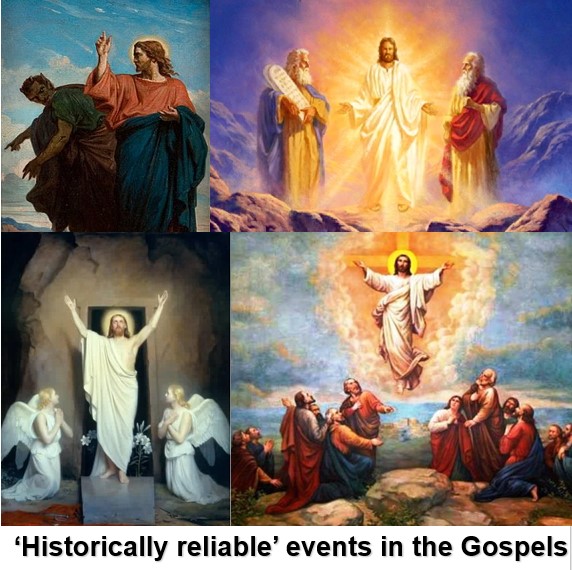


 rejectingjesus,