Things a Christian Wishes (Some) Atheists Would Stop Doing (And Saying)

corey

On his blog recently, Doctor Benjamin Corey offered up a post called ‘S%#t I Wish (Some) Atheists Would Stop Doing (And Saying)’. I discovered it via the Friendly Atheist blog and naturally felt compelled to respond to Doctor Corey’s four bits of S%#t. The comment I posted on The Official Blog of Benjamin L. Corey is as follows:

S%#t 1: Please stop saying or insinuating that we’re a bunch of uneducated or unenlightened idiots.

Do atheists say or insinuate this? I’m not sure they do. I would suggest atheists find it difficult to understand why people of evident intelligence choose to believe propositions for which little or no evidence exists, that are rooted in myth and which, in reality, fail to deliver on their promise. It’s not that believers are necessarily unintelligent or idiots – clearly many are not – it’s that they are prepared to disengage their intelligence, critical faculties and rationality in order to believe all manner of spurious nonsense.

S%#t 2: Please stop insisting that we read our Bible like right-wing fundamentalists.

I’m surprised you offer this as something you wish atheists would stop ‘insisting’. First of course, atheists don’t insist that anyone read the Bible the same way as anyone else. We would prefer it if no-one read it at all. It is well past its sell-by date and has nothing to offer people living nearly two thousand years after its creation; it is after all a testimony to the failure of the beliefs that spawned it (the Son of Man ascending to the Earth to establish the Kingdom of God here).

Second, implicit in this demand is that there is an intelligent way to read the Bible and there’s the ‘ring-wing fundamentalist’ way. In fact, you don’t even insinuate that certain Christians are ‘ignorant’ and ‘unenlightened’ because of how they read the Bible, you say so explicitly when you talk, ungrammatically, about the ‘unenlightened, ignorant nonsense that fundamentalists do with the Bible.’

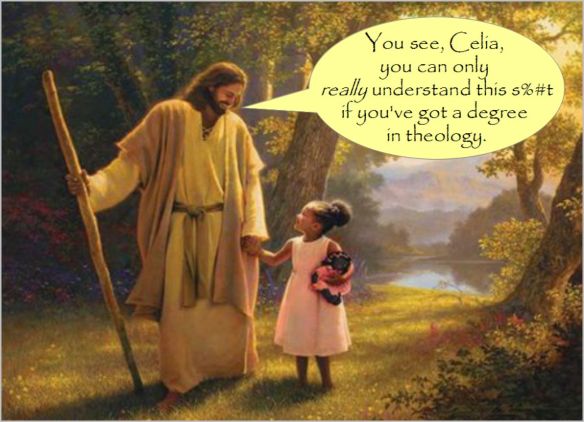
But at least fundamentalists regard the Bible as the Word of God (agreed they cherry-pick it and don’t behave according to it precepts) and claim it is ineffable and infallible. Perhaps, as you suggest, more enlightened Christians are free to interpret it in more liberal ways, dismissing that which is context-bound and so on. But then, where does that leave it? Is it authoritative or not? Does it speak directly to people or can it only ‘really’ be understood through the exegesis of scholars? If the latter, as you imply, then can it only be read and understood by those with above average intelligence? How does this square with Jesus’ insistence that his Kingdom was for those with child-like trust?

S%#t 3: Please stop referring to our belief system(s) as fairy tales.

Difficult this one. It depends whether myth and fairy tale are synonymous. Having taught English literature for many years at a university in the UK, I would argue they’re not. To the layman, however, they probably are in that both involve fantasy beings, implausible events, symbolic characters, sacrifice and enlightenment – just like religion really. So no, there is definitely a case here, Dr Corey, that if the cap fits… if your ‘belief-system’ walks, talks and smells like a myth (or fairy tale) then it probably is. You are stuck with atheists pointing this out to you, I’m afraid.

(By the way, your examples of Mickey Mouse and the Old Woman in the Shoe are not fairy tales. One is a commercial enterprise involving anthropomorphised animals and the other a nursery rhyme. I suggest you consult scholars who can explain to you what a fairy tale is, and the differences and similarities between it and myth.)

S%#t 4: Maybe lay off the whole, “religion hasn’t done any good for humanity” type of argument, because it’s obnoxiously untrue.

Reference for this quotation or did you just make it up? Sam Harris perhaps comes closest to saying this sort of thing – comes close but doesn’t actually say it. He says on balance that the good religion has done is outweighed by the evil perpetrated in its name. He doesn’t, though, say no good has come from religion. Sorry, Benjamin, but this is a straw man ‘argument’ you’re presenting here and is itself ‘obnoxiously untrue’.

Would we be better of without religion? Without the myth, the deadening of critical faculties and the adversarial nature of ideologies (even within Christianity)? Of course we would. Without precepts like ‘love your neighbor, love your enemies’? No, but then these are not exclusively religious. Far too many believers disregard them anyway.


The Virgin Birth: what really happened?

mary2

Menachem Av: Month 2

I’ve missed twice. No pains or discharge now for two months. I thought the first time I was just late. I’ve not been having the uncleanness for long so it could have just been things not working like they should. That happens right? But then a second time. Not so good. And then I started to show. How as I going to explain it – to the family, the village and most of all to Yossef who they’ve decided I’m marrying?

It wasn’t him. We haven’t, you know, done anything. I’ve only met him a couple of times. He’s older of course, nearly twice my age. He seems nice enough, though it wouldn’t make any difference if he wasn’t. He’s going to be my husband. I’m going to be his wife. Or I am if I survive this.

So what am I going to say? Can’t tell them who it really was. Thaddaios, Shim’on the builder’s boy. Same age as me. We just got to messing about. I didn’t want to, knew it was wrong. Knew it would land us, specially me, in trouble one way or another. But I did want to do it too. It was nice. Nice being touched under my clothes. He was gentle and kind.

But then there was blood and mess. The blood was mine, the mess was his. I wasn’t expecting that – the blood, I mean. I was shocked. I touched it and cried. Touched myself after I’d touched him. That’s when it must’ve happened. Some of his mess found its way inside me, off my fingers, and that’s how the seed of his baby began to grow in me.

Technically, though, I’m still a virgin. I can tell Yossef that: ‘technically I’m still a virgin’, ’cause technically that’s true. Thaddaios never put his thing in me. I wouldn’t let him even though he wanted to, ’cause I know how important it is I’m a virgin on my wedding night. Yossef’s family could do bad things to me if they found out I wasn’t. But I am. Technically anyway.

So that’s the story. I’m a virgin but, you know, with child. Yeah, doesn’t make sense. Yossef’s going to have trouble believing it. I know I would. Maybe I can tell him the Lord had a hand in it somewhere. The Lord’s hand instead of my fingers! Maybe. He might go for that. His family’s very orthodox.

Ellul: Month 3

‘Come off it, Miriam,’ Yoseff said when I told him. ‘Who was it?’ But I stuck to my story. So he prayed about it and said the Lord told him he’d to stand by me, so he has done. He says that when it comes everyone’ll thinks it’s his and he’ll just let them. He’s not such a bad sort. It could be a lot worse. But, he says, it’d be best if we took off somewhere, away from all the questions, to hide my shame, he said, when I really begin to show So we’re trekking off to some God-forsaken part of the country where he has relatives or something.

Nissan: Month 9

So that’s how we ended up here, in one room where the animals come in at night. It could’ve been worse, I suppose. His aunt or whoever she is delivered it. The baby that is. It went okay, if you think having your body just about ripped in two is okay. The baby was fine though and I’m recovering. After, his aunt held it up; a bloody mess, arms outstretched. ‘Well,’ she said, ‘it won’t change the world, but you have a fine healthy baby.’ I might’ve smiled then. She cleaned it up and wrapped it in the swaddling. I looked and thought, maybe it’s not too bad.

Yoseff came in and peered at it.

‘So,’ he said, as if he was interested, ‘what you going to call her?’


God’s Election

church4

As we saw in the previous post, the Bible tells us that God chose his ‘Elect’* before the creation of the world (Ephesians 1.4-6). Which begs the questions –

1: On what basis did God select the favoured few untold aeons before they were born? Did he decide by looking at their dress sense, as Jesus’ parable in Matthew 22.1-14 suggests? I guess it must be, given the Bible is the ‘literal’ word of God.

Or did God assess ahead of time just how righteous his Chosen would turn out to be? In Matthew 25.31-46 Jesus says righteousness is the yard stick (though naturally Christians don’t believe him because Paul says something different).

Or did God decide in advance – Paul says he ‘foreknew’ – who would repent and turn to Jesus, free-will be damned? Maybe, but then Jesus suggests that not everyone who does even this will make it into God’s Kingdom (Matthew 22.1-14).

What a bummer! Looks like God’s decision is/was purely arbitrary. You make it, or not, on the whim of a capricious monster.

2: What’s the point of evangelism? If God chose who was going to have eternal life/enter the Kingdom/live in Heaven before the creation of the world, then there can be absolutely no need for anyone to tell anyone else about Jesus, sin and salvation. Why? Because it makes no difference; God’s Chosen will remain his Chosen, as they were long before they were born, and he’ll be sure to rescue them once they die. Those who haven’t been pre-selected will stay lost and will go to Hell whether or not they’ve heard or responded to the gospel.

‘But how will the unsaved Chosen hear the message if we don’t tell them?’ ask our zealous evangelical friends, still not getting the point. Jesus, lads! The Chosen don’t need to hear the gospel: God – has – already – chosen – them. They will go to Heaven, live in the Kingdom or whatever, regardless of your efforts. You and your evangelism are superfluous.

3: How can you be sure, if you’re a Christian, that you’re of the ‘Elect’ and so destined for Eternal Life? Yes, you’ve chosen Jesus – but has he chosen you? How can you know? Your own sense of righteousness, your faith, self-sacrifice and adherence to sound doctrine (whatever that is) are no guide to whether or not you’ve made the grade. Only God knows that, and he’s not telling.

Not yet, anyway, so you’d best make sure you’re buried in your very best clothes, just in case.

* Jesus is made to call the chosen few ‘the Elect’ in Matt 24.22, 24 & 31; Mark 13.20, 22 & 27 and Luke 18.7.

Smash! Kill! Destroy!

handsofgod

So how has the great God of Reason done so far?

We’re still not out of Genesis and he’s –

Trashed his entire creation just because a couple who didn’t know how touchy he is managed to upset him;

Destroyed two towns and almost everyone in them because he found the locals offensive;

Drowned everyone in existence (except for an old piss-head and his family) because – you guessed it – they offended him;

Engineered a spot of child-abuse;

Decided the best way for people to show him they’re his bestest buddies is to have them disfigure their genitals.

Now, honestly, Christians, how can you say any of this is rational or logical, reasonable or considered? Your God’s response to everything is Smash! Kill! Mutilate! Destroy! – never as a last resort, always as his first reaction. He’s the Hulk, Godzilla and ISIS all rolled into one. Not once does he apply reason or logic. Smash! Kill! Mutilate! Destroy! And not only in Genesis but throughout the Old Testament:

His chums want the land occupied by other tribes? Smash! Kill! Destroy!

They don’t show him enough love? Smash! Kill! Destroy!

They break one or other of his mostly petty rules? Smash! Kill! Destroy!

They offend him in some remarkably trivial way (collecting sticks, teasing a bald bloke, doing sex wrong)? Smash! Kill! Destroy!

Over and over again.

Until, at last, he has another big idea! Another Master Plan! The Master Plan to end all Master Plans! (His fourth at least.) And guess what? It’s all Smash! Kill! Destroy! Especially Kill! This is a dude who really can’t think outside the box.

Here’s how it goes: the Lord gives up on his previous Master Plan, which he’d told some selected desert marauders was forever and ever, and decides its time to have another go at sorting out mankind that he helped screw-up in the first place. His idea this time is to come to Earth himself as a sort of clone, which he creates by raping a young woman, just like all the other gods of old. When he grows up this clone/avatar tells everyone how God wants them to behave so they don’t upset the version still in Heaven quite so much. The clone then gets himself murdered at the hands of the very people he’s come to visit – the same ones the Lord promised to take care of forever and ever in his previous Master Plan – which magically allows anyone who repeats a special incantation to join an exclusive club. Everyone else he plans to torture and murder for all eternity, because that’s what he likes doing best. Of course, the version of himself he sends to Earth won’t actually make any of this clear – that’ll be left to someone else to make up afterwards – but, in the best illusion yet, he’ll come back to life before beaming up to Heaven to cosy up to his other self, the one preoccupied with death, destruction and mutilation.

This time it’s foolproof: a well-thought through, logical, rational and reasonable plan.

Except… not really. It’s bullshit. There’s no reasoning here, just a lot of stuff made up as people went along. None of it makes sense. The copy seems to have no idea what’s going on and certainly no inkling that his death has cosmic significance. On top of that, no-one really knows how the magic works – everyone who mentions it has a different idea – and the record of it all is scrappily cobbled together donkeys’ years after it all was supposed to have happened. Still, the main thing is it all involves a lot of killing – the clone first; then the poor sap manipulated into ‘betraying’ him; a couple who don’t want to give away all their belongings; some of the dudes who believe the magic is for real then, after they’ve really pissed off the Romans, lots more of them and finally, once the nutjobs get the upper hand, loads and loads of other people – which must really have pleased the God of Death Reason.

If this is the best he can do, then we’re in trouble deep. If our ability to reason comes from him, as Christians claim, it’s no wonder we can be irrational, illogical, unreasonable and unreasoning. Which of course is why he is, because he’s a reflection of the beings  that created him – us. Human emotions and cognitive capabilities came first and were projected onto the gods we created, including, eventually, the monotheistic monster, Yahweh. It was he primitive tribesmen decided must be responsible for natural disasters and the brevity and brutality of life. Such things had to be punishments, hadn’t they? And if punishments, then there had to be One doing the punishing. One who must be appeased if he was ever to stop. Hence sacrifices, behaving in ways that might please him, killing those who don’t, worship. All futile, like pleading with one’s own reflection in a mirror.

The God created by this kind of thinking only reflected back at his makers the worst of themselves; jealousy, anger, intolerance, belligerence, petulance, vengefulness and violence. Hardly ever Reason. 

And so does he still.


The God of Reason

god4

The next three posts will look at the claim Christians make for their God being the God of Reason. The fact that he is, they say, demonstrates how inconsistent those who see no evidence for a deity are when we use his very attributes – reason, logic and rationality – to make a case against him. Here’s Dr Jason Lisle on Answers In Genesis:

…there is an absolute standard for reasoning; we are to pattern our thoughts after God’s. The laws of logic are a reflection of the way God thinks… Laws of logic are God’s standard for thinking. Since God is an unchanging, sovereign, immaterial Being, the laws of logic are abstract, universal, invariant entities. In other words, they are not made of matter—they apply everywhere and at all times. Laws of logic are contingent upon God’s unchanging nature. And they are necessary for logical reasoning. Thus, rational reasoning would be impossible without the biblical God.

The materialistic atheist can’t have laws of logic. He believes that everything that exists is material—part of the physical world. But laws of logic are not physical… The atheist’s view cannot be rational because he uses things (laws of logic) that cannot exist according to his (Godless viewpoint).

Similarly, Tim Keller in his book The Reason for God argues that the fact humans can reason is evidence both of God’s existence (because reason has to come from somewhere) and of our being made in his image.

According to Christians then, God is the only reason we can think rationally at all.

But then where did God’s rationality come from? Is he pure reason or is reason an attribute he acquired or evolved over time as we did? As Richard Dawkins has pointed out, the only reasoning intelligence we know of is our own, and it is the product of evolution. If God’s ability to reason also evolved – and we know of no other way it could have developed – then he must intially have been incomplete. He could not have been the supreme intelligence Christians claim he is now. If, on the other hand, God is and always has been pure reason, there should be plenty of evidence for it. Let’s take look:

We first encounter God in the opening chapters of Genesis, where he puts two naked humans in a garden and tells them not to eat the fruit of a tree labelled ‘The Tree of the Knowledge of Good and Evil’.* He sets this tree right where they can see it and then he leaves. The two people, who have no concept of right and wrong (that’s the point of the tree) each take a bite of its fruit. While taking his evening stroll in the garden, God discovers what they’ve done and is not best pleased. (I hope you’re getting just how logical all of this is.**)

This deity, who, according to Dr Lisle and Tim Keller is the epitome of logical reasoning, doesn’t then take the trouble to explain to his creations, ‘Look, I’m sorry I made you without a sense of right and wrong; I’ll put that right. But you’ve got to promise me you’ll do as I say from now on because you won’t like me when I’m angry.’ No, he doesn’t do this; instead he throws a hissy fit. He punishes the couple, who until they’d tried the fruit had no idea disobeying him was wrong, and, just for good measure, he trashes the rest of Creation too – forever. Because of a single act committed by two naive individuals who didn’t know any better, he ruins everything and then, irrationally, blames the humans for the mess he’s made. That’s his reasoned, reasonable and rational response to their upsetting him – which, if he was the omniscient being Christians tell us he is, he’d have known was going to happen anyway.

Of course the whole set up and God’s reactions are not rational, reasonable or logical at all. They’re not considered, proportionate or insightful either. The God of Reason, the God who is Reason according to Answers in Genesis and Tim Keller, scores on this, his first outing, zero points on the scale of reasoned, reasoning reasonableness.

Maybe though God was just having an off day and he improves later on, once his intelligence has evolved a bit more. We’ll find out next time.


* All my examples of God’s great thinking skills and ‘reasonableness’ are drawn from the Bible; there are, however, simply too many to reference throughout this series of posts. I would be happy to supply them to any who feel the need to see them.

** Yes, I’m aware it’s a myth but a) many Christians don’t and b) even as a myth the story seeks to address how humans became alienated from God, ironically by developing the capacity to think for themselves. 


Idiotic Stuff Jesus Said

JC&ManJust what did Jesus say? The Jesus Seminar and other scholars* conclude that only about 18% of the words attributed to him in the gospels are authentically his. They reach this conclusion because so much of what Jesus ‘said’ – 82% of his utterances – is demonstrably derived from elsewhere.

There were four major sources for his words, which I’ll discuss briefly here, providing an example of each. Bear in mind also that whatever the derivation of Jesus’ words, those we have today have been subject to, in their earliest days, an unreliable oral tradition, repeated copying and deliberate and accidental alteration. The earliest surviving ‘words of Jesus’ (a few fragments of the fourth gospel) date to a century after he lived.

1. The early church created a good deal of the Jesus narrative, making him say what was important to them. For example, ‘take, eat, this is my body,’ and ‘take, drink, this is my blood that is shed for you,’ is clearly a post-crucifixion perspective. While it appears in arguably the most Jewish of the gospels (Matthew’s) the idea of drinking blood, even symbolically, would have been, and remains, anathema to Jews, whose scriptures forbid it (Leviticus 17.10 -16). Jesus was an orthodox Jew; it was the Hellenised Paul who transplanted the pagan ritual into nascent Christianity. He relates in 1 Corinthians 11.23-26, written about 15 years before the first gospel, how his wholly imaginary ‘Christ’ told him of this bizarre activity. Once established in the early church, Jesus then had to be made to endorse it and it was written back into the gospels.

2. The gospel writers (or others) invented dialogue for him. His entire conversation with Pilate, for example, is invented not once but four times, the encounter being rendered differently in all four gospels. It is probable that the entire scenario is fiction, given the likelihood the excessively cruel Roman governor would even entertain the idea of questioning a seditious nobody himself. And then there’s the ‘I am’ statements of John’s Jesus that I considered here.

3. The gospel writers altered difficult sayings into something more palatable. For example, in Matthew 15.24 Jesus says he was ‘sent only to the lost sheep of Israel’ (my italics). By the end of the same gospel, as well as in Luke and John, this has become a commandment to ‘make disciples of all nations, baptising them in the name of the Father, the Son and the Holy Spirit’ (Matthew 28.19). So which was it? Was the message exclusively for Jews or was it for all? It suited early churches, filled with non-Jews, that the gospel was for everyone, just as Paul had argued. Jesus’ words to the contrary – even if they were sufficiently widely known to have had to be included in Matthew’s original account – needed to be amended. Who amended them and when we shall never know, but it was certainly after the idea of the Trinity had taken hold.

4. Statements Jesus actually made. The Jesus Seminar regards as authentic sayings such as:

If anyone strikes you on the right cheek, turn the other also (Matthew 5.39)

If anyone wants to sue you and take your coat, give your cloak as well (Matthew 5.40)

Love your enemies (Luke 6.27)

Blessed are you who are poor for yours is the Kingdom of God (Luke 6.20) [changed in Matthew’s gospel to the less radical ‘poor in spirit’!]

If anyone forces you to go one mile, go also the second mile (Matthew 5.41)

As inspiring as these might initially appear, they actually mean very little; they’re either prophecies that didn’t come to pass, impractical moral expectations or pseudo-spiritual homilies. And how much of this advice, these admonitions, do today’s Christians follow? You’d be hard pushed to find many that do. After all, following Jesus doesn’t entail doing what he says.

* I have used Robert W. Funk et al‘s The Five Gospels (HarperOne, 1997), Simon Loveday’s The Bible For Grown-Ups (Iconbooks, 2016) and Mark Allan Powell’s rather less impartial The Jesus Debate (Lion, 1998) for this post

Recent Encounters of the Religious Kind

1. The kindly street preacher

preacher4

A bad-tempered looking man is standing next to a sign that announces that ‘Evolution is a Lie’ and ‘Jesus is Lord’. He – the grumpy man, not Jesus – is giving out some sort of glossy card. I do my best to sidestep him but he approaches and gives me one. It is entitled God Commands: 4 Things That God Commands, at least half of which is redundant. I notice that a group of Jehovah’s Witnesses have set up stall next to him (or perhaps he set up next to them).

‘So,’ I ask, ‘who’s right? You or them?’

They,’ he growls, ‘are of the devil.’

What a problem Christianity has. Islam too: so many damn different versions, all of which lay claim to being the one and only Truth. The Center for the Study of Global Christianity reports that there are now 45,000 different churches, denominations, sects and cults within Christianity, every one of them insisting that they – and they alone – represent God’s Truth, only they have got it right. There are as many Christian web-sites out there slagging off other Christians – Apostate! Wolves in Sheep’s Clothing! Doing the devil’s work! False teachers! – as there are sites ‘reaching out’ to the ‘lost’.

What’s more, every one of them knows they alone have the Truth because the Bible itself says so. They quote from it to prove how right they are and how wrong everyone else is. Which just goes to show what a damnable, scurrilous load of tosh the Bible really is. If God is not, as it says in 1 Corinthians 14.33, the author of confusion then he can’t have had anything to do with it.

Of course we know he didn’t; it’s human through and through, every mean-spirited, self-righteous verse of it.

Who wrote the Bible?

According to Christians, Moses wrote the first five books of the Bible; Genesis to Deuteronomy are widely known as ‘the books of Moses’. There is little evidence Moses had anything to do with them and plenty that he didn’t. The narrative, for example, is never once in the first person; it’s all ‘Moses ordered this slaughter, Moses ordered that slaughter’, never ‘I was the bastard who ordered all the genocide.’ Maybe he was embarrassed about it or – much more likely – it was written by someone else..

In fact, the books were compiled from a range of sources, including stories from other cultures. They reached the form in which we know them around 600-400BC, a mere eight hundred to a thousand years after Moses was supposed to have lived. The events and folk-heroes they describe are demonstrably mythical.

Moses2

Christians like to say that King David wrote many of the Psalms. While David’s name is attached to 73 of the 150, there is no reason to conclude he wrote them. It is more likely ‘of David’ serves as a dedication to a revered (and long dead) figure and may, indeed, have been added much later. The Psalms were actually created over an extended period of time – as much as five hundred years – by a wide range of unknown composers.DavidBelievers attribute much of the book of Proverbs to King Solomon, the fruit of David’s loins. Again, this is highly unlikely. The sayings are largely traditional and the attribution ‘is likely more concerned with labeling the material than ascribing authorship.’

Palin

Christians believe four blokes called Matthew, Mark, Luke and John wrote the New Testament’s gospels. They didn’t. The gospels were written anonymously and did not have the traditional names attached until a century or so after their composition. None is by an eye-witness. There is no evidence that the writer of Mark was a disciple of Peter’s, nor that ‘Luke’ was a companion of Paul’s (and even if he was, this wouldn’t make him an expert on the historical Jesus), nor that ‘John’ was a bona fide disciple. The fourth gospel was written between 90 and 110CE when the disciple would have had to be between 80 and 100 years old, or, much more likely given life-expectancy in the first century, dead. There are several hands at work in ‘John’, as the gospel itself concedes (John 21.24).

 Beatles

Christians insist that all of the letters attributed to Paul in the New Testament were written by him. However, despite the fact they say they’re by Paul, Colossians, Ephesians, 2 Thessalonians, 1 & 2 Timothy and Titus are not; they are forgeries. They were composed long after Paul’s death, which occurred some time around 64CE. The earliest of the forgeries, Colossians, is thought to be circa 75CE, while the ‘pastoral’ letters to Timothy and Titus may be as late as 150CE. All of the forgeries contradict the ideas expressed in Paul’s genuine letters.

PaulPeter wrote the letters that carry his name, or so god-botherers claim, but according to the Bible itself, Peter was an illiterate Galilean fisherman (Acts 4.13). The Greek of the letters supposedly by him is accomplished and the theology well developed. Did Peter have time to learn Greek and polish its written form to perfection while busy preaching the gospel to all nations? Even if he did, how did he manage to write a letter (2 Peter) concerned with conditions in the church more than a century after his time with Jesus?

Anderson3

Jesus’ brothers James and Jude, we’re told, wrote the letters carrying their names. Again, they didn’t. The letter of James may have originated in the early Jerusalem church presided over by James the Just, but there’s no evidence this was Jesus’ brother. Jude is plagiarised from 2 Peter – word-for-word in places – which is itself a forgery. Would someone who knew Jesus as intimately as a brother need to steal what he had to say from an illegitimate source? Jude would have had to be well over a hundred years old to pull this one off.

Robertson2When all else fails – and it does – Christians fall back on that most implausible of last resorts, ‘the Holy Spirit’. The very breath of God, they insist, presided over the creation of the Bible from start to finish. If it did, it made a staggeringly bad job of it; misattribution, mistakes and forgeries are the hallmarks of ‘God’s precious Word’.doveAnd on this unstable foundation, this tissue of lies, rests the entire edifice that is Christianity.

(It is difficult to find online sources on the authorship of the Bible. Christians have taken over the Internet with innumerable sites insisting the Bible was written by whoever they say it was. I’ve had to fall back on Wikipedia here (the articles are pretty comprehensive) but if you don’t think it reliable enough, I recommend Bart D. Ehrman’s Forged: Writing in the Name of God – Why The Bible’s Authors Are Not Who We Think They Are.)


Did Jesus Exist? (part two)

WaterIf Matthew, Mark and Luke were creating a Messiah from scratch, or, more probably, recording the invention of believers who went before them, then it is unlikely they would have arrived at the loser preserved in their accounts. The Jesus we find there is nothing like the Messiah anticipated in Jewish scripture nor by Jews at the time.

He is a false prophet, his good news about the imminent arrival of the Son of Man and the Kingdom of God being patently unfulfilled. His ministry is a failure, ending as it does in ignoble execution. This is not the Messiah anyone would create if they were inventing one to satisfy the longings of a thwarted people. In particular, God’s emissary would not lose control of the situation in the way the Jesus of the synoptic gospels does. He would not allow himself to be executed by the occupying forces in the manner the gospels record. (All the surviving sources attest to his death by crucifixion; we can be fairly certain he died in this way.)

A created Messiah, on the other hand, would surely have announced the arrival of the Son of Man/Kingdom of God before leaving the stage of his own volition – ascending to heaven perhaps as some of the gospel writers eventually have him do – to await the unfolding of the events he had proclaimed. Of course, the death of a godman is a recurrent theme in the mythologies of the ancient world, so it is possible that an unpleasant death would be invented for an imaginary Jesus so that he complied with the trope. But, as I’ve already suggested, the central figure of the synoptic gospels is noticeably ungodmanlike. We only see him as such through the distorting prism of Paul’s theology; without this, we can see that the gospels of Mark, Matthew and Luke really don’t portray him like this at all.

It seems much more likely, therefore, that what the synoptic writers are conveying are distorted memories of an individual who actually lived. A man who promised much but whose mission went drastically wrong but which would, his earliest followers believed, be completed by God himself in the near future. This latter part is, as we now know, pure invention, the gospels conveying only an imaginative interpretation of this man. It would seem, nonetheless, to be an interpretation of someone – a charismatic Jewish preacher and failed heir-presumptive – who had actually lived some years before.

As I said at the beginning of this two-part post, I don’t really care whether Jesus existed or not. The end result is the same; millions of people seduced by a significance he did not have, either as a real person or as an imaginary construct. On balance, for the reasons I’ve touched on in these posts, it seems to me Jesus – Yeshua bar Yosef – did once exist. Like we all must, he died and others set about interpreting his life in their various, incompatible ways. These interpetations are all ultimately meaningless; we can be absolutely certain that, whatever the Bible and Christians today tell us, Jesus, whether he lived two thousand years ago or not, does not exist now in any shape or ethereal form.

Did Jesus Exist? (part one)

Cross3

I want to say at the outset that I don’t think it matters whether Jesus existed or not. Even if he lived, it is highly unlikely he said much that is attributed to him or that he performed the miracles ascribed to him. Neither would it be the case that he rose from the dead or became a supernatural godman afterwards. All of these supposed attributes would be, for an individual who actually existed, later accretions. The man underneath them, the so-called historical Jesus, is difficult to detect. It hardly matters to Christians; they’re really only interested in the accretions, the later add-ons, the myth the man became.

Those who think Jesus never existed raise a number of interesting points, chief of which is that what I’ve referred to as accretions, being central to subsequent Christian belief, actually came first. The accounts of Jesus’ life – the gospels – they see as later attempts to provide the myth with a ‘realistic’ back story based in history. Certainly the gospels came after Paul had had his vision and had set about interpreting it to arrive at his convoluted theology about ‘the Christ’. Jesus-belief certainly existed decades before the first gospel account, Mark’s, and was as a result entirely independent from it. In this scenario, therefore, the myth came first and the stories of Jesus were crafted afterwards as supplementary fiction.

For me, however, as problematic as the gospels are, the synoptic accounts – Matthew, Mark and Luke – are largely at odds with Paul’s theology. If they were written to bolster the myth of a supernatural godman, they don’t do it very well. John’s gospel, on the other hand, is much more successful in portraying a mythical being, which is why its implausible ‘Word became flesh’ is not very much like the Jesus of the synoptic gospels.

The synoptics of course have their own agendas and do not represent accurate biographies of Jesus either – there are too many contradictions and anomalies to claim they do – but, to varying degrees, they do not present a Jesus who is the embodiment of Pauline theology. The synoptic Jesus doesn’t, for example, promote a salvation plan involving his own death or say that faith is the means by which one enters the Kingdom of God. These are ideas of Paul’s, as are notions of grace, election, sanctification, redemption, substitutionary atonement, imputation, gifts and fruits of the Spirit and even more mumbo-jumbo besides.

The good news of the synoptics’ Jesus, however, is that God’s Kingdom is coming to Earth soon and to be part of it one must become ‘righteous’ both by serving others and relating to them in a ‘measure for measure’ way: forgiving in order to be forgiven, being compassionate to be shown compassion, giving in order to receive, not judging so as to avoid being judged. This Jesus and his gospel are, moreover, predominantly Jewish; Matthew’s version in particular is virulently anti-Gentile. All of this is totally at odds with the magic formula of salvation-available-to-all of Paul’s make-believe. If this came first, it is difficult to see why the synoptic gospels would not present, as John does, a Jesus who is more compatible with it.

Either the synoptic gospel writers got much wrong in providing the Christ’s supposed back story or they were representing other traditions, ones that were different from and possibly even older than Paul’s interpretation. Belief in Jesus as teacher, prophet and, possibly, Messiah predates Paul (he refers to it himself while Matthew and Luke make use of an earlier sayings gospel known as ‘Q’) and it seems likely that Mark and Matthew in particular reflect these traditions, untainted by Paul’s fantasies. Of course these traditions too could have been invented, just as Paul’s theology is, but if that is the case, then, once again, the gospel writers – Mark and Matthew especially – make a decidedly bad job of it.

Next: what this ‘bad job’ tells us about the existence of Jesus.