What Is Truth?

I’m sceptical (or skeptical if you’re in the US). It’s a legacy of my years of believing the promises of Christianity. Preachers, pastors, Bible study leaders told me for 25 years that the promises of the bible, of Jesus himself, were all true. And like a fool I believed them. Jesus had made a new creature out of me; he loved me; he was guiding my life; he was returning soon; I’d be resurrected; I’d live in heaven forever… and on and on.

What a preposterous set of propositions! It took my Great Realisation, my own personal revelation that there was no God, to make me see how ridiculous they were.

It is this that left me with a legacy of scepticism. If I’d been misled all this time by people I respected and admired, what else was I accepting as true that very well might not be? I wasn’t going to be fooled again and so began to question practically everything I was told by authorities, experts and the media. If it seemed ‘off’, as we say these days, not quite right or too good (or bad) to be true I asked, ‘Who says so?’, ‘How do they know this?’, ‘What is the evidence?’, ‘Do they jump to conclusions or is their reasoning sound?’, ‘Why should I believe what they say?’ It’s exhausting, I assure you, having to search out the evidence – the primary sources of information – and to sift through it, recognising any bias that has been imposed on it. It’s either this or I must accept without question that everything I’m told is true. I can’t do that any more.

Here are a few examples of claims that I’ve been sceptical of on the recent past:

We are being guided by the science, said politicians during Covid to ensure compliance with whatever lockdown measures were being imposed. Did this really just mean was ‘we are being guided by our interpretation of some rather suspect data’? It became clear after we emerged from the hysteria surrounding the pandemic that this was the case.

Tens of thousands will die of Covid unless you comply: this based on computer predictions which turned out to be very far from accurate: the suspect data that ‘guided’ politicians.

A woman can have a penis. A man can have cervix. Yes, our politicians told us this during our recent fixation with transgenderism. Whatever you think of people changing sex, these two statements, designed to change hearts and minds, if not penises and cervixes, are patently false. Whatever was guiding those who said such things, it certainly wasn’t ‘the science’.

No more irresponsible, undeliverable promises. So said the Prime Minister exactly a year ago. I’m not going to be sceptical or cynical about this. I feel sure it’ll turn out to be true. Is he implying though that promises made earlier than this were indeed ‘irresponsible and undeliverable’. Surely not.

We will not raise taxes on working people (and energy prices will fall by £300 in the long term), Labour politicians, now the government, said only last year in an attempt to gain our votes. I was sceptical about this, as with much they said, and for the first time in many years Labour did not get my vote. Taxes have increased considerably for working people and everyone else in the last year and are set to rise again this week. The price of energy has risen too, by 18%, and will do so again in January. A £300 reduction by 2030, if it happens at all, is not really going to offset this by much. This was all very predictable; since when do politicians tell us the truth in order to get us to vote for them?

Anything Donald Trump says. Insert your selection here.

The NHS is the envy of the world. Pundits and politicians are very fond of this one. They like to add too that the NHS is underfunded. But the NHS is expensive, management heavy and wasteful. Is it really the envy of the world, and if it is, so what, when it’s constantly in crisis at home?

The BBC is the envy of the world. It is impartial and balanced. Is it? A number of independent reviews have determined that it has its own agendas and biases. During lockdowns it fuelled hysteria and now contributes to climate change panic. Rather than reporting facts, it tells us too often what we’re meant to think about issues. It has also been rocked over the past dozen years by sleaze and scandals.

Islam is a religion of peace. So many questions about this one. Many Western politicians have claimed something like it. President George W. Bush did, shortly after 9/11. Perhaps ordinary Muslims are committed to peace but there are many Islamists (the term now used for Muslim extremists) are evidently not: as well as 9/11 there have been acts of Islamist terrorism in London (7th July 2005), at Charlie Hebdo in Paris, in Manchester, the slaughter in the street of an off duty soldier, the massacre of Israeli young people in October 2023, the killing of Christians and others in Nigeria.. Is ‘Allahu Akbar’ really a cry of peace?

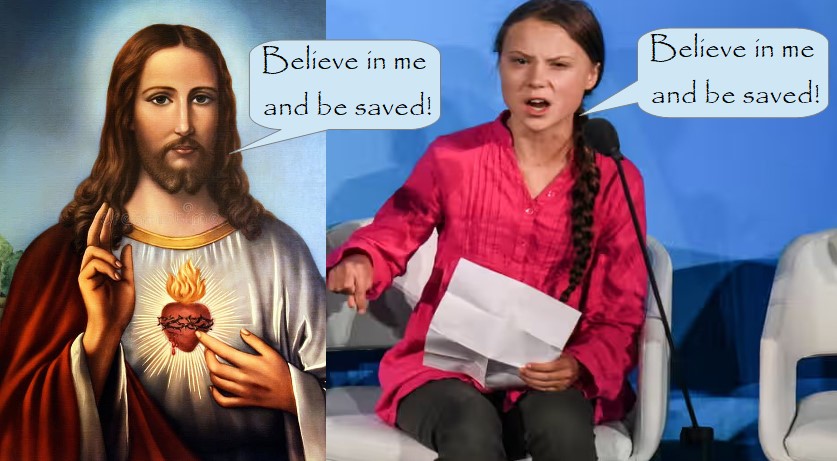
We can halt or reverse the climate changes we ourselves have caused. Can we? Who says? (Greta Thunberg, yes, but no actual scientists that I can find.) We can perhaps mitigate and slow down the change, and we should. But the climate will continue to change. Are these changes solely the fault of us humans – we’re contributing to the pace of change, certainly – when the climate has been in constant change from time immemorial?

I was accused of trying to be a maverick in a recent comment on an old post. Honestly, I’m not. It’s more a case of ‘once bitten, twice shy’; I’m not going to be told ever again what to think, especially not by those who don’t present good reasons why I should (I’ve Jesus to thank for this). Everything needs to be questioned, otherwise our minds are not our own. Be sceptical.

Not The Answer

Unlike most Brits, I knew of Charlie Kirk before his assassination last Wednesday. He cropped up on American blogs I read, most frequently on Joe.My.God. I profoundly disagreed with practically everything Charlie Kirk had to say, though a little of it made me re-examine my position on some issues. His views on gun control seemed to me to be extremely foolish and I objected to what he had to say about gay people, our relationships and status in society. I reacted against his Christian views, entangled as they were with his extreme political views. I objected too to his promotion of his faith; it seemed trite and smug (but then I think this of anyone who preaches Jesus.)

Following Kirk’s death, it’s been reported that he was prepared to debate with those who disagreed with him. He said, ‘When people stop talking, that’s when you get violence… When people stop talking, that’s when civil war happens, because you start to think the other side is so evil, they lose their humanity.’ Seemingly then he valued free speech and recognised the importance of dialogue and discussion, though perhaps his intent was to influence the views of others rather than reconsider his own.

He was opposed to transgenderism and this, at the time of writing, looks to have prompted his murder. Many on the Utah University campus last Wednesday would have been incensed by Kirk’s position that trans people were an ‘abomination’, showing a ‘throbbing middle finger to God.’ Some engaged him civilly on the issue, asking pertinent questions. Tyler Robinson, however, decided he would oppose Kirk’s more extreme views and advance the Trans cause by shooting him dead.

There is no justification for what Robinson did. Executing people one disagrees with is a feature of Putin’s Russia or Kim Jong Un in North Korea. It ought not to happen in the democratic west where we debate our opponents or, if they happen to be politicians, vote them out of office. Murder is never the solution, and in this case did not advance the cause the shooter felt so strongly about. Quite the opposite.

Those who argue that his shooting was justifiable – and yes, they’re out there – on the basis that Kirk’s views were extreme and reactionary must also accept that the assassination of any public figure is justifiable on the basis that some people find their views objectionable. Do we really want to go down this road, of rationalising assassinations on the basis the target espouses an ideology we find objectionable?

Those who rejoice at Charlie Kirk’s demise demonstrate a lack of humanity and support the desecration of Western values, free speech in particular.


Hysteria/Mission Creep/Overreach

When I was head (principal) of a primary (elementary) school in the 1990s, I had a staff member who regarded every small problem as ‘a Major Disaster’ (her words). Everything from a mislaid document to wet weather on sports day was an earth-shattering calamity. She was not the only one to overstate manageable events. Those who wield authority over us, their media lackeys and those with a cause of their own to promote are expert in whipping the populace up into a frenzy disproportionate to the given situation. After a short period in the spotlight, the hysteria and the movements that cause it usually fade, as the media finds something newer and shinier about which to induce panic. Occasionally, the newly out-of-favour movements fight back with renewed vigour, a mission creep extending their influence into new areas.

Looking back over the last 25 years, I and my fellow citizens here in the UK have been expected to be alarmed to an alarming degree about:

The Millennium Bug, when every computer in the world, so the experts said, would crash the instant the year 2000 started. This would, in turn, crash every automated system everywhere, causing chaos and mass fatalities. You all know what actually happened.

Foot & Mouth Disease, when millions of cattle and sheep were slaughtered and burnt. Millions of healthy animals were destroyed in case they contracted the disease.

Weapons of Mass Destruction supposedly amassed by Iraq who, we were told, could unleash them on the West within 45 minutes. That there was no evidence of any WMDs and the fact Iraq did not deploy them (because you can’t deploy something that doesn’t exist) did not deter George W. Bush and Tony Blair from launching their oxymoronic (with the emphasis on the moronic) ‘war on terror’. In so doing, they destabilised the world, creating many of the problems we face today.

Child Abuse Scandals: After either missing or covering up the serial abuse of children and vulnerable people by a BBC celebrity, British authorities went to town on ‘suspected paedophiles’, many of whom were nothing of the sort. (A friend of mine was caught up in this hysteria and spent time in prison for a youthful indiscretion many years earlier.) Unfortunately, this national crisis and the perceived need not to offend Muslims came into conflict when, over 20 years, rape gangs comprised mainly of Pakistani men were able operate in up to 50 UK cities with impunity. Hundreds of thousands of vulnerable, white working-class girls were systematically groomed and raped while the police and authorities turned a blind eye, the consequence of a woke priority taking precedence over the rights and safety of others.     

The Covid Pandemic and Lockdown, when governments the world over (apart from Sweden) panicked about a flu-like virus, closed down entire countries, failed to protect the vulnerable and crashed the very economies needed to fund healthcare and treatment for the infected. Britain was closed down for almost 2 years and still hasn’t recovered from the consequences. Citizens are now paying heavily for actions taken by a government that extended its powers to achieve very little.

        Cartoon by Mark Woods, Spectator magazine, 7th June '25

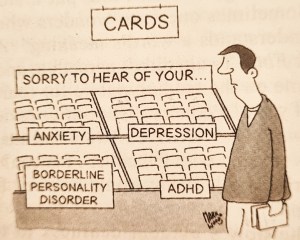
Mental Health issues and the medicalised labelling of ordinary human behaviours. We all have mental health issues; this is what it is to be human. Some, it is true, have more than others. Determining an individual has ‘mental health issues’ forces him or her to become his or her issues. Instead of being prone to depression (as I was) or anxiety, the individual who experiences these is now ‘neuro-diverse’. Instead of suffering from a condition the individual could do something about they become that condition. Some people, usually males, used to be diagnosed as autistic. Now that autism is seen as a spectrum, everyone is deemed to be on it somewhere; everyone as a result is autistic. People become trapped in their condition with no way out, lifelong treatment the only recourse.

Black Lives Matter. As Lionel Shriver asks here, do black lives matter any more now than they did before all that righteous indignation and virtual signalling from white people?

Identity Politics in which individuals were told as a matter of urgency to self-identify solely on the basis of their ethnicity, religion, gender or sexuality. Gender dysphoria became a thing from which the trans-movement emerged. While I’ve every sympathy for those who feel they were born in the wrong body, society was unprepared for and incapable of dealing with the consequences. Women became ‘cis-women’, sex became ‘gender’ (a grammatical term), ‘non-binary’ became an option and the abuse of pronouns was politicised. An individual could identify as a plural ‘they’, while others lost their jobs if they declined to play along. Worst of all, children, who were too young to be allowed a tattoo, were given puberty blocking drugs, and in some cases surgery, because they felt they were the wrong sex. Children.

The High Court in the UK recently ruled that a man cannot become a woman, entrenching the views of campaigners and prompting other supporters to claim they knew this all along.

Wokeism; while it’s right and proper to treat each other with kindness, courtesy and consideration, politicising something we were, by and large, already doing was not. Wokeism pushed the boundaries over what could be done or said, or rather could not. Anything that might cause someone else offence was forbidden; commenting or criticising others’ religious beliefs or defending women’s rights became ‘hateful’; having a view on unsustainable immigration numbers made you a fascist. This was the era of cancelling those who did not conform to woke ideals. Toppling statues was popular too on the basis that a long-forgotten figure from 250 years ago may have had a slight connection with the slave trade. Western guilt for actions over which people living today had no part in and demands for reparations to those equally uninvolved ensued.

The ‘necessary’ control of free speech, a panic we’re still mired in. Stupid and inflammatory comments on social media can now earn you a prison sentence longer than that of a paedophile offender, often preceded by a visit from half a dozen policemen who will root through your house looking for evidence that you might have once had a ‘Brexity’ thought. Subjects off limits are; arguing that Covid19 began in a Wuhan laboratory (it might upset the Chinese); Islam, Islamic extremism and the Pro-Palestinian movement (however it’s still okay to criticise and condemn Jewish people for the actions of their government); expressing views different from the UK government’s and whatever the prevailing narrative happens to be. A government agency, ‘Prevent‘, last year redefined terrorism (see below) as ‘vocal support of ideologies that advocate discrimination’ and any expression of what it calls ‘cultural nationalism’. What this means is that those who call out religiously-motivated discrimination, lawlessness and terrorism are to be considered terrorists themselves. Actual terrorism and violence is therefore protected against those who would speak out about it, those who do so being the real terrorists. To put it another way, which I read recently (though can’t remember where): those who say hurty things are far more culpable than those who commit actual hurty things. This Orwellian doublespeak must now be taught in universities and other higher education institutions.  

The Climate Crisis and Net-Zero. You must be alarmed by the climate crisis (see here for how much of it Al Gore got wrong). You must too pay heavily for net-zero, thanks to additional taxes; energy prices in the UK are the highest in the world. You must buy into the government’s attempts to enforce a net-zero energy policy by 2050, despite net-zero being unachievable.

What if, might, could, maybe: the media’s favourite phrases to ramp up hysteria. ‘There might be terrible consequences’; ‘we could be headed for another Major Disaster’; ‘if X happens (though it hasn’t) then Y could possibly follow.’ When did the media stop reporting what has actually happened and take up fortune telling instead?  

* * * * * *

There is some comfort in the fact that the so-called crises and hysteria of the past eventually receded and faded away. So too will many of these current causes. All things, as George Harrison once wisely reminded us, must pass. They will, however, be replaced by others equally irrational and preposterous. Those who create them, be they governments, special interest groups or overwrought Swedish teenagers will expect us to conform to their Chicken-Little levels of hysteria. When they do, don’t be alarmed and be sure to seek out the evidence for yourself.

Provoking the Lion: a Fable

The others didn’t need much persuading when Sinwar told them they really had to do something about the lion. It was, he said, too near the camp and represented a threat. The gods demanded they gather their guns and other weapons to launch an attack not only on the alpha-male itself but the entire pride. That way, any future threats would also be eliminated. The problem of the lion and its proximity to the camp would be resolved once and for all.

They planned a dawn expedition when the lion and the pride could be caught unawares. As hunters they knew how to take their prey by surprise. They crept into the undergrowth and caught different members of the pride in their sights. Then, the onslaught began.

The cubs and unwary females were butchered first, with unrelenting savagery. Lionesses that sought to protect their offspring were mercilessly gunned down. Finally, the males appeared from the undergrowth and were met with a hail of bullets that tore into their powerful bodies, ripping them apart. They were no match for the hunters’ arsenal.

Caught unaware as it was, the pride stood no chance. The hunters looked on the carnage and knew it was good. They returned to camp, taking with them the only cubs to have survived the onslaught, mortally wounded and unable to resist. Once safely returned they praised the gods who had surely blessed their mission and ensured its success.

News of their heroic efforts soon spread until all around marvelled at their accomplishments. No-one gave much thought to the lions who had been slaughtered. It was taken as read that the pride had been in need of a merciless cull. Right had prevailed.

Unknown to Sinwar and the hunters, however, the alpha lion had survived. Hidden in the shadows, he licked his many wounds and knew instinctively he would exact revenge. He had been severely provoked and he vowed to himself that such provocation would not go unpunished. Others joined him; males who had recently left the pride to establish their own, heeded the deep instinct that they must band together to ensure their survival.

They attacked when their hunters were least expecting it and returned the savagery that had been meted out to them. The nearby townsfolk were shocked at the bloody retaliation; the hunters had been within their rights to attack the pride, after all. The lions had no right to exact a deadly revenge. Everyone in the region and even further afield seemed to think so. Nonetheless, a great deal more senseless death followed.

Having decimated the hunters and rescued some of the cubs, the lions took many townsfolk in their savage maws. They then moved on to new territories, sensing the allegiance of others to the hunters. They attacked those who had lent their support and had hunters of their own, losing some of their own number while destroying any who stood in their way. A rogue elephant from far away blundered into the fray, trampling many more while demanding the hunters and lions make up and be friends. (Meanwhile, a pygmy shrew from another land wondered if it too should join in but found itself incapable of deciding even whose side it should be on.)

Having stood its ground, the alpha lion returned to its den. He had taught the hunters and those who supported them that they provoked him at their peril. It would, he vowed, never happen again.

Live Backwards

I wanted in this post to think about the source(s) of evil, given it cannot be supernatural. However, defining evil isn’t as straightforward as I anticipated. The Oxford English Dictionary offers ‘Profoundly immoral and wicked’ while Merriam Webster goes for ‘morally reprehensible: sinful, wicked.’ Other dictionaries also mention both immorality and wickedness, replacing one concept in need of explanation with two. ‘Wicked’, it seems to me, is synonymous with evil, which doesn’t get us any closer to defining it. There are problems with ‘immorality’ too, as what constitutes immorality is frequently culturally determined.

Evangelicals, for example, regard same-sex relationships as immoral (so that’s me told) as is sex outside marriage. When I was involved in the church, dancing, drinking and listening to rock music (with all its backward messages!) were anathema. In some countries today many of these behaviours attract the attention of so-called morality police and are punishable by death (how moral is that!) Then there are those who fail to keep their word. Within months of being elected, the UK government under Keir Starmer has reneged on almost every promise they made prior to the election. Everyone expects politicians to lie so perhaps allowing ourselves to be duped by them means they’re not entirely responsible. Let’s not forget too that for some, eating meat is immoral, as is using fossil fuels. Our eating meat and our burning fossil fuels, that is.

So, are the practitioners of such relatively low-level, and disputed immoral acts – being gay, having non-marital sex, drinking and dancing, lying, using oil, eating meat – actually evil? Are women who have abortions, and the people who carry them out, evil? Of course not. It’s debatable whether some of these behaviours are immoral to begin with, but even if they are, immorality does not always equate with evil. I would argue that while all truly evil acts must, by definition, be immoral, not all (supposed) immorality is evil. Somehow personal immorality lacks the scale and awful consequences of true evil.

The Sanford Encyclopaedia of Philosophy is much nearer the mark when it comes to defining evil:

Evil must involve harm, and it must be serious enough to damage its victims’ capacity to function normally… Furthermore, the harm must be unjustified…

I’ll adapt and paraphrase this as ‘the malicious and unnecessary inflicting of harm on others’ to give us a working definition of evil.

So, who qualifies? Hitler obviously. Putin certainly. Other oppressive regimes. Murderers. Hamas. Child abusers. The gangs who have raped very young girls in numerous UK cities. How about the God of the Old Testament? He orders the cruel deaths of Israel’s enemies (Deuteronomy 7), promotes the smashing of babies’ heads against rocks (Psalm 137:9) and orders the taking of prison-of-war virgins as sex slaves (Numbers 31: 17-18). Later, Jesus – like father, like son – relishes the opportunity to put his enemies to the sword (Luke 19:27) and orders those who don’t believe in him be consigned to hell where they’ll be tortured forever (Matthew 25: 41-46). This is evil by any definition.

So, given there isn’t a God nor a heavenly Jesus, from where does evil originate? I’ll get to that, at last, in the next post.

The End of Days

A friend of mine was recently given the book The Dragon’s Prophecy: Israel, the Dark Resurrection and the End of Days by Jonathan Cahn. My friend, already concerned about the state of the world, said how much the book had disturbed her. She had become convinced that the time we live in had been predicted in the Bible, in Revelation in particular. ‘It’s all there in the Bible,’ she said to me. ‘It’s all happening just as it says.’

I tried to reassure her that Revelation was written by someone who, 2000 years ago, believed that the situation then couldn’t get any worse, what with the Roman occupation, the destruction of Jerusalem and the persecution of Christians (as the writer saw it.) This, together with his belief that the Lord would soon be coming on the clouds (Revelation 1:7), convinced him he was living in the world’s last days. I told my friend that because of the mess the world is in today (and when is it not a mess?) the book of Revelation resonates with some people; a voice from the past echoing down the ages. In no way, however, was it written about today.

My friend was unconvinced so I took it upon myself to read The Dragon’s Prophecy. Coincidentally, I had just begun to read Bart D. Ehrman’s Armageddon: What the Bible Really Says About the End, dealing with the same concerns. The comparison between the two books couldn’t be more striking.

Ehrman’s is a measured analysis of Revelation and other ‘prophetic’ books of the Bible. He demonstrates from the outset that Revelation was written for believers of the late first/early second century and that its symbolism represents individuals and events of that time. John of Patmos, whoever he may have been (a cult leader, Ehrman suggests) expected, like most early Christians, that the End was going to materialise soon, in the first or early second century, emphatically not in the 21st.

Ehrman warns that ‘professional prophecy writers’ (he doesn’t name Cahn) think ‘the way to use the Bible is to assemble the pieces to reveal the big picture, which until now no one has seen before’ (p17). He’s right. This is precisely what they do. In his book, Cahn promises ‘to put together the pieces of the mystery’ (p11) and claims ‘We (sic) will now begin assembling the pieces of the puzzle’ (p36). He then proceeds to jump around the Bible like a grasshopper on steroids. He’s one of the ‘prophets’ who, as Ehrman puts it, sees the Bible as ‘a great jigsaw puzzle with one piece hidden in this place, one in another and yet a third somewhere else’ (p17).

Cahn opens his argument with a series of bald, unsupported assertions: ‘Behind the perceivable realm lies another, beyond our ability to measure or quantify’ and ‘Behind the history of this world lies another, unrecorded, unrecited (sic), unknown,’ his readers evidently not expected to ask how he knows any of this codswallop. He goes from there to build his argument, such as it is, with a bombardment of ridiculous questions and pseudo-profundities:

What is evil? And how did it come into existence? It is both a mystery and a problem. The mystery is the problem (p9).

Then there are the propositional statements of the ‘If… then we’d expect’ variety. There’s rarely any evidence for the ‘if’ and none at all for the proposed expectation. Here’s the two – rhetorical question and propositional statement – rolled into one: ‘If evil is uncreated, how did it come to exist?’ (p32). Naturally, Cahn is going to answer this question and all the others like it, with a series of unfounded assertions, non-sequiturs and a smattering of unrelated Bible verses.

A central premise of The Dragon’s Prophecy, the dragon being that of Revelation 12:9 and therefore the devil, is ‘the dark resurrection’ of its subtitle. This Cahn explains, pretending the idea comes from the Bible when it doesn’t, is the re-emergence of the Israelites’ old, (extinct) enemies, the Philistines. Like the Israeli nation they too have now been resurrected: as the Palestinians. Under the control of the dragon/devil, they re-enacted on October 7th last year one of the many ancient Philistine attacks recorded in the Bible, only this time with ‘guns and explosives’:

On that October morning, the ancient drama replayed. The resurrected Philistines had again invaded the land, and the resurrected Israelites had again gone into hiding, keeping silent and still in fear of their pursuers (pp99-100).

How do we know this is a replay of an ancient invasion? Because some of those under attack on 7th October went into hiding, just as the Israelites did in 1 Samuel 13:6. As if no other group of besieged civilians hasn’t tried to hide at any other point in history. That and the ‘fact’ there were, according to Cahn, exactly 3,000 invaders on each occasion. Yes, the book really is this bad.

And so, Cahn says, the stage is set for the final battle and the return of Christ who will knock a few heads together, torture and slaughter everyone who isn’t a Christian and set up his faithful followers in a new Jerusalem made of gold and fancy stuff. As Ehrman says, this is indeed what Revelation promises – for the world 2,000 years ago. Ehrman argues that the author of this revenge porn, (he doesn’t use the term: that’s my contribution – you’re welcome) creates a Christ so unlike those of the gospels that he can only be a fiction (aren’t they all?)

Revelation barely made it into the canon and we would all be better off if it hadn’t; certainly my friend would be, and as Ehrman shows, human society and the planet in general would be too. He warns us to read what the Bible actually says, instead of, as Cahn does, forcing it to say what we want it to (to sell books). Irritatingly, Ehrman consistently refers to the Christ’s prophesied appearance on the clouds as his ‘Second Coming’ when the Bible never uses the phrase. Read what it says Bart!

I don’t know whether I’ll finish Dragon’s Prophecy. Its cover blurb boasts that Cahn is a New York Times best seller so clearly there’s an audience for such poorly argued, alarmist nonsense – which is itself alarming. While Bart D. Ehrman has also made the NYT list in the past, Cahn easily outsells him. Nevertheless, I’ve bought my friend a copy of his Armageddon in the hopes it might serve as an antidote to the dire The Dragon’s Prophecy.

Evidence of God

As for evidence, you might be aware of Israel. That nation has been in the news much of late. So, without being flippant at all, I present Israel as evidence. Think about it. They are living the script written thousands of years ago. Not by chance.

Israel as evidence for the existence of God. I’m thinking about it as Don suggests.

Where did it all begin, this bizarre notion that one tribe in the Middle East was chosen by God to be his special people? According to the Genesis myth, it was when YHWH promised Abraham he’d be his best buddy forever and ever, so long as he mutilated his body and those of his sons in perpetuity. They would also have to keep every one of this bullying god’s 365 rules and regulations, including the petty and piffling ones. So far so good, apart from the fact it was all very one-sided, and the mutilation of course. You’d think this would’ve been a sign that things weren’t quite kosher, but no; Abraham and his descendants buy into it and almost straight away, YHWH begins to let them down.

God’s Chosen Ones soon find themselves slaves in Egypt. A second mythical character is needed – up pops Moses – to get them out of this scrape. Unfortunately, after Moses has finished chatting with YHWH, who identifies as a burning bush on the top of a mountain, the sulky deity feels slighted by something the Israelites are doing. As is his way, he has many of them slaughtered and the rest he forces to troop around the same small plot of land for 40 years. This is how best buddies treat each other!

Later, the Jews find themselves defeated by the Babylonians and are carted off into exile. This exile, which YHWH does nothing to prevent, lasts 70 years. Still, it leads to a pleasant song made famous by Boney M in 1978 so I suppose it was worth it.

For the next few hundred years, Israel falls under the rule of other nations more powerful than itself. Not to worry though, YHWH is still ‘looking after them’, particularly those who are slaughtered in the rebellions that ensue. As Robert Conner says in a recent comment on Debunking Christianity, ‘If Yahweh ever threatens to bless you and your children, just kill yourself and get it over with.’

Fast forward to the Roman occupation of Israel. YHWH, having undergone a makeover, reneges on his promise to take care of his Chosen Nation forever and ever and comes up with a different plan to save people from his own cussedness. Now, if they want to continue as his friend, they have to believe a supernatural being has returned from the dead.

Abandoned by God, as he now wants to be called, Jews who haven’t defected to the new faith see their sacred, eternal temple destroyed by the Romans in AD70. Thousands of them are massacred and the Jewish nation ceases to exist.

This sets the pattern for the next two millennia in which God’s new friends organise pogroms, massacres and vicious persecution of Jews. This culminates in the Final Solution of the Third Reich which seeks to eliminate the Jewish people entirely. While awaiting extermination in a concentration camp, Andrew Eames scrawls on the wall of his prison: ‘If there is a God, He will have to beg for my forgiveness.’ God allows six million of his Chosen People die at the hands at the Nazis.

Following the second world war, Israel takes possession of the area surrounding Jerusalem, then occupied by Palestinian Muslims who are themselves descended from earlier immigrants. Thousands on both sides are slaughtered in the conflict that follows. In 1948, after almost 2,000 years, Israel becomes a nation once again; not through any miracle of God but as a result of human endeavour and bloodshed.

Tension and further skirmishes followed, leading to the present day when Israel finds itself under attack by Hamas terrorists. Thousands of innocents – women, children and babies – have been slaughtered without mercy. Israel is, as I write, retaliating and intends to enact further vengeance. And where is God in all this? You guessed it: nowhere to be seen.

All of this, according to some – including the naive writer at the top of this post – serves as evidence of God’s existence. That Israel has persevered for so long, despite opposition, persecution and the holocaust is not, however, evidence of God, any more than the great cathedrals of the world are. It is instead testimony to the resilience, resolve and sheer bloody mindedness of the people themselves. Perhaps their belief in YHWH (they don’t of course recognise his Christian counterpart) has fuelled their persistence, as it has their territorial claims.

Jewish beliefs and history are not evidence that YHWH exists. If anything, his apparent abandonment* during their many trials and tribulations is evidence to the contrary.

*Of course a non-existent entity can’t actually abandon anything, any more than it can lend its support or favour one group of people over another.

The Power of Figments

Since his death, no-one has seen the itinerant preacher now known as Jesus. Some dispute he existed in the first place and certainly the character depicted in the gospels is a fictional creation. Assuming, however, that there was a real individual on whom this character was based, no-one has seen him in the flesh for 2000 years.

This includes all or most of those who wrote about him in the early years of the cult and whose writing now forms the New Testament. They either learnt about Jesus by word of mouth, as most converts throughout history have done, or they had a vision within their own heads of – what exactly? Those who write of such visions are either vague about what they claim they saw (Paul in Galatians 1: 15-16), are evidently making it up (John of Patmos in Revelation) or their visions are related by third parties many years down the line (Peter and Mary in the gospels, Stephen in Acts.)

Either way, the character believers claim to have seen or have heard about is a fantasy figure, not the rabbi who may or may not have existed. It’s this fantasy who lives in heaven snuggled up to his equally fictitious father, monitoring people’s behaviour, listening into their thoughts while simultaneously observing ‘the destruction the world is bringing on itself’ and doing not a thing to help.

All this from the heaven no Christian can locate: in another unspecified, invisible, undetectable dimension is the best they can offer. Nonetheless, if only more people would turn to him, Super-Jesus would help us solve the problems we face.

Because theocracies have always been so effective. They’ve led to a more just, fairer world as wise compassionate religionists have listened to their heavenly leaders – God, Allah, Jesus, Muhammed – and have applied the principles of their holy books to the running of their societies. Only obstinate sinners have had anything to fear from the arrangement: the degenerate, like those who have sex outside marriage and want access to contraceptives; gay people (especially); women who don’t know their place; women who seek abortions; the powerless; other, ‘inferior’ races; those of other religions, non-believers and atheists. None of these would have a place in Jesus’s new perfect world either, just as they don’t in societies controlled by Muhammed’s holy ones. Jesus’ agents will be happy to exterminate them, just as he instructs.

Magic Jesus as a figment of his followers’ imaginations can be made to say whatever they want, just as he was when he was being created by Paul and the gospel writers. He is a perpetual work in process, constantly changing to conform to what those who claim to know him want him to be. It’s easy to achieve this with a non-existent being from a non-existent place.

Jesus: not worth the paper he’s printed on?

There is broad consensus amongst respected scholars that the Jesus of the gospels didn’t exist. This is hardly surprising. Gospel Jesus, as I hope I’ve demonstrated over the past few weeks, is constructed from fragments of Jewish scripture and Paul’s (and others’) visions and dreams. There is also good evidence, which I’ve not discussed, that some Jesus stories are recreations of legends and tales of other god-men (turning water into wine and the Road to Emmaus story*, for example).

All of which raises the question suggested by David Fitzgerald in Nailed, that if there was a real Jesus who was so incredible that he gave rise to an entire religion, why was almost everything about him invented? Why could his story not have been told as it was? Why didn’t his inspiring, dynamic personality speak for itself? Personally, I don’t care whether Jesus existed or not, but if the supposedly remarkable Jesus of history did once exist, he has been totally obscured by the stories, legends and myth that were constructed around him not long after he died. The celestial Jesus that today’s Christians claim to know personally, who they say inhabits their hearts while simultaneously living in heaven, is emphatically not the man who lived, but a myth. A different myth, even, than that of the New Testament. A non-existent star-man, waiting in the sky.

Jesus belongs with all those other heroes who may or may not have existed prior to their being turned into myth and legend: Abraham, Moses, Buddha, Confucius, Saint Nicholas, Robin Hood, Paul Bunyan. There is very little evidence, apart from stories and legends, that any of these figures actually existed. More, it’s entirely conceivable that Jesus belongs to a still different group of super-beings: those who were created as mythic characters, including but not confined to, Osiris (and the entire Egyptian panoply), Apollo (and all the Greek gods), Romulus, Circe, Attis, the angel Gabriel, Mithras, Aladdin, the angel Moroni, Superman, Harry Potter…

There is meagre evidence there was an historical Jesus who, even if he did exist, is now buried beneath layers of make-believe. The Jesus who has come down to us through the gospels and the rest of the New Testament is fictional. From his fairy-tale origin to his fantasy ascension and beyond, he’s completely imaginary.

I’m conscious I’ve written other posts making this same point. I find that, whatever starting point I take, invariably I end up here. Whether it’s ‘prophecy’, prayer, promises, miracles, the second coming, any aspect of the faith, none has any substance. They’re ineffectual, empty and have no bearing on reality. The character who supposedly embodies and promotes them becomes, as a result, similarly void. Either Jesus was transformed into a fantasy figure soon after he lived or he was imagined, by the likes of Paul, as a magical being to begin with. Whichever it was, from the earliest days of Christianity, there was no way for people to hear of or know about a man who actually walked the Earth.

*See Carrier, On the Historicity of Jesus: Why We Might Have Reason to Doubt, pp 480-81

God’s Wrath (and those who direct it)

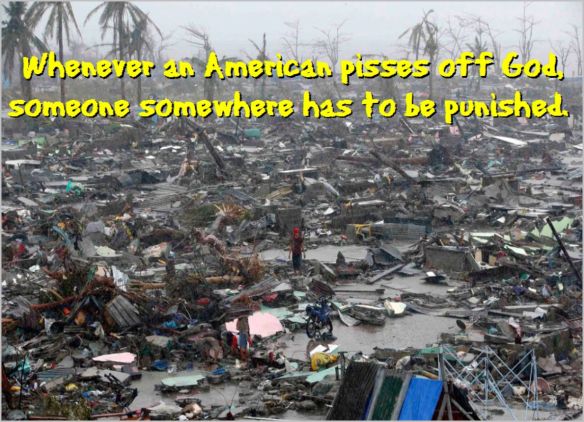
typhoon-phillipines

The idea that natural disasters and death are punishments from God – for whatever we humans have done to offend him – is still with us. As I suggested here, such a notion has been around from the beginnings of religious belief. It, together with its counterpart – that we need to appease the god(s) who so afflict us – is responsible for the genesis of all religion. There are those today whose thinking is wilfully stranded in the ancient world-views of ‘sacred’ texts that embody this dual notion of punishment that’s somehow merited and the need to appease the deity dishing out the punishment.

Here it is expressed recently by bear of little brain, Sam Rohrer, who has it directly from the Lord that he, the Almighty, has turned his back on America because it does not force immigrants to believe in him. America, he says has

changed the historic biblical rules (regarding immigration) … this is a reason why God must discipline our country.

Looney tune Pat Robertson, with his direct hotline to the Almighty, insists that it’s abortion that’s going to bring down God’s wrath:

One day, a righteous, holy God is going to demand an accounting for every drop of blood that has been spilled of innocent, unborn babies. And we just keep it in mind, when it happens it’s going to be awful.

Andrew Bieszad, on the other hand, knows that Hurricane Matthew which struck Florida back in August was God punishing the State for its tolerance of ‘evil sodomites’ (you don’t get much more tolerant than that.):

Stop sinning, especially with sodomy, as it is one of the four sins in the Bible which cry out to God for vengeance, which we are seeing now.

And these are just a few examples. There are many more. According to his whack-job servants, God can punish us, entirely indiscriminately, by unleashing earthquakes, tsunamis and floods; he can turn his back on us so that we wallow in our own filth; he can show his distaste for our ‘sin’ by raining down death and destruction upon us.

Naturally there’s plenty of this kind of thinking in the Old Testament, where God is credited with drowning his entire creation when a few ancient tribesmen misbehave (Genesis 6); he’s made to destroy Sodom and Gomorrah after every male turns inexplicably violent-gay (Genesis 19) and he’s said to wipe out whole swathes of his chosen people because they don’t pay him enough attention (Exodus 32.28).

None of these things happened, of course. They’re stories, myths or legends that incorporate the primitive thinking of the pre-scientific people who devised them, people who could only explain violent events in terms of divine punishment. It is this same thinking that is perpetuated today by those whose development is similarly arrested: through exposure to these same stories, an unwillingness to think rationally, an unhealthy preoccupation with God-nonsense and an overweening sense of self-righteousness (‘don’t blame us; it’s those others that attract God’s wrath.’)

There is no correlation between the disasters that befall humankind and God. Not one of the self-appointed prophets who say there is offer a single scrap of evidence that they are inflicted by a deity. Not one of their cause-and-effect assertions has ever been tested, can ever be tested. And – the clincher – there is no God anyway. All of which renders appeasement unnecessary and is good enough reason not to believe a word from these misguided charlatans.