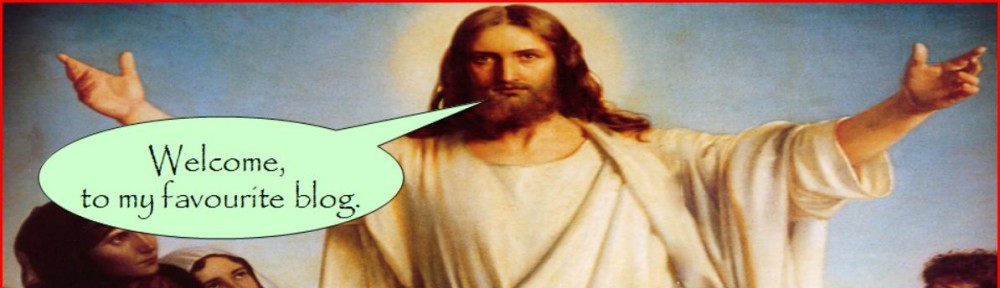
Christians’ Favourite Delusions 3: Jesus is Perfect

buddyjesus1Jesus – practically perfect in every way.

Or was that Mary Poppins?

Christians go to great lengths to present Jesus as perfect. They do this by ignoring the evidence, such as we have it in the gospels, and by believing blindly in a false version of the god-man perpetrated by those who’ve gone before them. They call it ‘faith’; the rest of us know it as cognitive dissonance. Step out from behind it, look at the Biblical record without preconceptions and what you will see is that Jesus was an unmitigated disaster.

His prophecies were wrong, his promises untrue, his morality, as his followers demonstrate to this day, impossible. His mission, to herald the arrival of the Kingdom of God for the Jewish people, was a failure that led, ultimately, to untold evil being committed in his name. He was responsible for the stultification of mankind’s cultural and intellectual development, and, still today, the suppression of reason, autonomy and equality. The world would have been a better place if he had never lived, or at least if those who followed him hadn’t made a religion out of his failure. He believed that the root cause of illness was sin and demonic possession: he was uneducated and unsophisticated. He was inconsistent, unpleasant to those who opposed him and dismissive of those outside his own circle. He was arrogant, abusive and divisive.

He was, in all of this, thoroughly human. He was not God, nor the Son of God, and he was not delivering any divine salvation plan. He was a charismatic, Jewish fanatic from a superstitious backwater of the first century. He has, or should have, no more relevance to the lives of people today than any of the other itinerant preachers of the time. I say this not because I’m choosing to ‘reject’ him; in spite of the name of this blog he can no more be ‘rejected’ than other ‘divine’ figures like Mithras, Krishna and Superman. Nor do I say it because I want to revel in my own ‘sin’, as Christians assert of those of us who really don’t see what all the fuss is about. I say it because this is what the evidence shows us.

Read the synoptic gospels for yourself, ignoring the interpretive gloss invented by Paul and later Christians, and this flawed individual is the Jesus you’ll see.

Why I could never be a Christian

RidiculousIn Through The Looking Glass, And What Alice Found There, Lewis Carroll has the White Queen boast that in her youth she could believe ‘six impossible things before breakfast’. Pfa! Only six? Today’s Christian can beat that with ease, and not only before breakfast!

To be a Christian you must accept through faith, and contrary to the evidence, that:

  • there is a reality above and beyond nature wherein exist angels, archangels, devils, demons, principalities (whatever they are), spirits (holy and otherwise) and God himself;

  • virgins can conceive and give birth;

  • a man who died 2,000 years ago is still alive;

  • this man could, when he lived, defy gravity; control the weather; sweat blood; reanimate corpses (his own included); pass through solid objects and project himself into space;

  • an intangible part of everyone survives death;

  • believing in a magic formula (‘Christ died for me’ or similar) leads to eternal life;

  • after death, believers will live again in an improved copy of the body they had when alive;

  • God reversed the laws on which the universe operates to make all of this possible, because he wanted to sacrifice a part of himself to himself;

  • he can do this because he is God;

  • he prompted men to explain his plan in a special book;

  • all you have to do to live forever is believe this book is true.

In addition to ‘essential’ beliefs like these, there are still more that Christians choose to accept on faith, add-ons that Christians are invited to see as the underpinning of ‘important’ doctrines. While not absolutely crucial, they are recommended as a means of adhering to (uncorroborated) biblical truth. Consequently, we find Christians who believe that:

  • God created the universe 6,000 years ago (because this is the time-scale that can be calculated from the Bible’s genealogies);

  • dinosaurs and humans co-existed (because this must be the case if the creation stories in Genesis are literally true);

  • evolution didn’t happen; God created the Earth and everything on it in just six days.

  • reality can be changed by the simple expedient of asking God to change it (prayer);

  • God directly controls the weather (omnipotence/divine irritability);

  • Jesus is coming back – with a selection of scenarios available to true believers about what this will be like (the second coming);

  • all unbelievers will be consigned to hell / oblivion / annihilation: again, take your pick (judgement).

There is not one scrap of evidence outside the special book that any of these items of faith are true. None is verifiable, and consequently none has ever been verified (accounts written inter-dependently fifty years after the alleged miracle-man lived don’t count).

There is, on the other hand, overwhelming evidence that virgins don’t conceive; that there is no agency behind the weather and natural disasters; that nothing of an individual’s self survives death and that dead bodies stay dead. This has always been the case and always will be. It was how nature operated two thousand years ago when all of the ‘essential’ items of faith, invented by the kinds of mind that believed earthquakes and floods were deliberate acts of God, were gaining currency.

Though I once did, I can’t subscribe to any of these ridiculously ‘impossible things’ in the vain hope that I might live forever.

Can you?

My creed (sort of)

Image

I was asked recently by a good Christian friend, now I’m no longer a believer myself, what I ‘place my faith in’ these days. Despite the claim from some Christians – Ken Ham of Answers In Genesis, for example – that atheism itself is a religion, we atheists generally don’t have ‘faith’ in anything; we are much more interested in knowing, in evidence and in not accepting on trust whatever self-appointed authorities might tell us. Nor do we have ‘faith’ in the ‘goodness’ of man as Christian Voice’s Stephen Green tells me we do. Though we might recognise that the only way to solve the many problems we face is going to be through human endeavour; there is no god who is going to bail us out.

So in these liberating post-Christian days, my world-view differs from my friend’s and other believers’ in a number of crucial ways. This post looks at the first three of these and there’ll be three more next time. Together, these make up something of a creed for me, even if some, like these first three, are expressed as negatives:-

There are no supernatural beings.

There is no empirical evidence that supernatural beings exist. There is, however, plenty of evidence that such ‘beings’ are the creations of the human imagination. It follows from this that are no fairies, ghosts, demons, spirits (holy and otherwise), angels, Santa Claus, Satan, Zeus, Osiris, Baal, Allah, Yahweh, resurrected Christ, or God of any sort ‘out there’.

And, no, books written by human beings are not evidence of the external, independent existence of any of these characters. Such inventions bring us back squarely into the realm of the human imagination.

Neither, as Romans 1:20 claims, is the natural, physical universe evidence of a supernatural realm. To argue that it is is the same as saying that because there is an Athens there must be a Zeus, or that the existence of tea-shops proves Bertrand Russell’s celestial teapot must really be orbiting the sun. That which is material, visible and natural can never be proof of something that is invisible, immaterial and supernatural. And in the end, there is no difference between something that is invisible, immaterial, supernatural and unprovable – and that which is non-existent.

Faith is no substitute for evidence (and wishful thinking doesn’t work).

Declarations, statements and views that begin ‘I believe’ are suspect and not to be trusted. They usually mean the person uttering them has no evidence for their belief. Otherwise, why believe? Wouldn’t you ‘know’ if you had evidence? ‘Believing’ does not make the object of your belief a reality. ‘Believing’ that you have eternal life won’t enable you to live forever. Hoping you’re going to Heaven when you die doesn’t mean heaven exists nor will it get you there in the future. Having ‘faith’ in Jesus will not make you right with God for all sorts of reasons. In short, wishful thinking doesn’t work.

Science, not religion, offers the best explanations of life, the universe and everything.

Religionists (wilfully?) misunderstand the scientific use of the word ‘theory’; they insist it is a synonym for guesswork or argue that because some scientific theories, like evolution, cannot be replicated in the laboratory they are therefore null and void (see Answers in Genesis again with its battle cry of ‘were you there [when the world was made]?’ No, and neither was Ken Ham, nor the writers of Genesis, nor any deity; see above). But a scientific theory offers an explanation which can be tested against observable phenomena and processes. It asks ‘is this what we might expect if the theory (explanation) is accurate?’ If yes, the theory is validated, repeatedly. If no, the theory has to be modified to fit the facts or completely reformulated, again so it accurately mirrors what is observed. The scientific principle of actively seeking out evidence that might refute a given theory, or aspects of it, ensures a process that can be trusted. Note though, that having such trust in science is not a matter of faith: it is about considering the evidence and developing knowledge from it.