Why I Can’t Believe in the ‘Lord Jesus Christ’: 2. Demons, demons everywhere

Demon2

They tell you all you need to do is accept Jesus as your Lord and Saviour. But it’s not true. You also have to accept on faith all sorts of peripheral nonsense. Nonsense like demons. And the ever-present malevolent Force that will pressurise you into misbehaving and compromising your commitment to the Lord. This Force is ‘The Enemy’, a.k.a. Satan or the Devil, and leading Christians astray is its/his principal occupation. The Enemy and his minions, the demons, are everywhere! All over the internet for a start, mainly on Christian sites. While the Church of Lucifer has an online presence, it’s Christians who love the bad guys the most.

According to some, Satan and his demons are in charge of this reality (though it could be God who’s got the whole world in his hands.) When they’re not attacking true believers, demons are doing their damnedest to bring America to its knees, mainly through ‘The Homosexual Agenda‘™ and abortion rights.

Perhaps it’s possible to ignore this aspect of the faith and still be a Christian, but to do so is to disregard the significant presence the devil and his demons have in the New Testament. Jesus himself has a cosy chat with Satan during his time in the wilderness, or so Matthew 4.1-11 would have us believe. Throughout the synoptic gospels, Jesus speaks very much as if he believes Satan to be an actual being, not merely a metaphorical personification of evil (eg: Luke 11:14-26). He also exorcises a significant number of individuals possessed by demons.

Steve Hayes on Triablogue blithely suggests that ‘when friends and relatives brought people to Jesus to be exorcized, that reflects their diagnosis, not his. They think the individual is possessed – which doesn’t imply that Jesus always shared their suspicions.’ But of course it does; to imply he was God and therefore would have known better is to impose a perspective that had yet to develop when the synoptic gospels were written – that, and a modern sensibility onto a first-century conditioned mind. If Jesus didn’t regard those brought to him to be possessed by demons, he would have said so. He is quick enough to correct his disciples elsewhere when they ascribe the wrong reasons to the causes of illness (John 9.1-3). Inventing ways to excuse Jesus’ ignorance is to avoid what the text clearly indicates; Jesus believed in demons. When he diagnoses a disturbed mind himself he doesn’t hesitate to conclude they are involved; he even engages in conversation with them (Luke 8.30-35).

We know now, and have known for some time, that illness and mental conditions are not caused by demons. We know too that same-sex relationships are not Satanic. There are no supernatural forces trying to debase America. There are no supernatural forces, full stop. It follows that Jesus’ mission couldn’t have been to magically defeat the devil by dying on the cross (Hebrew 2.14); his supposed sacrifice couldn’t have been the beginning of the end of the devil’s reign (Romans 16.20). Neither can there be any of the spiritual warfare against ‘powers and principalities’ of the air that dimwitted Christians imagine themselves to be engaged in (Ephesians 6.12).

Christianity is nothing without its imagined adversaries. With them it is nothing more than a superstition, which its founders ignorantly subscribed to and worked hard to perpetuate. Christians are about the same business today.

As for me, I cannot believe in a ‘Lord Jesus Christ’ who was so primitive, so uneducated and so ignorant he regarded Satan and his demonic forces to be real.


The Christian blog that knows better than Jesus

Triablogue-Header-240x1080 (1)

The superior intellects at Triablogue responded to my comment (see previous post below) by telling me they’d already dealt with the claim that Jesus believed the arrival of the Son of Man/the End of the Age/the Final Judgement and God’s Kingdom on Earth were imminent.

They directed me to one of their articles, Misdating the Second Coming, which argues that neither Jesus nor Paul really believed the end was nigh and that the texts which suggest they were need to be interpreted carefully (i.e. to get round what they clearly say to make them say something else.)

I can’t find any other instance of Triablogue contributors proposing that Jesus didn’t really say what the gospels have him say. They don’t dispute, for example, the so-called great commission in Matthew 28.19 (‘Therefore go and make disciples of all nations, baptizing them in the name of the Father and of the Son and of the Holy Spirit‘) even though, with its Trinitarian formulation, Jesus almost certainly didn’t say it. Instead, the know-alls at Triablogue  reserve their hedging for the prophecies that patently failed to materialise, on the basis that Jesus couldn’t possibly have been wrong so he must have meant something else.

I’ve written several posts under the banner Making Excuses for Jesus, on the varied and feeble attempts Christians make to get round the fact the synoptic gospels consistently have Jesus say the Kingdom of God, and all that accompanies it, are just around the corner. His early followers all believed this and his eschatological pronouncements are recorded in all of the earliest texts. Mark’s gospel includes his prophecies about the Son of Man while Matthew and Luke include material not found in Mark from their ‘M’ and ‘L’ (oral?) sources that warn it is the ‘eleventh hour’. The entire thrust of the synoptic gospels is that the Kingdom is about to arrive and therefore people need to be prepared for it: ‘The time is fulfilled, the kingdom of God is at hand; repent and believe the good news’ (Mark 1.15).

The sayings gospel ‘Q’, which predates Mark and was probably in circulation only a few years after Jesus died, preserves several Son of Man sayings; he would be appearing soon to kick-start the Kingdom. Paul, writing decades before the gospels, tells his readers to expect the Second Coming – the Son of Man having become Jesus himself – while he and they are still alive (Thessalonians 4.14-15). Likewise, the anonymous writer of Hebrews believed he lived in the ‘last days’ (1.1-2) while the nutjob who concocted Revelation claimed he was quoting the Risen Jesus promising he would ‘surely come quickly’ (22.20). The imminence of God’s Kingdom on Earth is the consistent message of the New Testament.

And what do the cerebral Christians at Triablogue do when confronted with a summary of these facts? They don’t approve my comment, that’s what. I guess that’s all you can do when you really don’t have an answer for why your Savior™ got everything so drastically wrong; dishonestly pretend he didn’t and silence those who show that he did

Why I can’t believe in ‘the Lord Jesus Christ’ (one of many reasons)

Jesus10

Over on the very smug Christian web-site, Triablogue, which I discovered via Gary’s Escaping Christian Fundamentalism blog, a commenter poses the question, ‘What evidence would it take to believe in the Lord Jesus Christ?’ This is the answer I left:

If the Son of Man came back through the clouds with a heavenly host of angels in full view of the tribes of the Earth to judge the nations and separate the righteous from the unrighteous; if this Son of Man then established God’s Kingdom on the Earth for the meek and righteous while consigning the unrighteous to eternal punishment; if he and those he appointed to rule alongside him then reigned over this Kingdom for ever and ever, and if all of this happened within the lifetime of Jesus’ original followers, as he promised and predicted it would, then, and only then, would I be able to believe in him.

After all, this was Jesus’ good news (Luke 4.43). When none of his predictions/prophesies/promises came to pass then, as always happens with failed cults and failed cult leaders, those who followed came up with alternative explanations. They hoped, and no doubt believed, that these would do instead of the original ‘good news’. In many ways they weren’t wrong, given the later success of these interpretations, but these were not the cult’s original message and were no more true than Jesus’ Son of Man/Kingdom of God fantasy.

* * * * * *

Just in case you don’t think Jesus promised all these things here’s a mere sampling of where he does:

The Son of Man coming through the clouds: Mark 13.26

with a heavenly host of angels: Matthew 16.27

in full view of the tribes of the Earth: Matthew 24:30

to judge the nations: Matthew 16.27

and separate the righteous from the unrighteous: Matthew 25.32

The Son of Man establishing God’s Kingdom on the Earth: Matthew 19.28, 25.34

for the meek and righteous: Matthew 5.3

while consigning the unrighteous to eternal punishment: Matthew 25.46

Those he appointed ruling alongside him: Matthew 19.28, Luke 22.30

and reigning over this Kingdom for ever and ever: Matthew 6.13, Revelation 11.15

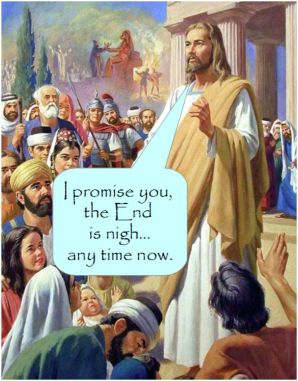
all of this to happen within the lifetime of Jesus’ original followers, as he promised and predicted it would: Mark 1.15, 9.1, Matthew 10.23, 16.28; 24.34, Luke 9.27 etc

I apologise for the strong language in the picture above, but c’mon, how can Christians reasonably explain the out-and-out failure of all of Jesus’ promises and predictions, while still maintaining he was somehow a manifestation of the God of the Universe?

ChristianSpeak™ for Beginners (part two)

JC6

Last Days: The previous 2,000+ years. The whole Last Days routine is a reflection of the paranioa/relish promoted by the self-righteous since before Jesus arrived with his ‘good news’ that the end was nigh (Mark 1.15 & Matthew 4.17). The Last Days are, in fact, a permanent state of affairs, the result of believers finding that the world just won’t work the way they want it to.

Lifestyle: Homosexuality. Occasionally applied more broadly to refer to any sex outside traditional marriage.

Marriage: The union of one man and one woman for life (even though this is not actually advocated in the Bible) with the right to divorce when the participants want to. Not the formalisation of loving same-sex relationships. What would become of marriage if that were allowed?

New Age: the disparaging term used to describe any wacky spiritual beliefs that are not of Christian origin (see also ‘pot’ and ‘kettle’).

Outpouring (of the Holy Spirit): Euphoria/hysteria.

Pro-life: Anti-abortion

Pro-marriage: Anti-gay

Pro-family: Anti-abortion and anti-gay

The Rapture: The ultimate high. When Jesus first appears in the sky at his second coming he will use his power of mass-levitation to draw his followers up into the air to be with him. Not all Christians are convinced this will happen, however, even though it’s based on an idea of Paul’s in 1 Thessalonians 4:17.

Righteous:

a) Irritable, prone to jealousy, murderous. As God is all of these, it must be what Christians mean when they say he is righteous.

b) Self-induced feelings of superiority, enjoyed by many Christians. Closely related to ‘hypocritical’.

Slain in the Spirit: the compulsion to fall over while in a state of euphoria and attribute this to the Holy Spirit. A favourite trick of faith healers, it has nothing to do with faith or healing.

A Thousand years: Pretty much the same as a day (see 2 Peter 3.8 again).

The World: Not the Earth or its populations as we might normally refer to them, but unredeemed mankind living in godless societies that do not follow Christ or the Christian way. Also known as ‘normality’. Christian use of the term based on verses such as 1 John 2:15-16.

Adapted from my book, Why Christians Don’t Do What Jesus Tells Them To …And What They Believe Instead. (Available here, here and other Amazon oulets.)

ChristianSpeak™ for Beginners (part one)

Trump3Bible-based values: Judgemental intolerance, arrived at by cherry-picking the bits of the Bible that confirm one’s existing prejudices.

Biblical Exegesis: the neat trick of reinterpreting bits of the Bible – under the guidance of the Holy Spirit, naturally – so they say whatever you want them to say. Perhaps the closest believers come to changing water into wine.

Blessing: a) Feeling good, euphoria. Attributed to God. b) Aspects of a comfortable life. Attributed to God

Born Again: Converting to Christianity, switching off your critical faculties, and imagining you’re having a meaningful relationship with a person who’s been dead for two-thousand years.

A Day: a period of time similar in length to a thousand years (see 2 Peter 3.8)

Family: Opposition to sex outside traditional marriage. Christian organisations with ‘Family’ in their titles, for example the Family Research Council, the American Family Association, and Focus on the Family are dedicated to opposing something they call ‘the homosexual agenda’.

The Flesh: the dictates of the body and the unregenerate or ‘carnal’ mind. It also stands for the life lived by an unsaved person whose existence is determined by ‘baser needs’. Christians, on the other hand, never succumb to the flesh and as a result are known never to eat, experience lust or have sex of any sort. The idea is Paul’s – see Romans 5.24 – and doesn’t sit easily with Jesus’ own enjoyment of eating, drinking and making merry (Matthew 11.19). As disparaged as the flesh is, Christians are promised a new physical body come the resurrection (1 Corinthians 15.53-54).

The Gay Agenda, a.k.a. the homosexual agenda: An invention of right-wing Christians designed to frighten more impressionable brothers and sisters into thinking gay people want to take over the world and make everyone else homosexual too. Overlooking the fact it’s Christians who like to convert and recruit others, this hateful nonsense galvanises opposition to rights for gay people, whose ‘agenda’ is usually the same as everyone else’s; to be treated fairly and get peaceably through the day.

Holy Ghost: The artist formerly known as the Holy Ghost is now, after a recent make-over and re-branding, the Holy Spirit. The shedding of its former association with non-existent entities like apparitions and phantoms – which, of course, it most emphatically is not – produces a concept that’s much more hip for today’s with-it believer.

Adapted from my book, Why Christians Don’t Do What Jesus Tells Them To …And What They Believe Instead. (Available here, here and other Amazon oulets.)

More to come…

Faith Exposed

Announcing the companion volume to Jesus Exposed

Faith Exposed: What’s Love Got To Do With It?

FaithExposed

Available from Amazon UK and US and worldwide.

Get your now copy before the Rapture!

Abandon Reason all ye who enter the Faith

Descartes

The question of whether religious believers are less intelligent than non-believers surfaces every now and again. The atheist blogs I read are usually courteous enough to say that of course believers are not less intelligent, and there are no studies that I can find that have considered the matter.

Evidently there have been intelligent Christians; C. S. Lewis comes to mind, Francis Collins of the Human Genome project and William Lane Craig are evidently intelligent men. (I can’t think of any obviously intelligent women who subscribe to religion; I suspect intelligent women are intelligent enough to avoid superstition altogether.) It seems to me though that what those who profess religious belief are prepared to do, is sublimate whatever intelligence they have and sacrifice intellect in the service of faith. They suppress their critical faculties, usually through a form of cognitive dissonance, and press rationality into the servitude of beliefs that have been arrived at irrationally. I might be wrong of course, but this what the evidence suggests to me.

A recent commenter on this blog by name of tides99, does seem to support to this hypothesis. tides99 originally wrote to say how his chosen superstition, Catholicism, is the one true way (aren’t they all) and that while I’m right to criticise Protestantism, I really should investigate Catholicism for myself. When I declined his very generous offer, tides99 responded – you’ll find his comments in ‘the author’ section above – with a number of points about the limits of human reason. It is these I take apart respond to here.

tides99: I have a PhD in philosophy, so I certainly would not believe in anything that goes against reason or requires one to repress or contradict one’s critical faculties.
For one who professes a PhD in philosophy, tides99, there is some very sloppy reasoning here and throughout your argument. Already in this first sentence we see the contradiction between belief and reason; they are not the same and can’t ever be; belief doesn’t require reason. That is why it is often called ‘faith’.

Criticsl (sic) reason is only one way of encountering and assessing reality… You’re right, tides99, but not for the reason you think. Critical reasoning is one way of assessing reality, but is insufficient on its own. It needs the support of evidence. Evidence is supplied by science and the methods used in scientific enquiry that seek to eliminate, as far as possible, human bias and presupposed conclusions.

and there are aspects of reality that reason cannot adjudicate because it cannot access them. If there are aspects of reality that reason cannot ‘adjudicate’ (whatever that means) and that science cannot access, then how do you know these supernatural aspects exist? You feel them? Your church says they do? You’d like them to? Maybe so, but none of these mean that these mysterious ‘aspects’ really do exist. You’re sneaking supernaturalism in through the back door here, tides.

Rationalism is itself based Upon faith, of faith… Oh dear, this old chestnut.

in the ultimate intelligibility of the universe, and its perfect transparency to human reason. Is rationality really based on these things? Scientists concede there may be aspects of the universe which, while we might observe them or extrapolate mathematically, we might never properly understand or be able to explain. This doesn’t, to my knowledge, prevent the exercise of rationality.

This of course cannot be proven, yet you believe it anyway. Scientists and free-thinkers rarely go in for ‘proof’. Your use of the word makes me suspicious of your claims about your credentials. Things can be proven mathematically, it’s true, as can matters in a court of law (beyond reasonable doubt) but by and large science is more interested in theories, working models and demonstration. So, no-one is looking to ‘prove’ that the universe is ultimately intelligible and no-one ‘believes’ it is perfectly transparent to human reason. This is a strawman argument, tides.

It’s quite superstitious to have such faith, but yet have nothing really to ground it on. Whatever reason and rationality are based on, it is not faith in the universe’s intelligibility or transparency. The use of reason and the application of the scientific method are nothing like ‘faith’. Both are tools, and they are the best we have.

The truth is that the reason why reason exists is because the universe is ordered… Beware any statement that starts ‘the truth is’! Reasoning is a manifestation of the human brain. It is not something that has discreet, independent existence. It has not been floating around for aeons, out there somewhere, waiting for advanced apes finally to discover it and make it their own. The only reason reason exists is because the human brain evolved to the extent it became capable of reasoning. All the same, the brain did not leave behind its capacity for irrationality, unreasonableness and disorderly impulse. Might we not then claim, this being an equally viable proposition, that because these are human traits of even longer standing than our capacity for reason, that the universe must therefore also be irrational, unreasonable and disordered? Of course not, because the universe’s characteristics are not a reflection of the human brain’s abilities, and vice versa. The inclination to project human behaviour onto an impersonal, indifferent environment – to anthropomorphise the universe – exemplifies our irrationality, not rationality.

But, just a minute, we have another contradiction here, tides99. You have already speculated that there are aspects of reality beyond our grasp – and yet here you are telling us that, along with the rest of the universe, these supernatural aspects are ordered. How do you know this? How do you know anything about parts of reality which reason cannot ‘adjudicate’ and science cannot access?

and the reason why it’s ordered is, of course, because there is an orderer, namely God. And there we have it. It’s God. Of course it is. Far from demonstrating that the universe is ordered, you now conjecture that the order you claim for it has an orderer behind it. Yes, it’s another leap of faith, reason be damned. Anthropomorphising the universe leads inevitably to deities and, ultimately, the Christian god, who is merely ourselves writ large.

Speaking for myself, anyway, I can say this much. When I was an undergrad I came across the saying that learning a little philosophy leads you away from God, but learning a lot of philosophy leads you back. As a young man who had learned a little philosophy, I scoffed. But in later years and at least in my own case, I would come to see that it’s true.

It’s no good blaming a surfeit of philosophy, tides99. If what you say were true, all philosophers with PhDs would have reached conclusions similar to your own. The majority haven’t.

To summarise your argument, you claim – without evidence – that there are supernatural aspects to the universe/reality which reason and science can’t detect. You assert that nevertheless the universe as a whole is ordered and it follows therefore that there must be an orderer. This orderer, you then go on to assume, is the very God you’ve chosen, for entirely irrational reasons, to worship.

Science and reason tell us that every one of these assertions is wrong. You are projecting your beliefs onto the universe as you perceive it, tides99. Project away, by all means, but remember, these beliefs and your version of reality are only in your head. The real universe as science, and, I’d venture to say, reason demonstrate, is busy doing something else entirely.

Young men’s visions, old men’s dreams

Stephen4

In Acts 2.17, Luke (mis)quotes a prophecy from Joel 2.28:

In the last days, God says, I will pour out my Spirit on all people. Your sons and daughters will prophesy, your young men will see visions, your old men will dream dreams.

I was always taught that the Acts version was a prophecy in its own right, predicting what would happen in the very last days before Jesus returned, some time in the future (his future, though maybe not ours.) But it isn’t. Luke, or whoever wrote Acts, is claiming the fulfilment of the prophecy in his own time. He’s not saying,’ this is what will happen at some point in the next few millennia.’ He’s declaring – or he’s making Peter declare – ‘this is what’s happening right now.’ Luke, like all members of the cult in its early days, believed the last days had arrived; God was about to impose his Kingdom on the Earth, in a display of power and glory (Luke 21.27).

The dreams and visions of which Luke speaks were, he believed, happening then, as he was writing. To prove it, he relates numerous dreams and visions in Acts; Stephen’s vision of God and Jesus; Paul’s ‘sighting’ of the risen Christ on the road to Damascus and Peter’s encounter with, erm… a table-cloth to name only a few. Elsewhere, Paul himself refers obliquely the innervision that led to his conversion (Galatians 1.16) and recounts his ‘visit’ to ‘the third heaven’ (2 Corinthians 12.2); he’s kind of embarrassed about this one though – as well he might be – and relates it in the third person.

Luke knows that the new cult is built on dreams and visions. He believes such hallucinations are genuine revelations from God himself. Moreover, Luke tells his readers explicitly and directly in Acts 2.17 that such visions and dreams were how the cult’s founders experienced the risen Jesus. How do we know this is what he means? Because he puts the quotation about young men having visions and old men dreaming dreams into the mouth of Peter. That’s the disciple Peter whom the gospels tell us was one of the first to experience the risen lord. Luke has Peter reveal the nature of that experience. ‘This is how it was for me,’ he confesses. ‘I had a god-given vision, just as the scriptures promise.’

Luke is proud of the fact that the new faith is based on young men’s visions and old men’s dreams. Proud enough to include it in Acts 2.17 and proud enough to make Peter of all people declare it. Christianity owes its existence to these hallucinations and delusions, nothing more.


What A Dream I Had

Resurrection3

Last night.

I dreamt I was troubled and anxious about something or other, even though I’m not aware of being this way in reality.

In the dream, a couple of people drop by to console me. One of those people is my dad. He asks what’s wrong, listens and offers advice. He’s concerned and wise, positive and supportive. I have no doubt this is my father; he looks and sounds like him, but he’s an idealised version of him. I’m dimly aware in the dream that he’s behaving differently from the way he would in life – we rarely had heart-to-heart talks – but I’m so grateful for the help he’s offering, and it’s good to feel close to him.

In reality, my father died over ten years ago. I’m not sure I was aware of this in the dream or perhaps I just ignored it. I certainly ignored the way he was acting slightly out of character; I just was glad to see him again. I woke this morning feeling invigorated by the time spent with him (or the illusion of time spent with him) and with other friends who appeared in the dream to offer support.

I don’t for minute believe that the father I experienced in my dream was really my dad, returned from wherever he’s been these last ten years to offer words of comfort. My real dad has been nowhere for the past decade. He ceased to be in 2007. The version of him in my dream was a construct of my own mind, made from memories, wishful thinking and – okay, I admit it – a glass or two of wine. He was an image of how I’d like my dad to have been, perhaps – not that I give that much conscious thought. Nevertheless, this version of him is evidently buried somewhere in my head, waiting to be resurrected when the dream circumstances are right.

This is what it must surely have been like for those few individuals who, in visions and dreams, experienced Jesus after his death. In their grief and turmoil, the need to embrace the dream version of their friend must have been overwhelming. They would have persuaded themselves it really was him, communicating with them from beyond the grave. The fact one or two others had a similar experience can only have reinforced the compulsion to believe: ‘You saw him too? Then it must really have been him.’

It wasn’t, of course. What those who witnessed the risen lord experienced was, as Paul suggests in Galatians 1.16, a creation of their own minds, constructed from religious fervour, wishful thinking and a powerful need to believe.

From this, all else followed.

The Resurrection Explained

Light2

The earliest reference to Jesus being raised from the dead appears in Paul’s first letter to the Corinthians: 

Christ died for our sins, just as the Scriptures said. He was buried, and he was raised from the dead on the third day, just as the Scriptures said. He was seen by Peter and then by the Twelve. After that, he was seen by more than 500 of his followers (Corinthians 15.3-6).

Scholars are generally agreed that Paul is quoting from a very early creed, created within a few years of Jesus’ death. Ftbond, a commenter on Escaping Christian Fundamentalism, asks that if this creed was in existence

within a year or two or three after Jesus crucifixion (and, obviously, claimed resurrection), then one must ask: What was so important, so astounding, so amazing, so desirable, so attractive, so encaptivating (sic) and charismatic about that person that anyone would think him to be a “candidate” for resurrection in the first place?

It seems to me all of these questions and attendant adjectives are irrelevant and that ftbond is looking at the resurrection claims the wrong way round.

First, the creed doesn’t refer to ‘resurrection’. ‘He was raised’ is the term favoured by these earliest of Christians, one that doesn’t suggest they could only have had a reanimated corpse in mind.

There is no justification for supposing that ‘he was raised’ meant the same, either in Paul’s mind or that of the creed writers, as ‘bodily resurrection’. To assume they’re the same is to impose all the later accretions of the latter term onto the much simpler earlier one. We know Paul’s ‘risen Christ’ was a ‘revelation’ in his own head (let’s call it an hallucination) and nowhere does he suggest that Jesus was brought back to life in his old body. Paul talks only of Jesus being raised as ‘a life giving spirit’, not a ‘corrupt’ body of flesh at all (1 Corinthians 15.46).

Hallucinations of a ‘raised’ Jesus, then, long preceded the idea that he had returned in the same physical body that two days earlier had died on the cross. The notion that he was alive again resulted from the ‘visions’ – quite possibly dreams – that two or three of his early followers had. They took these visions to mean that Jesus had returned spiritually from beyond the grave.

Others came to believe in the risen Jesus, not because they personally experienced a vision or dream about him (though Paul insists there were some who did), but because of the reports of others experiencing them. Still more became believers as a result of reports of reports (of reports.) These experiences were then incorporated into creeds like the one quoted by Paul, and ultimately into the gospels when they were written 40-100 years later. By that time the original hallucinations were being worked up into real encounters with a Jesus physically resurrected in the flesh.

No-one needed to find Jesus ‘captivating’, ‘astounding’ and all those other adjectives ftbond applies to him; most converts, like Paul, would never even have met him. It is all a matter of interpretation; either a few early believers convinced themselves they’d experienced their late charismatic companion alive again, or, if he didn’t actually exist (and he is so mythic this is a possibility), they concocted a back story for their mystical experiences. The result was the creation of stories about Jesus, largely cobbled together from the ‘Scriptures’ (as Paul all but admits.)

This seems to me to be the most likely explanation of the ‘resurrection’. There is so much special pleading in the gospel accounts, so much that is clearly invented and designed to fulfil prophecy, so many inconsistencies and anomalies, that the entire enterprise smacks of imaginative invention, designed to lend credence to a few people’s innervisions.