Surviving 2026

It’s that time of year when, according to the media, we need to consider what our strategies might be for surviving the 12 months ahead. I thought I’d share with you some of my thoughts along these lines:

1. Have the lowest expectations of politicians that you can muster. That way you’ll only be mildly disappointed when they fail to live up to them.

2. Have a sense of proportion. The universe has existed for 13.8 billion years, the earth for 4.54 billion, life for 3.8 – 3.5 billion, humans for a mere 300,000 years and you for a miniscule fraction of even this final statistic. None of these events has been directed by a sentient power. They are all the result of natural forces. With this perspective you’ll recognise how nonsensical it is to attribute anything to a tribal deity.

3. Reserve your respect for people who merit respect. You do not have to respect those who espouse nonsense and/or don’t respect you. You certainly don’t have to genuflect in front of ideologies, whether religious, philosophical or political. Ideologies are not people.

4. Party like it’s 1999. That way you can pretend the world isn’t being run by septuagenarian megalomaniacs.

5. Resist the Newspeak that is daily foisted upon us. Call a spade a shovel, an Islamist a Muslim, and send the Thought Police packing when they turn up at your door because someone somewhere is offended by something you’ve said, on someone else’s behalf.

6. Spend lots of time with friends. Studies repeatedly show that socialising contributes significantly to living a longer, happier, healthier life. Even talking to strangers helps. I know that other people can sometimes be  challenging (see below) but being with them is, on balance, pleasurable and rewarding. They do you good (and you them).

7. Stop anyone who starts a sentence with ‘Me and partner’. Point out that this is grammatically incorrect and reflects badly on both their education and personal integrity.

8. Read comic books.

9. Take pride in your country. It belongs to you, not just to politicians and billionaires. Other countries quite rightly take pride in their country’s achievements, culture and values. We need to as well. .

10. Write to your MP/Congressperson to tell them what you think of the job they’re doing. Tell them what they should be doing instead, like keeping their promises. Do this while trying not to use swear words.

11. Do something you might not normally do. Keep it legal. Or at least don’t get found out.

12. Question everything, including everything that’s written here.

I hope 2026 turns out to be a great year for you.

Who Has Seen The Wind, Or Cause and Effect

The first time I encountered this poem was when Yoko Ono intoned it, as only she could, on the B-side of John Lennon’s Instant Karma!, back in 1970.

I noticed at the time (because I always read such things, while playing the B-sides of singles) that the poem’s composer was someone called ‘Rossetti’. Back then I knew nothing about him or her. Years later, I came across Dante Gabriel Rossetti, the Pre-Raphaelite artist but it turned he didn’t write the poem either. His sister Christina did.

Christina Rossetti was profoundly religious. She set about helping fallen women: ‘fallen’ according to the sexual mores of the day. A number of these young girls may well have been ‘led into sin’ in the first place by her hell-raiser brother, Dante. Her poem Who Has Seen The Wind, written in 1847, is an allegory of the work of the Holy Ghost: as the wind itself can never be seen, only detected by its effects, so too the Holy Ghost can be sensed only by its invisible workings in the real world. It’s an old argument, hinted at in Psalm 19:1, which says the heavens declare the handiwork of the Lord. Modern versions of the argument exist, based on the philosophical assertion that every effect must have a cause, including one that equates God with a murderer, 

It’s a terrible idea in all its forms. First, we know the wind, and murderers too, exist. The wind can be measured and the processes involved in creating winds of various strengths are well understood. Likewise murderers (as tempting as it is to equate God with a callous killer.) The inference that the cause of any given effect must be supernatural – a Ghost, a god, an angel – is mere primitive instinct. Even more unjustifiable is the leap that says this supernatural cause is The First Cause, which itself has no cause. A further leap into the absurd is the assumption that this uncaused First Cause is a God who was first imagined by middle-eastern tribesmen and later reshaped by early Christians and the church.

Which brings us to God: The Science, the Evidence, a new book by a Christian scientist, Olivier Bonnassies and industrialist Michel-Yves Bolloré, proposing that because we don’t fully understand how the universe came into being, it must have been God. Bonnasaries explains how they arrived at this conclusion:

It’s the fact that this (piece of paper) exists. And that because it exists, it needs a cause, and that (cause) needs another cause, and at the end, you need what we call a primary cause in order that everything exists. Because nothing can exist by itself.

Except, apparently, that cause designated, without evidence, the First Cause: God.

It is this, Bonnasaries and Bolloré claim as a scientific hypothesis. Bonnasaries must surely know as scientist that it is far from scientific. ‘God did it’ is a conclusion, arrived at without evidence; there is nothing observable, testable or measurable about it. It is philosophical conjecture at best, theology at worst. Christina Rossetti put it so much better, all those years ago (but still she got it wrong).


Proving God

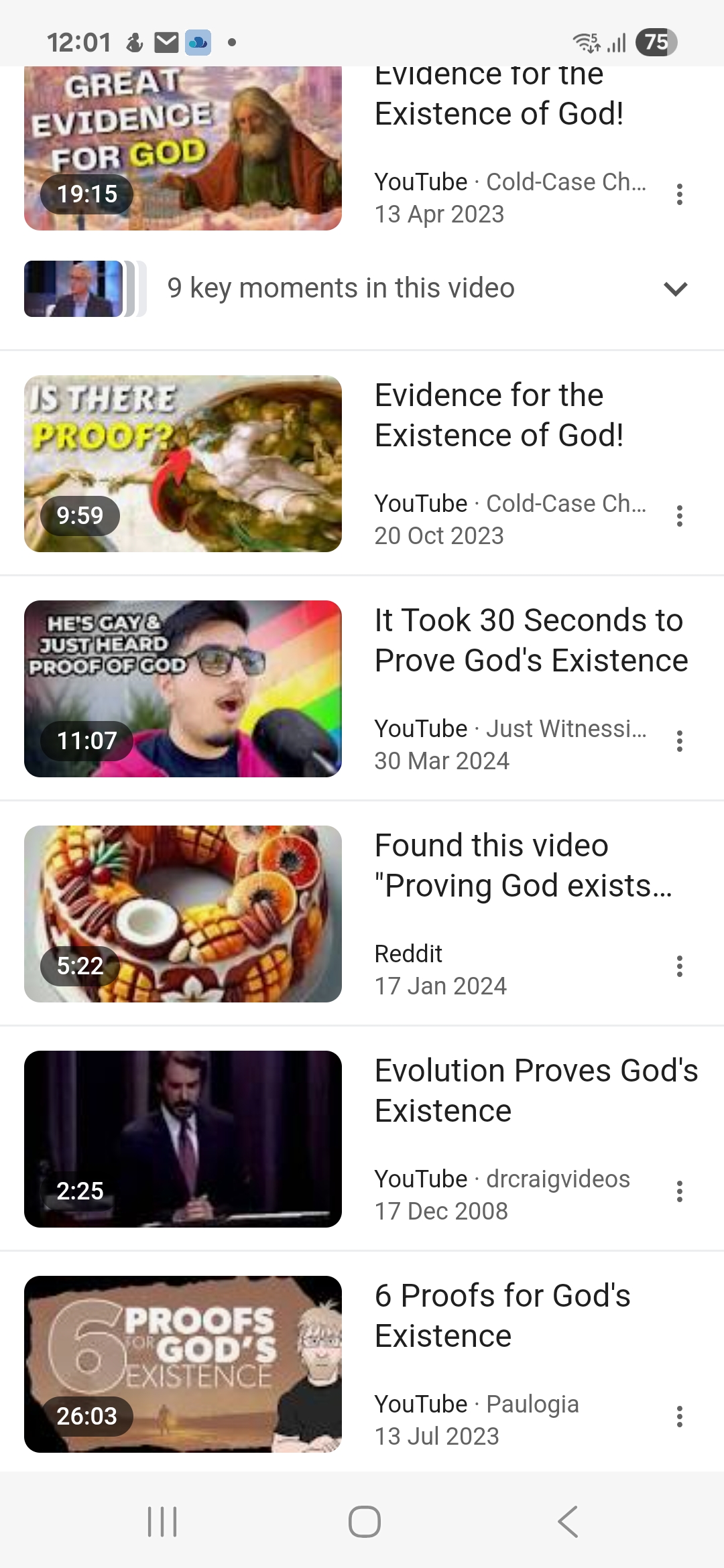
Google ‘Proving the existence of God’ and up come hundreds of videos like these:

My favourite has to be the one that says it only takes 30 seconds to prove God exists and then takes over 11 minutes to do it. The A.I. summary of the online articles and blogs about the subject is, for once, right when it says God’s existence can’t be demonstrated. But that doesn’t stop those who think they can ‘prove’ it from giving it a go. Many of them take a smug swipe at atheists for not seeing the supposed scientific, philosophical and theological ‘evidence’ when it’s right in front of them. Others point out that even if they can’t demonstrate God’s existence conclusively, neither can atheists disprove it. They’re correct, but it’s incumbent on those making the claim to demonstrate it, not those who find it unconvincing to disprove it. 

Let’s imagine the scenario where this isn’t the case though. A scenario where those proposing the existence of God finally manage to present empirical, indisputable evidence that he’s really out there in the vast expanse of the lifeless universe or in a dimension hitherto imperceptible to humans. What then?

They’d have proved God in generic, ill-defined terms. They would not have demonstrated that this Being is creator of the universe, or that he(?) is remotely interested in humankind or that he listens to us or guides us or in any way involves himself in our affairs. They certainly won’t have demonstrated that he is the only God, who befriended one tribe on the Earth, 4.6 billion years after its creation and 23.4 billion years after the universe’s beginning, prompting them to create legends about him. They will not have provided any evidence that he is the one who sent Jesus to the Earth, nor that he is in some incomprehensible way Jesus himself.

Theists haven’t demonstrated a basic God, let alone one with all the characteristics they want him to have. That those who devised stories a mere 2.5 to 2 thousand years ago, claiming their God had all these characteristics, is not evidence he did nor that he even existed. Osiris, Zeus and Allah are all as likely to be accurate reflections of this nebulous God as YHWH or Jesus. And if we’re honest, we know they’re not. None of them are.

At least atheists have probability on their side.

Spiritual Forces of Evil in the Heavenly Realms

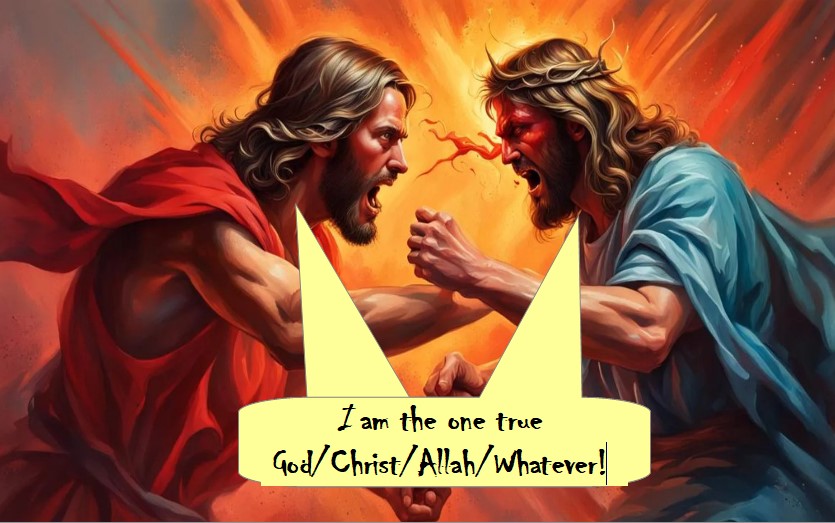
Original AI image from Night Cafe 

For our struggle is not against flesh and blood, but against the rulers, against the authorities, against the powers of this dark world and against the spiritual forces of evil in the heavenly realms. (Ephesians 6:12)

…you followed the ways of this world and of the ruler of the kingdom of the air, the spirit who is now at work in those who are disobedient. (Ephesians 2:2)

the prince of this world now stands condemned. (John 16:11)

The first-century worldview of early Christian cultists was that somewhere above the Earth a battle raged between God and Satan. The powers of darkness – the devil and his demons – had in ages past launched an attack on the Lord and his angels. This war in the spiritual realm continued unabated up to the time when a cultist wrote Ephesians, pretending to be Paul. Paul himself had already alluded to Satan as the god of this age (2 Corinthians 4:4), while the authors of the fourth gospel would later refer to him as the archon – ruler and prince – of this world (John 12:31; 14:30).

Which just goes to show how the Almighty God they believed in was nothing of the sort. He had tussled with his arch-enemy for eons without quashing his rebellion and putting an end to his persistent attacks. The stand-off had gone on for millennia, and, according to today’s Christians, is still happening. A puny god it is who cannot get the better of one of his far less powerful creations.

And what are God and Satan fighting over? Us, apparently. The devil wants control of human beings.

Why? Who knows. In fact, according to Paul, Satan already has control over us. He enslaves us to sin, which in turn leads to death (Romans 5:12, 6:23). 

Not to worry though, Paul, fake Paul and the fourth gospel writers assure us that their enfeebled God has a cunning plan! He’ll allow a being who is precious to him – like a son, in fact – to be sacrificed so that anyone who believes in him will no longer be enslaved to Satan and sin and will be granted eternal life. How’s that for special magic!

Who shouted out from the back that that sounds like a cop-out? It’s a fantasy bordering on the insane. Like it or not, we are somehow embroiled in heavenly warfare, specially if we’re of the number who’ve bought into this malarkey.

While we’re at it, have you noticed how so many of the wars and skirmishes currently afflicting the world have religion at their heart? YHWH is scrapping with Allah, Allah is up against the Great Satan while Jesus – no stranger to war-mongering himself – presides over it all, leading the world to Armageddon and his own ultimate ‘return’.

Here’s my suggestion. All the gods and demons need to get their act together. They should agree to an ultimate slug-fest, a final battle in the spiritual realm to decide who’s really the Supreme God – the last deity standing – and leave us humans out of it entirely. Surely, being gods, they’re up for finding out who can piss furthest up the wall.

A preposterous idea? Of course it is. None of these fantasy beings exist. There’s no YHWH, Allah, Heavenly Father, Jesus, Krishna, angels, archons, Satan or ‘spiritual forces of evil’ to duke it out. There’s no ‘heavenly plane’ where they can get to it. Everyone of these despotic characters is a human creation, as are the wars, disputes and skirmishes they underpin. It follows that none of them can be the supreme god and certainly none of them are worth fighting over. It’s time we grew up and put away all of our childish imaginary tyrants.

The End Is Nigh

The End is Nigh. Yes, really. Climate change activists waste energy on a daily basis letting us know. Unless we listen to them, our self-appointed Saviours, and immediately give up fossil fuels, the world is headed for calamity and will end soon. Never mind the pollution caused by Russia’s war-mongering and that of the 21 wars and 108 other armed conflicts (what’s the difference?) in the world today. It’s the way you heat your home that is going to bring about the end.

Not with the same focus as today’s climate fanatics but with the same religious fervour, the Jews of two and a half millennia ago waited expectantly for their very human Mashiach (anointed one) to appear. He was to deliver them from their oppressors and make them oppressors instead. He failed to arrive.

Years later, in the first century CE, a small enclave of Jews became convinced their Messiah was on his way. He had by this time transmogrified into a heavenly being but would soon be arriving to set the world aright and deliver his little band of followers from evil and, they decided, from death too. He didn’t make it, but such irrational wishful thinking is how all religions get going and Christianity was no exception.

Muslims, meanwhile, believe that the Day of Judgement is not far off. Everyone will then be judged according to their service to Allah, the faithful rewarded with eternal life, the rest sent to Jahannam (hell).

So here’s a question for you: what do these years have in common? 66-70CE, 365, 370-400, 500, 793, 800, 847, 1000, 1033, 1200, 1284, 1504, 1585, 1600, 1705, 1792, 1833, 1836, 1874, 1901, 1918, 1936, 1967, 1977, 1982, 1994, 1997, 2000, 2007, 2011 and 2021.

They are, of course, a few of the innumerable predictions that the end isn’t far off, after which there will be a great reset. As I suspect you already know, none of these predictions came to pass.

Neither will any of the numerous predictions of future apocalypses– lots of them here – either. It’s not that we’re incapable of wiping ourselves out; it’s possible we will one day, but there won’t be a Mashiach, Christ or God who will step in at the last minute to rescue a favoured few so that everything can start again. There’s no simplistic fix of the sort climate zealots, Islamist terrorists and bumptious politicians insist. Like their apocalyptic predecessors they’re only deluding themselves and lying to the rest of us.

We are, it seems, obsessed with End Times scenarios, and always have been. Our only saviours, however, will be ourselves, if we’ve the will to be. I’m not sure we have, but a first step might be recognising that there’s no Starman (Starmer?) waiting in the sky, or anywhere else, eager to save us. There’s no magic panacea that will rescue us and reset the world.

Flourishing

The solution to all our problems is to return to God.

How many times have we been told this recently? It seems here in the UK that hardly a week goes by without a new book, report or high-profile article appearing advocating a return to ‘Christian values’ or acknowledging Something Greater Than Ourselves (invariably the Christian God). This, it invariably assures us, is the only way to bring us back to our senses and solve all our problems. Even previously atheist/agnostic writers – Richard Dawkins, Douglas Murray, Tom Holland, Jordan Peterson, Aaran Hirsi Ali and Russell Brand (how’d he get in here?) – suggest that Christianity must be revived to prevent the vacuum created by its decline from being filled by the less humane Islam.

I’ve written about this fallacy before – here and here – so won’t go over the same ground again. Instead, I want to highlight a recent report, The Global Flourishing Study, carried out by Harvard University and funded primarily by the Templeton Foundation. Alarm bells! The Templeton Foundation is a religious organisation, so already the study’s conclusions are thrown into question. What were participants asked? What was their background? What bias did the questions convey?

Not surprisingly then, the study concluded that many people in the world are not flourishing and that those who are, are flourishing – surprise, surprise – largely as a result of religion:

Religious service attendance was one of the factors most consistently associated with present or subsequent wellbeing, across countries and across outcomes.

Religious groups have leapt on the conclusions as evidence that humans need God to live fulfilling lives. The key word here, however, is ‘attendance’. The study itself acknowledges that human community – being with other, like-minded people with a common interest or cause – is a significant aspect of the resulting flourishing. But we knew this already so maybe the $43.4 million spent on the study might have been better spent: feeding the hungry, perhaps? An earlier 2017 study also by Harvard was headlined:

Harvard study, almost 80 years old, has proved that embracing community helps us live longer, and be happier.

Numerous other recent studies have reached this same conclusion (see here, here, and here for more).

The god factor injected into Harvard’s more recent study to satisfy the Templeton Foundation and its affiliates is further complicated by the fact that there isn’t only one god involved in making us all feel jollier. There are currently thousands in use throughout the world (the internet is unable to provide an actual figure, however approximate). Thus, those who congregate in the mosque to praise Allah enjoy the same ‘flourishing’ as those who meet at the synagogue to worship Yahweh. Likewise, those who come together to worship Brahman experience the same benefits as those who gather to praise Jesus. Not because any one of the gods in question is the real one – they can’t all be – but because the participants are worshipping and serving together, collectively as a community. That is where the ‘blessing’ comes from. The innumerable gods involved are incidental. Indeed, each is dismissed, if not held in contempt, by the adherents of the others.

In the end then, what enables us to flourish and live longer healthier lives is company – human company. This doesn’t require a church, mosque, synagogue or temple. There are other, superstition-free ways: time spent with family; volunteering with others; joining a drama/bridge/walking/sports/writing/LGBT (worked for me) /whatever-you’re-interested-in group. The song from Funny Girl gets it right: ‘people who need people are the luckiest people in the world’. Of course other people can be frustrating (present company excepted) but unlike the gods they’re real and provide the companionship, fellowship and company we need to thrive. As ever, no God required.

More of The New Testament In The Right Order

Last time we got up to Colossians and Ephesians in our quest to put the New Testament’s books in chronological order. Let’s press on.

Next we come to two curios: the book of Hebrews and the letter of James. The former is a treatise of the Messiah’s activities and ultimate sacrifice in the heavenly realm that draws heavily on Jewish scriptures. Yet again, the authors of this book seem not to know anything about an earthly Jesus. James’ letter is a refutation of Paul’s justification by faith alone, asserting that ‘good works’ are essential for salvation. James could be anybody; it is unlikely he was Jesus’ brother or the early leader of the Jesus cult. Whoever he was he makes no reference to anything the earthly Jesus said or did.

Another gospel makes itself known. The writers of the fourth gospel evidently felt that Jesus needed a complete makeover. Taking the basic outline of its predecessors, the gospel according to John reimagines Jesus as an ethereal super-being who bears no relation to the earlier versions of the character. There is nothing historical about this Jesus. Or, if there is, there can be nothing historical about his previous incarnations. While it’s possible the community who concocted this gospel were devotees of John, one of the original pillars, it’s unlikely the man himself had a hand in creating it.

The fourth gospel introduces a character absent from the previous three: ‘the disciple whom Jesus loved’. It suggests this fictional and hitherto unknown character is witness to the events the gospel describes. It stands to reason that a fictional character is not a reliable source of evidence. Gone are all references to the Messiah coming to Earth imminently to initiate the kingdom, replaced by the first intimations of eternal life in heaven. After the Messiah’s failure to appear, the cultists that the fourth gospel was created for needed to hear a different promise.

Our new New Testament rounds off with the Book of Revelation (circa 96 CE), the Johannine letters (circa 100) and another batch of forgeries. Revelation, written around 96 CE, is revenge porn designed to show what would happen when The Christ descended from the heavens to wreak havoc on those who failed to believe in him. Apart from exposing the disturbed mind of its author there is nothing historical about the book. Like those that precede it, it depicts a made-up Jesus, this time in the guise of an avenging angel. Revelation was very nearly omitted from the existing New Testament but serves as testimony to the venomous nature of some early Christian thought.

The Johannine letters were almost certainly not written by the disciple John, nor by the author(s) of the fourth gospel. They deal with a rift in one of the cult’s communities caused by some of its members denying that Jesus appeared in the flesh. The epistles tells us nothing about any earthly Jesus but do indicate that there were still those in the late first century who believed he was entirely a supernatural being.

Finally, the remaining forgeries. These are interesting insofar as they indicate the state of the church towards the end of the first century and beginning of the second. They tell us nothing about Jesus other than he is a heavenly figure. 1 Timothy warns Christians not to be deceived by the ‘myth and endless geneaologies’ that were then in circulation, a description that sounds suspiciously like Matthew and Luke’s gospels. 2 Timothy includes the famous assertion that ‘all scripture is God-breathed’. This can only be referring to the Jewish scriptures (the Old Testament) because of their supposed prophecies of the Messiah. There was at this point no Christian scriptures and no evidence that the letters of Paul, the four gospels or any other Christian literature had acquired such elevated status.

So there we have it: the New Testament in the right order. What this tells us about the emergence of Christianity, the beliefs of the early cultists and whether their beliefs included a Jesus who had visited Earth, we’ll consider next time. Bet you can’t wait.

Getting Things in the Right Order

It’s difficult to find the probable chronology of the New Testament online. The Christians have taken over, many insisting the order of the books as we have them today is correct. I’ll work from one originally devised by Bart D. Ehrman in The New Testament: A Historical Introduction (accessed here). While there are apologists who insist improbably on earlier dates and scholars who argue for later ones, there is general consensus amongst scholars for the order of the books as they’re shown here:

The first book of our reordered New Testament, if we had it, would describe the visions of Cephas, and possibly others, who believed they’d seen the heavenly Jewish Messiah. Apparently, this envisioned Messiah told them he was coming to the Earth real soon to usher in God’s kingdom. This is all we know of the beliefs of these original Christians and we know it only from Paul. They themselves left no writing of their own. And why would they? The Messiah had appeared to them (in their heads), which could only mean he’d be coming to the Earth imminently. It was all too urgent to bother writing a treatise about it. It was going to happen any day!

Paul opposed these early Jewish cultists over their very concept of the Messiah. After his own visions converted him to a belief in Jesus, he profoundly disagreed with them over their insistence that the Messiah was coming from Heaven to rescue only his own people, the Jews. They held, as Paul did not, that Jewish rites and traditions must therefore be maintained. These ‘so-called pillars of the church’ as Paul snidely calls them in Galatians 2, were probably wiped out when the Romans destroyed Jerusalem and most of its inhabitants in 70 CE.

Following this representation of pre-Pauline cultists, our reordered New Testament would next have Paul’s letters. Written between 49 and 59 CE or thereabouts, the letters derive from the visions Paul claimed he’d had of the Jewish Messiah and what he thought these meant: his so-called revelations from the Lord. He decided the Messiah had made the ultimate sacrifice in order to offer salvation to all people, not just Jews. While the letters in chronological order reveal Paul’s evolving theology they have nothing to say about a human Jesus who wandered around Galilee a couple of decades earlier. Either Paul knew nothing about this character or he didn’t care about him. Or there was no earthly Jesus for him to know about. Paul boasts several times that he devised all of he knew about ‘the Christ, Jesus’ from his visions and subsequent contemplation.

The first gospel (‘Mark’) was written circa 70 CE. Whoever created it transplanted Paul’s Heavenly Messiah into a geographical and historical context. He structured his story around Paul’s ideas, predictions about the Messiah from Jewish scripture and sayings from those same scriptures. He also incorporated cult beliefs and rules from his own time. The original ‘so- called pillars of the church’ he cast as Paul viewed them – as boneheaded disciples who failed to understand the significance of what they were experiencing. He didn’t, curiously, include any resurrection appearances.

Next comes the second letter to the cult in Thessalonica and the first of the letters supposedly by Peter. Both are considered to be forgeries for all the reasons Ehrman discusses here and here.

2 Thessalonians concentrates on the vengeance Jesus will wreak on those who have rejected him. Like in the real Paul’s letters, there’s nothing about any historical Jesus. 2 Thessalonians and 1 Peter demonstrate that possibly as early as 70 CE, cultists were happily making stuff up and passing it off as written by cult heroes (who’d also made stuff up.)

Matthew, Luke and Acts follow. Again, these books were written anonymously only acquiring their traditional attribution many years later. Matthew takes 80% of Mark, adds some material of his own derived from the Jewish scriptures, and presents his new gospel as the definitive account of the Jewish Messiah’s time on Earth. Matthew’s gospel takes the use of allegory and metaphor that he’s picked up from Mark to extremes.

Luke likewise plagiarises Mark, adds some Matthew (though he’s not keen on Matthew’s Jewish emphasis so eliminates it) and creates material of his own based on Paul and Josephus. 

Buoyed by the success of his story, Luke ploughs straight on into an account of the early church and Paul’s doings. There are multiple problems with Acts, not least that Paul’s theology in the book is nothing like that of the real Paul. It is not history but a fabrication, reworking parts of older stories, such as the Odyssey, in several places.

A couple more forgeries follow: Colossians and Ephesians, both written between 80 -100 CE, long after Paul’s death in 64/65 CE. The two books make no mention of an earthly Jesus, despite at least three accounts of his supposed life that were, by the time Colossians and Ephesians were written, in circulation among the various sects of the new cult. Instead, Jesus is depicted as a heavenly super-being. Because they’re forgeries, they really don’t belong in our new New Testament; they muddle Paul’s already muddled thinking.

Well, we’re only half way through and I figure we all need a break. We’ll pick up on the second half of Putting The New Testament In The Right Order next time.


The Great Eternal Life Scam

Heathens like me, and you dear reader, are gambling how we’ll spend eternity by rejecting Jesus. We’re turning down everlasting life to live in the mire of our own sin. Or so we’re told by evangelicals and other religious zealots.

So convinced am I that the claims of Christianity are wrong in every respect that I know I’m not gambling anything. Like everyone else who has ever lived, I will not survive my death. This is the nature of death – extinction, obliteration, oblivion. It is absurd to believe it is anything other when we know it is not.

I would not be averse to existence, particularly my own, continuing after death. I’d definitely go for it if that were available; I like being around, all sentient and self-aware and such. This is the sentiment to which Christianity appeals; most people do not want to think their existence is finite and that this often challenging life is really all there is. But life patently does not continue post mortem, except in works of fiction: fantasy, science fiction, the gospels.

Everlasting life is not the only promise Christianity makes, of course. There’s the whole ‘getting right with God’ shtick, forgiveness of sins and Life in all its fullness. Eternal life is the big one though, Christianity’s most miraculous, death-defying special offer.

Those doing the gambling are not atheists or sceptics. It’s Christians themselves doing that, succumbing to the false, utterly worthless promise of life after death. Those fully committed to Christianity spend their lives enslaved to its cultish demands, desperately trying to convince others they should surrender to its preposterous claims.

I value this life too much to squander any more of it on such nonsense. Yes, I did once, but I saw the light and stepped into it. Life is what you make it and needs to be lived before you die. There is zero chance you’ll be able to once it’s over.

Burst the bubble, those of you trapped within it. Your one and only life awaits you here on Earth. The clock is ticking.

Free Speech

The British government is considering making what it describes as Islamophobic remarks, on social media and elsewhere, a crime. It has so far been unable to define what Islamophobia is, but evidently it goes beyond the libel laws that already exist and which were used to jail the idiots who called for violence against immigrants (not exclusively Muslims) in the summer.

Critics say the government’s proposals are the means of introducing a blasphemy law through the back door. They fear it could lead to criminalising legitimate criticism of Islamic beliefs and practices. Should these be immune from criticism when some Muslim beliefs are as absurd as their Christian counterparts, others positively harmful and some antithetical to British democratic and social values? Should these aspects of Islam be immune from criticism or mockery? It would be a mistake if they were. Islam troubles me, and many others here in the UK, by virtue of the fact it is a religion. The imposition of a protected religion – any religion – is not something that would be beneficial for a largely secular society (or any other in my opinion).

And what of other religions? There has been mention that the new law would also protect Jews from anti-Semitism though there are, again, existing laws that do that. It’s difficult too to know what would be considered ‘anti-semitic’. Is criticism of the Israeli government’s actions? Hasidic Jews treatment of women? It’s hard to say, and it seems unlikely the British government will enlighten us any time soon.

You can be sure that if comment deemed Islamophobic or anti-Semitic becomes punishable by law, other religions will soon look to have their beliefs and practices granted the same ‘protections’. It would be perfectly reasonable for them to do so. After all, the criticism and mockery of Christianity and Christians themselves found here and elsewhere on the internet could be seen as being Christophobic, or whatever the Christian equivalent of Islamophobia is called. Of course Mormons and Jehovah’s Witnesses would be entitled to special protection too, as well as Buddhists, Hindus and all fringe religions. It might not be too long before criticism of politicians and politics is similarly curtailed.

Free speech would still exist for the practitioners of religions themselves of course. Our beloved local street preacher would still, presumably, be able shout about the evils of Pride and the sinfulness of homosexuality; his right to do so is, after all, enshrined in law. Muslim groups in Britain would still be able to deny women the same rights as men, while calling out the decadence and immorality of kafir Western cultures that have given them refuge. Terrorist acts carried out by Islamists would be protected from comment and censure. All religions would be able to assert the rightness of their ideologies over the mistaken beliefs of all the others.

Or will they? Will the proposed new law defining criticism of Islam as ‘Islamophobia’ escalate in the way I’m suggesting so that no-one can criticise or mock the beliefs of others? What of free speech then? How long before any such comment would be deemed hate speech, as negative remarks about transgenderism are now. How long before commenting on government policy is deemed to be ‘misinformation’? Questioning its ruinous pursuit of net zero, its immigration policy (or lack of one) and speaking out against whatever the current narrative happens to be might soon be anathema, in the same way questioning approaches to Covid were a few short years ago. How long before such ‘hate speech’ and ‘misinformation’ is punishable by law?

Of course I’m not saying calls to violence against any group of people whether religious, gay or transgender is something that should be tolerated. There are already laws to punish advocates of real hatred, as those who used social media to provoke riots in the UK discovered. Severely restricting free speech on the pretext of controlling hate speech and ‘misinformation’ still further will serve only to extinguish the legitimate criticism of religion, politics and other belief systems. It’s something totalitarian states do.