Now make up a story about it

Bible4

So there we have it. The accounts of Jesus’ resurrection all derive from imagined sightings of him post-mortem. Call them hallucinations, visions or revelations, none of them were encounters with a real, revived physical being.

Except that’s not quite it, because it’s worse than that, Jim.

Most of our accounts of the resurrection appearances are fifty years or more too late. Paul’s is the only first hand account we have and even that is sketchy and recounted several years after it happened. For at least three of those years, Paul meditated on his seizure and interpreted it as a revelation from the Lord. Undoubtedly, others had similar experiences; the stories of the resurrected Christ came from somewhere and the resurrection seems to have been central to Christian faith from its earliest days. Paul cites in 1 Corinthians 15:4-8 those he says have encountered the risen Christ:

He appeared to Cephas, then to the twelve. After that He appeared to more than five hundred brethren at one time, most of whom remain until now, but some have fallen asleep; then He appeared to James, then to all the apostles; and last of all, as to one untimely born, He appeared to me also.

Paul implies here that his own experience is the same as that of the others on his list; they too, then, had visions of the risen Christ within their imaginations. Significantly, Paul omits Mary Magdalene, the first to ‘see’ the post-mortem Jesus according to the later gospels, while some of the other encounters Paul claims to know about do not find their way into those accounts. Of those that do, we can be confident the details are wrong. They were most certainly not as they are described in the stories that eventually came to be written.

The earliest copies of Mark’s gospel famously have no resurrection appearances. The women discover the empty tomb, which Matthew and Luke later lift into their gospels, and, bizarrely, decide not to tell the disciples about it. By the time we get to last canonical gospel, written some thirty years down the line, its author embellishes Luke’s attempts to suggest that the risen Jesus has some physicality; he allows his old friends, especially Thomas, to poke around in his wounds and he eats fish. Nonetheless, as in the earlier gospels, the disciples all have trouble recognising him, even on a third occasion, and are afraid to ask him who he is (John 21.12). Did his followers simply experience, as John 14.15-20 and Matthew 18.20 seem to suggest, an intense sense of Jesus’ presence? This would make the reports of actual sightings evidence of later believers’ need for something more substantial than flashing lights and fuzzy feelings. Which is how, over time, surrounding detail came to be added.

In their specifics, the resurrection appearances in the gospels and Acts are stories that accrued around the visions and inner traumas experienced by Jesus’ friends and other zealots. As such they are fiction; the angels at the tomb – probably the empty tomb itself – the encounter on the road to Emmaus, the fish breakfast and the rest. Bart D. Ehrman demonstrates convincingly in Jesus Before The Gospels, that the oral tradition was not capable of transmitting the details of Jesus’ life and ministry accurately over a 40 year period (when Mark’s gospel was written). The same is true, perhaps moreso, of individuals’ idiosyncratic inner experiences. Over 50+ years, after which Matthew and Luke’s gospels were composed, reports of these visions would have been altered innumerable times by those relating them, ever onwards and outwards; details would inevitably have been changed, added, removed and invented in a protracted game of Chinese whispers. In all probability the gospel writers themselves introduced their own embellishments.

So then, from a small number of visions/hallucinations/feelings, via significantly altered accounts of these same subjective experiences, together with others that are pure invention, to the eventual recording of such stories 50 to 80 years later, this is the evolution of the fantasy that is the risen Christ.

The Stuff Christians Say… (part three)

DoorToDoorAtheists are aggressive/militant/unreasonable: The Christians might’ve got us on this one. After all, it is incredibly irritating when we atheists start preaching in the town centre or invade others’ events to tell them what to believe or dish out loony pamphlets or turn up at people’s doors when they’re just about to have their tea. And what about all those meeting places we have, on just about every corner of the city, with smart-arse posters about Adam and Steve on the board outside? And let’s not forget our readiness to blow up ourselves and others in the name of our great cause. Now that’s ‘militant’! Yes, we atheists really do have too much freedom to push our views on others. No wonder we’re so insufferable. (Note to self: check you’ve got this right.)

It takes more faith to be an atheist than a Christian: It takes no faith to recognise there are no supernatural beings. It takes no more faith not to believe in God – or to acknowledge that there is no God to believe in – than it does not to believe in Santa Claus, Poseidon or Ra. Christians themselves require no great abundance of faith to dismiss these characters. Is it so difficult to understand that atheists disregard the Christian pantheon of fantasy figures in exactly the same way? Or are believers practising their dishonesty-for-Jesus again? There is no faith involved in being an atheist. On the other hand, believing in an omnipotent but suspiciously inactive God, a super-hero Saviour, a magic Spirit, angels, cherubim, seraphim, demons, Satan, resurrected saints, Heaven, Hell and all manner of powers and principalities – this requires faith in delusional quantities. No atheist could possibly compete. Nor would they want to.

Faith: An Exercise In Futility

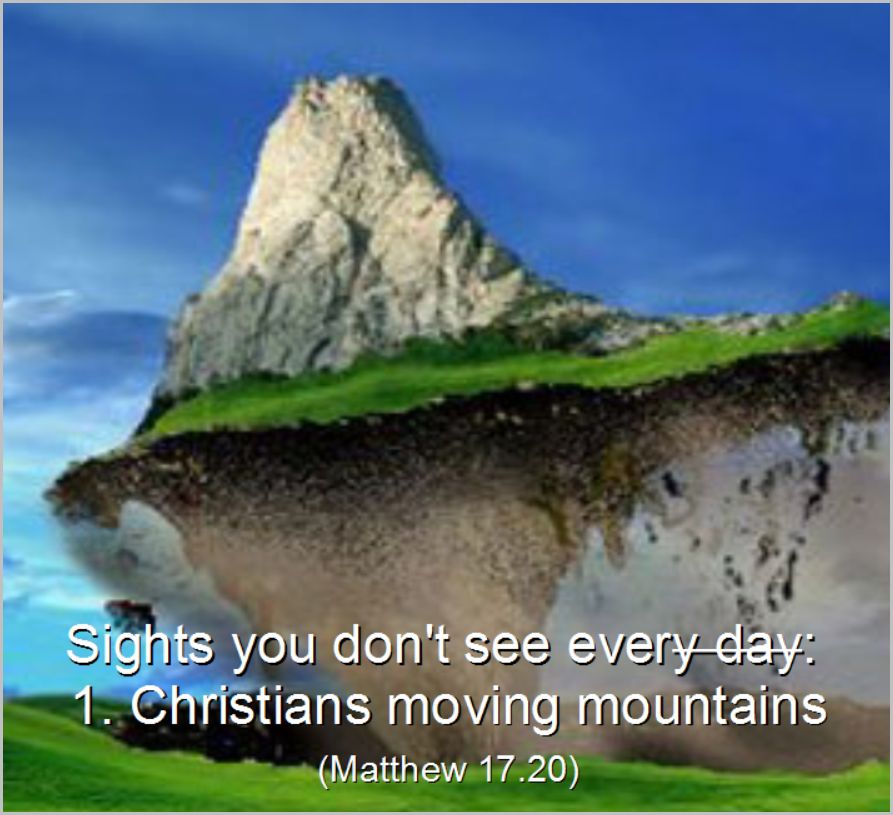
MountainsWhat is faith?

The anonymous author of the book of Hebrews says it’s ‘the substance of things hoped for, the evidence of things not seen.’ (11.1)

Hoping for ‘things’ like perfection, resurrection, eternal life, heaven (not to mention the ability to move mountains), the likes of which no-one has ever achieved, is nothing but wishful thinking. Despite what the Hebrews author says, wishful thinking isn’t evidence of anything – except a capacity for wishful thinking.

By it’s very nature, then, faith is not evidence, but the very opposite. It is the effort to believe in things for which there is no evidence and the delusional insistence that the imagined is more real than that which is.

Is It Wise To Be An Atheist?

Tract

Christians say the funniest things… like ‘atheists can’t possibly know that there’s no God.’

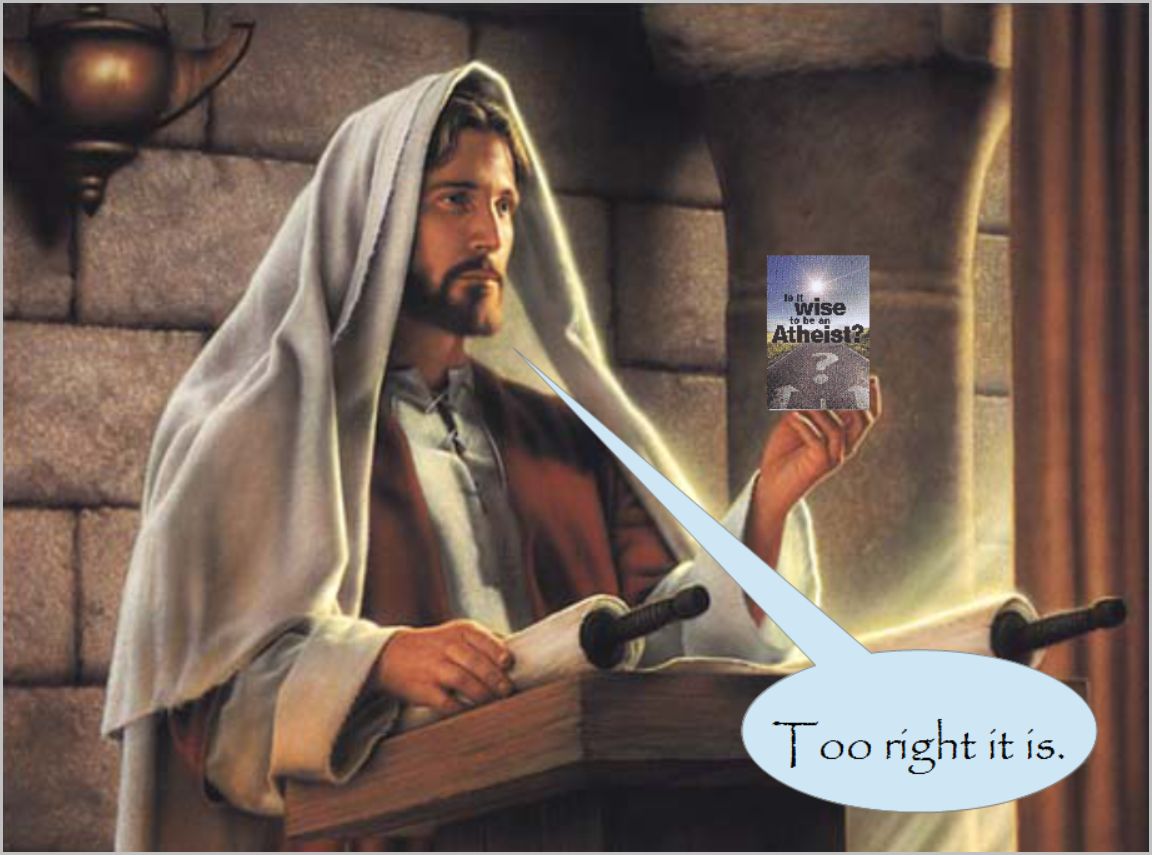
This is the argument expressed in a tract,  Is It Wise To Be An Atheist?, that I was given on the street the other day:

A person cannot really be sure there is no God (unless) they have existed for all time and have identified that God isn’t there; they have been everywhere and have seen that God isn’t anywhere and they know everything and therefore know for certain that God is non-existent.

Safe to say, these are not the same impossible criteria Christians apply when determining whether deities other than their own exist. Even Christians know that Allah, Zeus, unicorns and the tooth fairy don’t really exist. But without being immortal, omnipresent and omniscient, they cannot know for sure. By their own criteria, all mythical/supernatural beings have as much chance of existing as their God. Yet Christians do claim, with reasonable certainty, that other Gods and imaginary entities are not real. This is because determining the authenticity of entities is not about absolute certainty but probability and, yes, reasonable certainty.

For reasons I explore on this blog – here, here and here, for example – the likelihood that a god of some sort exists is low. That that god should then turn out to be the one worshipped by Christians today reduces the possibility still further, on the basis that the more conditions one adds to a proposition, the more improbable it becomes.

To put it another way, the probability that there is no god is already high; that there is no God as conceived by Christians is higher still. Therefore it is reasonable to conclude he does not. This is reasonable certainty; the same reasonable certainty Christians apply when dismissing all other gods.

Better luck next time, Christians.

Arguing for God

God3It’s a funny thing, but there aren’t hundreds of sites on the internet arguing for Barrack Obama’s existence. Nor the Eiffel Tower’s. Nor Australia’s. Nor the moon’s, nor the universe’s.

Why not? Because we have an abundance of empirical evidence that all of these things are real. People have experienced them first hand, can observe them and interact directly with them. There is no need to ‘prove’ or argue for their existence.

There are, however, hundreds of sites – plus books and broadcasts – that argue for the existence of God. This is telling. It is, whether those offering such arguments realise it or not, a blatant admission that there is no empirical evidence for him. If there were, there would be no need for argument and ‘proofs’; no need for apologists to resort to persuasion that is ultimately self-refuting to ‘demonstrate’ his existence. No need for apologists. Their problem is, of course, no-one has ever met God nor observed or interacted directly with him. Not in the same way people have met President Obama, seen him on the television, heard him speak or interacted with him in person. No-one has done anything of the kind with God, not even those who claim they have and feel compelled to tell us all about it. Every encounter with the Almighty has taken place in the mind of the individual experiencing it, just as St Paul admitted. God himself has never made an appearance.

So, yes, it’s very telling, this having to argue for God. If there was clear evidence of him there wouldn’t be any need to devise arguments for his existence; he’s not, or shouldn’t be, a philosophical proposition. An omnipotent, omniscient, omnipresent, creative being would, by dint of his immanence (presence in this world), be somewhat obvious and there would be incontrovertible evidence of his existence. Christians and other god-botherers say there is such proof, citing Nature, Goldilocks universes, Holy Books and personal experience. But these are far from incontrovertible, being much better explained by other means, none of which involve God. His very superfluousness demands that, through the application of Occam’s razor, he be discarded; not, as apologists would have it, rebranded as ‘transcendent’, a sleight of hand allowing them to proffer unreality as the ultimate reality.

The desperation to convince others there’s a God with an existence outside the human imagination is, then, more than adequate demonstration that there isn’t. Christians and others who want us to believe their God is real, protest much too much and in so doing, demonstrate precisely the opposite.

God’s Ache

 TBNI was going through my nightly ritual of channel-hopping before going to bed the other night when I lighted on a station called ‘TBN’. ‘TBN’, for the uninitiated, stands for ‘Trinity Broadcasting Network’. It is managed and operated by a posse known only as the Father, Son and Holy Spirit. No-one else is involved. These three have decided the best way to get the word out to the masses is to do it on the TV, which, I suppose, beats the old-tech approach. I mean, who reads books these days?

The Father, Son and Holy Spirit Collective was evidently having a night off and had delegated the job of running the station to an ordinary mortal (whose name I was sure I’d remember but have already forgotten). This chap was telling everyone – I say ‘everyone’ though he was standing in an empty attic – just how much God loves us and yearns to heal us. That was his word, ‘yearns’, which means to desire strongly or to ache to do something.

And I found myself wondering why he doesn’t – heal us, that is. I’ve already shared my thoughts on the Godhead’s abdication of any hands-on demonstration of his love, but if this bloke was right and God really does want to heal us – then why doesn’t he just get on with it? He could post a big miraculous sign in the sky saying ‘Hi. It’s me, God. I’m doing all this, the healing you’re seeing all over the world,’ so everyone would know it was him and not aliens or some super-advanced scientists who’d travelled back from the future. Or – even better idea – he could have it broadcast on his very own TV station. If he’s not available to do it himself, what with all his preparations for the miracle-to-end-all-miracles, he could get one of those Holy Joes who’ve got a direct line to him to announce it for him. Franklin Graham maybe, or Jan Crouch, who could have her hair roughed up specially:

Starting tomorrow at 12.00 the Lord God Almighty will be curing every illness, healing every psychological and physical ailment and eradicating all illness, just like he said he would way back when (in Isaiah 35.5 and Matthew 11.5 if you’re interested). Okay, he’s a little behind schedule but he’s been busy and, well, better late than never.

Something like that.

If the Lord doesn’t care for either of these splendid options then surely he can come up with a better alternative; according to his human mouthpieces, he sends storms and earthquakes when he’s unhappy, so he could easily conjure up something nice for a change. He’s a creative sort, after all. Not to mention omnipotent.

Now I know there are a couple of theological flies in the ointment that would make all of this difficult for him. The first is Kryptonite. Or human sin… one or the other. But he could obliterate this at the same time, couldn’t he; make us all perfect first then the Kryptonite couldn’t harm him while he’s busy fixing us. I know, you’re going to tell me this would be an infringement of our free-will. But there’s nothing Biblical about free-will. God’s never been keen on it, preferring instead to choose his buddies up front, and in any case, he’s going to eliminate it completely once they’re all taken up into Heaven. So it really wouldn’t hurt him to make some sort of decision about it now. With free-will gone he could just get down to the business of making us all better, not forgetting to take credit for his work in one of the mysterious ways I’ve suggested.

‘What’s in it for God?’ I hear you ask. Well, my tele-evangelist failed to say, but I can think of at least three benefits: 1. He’d get over his ache. Instead of just yearning to do something about disease he’d have actually done something and this would make him feel a whole lot better about himself. 2. He wouldn’t have to worry about Kryptonite any more. 3. He’d have lots of new friends that he wouldn’t then have to consign to Hell.

To be honest, I can’t see why God hasn’t done something like this already. His first idea, to bully a load of ancient tribesmen into submission, didn’t work so well and Plan B just ended in tears. Let’s face it, it wasn’t the greatest of ideas. This though is a far better option. So if you’re listening God, it’s yours, gratis.

                        God?

                                      God?

All in the mind

Disaster

A new minister at the church near where I live has announced his plans to bring ‘God’s love’ to people in the parish. This sounds laudable enough, I suppose – it’s better than delivering God’s condemnation and judgement as many holy rollers are prone to do – but it begs the question why God doesn’t deliver his own love in person. Why is it he feels he can only channel his love through flawed and fallible human beings? Why doesn’t he engage intimately with his creation and let his love be known and felt directly? Why doesn’t he show his love by eradicating cancer, say, or preventing natural disasters, or exterminating the mosquitoes that cause the deaths of up to 2.7 million people every year? Why, in anything that would count as a tangible expression of God’s love for the world, as declared in John 3.16, is there a singular lack of evidence for both his love and his very presence?

‘Ah, but wait!’ say any Christians reading this. ‘God’s love is made manifest through his people, just as the new minister suggests.’ But this is my point; if I only ever expressed my affection for my loved ones through intermediaries – or even strangers, as this minister is to me – or only through a succession of Valentine’s cards, what sort of impression of my love would they have? They would, I think, be unconvinced of it, because love is not just a distant expression of feeling; it’s what we do for others. Love is action.

‘Ah, but wait again!’ say the Christians. ‘What about the second part of John 3.16 that tells us that God showed his love for the world by sending Jesus to die for us?’ You’ll pardon me, won’t you, if I find that a paltry and pathetic expression of love? If I had somehow expressed my love for others millennia ago, no-one at this distance would be impressed by a largely symbolic ‘gift’ proffered only after its original intended recipients declined it (Matthew 22. 8-10).

God didn’t really do this, of course; he didn’t send Jesus, didn’t instruct Paul to extend to all and sundry the offer of salvation that Jesus made only to Jews, didn’t transmit any sort of time-travelling compassion to reach us in the present; doesn’t express his love through other flawed human beings today. How do we know this? Because there is no God to show us love nor to judge or condemn us. Any judgement, condemnation or love is expressed by other human beings, frequently in the name of one god or another but humanly derived even when drawn from a holy book. Gods don’t write books; they’re human creations too.

Everything to do with God, from his very existence and all of his supposed attributes – his aversion to sin, his revelations about himself, his miraculous and mysterious ways, his answers to prayer, his non-answers to prayer, his supposed offer of eternal life, his holy books and his hatred and love – derive from human hopes and fears and our need for explanation. We know this because God’s love and all his other supposed characteristics are made manifest through human agency and in no other way; they have no existence outside the human imagination. So the new minister’s love can’t really be from God. At best, it will be a level of interest and concern for a limited number of people, because that is all that is humanly possible. Even so, it’s more than a God with no direct dealings with his creation can manage. Every expression of who he is, how he thinks and how he behaves is a projection of how human beings think and behave. That is why he is so maddeningly inconsistent across cultures and even within them, depending on which cult (and they’re all cults), denomination or church claims to be representing him. The Christian God is, like all the others, a human creation and all manifestations of him – including his much vaunted love and the relationship believers claim to have with him – are entirely human too.

What Does Atheism Have To Offer? (Part Three)

Celia17. Atheism offers knowledge instead of belief
‘But you must,’ Christians have said to me, ‘believe in something greater than yourself’ and ‘You can’t deny your spiritual needs.’ Well of course there are things greater than me and of all of us. The universe for a start; love, beauty, friendship, music, great art, nature, the night sky – sex even. Who hasn’t had a spiritual experience through their appreciation of these things? The fact they exist though, makes ‘belief’ in them redundant. We only need ‘believe’ in those things for which there is no evidence – which is why you can’t ‘believe’ in evolution; you can only know it as fact. Similarly, atheists know there are greater things than themselves. They don’t, as a rule, worship them, but appreciate them, often in awe and wonder, for what they are. As for such experiences being ‘spiritual’, we do not, of course, have ‘spirits’ either to nurture or express. We are emotional creatures and the value we find in those things greater than ourselves often stimulates sublime emotional responses. Nothing wrong with that, of course, but our responses reflect conditions within us, not the supernatural without.

8. Atheism offers the embrace of reality
Part of the inherent honesty of atheism is its recognition that this life is all there is. Atheism faces up to the fact that we are organic beings and like all organic beings our lives come to an end; there is nothing in us, no part of us, that survives death. Knowing heaven and eternal life are impossibilities atheism promises neither. Religions do, of course, and that is their great selling point but no-one, apart from atheists, seems to notice that they never actually deliver what they promise (because they can’t.)

Christians also tell atheists that it takes more faith not to believe in God than it does to believe in him. They need only look to their own experience to realise this cannot be so: they don’t need faith not to believe in Allah, Santa Claus or any number of other mythical beings. Equally atheists don’t exercise any faith at all not believing in Yahweh.

9. Atheism offers, unfortunately, an unsatisfactory name
One thing I wish atheism made possible but doesn’t – not yet anyway – is a better term for one who is unencumbered by gods, the supernatural and superstition. I have no wish to be defined by what I’m not, which is how ‘atheist’ works. It also implies that being a theist is somehow the default position and that any other is an aberration. I quite like ‘humanist’, but that doesn’t quite capture it either, but I’m not keen at all on Richard Dawkins’ suggestion of ‘bright’. The tide is turning though and once absence of belief becomes the norm, the right name for the true default will present itself.

10. Atheism offers a sense of well-being
Happiness, tranquility, peace perhaps don’t come from atheism per se, but they do stem from it: the opportunity for the consciousness I think of as ‘me’ to experience life in the here and now. I know many are not able to enjoy being here to the same extent that I and many in the west are able to, but this only makes it more important that we all do something to help improve the lot of others. As the nineteenth-century atheist Robert Ingersoll expressed it, ‘the time to be happy is now, the place to be happy is here, and the way to be happy is to make others so,’

As I write, Queen’s ‘Who Wants To Live Forever?’ is playing on the radio. It hardly matters who wants to; we can’t and we don’t. And – same group, different song – it’s true that ‘nothing really matters’. Really, it doesn’t, and so we are free to get on with living instead of trying to impose our beliefs on others, exterminating those we don’t like or squandering our one and only life because we think there’s a better one waiting. Atheism is far from nihilistic – it allows us to see the value of this life and helps us live it to the full.

So, what has atheism to offer? Freedom, honesty, meaning, contentment. Or, to put it another way, and to paraphrase what somebody or other once said, atheism really is the truth that can set you free.

Big Bang Theory

BigBang

You’re probably familiar with William Paley’s teleological argument for the existence of God. If you haven’t used it yourself then you’ll have been subjected to it by proselytising believers. A couple of days ago I had someone treat me to an updated version of the argument.

I was on the phone with a sales-person, talking about his company’s product, when he decided it would be a good time to dust off the old idea, give it a make-over and use it to convince me of God’s existence.

He started by asking me if I would agree that a computer must have an intelligent designer; I agreed this was so (though I have my reservations.) He responded with ‘how much more then must the universe and life on Earth – being so much more complex than a computer – also have an intelligent designer.’ He said this was ‘something to think about,’ and I agreed it was, though maybe this wasn’t the best answer I could’ve given.

Having ‘demonstrated’ that everything must be intelligently designed, my new friend announced that this was therefore irrefutable proof that Allah must have made everything.

Oops. I’m sure this isn’t what the Reverend Paley had in mind when he devised his watch analogy two centuries ago. His proof, however, is every bit as much a demonstration of Allah’s existence and creativeness as it is Yahweh’s. Or Vishnu’s or Marduk’s or any other of the multitude of deities credited with intelligently creating the universe and life in this insignificant part of it. Any one of them could’ve done it according to the teleological argument. Take your pick and sign up for the set of beliefs that corresponds with your choice.

But wait – complex machines like watches and computers bear no relation to anything in nature. A watch found on a heath, as Paley conjectures, or computers in hedgerows, can only have got there because a human being put them there (fly-tipping again). They would not be there because they’d arisen, like the rocks, grass and other plants that surround them, through the processes involved when nature creates something. Moreover, we know that machines have intelligent creators, because we are they. What doesn’t follow is that because man-made objects are demonstrably the product of intelligence that natural ones, which, remember, bear no relation to computers, watches, cars and CAT scanners, are as well.

We are gaining more understanding of how the universe came to be. Significantly, it doesn’t require that there is intelligence behind it. If it did, we would then need to explain how that intelligence arose, who created it and by what process. To say, as religious believers are wont to do, that this supreme intelligence has always existed is no explanation at all. If we’re to have something that has always existed then it is far more likely to be that which we know really does exist, rather than something we don’t. Conceding the longevity of the components of the universe, which we know to exist, is a far better bet than inventing deities to account for it. A God no more explains life, the universe and everything than do fairies the intricacies of my computer (gremlins maybe, but not fairies.)

For all that, life on Earth does have a creator. The genealogy of the universe tells us that physics begat chemistry begat biology. (‘But if life emerged from physical and chemical processes, then how come there’s still physics and chemistry?’) All life on Earth, including ourselves, is the product of these processes, ‘the blind watchmaker‘ that Richard Dawkins speaks of. They are not intelligent, do not have names like Yahweh or Allah and do not, on their own, create the machines that only humans can design.

You’re all sinners!

BabyYou are a sinner. You deserve the wrath of God. After you die, you will meet God face to face and because of your sin he will throw you into the pit of hell for all eternity. But repent of your sin and believe the gospel and instead he will cast your sin away from you, as far as east is from west.

Or so said the street preacher in the centre of town at the weekend (yes, our old friend Dale McAlpine; he who suffers excessively from religion-virus).

I’m not a sinner. And neither, dear reader, are you. Sometimes in my life I’ve behaved badly, it’s true. I’ve hurt other people, though usually unintentionally, and I’ve been thoughtless. I’ve been unappreciative of loved ones and haven’t done enough for others. I’ve said things I shouldn’t and have occasionally lost my temper. I’ve even had sex when it wasn’t for making babies.

Maybe you’ve done similar things and, like me, have transgressed the moral law (which is entirely of human making) in all of these minor ways. Others have transgressed it, and the societal laws it gives rise to, in far worse ways, by deliberately hurting or abusing others, raping and murdering.

But still neither they nor us are sinners. Whether we have behaved reprehensibly or only a little thoughtlessly, we are still not sinners. We are human and we behave as humans behave; as evolved apes our developed brains jostle with animal natures, and we act as our distinct environments have taught us. ‘Sin’, on the other hand, is a distinctly religious concept, a component of a fantasy perspective of life with no purchase outside of its religious context. The problem with it is, however, that it has intruded for the best part of a two thousand years into reality, into life as it is lived by most people most of the time, and we’ve grown used to it. We give it credence when it’s talked about or preached from pulpit or soap box. But it is a meaningless concept.

The word for sin that is used most frequently in the New Testament (221 times) is ‘hamartia’, an archery term meaning ‘to miss the mark’. It means not being as good as we could be; not coming up to God’s standard: ‘for all have sinned and fall short of the glory of God,’ as old wingnut Paul puts it in Romans 3.23. And this is the secondary – some would say primary – application of the idea of sin; it denotes our separation from God. The thinking behind this idea goes as follows: there must be a reason God always seems so distant, remote, far away, elusive and absent from us. And because he’s God and so wouldn’t behave in such a cold-hearted way if we didn’t deserve it, it can only be our fault. His distance, therefore, can only be because of sin, our failure to behave and be, from the moment of our birth, as he would want us to. Yes, sin really is God’s kryptonite and, according to Christian doctrine, Jesus came to be the lead lining that blocks its rays.

But this is an unnecessarily convoluted way to account for the perceived divine distance. It is much better explained by God’s existential and literal absence. It’s not our fault he’s so far away – or rather it is, but not because we sin. In our childish need to have someone out there who both explained everything and cared for us, we made him up. We anthropomorphised an insentient, indifferent universe, which could only ever lead to a God who felt distant and remote.

So, as Dale was recommending on Saturday, free yourself from ‘sin’. Recognise that you don’t fall short of the glory of God, because no such thing exists, and that you behave as you do because you’re human. And then you will be free indeed.