Revealing the Truth of John’s Revelation

The revelation from Jesus Christ, which God gave him to show his servants what must soon take place. He made it known by sending his angel to his servant John, who testifies to everything he saw – that is, the word of God and the testimony of Jesus Christ.

Blessed is the one who reads aloud the words of this prophecy, and blessed are those who hear it and take to heart what is written in it, because the time is near… “Look, he is coming with the clouds,” and “every eye will see him,
even those who pierced him”; and all peoples on earth “will mourn because of him.”
So shall it be! Amen…

On the Lord’s Day I was in the Spirit, and I heard behind me a loud voice like a trumpet, which said: “Write on a scroll what you see and send it to the seven churches: to Ephesus, Smyrna, Pergamum, Thyatira, Sardis, Philadelphia and Laodicea.” I turned around to see the voice that was speaking to me. And when I turned I saw seven golden lampstands…

So begins the Book of Revelation, written by a fanatic identifying as John (think Steven Anderson) who finds himself on the island of Patmos ‘because of the gospel’, with an account of the imminent end of the world (1:3 ‘the time is near’ and 1:7 ‘even those who pierced him’ will see him.)

What follows is a disturbing and disturbed account of what the Earth could soon expect when Jesus descended from the heavens to wreak vengeance on sinful human kind.

John claims the scenario he’s about to describe was given to him by an angel who got it from the Lord Jesus Christ, who in turn received it from God himself (1:1). Or perhaps the angel and Jesus Christ are one and the same. Did John regard Jesus Christ as an angel, the ‘messenger’ of God (the literal translation of the Greek angelos)?

I’ve often wondered about this ’revealed’ business. Paul too talks about having Jesus ‘revealed’ in him (Galatians 1:16). What exactly are Paul and John talking about? John says he ‘saw’ (1:2) all that he’s about to describe in the next twenty-two tedious chapters, as if this ‘revealing’ is some sort of vision or hallucination. Given the complexity of what he then describes, this seems to me highly unlikely. He ‘sees’ in his mind’s eye god’s throne, attendant angels, the four horsemen, the opening of seven seals, the destruction of the world, the annihilation of most of mankind, the descent from heaven of the holy city, the intricate details of the construction of this city… read the book for yourself for even more. Even dreams are not this detailed or vivid.

I’m not convinced Paul saw the resurrected Jesus as a figure in front of him (or as a bright light or some other quasi-physical manifestation.) What Paul and John did when ecstatic with religious fervour – what John describes as being ‘in the Spirit’ – was concoct an explanation for the way they were feeling; Paul persuaded himself he’d seen a resurrected God-man and worked out over time what this might mean. He then attributed this thinking to his God and his divine influence. John under persecution (it’s generally accepted his being on Patmos ‘because of the gospel’ (1:9) was as punishment for being a public nuisance) fomented a doomsday scenario for those who persecuted him and the divine elevation of those who believed like he did, and attributed this to spiritual beings. The scenario was not revealed instantaneously to him by a supernatural agent; again, it was something developed over time – hence the quotations from other sources (1:7) – in an aggrieved fanatic’s head.

Revelation is a calculated literary construct, like the gospels themselves, devised and refined over time. John ‘saw’ none of it, nor did he ‘hear’ an actual disembodied voice telling him about living room furniture (1:12’s lampstands). No higher power ‘revealed’ any of it to him. On the contrary, he devised it himself, working out every aspect in his head. Either he was deluded enough to think he was actually being fed revenge-porn by an angelic Jesus or he cynically, deliberately attributed it to him.

There was not then, as there is not now, a heavenly Jesus who spoke to susceptible mortals here on Earth. The savage, avenging Jesus that John of Patmos creates from his own anger, bitterness and sense of persecution bears little relation to the other versions of the character in Paul and in the gospels (as Ehrman demonstrates in Armageddon). Revelation’s savage, slaughtering Jesus is at least the sixth manifestation of the character proffered in the New Testament. John demonstrates just how easy it was, and is, to invent one’s own version of a supposedly unchanging character (Hebrews 13:8; Revelation 1:8) and make him do, at least in your imagination, just what you want him to do.

Dying For A Lie, part 94

Over on Gary Marston’s Escaping Christian Fundamentalism, he has been arguing, along with some of you, about the resurrection with Joel Edmund Anderson, self-professed expert on all things Biblical. Joel – he has a PhD in Biblical Studies, don’t you know – has twice said in the discussion that the disciples would not have died for a lie, meaning they wouldn’t have let themselves be martyred if they hadn’t really seen Jesus alive again in the flesh.

I’ve addressed the assertion that they wouldn’t have died for a lie several times already on this blog: here, here and here for example, though some of my thinking about the Jesus phenomenon has changed since then. Nonetheless, I added my penny’s worth to Gary’s discussion (it’s difficult to get involved in real time because of the time differences between the US and UK):

And there it is again: ‘they wouldn’t suffer death and persecution for what they knew to be a lie.’

While you (Joel) mention the execution of James there is no evidence even in your hallowed text that this was because he believed in the bodily resurrection of Jesus.

The later legends of the martyrdoms of Peter and Paul are just that: legends. (And Paul wasn’t even a disciple! Moreover, he is clear in Galatians that his experience of the risen Jesus was ‘in’ his head.) There is no evidence, none at all, for your claim that ‘the disciples’ (all of them?) died or were even persecuted because of their belief in a bodily resurrection.

If some were put to death, it could equally have been because of their abandonment of conventional Jewish beliefs; their provocation of religious authorities (there’s plenty evidence of this in the gospels); their replacement of emperor worship with a deified itinerant preacher or for political reasons. We simply do not know.

That said, there are zealots today prepared to die for lies (think 9/11, Islamist terrorists) so there is no reason to think it didn’t also happen 2,000 years ago.

This line of argument, as ‘proof’ of the resurrection is exceedingly weak, Joel, yet it appears to be all you’ve got.

Joel did not respond. I feel sure he will make the claim again at some point in the future because it’s what he, like many other Christians, want to believe, which is really what ‘faith’ is all about.

Evidence of God

As for evidence, you might be aware of Israel. That nation has been in the news much of late. So, without being flippant at all, I present Israel as evidence. Think about it. They are living the script written thousands of years ago. Not by chance.

Israel as evidence for the existence of God. I’m thinking about it as Don suggests.

Where did it all begin, this bizarre notion that one tribe in the Middle East was chosen by God to be his special people? According to the Genesis myth, it was when YHWH promised Abraham he’d be his best buddy forever and ever, so long as he mutilated his body and those of his sons in perpetuity. They would also have to keep every one of this bullying god’s 365 rules and regulations, including the petty and piffling ones. So far so good, apart from the fact it was all very one-sided, and the mutilation of course. You’d think this would’ve been a sign that things weren’t quite kosher, but no; Abraham and his descendants buy into it and almost straight away, YHWH begins to let them down.

God’s Chosen Ones soon find themselves slaves in Egypt. A second mythical character is needed – up pops Moses – to get them out of this scrape. Unfortunately, after Moses has finished chatting with YHWH, who identifies as a burning bush on the top of a mountain, the sulky deity feels slighted by something the Israelites are doing. As is his way, he has many of them slaughtered and the rest he forces to troop around the same small plot of land for 40 years. This is how best buddies treat each other!

Later, the Jews find themselves defeated by the Babylonians and are carted off into exile. This exile, which YHWH does nothing to prevent, lasts 70 years. Still, it leads to a pleasant song made famous by Boney M in 1978 so I suppose it was worth it.

For the next few hundred years, Israel falls under the rule of other nations more powerful than itself. Not to worry though, YHWH is still ‘looking after them’, particularly those who are slaughtered in the rebellions that ensue. As Robert Conner says in a recent comment on Debunking Christianity, ‘If Yahweh ever threatens to bless you and your children, just kill yourself and get it over with.’

Fast forward to the Roman occupation of Israel. YHWH, having undergone a makeover, reneges on his promise to take care of his Chosen Nation forever and ever and comes up with a different plan to save people from his own cussedness. Now, if they want to continue as his friend, they have to believe a supernatural being has returned from the dead.

Abandoned by God, as he now wants to be called, Jews who haven’t defected to the new faith see their sacred, eternal temple destroyed by the Romans in AD70. Thousands of them are massacred and the Jewish nation ceases to exist.

This sets the pattern for the next two millennia in which God’s new friends organise pogroms, massacres and vicious persecution of Jews. This culminates in the Final Solution of the Third Reich which seeks to eliminate the Jewish people entirely. While awaiting extermination in a concentration camp, Andrew Eames scrawls on the wall of his prison: ‘If there is a God, He will have to beg for my forgiveness.’ God allows six million of his Chosen People die at the hands at the Nazis.

Following the second world war, Israel takes possession of the area surrounding Jerusalem, then occupied by Palestinian Muslims who are themselves descended from earlier immigrants. Thousands on both sides are slaughtered in the conflict that follows. In 1948, after almost 2,000 years, Israel becomes a nation once again; not through any miracle of God but as a result of human endeavour and bloodshed.

Tension and further skirmishes followed, leading to the present day when Israel finds itself under attack by Hamas terrorists. Thousands of innocents – women, children and babies – have been slaughtered without mercy. Israel is, as I write, retaliating and intends to enact further vengeance. And where is God in all this? You guessed it: nowhere to be seen.

All of this, according to some – including the naive writer at the top of this post – serves as evidence of God’s existence. That Israel has persevered for so long, despite opposition, persecution and the holocaust is not, however, evidence of God, any more than the great cathedrals of the world are. It is instead testimony to the resilience, resolve and sheer bloody mindedness of the people themselves. Perhaps their belief in YHWH (they don’t of course recognise his Christian counterpart) has fuelled their persistence, as it has their territorial claims.

Jewish beliefs and history are not evidence that YHWH exists. If anything, his apparent abandonment* during their many trials and tribulations is evidence to the contrary.

*Of course a non-existent entity can’t actually abandon anything, any more than it can lend its support or favour one group of people over another.

The Son of Man

I started wondering why, if his creators believed him to be the Messiah, they have gospel Jesus habitually refer to saviour-figures in the third person? He does it Matthew 23 which we looked at couple of weeks ago, when he talks about there being ‘one instructor: the Messiah’, and he does it repeatedly in all four gospels when he refers to ‘the Son of Man’. The term comes from Daniel 7:13 where it is rendered as ‘one like a son of Man’.

In my vision at night I looked, and there before me was one like a son of Man, coming with the clouds of heaven. He approached the Ancient of Days and was led into his presence.

The interpretation of which, supplied in Daniel 7:27, is that:

The sovereignty, power and greatness of all the kingdoms under heaven will be handed over to the holy people of the Most High. His kingdom will be an everlasting kingdom, and all rulers will worship and obey him (my emphasis).

The phrase used for ‘son of Man’, bar enash, means simply ‘human being’ and is used to contrast with the ‘beasts’ of nations that the ‘prophecy’ says will rule prior to this. However, as Daniel explains, the human being in question is the nation of Israel – the holy people of the Most High – who will finally triumph over the four beastly nations that will dominate the Earth first. The nation of Israel will metaphorically emerge from the clouds and join the Ancient of Days to rule from Heaven. There is no mention anywhere in the Daniel dream-prophecy of a Messiah or individual human being who will accomplish any of this.

As Neil Godfrey puts it:

The coming of this “Son of Man” is within the realm where one expects deities to travel. The coming is, moreover, to another station within the clouds, namely the throne of the Ancient of Days. The context again explains that this “coming” is effecting a change of rule on earth. A kingdom is falling, and freedom is given to “the saints of the Most High”.

Nevertheless, it is this title – the now fully capitalised ‘Son of Man’ – that Mark has Jesus assume. The other three gospel writers copy it from him. Paul, writing decades before them, seems not to know that Jesus used it. Evidently the celestial Christ he encountered in visions and revelations didn’t feel the need to mention it. (Hardly surprising when Mark is freely inventing years later.)

So what does this tell us about Jesus, or, more specifically, about how the Jewish Christians of Mark’s community viewed him?

A number of scholars (e.g. Ehrman, Carrier, Goodacre, Westar Institute) have argued (as have I in my own amateurish way) that gospel Jesus is constructed from ‘prophecies’ lifted from Hebrew scriptures. Other commentators have demonstrated how he is, in the first two gospels at least, the personification of the nation of Israel*. This isn’t just because he identifies with the son of Man figure in Daniel. He also equates himself with the Suffering Servant of Isaiah 53 and elsewhere. Strictly speaking, he is made to identify with the Suffering Servant by Mark and the other gospel authors, particularly Matthew, who all copy Mark’s original idea. As Isaiah 53 makes clear, God’s Suffering Servant is not a person: it is Israel.

Not only is Jesus identified with Daniel’s son of Man and Isaiah’s Suffering Servant – the personification of the Jewish nation – but Isaiah 53 is used as a template for his trial, mockery, crucifixion and resurrection. It is the nation that is God’s servant which, as Mark was writing, was going through trials, tribulation, suffering and apparent death: the destruction of Jerusalem and its temple, with thousands of Jewish people being crucified by the Romans.

So it will be Israel, Mark hints in his extended parable, that will emerge resurrected and who will ascend metaphorically through the clouds to sit at the right hand of God to rule the nations. He leaves out the details of this resurrection and ascension from the end of his gospel because at the time of his writing they had yet to happen. But, he tells his readers and listeners, they will. They have to because Daniel and Isaiah say so: after suffering comes God-assured victory. Mark’s Jesus story, then, is an allegory of the history of the Jewish nation and its projected future. The allusions to Abraham, Moses, the Exodus, Elijah, Isaiah’s Suffering Servant, Daniel’s son of Man and the accompanying ‘prophecies’ make this more than apparent.

Gospel Jesus is a metaphor (or indeed a simile, one who is like a son of Man/the Jewish nation), his life made to conform in every respect with the history of that same nation. He is an allegory as Mark makes clear throughout his gospel. 

The clues are there for all to discern and as Mark advises, ‘he who has ears, let him hear’.

*See Watts: Isaiah’s New Exodus and Mark and numerous Christian apologists who make the same point: Google ‘Jesus and Israel’.

What Jesus didn’t know

Blog416

Creating the picture for the previous post reminded me of how little Jesus, assuming he actually existed, knew of the consequences of his ‘ministry’. Here’s a few of the things he either didn’t do or had no knowledge of while he lived.

  • Jesus never read a single word of the New Testament. The earliest of its books, I Thessalonians, was written about twenty years after he died. The New Testament did not appear in its entirety until the end of the 4th century.
  • He never read any of the accounts of his life, the first of which didn’t appear until about forty years after his death.
  • He had no control at all over what went in any of the gospels.
  • He did not endorse them in any way, nor verify their accuracy.
  • He never met Paul nor was he aware of the fantastical claims Paul would make about him.
  • He had no idea he would come to be regarded as God.
  • He did not know that soon after his death, people would worship him as God.
  • He would not have anticipated that his teaching would be adapted for a Gentile audience. It is unlikely he would have approved if he had.
  • He had no idea a new religion would be created in his name.
  • He did not know anything about, nor did he anticipate, the Church. His apparent acknowledgement of it is a fabrication.
  • He did not know the damage those who followed him would do in his name.
  • He did not know that the Kingdom of God would never arrive on Earth, nor that the Romans would continue to dominate it for a further 400 years.
  • He did not know the world would continue pretty much as it was for another 2000 years.
  • He did not know of the scientific discoveries that would be made in those years that would invalidate his beliefs and worldview.
  • He did not know that, forty years after his ‘ministry’, the Jerusalem temple would be destroyed by the Romans. His ‘prophecy’ of it is a fabrication written after the event.
  • He did not know of the world beyond the Roman Empire, if he was aware even of that. He certainly did not know of the American continent.
  • He had no knowledge of the United States, founded more than 1,700 years after he died.
  • He had no concept of most, if not all, of the concerns of today’s evangelicals: religious liberty, right-wing politics, guns, abortion, ‘the homosexual agenda’.
  • He had no idea what his legacy would be: the arrested development of millions and of western society itself; pogroms, persecutions and inquisitions; a corrupt and abusive church; the psychological damage caused to innumerable people; his name hi-jacked for political causes he had never heard of and almost certainly would not have approved of.

None of this is what he saw for himself. He thought he would be ruling the world with his besties on behalf of Yahweh. Like every other mortal, he had no idea of anything that would happen after his lifetime. What does this tell us about him?

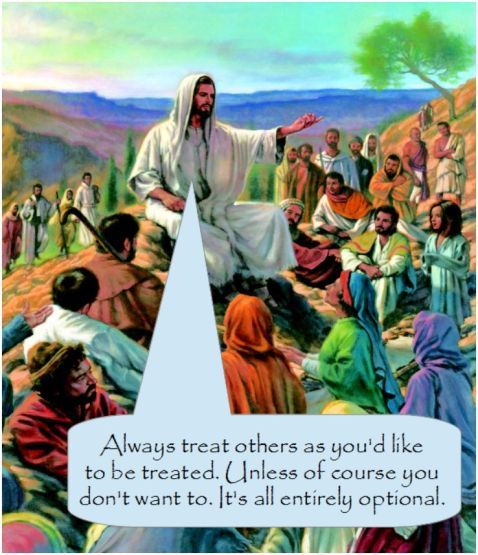
Whatever happened to the Golden Rule?

Blog375a

So in everything, do to others what you would have them do to you, for this sums up the Law and the Prophets. (Matthew 7.12: New International Version)

In everything, treat others as you would want them to treat you, for this fulfils the law and the prophets. (Matthew 7.12: NET Bible)

I went to see a performance at the Edinburgh Fringe on Saturday. Actor David Benson presented a one-man show about the Cato Street Plot, which was an 1820 plan to assassinate the British Prime Minister and government (or possibly not. It was probably a set-up.)

During the show, Benson riffed on some of Jesus’ sayings, including the one above, about how we should treat one another in a country that claims to be Christian (as Britain did in 1820). ‘Do unto others’ has become known as The Golden Rule and like most rules it is largely ignored, even (or especially) by many who profess to be disciples of the man said to have formulated it. The principle is of course much older than the gospels.

When I returned home I caught up with some of my favourite blogs and read about:

A military organisation that promotes the separation of church and state in the U.S. on the receiving end of Christian hate mail.

A preacher who thinks the comedian Sarah Silverman should have her teeth smashed before dying prematurely and being sent to Hell.

The same preacher promising that the Jews, who he says are not God’s Chosen People, will be made to bow down before male Christians, who are.

A different pastor who recited Bible verses while allegedly assaulting an under-aged girl.

The cover-up of the sexual abuse of minors by the Jehovah’s Witness cult.

A Baptist Preacher charged with sexual assault.

Thousands of hateful messages, many from Christians, sent to Montreal Pride organisers.

They just don’t get it, do they? Being a Christian means doing what Jesus says (doesn’t it?) and he says that in everything we should to treat others as we ourselves like to be treated. Note how all encompassing that is: in everything, meaning ‘in every circumstance, with no exception’.

My guess is that the majority of Christians like to be treated fairly, with kindness and respect. I know they do because they whine endlessly when they think they’re not being. Yet so many of them won’t extend the same fairness, kindness and respect – in every circumstance – to other people.

I recently saw a slogan that said ‘Why be racist, sexist, homophobic or transphobic when you could just be quiet’; too many Christians can’t even manage that. They feel compelled to hurl vitriolic insults and threats in defence of the most powerful being ever imagined (and he is imagined). Others think that people more vulnerable than themselves, children included, exist only for their own sexual gratification. These Christians have no interest in ‘In everything, treat others as you like to be treated’. It just doesn’t apply to them.

Strike up another failure for their Lord and Saviour, Jesus Christ.

Gilead – just a stone’s throw away

Stone3

Ken Ham’s Answers In Genesis thinks it’s okay to stone people. Specifically, your wayward kids. The bible says so and AiG’s Elizabeth Mitchell is eager to defend whatever the bible says, on account of it being ‘God’s Word’. She does warn us that we need to read Deuteronomy 21:18–21, where you’ll find this particular bit of parenting advice, in context, because although the bible is the fallible, eternal, literal word of the Creator of the Universe it needs interpreting, and has to be understood in terms of the time it was written.

The context is of course that Deuteronomy and all of the Old Testament was written by primitive, superstitious bronze-age tribesmen who had the same mentality the Taliban and Isis have today. But this isn’t good enough for ‘Doctor’ Mitchell. No, her context is altogether different; she tells us in an article recently posted on the Answers In Genesis Facebook page that Deuteronomy 21 isn’t talking about children. No, it’s referring to uppity teenagers, which makes it okay. And not just teenagers, but really, really troublesome ones, which makes it doubly okay. These really, really troublesome teenagers are the scourge of society and can be stoned with impunity. The bible says so.

And yet, they’re not. Christians don’t stone awkward family members, thankfully. Perhaps, despite articles like Mitchell’s and others’, Christians don’t really believe the brutality promoted in and by the bible. Mitchell offers no explanation for this inconsistency of belief. Instead, her article peters out with some incoherent rambling about Jesus; the same Jesus who declared his undying support for these brutal, Old Testament laws (Matthew 5.17-19).

I suggested in the comments on Facebook that it doesn’t matter how much one takes context into account, the command of Deuteronomy, that rebellious youths be stoned to death, is utterly indefensible. It is cruel, barbaric and belongs in the past when, presumably, unfortunate young people were actually killed in this way by their families and tribal elders. I suggested morals and standards have evolved for the better since the days when people considered that murder was the best way to deal with youthful bad behaviour.

And for that I was metaphorically stoned myself. How dare you challenge God and his Word! How ridiculous to suggest we have better moral standards today when clearly we are in an immoral abyss worse than any before! Last Days! God’s standards are inviolate and if he says the best way to deal with miscreants is to stone them to death then it is!

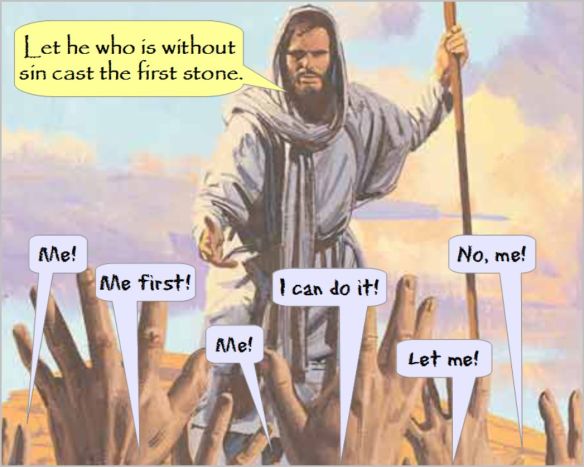
The Gilead regime envisaged by Margaret Atwood in The Handmaid’s Tale, where Old Testament sanctions are stringently applied in contemporary society, is closer than we think. People like those who hang around on Answers In Genesis’ Facebook pages, like flies around a corpse, would be more than happy to see the death penalty for those who infringe God’s barbaric laws. They’d be only too willing to throw the first stone, not only at difficult teenagers, but at all the others ‘God’s Word’ says merit the death penalty: couples who have sex when the woman is on her period (Leviticus 18.19); women who are not virgins on their wedding nights (Deuteronomy 22.13-14; 20-21); gay people (Leviticus 20.13); those who work on the Sabbath (Exodus 35.2; Numbers 15.32-36); blasphemers (Leviticus 24.16) and worshippers of other gods (Deuteronomy 13.6-9).

I am not an advocate of censorship but some form of censure is necessary for those who, either in speech or writing, advocate that others be put to death. Calling for the execution of those with whom you disagree or who have different moral codes cannot – must not – be tolerated in a civilised society. Pronouncements like those of Elizabeth Mitchell, her supporters and other religious crackpots who defend the indefensible, should be flagged up as hate speech, carrying a warning that the views expressed are themselves immoral, insupportable and, ultimately, illegal in civilised society. Ideally, their poisonous rhetoric should not be provided with an online platform. This wouldn’t, before anyone suggests otherwise, violate their right to free speech; they would still be free to express their unpalatable views in their churches, Creation Museums and own homes. Excluding them from Twitter, Facebook and YouTube, however, would deprive them of their wider audience – they’re only showing off, after all – and confine their hateful rhetoric to where it can do least harm.

These people are not merely ‘causing offence’ – offence is not the issue. They are inciting violence against others, influencing fellow believers to adopt their repellent views as their own. The standards of bronze-age tribes are not ours today; those who think they are abuse free speech and forfeit their right to be heard publicly.


Famous Christian makes fatuous comments

Sentamu3

The Archbishop of York, John Sentamu, has spoken out on one of the most important issues of the day.

       Chemical warfare in Syria?

                                              Poverty?

                                                     The repercussions of Britain’s departure from the EU?

No, none of these. Chocolate Eggs. Or more precisely Chocolate Egg Hunts – those arranged by the National Trust in conjunction with chocolate manufacturers, Cadbury. This year, you see, these are not being promoted as Easter Egg Hunts but as Cadbury Egg Hunts.

And I’m sure you can appreciate just how significant this is. Because you see, without the name of a Germanic goddess of fertility (from which we also derive the word ‘oestrogen’) in the title of such a deeply spiritual activity, then, according to Sentamu, ‘faith is being airbrushed out of Easter.’ After all, chocolate eggs were such a crucial part of the original Christian Easter story, when the first thing the resurrected Jesus instructed his disciples to do was find all the Easter Eggs he’d hidden round the garden. And so it came to pass.

That’s why omitting the word ‘Easter’ from the Egg Hunt is, again according to silly old Sentamu, ‘tantamount to spitting on the grave’ of John Cadbury, who was there for that very first Easter but didn’t start making chocolate eggs until 1875.

But wait! Wasn’t John Cadbury a Quaker? And isn’t it the case that Quakers don’t celebrate ‘Easter’ because of its pagan associations? So Mr Cadbury is hardly likely to be upset, even if dead people could be, at his company’s alleged metaphorical grave spitting. Furthermore, might it just have been the case that those original Easter Eggs were – and remain – a cynical capitalist cash-in on a festival that the man himself didn’t actually believe in? Oh my, yes.

So, here’s all that spitting right back atcha, Senty – one in the eye for all your vacuous, self-promoting twaddle.


Next time: Why the side-lining of cute and cuddly Easter bunnies is an affront to the faith of many devout Christians, by Theresa May.


The Kingdom Comes

This guy they think is going to save the world – or at least make his country great again – is one smug bastard. An egotistical megalomaniac who carries on as if he’s God Almighty.

He expects to be obeyed at all times, issuing orders he demands everyone follow, regardless of how reckless or impractical they are, and making promises he can’t possibly keep. He’ll countenance no dissent, argument or protest, lambasting those who challenge him with petty name calling and abuse. Being hyper-sensitive and childishly petulant, he takes offence easily, abandoning any semblance of rationality and becoming malicious and spiteful in his condemnation – damnation, even – of those he regards as his enemies. Despite this obnoxiousness, he can’t understand why he isn’t universally loved. That he isn’t, is, he tantrums, the fault of those who wilfully, stubbornly, refuse to recognise his magnanimity.

He says he’s pro-God, but what really matters to him is his own legend. His first love is himself. He’s self-focused and self-promoting, racist and xenophobic, divisive and irritable, obsessed with his own status and what he sees as his God-given mission to revitalise his nation and return it to those he regards as his own. To this end, he’s surrounded himself with acolytes, cranks like himself, who will serve as his yes-men and women, who’ll do whatever he tells them. In return, he offers them a share in the power he’s assumed, together with the privilege of enjoying a little of the glory he’s convinced is his. Naturally, these sycophants do his bidding; they know that if they don’t, they’ll be out, ejected from the inner circle as energetically as Porky Pig from a bar Mitzvah.

But enough of Jesus.

If only there were some sort of parallel in the world today that would help me convey what a delusional, controlling, self-aggrandising individual he really was. Sadly, I can’t think of any.

bannon


Imagine… no religion

Jimenez2People say, like, you know, “Aren’t you sad that 50 superstitious nut-jobs died?” Here’s the problem with that. It’s like the equivalent of asking me, you know, what if you asked me, “Hey, are you sad that 50 Christians were killed today?” Um, no, I think that’s great! I think that helps society! You know, I think the world is a little safer tonight!…

The tragedy is that more of them didn’t die… because these people are predators! They are abusers! They take advantage of people! And look, as Rationalists, we need to take the stand that it is not our job to sit there and say, “Oh, this is a tragedy” or “Oh, this is something we mourn.” Look, everything tells us these are deluded, wicked people. These are evil people.

… People sometimes will say, “You guys are advocating violence!” We’re not advocating violence! We’re not saying we should go do this! But we’re just saying this: If we lived in a rational nation with a rational government, then the government should be taking them… I wish the government would round them all up, put them up against a firing wall, put a firing squad in front of them, and blow their brains out. If we lived under a truly secular government that loved rationality and loved children, and wanted to protect them, that’s what we’d do.

Hate speech? Certainly. But not mine. The original, which you can find here, is about the Orlando shootings a few weeks ago, and is directed at gay people. I’ve simply replaced gentle ‘Pastor’ Jimenez’s use of ‘sodomite’ and ‘paedophile’, which he disingenuously uses interchangeably, with ‘Christians’ and ‘religious nut-jobs’, and his use of ‘God’ and ‘righteous’ with ‘superstition’ and ‘rational’. Jimenez, emissary of a religion of love (Matthew 5.44 etc), would like to see his government exterminate LGBT people.

But, you know, maybe there’s also a case to be made for eliminating the superstitious and irrational from among us. Those of us who have adopted a rational basis for our lives would be happy to see the end of religion and superstition, the removal from the Earth of the religious and the superstitious (I use the terms interchangeably). After all, what do believers in mumbo-jumbo add to the world that is any way positive? What can those who are unable to engage with reality without the crutch of make-believe possibly have to give? On top of their general uselessness, they’re also dangerous and predatory.

Maybe there is a case to be made. But I’m not making it. Any philosophy, ideology or religion that preaches the extermination of other people is wrong, debased, corrupt (you’d think, wouldn’t you, that we’d have learnt that by now.) If you subscribe to such a view – be it from a Christian, Islamic or Jewish perspective – you are wrong. No-one, whatever magic books may say about them, merits death simply because those magic books say so (ratified, of course, by the dim-witted prejudices of those who subscribe to them). Rationality and a secular perspective, on the other hand, eschew hatred and are philosophically opposed to harming those who might not agree with them. Yes, even the religious.

In this way it is vastly superior to religion – your religion, whatever that happens to be.