If not Metaphor, then what?

I’ve been arguing that everything in Mark’s gospel is metaphor (because he says so) but there are some pronouncements credited to Jesus in the synoptic that do seem to read as if they’re not. These look as if they are meant to be taken at face value: 

Mark 9:1 And he said to them, “Truly, I say to you, there are some standing here who will not taste death until they see the kingdom of God after it has come with power.”

Mark 10:21. Go, sell everything you have and give to the poor, and you will have treasure in heaven. Then come, follow me.

Matthew 5:39. But I tell you, do not resist an evil person. If anyone slaps you on the right cheek, turn to them the other cheek also.

Matthew 5:40. And if anyone wants to sue you and take your shirt, hand over your coat as well.

Matthew 5: 43-44. You have heard that it was said, ‘Love your neighbour and hate your enemy.’ But I tell you, love your enemies and pray for those who persecute you,

Matthew 6:24. No one can serve two masters. Either you will hate the one and love the other, or you will be devoted to the one and despise the other. You cannot serve both God and money.

Matthew 6.25. Therefore I tell you, do not worry about your life, what you will eat or drink; or about your body, what you will wear. Is not life more than food, and the body more than clothes?

Matthew 7:6. Do not judge, or you too will be judged. For in the same way you judge others, you will be judged, and with the measure you use, it will be measured to you.

Luke 6:30. Give to everyone who asks you, and if anyone takes what belongs to you, do not demand it back.

Luke 14:26 If anyone comes to me and does not hate father and mother, wife and children, brothers and sisters – yes, even their own life – such a person cannot be my disciple.

Perversely, these are the very commands that most Christians insist are intended metaphorically. This includes those who oppose the idea that, Jesus’ parables excepted, the gospels are in any way symbolic. I know from experience that they have any number of unconvincing arguments of why Jesus doesn’t really mean what he is made to say. For example: ‘these pronouncements are too severe and impractical to be taken literally’; ‘the verses are being taken out of context’, and ‘they have a deeper spiritual meaning’ (oops – that’d be metaphor, wouldn’t it?). Ask these same folk if the statements are therefore metaphorical and you can expect to be met with barrage of abuse.

If they’re not metaphorical, why do we not find Christians striving to live according to them: renouncing wealth, giving to all who ask, selling all they have, resisting no-one, judging no-one, hating family, becoming a slave and having no care for their own welfare for the sake of the kingdom that Jesus promised was imminent.

Because they don’t believe him. Easier to disregard his words about the kingdom arriving within his disciples’ lifetime and the instructions for living in the short time until then. The hard stuff is treated as metaphorical when it makes demands on Christians themselves.

Possibly they’re right. I’d suggest that the pronouncements like those above were not Jesus’s at all. They’re cult-speak; the extreme demands of cult leaders seeking to control their acolytes. In case this sounds like an about face on my part, let me assure you it isn’t; I’ve long argued that among the metaphor and the reworking of Jewish scripture, the gospels include copious amounts of early cult rules.

Whether they’re metaphor or extreme demands once imposed on cult members, no-one today takes much notice of Jesus’ commands. What does this tell us about their worth? What does it tell us about Christians from the earliest days until now? What does it say about their willingness to crucify themselves (definitely a metaphor) in order to follow him?

Jesus’ Ungrateful Slaves

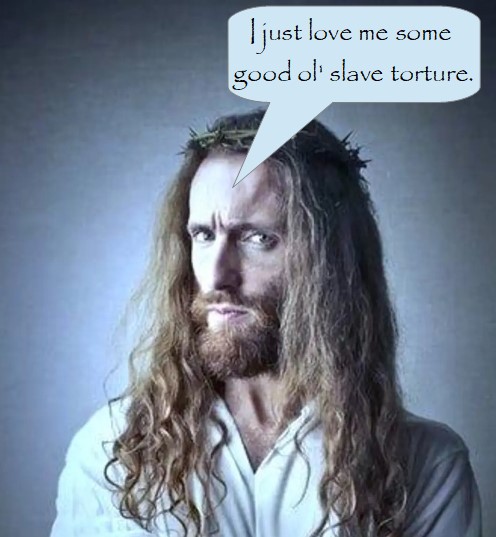
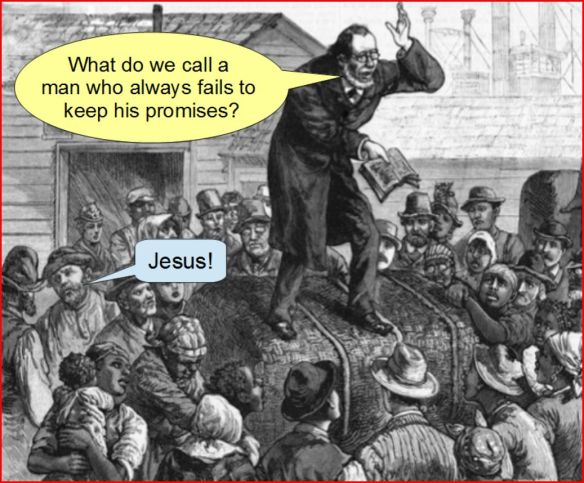
Jesus really liked telling stories about slaves. It’s as if he’d no objection to the inequitable arrangement of one person owning another. You’d think, if he really was the Son of God, he wouldn’t be quite so ready to assume unquestioningly, the zeitgeist of his day that decreed slavery was acceptable; necessary even. His being a man of his time, incapable of thinking beyond the assumptions and indoctrination of his culture might suggest he wasn’t a heavenly being at all. Either that or his creators, the writers of the gospels and the likes of Paul, were incapable of seeing beyond the zeitgeist and so made their god-man in its image.

In any case, they have Jesus tell a parable in Matthew 18:21-35 about forgiveness, which is populated once again with slaves and a slave owner. The story, in which a slave is forgiven by his master but fails in turn to forgive a fellow slave, ends with the following:

…after he had summoned him, his master said to him, ‘You wicked slave! I forgave you all that debt because you begged me. Shouldn’t you also have had mercy on your fellow slave, as I had mercy on you?’ And his master got angry and handed him over to the jailers to be tortured until he could pay everything that was owed. So My Heavenly Father will also do to you if each of you does not forgive his brother from his heart.”

Of course, the slave owner, referred at the start of the tale as ‘the king’ is – predictable metaphor alert – Jesus himself. He’s fond of casting himself in the role of kingly slave owner, with ordinary mortals his slaves. As we’ve seen already, this is the favoured analogy of New Testament writers to describe the relationship between their manufactured saviour and themselves.

Actually, the moral of the tale in this instance isn’t too bad; if you’re forgiven much it’s not unreasonable to suppose you could, in turn, forgive others their more minor offences. But this isn’t quite enough for Jesus’ script writers who have him drag jail, torture and retribution into the story. These, Jesus concludes, are the very things his wonderful Heavenly Father – based on the despotic rulers of the time – will inflict on anyone who doesn’t forgive as generously as they might.

What hypocrisy! Forgiveness is all according to Jesus but his Heavenly Father, he says with relish, will torture unforgivably anyone who doesn’t comply. What were the cultists who created this awful malicious character thinking? Jesus and everything to do with him is anti-human and soul-destroying.

As for me, I’d recommend forgiving others where you can, learning from the experience (once bitten twice shy and all that) and moving on. You won’t, whatever you do, be tortured by a fictitious, vindictive slave owner and his bullying idea of a god.


Jesus Is Cool With It

I was handed a sticker the other day that read ‘Jesus is cool with it’. Just what the hip Jesus of the sticker was cool with was explained by an accompanying leaflet, and the fact I was at a Pride event at the time.

I worked out from the leaflet and his rainbow flag, that what Jesus is cool with is homosexuality and all that goes with it. He might also be cool with transgenderism and other variations in human sexuality, but who knows; the leaflet didn’t say so directly. It did, however, have a list of websites that support those who are religiously afflicted and gay, transgendered or of unorthodox sexuality. It suggested that through these sites it might be possible to find a gay affirming church in the local area.

I was at first pleased to see that Jesus had had a change of heart. That he had in fact made a complete u-turn from his previous position, which evangelicals have long assured me, is that homosexuality is a heinous sin and a ‘violation of God’s design for human sexual behaviour’.

Eagerly, I logged into my favourite – I use the word loosely – Christian sites to see how they were celebrating this new revelation from the Lord. Unfortunately, they had yet to be updated and so weren’t conveying the news that Jesus was now ‘cool’ with gayness and the like.

That was over a week ago. I’ve just checked again only to find that they’re still not proclaiming this particular piece of good news. In fact, some have published even more rants well considered pieces about the evils of homosexuality, drag acts, people who are changing sex and the rest. They are so uncool about it that they’re still quoting the Bible: the Old Testament verses where it says that for a man to lie with another man is an abomination, and Paul, who, channelling Jesus (or so he’d have us believe) insists that homosexuals won’t make it into God’s Magic Kingdom. Some sites also mention Jesus’ pronouncement in Matthew 19:14 (yawn) that God made only male and female and the only time they’re allowed to get jiggy with each other is when they’re married.

I’m left wondering who is right. The ‘Jesus is Cool’ brigade or the great preponderance of evangelical churches that say he isn’t cool, not one jot or tittle, with same-sex doings.

The thing I’ve learnt through this, is that Jesus can be whatever you want him to be: a really cool guy who gives the thumbs up to whatever consensual sex you enjoy or a grouch who didn’t die just so you could continue in your old sinful ways. Take your pick. He’s both, depending on which bits of the Bible you prefer.

I wouldn’t care one way or another if it weren’t for the damage done by those who think they speak for the grouch.

Jesus Shows How To Treat Slaves

Jesus’ parable of the talents

Three slaves are given money by their owner, two invest it while the third buries his share. He is castigated by his master (yes, it’s Jesus as his favourite metaphor: slave master) who says to him on his return:

I tell you that to everyone who has, more will be given, but from the one who has not, even what he has will be taken away. But as for these enemies of mine, who did not want me to reign over them, bring them here and slaughter them before me. (Luke 19:26-27)

I know, that last sentence doesn’t fit the rest of the story, but it tells us what a despicable s**t Jesus was, quite happy to see those who didn’t want a peasant with delusions of grandeur lording it over them exterminated. Thank God the Romans got to him first (if indeed he existed.) No-one likes a dictator, specially not another dictator.

How about the conclusion to the actual parable, the one about the slaves and the money? The talents are evidently a metaphor for something or other. According to Christianity.com, it’s that the third slave, ‘didn’t take joy in the promise of the master’s return but instead wasted his time, his opportunities, and the master’s money.’

In other words, it’s fanatic talk aimed at those with a lack of commitment to the cult and its beliefs, including the ‘master’s’ imminent return, when wastrels will be in big trouble. As Christianity.com puts it:

Those who are not (faithful) may face the harsh reality of being called a wicked and lazy servant. Worst of all, they may not share in the joy of their master’s presence when he returns.

And there we have it, the softening of Jesus’ dictatorial original: ‘will’, as in ‘will lose everything’ becomes the hedging-your-bets ‘may’ while ‘slave’ (doulos again) becomes the watered-down ‘servant’. After all, we wouldn’t want to draw attention to how much of a cruel bastard Jesus was originally conceived as being. (Because, yes, these stories were invented by the early Jesus cult.)

The cult took no prisoners; in terms of commitment. It was all or nothing. Waiver in that commitment and you risked expulsion when the slave-master returned. So much for being redeemed unto salvation, so much for salvation by grace alone. If you weren’t utterly committed you stood to lose it all. What the original cultists weren’t to know, of course, was that the master would never return. The whole sorry parable was as irrelevant then as it is now.

An Open Letter to the Bride of Christ

Every day, it seems, there are reports of pastors, ministers, priests, youth workers, church officials – you name it – who sexually abuse children, teenagers and other vulnerable people. These predatory abusers are especially repugnant because they are Christians; born again servants of the Lord, cleansed, supposedly, by the blood of Jesus. As such they have a higher moral standard than those of us who don’t have God to make us good. Or so you keep telling us. Instead these individuals take advantage of their status to rob others of their innocence, psychological well-being and the joy they should later experience in a healthy, adult sexual relationship.

You, the Bride of Christ, the Church at large, who harbour these truly awful people, need to get your house in order. You’ve had a mere 2,000 years to do it. Instead, you spend your time condemning atheists, gay people, trans-people, feminists. Have you not read 1 Corinthians 5:12: ‘What business is it of mine to judge those outside the church? Are you not to judge those inside?’ Likewise, you are told by your Saviour to attend to the log in your own eye instead of carping about the speck you perceive in others’.

You need to stop tolerating the abusers in your midst. Stop defending them when they’re found out, stop pretending all is wholesome and savoury in the Church. Stop lying when you claim that the few offenders who do get caught are mere bad apples and not ‘true’ Christians.

If not for the good of others, do it for your own sake. The Bridegroom when he descends to claim his Bride is not going to want to copulate with you, riddled as you are with malignant sexual disease.


Christian Values

I keep coming across the idea that the West is abandoning its ‘Christian values’ (here for example). Some say we’re doing so without having anything with which to replace them, while others bemoan the influence of ‘wokeism’, Islam and social media.

This seems to me to be lazy journalism. What Christian values are we talking about?

  • Self-sacrifice, humility, selling all to help the poor, putting others before oneself? These are Christian values according to gospel Jesus but they have never been the prevalent values of Western culture.

  • Prohibitions against lying, stealing and murdering, together with admonitions to be civil and respectful predate the Bible by some considerable time. Then, as now, they were not values adhered to by everyone but were, nonetheless, ones that ancient cultures aspired to.

  • Sexual mores, then. This is, after all, what most Christians mean when they refer to Christian values. These are forever in a state of flux in any culture; however much authorities attempt to legislate sexual practices, consenting adults will always do what they want to do. The sixth commandment and the Bible’s homophobic stance would not exist if adultery and homosexuality were not practised in the barbaric past. Meanwhile, polygamy, paedophilia and non-consensual sex (with slaves) get a free pass in the Old Testament. The West’s sexual mores, which in any case vary from culture to culture, are not based on the Bible.

  • Anti-Semitism, superstition, slavery, the subjugation of women and the denigration of those of different religions, race and sexuality, are Christian values, all derived from the Bible, that the West has upheld in the past, and occasionally returns to still. If these are the Christian values we are abandoning then good, and good riddance too. We’re all better off without them.

The West’s values are capitalism, ‘civil rights, equality before the law, procedural justice’, education, empiricism and democracy, none of which derive from Christianity. Arguably they emerged in the West as a reaction against the church and the establishment, with their oppressive values, during the Enlightenment. These are humanistic values that, it seems to me, are not under threat today (though some of them could benefit from reform).

This being said, other values, particularly the right to free speech, empiricism, privacy and the right to live peaceably according to one’s own principles do appear to be under threat. There are aspects of wokeism and its troublesome twin, cancel culture, that pose a threat to these values, which have been, until recently, highly prized in the West. wokeism gnaws troublesomely at the West’s self-esteem and self-respect, rewriting its history and insisting it apologise and make reparation for the actions of people who lived hundreds of years ago. Even so, the values wokeism threatens were not derived from Christianity; you will not find individuals’ rights, empiricism and free speech promoted in the Bible, nor by later church tradition. These values were hard won by enlightened men and women and subsequently evolved, as all values and principles do, over the last couple of centuries.

Despite the loud lament that the West is losing its Christian values, it isn’t. Apart from a few unpalatable prejudices that can be traced back to the Bible, the West does not operate on Christian values and has not done so, if it ever did, for a very long time.

Jesus: Practically Perfect In Every Way?

Was Jesus a gracious, gentle and humble as Christians like to claim or was he intolerant, self-important and frequently wrong? What do the gospels say?

He’s intolerant and self-important when:

He insists people should love him more than their own families (Matthew 10:37).

He says he’s not a peacemaker but intends creating strife (Luke 12:51).

He claims anyone who doesn’t follow him deserves to be burnt (John 15:6).

He wants the world to be destroyed by fire (Luke 12:49).

He commands people not to call others ‘fools’ (Matthew 5.22) but tells those he doesn’t care for that they’re ‘swine’, ‘dogs’, ‘snakes and vipers’, ‘whitewashed tombs’, and, yes, ‘fools’ (Matthew 7:6; 15:26; 23:33; 23:27; 23:17 & Luke 11:40).

He deliberately speaks in riddles so that people won’t understand him and won’t find forgiveness (Mark 4:12).

He tells his followers to love their enemies but says he’d have his own killed (Luke 19:27 & Matthew 13:41-42).

He endorses slavery and the cruel treatment of slaves (Luke 12:47-48).

He says people would be better off if they cut off their hands, plucked out their eyes and castrated themselves (Mark 9:43-48 & Matthew 19:12).

He endorses the Jewish law that demands the death penalty for those who disrespect their mother and father (Matthew 15:4-7).

He disrespects his mother (Matthew 12:48-49).

He tells people not to get angry but loses his own temper (Matthew 5:22 &Mark 3:5).

He callously kills a herd of pigs and, in a fit of pique, destroys a fig tree (Matthew 8:32 & Matthew 21:19).

He takes a whip to people (John 2:15).

He tells his mates he’ll soon be king of the world and promises them that they’ll rule alongside him (Matthew 19:28).

Are these the marks of a tolerant, compassionate man? Or the characteristics of an unpleasant, delusional megalomaniac?

As for frequently wrong: first, the false promises –

I will do <em>whatever</em> you ask in my name, so that the Father may be glorified in the Son (John 14:13).

Very truly, I tell you, if you ask <em>anything</em> of the Father in my name, he will give it to you (John 16:23).

These signs will accompany those who believe: …they will lay their hands on the sick, and they will recover’ (Mark 16:17).

Therefore do not worry, saying, “What will we eat?” or “What will we drink?” or “What will we wear?” But strive first for the Kingdom of God and his righteousness, and all these things will be given to you as well (Matthew 6:25-7.1).

and then there’s the failed prophecies –

For the Son of Man is going to come in his Father’s glory with his angels… I tell you the truth, some who are standing here will not taste death before they see the Son of Man coming in his Kingdom (Matthew 16:27-28). Just in case we don’t get this the first time, he tells us again in Matthew 24:27, 30-31, 34 and in Luke 21:27-28, 33-34.

Did he return with the angelic host and establish God’s kingdom on Earth before his disciples died? He did not.

Christian zealots unable to accept the evidence of the gospels themselves will no doubt have a hundred and one clichéd, implausible excuses for Jesus’ many failures: ‘he was speaking metaphorically’; ‘you lack the spiritual insight to see what he really meant’; ‘you’re quoting him out of context’, blah blah, blah.

All I ask is that they please, please don’t inflict these excuses on us here when we’ve heard them all so many times before.

Suffer, Little Children

I recently wrote the post below for The Life and Times of Bruce Gerencser and thought that if you missed it, you might like to read it here. 

I was reading Gary Marston’s latest post on Escaping Christian Fundamentalism God Is So Good! He Allowed Ten Thousand Children to Starve to Death Today.

Gary has his very own Christian troll (All atheist/agnostic bloggers have them) called Swordmanjr, who leapt to God’s defence, the mighty Creator Of All Things needing fallible, flawed human beings to do this for him. Swordmanjr accused Gary of scapegoating God who, apparently, is not really responsible for suffering, nor indeed anything horrible.

I guess God could be being scapegoated if it wasn’t for the fact, his Son, God Incarnate according to some, tells us he cares for human beings much more than he cares for sparrows (which is, admittedly, not much at all), that he is concerned to the extent that he numbers each and every hair on individuals’ heads (Matthew 10:29-30). This must be before he allows so many of them to die of starvation and in natural disasters.

The evidence is that God does not care. He doesn’t care if you’re a child born into poverty who then dies a slow, miserable, painful death through malnutrition. He doesn’t care if you’re caught up in a natural disaster like the recent earthquake in Turkey (which, according to some Christian nutjob, was God’s response to Sam Smith’s performance at the Grammies) in which your entire community and you yourself are wiped out. He doesn’t care if you die of a nasty virus, which ultimately he’s responsible for, as millions including Christians did during the pandemic. He doesn’t care that you die, when, or how horribly. He – just – doesn’t – care, period.

Jesus, as he was about so much, was plain wrong about his Father’s caring. The real world does not and will not match up with this early Christian fantasy.

Believers who leap to God’s defence invariably do it by launching vitriolic ad hominem attacks on non-theists who dare to criticise his shoddy performance. In doing so, they demonstrate yet another of Christianity’s disconnects; it’s promise that it makes new creatures of people, filled with love and compassion (2 Corinthians 5:17).

By their fruits shall ye know them,’ proclaims Jesus in Matthew 7:15-20. If the Christians who lurk around atheist blogs are anything to go by, those fruits are often pretty rotten: vitriol, spite, hatred… ‘evil’ Jesus calls it. These Christians frequently end their comments with a threat: one day the atheist will stand before God’s judgement throne and then they’ll be sorry: hell awaits!

God is not there in this kind of behaviour. He’s not there when humans suffer and die, frequently horribly. He’s not there in the Bible verses that promise he is there in such circumstances. God is not there.


Is Jesus the Saviour, the Messiah and the Son of God?

Is Jesus the Saviour, the Messiah, and the Son of God?

No, no and no.

We know he’s not the Saviour because he hasn’t saved anyone. Every single person who has believed in him over the last 2,000 years has died and stayed dead. He hasn’t resurrected a single one of them and hasn’t ushered anyone into the heavenly mansion he (supposedly) said he was preparing for his Elect. Neither has he saved them from the trials of this life: illness, pain or suffering. His followers are no more saved from these than the rest of us.

Of course, Christians claim that what he saves people from is ‘sin’. But sin is an empty and peculiarly religious concept signifying the separation of ‘man’ from God. If there’s no God to be separated from there can be no sin. If, however, we’re talking about morals – ‘sinning’ – then it’s evident that believers are no more or less moral than anyone else. Jesus, it turns out, doesn’t save anyone from their own bad behaviour.

He’s not the Messiah (I’m resisting the temptation to add the Monty Python completion of that sentence) which is why most Jews do not believe in him. He doesn’t demonstrate any of the characteristics of the Messiah prophesied in Jewish scripture. He didn’t overturn the oppression his people endured under Roman rule and he hasn’t been there for the Jewish people in all their subsequent suffering. He certainly didn’t rescue them from the Holocaust. Only by redefining what is meant by ‘Messiah’, as early Christians did when they made the term synonymous with ‘saviour’, could Jesus even be considered a contender. In reality, he is an utter failure as a Messiah.

He’s not the Son of God. Even in the synoptic gospels he doesn’t claim to be; he’s cagey whenever the subject arises. It’s as if his early followers couldn’t make up their minds about how divine he actually was. Later Christians were more emphatic, claiming that the resurrection demonstrated Jesus’ divinity. Paul, however, doesn’t think so, saying only that Jesus’ return from the dead elevated him to a favoured position in God’s hierarchy (Philippians 2:9). Even this is going too far when the evidence of Jesus’ physical resurrection is so poor; the gospel stories do not  qualify him for Sonship. Nor do his failed promises and prophecies; if he were the Son of God, he’d have known the appearance of Son of Man (he himself?), the last judgement, the Kingdom of God on Earth, the inversion of the social order and the meek inheriting the Earth would not happen when he said they would. Or indeed at all. He was ignorant about so much! What sort of Son of God was he, to get so much so wrong?

In fact, we can be certain Jesus was no more the Son of God than Alexander the Great was Son of Ammon-Zeus or Augustus the ‘Son of the Most Divine’. How? Because like Ammon-Zeus and ‘the Most Divine’, the likelihood YHWH exists is ridiculously low; so low it’s reasonable to conclude he doesn’t. And no God = no Son of God.

To be continued.

Fakin’ It

Here’s my dilemma. I got this letter from a group of students at the university of Selcuck in Turkey. Well, when I say I received the letter, it was addressed to Professor Paulson who was head of the Philosophy department here in the 90s. He’s been dead now over 20 years of course, so when I picked up the letter, I thought I’d just write back and tell them that and that they’d have to work out their problems for themselves. Then I thought, ‘well, hang on a minute, the Professor was your tutor back in the day. You know how he thought and how he’d address these particular problems. Hell, you’ve even got some of his old papers locked away in your filing cabinet. You could take one or other of those and with a bit of tweaking, concoct a reply yourself. That’d be perfectly legitimate wouldn’t it?’ I mean I occupy the chair he once did so I am in effect his replacement.

So that’s what I do. I take one of Professor Paulson’s papers and I use it as the basis of a letter. Of course, matters in philosophy have moved on a bit since the Professor’s time so I add quite a bit of my own stuff, which is all pretty good and in line with what he might have thought, had he lived this long. After all, I studied under him in the ’80s so I have a pretty good idea of what he might think today, if he were still with us. If I do say so myself, it’s pretty good stuff. Nobody could tell Paulson didn’t write it.

Now, I do consider admitting at the start of the letter, or maybe the end of it, that I wrote the letter and not the Prof. But then I think, well, these folk don’t know he’s no longer with us so what’s the harm? I’ll just send it and they can reach their own conclusions. I mean, it wouldn’t be my fault, would it, if they jumped to the wrong conclusion. And then I think, well, if they’re going to do that I might as well sign it as if it is from the Professor. I mean, who’s to know? And maybe I could add that bit at the beginning suggesting it was from him. Suggesting? Saying it is from him. That’s what I do, and off it goes.

I hear later, on the grapevine, it’s gone down pretty well. They like what it says and are convinced it’s from Paulson. Everybody’s happy.

And then I find out, a couple of months down the line, that it’s been published. The Selcuck students have had it published, in an influential journal no less, and the academic world is celebrating the final lost paper of Professor Paulson’s. And here’s my dilemma: it’s not, is it. It’s me. I’ve taken his old paper, embellished it and sent it out into the world as if it’s his. What do I do? What would you do? Confess it’s not what it seems? Or bask in the knowledge that what I’ve written is as good as anything he wrote in life? A fake, yes, for sure, but a damn good one that, with a bit of luck, no-one’s ever going to spot. Do you know, I think I’ll leave it, say nothing. The joke’s on them.

Of course such a thing could never happen. Or could it? The letter to the Ephesians in the New Testament claims to have been written by Paul. It starts with this greeting:

Paul, an apostle of Christ Jesus by the will of God, To God’s holy people in Ephesus, the faithful in Christ Jesus: Grace and peace to you from God our Father and the Lord Jesus Christ.

and ends with some vaguely autobiographical details.

But it wasn’t written by Paul. Scholars think it was created in the 80s, about twenty years after Paul died. Much of the letter is a reworking of Colossians, the authorship of which is similarly disputed. Here’s the opening of Colossians:

Paul, an apostle of Christ Jesus by the will of God, and Timothy our brother, To God’s holy people in Colossae, the faithful brothers and sisters in Christ: Grace and peace to you from God our Father.

The Ephesians opening is a direct lift. None of Paul’s genuine letters follow this format. The letter itself has a style and vocabulary unlike that in the genuine Pauline letters and there are significant differences in theology too. Here’s how Bart Ehrman summarises the problem (though note he is not the only scholar who disputes Paul’s authorship of Ephesians; it is the consensus view): 

Ephesians does not resemble Paul’s writing style and the letter contains an inordinate number of words that Paul does not use in any of his undisputed letters. As in Colossians, Ephesians suggests that the believer has already been raised with Christ-a view that contradicts Paul’s undisputed writings. The author of Ephesians, moreover, uses the term “works” differently than Paul. For Paul, “works” refers to adherence to the Jewish law, actions that cannot save. The author of Ephesians, however, understands “works” to mean those actions that demonstrate one’s faith.

Some generously describe Ephesians and other letters attributed to Paul that aren’t by him, as Deutero-Pauline: ‘in the tradition of Paul’. Some speculate that they were written by one of Paul’s disciples but there’s no way of knowing this for sure. Others prefer the term Pseudepigrapha, literally ‘false inscription or writing’, which is nearer the mark.

The author of Ephesians, like those of other pseudepigraphical letters, such as the pastorals (1 and 2 Timothy and Titus) claims explicitly to be Paul knowing full well he is not. This is not some disciple trying to express the views of the master, this is someone passing themselves off as someone else, pretending they are the more well-known, revered and authoritative figure. Even if they were someone familiar with Paul’s teaching (the differences in theology suggest otherwise) would it be legitimate for him to claim he is Paul?

Like my fictional individual above, the author of Ephesians is a deceitful impostor, his work a forgery, designed possibly to ‘correct’ Paul’s position on certain issues. And yet here is his letter in the New Testament; God’s Holy Word no less. While there is a very human history of how works were selected for inclusion in the New Testament, how on Earth did God, in the guise of the Holy Spirit, allow this and other forgeries to become part of the canon?

Of course, God had nothing to do with it. The author of Ephesians duped not only the letter’s original audience, but also the later believers who included it in the Bible. He continues to deceive the faithful down to this day.  I know: I was one.