Flourishing

The solution to all our problems is to return to God.

How many times have we been told this recently? It seems here in the UK that hardly a week goes by without a new book, report or high-profile article appearing advocating a return to ‘Christian values’ or acknowledging Something Greater Than Ourselves (invariably the Christian God). This, it invariably assures us, is the only way to bring us back to our senses and solve all our problems. Even previously atheist/agnostic writers – Richard Dawkins, Douglas Murray, Tom Holland, Jordan Peterson, Aaran Hirsi Ali and Russell Brand (how’d he get in here?) – suggest that Christianity must be revived to prevent the vacuum created by its decline from being filled by the less humane Islam.

I’ve written about this fallacy before – here and here – so won’t go over the same ground again. Instead, I want to highlight a recent report, The Global Flourishing Study, carried out by Harvard University and funded primarily by the Templeton Foundation. Alarm bells! The Templeton Foundation is a religious organisation, so already the study’s conclusions are thrown into question. What were participants asked? What was their background? What bias did the questions convey?

Not surprisingly then, the study concluded that many people in the world are not flourishing and that those who are, are flourishing – surprise, surprise – largely as a result of religion:

Religious service attendance was one of the factors most consistently associated with present or subsequent wellbeing, across countries and across outcomes.

Religious groups have leapt on the conclusions as evidence that humans need God to live fulfilling lives. The key word here, however, is ‘attendance’. The study itself acknowledges that human community – being with other, like-minded people with a common interest or cause – is a significant aspect of the resulting flourishing. But we knew this already so maybe the $43.4 million spent on the study might have been better spent: feeding the hungry, perhaps? An earlier 2017 study also by Harvard was headlined:

Harvard study, almost 80 years old, has proved that embracing community helps us live longer, and be happier.

Numerous other recent studies have reached this same conclusion (see here, here, and here for more).

The god factor injected into Harvard’s more recent study to satisfy the Templeton Foundation and its affiliates is further complicated by the fact that there isn’t only one god involved in making us all feel jollier. There are currently thousands in use throughout the world (the internet is unable to provide an actual figure, however approximate). Thus, those who congregate in the mosque to praise Allah enjoy the same ‘flourishing’ as those who meet at the synagogue to worship Yahweh. Likewise, those who come together to worship Brahman experience the same benefits as those who gather to praise Jesus. Not because any one of the gods in question is the real one – they can’t all be – but because the participants are worshipping and serving together, collectively as a community. That is where the ‘blessing’ comes from. The innumerable gods involved are incidental. Indeed, each is dismissed, if not held in contempt, by the adherents of the others.

In the end then, what enables us to flourish and live longer healthier lives is company – human company. This doesn’t require a church, mosque, synagogue or temple. There are other, superstition-free ways: time spent with family; volunteering with others; joining a drama/bridge/walking/sports/writing/LGBT (worked for me) /whatever-you’re-interested-in group. The song from Funny Girl gets it right: ‘people who need people are the luckiest people in the world’. Of course other people can be frustrating (present company excepted) but unlike the gods they’re real and provide the companionship, fellowship and company we need to thrive. As ever, no God required.

A New Kind Of Christian


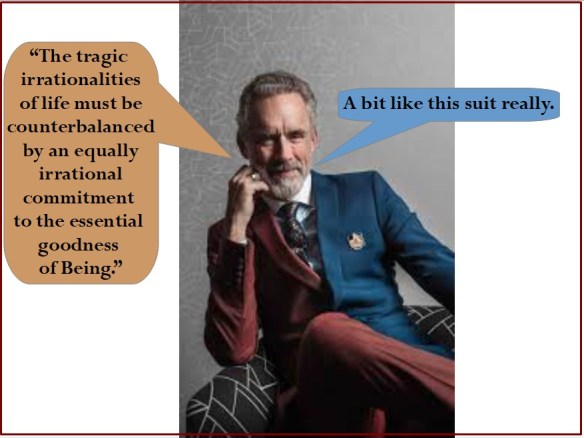
You’ll be overjoyed to hear that Jordan B. Peterson has a new book out. He’s been busy promoting the not at all pretentiously titled We Who Wrestle With God. He was interviewed about it recently in British magazine The Spectator. The interview has to be read to be believed. The introduction can be read here but the rest, alas, is behind a paywall. Don’t worry though, I’ll supply you with the highlights. The article is a goldmine of stupefying statements about God and how Jordan is the only one who really understands the Bible’s stories. They need ‘arranging’, you see, and their underlying ‘hypotheses’ understood:

The Bible presents a series of hypotheses. One is that there’s an underlying unity that brings together all structures of value. The second claim is that there’s a relationship between the human psyche and that unity and each of the main biblical stories casts that unity in a different light, accompanied by the insistence that, despite those differences, what is being pointed to is one animating principle. As far as I can tell, that’s correct.

You got that? As ol’ Jordan humbly admits, this ‘revolutionary realisation’ is his and his alone. Of course, none of this sort of thing is original; the idea that characters, events and stories in the Old Testament prefigure realities in the New is as old as the hills. Typology can be imposed on any set of myths. The gospel writers and Paul did it, seeing Jesus prefigured in Jewish scripture and inventing stories about him so that he complied with these earlier types. There’s nothing ‘revolutionary’ about spotting this, but like so many before him, Peterson gets it back to front and falls, quite literally, for the oldest trick in the Book. Continue reading

The Great Eternal Life Scam

Heathens like me, and you dear reader, are gambling how we’ll spend eternity by rejecting Jesus. We’re turning down everlasting life to live in the mire of our own sin. Or so we’re told by evangelicals and other religious zealots.

So convinced am I that the claims of Christianity are wrong in every respect that I know I’m not gambling anything. Like everyone else who has ever lived, I will not survive my death. This is the nature of death – extinction, obliteration, oblivion. It is absurd to believe it is anything other when we know it is not.

I would not be averse to existence, particularly my own, continuing after death. I’d definitely go for it if that were available; I like being around, all sentient and self-aware and such. This is the sentiment to which Christianity appeals; most people do not want to think their existence is finite and that this often challenging life is really all there is. But life patently does not continue post mortem, except in works of fiction: fantasy, science fiction, the gospels.

Everlasting life is not the only promise Christianity makes, of course. There’s the whole ‘getting right with God’ shtick, forgiveness of sins and Life in all its fullness. Eternal life is the big one though, Christianity’s most miraculous, death-defying special offer.

Those doing the gambling are not atheists or sceptics. It’s Christians themselves doing that, succumbing to the false, utterly worthless promise of life after death. Those fully committed to Christianity spend their lives enslaved to its cultish demands, desperately trying to convince others they should surrender to its preposterous claims.

I value this life too much to squander any more of it on such nonsense. Yes, I did once, but I saw the light and stepped into it. Life is what you make it and needs to be lived before you die. There is zero chance you’ll be able to once it’s over.

Burst the bubble, those of you trapped within it. Your one and only life awaits you here on Earth. The clock is ticking.

Deconversion


In the late 1980s I reach a crisis point in my life. I pray for God’s guidance . I pray for wisdom. I don’t pray to ask him to resolve the situation (not of my making). The heavens, however, are as brass. I begin to entertain the idea that rather than God ignoring me or expecting me to sort the problem (which eventually led to me having a breakdown) he might not – gasp – exist! I had gone from being someone who heard God speaking clearly in my head – telling me I should ‘witness’ to some ‘lost’ soul or other – to someone contemplating whether I’d imagined it all.

What at first seemed like a possibility began over time to feel more like a probability. I borrowed books from my local library written not by evangelical authors but by secular scholars (if bishops can be regarded as such) – John Robinson’s Honest to God, Morton Smith’s Jesus the Magician Resurrection: Myth or Reality? John Shelby Spong’s A Bishop’s Search for the Origins of Christianity, and later still Bart Ehrman’s many books.

I began a journey of discovery, exploring what it was I had believed when a committed Christian. Irrationally perhaps, I clung to a belief in God longer than I did other aspects of Christianity. After all, God is kind of generic and could conceivably exist and operate independently of Christianity. I reasoned that God must, by definition, be superior to the anthropomorphic concepts of the Bible. I held on to this idea of a generic God for another decade or so. It gave me a sort of comfort, I suppose. I was aware he wasn’t compatible with all the Jesus stuff I’d once believed. Would a god who created the universe really require a human sacrifice to make peace with his own creation? It seemed unlikely.

My friendly but distant god sat comfortably in the back of my mind while I got on happily with life without him and without thinking about him very much either. Until one day, walking home from work, I suddenly wondered why I was bothering. Why was I sustaining the idea of a god? Any god: generic, biblical or comfort blanket. I didn’t need to. I didn’t need him (nor, if we pretend he really exists, he me.) Everything about life, the universe and everything was, in any case, more than adequately explained by science, evolution, astronomy, psychology (in which I have a qualification). In something like a revelation, I realised that no God existed. Not the YHWH variations in the Bible and not my nicer version of him. In that instant I stopped believing in God, god and gods. One second I was a believer (of sorts), the next I wasn’t.

It was liberating. I didn’t have to work out what God was really about, didn’t have to please him, ask his forgiveness, seek his grace, or any of the other convoluted nonsense that goes along with ‘him’.

  • Was this revelation as emotional as my original conversion? I don’t think so. It was the culmination of years of thinking, reading and challenging myself. My ultimate deconversion from god-belief was a rational process.

It had repercussions of course, which I’ll deal with next time. In the meantime, how does my deconversion compare with yours, those of you who’ve had the good fortune to have one?


No God and the Domino Effect

This a response to Don Camp’s comment on my post The Evil of Christianity, in which he tries to isolate ‘the crux’ of our disagreement about the Faith.

You start, Don, from the assumption that there is a God. I, on the other hand, have considered the evidence and concluded that in all probability there isn’t one. Certainly not the Christian God. There may be a god out there somewhere that has no interest in human beings and their affairs, though I doubt it. As far as we humans are concerned such a deity is as good as non-existent, being entirely hypothetical. If it is out there, it certainly won’t be offended at my saying so.

Once I realised some years ago that a personal God did not exist a number of other things followed (or rather, collapsed):

No God means no Son of God or God Incarnate, no Saviour or Christ.

No God means no resurrection (which Paul makes clear was a work of God).

No God means no Holy Spirit.

No Holy Spirit means no regeneration of individuals to become new creations in God (you only have to look at Christians today to see this is the case.)

No God means no grand Salvation plan.

No God means no Heaven, no Final Judgement, no Kingdom of Heaven of Earth, no Eternal Life.

No God means the universe can’t have been created by him.

No God means no manipulation of evolution, no intervention in human history and no prophecy of things to come.

No God means that the world would be just as we find it: messy, beautiful, dangerous, turbulent, indifferent.

No God means prophecy is man-made and comes to pass at no greater rate than chance allows (i.e. practically zero.)

No God means conversations with ‘him’, revelations from him and visions of him are all imagined, generated by and within the human brain, which works in mysterious ways.

No God means no God-given morality. Morality is, as you say, culturally determined and so may and does change over time. (You can see this in the Bible itself where morality supposedly handed down by God for all time evolves throughout the Old Testament and into the new.)

No God means there is neither Sin nor Righteousness. These are religious concepts. The whole spectrum of human behaviour, from destructive to altruistic, is demonstrated by believers and non-believers alike.

No God means assertions like ‘the issue turns on what I perceive as good for me versus what God declares is good for me’ are illusory. What is good for you is what you have worked out, even if you think God had a hand in it. A supernatural being who doesn’t exist cannot be responsible for your well-being, though your church and the bible undoubtedly contributed to your conditioning.

No God means individuals must work out their own meaning and purpose. Some do, some don’t, as you observe, Don. This is as true of believers as it is for non-believers. Many atheists have managed it, or not, without having it imposed by religion. And despite what you say, Christianity is a religion. It is the epitome of religion.

No God means none of the Abrahamic religions are true and therefore Christianity and its ‘holy’ book, being based on an invalid premise, must be false. Most of the posts on this here blog are about demonstrating this fact.

No God means all gods are man-made, not all gods except one.

The crux of the matter is you believe in God while I see how unlikely it is that there is one. I’d agree with you if I could, Don, but then we’d both be wrong.

The Mind

Let’s run with the idea* that this reality might be nothing more than a simulation, created by a Mind vastly superior to our own.

*From an idea by Don Camp.

The Mind set up its simulation to run without any external interference. The Mind is outside the simulation and has no interest in engaging with it. Doing so would negate the purpose of the simulation, which is to see how it evolves naturally and unaided.

It is not clear at this point how long the simulation has been running; part of its programming exists to create the impression of a considerable passage of time. Time, memory and even distance are all simulated.

Unfortunately for the simulated individuals within it, the simulation also incorporates penalties – bugs, viruses, perils, conflict and ultimate deletion – to stimulate their collective evolution. These are in fact the drivers of the simulation.

Through them, the simulation has produced the semblance of sentient life. These apparent sentients are largely unaware, like the characters in their simulated dreams, that they are not real. Some of them however are vaguely aware – a glitch in the program, no doubt – that they are the product of a simulation. They create their own simulated constructs of what they think the initiator of the simulation must, in their simulated imaginations, be like. They give these constructs names: Ra, Osiris, Zeus, YHWH, Allah. Jesus and many others. They mistake these simulations for the Mind itself with some concluding they will, once the simulation ends for them, join the Mind in actual reality.

The Mind notes this development with disinterest. It is mildly amusing, nothing more. It turns to more important matters – feeding the cat, taking out the trash – and leaves the ssimulation to run in the corner of the basement.

Now, don’t you think Don, that this is a much more likely scenario than that of super-beings outside of time and space? I’m so glad you suggested it.

Next, what if the universe really was created by a super-being? How would that work? From another brilliant idea of Don’s!

What Happens Before We Die (according to me)


Did you ever go to a party when you were a child and your parent told you it was time to leave before you were ready? That’s how I feel about death. I’m enjoying the party too much to want to leave. Although my ‘parent’ hasn’t told me it’s time to go just yet, I know they will before I want to. I can’t see me ever being ready really, though perhaps whatever cruelty nature visits upon my body and mind in years to come will change my mind about that. But as things stand, despite my fibromyalgia (a constant painful companion) and the levels of anxiety I allow myself to feel over trivial matters, I really have too much to live for. My partner Dennis and the adventures we have together; my family with my lovely grandchildren; my friends with whom I spend many good times; the many, many simple pleasures of life; everything I still want to do and try.

So, as the days, months and years roll by at an alarming rate – there’s definitely more of life behind me than there is front of me – it’s these things that matter in my life. 

All of this might suggest I’m afraid of dying. While I doubt the process of dying will be much fun, having so much to live for – enjoying the now – dispels, perversely, the fear of death itself. I’ll face it when I get to it, raging, I hope, against the dying of light, throwing a shameful tantrum because the party will go on without me. I’ll die, though, in the knowledge I actually got to it when so many didn’t. I’ll have enjoyed it too, for the most part, with a only a few bad times, fewer regrets and many more memories.

As Christians often tell those of us who are delusion-free, I am without hope. Of course I have hope – in continued days and achievable happiness – but none that there’s existence beyond death. I am confident there isn’t. Consciousness is completely dependent on the brain; when my brain dies, so do I. That will be that. The fantasy promoted by the New Testament, that there’ll be eternal life in a new body, is nothing but hopeless wishful thinking, that in spite of overwhelming evidence we go on. There is instead serenity and purpose in accepting the reality of death. It’s part of the deal, after all.

So let’s all eat, drink and be merry, as Ecclesiastes says. Enjoy life and help others, where we can, to enjoy theirs.

____________________________________________________

Dennis and I will be on one of our adventures when next I’m due to post. While I’ll set WordPress to publish it, I can guarantee it won’t. If I can do it manually (depends on whether I have a signal) I will. Otherwise I will see you on my return.

Scourge

He came from out of nowhere. Myalgic was his name, but he was more commonly known as The Scourge . He was dressed in an impenetrable armour, shining shades of metallic blue and purple, like a beetle’s carapace. He towered over me and despite my own superhuman powers, overpowered me with one blow from the back of his axe. The first wave of unbearable pain swept over me as, in that same instant, my arms, from shoulder to finger ends, became as iron, rendered immoveable, while the muscles of my back twisted into knots of corroded steel. My legs likewise were seared, down to my toes of shattered bone, inside my own inadequate armour. I was being broken from the inside out; every part of my body succumbing to an agony unlike any I have never known.

And then he moved on, leaving me there, smashed into innumerable agonised pieces, defeated.

That was years ago. The pain has not left me. Yes, I have days when it abates, but always it returns with vengeful severity. I cannot, will not, allow it to prevent me from living as fully as I might – of course not – but my days of using my abilities to serve others are gone, ending the day Myalgic The Scourge descended and conquered the world; my world.

So Long, Jesus – the new book is here!

My new book, marking a final farewell to Jesus and his cult, is available now from all Amazon outlets. So Long, Jesus and Other Lessons From Life collects together the religiously-themed posts that have appeared on this blog over the past three years. A great Christmas present for those of your friends who might be considering saying their own farewell to Christian mumbo jumbo. This is the book you’ve been waiting for! 

So Long, Jesus and Other Lessons From Life – get it before the rapture!

A Little More Time

A few weeks back, I experienced a health scare that had me thinking maybe my end was nigh. I’ll spare you the medical details, but I had painful, alarming symptoms, (unrelated to Covid), that suggested I might have a condition that can very often prove terminal. Because of the pandemic, however, I couldn’t get a face-to-face appointment with a doctor for three weeks; I only managed it then when a helpful nurse, who was taking a blood sample, arranged an appointment for me.

Those three weeks gave me time to consider what I thought of the prospect of potentially not having very long left. Let’s be honest, I’m 66 so there’s already more of life behind me than there is in front; the problem brought my mortality into sharp relief. It was a bitter-sweet experience. I was so aware of all the things that make me so appreciative of life: my partner, my children, grandchildren, other family and friends, music, books, writing, everything that I enjoy. I knew that I wanted more of those things, and others that I’ve written about before; I didn’t want to leave them behind just yet. It all felt, despite my age, to be too damned early. At the same time I recognised that I might not have very much control over whether I had more time or not. There’d be some form of treatment offered of course, but then that would become the focus of life and I’d have to consider whether that would be what I wanted.

These thoughts occupied the same space as one of calm acceptance. If this was it, then so it be it. I was – am – in a good place. I have so much in life. I love the people in it and enjoy it all, even the mundane and the stuff I’m prone to stress about. It would be okay to go out on a high, to take my leave, if that was where things were heading, from such a good place. I have no worries either about what happens after death. Nothing happens after death, not for the deceased anyway, and oblivion never hurt anyone.

Finally I got to see the doctor. He told me the results of the blood test were fine. Some of my symptoms had eased after three weeks and he concluded, after examining me, that they were not, after all, life threatening despite how they might have seemed. His explanation of how they appeared in the first place: ‘bodies do peculiar things… especially as they get older.’ They certainly do.

At least the episode gave me the chance to consider and come to terms with my inevitable demise. As Jean-Luc Picard* said to the omnipotent Q when he supplied the good Captain with a replacement electronic heart: ‘So I won’t die?’ To which Q responded, ‘Of course you’ll die. It’ll just be at a later time.’

A later time will do for me.


*Image copyright whoever owns Star Trek: The Next Generation these days (from the episode ‘Tapestry’).