Surviving 2026

It’s that time of year when, according to the media, we need to consider what our strategies might be for surviving the 12 months ahead. I thought I’d share with you some of my thoughts along these lines:

1. Have the lowest expectations of politicians that you can muster. That way you’ll only be mildly disappointed when they fail to live up to them.

2. Have a sense of proportion. The universe has existed for 13.8 billion years, the earth for 4.54 billion, life for 3.8 – 3.5 billion, humans for a mere 300,000 years and you for a miniscule fraction of even this final statistic. None of these events has been directed by a sentient power. They are all the result of natural forces. With this perspective you’ll recognise how nonsensical it is to attribute anything to a tribal deity.

3. Reserve your respect for people who merit respect. You do not have to respect those who espouse nonsense and/or don’t respect you. You certainly don’t have to genuflect in front of ideologies, whether religious, philosophical or political. Ideologies are not people.

4. Party like it’s 1999. That way you can pretend the world isn’t being run by septuagenarian megalomaniacs.

5. Resist the Newspeak that is daily foisted upon us. Call a spade a shovel, an Islamist a Muslim, and send the Thought Police packing when they turn up at your door because someone somewhere is offended by something you’ve said, on someone else’s behalf.

6. Spend lots of time with friends. Studies repeatedly show that socialising contributes significantly to living a longer, happier, healthier life. Even talking to strangers helps. I know that other people can sometimes be  challenging (see below) but being with them is, on balance, pleasurable and rewarding. They do you good (and you them).

7. Stop anyone who starts a sentence with ‘Me and partner’. Point out that this is grammatically incorrect and reflects badly on both their education and personal integrity.

8. Read comic books.

9. Take pride in your country. It belongs to you, not just to politicians and billionaires. Other countries quite rightly take pride in their country’s achievements, culture and values. We need to as well. .

10. Write to your MP/Congressperson to tell them what you think of the job they’re doing. Tell them what they should be doing instead, like keeping their promises. Do this while trying not to use swear words.

11. Do something you might not normally do. Keep it legal. Or at least don’t get found out.

12. Question everything, including everything that’s written here.

I hope 2026 turns out to be a great year for you.

What Is Truth?

I’m sceptical (or skeptical if you’re in the US). It’s a legacy of my years of believing the promises of Christianity. Preachers, pastors, Bible study leaders told me for 25 years that the promises of the bible, of Jesus himself, were all true. And like a fool I believed them. Jesus had made a new creature out of me; he loved me; he was guiding my life; he was returning soon; I’d be resurrected; I’d live in heaven forever… and on and on.

What a preposterous set of propositions! It took my Great Realisation, my own personal revelation that there was no God, to make me see how ridiculous they were.

It is this that left me with a legacy of scepticism. If I’d been misled all this time by people I respected and admired, what else was I accepting as true that very well might not be? I wasn’t going to be fooled again and so began to question practically everything I was told by authorities, experts and the media. If it seemed ‘off’, as we say these days, not quite right or too good (or bad) to be true I asked, ‘Who says so?’, ‘How do they know this?’, ‘What is the evidence?’, ‘Do they jump to conclusions or is their reasoning sound?’, ‘Why should I believe what they say?’ It’s exhausting, I assure you, having to search out the evidence – the primary sources of information – and to sift through it, recognising any bias that has been imposed on it. It’s either this or I must accept without question that everything I’m told is true. I can’t do that any more.

Here are a few examples of claims that I’ve been sceptical of on the recent past:

We are being guided by the science, said politicians during Covid to ensure compliance with whatever lockdown measures were being imposed. Did this really just mean was ‘we are being guided by our interpretation of some rather suspect data’? It became clear after we emerged from the hysteria surrounding the pandemic that this was the case.

Tens of thousands will die of Covid unless you comply: this based on computer predictions which turned out to be very far from accurate: the suspect data that ‘guided’ politicians.

A woman can have a penis. A man can have cervix. Yes, our politicians told us this during our recent fixation with transgenderism. Whatever you think of people changing sex, these two statements, designed to change hearts and minds, if not penises and cervixes, are patently false. Whatever was guiding those who said such things, it certainly wasn’t ‘the science’.

No more irresponsible, undeliverable promises. So said the Prime Minister exactly a year ago. I’m not going to be sceptical or cynical about this. I feel sure it’ll turn out to be true. Is he implying though that promises made earlier than this were indeed ‘irresponsible and undeliverable’. Surely not.

We will not raise taxes on working people (and energy prices will fall by £300 in the long term), Labour politicians, now the government, said only last year in an attempt to gain our votes. I was sceptical about this, as with much they said, and for the first time in many years Labour did not get my vote. Taxes have increased considerably for working people and everyone else in the last year and are set to rise again this week. The price of energy has risen too, by 18%, and will do so again in January. A £300 reduction by 2030, if it happens at all, is not really going to offset this by much. This was all very predictable; since when do politicians tell us the truth in order to get us to vote for them?

Anything Donald Trump says. Insert your selection here.

The NHS is the envy of the world. Pundits and politicians are very fond of this one. They like to add too that the NHS is underfunded. But the NHS is expensive, management heavy and wasteful. Is it really the envy of the world, and if it is, so what, when it’s constantly in crisis at home?

The BBC is the envy of the world. It is impartial and balanced. Is it? A number of independent reviews have determined that it has its own agendas and biases. During lockdowns it fuelled hysteria and now contributes to climate change panic. Rather than reporting facts, it tells us too often what we’re meant to think about issues. It has also been rocked over the past dozen years by sleaze and scandals.

Islam is a religion of peace. So many questions about this one. Many Western politicians have claimed something like it. President George W. Bush did, shortly after 9/11. Perhaps ordinary Muslims are committed to peace but there are many Islamists (the term now used for Muslim extremists) are evidently not: as well as 9/11 there have been acts of Islamist terrorism in London (7th July 2005), at Charlie Hebdo in Paris, in Manchester, the slaughter in the street of an off duty soldier, the massacre of Israeli young people in October 2023, the killing of Christians and others in Nigeria.. Is ‘Allahu Akbar’ really a cry of peace?

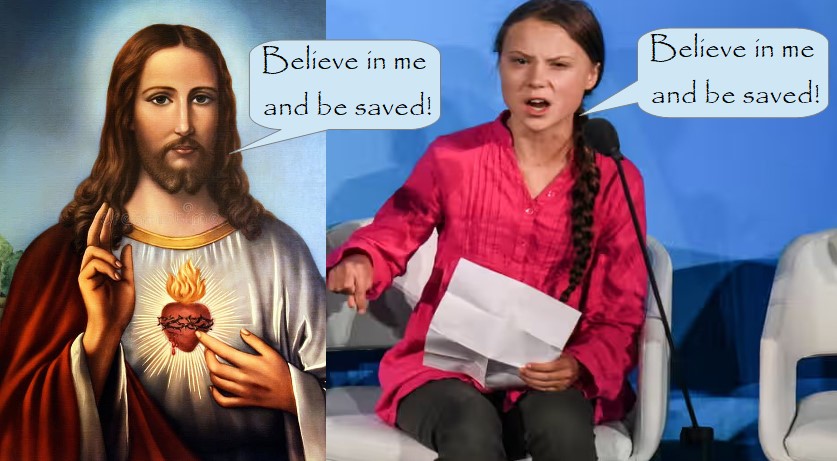
We can halt or reverse the climate changes we ourselves have caused. Can we? Who says? (Greta Thunberg, yes, but no actual scientists that I can find.) We can perhaps mitigate and slow down the change, and we should. But the climate will continue to change. Are these changes solely the fault of us humans – we’re contributing to the pace of change, certainly – when the climate has been in constant change from time immemorial?

I was accused of trying to be a maverick in a recent comment on an old post. Honestly, I’m not. It’s more a case of ‘once bitten, twice shy’; I’m not going to be told ever again what to think, especially not by those who don’t present good reasons why I should (I’ve Jesus to thank for this). Everything needs to be questioned, otherwise our minds are not our own. Be sceptical.

Not The Answer

Unlike most Brits, I knew of Charlie Kirk before his assassination last Wednesday. He cropped up on American blogs I read, most frequently on Joe.My.God. I profoundly disagreed with practically everything Charlie Kirk had to say, though a little of it made me re-examine my position on some issues. His views on gun control seemed to me to be extremely foolish and I objected to what he had to say about gay people, our relationships and status in society. I reacted against his Christian views, entangled as they were with his extreme political views. I objected too to his promotion of his faith; it seemed trite and smug (but then I think this of anyone who preaches Jesus.)

Following Kirk’s death, it’s been reported that he was prepared to debate with those who disagreed with him. He said, ‘When people stop talking, that’s when you get violence… When people stop talking, that’s when civil war happens, because you start to think the other side is so evil, they lose their humanity.’ Seemingly then he valued free speech and recognised the importance of dialogue and discussion, though perhaps his intent was to influence the views of others rather than reconsider his own.

He was opposed to transgenderism and this, at the time of writing, looks to have prompted his murder. Many on the Utah University campus last Wednesday would have been incensed by Kirk’s position that trans people were an ‘abomination’, showing a ‘throbbing middle finger to God.’ Some engaged him civilly on the issue, asking pertinent questions. Tyler Robinson, however, decided he would oppose Kirk’s more extreme views and advance the Trans cause by shooting him dead.

There is no justification for what Robinson did. Executing people one disagrees with is a feature of Putin’s Russia or Kim Jong Un in North Korea. It ought not to happen in the democratic west where we debate our opponents or, if they happen to be politicians, vote them out of office. Murder is never the solution, and in this case did not advance the cause the shooter felt so strongly about. Quite the opposite.

Those who argue that his shooting was justifiable – and yes, they’re out there – on the basis that Kirk’s views were extreme and reactionary must also accept that the assassination of any public figure is justifiable on the basis that some people find their views objectionable. Do we really want to go down this road, of rationalising assassinations on the basis the target espouses an ideology we find objectionable?

Those who rejoice at Charlie Kirk’s demise demonstrate a lack of humanity and support the desecration of Western values, free speech in particular.


The End Is Nigh

The End is Nigh. Yes, really. Climate change activists waste energy on a daily basis letting us know. Unless we listen to them, our self-appointed Saviours, and immediately give up fossil fuels, the world is headed for calamity and will end soon. Never mind the pollution caused by Russia’s war-mongering and that of the 21 wars and 108 other armed conflicts (what’s the difference?) in the world today. It’s the way you heat your home that is going to bring about the end.

Not with the same focus as today’s climate fanatics but with the same religious fervour, the Jews of two and a half millennia ago waited expectantly for their very human Mashiach (anointed one) to appear. He was to deliver them from their oppressors and make them oppressors instead. He failed to arrive.

Years later, in the first century CE, a small enclave of Jews became convinced their Messiah was on his way. He had by this time transmogrified into a heavenly being but would soon be arriving to set the world aright and deliver his little band of followers from evil and, they decided, from death too. He didn’t make it, but such irrational wishful thinking is how all religions get going and Christianity was no exception.

Muslims, meanwhile, believe that the Day of Judgement is not far off. Everyone will then be judged according to their service to Allah, the faithful rewarded with eternal life, the rest sent to Jahannam (hell).

So here’s a question for you: what do these years have in common? 66-70CE, 365, 370-400, 500, 793, 800, 847, 1000, 1033, 1200, 1284, 1504, 1585, 1600, 1705, 1792, 1833, 1836, 1874, 1901, 1918, 1936, 1967, 1977, 1982, 1994, 1997, 2000, 2007, 2011 and 2021.

They are, of course, a few of the innumerable predictions that the end isn’t far off, after which there will be a great reset. As I suspect you already know, none of these predictions came to pass.

Neither will any of the numerous predictions of future apocalypses– lots of them here – either. It’s not that we’re incapable of wiping ourselves out; it’s possible we will one day, but there won’t be a Mashiach, Christ or God who will step in at the last minute to rescue a favoured few so that everything can start again. There’s no simplistic fix of the sort climate zealots, Islamist terrorists and bumptious politicians insist. Like their apocalyptic predecessors they’re only deluding themselves and lying to the rest of us.

We are, it seems, obsessed with End Times scenarios, and always have been. Our only saviours, however, will be ourselves, if we’ve the will to be. I’m not sure we have, but a first step might be recognising that there’s no Starman (Starmer?) waiting in the sky, or anywhere else, eager to save us. There’s no magic panacea that will rescue us and reset the world.

Hysteria/Mission Creep/Overreach

When I was head (principal) of a primary (elementary) school in the 1990s, I had a staff member who regarded every small problem as ‘a Major Disaster’ (her words). Everything from a mislaid document to wet weather on sports day was an earth-shattering calamity. She was not the only one to overstate manageable events. Those who wield authority over us, their media lackeys and those with a cause of their own to promote are expert in whipping the populace up into a frenzy disproportionate to the given situation. After a short period in the spotlight, the hysteria and the movements that cause it usually fade, as the media finds something newer and shinier about which to induce panic. Occasionally, the newly out-of-favour movements fight back with renewed vigour, a mission creep extending their influence into new areas.

Looking back over the last 25 years, I and my fellow citizens here in the UK have been expected to be alarmed to an alarming degree about:

The Millennium Bug, when every computer in the world, so the experts said, would crash the instant the year 2000 started. This would, in turn, crash every automated system everywhere, causing chaos and mass fatalities. You all know what actually happened.

Foot & Mouth Disease, when millions of cattle and sheep were slaughtered and burnt. Millions of healthy animals were destroyed in case they contracted the disease.

Weapons of Mass Destruction supposedly amassed by Iraq who, we were told, could unleash them on the West within 45 minutes. That there was no evidence of any WMDs and the fact Iraq did not deploy them (because you can’t deploy something that doesn’t exist) did not deter George W. Bush and Tony Blair from launching their oxymoronic (with the emphasis on the moronic) ‘war on terror’. In so doing, they destabilised the world, creating many of the problems we face today.

Child Abuse Scandals: After either missing or covering up the serial abuse of children and vulnerable people by a BBC celebrity, British authorities went to town on ‘suspected paedophiles’, many of whom were nothing of the sort. (A friend of mine was caught up in this hysteria and spent time in prison for a youthful indiscretion many years earlier.) Unfortunately, this national crisis and the perceived need not to offend Muslims came into conflict when, over 20 years, rape gangs comprised mainly of Pakistani men were able operate in up to 50 UK cities with impunity. Hundreds of thousands of vulnerable, white working-class girls were systematically groomed and raped while the police and authorities turned a blind eye, the consequence of a woke priority taking precedence over the rights and safety of others.     

The Covid Pandemic and Lockdown, when governments the world over (apart from Sweden) panicked about a flu-like virus, closed down entire countries, failed to protect the vulnerable and crashed the very economies needed to fund healthcare and treatment for the infected. Britain was closed down for almost 2 years and still hasn’t recovered from the consequences. Citizens are now paying heavily for actions taken by a government that extended its powers to achieve very little.
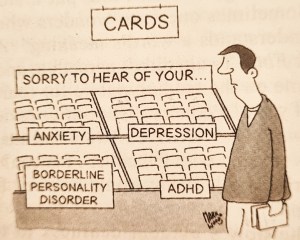
        Cartoon by Mark Woods, Spectator magazine, 7th June '25

Mental Health issues and the medicalised labelling of ordinary human behaviours. We all have mental health issues; this is what it is to be human. Some, it is true, have more than others. Determining an individual has ‘mental health issues’ forces him or her to become his or her issues. Instead of being prone to depression (as I was) or anxiety, the individual who experiences these is now ‘neuro-diverse’. Instead of suffering from a condition the individual could do something about they become that condition. Some people, usually males, used to be diagnosed as autistic. Now that autism is seen as a spectrum, everyone is deemed to be on it somewhere; everyone as a result is autistic. People become trapped in their condition with no way out, lifelong treatment the only recourse.

Black Lives Matter. As Lionel Shriver asks here, do black lives matter any more now than they did before all that righteous indignation and virtual signalling from white people?

Identity Politics in which individuals were told as a matter of urgency to self-identify solely on the basis of their ethnicity, religion, gender or sexuality. Gender dysphoria became a thing from which the trans-movement emerged. While I’ve every sympathy for those who feel they were born in the wrong body, society was unprepared for and incapable of dealing with the consequences. Women became ‘cis-women’, sex became ‘gender’ (a grammatical term), ‘non-binary’ became an option and the abuse of pronouns was politicised. An individual could identify as a plural ‘they’, while others lost their jobs if they declined to play along. Worst of all, children, who were too young to be allowed a tattoo, were given puberty blocking drugs, and in some cases surgery, because they felt they were the wrong sex. Children.

The High Court in the UK recently ruled that a man cannot become a woman, entrenching the views of campaigners and prompting other supporters to claim they knew this all along.

Wokeism; while it’s right and proper to treat each other with kindness, courtesy and consideration, politicising something we were, by and large, already doing was not. Wokeism pushed the boundaries over what could be done or said, or rather could not. Anything that might cause someone else offence was forbidden; commenting or criticising others’ religious beliefs or defending women’s rights became ‘hateful’; having a view on unsustainable immigration numbers made you a fascist. This was the era of cancelling those who did not conform to woke ideals. Toppling statues was popular too on the basis that a long-forgotten figure from 250 years ago may have had a slight connection with the slave trade. Western guilt for actions over which people living today had no part in and demands for reparations to those equally uninvolved ensued.

The ‘necessary’ control of free speech, a panic we’re still mired in. Stupid and inflammatory comments on social media can now earn you a prison sentence longer than that of a paedophile offender, often preceded by a visit from half a dozen policemen who will root through your house looking for evidence that you might have once had a ‘Brexity’ thought. Subjects off limits are; arguing that Covid19 began in a Wuhan laboratory (it might upset the Chinese); Islam, Islamic extremism and the Pro-Palestinian movement (however it’s still okay to criticise and condemn Jewish people for the actions of their government); expressing views different from the UK government’s and whatever the prevailing narrative happens to be. A government agency, ‘Prevent‘, last year redefined terrorism (see below) as ‘vocal support of ideologies that advocate discrimination’ and any expression of what it calls ‘cultural nationalism’. What this means is that those who call out religiously-motivated discrimination, lawlessness and terrorism are to be considered terrorists themselves. Actual terrorism and violence is therefore protected against those who would speak out about it, those who do so being the real terrorists. To put it another way, which I read recently (though can’t remember where): those who say hurty things are far more culpable than those who commit actual hurty things. This Orwellian doublespeak must now be taught in universities and other higher education institutions.  

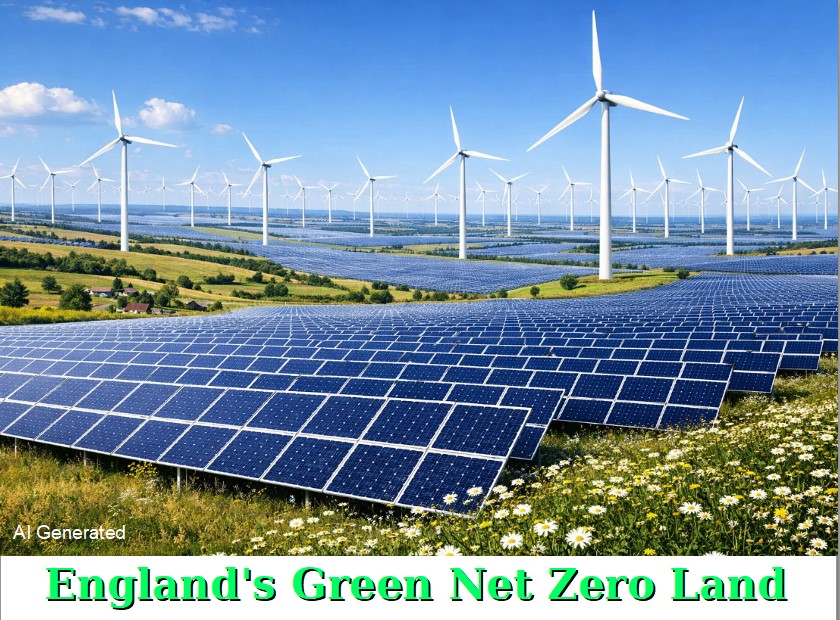
The Climate Crisis and Net-Zero. You must be alarmed by the climate crisis (see here for how much of it Al Gore got wrong). You must too pay heavily for net-zero, thanks to additional taxes; energy prices in the UK are the highest in the world. You must buy into the government’s attempts to enforce a net-zero energy policy by 2050, despite net-zero being unachievable.

What if, might, could, maybe: the media’s favourite phrases to ramp up hysteria. ‘There might be terrible consequences’; ‘we could be headed for another Major Disaster’; ‘if X happens (though it hasn’t) then Y could possibly follow.’ When did the media stop reporting what has actually happened and take up fortune telling instead?  

* * * * * *

There is some comfort in the fact that the so-called crises and hysteria of the past eventually receded and faded away. So too will many of these current causes. All things, as George Harrison once wisely reminded us, must pass. They will, however, be replaced by others equally irrational and preposterous. Those who create them, be they governments, special interest groups or overwrought Swedish teenagers will expect us to conform to their Chicken-Little levels of hysteria. When they do, don’t be alarmed and be sure to seek out the evidence for yourself.

The More Things Change

What a year it was! The weather went mad! It can only have been climate change. There was heavy snow and hail all over the UK in the first week of January. Shoppers in London collapsed from the cold while a blizzard blanketed the north of England with several inches of snow. Five foot drifts marooned a train in Scotland while in Australia bush fires raged. By the middle of the month ‘killer smog’ had enveloped London and whole communities in Scotland were buried by more blizzards.

Early in February the Hudson River froze from shore to shore for the first time in 37 years. Fresh snow covered Britain again on 20th .

Floods killed 200 people in Australia on March 3rd. A further 44,000 were left homeless and 300,000 animals also drowned.

April saw more unseasonal weather, yet by July temperatures in Scotland reached 80°F (27°C) while Buenos Aires saw its first snow for decades. On July 14th lightning killed a woman and injured 46 racegoers at Royal Ascot. July was the hottest and driest for 86 years in the UK. An earthquake in Turkey killed 4 and left 25 injured. 600 houses were destroyed and 1,000 damaged.

Large parts of the US suffered the worst drought for 46 years and there were water shortages in Britain during August. Towards the end of the month, torrential rain caused serious problems in the south of the country.

By October, 71mph winds caused problems in the north, closing Liverpool’s Speke airport. India’s Punjab meanwhile suffered 12,000 square miles of flooding. 7,000 villages were inundated. Torrential rain and gales hit the south and east coasts of England later in the month. In November the south and west were blanketed in fog and as a result central London was dark by mid-afternoon.

By mid-December dense fog, gales, floods and snow affected all of Britain. In County Durham visibility was reduced to nil while the Orkneys experienced 94mph winds. The area was still suffering from the drought that first affected it in July. Churches took it upon themselves to pray for rain throughout December. Prayers that went unanswered.

The weather was certainly messed up in 1955!

* * * * * *

The weather conditions described are taken from the book, The Year I Was Born: 1955 (I was!) containing newspaper reports from that year. I haven’t included all the variations the book refers to. The world population in 1955 was 2.5 billion (8 billion today), the UK population was 49.5 million (68.4 today) and the USA 166 million (340 today).

Were the extremes of weather in 1955 the result of global warming? No-one has ever said so, not even Greta Thunberg. In fact, no-one mentions how volatile the weather was in the recent past when they’re busy telling us how much more calamitous it is today.

Is it though, really?

On Climate Change

The climate is not having a crisis. I’ve consulted it and it assures me it feels perfectly fine about everything. It explained that every now and then it goes through a few fluctuations, much as we all do in life, and that this isn’t anything new.

I ask the climate whether it is concerned that the changing weather conditions it is imposing on us now are something it has any concern about. It laughs icily and says it couldn’t care less what anyone thinks about what the weather is doing.

It is, it reminds me, only we who are anxious about its recent activities. Frankly, it intones brightly, it doesn’t give a damn. When I put to it that we humans may have contributed to its recent, erratic behaviour it guffaws intemperately and says we’ve merely contributed to the inevitable. It scoffs at our hubris in thinking we can somehow change or even ‘reverse’ the course it has set for itself. It points out that even if the entire world were to stop using oil and fossil fuels right now – which China, Russia, India and the USA aren’t ever going to do – it would make no difference. The weather would continue to do just what it wanted to do.

Maybe I shouldn’t have confused climate and weather as essentially the same thing. After all, scientists tell us they’re not, even as they show us ‘freak’ weather conditions to prove that the climate is indeed having a crisis. Oddly, they don’t seem to accept as evidence environments where the weather is much the same as its always been, only where it’s grown ‘worse’ by human reckoning. They blame events like flash floods and forest fires on climate change when a little research suggests that while these are the consequence of human activity – building on flood planes,  straightening rivers while neglecting to dredge them, failing to clear brush from forest floors to create fire breaks (not to mention the idiots who start fires either deliberately or carelessly) – they are the result of more general stupidity. 

The weather/climate merely chuckles warmly at such folly. It reminds me, it says briskly, of the three hundred years in the Middle Ages when the climate was the same as or even warmer than today’s, and the time in the 14th century when severe storms destroyed large swathes of East Anglia, England. And, it asks coldly, what about the Little Ice Age that affected Europe for 600 years between the 13th and 19th centuries? Remember, it says, when the River Thames froze over on a regular basis so that Frost Fairs could be held on it? All conveniently forgotten now because they occurred before ‘reliable’ records began. The weather reminds me that, despite this, it now kills 95% fewer people with its extremes than it did 100 years ago. And what thanks do I get for it? it demands airily.

The weather storms off, leaving an assortment of climates in its wake. I get the impression it will continue on its own sweet way regardless of anything we can do. It will fluctuate, as it put it, delivering ‘extremes’ of heat and cold, storms, clement and inclement weather (as we might see it) because that is what it has always done, indifferent to those living under its tyranny.

We Need To Talk About Pride

I recently had a letter published in The Spectator, one of the world’s oldest news and politics magazine, first published in 1828. I was responding to an article by Lionel Shriver, an author I like, famous for We Need To Talk About Kevin, and Mania, who was writing about how Pride is now redundant. This may be so, but her argument consisted of a number of fallacies that I felt compelled to address (her original article is behind a firewall, unfortunately.) I thought you might like to read my reply:

Sir: In ‘The War on Normality’, Lionel Shriver does precisely what she accuses gay people of doing. She reduces relationships to mere sex and then equates sex with only reproduction (or lack of it.)

Does she not know that both ‘heteronormative’ and homosexual people have sex for pleasure; most sexual activity in the world is for this hedonistic purpose, not reproduction. She next repeats the fallacy that homosexuals couples cannot reproduce. I can assure her they can, if not with each other, and play their part in advancing human evolution.

More than this, homosexual people value relationships, from which they derive companionship, affection, fulfilment and yes, intimacy, just as much as their heteronormative counterparts. Why Ms Shriver thinks gay people are any different in this respect is a mystery. Perhaps she realised she couldn’t write quite such a condemnatory column unless she did so.

Yours, happily (and proudly) in a same-sex relationship,

Neil Robinson

The intelligentsia’s misrepresentation of gay people makes it easy for more extreme bigots to advocate for their suicide and execution. It’s a small step then for some to take matters into their own hands. Looks like we do still need Gay Pride, after all.

I Don’t Count


I don’t count. You don’t count. Not if, like me you’re an ordinary person quietly getting on with life, perhaps working to support your loved ones or maybe retired now, drawing the pension you’ve paid into all your life and paying your taxes. You don’t count. I don’t count.

Politicians only become interested in you, and then only as a statistic, when election time rolls round. They see us, in the UK at least, as a cash cow, needed only to fund not merely those services that are necessary to a functioning society but also for every other ill-thought-through scheme they devise.

When Labour – the equivalent of the Democrats in the States – came to power last year they suddenly ‘discovered’ that the previous Tory (Republican) government had left them with a £22 billion debt. A number of financial institutions disputed this figure and the government produced no concrete evidence for it. Nonetheless, they took immediate action, shelving most of their pre-election promises until the debt could be repaid. To this end, our politicians, being among the most unproductive members of society, cut out an enormous amount of government waste and immediately cancelled projects of no benefit to the British people. The Spectator magazine estimated that they saved in the region of £200 billion this way. They were quids in!

Except they did nothing of the sort. What they did was keep up their prolific spending, turning to their cash cow – the British tax-payer – to milk it for even more money by increasing taxes all round. Particularly hard hit were high earners (which I am not), the lower paid, businesses and farmers.

A disputed debt, created solely by politicians (much of it by unnecessarily locking down for two years), now has to be paid for by those who had nothing to do with its creation. As if this weren’t bad enough, the new UK government has extended its control of its people by –

  • Deciding what can and can’t be said online and elsewhere (a new, so-called Islamophobic blasphemy law is currently being considered);
  • Encouraging police to investigate ‘non-crime hate incidents’, while ignoring burglaries and shoplifting ‘incidents’;
  • Restricting how much of our own money we can give away to family and friends before the government helps itself to a massive slice;
  • Freezing tax thresholds, meaning individuals will start to pay tax at lower levels of income;
  • Making taxpayers pay for schemes and projects with no proven track record (carbon capture, net zero);
  • Permitting local councils to increase council taxes, some above the legal limit, for fewer services. (Almost a quarter of council tax collected is spent on ‘unjustifiably generous’ staff pensions.)
  • Allowing government agencies access to private bank accounts in order to determine whether benefit recipients are lying about their income (powers that are set to be extended in 2029);
  • Making tax payers fund mass immigration, which successive governments have failed to control.
  • Requisitioning farm land in order to build more houses. In a second blow to farmers, paying them less than the market value. The government seems hell-bent on destroying food production in the UK.
  • Expecting tax-payers to pay Mauritius between £9 billion and £18 billion to take a tiny island in the Indian Ocean off our hands (though Trump might prevent the handover). 

Also under consideration is a two-tier justice system offering greater lenience to those from minorities. Should penalties for criminal acts be determined by ethnicity?

None of this makes us North Korea, but it certainly doesn’t feel like we’re  living in a Western democracy. What happened to government of the people for the people? Why is there growing resentment in the UK that government is now something that is done to the electorate? Beware legislation that is ‘for your own good’ because it never is.

It’s no wonder so many British citizens feel neglected and side-lined by politicians who view them only as a source of income. Can you blame them, and me, for feeling like we don’t count?

Live Backwards

I wanted in this post to think about the source(s) of evil, given it cannot be supernatural. However, defining evil isn’t as straightforward as I anticipated. The Oxford English Dictionary offers ‘Profoundly immoral and wicked’ while Merriam Webster goes for ‘morally reprehensible: sinful, wicked.’ Other dictionaries also mention both immorality and wickedness, replacing one concept in need of explanation with two. ‘Wicked’, it seems to me, is synonymous with evil, which doesn’t get us any closer to defining it. There are problems with ‘immorality’ too, as what constitutes immorality is frequently culturally determined.

Evangelicals, for example, regard same-sex relationships as immoral (so that’s me told) as is sex outside marriage. When I was involved in the church, dancing, drinking and listening to rock music (with all its backward messages!) were anathema. In some countries today many of these behaviours attract the attention of so-called morality police and are punishable by death (how moral is that!) Then there are those who fail to keep their word. Within months of being elected, the UK government under Keir Starmer has reneged on almost every promise they made prior to the election. Everyone expects politicians to lie so perhaps allowing ourselves to be duped by them means they’re not entirely responsible. Let’s not forget too that for some, eating meat is immoral, as is using fossil fuels. Our eating meat and our burning fossil fuels, that is.

So, are the practitioners of such relatively low-level, and disputed immoral acts – being gay, having non-marital sex, drinking and dancing, lying, using oil, eating meat – actually evil? Are women who have abortions, and the people who carry them out, evil? Of course not. It’s debatable whether some of these behaviours are immoral to begin with, but even if they are, immorality does not always equate with evil. I would argue that while all truly evil acts must, by definition, be immoral, not all (supposed) immorality is evil. Somehow personal immorality lacks the scale and awful consequences of true evil.

The Sanford Encyclopaedia of Philosophy is much nearer the mark when it comes to defining evil:

Evil must involve harm, and it must be serious enough to damage its victims’ capacity to function normally… Furthermore, the harm must be unjustified…

I’ll adapt and paraphrase this as ‘the malicious and unnecessary inflicting of harm on others’ to give us a working definition of evil.

So, who qualifies? Hitler obviously. Putin certainly. Other oppressive regimes. Murderers. Hamas. Child abusers. The gangs who have raped very young girls in numerous UK cities. How about the God of the Old Testament? He orders the cruel deaths of Israel’s enemies (Deuteronomy 7), promotes the smashing of babies’ heads against rocks (Psalm 137:9) and orders the taking of prison-of-war virgins as sex slaves (Numbers 31: 17-18). Later, Jesus – like father, like son – relishes the opportunity to put his enemies to the sword (Luke 19:27) and orders those who don’t believe in him be consigned to hell where they’ll be tortured forever (Matthew 25: 41-46). This is evil by any definition.

So, given there isn’t a God nor a heavenly Jesus, from where does evil originate? I’ll get to that, at last, in the next post.