There May Be Trouble Ahead…

Prophets, from left to right: Elijah, Julie Stephens,
Cindy Jacobs and er... Ed Miliband

Prophets don’t exist. A bunch of people intoxicated by religious fervour who think God has given them a special message that they must deliver to whoever will listen, are not prophets; they are a collection of extremists intoxicated with religious fervour.

We know this because no God exists. He can’t, as a result, drop messages, special or otherwise, into the heads of fanatics.

That’s it, really. No more to be said.

But so-called prophets exert quite an influence on our modern world. According to Abraham (I know, he’s a mythical figure but bear with me), God selected an ancient Jewish tribe to be his favourite buddies, so long as they did whatever he demanded of them, including hacking off their foreskins and that of their sons. What sort of prophet – what sort of God – comes up with this kind of lunatic fetishism?

Later the creators of a new prophet, whom they called Moses, came up with a story in which their hero encountered God in a bush (the symbolism is lost on us today.) This time he wanted his special buddies to invade their neighbour’s territory, slaughter them and take their land for themselves. This his favourite, de-foreskinned tribe did (modern genetic analysis of the peoples in the region suggests this isn’t what happened.)

After these fictional madmen came some potentially real fanatics who thought God had assigned them to lambast their fellow Jews for their shortcomings. These prophets promised the rubes rewards if they behaved as the prophets thought they should. These guys also came up with the idea that God would send a warrior Messiah to help his special little tribe take over the world. This is what happens when fanatics are allowed to get a hold of things.

A couple of centuries later, another self-proclaimed prophet turned up (or is invented) who seemed to think he’s the most special-est of all the prophets so far. This guy, called Yeshua (meaning ‘salvation’, so obviously not in any way symbolic) prophesied that the Messiah would be arriving real soon to sort the world out. He’d then hand it over to the Jewish people to manage. This guy’s script writers weren’t sure if Yeshua was talking about himself or some other supernatural character called the Son of Man. It doesn’t matter really. Nothing he prophesied happened when he confidently predicted it would: there was no Messiah who flies down from heaven, no final judgment, no great reset for the Earth. He was an absolute failure as a prophet; evidence, if more is needed, that those who claim to speak for God don’t know what they’re talking about. Don’t worry, though, this guy was recast as a resurrected Godman, just like the ones in pagan myths.

A few other prophets appeared around about the same time. In fact, the extremist who changed his name to Paul seemed to think that just about anyone could become one so long as they ‘edified’ the brethren. It was a few years though before the next really big so-called prophet came along.

In the 8th century, a guy called Muhammad said he was told by an angel who represented a different version of God that, amongst other things, Islam would spread worldwide and there would be an increase in senseless murders. These rather nebulous and self-fulfilling predictions are even now coming to pass. Muhammad’s future followers are indeed spreading Islam across the globe while senseless murders continue being committed, a good many of them by Muslims themselves.

While Muslims have made it clear that Muhammad is the final prophet, history has blessed us since with a few more. Joseph Smith in the 1880s was commanded by a different God (or maybe by the same one who’s changed his mind again) to start a new church and to obliterate anyone who stood in his way. He was successful in this enterprise, despite managing to get himself killed in the process.

You’d think, wouldn’t you, that given their abysmal success rate and the number of people who have suffered or perished as a result of their endeavours that we’d have had enough of prophets. While churches cannot agree on whether ‘genuine’ prophecy still exists, the prophets keep coming. Fanatics the world over, every bit as barmy as their predecessors, appoint themselves some deity’s spokesperson, and the ‘prophetic’ pronouncements begin: meaningless theobabble spattered across the Internet.

More Daft Things Christians Say

Image from a video by Intimacy With God, available here. I don’t recommend it.

In this season: a new favourite of evangelicals.

Though it is biblical (2 Timothy 4:2), what the hell does it mean in the mouths of today’s Christians? Here it is used to excess in the FreshPerspective blog: 

God is shifting his faithful sons and daughters into new seasons. But before I divulge into the signs, understand that everyone is called to different seasons. Some are being released into a season of exposure (platforms, opportunities etc), some into a season of preparation (preparing for a new season), and some into a wilderness season (a time of God pruning you, deliverance from past sins and behaviors before you enter a new season). So don’t be discouraged when it seems like you’re not where everyone else is. Seek God, pray and receive his wisdom and knowledge for what season you’re in.

It’s meant to sound profound, but there’s nothing profound about it. It’s pretentious, meaningless twaddle. Bob Dylan said it far better when he sang, ‘the times they are a-changing’. Things change; they continually evolve. Likewise our personal circumstances. God isn’t blessing, releasing, pruning or preparing you. Nor has he any great plans for you or the church. (Why? Because he’s not real.)  

Thoughts and Prayers/I’ll pray for you

Thoughts and prayers are always proffered when disaster strikes. The ‘thoughts’ I understand; when a long-distance friend lost her daughter to suicide a couple of years ago, I wanted her to know I was thinking of her and was ready to listen if she wanted to talk. She told me later that it was comforting to know that friends were thinking of her and were around if she needed them. I don’t think she said this just to make us, the friends, feel better. Such painful circumstances pare away insincerity.

There’s often not much more we can do beyond thinking about others when they are suffering like this. There are circumstances of course when we can offer more practical help, but adding ‘prayers’ to any expression of concern is lazy and glib. Prayers are of no use to anyone in distress or despair because prayers are, in any context, of no use, period. There’s no God out there, up there or inside us listening to our inner pleading. Even if there were, he is, according to his personality profile in the bible, so capricious and unheeding that he would do nothing to alleviate suffering. Neither would he step in supernaturally to remedy the terrible situations humans find themselves in. If he was even remotely concerned, he wouldn’t allow these to happen in the first place. Little point then in asking him to help with any mess he’s helped created, either intentionally or through disinterest.

But as I say, there’s no God so we need not trouble ourselves trying to work out what he’s playing at. Nor do we ever need the sanctimonious promise of prayers that will probably never be said. It doesn’t matter whether they are or not, so please, True Believers, can we dispense with  the cant?

The Daft Things Christians Say (the Sequel)

The return of an old favourite (of mine if no-one else’s)!

Dennis and I were in the States a couple of weeks ago and had the dubious pleasure of watching American news channels. I noticed on more than one, the presenters signed off with ‘God Bless’. As well as undermining what little objectivity they have left, the phrase rang hollow and made those using it, for whatever reason, as vapid and insincere.

It’s a phrase that many ordinary Christians and the nominally religious use (a waitress serving us lobster also came out with it, as if the lobster would magically be granted extra flavour.) It seems to me it’s a remnant from the days of incantation and magic. ‘May God bless you’ as opposed to ‘Let the devil smite thee’ or some such. ‘Goodbye’ has survived from these times too, originally ‘God be with you’, and is equally meaningless. Meaningless because if a God existed he would presumably be with you if he felt like it, or not as the mood took him. Attempting to summon his presence with an incantation of well-wishing is hardly going to influence him. Similarly with ‘God Bless’. Doesn’t the Bible say that God blesses whom he will (Romans 9:18)? No imperative will change that. Might it make the declarer of God’s presence of blessing feel more smugly self- righteous while the intended recipient might feel better, he or she convincing themselves they are actually ‘blessed’? Maybe, but God would have nothing to do with either state of mind.

Likewise that magic phrase Christians like to add to the end of prayers: ‘we ask this in Jesus’ name’. Will God not listen to their supplications if they don’t add it? Will he grant their requests if they do? I think we all know the answer. Why should it make any difference to Almighty God whether they add magic words to their pleas? If it does, what sort of God is it who must have exact words used, like a Hogwarts spell? The addition of a ‘just’ before the word ‘ask’, meaning ‘this is really a modest little request, your worshipfulness, we don’t want to bother you,’ doesn’t make it any more meaningful. From within the faith, as without, the phrase couldn’t possibly make any difference, apart from possibly allowing the supplicant feel better, more self-satisfied, like the child who adds a pretty picture to the end of their writing. ‘We (just) ask this in Jesus’ name’ another empty and vacuous magic spell.

A New Kind Of Christian


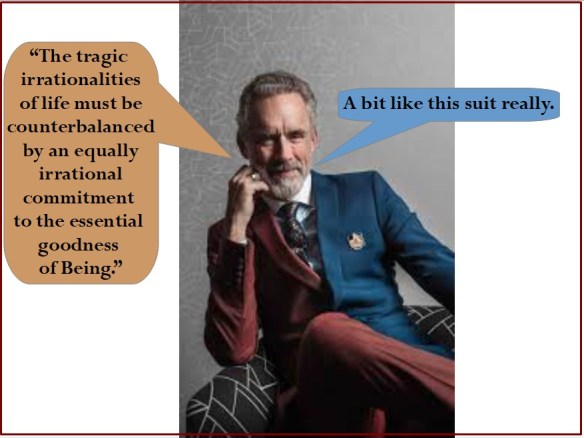
You’ll be overjoyed to hear that Jordan B. Peterson has a new book out. He’s been busy promoting the not at all pretentiously titled We Who Wrestle With God. He was interviewed about it recently in British magazine The Spectator. The interview has to be read to be believed. The introduction can be read here but the rest, alas, is behind a paywall. Don’t worry though, I’ll supply you with the highlights. The article is a goldmine of stupefying statements about God and how Jordan is the only one who really understands the Bible’s stories. They need ‘arranging’, you see, and their underlying ‘hypotheses’ understood:

The Bible presents a series of hypotheses. One is that there’s an underlying unity that brings together all structures of value. The second claim is that there’s a relationship between the human psyche and that unity and each of the main biblical stories casts that unity in a different light, accompanied by the insistence that, despite those differences, what is being pointed to is one animating principle. As far as I can tell, that’s correct.

You got that? As ol’ Jordan humbly admits, this ‘revolutionary realisation’ is his and his alone. Of course, none of this sort of thing is original; the idea that characters, events and stories in the Old Testament prefigure realities in the New is as old as the hills. Typology can be imposed on any set of myths. The gospel writers and Paul did it, seeing Jesus prefigured in Jewish scripture and inventing stories about him so that he complied with these earlier types. There’s nothing ‘revolutionary’ about spotting this, but like so many before him, Peterson gets it back to front and falls, quite literally, for the oldest trick in the Book. Continue reading

The Origins of Evil

Where does evil come from? The Billy Graham Organisation knows:

…the Bible does reveal two important truths about where evil comes from. First… evil comes from the Evil One — that is, from Satan… Satan is a powerful spiritual being who is absolutely opposed to God, and is far stronger than most of us realize. He isn’t equal with God, but is totally evil, and repeatedly works against God. Jesus called him “a murderer from the beginning…. a liar and the father of lies”.

No, not really. Evil is not a supernatural being cavorting around an unseen, undetectable spiritual realm while inflicting havoc on our reality (see here). Satan is not the embodiment of all evil for the simple expedient he and his minions do not exist.

What else does the Bible have to say about the origin of evil? Fake Paul in 1 Timothy 6: 9-10 claims that ‘…the love of money is the root of all evil’. He goes on to say, ’while some coveted after (money), they have erred from the faith, and pierced themselves through with many sorrows,’ which sounds suspiciously like a snipe at early Christians who refused to hand over their worldly goods to the cult.

Now, while greed and avarice can undoubtedly lead to wickedness, the love of money is not the root of all evil. Vindictiveness, spite, fear, ignorance, stupidity, hatred, lust for power, sexual lust, jealousy, coveting another’s property or territory, religious beliefs and deceit (take note, fake Paul): all can, and do, lead to evil.

Let’s give the Bible one last chance.

The author of Mark’s gospel has Jesus say:

What comes out of a man, that defiles a man. For from within, out of the heart of men, proceed evil thoughts, adulteries, fornications, murders, thefts, covetousness, wickedness, deceit, lewdness, an evil eye, blasphemy, pride, foolishness. All these evil things come from within and defile a man (Mark 7:20-23 NKJV).

While ‘Mark’ is talking about ritual purity in this bizarre mix of low-level immorality, religious offences and actual wickedness, he nails it as far as the source of evil is concerned. It emanates from human beings, most often, from men. While women are also capable of committing evil acts, and children too sometimes, most are perpetrated by men. 

It’s not easy finding evidence for this online, where misogynistic, religionist have taken over, claiming women are more evil than men on account of Eve eating the forbidden fruit. They also argue that women are more evil because they ‘hold a grudge longer’. However, a little digging dispels this ridiculous notion. Consider:

Are most dictators men or women? (Men, almost exclusively);

Are most genocidal acts initiated and carried out by men or women? (Men, almost exclusively)

Are most murderers men or women? (Men: 98% of murder convictions are of men);

Are most rapists men or women? (Men; 99% of convictions are of men);

Are rape gang members men or women? (Men, almost exclusively);

Are most child abusers men or women? (Men make up 88% of perpetrators);

Are most school shootings carried out by males or females? (Males, on a ratio of 145:4);

Are most terrorists men or women? (Men, on a ratio of 5:1);

Are most crime lords, drug barons and death-cult leaders men or women? (You already know the answer…)

Are most victims of sexual abuse male or female? (Female: 1 in 5 compared with 1 in 7 males)

Almost all malicious and unnecessary infliction of harm on others, nearly every evil act ever committed has been and is committed primarily by men. Only a small number are carried out by women. However, just because most evil is committed by men, not all men are evil. More than this, most human beings don’t commit ‘evil’. Neither do most Christians, though there does seem to be an inordinate number who are prepared to sexually abuse others. Nonetheless, many are happy to blame Satan for what evil there is, including their own. Attributing human evil to a malevolent fantasy figure is a duplicitous attempt to evade both responsibility and culpability.

In any case, according to true believers Satan’s main occupation is sowing the seeds of doubt in the minds of Christians, in an attempt to lead them away from Jesus (2 Corinthians 11:30). Satan is, when all is said and done, a pretty hopeless prop, not ‘a powerful spiritual being’ but an enfeebled metaphor for the evil that some humans engender.

Afterthought:

Where does goodness come from? That too is human. All compassion, kindness, consideration, empathy, helpfulness, love, joy and peace come from us.

Or not, as the case may be.

Live Backwards

I wanted in this post to think about the source(s) of evil, given it cannot be supernatural. However, defining evil isn’t as straightforward as I anticipated. The Oxford English Dictionary offers ‘Profoundly immoral and wicked’ while Merriam Webster goes for ‘morally reprehensible: sinful, wicked.’ Other dictionaries also mention both immorality and wickedness, replacing one concept in need of explanation with two. ‘Wicked’, it seems to me, is synonymous with evil, which doesn’t get us any closer to defining it. There are problems with ‘immorality’ too, as what constitutes immorality is frequently culturally determined.

Evangelicals, for example, regard same-sex relationships as immoral (so that’s me told) as is sex outside marriage. When I was involved in the church, dancing, drinking and listening to rock music (with all its backward messages!) were anathema. In some countries today many of these behaviours attract the attention of so-called morality police and are punishable by death (how moral is that!) Then there are those who fail to keep their word. Within months of being elected, the UK government under Keir Starmer has reneged on almost every promise they made prior to the election. Everyone expects politicians to lie so perhaps allowing ourselves to be duped by them means they’re not entirely responsible. Let’s not forget too that for some, eating meat is immoral, as is using fossil fuels. Our eating meat and our burning fossil fuels, that is.

So, are the practitioners of such relatively low-level, and disputed immoral acts – being gay, having non-marital sex, drinking and dancing, lying, using oil, eating meat – actually evil? Are women who have abortions, and the people who carry them out, evil? Of course not. It’s debatable whether some of these behaviours are immoral to begin with, but even if they are, immorality does not always equate with evil. I would argue that while all truly evil acts must, by definition, be immoral, not all (supposed) immorality is evil. Somehow personal immorality lacks the scale and awful consequences of true evil.

The Sanford Encyclopaedia of Philosophy is much nearer the mark when it comes to defining evil:

Evil must involve harm, and it must be serious enough to damage its victims’ capacity to function normally… Furthermore, the harm must be unjustified…

I’ll adapt and paraphrase this as ‘the malicious and unnecessary inflicting of harm on others’ to give us a working definition of evil.

So, who qualifies? Hitler obviously. Putin certainly. Other oppressive regimes. Murderers. Hamas. Child abusers. The gangs who have raped very young girls in numerous UK cities. How about the God of the Old Testament? He orders the cruel deaths of Israel’s enemies (Deuteronomy 7), promotes the smashing of babies’ heads against rocks (Psalm 137:9) and orders the taking of prison-of-war virgins as sex slaves (Numbers 31: 17-18). Later, Jesus – like father, like son – relishes the opportunity to put his enemies to the sword (Luke 19:27) and orders those who don’t believe in him be consigned to hell where they’ll be tortured forever (Matthew 25: 41-46). This is evil by any definition.

So, given there isn’t a God nor a heavenly Jesus, from where does evil originate? I’ll get to that, at last, in the next post.

It’s the End!

AI shows how it’s done. Arrange your elements carefully, and – hey, presto! – Jesus appears!

I’ve reached the end! The end of Jonathan Cahn’s The Dragon Prophecy that is. He has me convinced: the end of the age and the world itself, is just around the corner. He looks around the world, particularly the Middle East, sees the state it’s in and dives into the scriptures to uncover the prophecies that presage present day events. He then reveals how, collectively, these scriptures accurately describe the state of the world today following Hamas’s invasion of Israel on 7th October 2023.

Had he collected these passages prior to 7th October, would they have accurately foretold the events of that day? They should’ve done if that’s what they are really about. So where was this expose before 7th October? Where were the books, by Cahn or anyone else, revealing how the Bible predicted in detail, events that still lay in the future? Predicatbly (pun intended), they don’t exist. Cahn’s The Serpent’s Prophecy could only be written with hindsight, after the events, 7th October 2023 in particular, that he’s decided fulfil biblical prophecy. The prescience of these ancient scriptures is only apparent, to Cahn if no-one else, in retrospect.

He gathers disparate verses together to demonstrate how they do indeed predict current events. He omits many that don’t, even though they too appear to prophesy the future. He does this because they don’t fit the picture he’s trying to create: his interpretation of events in Israel and the significance he wants ascribed to them.

Cahn disingenuously forces unrelated verses to work together, like pieces from different jigsaw puzzles, to create a picture that loosely and disjointedly conforms with and thereby confirms his own conclusions. 

The culmination of The Dragon’s Prophecy is that the time is right and the stage set for Christ’s ‘return’. Cahn advises his readers to surrender to him before he comes though the clouds to do unspeakable things to them. While none of the ‘prophecies’ he’s pressed into service have ever been fulfilled and are certainly not being now, this one must surely be the greatest of the Bible’s failed prophecies.

Does all of this sound familiar? It should. Starting with Paul and the gospel writers, numerous hacks have pulled together biblical prophecies to show how events of their times fulfil the conditions for Christ’s return.

More than this, the gospels were created in exactly the same way that Cahn creates his end-of-the-world scenario. Mark, Matthew and Luke, ruthlessly plundered ancient Jewish scripture to show how their suffering Messiah (whether real or not) was predicted there. Significantly, no-one prior to the early days of the Christian cult believed that these particular scriptures foresaw a suffering Messiah who would die for the sins of his people before coming back to life. The scriptures could only be made to do so in retrospect. After some claimed to have seen the risen Jesus, early cultists began to scour the scriptures for passages – how many they had to ignore or misinterpret! – that could be made to create a loose, disjointed picture of their super-hero. It’s how Paul attempted to persuade others that Jesus was the Messiah (1 Corinthians 15:3,4 etc).

So Cahn is doing nothing new, finding a ready audience for his particular sleight of hand.

Experiencing Jesus

Back in my students days, sometime in the Middle Ages, I was involved in the conversion of a couple of friends. I’d only just met them, after starting college a week or so earlier. I was training to be a teacher and the college thought it would be a good idea if their new recruits spent a couple of weeks travelling to a school miles away to observe how education was delivered there (pretty chaotically it turned out.)

Jan, Karen and I travelled to the school in Rob’s Triumph Herald car. Rob was a new friend too. He and I met the first day of college and hit it off straight away, both being evangelicals (his guitar was covered in Arthur Blessit ‘One Way’ stickers) and bonding over our mutual love of Larry Norman.

Rob had one such sticker on the dashboard of his car and one day, on our way back from the school, Jan and Karen asked about it and what it was like to be a Christian. We had somewhere taken an unintended detour and the journey back to the college was taking longer than usual so we had plenty of time to share our faith with them. It was a dream come true – what committed Christian didn’t look for opportunities to witness to non-believers, which we did with great enthusiasm.

Before going off to college I’d had a strange vision: a vivid scenario playing out in my head. In it, some people I hadn’t yet met came to my dorm room and asked me to lead them to Christ. While I hadn’t seen my room at this point it turned out to look exactly as I’d seen it in the vision. Lo and behold, after our chat in the car, Rob appeared at my door that evening and said Jan and Karen had arrived at his room saying they wanted to become Christians. We took them to the little prayer room in the back of the college chapel and there the Holy Spirit took over. We prayed with ‘the girls’ and introduced them to Jesus. The entire room was filled then with another powerful presence like a wind or tongues of fire as we sensed Jesus there with us.

It was a powerful experience and for the girls an overwhelming one. They left praising the Lord on an all-time spiritual high. Soon after, Jan had to go into hospital (I forget why) and used the time to read the Bible we gave her in its entirety. She was on fire for the Lord there in that hospital ward. Later she surrendered her yoga materials to us once we’d shown her how the practice was Satanic and, doing the Lord’s bidding, we destroyed it for her. Jan and Karen joined the Christian Union, coming to the twice weekly meetings and began to attend the local evangelical church every Sunday.

To this day, Jan remains a Christian. I haven’t seen her for many years but we share Christmas cards and very occasionally comment on Facebook posts. Karen abandoned her faith a few years after her conversion.

How to explain this amazing experience? Conditioning meets emotion. That it was life-changing for both Jan and Karen (for a while) and also for Rob and me, was the result of our own intense feelings. Neither Jesus nor his Spirit was present in that little prayer room. We thought he was and that was enough. We didn’t need to see him, it was enough to sense his powerful presence (in reality our own heightened emotions.)

Wasn’t this how it was for the earliest Christians? Those Paul told about Jesus never actually ‘saw’ him; they felt him among them. This is how the gospels say it works, not the sighting of a physical body but the sensing of a presence. Matthew makes his version of Jesus predict that this is exactly what will happen (in reality Matthew is reflecting what early cultists had been experiencing for decades when he came to write his gospel):

For where two or three are gathered together in my name, I am there among them (Matt 18:20).

In other words, a small group intent in their worship would experience the presence of their heavenly saviour. They would manifest a sense of his being there through their collective emotions, just as Jan, Karen, Rob and I did in that prayer room. As did those, like Cephas, who experienced him way back at the start of the Jesus movement, and as Paul did in his imagined encounters with the risen Christ.

No reanimated corpse required.

Revealing the Truth of John’s Revelation

The revelation from Jesus Christ, which God gave him to show his servants what must soon take place. He made it known by sending his angel to his servant John, who testifies to everything he saw – that is, the word of God and the testimony of Jesus Christ.

Blessed is the one who reads aloud the words of this prophecy, and blessed are those who hear it and take to heart what is written in it, because the time is near… “Look, he is coming with the clouds,” and “every eye will see him,
even those who pierced him”; and all peoples on earth “will mourn because of him.”
So shall it be! Amen…

On the Lord’s Day I was in the Spirit, and I heard behind me a loud voice like a trumpet, which said: “Write on a scroll what you see and send it to the seven churches: to Ephesus, Smyrna, Pergamum, Thyatira, Sardis, Philadelphia and Laodicea.” I turned around to see the voice that was speaking to me. And when I turned I saw seven golden lampstands…

So begins the Book of Revelation, written by a fanatic identifying as John (think Steven Anderson) who finds himself on the island of Patmos ‘because of the gospel’, with an account of the imminent end of the world (1:3 ‘the time is near’ and 1:7 ‘even those who pierced him’ will see him.)

What follows is a disturbing and disturbed account of what the Earth could soon expect when Jesus descended from the heavens to wreak vengeance on sinful human kind.

John claims the scenario he’s about to describe was given to him by an angel who got it from the Lord Jesus Christ, who in turn received it from God himself (1:1). Or perhaps the angel and Jesus Christ are one and the same. Did John regard Jesus Christ as an angel, the ‘messenger’ of God (the literal translation of the Greek angelos)?

I’ve often wondered about this ’revealed’ business. Paul too talks about having Jesus ‘revealed’ in him (Galatians 1:16). What exactly are Paul and John talking about? John says he ‘saw’ (1:2) all that he’s about to describe in the next twenty-two tedious chapters, as if this ‘revealing’ is some sort of vision or hallucination. Given the complexity of what he then describes, this seems to me highly unlikely. He ‘sees’ in his mind’s eye god’s throne, attendant angels, the four horsemen, the opening of seven seals, the destruction of the world, the annihilation of most of mankind, the descent from heaven of the holy city, the intricate details of the construction of this city… read the book for yourself for even more. Even dreams are not this detailed or vivid.

I’m not convinced Paul saw the resurrected Jesus as a figure in front of him (or as a bright light or some other quasi-physical manifestation.) What Paul and John did when ecstatic with religious fervour – what John describes as being ‘in the Spirit’ – was concoct an explanation for the way they were feeling; Paul persuaded himself he’d seen a resurrected God-man and worked out over time what this might mean. He then attributed this thinking to his God and his divine influence. John under persecution (it’s generally accepted his being on Patmos ‘because of the gospel’ (1:9) was as punishment for being a public nuisance) fomented a doomsday scenario for those who persecuted him and the divine elevation of those who believed like he did, and attributed this to spiritual beings. The scenario was not revealed instantaneously to him by a supernatural agent; again, it was something developed over time – hence the quotations from other sources (1:7) – in an aggrieved fanatic’s head.

Revelation is a calculated literary construct, like the gospels themselves, devised and refined over time. John ‘saw’ none of it, nor did he ‘hear’ an actual disembodied voice telling him about living room furniture (1:12’s lampstands). No higher power ‘revealed’ any of it to him. On the contrary, he devised it himself, working out every aspect in his head. Either he was deluded enough to think he was actually being fed revenge-porn by an angelic Jesus or he cynically, deliberately attributed it to him.

There was not then, as there is not now, a heavenly Jesus who spoke to susceptible mortals here on Earth. The savage, avenging Jesus that John of Patmos creates from his own anger, bitterness and sense of persecution bears little relation to the other versions of the character in Paul and in the gospels (as Ehrman demonstrates in Armageddon). Revelation’s savage, slaughtering Jesus is at least the sixth manifestation of the character proffered in the New Testament. John demonstrates just how easy it was, and is, to invent one’s own version of a supposedly unchanging character (Hebrews 13:8; Revelation 1:8) and make him do, at least in your imagination, just what you want him to do.

The End of Days

A friend of mine was recently given the book The Dragon’s Prophecy: Israel, the Dark Resurrection and the End of Days by Jonathan Cahn. My friend, already concerned about the state of the world, said how much the book had disturbed her. She had become convinced that the time we live in had been predicted in the Bible, in Revelation in particular. ‘It’s all there in the Bible,’ she said to me. ‘It’s all happening just as it says.’

I tried to reassure her that Revelation was written by someone who, 2000 years ago, believed that the situation then couldn’t get any worse, what with the Roman occupation, the destruction of Jerusalem and the persecution of Christians (as the writer saw it.) This, together with his belief that the Lord would soon be coming on the clouds (Revelation 1:7), convinced him he was living in the world’s last days. I told my friend that because of the mess the world is in today (and when is it not a mess?) the book of Revelation resonates with some people; a voice from the past echoing down the ages. In no way, however, was it written about today.

My friend was unconvinced so I took it upon myself to read The Dragon’s Prophecy. Coincidentally, I had just begun to read Bart D. Ehrman’s Armageddon: What the Bible Really Says About the End, dealing with the same concerns. The comparison between the two books couldn’t be more striking.

Ehrman’s is a measured analysis of Revelation and other ‘prophetic’ books of the Bible. He demonstrates from the outset that Revelation was written for believers of the late first/early second century and that its symbolism represents individuals and events of that time. John of Patmos, whoever he may have been (a cult leader, Ehrman suggests) expected, like most early Christians, that the End was going to materialise soon, in the first or early second century, emphatically not in the 21st.

Ehrman warns that ‘professional prophecy writers’ (he doesn’t name Cahn) think ‘the way to use the Bible is to assemble the pieces to reveal the big picture, which until now no one has seen before’ (p17). He’s right. This is precisely what they do. In his book, Cahn promises ‘to put together the pieces of the mystery’ (p11) and claims ‘We (sic) will now begin assembling the pieces of the puzzle’ (p36). He then proceeds to jump around the Bible like a grasshopper on steroids. He’s one of the ‘prophets’ who, as Ehrman puts it, sees the Bible as ‘a great jigsaw puzzle with one piece hidden in this place, one in another and yet a third somewhere else’ (p17).

Cahn opens his argument with a series of bald, unsupported assertions: ‘Behind the perceivable realm lies another, beyond our ability to measure or quantify’ and ‘Behind the history of this world lies another, unrecorded, unrecited (sic), unknown,’ his readers evidently not expected to ask how he knows any of this codswallop. He goes from there to build his argument, such as it is, with a bombardment of ridiculous questions and pseudo-profundities:

What is evil? And how did it come into existence? It is both a mystery and a problem. The mystery is the problem (p9).

Then there are the propositional statements of the ‘If… then we’d expect’ variety. There’s rarely any evidence for the ‘if’ and none at all for the proposed expectation. Here’s the two – rhetorical question and propositional statement – rolled into one: ‘If evil is uncreated, how did it come to exist?’ (p32). Naturally, Cahn is going to answer this question and all the others like it, with a series of unfounded assertions, non-sequiturs and a smattering of unrelated Bible verses.

A central premise of The Dragon’s Prophecy, the dragon being that of Revelation 12:9 and therefore the devil, is ‘the dark resurrection’ of its subtitle. This Cahn explains, pretending the idea comes from the Bible when it doesn’t, is the re-emergence of the Israelites’ old, (extinct) enemies, the Philistines. Like the Israeli nation they too have now been resurrected: as the Palestinians. Under the control of the dragon/devil, they re-enacted on October 7th last year one of the many ancient Philistine attacks recorded in the Bible, only this time with ‘guns and explosives’:

On that October morning, the ancient drama replayed. The resurrected Philistines had again invaded the land, and the resurrected Israelites had again gone into hiding, keeping silent and still in fear of their pursuers (pp99-100).

How do we know this is a replay of an ancient invasion? Because some of those under attack on 7th October went into hiding, just as the Israelites did in 1 Samuel 13:6. As if no other group of besieged civilians hasn’t tried to hide at any other point in history. That and the ‘fact’ there were, according to Cahn, exactly 3,000 invaders on each occasion. Yes, the book really is this bad.

And so, Cahn says, the stage is set for the final battle and the return of Christ who will knock a few heads together, torture and slaughter everyone who isn’t a Christian and set up his faithful followers in a new Jerusalem made of gold and fancy stuff. As Ehrman says, this is indeed what Revelation promises – for the world 2,000 years ago. Ehrman argues that the author of this revenge porn, (he doesn’t use the term: that’s my contribution – you’re welcome) creates a Christ so unlike those of the gospels that he can only be a fiction (aren’t they all?)

Revelation barely made it into the canon and we would all be better off if it hadn’t; certainly my friend would be, and as Ehrman shows, human society and the planet in general would be too. He warns us to read what the Bible actually says, instead of, as Cahn does, forcing it to say what we want it to (to sell books). Irritatingly, Ehrman consistently refers to the Christ’s prophesied appearance on the clouds as his ‘Second Coming’ when the Bible never uses the phrase. Read what it says Bart!

I don’t know whether I’ll finish Dragon’s Prophecy. Its cover blurb boasts that Cahn is a New York Times best seller so clearly there’s an audience for such poorly argued, alarmist nonsense – which is itself alarming. While Bart D. Ehrman has also made the NYT list in the past, Cahn easily outsells him. Nevertheless, I’ve bought my friend a copy of his Armageddon in the hopes it might serve as an antidote to the dire The Dragon’s Prophecy.