There May Be Trouble Ahead…

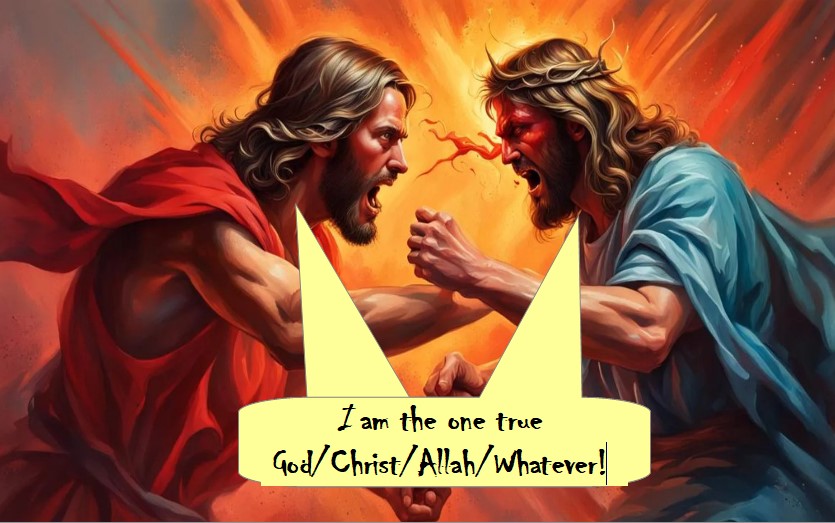
Prophets, from left to right: Elijah, Julie Stephens,
Cindy Jacobs and er... Ed Miliband

Prophets don’t exist. A bunch of people intoxicated by religious fervour who think God has given them a special message that they must deliver to whoever will listen, are not prophets; they are a collection of extremists intoxicated with religious fervour.

We know this because no God exists. He can’t, as a result, drop messages, special or otherwise, into the heads of fanatics.

That’s it, really. No more to be said.

But so-called prophets exert quite an influence on our modern world. According to Abraham (I know, he’s a mythical figure but bear with me), God selected an ancient Jewish tribe to be his favourite buddies, so long as they did whatever he demanded of them, including hacking off their foreskins and that of their sons. What sort of prophet – what sort of God – comes up with this kind of lunatic fetishism?

Later the creators of a new prophet, whom they called Moses, came up with a story in which their hero encountered God in a bush (the symbolism is lost on us today.) This time he wanted his special buddies to invade their neighbour’s territory, slaughter them and take their land for themselves. This his favourite, de-foreskinned tribe did (modern genetic analysis of the peoples in the region suggests this isn’t what happened.)

After these fictional madmen came some potentially real fanatics who thought God had assigned them to lambast their fellow Jews for their shortcomings. These prophets promised the rubes rewards if they behaved as the prophets thought they should. These guys also came up with the idea that God would send a warrior Messiah to help his special little tribe take over the world. This is what happens when fanatics are allowed to get a hold of things.

A couple of centuries later, another self-proclaimed prophet turned up (or is invented) who seemed to think he’s the most special-est of all the prophets so far. This guy, called Yeshua (meaning ‘salvation’, so obviously not in any way symbolic) prophesied that the Messiah would be arriving real soon to sort the world out. He’d then hand it over to the Jewish people to manage. This guy’s script writers weren’t sure if Yeshua was talking about himself or some other supernatural character called the Son of Man. It doesn’t matter really. Nothing he prophesied happened when he confidently predicted it would: there was no Messiah who flies down from heaven, no final judgment, no great reset for the Earth. He was an absolute failure as a prophet; evidence, if more is needed, that those who claim to speak for God don’t know what they’re talking about. Don’t worry, though, this guy was recast as a resurrected Godman, just like the ones in pagan myths.

A few other prophets appeared around about the same time. In fact, the extremist who changed his name to Paul seemed to think that just about anyone could become one so long as they ‘edified’ the brethren. It was a few years though before the next really big so-called prophet came along.

In the 8th century, a guy called Muhammad said he was told by an angel who represented a different version of God that, amongst other things, Islam would spread worldwide and there would be an increase in senseless murders. These rather nebulous and self-fulfilling predictions are even now coming to pass. Muhammad’s future followers are indeed spreading Islam across the globe while senseless murders continue being committed, a good many of them by Muslims themselves.

While Muslims have made it clear that Muhammad is the final prophet, history has blessed us since with a few more. Joseph Smith in the 1880s was commanded by a different God (or maybe by the same one who’s changed his mind again) to start a new church and to obliterate anyone who stood in his way. He was successful in this enterprise, despite managing to get himself killed in the process.

You’d think, wouldn’t you, that given their abysmal success rate and the number of people who have suffered or perished as a result of their endeavours that we’d have had enough of prophets. While churches cannot agree on whether ‘genuine’ prophecy still exists, the prophets keep coming. Fanatics the world over, every bit as barmy as their predecessors, appoint themselves some deity’s spokesperson, and the ‘prophetic’ pronouncements begin: meaningless theobabble spattered across the Internet.

The Real Jesus

Dear Christian,

When you became a Christian, did you meet the man who wandered around Galilee 2,000 years and who, according to ancient stories, died on a Roman cross? Was it an actual human being you met at the moment you ‘saw the light’ (the clue’s in the term)? Or was it something – an emotional experience perhaps – that you interpreted as the presence of a heavenly, supernatural being? If you’re honest you’ll acknowledge you didn’t meet a real person but felt something that you took to be one.

When you pray to Jesus, exactly who are you praying to? Is it the man who drifted around Galilee 2,000 years ago? Are your thoughts magically transported back in time so he hears you, somehow or other, in his head? No? So do you pray to a supernatural, celestial Jesus who for the past 2,000 years has been sitting at the right hand of God in a mythical never, never land? I’m guessing you’ll say this is the Jesus you commune with (while disputing my calling heaven never, never land).

When you worship Jesus are your honeyed words whisked back 2,000 years to sustain a man who meandered around Galilee spouting profundities before getting himself killed? Or do you envisage your prayers reaching a supernatural figure living out there in space or maybe in another dimension? (C’mon, you know it’s the latter.)

When you say Jesus was present at the creation of the world as described at the start of Genesis, do you mean the man who, billions of years later, would roam around Galilee? Or do you mean a celestial  Jesus who was a part of the Godhead in some mysterious, inexplicable way? (I’m guessing, again, it’s this latter.)

When you say Jesus will judge the living and the dead at the End of the Age, do you refer to the man who lived 2,000 years ago, trudging around Galilee? Or do you mean some mystical manifestation of this character who’s eager to separate the sheep from the goats while hovering in the sky prior to massacring the goats? (It’s this version, isn’t it.)

In the Bible, did Paul meet the flesh-and-blood man who had slogged around Galilee a few years earlier? Or did he hallucinate a celestial being as a flash of light? (It was the latter, wasn’t it.)

When you speak of the Jesus who died on the cross to save you from your sins, do you quote the individual who supposedly drifted round Galilee 2,000 years ago? Or do you more often reference Paul, who never met him and knows nothing of his supposed earthly life? (You know which.)

Yet despite your belief in mystical, spiritual versions of Jesus, you are adamant he was not a mythical being. Not at the start of time, not at the end, nor in Paul’s writings; not in your own conversion, not in your prayers or worship and especially not in your own inner experience of him. No, he was, according to you, a very real person.

Yet there are no signs you believe in this historical Jesus, the man who allegedly roamed around Galilee two millennia ago. You ignore him and his teaching if favour of a celestial superman. How do we know you ignore him? All the examples above for a start, but there’s also the way you don’t do what he says. You don’t love your neighbour and enemies alike, you don’t sell all you have to give to the poor, you don’t give to everyone who asks, you don’t despise riches, you don’t refrain from judging others. You rarely turn the other cheek or go the extra mile and you are not prepared to forgive endlessly. You don’t accept that this man believed the End of Age was coming in his own time (or at least that his script-writers did) nor that he was disastrously wrong. It’s the cosmic super-being you go for every time.

How very strange. Cognitive dissonance is a powerful phenomenon, don’t you think?

Do You See What I See?

Christianity with its visions of God, angels and resurrected god-men, is not distinctive. It emerged from a culture in which such epiphanies were commonplace and highly esteemed. Appearances of deities, other supernatural beings and dead people were valued as genuine encounters with a reality on the other side of this mortal life. Paul was a Hellenised Jew and a Roman citizen (if Acts 17 can be believed); it was perfectly natural for him and his contemporaries to see and hear things that weren’t there.

Not only was the fledging Christ-cult influenced by the superstitious culture around it, but was born too of Judaism, itself awash with visions, apparitions and revelations. How could the new religion fail to be when its originators existed in such a milieu. One or other of these ‘visionaries’ believed they’d seen a resurrected Jesus. Of course they did. This is how gods manifested themselves then; everyone knew it. There were even those who hadn’t really had any inner-visions but wanted to be regarded as mystics themselves so would pretend they too had had direct contact with the deities.

The human mind has always been susceptible to illusions, to the potency of dreams and to misinterpreting what is going on around it. It’s also prone to a spot of fantasising now and then. This propensity didn’t cease once Christianity established itself. Muhammed claimed to have been visited by angels who revealed new truths about the nature of God – not least a change in name.

In the 19th century, a young farmer, Joseph Smith, living during a widespread and particularly intense religious revival, imagined (or pretended) he’d been visited by God and Jesus. Later, he said he’d been visited by a hitherto unknown angel with the unlikely name of Moroni. The result of course was multiple wives for Smith and the foundation of the Church of Jesus Christ of Latter Day Saints. Sufficient numbers of people believed Smith’s cockamamie stories about his alleged visions to commit to Mormonism. Smith wasn’t alone; others had visions of deities, including but not restricted to the Big Two, Jesus and his Father God. Hundreds recently saw the Virgin Mary hovering above New York City. They couldn’t all be wrong could they? Of course not, but they were all be deluded. Just like Joshua Mhlakela whom Jesus appeared to and told him the date of the Rapture was 22nd September, or possibly the 23rd, then with ‘billion percent’ certainty 7th October. Or maybe 8th…

This is how religions are made, changed and adopted: on a bed of illusory sand. If we need any further evidence that such experiences are illusory, created by the mind itself, then consider this: each time God, his angels or his Son appear in the religion-soaked brains of mystics and fraudsters, they reveal a message at odds with that revealed to previous visionaries. Each revelation has to be different of course. There would be no reason for such ‘visits’ otherwise.

Hence Abraham (or his script writer) imagining YHWH promising an eternal covenant and a new land.

Moses (or his script-writer) claiming YHWH had issued new laws while at the time commanding the slaughter of tribal enemies.

Cephas thinking he’d seen a risen Jesus who may or may not have told him of the imminent the End of the Age.

Jesus himself reportedly talking with his ‘Father’ about the necessity of his execution.

Paul flying to heaven so that Jesus could explain in great detail a new covenant, negating the original ‘eternal’ covenant with Abraham.

John of Patmos envisaging Jesus coming to Earth to slaughter the enemies he purportedly instructed his followers to love. (And Christians claim the Bible presents a unified message!)

All of these are manifestations of, and within, the minds of fantasists. Such manifestations are a naturally occurring malfunction of the brain.

And so it continues. Beware anyone who claims to have seen or heard from a deity of any sort. They, like their biblical counterparts, are deluded and almost certainly ill.

Mystic Revelations

What do the three ‘great’ Abrahamic religions have in common?

They all started with visions, hallucinations, dreams and mystic revelations. They’re not only based on these but owe their very existence to encounters with the supernatural that took place entirely within people’s heads. This of course is if they happened at all; many of these encounters with angels and God’s revelations take place in stories that have all the characteristics of myth or legend. Even so, they reveal much about the primitive state of mind (still around today) that believed God frequently revealed himself to, and in the minds of, chosen individuals.

First, the grand-daddy of the Abrahamic religions, Judaism: 

When Abram was 99 years old, YHWH appeared to him. He said to Abram, “I am El Shadday. Live in my presence with integrity. I will give you my promise, and I will give you very many descendants.” Immediately, Abram bowed with his face touching the ground, and again Elohim spoke to him, My promise is still with you. You will become the father of many nations. So your name will no longer be Abram [Exalted Father] but Abraham [Father of Many] because I have made you a father of many nations. I will give you many descendants. Many nations and kings will come from you. I will make my promise to you and your descendants for generations to come as an everlasting promise. I will be your Elohim and the God of your descendants. (Genesis 17)

Then Moses:

The Angel of YHWH appeared to (Moses) in a flame of fire from the midst of a bush. So he looked, and behold, the bush was burning with fire, but the bush was not consumed.

Then Moses said, “I will now turn aside and see this great sight, why the bush does not burn.”

So when YHWH saw that he turned aside to look, Elohim called to him from the midst of the bush and said, “Moses, Moses!” And he said, “Here I am.” (Exodus 3)

Notice how the inner voice goes from being that of ‘the angel of YHWH’ to YHWH himself (or one of his aliases). The entire scenario is preposterous of course, as is the Abraham episode before it. I’ve omitted the other occasions YHWH is said to appear to Abraham, including the infamous Genesis 22, where YHWH instructs Abraham to sacrifice his son. These stories are legends written, created from whole cloth, centuries after Abraham purportedly lived. He, like the later Moses, is almost certainly mythical, a character created to represent the beginnings of the Jewish faith. Even his names are symbolic. In truth, no one knows how Judaism began.

Onto Christianity:

The angel said to (Mary), “Don’t be afraid, Mary; God has shown you his grace. Listen! You will become pregnant and give birth to a son, and you will name him Jesus. He will be great and will be called the Son of the Most High. The Lord God will give him the throne of King David, his ancestor. He will rule over the people of Jacob forever, and his kingdom will never end.” (Luke 1)

Did this happen? If you believe angels exist then possibly, but we know they do not. We also know that this is myth. However, Luke wanted his readers to know that Jesus’ birth was miraculous so invented a story in which Mary encounters a heavenly being. The gospel writer anchors the divinity of Jesus to an implausible event which at best can only be a young woman’s vision (though it most certainly isn’t.)

The same is true of the resurrection appearances. Here’s Matthew 28:1-8:

Now after the Sabbath, as it began to dawn toward the first day of the week, Mary Magdalene and the other Mary came to look at the grave. And behold, a severe earthquake had occurred, for an angel of the Lord descended from heaven and came and rolled away the stone and sat upon it. And his appearance was like lightning, and his clothing as white as snow. The guards shook for fear of him and became like dead men. The angel said to the women, “Do not be afraid; for I know that you are looking for Jesus who has been crucified. He is not here, for He has risen, just as He said.”

More angels (they multiply in later gospels); again at best, though still highly improbable, the angel(s), if seen at all, can only be a vision or an hallucination (or mistaken identity.)

Onto the only first hand account of an encounter with the divine that the bible includes, Paul’s:

God was pleased to reveal His Son in me so that I might preach Him among the Gentiles… I want you to know, brothers and sisters, that the gospel I preached is not of human origin. I did not receive it from any man, nor was I taught it; rather, I received it by revelation from Jesus Christ. (Galatians 1)

I know a man in Christ who fourteen years ago—whether in the body I do not know, or out of the body I do not know, God knows—such a man was caught up to the third heaven. And I know how such a man—whether in the body or apart from the body I do not know, God knows— was caught up into Paradise and heard inexpressible words, which a man is not permitted to speak. (2 Corinthians)

This is all there is. This is the extent Paul talks about his heavenly encounters. In Galatians he admits that God revealing whatever it was he revealed was ‘in’ him, that is, in his own head. The bizarre tale he relates in 2 Corinthians reads like an hallucination (Paul says he doesn’t know whether it was in the body or out of it) which is all it could’ve been; there is no paradise or ‘third heaven’.

And finally, there’s Mohammed:

while I was sleeping last night, the keys of the treasures of the earth were brought to me till they were put in my hand.”… 

The angel came to him and asked him to read. The Prophet replied, “I do not know how to read. The Prophet added, “The angel caught me (forcefully) and pressed me so hard that I could not bear it any more. (Sahih Bukhari 6998)

Encounters with heavenly beings in dreams, ‘revelations’, visions, hallucinations and invented stories: these are central to Judaism, Christianity and Islam. The religions would not exist without them. Written as myth long after they supposedly occurred or referred to obliquely by those who claim to have experienced them, they are the products of fevered pre-scientific minds.

Post-script: I’ve searched in vain for Darwin’s admission that an angel revealed the process of evolution to him. I can only find his collection of evidence, his scientific observations and his careful analysis of his findings. Likewise Mendeleev who calculated the existence of elements that were at the time unknown. Likewise Crick, Watson and Franklin who discovered the structure of DNA. Strangely, none of these people relied on visions, dreams or divine revelations in uncovering truths about reality.

Spiritual Forces of Evil in the Heavenly Realms

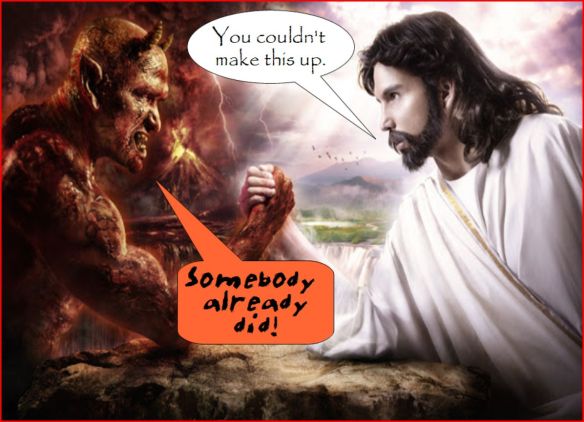
Original AI image from Night Cafe 

For our struggle is not against flesh and blood, but against the rulers, against the authorities, against the powers of this dark world and against the spiritual forces of evil in the heavenly realms. (Ephesians 6:12)

…you followed the ways of this world and of the ruler of the kingdom of the air, the spirit who is now at work in those who are disobedient. (Ephesians 2:2)

the prince of this world now stands condemned. (John 16:11)

The first-century worldview of early Christian cultists was that somewhere above the Earth a battle raged between God and Satan. The powers of darkness – the devil and his demons – had in ages past launched an attack on the Lord and his angels. This war in the spiritual realm continued unabated up to the time when a cultist wrote Ephesians, pretending to be Paul. Paul himself had already alluded to Satan as the god of this age (2 Corinthians 4:4), while the authors of the fourth gospel would later refer to him as the archon – ruler and prince – of this world (John 12:31; 14:30).

Which just goes to show how the Almighty God they believed in was nothing of the sort. He had tussled with his arch-enemy for eons without quashing his rebellion and putting an end to his persistent attacks. The stand-off had gone on for millennia, and, according to today’s Christians, is still happening. A puny god it is who cannot get the better of one of his far less powerful creations.

And what are God and Satan fighting over? Us, apparently. The devil wants control of human beings.

Why? Who knows. In fact, according to Paul, Satan already has control over us. He enslaves us to sin, which in turn leads to death (Romans 5:12, 6:23). 

Not to worry though, Paul, fake Paul and the fourth gospel writers assure us that their enfeebled God has a cunning plan! He’ll allow a being who is precious to him – like a son, in fact – to be sacrificed so that anyone who believes in him will no longer be enslaved to Satan and sin and will be granted eternal life. How’s that for special magic!

Who shouted out from the back that that sounds like a cop-out? It’s a fantasy bordering on the insane. Like it or not, we are somehow embroiled in heavenly warfare, specially if we’re of the number who’ve bought into this malarkey.

While we’re at it, have you noticed how so many of the wars and skirmishes currently afflicting the world have religion at their heart? YHWH is scrapping with Allah, Allah is up against the Great Satan while Jesus – no stranger to war-mongering himself – presides over it all, leading the world to Armageddon and his own ultimate ‘return’.

Here’s my suggestion. All the gods and demons need to get their act together. They should agree to an ultimate slug-fest, a final battle in the spiritual realm to decide who’s really the Supreme God – the last deity standing – and leave us humans out of it entirely. Surely, being gods, they’re up for finding out who can piss furthest up the wall.

A preposterous idea? Of course it is. None of these fantasy beings exist. There’s no YHWH, Allah, Heavenly Father, Jesus, Krishna, angels, archons, Satan or ‘spiritual forces of evil’ to duke it out. There’s no ‘heavenly plane’ where they can get to it. Everyone of these despotic characters is a human creation, as are the wars, disputes and skirmishes they underpin. It follows that none of them can be the supreme god and certainly none of them are worth fighting over. It’s time we grew up and put away all of our childish imaginary tyrants.

Seek and Ye Shall Find

Thanks to all the Christians who responded to my questions last week. Here’s the answers (in red) they helped me reach.

I asked –

1. What happens to you, as a Christian, when you die:

a) You go immediately to heaven (The Bible says this precisely nowhere)

b) You go into suspended animation until Christ’s coming and the final judgement (Paul implies this is the case in 1 Thessalonians 4:13-18. You have to ask yourself how he knew this)

c) You cease to exist (Yup, this is it. So, as Dolly says, better get to livin’)

2. According to the first three gospels, how long was Jesus in the grave?

a) About 36 hours (Friday tea-time till just before sunrise on Sunday. You do the Math)

b) 3 whole days (see above. Despite saying in Matthew 12:40 that this is how long he’d be dead, he fell way short. The fourth gospel, on the other hand, alters the timeline to make things fit)

c) He wasn’t: he went down to hell (according to 1 Peter 4:6 and the so-called Apostles’ Creed this is exactly what he did. Some people are daft enough to believe it)

3. Which of the following does Paul refer to in his letters?

a) Jesus’ miraculous birth (he mentions this zero times)

b) Jesus’ parables, teaching and miracles (likewise; not a single mention)

c) The Empty Tomb (nor this. Don’t you think that’s strange?)

4. How often did Paul refer to Jesus’ second coming?

a) In all of his letters (Nope)

b) 2 or 3 times (Nope)

c) Never (That’s it: not once. Paul looks forward to Jesus coming soon, as if it’ll be his first visit: 1 Thessalonians 4:13-18 again. Don’t you think that’s significant?)

5. How often did Jesus refer to his second coming?

a) Once or twice (No)

b) Frequently (Again, no)

c) Never (Yes, never. The fictional Jesus of the gospels says someone called ‘the Son of Man’ would be arriving real soon: Mark 14:62. Occasionally Jesus’ creators suggest he and the Son of Man are one and the same, which they are in that both are fictional)

6. When did Paul say the Messiah would be coming to the Earth?

a) Thousands of years in the future (To hear modern Christians talk you’d think this was it, but no: Paul never said this.)

b) While he himself was still alive (He says clearly that he expected he’d still be alive when Jesus came down from heaven: 1 Thessalonians 4:13-18. How many more times?)

c) He didn’t say (course he did: see above)

8. According to the gospels, when did Jesus say the Son of Man would be coming to the Earth?

a) He didn’t (he did)

b) Thousands of years in the future (Nope)

c) While those he was talking to were still alive (Yes: in Mark 9:1; 13:26 and 14:62)

8. What, according to the Bible, is the Word of God?

a) The Bible itself (‘Fraid not)

b) The Church (No)

c) Jesus (Yes, but not as often as you might think: only in John 1:1-3)

9. Which was written first?

a) Mark’s gospel (made up about 70CE)

b) Paul’s letters (the earliest, in the 50s)

c) Acts of Apostles (invented circa 80-90CE)

10. When the New Testament mentions ‘the Scriptures’, what is it referring to?

a) Ancient Jewish writings (exclusively so)

b) The whole of the Bible as we now know it (the Bible as such probably didn’t exist until the 4th century)

c) The New Testament (there was no New Testament when the writers who would later be included in it were writing. So, no)

11. How did the New Testament writers ‘prove’ Jesus was the Messiah?

a) By claiming the scriptures predicted he would be (Exclusively so)

b) By pointing to his miracles (Never)

c) By quoting things he said (Never)

Now isn’t that odd.

12. According to the Bible, how did Jesus want his followers to spend their time?

a) By witnessing to atheists on the internet (You think?)

b) By worshipping him (Never)

c) By feeding the hungry, healing the sick and helping the weak (This. See Matthew 25:31-46. So why you spending your days and nights harassing non-believers on the Net?)

Actually, no Christian helped out with this. The answers are those that scholars (and I, in my own humble little way) have arrived by actually reading the friggin’ Bible. 

Later ‘evidence’

The Didache is an early Christian manual discussing ethical behaviour and outlining liturgical practice. Scholars disagree about when it was created, most opting for a date around 100CE. Despite referring to itself as ‘The Teaching of the Lord Through the Twelve Apostles to the Gentiles’ in the only extant complete copy, the Didache doesn’t mention Jesus by name nor refer to any of the historical details of the kind provided in the gospels. Instead, it refers to ‘the Lord’ or ‘the Messiah’, the same terms Paul uses for his angelic Christ, and makes use of ‘teaching’ similar to that in the (invented) gospels, from which it almost certainly draws.

We’re now heading into a period when the gospels were in wider circulation and any reference to Jesus cannot be regarded as independent from them. We need, consequently, to be suspicious of any ‘evidence’ that appears to affirm his historical existence. Documents that appear after the gospels is unlikely to be from independent sources (not that they always reference their sources) but are merely relying on gospel data as filtered through contemporary Christian believers. Hence the Roman historian Tacitus, who wrote in his Annals circa 115CE:

Nero fastened the guilt (for the fire in Rome in 64CE) and inflicted the most exquisite tortures on a class hated for their abominations, called Chrestians by the populace. Chrestus, from whom the name had its origin, suffered the extreme penalty during the reign of Tiberius at the hands of one of our procurators, Pontius Pilatus, and a most mischievous superstition, thus checked for the moment, again broke out not only in Judæa, the first source of the evil, but even in Rome, where all things hideous and shameful from every part of the world find their centre and become popular.

Chrestians? Chrestus?

Pilate as procurator instead of prefect? Christianity as a ‘mischievous superstition’?

Actually, this last I can see. The other peculiarities are a problem for those who claim this is evidence for an historical Jesus. Written some 85 years after Jesus was supposedly active, this first extra-biblical reference to something approaching an historical figure is simply too late. Likewise everything after it.

We’ve exhausted the paltry references to ‘the Christ’ or ‘the Lord’ that exist prior to and just after the gospels. An historical Jesus there is not, in any of them. What does this all mean? 

Conclusions

So what do we see when we arrange the books of the New Testament in chronological order?

  1. In all probability, Jesus was first experienced in visions experienced by a few Jewish zealots looking for the arrival of the Messiah. His name – Yeshua – is symbolic and means ‘The Lord is Salvation’.

  2. These visions led to ‘revelations’ that convinced these zealots that the Messiah would soon arrive on the Earth to set God’s plans in motion.

  3. A small number of Jews were convinced of the veracity of these claims and sought to spread the message that the Messiah/Jesus was soon to arrive on Earth.

  4. A few years later, a Hellenized Jew who called himself Paul, argued that the Messiah – ‘Christ’ in Greek – had died in the heavenly realm and been raised from the dead by God. His sacrifice, Paul insisted, was a propitiation for human sin, both Jew and Gentile.

  5. Also according to Paul, the Christ’s arrival would trigger the resurrection of the dead, prophesied in Daniel 12:1-3 and Isaiah 26:19-20, the final judgement (Daniel 7:22) and the establishment of God’s kingdom on Earth, governed by God’s Chosen (Daniel 7:27). Regrettably, he drew most of these conclusion from a book, Daniel, now known to be fake.

  6. Paul ‘proved’ that the Messiah-figure he’d seen in his visions really was the Messiah prophesied in Jewish scripture by quoting from them extensively.

  7. Soon after Paul died, the original group of visionaries, who had had their differences with Paul, were all but wiped out when the Romans destroyed Jerusalem.

  8. Around the same time, an unknown cultist took it upon himself to write an allegorical history of the Christ’s activities. He based this allegory on Paul’s teaching about the Christ as well as events from Jewish scripture. He set his story in Galilee some forty years earlier and has his fictional Christ, Jesus, prophesy the arrival on Earth of the real Messiah whom he calls the Son of Man, after Daniel 7:13-14.

  9. Two other cultists set about altering and improving this original history. One re-establishes the Christ’s Jewish credentials, and extending references to and allegorising aspects of Jewish scripture.

  10. A completely imaginary history of the early cult was created by one of these writers, smoothing over the differences between the beliefs of the earliest visionaries and Paul.

  11. Other writers, including some pretending to be the late Paul, continue to write of Jesus the Christ as a celestial saviour.

  12. A fourth history of the Christ was created, this time providing Jesus with a bodily resurrection (contrary to Paul) and discarding some of the cult’s earlier beliefs, the imminence of God’s kingdom on Earth included. The authors of this account imply that dead believers will awaken to new life in heaven (John 14:2)

  13. The idea that the Messiah will arrive imminently was, however, kept alive by other writers. One anticipated the Christ would soon purge the world of evil-doers and bring a holy, bejewelled Jerusalem down to Earth.

  14. Others soon abandoned the idea that any of this would happen soon. The arrival of the Christ was postponed indefinitely.

  15. The notion the Son of Man/Messiah/Jesus had yet to appear was also dropped as the church adopted the allegorical gospels as real history. It began to expel those who disputed the gospels’ veracity and denied that Jesus was the Christ incarnate.

  16. While the term is not used in the New Testament the Christ’s delayed arrival was, from the early second century, thought of as a second coming.

  17. The church, once well established went on to embellish doctrine, adding the Triune God; eternal life in Heaven; the elevation of Mary and the saints; the New Testament as the Word of God and the infallibility of the Bible as a whole. Some of these were, and are, in direct contradiction of the beliefs of the earliest Christians.

  18. Believers today, if they read the New Testament at all, take its traditional order at face value, which distorts the evolution of its ideas. They allow their preachers to smooth over what now appear to be random contradictions (hermeneutics).

  19. Today’s Christians believe primarily in the heavenly Christ, who forgives their sins and guides their lives from Heaven. They also hold on to the belief that he was manifested as a human, and vociferously oppose the idea he was and is only an imagined supernatural being.

  20. At the same time they prioritise Paul’s teaching about him over anything he is made to say in the gospels .

That how I see it anyway. The more time I spend looking at the New Testament books in their correct order, as well as what this reveals about the beliefs of early Christians, the more I’m driven to these conclusions. They’re the only ones that make sense of all that we find in their writings. I realise this is contentious. Mythicism is not widely accepted but it is the only position that explains the recorded facts as we have them. The original Jesus was seen (in the mind of the first visionaries and by many later) as a heavenly Messiah. While the gospels were generally accepted as historical many decades after they were written, they are anomalies in the expression of the early faith. They can only be seen as allegories of the living, dying and rising of a cosmic saviour, a sequence not uncommon in the mythologies of the ancient world.

I recognise too that there may well be other problems with this position, which I’ll get to soon.

The New New Testament: part 3

Following the fourth gospel is the epistle of Jude, written at the end of the first century. It is certainly not by a brother of Jesus, despite this traditional attribution. Rather, it addresses false teaching in the Christian community of its day. It makes its points with reference to characters in Jewish scriptures and even mentions the apostles (those who had visions of Jesus) but knows nothing about an earthly Jesus. Parts of Jude are lifted wholesale into the later forgery of 2 Peter.

And then… another made up Jesus! This time the avenging angel of Revelation. I’ve written about Revelation recently so won’t repeat it all here. Suffice to say, this revealing is completely within a disturbed cultist’s head. He wants to see those who oppose the cult to suffer at the hands of his the Messiah who sweeps down from heaven determined to wipe out unbelievers and set the chosen few up as rulers of a reformed Earth. This Jesus seems to have forgotten he once told people to love their neighbours, pray for those who persecuted them, humble themselves, give all they had to the poor etc etc. Revelation Jesus has no time for this sorta shit! Of course, he’s no more real than any of the gospel Jesuses. He’s simply another made-up version, ‘revealed’, or so his creator would have us think, from Heaven. Revelation is chockful of symbolism – The Whore of Babylon, the Number of the Beast, the Marriage Supper of the Lamb etc – all of it applicable to the time when it was written. It has no bearing on anything after that time and doesn’t, despite sloppy interpretations, feature ‘the Anti-Christ’.

The letters of John were all probably written by the same person. This is not the John credited with creating the fourth gospel nor Revelation’s nut-job. This John, or whatever he was really called, is concerned with divisions within his community, chiefly those caused by a group who denied that Jesus was the Christ (1 John 2:22). They were literally anti-Christ. This is where the term occurs in the New Testament and it doesn’t refer to a future madman who will crush Christians in his attempt to rule the world. It seems likely that John’s anti-Christs believed Jesus did not visit Earth as a flesh and blood human being. They were perhaps the last remnants of those Christians who, like Paul and most of the preceding New Testament letter writers, held that Jesus was a divine being, active only in Heaven. With these epistles then, written around CE 100, we turn a corner. Belief in the symbolic Jesus depicted in the gospels as a real man, has become the orthodoxy. It took some time to get here.

And chronologically, that’s about it. There are four forged books left, making the properly ordered New Testament end, not with a bang but a whimper. While 1 & 2 Timothy and 2 Peter claim to be written by Paul and Peter respectively their late date rules this out. 1 Timothy provides the infamous line that women should remain silent in church and obey their husbands at all times. 2 Peter has all the nonsense about a day being the same as a thousand years in God’s eyes. Its duplicitous author argues that God is delaying bringing punishment to the world so that more people might be saved. Evidently he lacks any mathematical understanding. You would think at this point the cultists would have realised that the cultists of the previous century, so certain of the Lord’s imminent arrival had got it disastrously wrong. But no. They reinterpreted their ‘revelations’ and prophecies so that instead of his arrival being ‘at hand’ it was now set to happen at any time in the future, even thousands of years ahead.

Christianity was all but dead at this point. It simply refused to admit it.

The New New Testament: part 2

We’re up to Hebrews in our new, chronological New Testament. The authors of Hebrews contend that their salvation was first ‘announced by the Lord’ and confirmed by those who ‘heard him’. This is not necessarily evidence of an earthly Jesus. Their declaration could equally refer to a cosmic Christ who, as he did with others, provided internal ‘revelations’, just as there are those today who claim Christ speaks to them in their heads. Hebrews’ authors say as much when they claim their faith has been confirmed by spiritual experiences such as ‘signs, wonders and various miracles, and by gifts of the Holy Spirit distributed according to his will’ (Hebrews 2: 3-4). They go on to announce that the New Covenant initiated by the new Moses – Jesus – is in every way superior to the Old Covenant and that he is the new, sinless high priest. Bizarre doesn’t doesn’t begin to describe it.

Hebrews contains the only example in the New Testament of a prediction of Jesus’ second coming: ‘so Christ, having been offered once to bear the sins of many, will appear a second time, not to deal with sin but to save those who are eagerly waiting for him’ (9:28). Hebrews, however, regards the Christ only as a supernatural high priest, operating in the heavenly realms. This second appearance then can only refer to this character, who is not conceived as having had any existence here on Earth.

Around the same time as Hebrews appeared, a senior cultist was writing to a group of Jewish Christians to remind them that faith alone isn’t enough for salvation. It must, James says, translate into improved behaviour. This runs contrary to Paul’s teaching which is that faith alone is sufficient. The letter mentions Jesus only twice (James 1:1 and 2:1) as ‘Lord Jesus, the Christ’. When reminding its readers to love their neighbour as themselves it doesn’t, as we might expect, tell them that this is because Jesus said so. Rather, it quotes from Jewish ‘scripture’; Leviticus 18:19 to be precise. An incongruous thing to do if, as some insist, the James in question was Jesus’ half-brother. In fact, the author makes no claim to have known Jesus and tells us nothing about him. He doesn’t make any reference to the teaching, miracles or activities attributed to Jesus in the first three gospels. Instead, he refers to him 11 times as ‘the Lord’ and tells his readers to be patient because ‘the coming of the Lord is at hand’ (James 5:8). Note what this is saying: the coming of the Lord is not a second coming or a return. And his arrival is ‘at hand’ (εγγύς, ‘engus’), meaning real soon, first century time.

Then, when you thought we’d never get to it, along comes a fourth gospel. Its authors revise the Jesus character and everything about him in this late entry. This Jesus speaks differently about different things. He’s fixated on himself, fully aware he’s a celestial being, completely in control of events, directing the entire story. The gospel introduces a new sidekick too, Jesus’ gay lover ‘the disciple whom Jesus loved’. This is possibly Lazarus, first introduced as a character in a parable in Luke 16:19-31 ‘John’, not Jesus, brings this symbolic character to life in the fourth gospel referring to him as the one the Lord loves (John 1:3). The previous three gospels know nothing of him as a real person.

John goes on to change the day of the crucifixion, to Thursday, because it fits his forced symbolism, and goes overboard in portraying the resurrection as a physical one, Jesus displaying his wounds and inviting the disciples to poke about in them. Preposterous grotesquery that, together with John’s unique resurrection accounts, the other gospel authors somehow missed. Were they not part of the much vaunted oral tradition when they wrote? Did they not know of it from Q? As commanding as John’s Jesus is, he is a very much a literary creation, of the ‘what if our celestial Christ had lived on Earth?’ type. But then again, aren’t they all?