Coronavirus defeated

Blog395

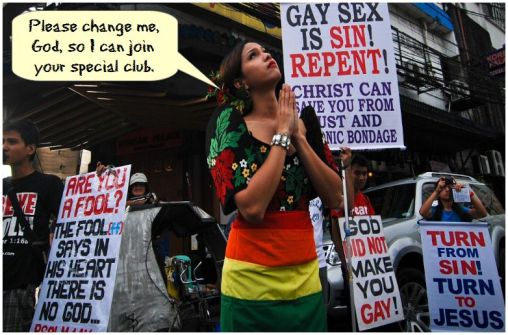
Thank God the Coronavirus pandemic is over. It was scary there for a minute or two. Over 3,000 people died from it. Fortunately, they were mainly Chinese and South Koreans. Vice-president Mike Pence and other anti-abortionists Christian leaders have now taken care of it. On Friday they prayed that it would go away and God has done as they asked. The picture above, courtesy of The Friendly Atheist, shows them doing it. Here’s some other nitwits righteous ones doing the same thing and here an article about the prophet whom God chose to announce to the world that the threat was over. You have to wonder, though, why he made the virus in the first place and why he allowed it to spread so indiscriminately. I mean, even Christians were infected.

Truly, the way to resolve a world wide health crisis is to enlist the help of an imaginary sky fairy who, as usual, does f**k all to help.

Next week: the coronavirus continues to spread. These same men of God then realise that the virus is actually God’s punishment for abortion… er, homosexuality… um, opposition to Trump… er, people shaking their fists in his face (he really doesn’t like that.) Then it all becomes clear why God made the virus in the first place. Difficult to explain why he started it off in China though, but the Lord will surely let his prophets know that too (I mean, those Chinese are commies.)

Life must be easy when all you have to do is make stuff up. It’s more than a little bit worrying that those who do it are listened to by multitudes who’ve switched off their critical faculties. More worrying still when some of these fantasists are in charge of entire countries. The only way coronavirus will be defeated is through science; the development of a vaccine, which is still many months away. Imaginary deities – and they’re all imaginary – prayers, pleading and blaming are all worse than useless.

The Darkening Age

Blog393

I’ve been reading Catherine Nixey’s The Darkening Age: The Christian Destruction of the Classical World. I highly recommend it.

Its sub-title says it all. The early church’s determination to destroy any way of life, any belief system or enterprise that it didn’t agree with was deliberate, systematic and brutal. It set out to eliminate the forms of worship, culture, learning and social norms in which it found itself. It did this initially by demonising, literally as far as it was concerned, the opposition. If it wasn’t Christian then it was demonic; ancient religious beliefs especially, but also schools of philosophy, science, education, the theatre, dancing and sexual mores.

As it grew in power, the church went from holding its ‘heathen’ neighbours’ views as suspect to actively and violently opposing them, destroying temples, toppling and mutilating statues of the old gods, razing to the ground historic buildings they considered ‘demonic’. Those they regarded as ‘pagans’ were compelled to convert to the new religion. According to the Christian propaganda of the time, these pagans turned to Jesus with joy in their hearts, once shown the error of their demonic ways. What choice did people have? It was either that or lose everything they held dear.

Once Christianity became the state religion under Constantine, religious authorities legislated against other philosophies and beliefs. As the Justinian code put it, ‘we forbid the teaching of any doctrine by those who labour under the insanity of paganism.’ Free thinkers could be arrested and have their possessions, including their homes, Blog393aconfiscated. They could be imprisoned for believing and saying things that ran contrary to Christian orthodoxy. Their works were burnt, often on public pyres, and that which survived was frequently written over with pages of scripture. Soon, however, even this wasn’t enough. It became a capital offence to subscribe to alternate beliefs, to write or teach about them. Similarly, same sex activity became outlawed and punishable by death. No wonder the philosophers of the day called Christianity ‘the tyrant’.

In 392, Christian mobs destroyed the magnificent temple of Serapis in Alexandria. The Great Library in the same city had disappeared by then too, quite possibly at the hands of Christian mobs. Hypatia, one of the Library’s greatest mathematicians, was degraded in the street and then murdered. (You may have seen the 2009 film Agora where Hypatia is played by Rachel Weisz; if not you definitely should.)

By AD500, the church had successfully and completely eradicated the opposition. The culture that had preceded it had gone; its knowledge, mythologies, philosophy together with the ability to think freely and to criticise – all consigned, if not to hell, then to oblivion. Nixey reports that 90% of classical literature is lost forever (p246), including almost all Greek writing from the ancient world. As John Chrysostom boasted, the writings of the Greeks ‘have all perished and are obliterated’ (p245). From the little that survives we know that Greek philosophers had postulated that the world was made from atoms and didn’t have a beginning as such. They had also developed a form of evolutionary theory (pp35-36). It would take the world 1500 dark years to catch up with these suppressed ideas.

The elimination of Christianity’s opponents was carried out in the name of the man who supposedly said, ‘love your enemies and pray for those who persecute you’ (Nixey points out that the persecution of Christians was greatly exaggerated; many early believers aspired to martyrdom and the church undoubtedly meted out more persecution than it received.) It was done to bring the world into line with the way they thought God had decreed it should be:

That all superstition of pagans and heathens should be annihilated is what God wants, God commands, God proclaims! (‘Saint’ Augustine)

Thank Enlightenment we can’t, in the west at least, be executed these days for our beliefs and philosophies. And whatever became of Christians? Those who oppose anything in their culture they consider contrary to their tyrannical views, who would punish, perhaps execute, sexual non-conformists and who regard other belief systems, atheism especially, as demonic. The same believers who would eagerly take us back to the demon infested dark ages.

They’re still with us of course and have, in the UK where I am and certainly in the United States, a disproportionate amount of influence and power. We must be grateful they are moderate, reasonable people who wouldn’t hurt a fly.

Aren’t they?

Bathwater

Blog392

While putting together the ‘Can You Be a Christian and…’ series, I encountered on more than one occasion the line of reasoning (I use the term lightly) used by moderate Christians that, essentially, certain parts of the Bible are no longer relevant. So you can, they said, be both a free thinker and a Christian; you can be gay, so long as you disregard what the bible says about homosexuality; you can be a Christian woman if you dismiss Paul’s denigration of women; you can acknowledge evolution provided you reinterpret what the bible says about creation; you can be a realist if you ignore the bible’s supernaturalism.

But if you’re going to disregard anything the bible teaches that appears incompatible with what we know about psychology, sexuality, biology and reality, then how does the Bible’s central objective truth, as one commenter on here calls it, survive? What makes its core message (that, in some way, Jesus’ death and resurrection is capable of saving humankind) an immutable, eternal truth, while almost everything else can be compromised, deemed to be ‘culture-bound’ and metaphorical, to the point of irrelevance?

I recognise, of course, that fundamentalist Christians don’t do this. For them the bible is inspired, infallible and immutable. They’re prepared to compromise themselves, science and reality in order to honour and preserve what the book says. For them evolution, feminism, homosexuality and independent thinking will always be wrong. The alternative is to acknowledge that the bible doesn’t get everything right and to take the approach of the liberal progressive Christian who is prepared to adjust and adapt what it says; to emasculate it.

Which brings us back to asking where this process stops. If progressive Christians are prepared to dilute to the point of meaninglessness what the bible has to say about creation, women, sexuality and reality itself then why not what it teaches about Jesus and salvation?

It’s a fact that almost all varieties of the Faith, including fundamentalism, are happy to ignore completely Paul and Jesus’ teaching that the Kingdom of God was due to arrive, in all its glory, in their own time. It’s the same with Jesus’ moral extremism (giving to all who ask, loving enemies, turning the other cheek.) So why not the rest of it?

Why are Paul’s muddled theology and selected bits of the Jesus stories considered to be the baby while the rest of the bible is the disposable bathwater? On what basis do progressive Christians decide what is inessential and what is crucial, critical, indispensable? Ideas about angry deities, blood sacrifice, the sins of the people and the resurrection of god-men are every bit as culture-bound as the bible’s perspective on all those other issues.  

Because really, in the end, it’s all bathwater.


Can you be a Christian and… gay?

Blog391

No. You can’t. The church regards your gayness, your same-sex attraction, as sinful. If you act on your feelings you are, according to the bible, an abomination. You cannot enter the Kingdom of God if you have sex with someone who’s the same sex as yourself, not even if that’s within a committed, loving relationship:

…do you not know that wrongdoers will not inherit the kingdom of God? Do not be deceived: Neither the sexually immoral nor idolaters nor adulterers nor men who have sex with men (1 Corinthians 6:9)

Paul doesn’t mince his words in Romans 1:25-28 either:

…God gave them over to degrading passions; for their women exchanged the natural function for that which is unnatural, and in the same way also the men abandoned the natural function of the woman and burned in their desire toward one another, men with men committing indecent acts and receiving in their own persons the due penalty of their error… God gave them over to a depraved mind, to do those things which are not proper…

There’s no getting away from this: the bible is emphatic and unequivocal about how it views homosexuality and those who ‘practise’ it. There’s no ‘hate the sin, love the sinner’ here. Gay people are unnatural, degraded, indecent, dishonourable, wicked, unrighteous, sinful and more: this, Paul is clear, is how God sees it too.

Some people, however, want to be both; they’re gay and they also consider themselves to be Christians. They’ve answered the altar call/been born again/baptised into the family of God and have made a commitment to Jesus/God/the church in whatever way their particular ‘fellowship’ teaches they should. Now they’re faced with what to do about their sexuality, when the bible, and in all probability their church too, finds it abhorrent. What to do?

Not all Christians are alike, of course, and not all churches the same. Some, a scattered few, are gay affirming. They say it’s okay for you and your partner to be gay, they still welcome you and see your homosexuality as a cause for celebration: you can, they say, be gay and Christian. To do this, however, they have to find ways around what the bible says about homosexuality. So they argue that the condemnation of the Old Testament is no longer applicable and doesn’t, in any case, refer to committed same-sex relationships. They make the case that Paul is really only referring to temple prostitution and promiscuity, not to loving couples.

If they’re honest, they acknowledge that these are pretty weak arguments and resort instead to ignoring everything the bible says about homosexuality (which is actually very little) and find comfort in the fact Jesus himself doesn’t appear to have mentioned it.

There are several problems with this way of thinking:

  • If you’re going to ignore these parts of the bible, what else can safely be ignored? It’s a slippery slope, brethren, a slippery slope;
  • Dismissing the bible’s grave warnings about same-sex sex, doesn’t mean that they’re not still there;
  • you’re engaging in a form of collective cognitive dissonance in pretending they’ve somehow disappeared or are no longer applicable;
  • You’re out of step with most other branches of Christianity, nearly all of which noisily disapprove of homosexual sex, relationships and even “marriage” (note obligatory scare quotes.)

In any case, gay-affirming churches are few and far between. The chances of living close to one are remote. Chances are, you’re stuck with a common-or-garden church. Chances are it disapproves of you. Chances are it will want you to renounce your sexuality. But there’s good news! If you’ve been saved/washed in the blood of the lamb/baptised, it’s easy. Your sins are forgiven and you are a new creature: God/Christ/the Holy Spirit will free you from the shackles of same-sex attraction. Here’s how Paul puts it in 1 Corinthians 6:10-11:

And such were some of you (idolaters, adulterers, homosexuals, that is). But you were washed, you were sanctified, you were justified in the name of the Lord Jesus Christ and by the Spirit of our God.

So that’s it then. You can’t be a Christian and gay. The gay has to go.

That’s the Christian perspective anyway. I hope I’ve represented it fairly enough. I can’t help but feel there’s more to it than that, however. We’ll consider whether there is next time.

Can you be a Christian and… a rational thinker?

Blog390

This is the first in a series of posts that pose the question, ‘Can you be a Christian and..?’ It seems to me that certain ways of being are incompatible with religious belief. Any religious belief, that is, though here I’ll limit myself to the Christian faith as that’s the belief system I know best and the one on which I wasted a great deal of my life.

Conversion is, I’ve become convinced, an emotional response to being told God loves you (who doesn’t want to be loved?) and that Jesus sacrificed himself so that you – yes, you – can enter into a full and meaningful relationship with God. It’s an intuitive, gut-reaction to the ‘promise’ that once you’ve accepted Jesus as Lord and Saviour, he will  be with you always, guiding you through life and guaranting you’ll survive death.

What is rational about this? Nothing; it’s muddled supernaturalism, magic based on others’ dreams and visions, that appeals to your need to be wanted, to matter and your hope that your life means something and will go on beyond death.

The rationalisation comes after you’ve made this response and after your commitment. It’s rather like buying something incredibly expensive you’re not sure you actually need but which makes you feel good momentarily as you hand over your cash. On the way home, as doubts start to assail you, you start trying convince yourself that you were right to buy it, on the basis you deserve it, so that by the time you’re home you feel completely justified. Psychologists tell us we do this often: act first and then come up with the rationalisation for why we’ve behaved the way we have.

So it is that once you’ve made the emotional response to what Christianity purports to offer, you start justifying your decision to yourself. You know there’s really no evidence for what you’ve started to believe. All there is is the bible and other people’s enthusiasm for what it teaches, but still, there must be some sort of justification for it; all those others, including the guys who wrote the bible, can’t all be wrong. You’re helped in your rationalisation of the irrational by sermons in which a respected pastor explains what certain teachings mean, the warm and fuzzy feelings you get from fellowship with other Christians and from reading the bible with the aid of a study guide that smooths out its many inconsistencies and contradictions. You start reading too those devotional books that have been recommended to you, which give your new-found faith a respectable gloss. All after the event.

And before you know it you are fully invested in an entirely new belief system. Not only have you accepted the central mystery (magic) of salvation but you find yourself entertaining the notion that there exist all manner of supernatural beings; angels, demons, devils, spirits all engaged in spiritual warfare in higher places. You convince yourself, even when your intellect is telling you to exercise caution, of the existence of Heaven and Hell. You become persuaded that talking to yourself inside your head is communicating with the God of the Universe and that your very thoughts can change his mind. You assume what you are told is biblical morality and alter your world view so that it conforms to the bible’s: sin everywhere, yet miracles happen; God creating humans and not just (or even) evolution; Jesus returning at any time soon to change the word so it is more to your liking.

Yet there is no evidence for any of this. A book written by Iron Age tribesmen and first century religious zealots is not evidence. Nor is any of it rational. You know this, but you hold fast to your belief that God’s ways are not our ways. He likes, it says somewhere in the bible, to conceal his plans from the worldly wise. Like many other believers you are not stupid but you’ve happily sublimated your intellect to assume irrational, unsupported beliefs. You’ve subjugated your capacity for rationalisation in deference to these beliefs. If and when a rational objection forms itself in your mind, you dismiss it as a doubt, or worse still, a Satanic attempt to snatch you away from your salvation.

How do I know? Because I did so myself.

So, can you be a Christian and rational thinker? No. Because once you’ve tethered your intellect to ancient superstition you’ve denied yourself the possibility of independent thought. Rational thinking can go then in only one direction, towards the conclusions already established by the Faith. It isn’t possible to be an independent thinker and to adopt a worldview based on others’ emotions, dreams and visions. It isn’t possible to believe irrational things and be a rational thinker.

In which the Messiah loses his mind and his mother loses her memory

BlogXmas

So there it is; all the evidence you need that the nativity stories are pure invention, right there in the bible itself.

In Mark 3:20-21, Jesus’ family witness him spouting platitudes and setting himself up as a leader of his people. They think, not without reason, that he’s lost his mind.

When his family heard about this, they went to take charge of him, for they said, “He is out of his mind.”

As Bob Seidensticker says in a recent post, this could be because the writer of Mark’s gospel wanted to denigrate Jesus’ dumb old family in favour of Paul’s brand of Christianity. 

Luke 2:19, however, tells us that, back when she was still passing herself off as a virgin, Mary ‘treasured in her heart’ all the amazing things that happened at the time of her son’s birth.

Shouldn’t, then, Mark’s ‘out of his mind’ story be followed by something like this?:

And lo, when his brethren did decry Jesus, saying was out of his mind, Mary his mother did jump up and sayeth out loud, ”leave off, you bullies. I know from the way the Almighty impregnated me, from what Gabriel said and the miraculous things that on went on at his birth – wise men, armies of angels and magic stars – that my boy is the Messiah, the Son of God, maybe even God himself.”

And his brethren were amazed at this, because they’d never heard any of it, on account of those fanciful nativity stories not being invented for another fifty years.

I wonder why it isn’t?

A very happy Christmas to both my readers.


Metaphor, Hyperbole and Context

Blog387a

A moderate and self-styled ‘intellectual’ Christian told me in a online discussion recently that ‘most of the bible is metaphor’. When I asked what it was a metaphor for, he decided it was time to end the discussion. A metaphor signals a deeper or alternate meaning; the bible cannot be ‘mostly metaphor’ without there being something else – what Christians might regard as a ‘greater truth’ – the metaphor is intended to convey. So, yes, I can see that the Genesis creation stories might be interpreted metaphorically (though symbolically might be a better term) as the inclination of all humans to rebel against God… but then that’s only one of many interpretations, and not actually what the text says. If the bible is mostly metaphor then understanding what God is supposedly communicating through it becomes a matter of personal, subjective interpretation, which is why there are so many factions and sects within the Christian brand.

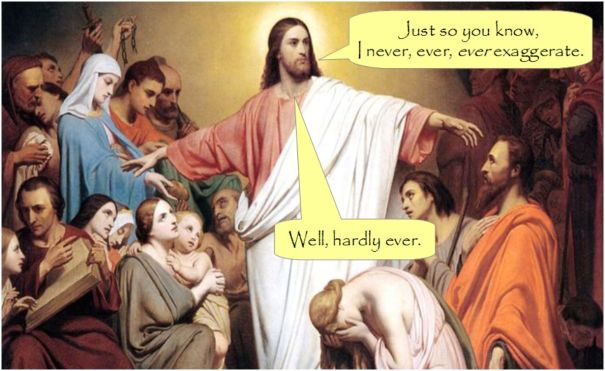
Similarly, when I challenged Dave Armstrong on Biblical Evidence for Catholicism, about why Christians don’t take everything Jesus said literally, he told me it’s because Jesus was fond of hyperbole and it’s the point underlining his hyperbole that matters. I knew, of course, that Jesus liked to exaggerate so I asked Dave how we know which of Jesus’ remarks are hyperbole and which are not. He declared that this was ‘obvious’. Perhaps it is, in sayings like ‘when your eye offends you pluck it out’, but it’s less apparent with pronouncements like ‘sell all you have and give to the poor’ or ‘abandon everything and follow me’. Again, it becomes a matter of subjective opinion, however learned that opinion might consider itself to be, about which of Jesus’ words are hyperbole and which are meant to be followed to the letter.

When I made this point, Dave decided that, rather than it being ‘obvious’, it actually takes years of study to know which is which: ‘It’s by studying Bible commentaries and linguistic aids, and the rules of hermeneutics and exegesis (Bible interpretation).’ Jesus as the incarnation of the God of the Cosmos, and the gospels in reporting him, could surely have made it clear. Instead, it seems, it takes armies of theologians and commentators, and years of study to work it out.

The third way Christians (of all stripes) manoeuvre around the bible’s shortcomings is to say that anything they’re keen to disregard is ‘context-bound’. There are some matters, they say, that are of their time and ancient place and are therefore no longer applicable today.

There are things in God’s timeless Word that pertain only to the time in when they were written? Who knew?

So, instructions like ‘greet each other with a holy kiss’ (which Paul advocates four times in his letters: Romans 16:16, 1 Corinthians 16:20, 2 Corinthians 13:12, and 1 Thessalonians 5:26); ‘women should always have their heads covered in church’ (1 Corinthians 11:2-16) and ‘heal the sick by anointing with oil’ (James 5:14) are now generally considered to be context-bound. This, however, creates the same problem that arose over Jesus’ hyperbole. How do we know which of the bible’s pronouncements are context-bound and which are still of significance today? Answer: we don’t.

It could be argued that, just as ‘greet each other with a holy kiss’ is a custom anchored in the first century, beliefs like

the world is populated by demons,

humans are capable of living forever,

and

incantations (that Jesus is the Saviour) work

are equally context-bound. We know categorically in the 21st century, that demons don’t exist, humans cannot live forever and magic spells don’t work. Only those in a pre-scientific age, dominated by superstition, thought so (together with those today who buy into these same ancient beliefs.)

Once believers start claiming – and it’s Christians themselves who do this – that significant parts of the bible are metaphor, hyperbole or are context-bound, then they’re acknowledging that the bible frequently makes little sense, and that significant portions  lend themselves to whatever interpretation suits the individual reader. Some parts can even be dismissed altogether, which is precisely what Christians do with them (how many Christians do you know who believe they can move mountains or heal the sick by laying on of hands?) What this shows is that they don’t really believe the bible is God’s Word, either in the literal, evangelical sense, nor in a moderate, quasi-intellectual way.

In practice, even to most Christians, the bible is a book of no particular merit.

The only True Christians

Blog384

Pete Buttigieg, mayor of South Bend, Indiana and Democratic hopeful, isn’t a Christian. No, he isn’t, because, you see, despite saying he is, despite being committed to Jesus and regarding himself as saved in some way, he can’t be a Christian™. Why not? Because he’s gay. That precludes him from being a Christian of any sort. We all know how much God hates gays and their ‘lifestyle’, don’t we. It says so right here in this article from Charisma News, reposted on Bruce Gerencser’s blog.

Catholics are not Christians either. Nor are Mormons and Jehovah’s Witnesses. Yes, they say they are, but True Christians™ know better. Catholics, Mormons and Jehovah’s Witnesses are not True Christians because they’ve added to the simplicity of biblical faith: popes and saints and alternate holy books. Only those who believe exclusively in the original holy book are True Christians.

Except those who don’t interpret it properly. Charismatics, for example, are not true Christians. Yes, they profess Jesus with their hearts and voices, but the age of special spiritual gifts, like speaking in tongues and prophesying, has ceased. Christians with the wisdom to reject such things are clear about this. (I’ve no idea where this leaves Charisma News. Maybe it’s heretical too.)

Preachers like Beth Moore, Paula White and Joyce Meyer are not Christians. They’re not doctrinally sound. They’re false teachers, wolves in sheep’s clothing misleading the flock. I know this because respected Christian leaders say so (here and here and here.) In any case, they’re women, and women shouldn’t teach or be in a position of authority over men (1 Timothy 2:12.) That alone rules them out from being True Christians.

Moderates aren’t True Christians either. They’re too… well, moderate. They’re bland and compromising. Christ calls for Christians to be bold and zealous in spreading the gospel. Moderates though are neither hot nor cold, so he spews them out of his mouth (Revelation 3.16).

At the same time, extreme Christians aren’t True Christians. Westboro Baptist Church, for example, is just an embarrassment to real True Christians. So are Steven Anderson and other fanatical preachers. They might be getting their hatred and prejudices from the bible, and what they say may be what True Christians believe in their hearts, but, really, such people need to be kept at arm’s length. Even though they profess faith in Jesus, their fanaticism prevents them from being considered True Christians.

No, the only True Christians are the ones who agree with me. I know it sounds stark when put like that, but it’s the truth. Only those who have the same beliefs as me, who interpret the bible the same way I do and have arrived at the same doctrinal position as me are True Christians. There aren’t many of us, it’s true, but isn’t that what the bible says? That in the last days only a remnant will survive as the true church, being faithful to the Words of the Savior while others succumb to apostasy? Yes, it does, in Romans 11.2-5, and I and my church are that remnant.

Not that lot over there who say they are. They’re not true Christians at all, despite the fact they claim to believe in Jesus. They’re apostates who delude themselves and others.

You too can be free

Blog381

One of the most liberating aspects of jettisoning Christianity was the realisation that nothing I did had cosmic significance. Nothing anybody does has cosmic significance. Yet to hear the cult’s leaders and spokesman talk, now as then, everything matters.

First and foremost, what you believe determines whether you lived forever in Heaven or not. Can you credit that: what you believe. So better get that doctrine sorted out! Right thought makes all the difference. You only have to read a few Christian blogs to realise how important this still is. Believe something only minimally unorthodox and your eternal life is in jeopardy. Not only that, but what you think in the privacy of your own head about issues like abortion, homosexuality, politics and society is subject to the Lord’s scrutiny. Better get it right – ‘Right’ being the operative term. It means recognising that Trump is God’s Chosen One because the Almighty is really only interested in the USA. He has much less time for other nations, except maybe Israel, so better get your thinking straight on that score, buddy.

God is, or so his self-appointed mouthpieces like to tell you, obsessively interested in how you, as an individual, spend your time, the language you used and whether you’re a faithful steward of the money he supplies (that’s the money you work hard for yourself). He lays it on your heart about how you should spend your time, the only valuable way being in the service of his Kingdom-that-never-comes. You’re made to feel that if your marriage isn’t close to perfection then you’re not really working at it (though god knows the biblical view of marriage is nothing like the one promoted by today’s Christian leaders). You’re made to feel you must share the gospel with everyone else you have relationships with: children, friends, colleagues, acquaintances, complete strangers. Don’t they too deserve to have a chance at eternal life? You don’t want them denied it because you failed to speak up, do you? Well, do you?

And then there’s the guilt when you can’t do all of this. You’re not sure you believe all the right stuff. You think you do but then you’re told about some point of doctrine you hadn’t considered and it is, apparently, really essential you do. So you consult the Holy Spirit who you think lives in your heart and you wonder why he hasn’t spoken up before now. Maybe you have liberal views about abortion. And really, you can’t find it in yourself to condemn all those ‘sodomites’ you’re told about; what difference does it make if you do or don’t? And your marriage is less then perfect. In fact, it’s a little bit messy, like human relationships tend to be, and sometimes you want just to relax, maybe laze a little bit. Not everything you do has to contribute to the Kingdom, after all.

But the guilt won’t let you. What kind of Christian are you, anyway? And as for witnessing at every opportunity, you wonder why you feel like a dog that’s compelled to pee at every lamp-post. Can’t friends just be friends? Can’t you just appreciate others for who they are, not as sinners who need saving? Apparently not.

What a wonderful release it is then, when you finally realise that none of this crap matters. Nothing you do, say or think makes the slightest bit of difference to whether you or others live forever (Spoiler: you won’t, they won’t.) How you act may help others feel a bit better about themselves or provide you with a sense of fulfilment but that’s the extent of it. Outside your immediate context, you’re insignificant, and there’s great significance to that. The pressure is off; God is not watching you to see whether you’re a good and faithful servant. Your time, money and thoughts are yours and yours alone. It’s entirely up to you how you use them, free from the tyranny of religion.


Hope v. Miserable Christians

Blog380c

I am without hope.

Well, I’m not actually, but I am according to many of the Christians who engage me in futile dialogue about how lost I am, how much in need of repentance I am and how not believing in Jesus leaves me entirely adrift in life. ‘Hope of what?’ I invariably ask, and they tell me of being resurrected after I die, of avoiding the judgement of God in the post-mortem state and of spending eternity thereafter with the Lord.

And I have to agree, I am without hope of these things. In return I tell them that evidence shows us that people do not live forever, that because no-one survives death there can be no judgement after it and that no-one therefore gets to spend eternity with the Lord (never mind the fact there’s no Lord to spend it with.) No-one in the entire history of humankind, I tell them, has ever done such things. They say then that they feel sorry for me, because the bible promises they will happen and that only as a Christian (repent! repent!) can I have hope that I will enjoy them for myself.

Just in case you were wondering, all this Christian ‘hope’ in impossible events might sound like it’s indistinguishable from wishful thinking, but it’s not! Here’s how the Desiring God website puts it:

When you read the word “hope” in the Bible (like in 1 Peter 1.13* ‘set your hope fully on the grace that will be brought to you at the revelation of Jesus Christ’), hope is not wishful thinking. It’s not “I don’t know if it’s going to happen, but I hope it happens.” That’s absolutely not what is meant by Christian hope.

Christian hope is when God has promised that something is going to happen and you put your trust in that promise. Christian hope is a confidence that something will come to pass because God has promised it will come to pass.

*written by someone who wasn’t Peter, but we’ll overlook that.

So, you see, Christian ‘hope’ is fixing one’s own wishful thinking onto the wishful thinking of people who lived two thousand years ago, people who believed with certainty that Jesus would be coming to the Earth through the clouds to rescue them at any moment. Having hope today is trusting in this mistaken belief; wishing and hoping that these guys were right, when clearly they were wrong. The hope of today’s wishful thinkers is that the wishful thinking of the past will eventually happen. But these first century wishful thinkers were making it all up; wishing and hoping and praying that Jesus would be back soon, that the resurrection process that they thought he’d begun would continue with them and that they’d inherit the Earth and live forever. As Word of God for Today puts it:

Paul spoke* of the “…hope of eternal life, which God, who does not lie, promised before the beginning of time… (Titus 1:2). Only in Christianity is there such a promise of glorious life beyond the grave. The hope of eternal life is very important, and even if we Christians have hope only in this life we are of all people most miserable (1 Cor. 15:19).

*Not Paul, but we’ll overlook that too.

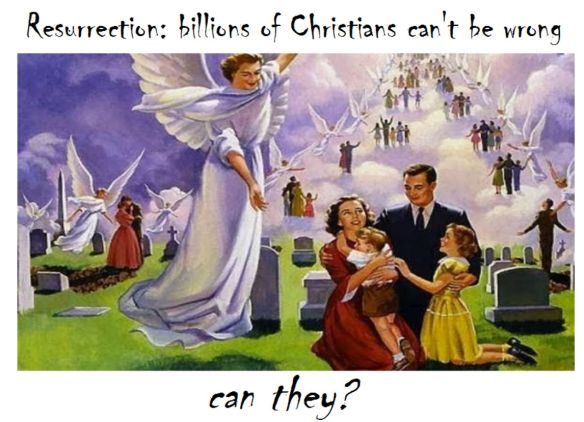
I sometimes ask Christians to point me to one person, one ordinary mortal who has ever achieved immortality – not someone from a story or (biblical) myth; not Jesus who wasn’t, according to them, an ordinary man, but an incarnate deity – who has survived death and gone on to live with God forever. They can’t, of course. None of the bible’s scenarios for the end of the age, the return of Jesus, the resurrection of believers and the rest has ever come to pass. Nor will it.

Despite their denials, hope that all these fantasies will come true is wishful thinking, just like the Rastafarians hope that Haile Selassie will return from the dead to rescue the descendants of slaves from Jamaica, or my fantasy that one day I’ll win the lottery when I don’t even buy a ticket. It’s wishing, as countless people from different cultures and religious background have throughout history, that life doesn’t end when we die.

Christian hope is futile wishful thinking in an impossible dream. I for one am glad to be without it.