The Bible as Metaphor (again)

A few days ago, Dennis and I visited Penrith, a small market town a short distance from the city where we live. What a delight it was to discover that the street preacher who plagues our city – the humourless Dale McAlpine – also inflicts himself on this smaller place. We so enjoyed hearing him bellow out, as we manoeuvered past his confederates handing out poorly written tracts, that we were all sinners – ye, everyone of us – bound for hell.

As we stopped at an ATM we heard Dale announce how Jesus healed lepers and cured leprosy, which patently he did not. He said Jesus’ healing of lepers was a metaphor for what he could do for us all, by removing our sin and making us whole again. His metaphor schtick – an sophisticated one for a simple street preacher – put me in mind of our very own Camp commenter. As Sunday school teacher Don frequently reminds us, the Bible is a) literature and b) largely metaphorical.

In case he’s forgotten and is arguing this week that we should view the bible’s stories as historical accounts (his other favourite tack), here’s what he actually said:

Much of scripture is the kind of literature in which metaphor and other kinds of figurative language is common… you are out of touch with the literary character of ancient literature.

I hope you all feel thoroughly chastised by this. I know I do. Don was taking exception to my post in which I itemised the Bible’s mythical creatures, talking animals and impossible events. So, I’m going to take him, and Dale at their word and take a fresh look at the Bible’s use of ‘metaphor and other kinds of figurative language’

First though, let’s understand that metaphor and figurative language are distinctly literary techniques. In literature and sometimes in speech, metaphors make subtle comparisons and bring to mind a host of associations that the author does not then have to explain. Outside of fiction, they don’t have much of a function. We don’t, for example, attribute metaphorical meaning to human events and interactions in the real world. The present war in the middle east is not a metaphor for something else, like, for example, the warfare that Christians believe rages in the Spirit world. Sleepy Joe Biden’s activity, or lack of it, is not a metaphor for the present condition of the USA (let’s hope not anyway). Our personal relationships are not metaphors for something grander. There is no metaphor embedded in actual events or real world interactions.

No. Metaphor exists almost entirely in literature. While the occasional non-fiction author might add a metaphor for flourish, strictly speaking, metaphor exists in and for fiction and poetry. More than this, when, in fiction, ideas are expressed metaphorically, it signals that the surface meaning is of lesser significance. It is the underlying or hidden meaning that matters. The fiction is the vehicle by which the metaphorical truth is conveyed. Don admits as much in his comment.

Let’s try some illustrations. The underlying metaphor of The Great Gatsby, its truth, is the dark underside of the American dream. Its surface story isn’t real; it is fiction. The metaphor conveyed through Moby Dick – the fictional whale as well as the novel as a whole – is the destructive nature of obsession. Again, as powerful as this is, none of the story that conveys it actually happened. Frankenstein’s central metaphor is the danger that uncontrolled science represents to humankind. The story that carries this message is, however, pure invention. In All The Light We Cannot See, Light is the metaphor, as it frequently is. The characters’ insights into truth are what the author seeks to convey. The fiction is the vehicle of that truth. Choose your own example: fiction embodies metaphor, the ‘truth’ of the story. But the story itself is rarely an actual event. Even when it’s based on one, as the movies say, the narrative is extensively fictionalised.

So, let’s go back to Dale’s leprosy metaphor. In several gospel stories, the authors have Jesus cure lepers precisely to illustrate how he can heal people of their inner leprosy: their sinful nature. Jesus almost certainly did not heal any lepers; this is the fiction. The creators of the gospels designed the story to carry metaphorical meaning, which, in this case, is that Jesus can heal us from sin.

Likewise the stories in which he heals the blind; the blindness is metaphorical. The saviour opens people’s eyes to spiritual truth. He didn’t really cure blind people; that is the fictional vehicle for the metaphor.

He didn’t turn water into wine; the writers of the fourth gospel wanted to convey the spiritual ‘truth’ that the new cult’s beliefs were superseding old Jewish ones; a metaphor was a memorable way to do it.

Lazarus was not raised from the dead; the story is a metaphor to illustrate how God will raise believers at the last day.

The Romans did not execute Jesus; it was the spiritual rulers of the age who, according to Paul in 1 Corinthians 2:8, put the saviour to death. The Romans are the metaphor for the wickedness of these supernatural beings.

Jesus did not rise from the dead. This too is a metaphorical fiction.

How did I do, Don? I’ve interpreted isolated periscopes from the gospels metaphorically. I’ve borne in mind that metaphor and other figurative devices are purely literary, techniques in fiction. I’ve channelled the literary character of ancient literature as defined by you (except of course you never actually do define it.)

You are invited to respond. I offer to post your comment, if it is as lengthy as I expect it to be. You must, however, keep to the point and resist making personal jibes. Choose any of the miracles, healings or pericopes from the gospels and demonstrate that they are real historical events.

It matters to you and to other Christians that the events of Jesus’ life did happen. That they’re not just the invention of clever writers who, taking inspiration from Jewish scriptures, created metaphorical events to convey higher ‘truths’. So persuade us that at least one miracle, healing or episode is more than a literary device, a metaphor for some fanciful theological ‘truth’. Provide the evidence that it really happened. Claiming the disciples witnessed the miracles or healing won’t cut it, when the disciples are themselves characters in the stories, and metaphorical at that.


Evidence of God

As for evidence, you might be aware of Israel. That nation has been in the news much of late. So, without being flippant at all, I present Israel as evidence. Think about it. They are living the script written thousands of years ago. Not by chance.

Israel as evidence for the existence of God. I’m thinking about it as Don suggests.

Where did it all begin, this bizarre notion that one tribe in the Middle East was chosen by God to be his special people? According to the Genesis myth, it was when YHWH promised Abraham he’d be his best buddy forever and ever, so long as he mutilated his body and those of his sons in perpetuity. They would also have to keep every one of this bullying god’s 365 rules and regulations, including the petty and piffling ones. So far so good, apart from the fact it was all very one-sided, and the mutilation of course. You’d think this would’ve been a sign that things weren’t quite kosher, but no; Abraham and his descendants buy into it and almost straight away, YHWH begins to let them down.

God’s Chosen Ones soon find themselves slaves in Egypt. A second mythical character is needed – up pops Moses – to get them out of this scrape. Unfortunately, after Moses has finished chatting with YHWH, who identifies as a burning bush on the top of a mountain, the sulky deity feels slighted by something the Israelites are doing. As is his way, he has many of them slaughtered and the rest he forces to troop around the same small plot of land for 40 years. This is how best buddies treat each other!

Later, the Jews find themselves defeated by the Babylonians and are carted off into exile. This exile, which YHWH does nothing to prevent, lasts 70 years. Still, it leads to a pleasant song made famous by Boney M in 1978 so I suppose it was worth it.

For the next few hundred years, Israel falls under the rule of other nations more powerful than itself. Not to worry though, YHWH is still ‘looking after them’, particularly those who are slaughtered in the rebellions that ensue. As Robert Conner says in a recent comment on Debunking Christianity, ‘If Yahweh ever threatens to bless you and your children, just kill yourself and get it over with.’

Fast forward to the Roman occupation of Israel. YHWH, having undergone a makeover, reneges on his promise to take care of his Chosen Nation forever and ever and comes up with a different plan to save people from his own cussedness. Now, if they want to continue as his friend, they have to believe a supernatural being has returned from the dead.

Abandoned by God, as he now wants to be called, Jews who haven’t defected to the new faith see their sacred, eternal temple destroyed by the Romans in AD70. Thousands of them are massacred and the Jewish nation ceases to exist.

This sets the pattern for the next two millennia in which God’s new friends organise pogroms, massacres and vicious persecution of Jews. This culminates in the Final Solution of the Third Reich which seeks to eliminate the Jewish people entirely. While awaiting extermination in a concentration camp, Andrew Eames scrawls on the wall of his prison: ‘If there is a God, He will have to beg for my forgiveness.’ God allows six million of his Chosen People die at the hands at the Nazis.

Following the second world war, Israel takes possession of the area surrounding Jerusalem, then occupied by Palestinian Muslims who are themselves descended from earlier immigrants. Thousands on both sides are slaughtered in the conflict that follows. In 1948, after almost 2,000 years, Israel becomes a nation once again; not through any miracle of God but as a result of human endeavour and bloodshed.

Tension and further skirmishes followed, leading to the present day when Israel finds itself under attack by Hamas terrorists. Thousands of innocents – women, children and babies – have been slaughtered without mercy. Israel is, as I write, retaliating and intends to enact further vengeance. And where is God in all this? You guessed it: nowhere to be seen.

All of this, according to some – including the naive writer at the top of this post – serves as evidence of God’s existence. That Israel has persevered for so long, despite opposition, persecution and the holocaust is not, however, evidence of God, any more than the great cathedrals of the world are. It is instead testimony to the resilience, resolve and sheer bloody mindedness of the people themselves. Perhaps their belief in YHWH (they don’t of course recognise his Christian counterpart) has fuelled their persistence, as it has their territorial claims.

Jewish beliefs and history are not evidence that YHWH exists. If anything, his apparent abandonment* during their many trials and tribulations is evidence to the contrary.

*Of course a non-existent entity can’t actually abandon anything, any more than it can lend its support or favour one group of people over another.

Jesus Is Cool With It

I was handed a sticker the other day that read ‘Jesus is cool with it’. Just what the hip Jesus of the sticker was cool with was explained by an accompanying leaflet, and the fact I was at a Pride event at the time.

I worked out from the leaflet and his rainbow flag, that what Jesus is cool with is homosexuality and all that goes with it. He might also be cool with transgenderism and other variations in human sexuality, but who knows; the leaflet didn’t say so directly. It did, however, have a list of websites that support those who are religiously afflicted and gay, transgendered or of unorthodox sexuality. It suggested that through these sites it might be possible to find a gay affirming church in the local area.

I was at first pleased to see that Jesus had had a change of heart. That he had in fact made a complete u-turn from his previous position, which evangelicals have long assured me, is that homosexuality is a heinous sin and a ‘violation of God’s design for human sexual behaviour’.

Eagerly, I logged into my favourite – I use the word loosely – Christian sites to see how they were celebrating this new revelation from the Lord. Unfortunately, they had yet to be updated and so weren’t conveying the news that Jesus was now ‘cool’ with gayness and the like.

That was over a week ago. I’ve just checked again only to find that they’re still not proclaiming this particular piece of good news. In fact, some have published even more rants well considered pieces about the evils of homosexuality, drag acts, people who are changing sex and the rest. They are so uncool about it that they’re still quoting the Bible: the Old Testament verses where it says that for a man to lie with another man is an abomination, and Paul, who, channelling Jesus (or so he’d have us believe) insists that homosexuals won’t make it into God’s Magic Kingdom. Some sites also mention Jesus’ pronouncement in Matthew 19:14 (yawn) that God made only male and female and the only time they’re allowed to get jiggy with each other is when they’re married.

I’m left wondering who is right. The ‘Jesus is Cool’ brigade or the great preponderance of evangelical churches that say he isn’t cool, not one jot or tittle, with same-sex doings.

The thing I’ve learnt through this, is that Jesus can be whatever you want him to be: a really cool guy who gives the thumbs up to whatever consensual sex you enjoy or a grouch who didn’t die just so you could continue in your old sinful ways. Take your pick. He’s both, depending on which bits of the Bible you prefer.

I wouldn’t care one way or another if it weren’t for the damage done by those who think they speak for the grouch.

Jesus Shows How To Treat Slaves

Jesus’ parable of the talents

Three slaves are given money by their owner, two invest it while the third buries his share. He is castigated by his master (yes, it’s Jesus as his favourite metaphor: slave master) who says to him on his return:

I tell you that to everyone who has, more will be given, but from the one who has not, even what he has will be taken away. But as for these enemies of mine, who did not want me to reign over them, bring them here and slaughter them before me. (Luke 19:26-27)

I know, that last sentence doesn’t fit the rest of the story, but it tells us what a despicable s**t Jesus was, quite happy to see those who didn’t want a peasant with delusions of grandeur lording it over them exterminated. Thank God the Romans got to him first (if indeed he existed.) No-one likes a dictator, specially not another dictator.

How about the conclusion to the actual parable, the one about the slaves and the money? The talents are evidently a metaphor for something or other. According to Christianity.com, it’s that the third slave, ‘didn’t take joy in the promise of the master’s return but instead wasted his time, his opportunities, and the master’s money.’

In other words, it’s fanatic talk aimed at those with a lack of commitment to the cult and its beliefs, including the ‘master’s’ imminent return, when wastrels will be in big trouble. As Christianity.com puts it:

Those who are not (faithful) may face the harsh reality of being called a wicked and lazy servant. Worst of all, they may not share in the joy of their master’s presence when he returns.

And there we have it, the softening of Jesus’ dictatorial original: ‘will’, as in ‘will lose everything’ becomes the hedging-your-bets ‘may’ while ‘slave’ (doulos again) becomes the watered-down ‘servant’. After all, we wouldn’t want to draw attention to how much of a cruel bastard Jesus was originally conceived as being. (Because, yes, these stories were invented by the early Jesus cult.)

The cult took no prisoners; in terms of commitment. It was all or nothing. Waiver in that commitment and you risked expulsion when the slave-master returned. So much for being redeemed unto salvation, so much for salvation by grace alone. If you weren’t utterly committed you stood to lose it all. What the original cultists weren’t to know, of course, was that the master would never return. The whole sorry parable was as irrelevant then as it is now.

Redeemed: From Slavery to… erm, Slavery

Thanks be to God, who delivers me through Jesus Christ our Lord! So then, I myself in my mind am a slave to God’s law, but in my sinful nature a slave to the law of sin. (Romans 7:25)

Do you not know that if you present yourselves to anyone as obedient slaves, you are slaves of the one whom you obey, either of sin, which leads to death, or of obedience, which leads to righteousness? (Romans 6:16)

(We are) justified freely by his grace through the redemption that is in Christ. (Romans 3:24)

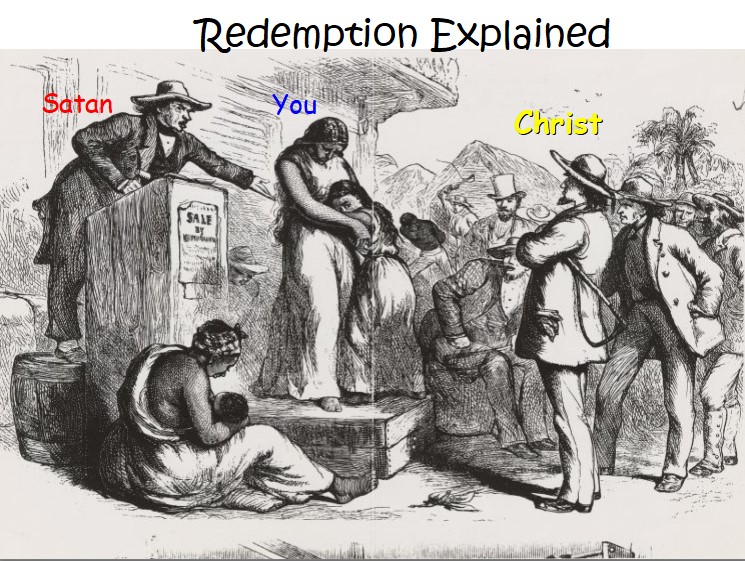
When a slave had served sufficient time and had accumulated sufficient wealth or found a benefactor, he or she could buy their freedom. This seems particularly egregious when their servitude was already, in the case of debt, the means of paying back what was owed. In effect the enslaved individual was paying twice for their freedom. Be that as it may, the act of buying oneself out of slavery was known as redeeming oneself; redemption. Likewise, a third party buying your release was also known as redeeming. We still use the term in this sense today: a pawned item can be redeemed, bought back, for a greater amount of cash than the pawnbroker originally paid for it. The related term ‘ransom’, in Mark 10.45 has the same sense; paying money to secure the release of a captive.

The principle of buying oneself out of captivity and slavery underscores the Christian idea of redemption. It is the analogy Paul and other New Testament writers use, to explain Christ’s paying the price, through his sacrificial death, for the slave’s release. He redeems (or will do at some future point depending on which fantasist you’re reading) in exactly the same way a slave was redeemed, from a life of captive slavery to sin/the Law/Satan and his minions. 

There’s a catch. If a slave was redeemed by a third party, he was likely to find himself not free at all but the property of whoever had redeemed him. His debt having been paid off to his first owner, he might very well find himself in hock to a new one. So it is with Christian redemption. Christ may have paid off your perceived debt to your original owner (sin, Satan or whoever) but now you’re indebted to him. You’re his slave, as we saw in the previous post.

To downplay slavery as it was practised in the centuries before the cult adopted it as an analogy, is to undercut redemption as Paul and early cultists perceived it. Arguing that slavery was a relatively benign practice removes the basis of Christian redemption; if being a slave wasn’t really too bad then neither can being a slave of sin/the Law/Satan be too serious either. There’s really no great need to be redeemed and what Paul says in Romans and elsewhere counts for nothing.

But we knew that anyway.


God’s Agents?

Christians are agents of God or so we’re informed. I’ve tried to locate where in the Bible it says that the Lord appoints fallible humans to be his 007s, but alas, I can’t find it anywhere. The best I can do are the claims in the fourth gospel that Jesus was God’s agent on Earth, but that’s not the same thing.

What about the idea then, also touted by Christians, that they are somehow God’s ‘partner’? No, that’s not there either. God regards himself as so far above us, his creators, that it would be like you or I partnering one of the ants crawling around in our gardens.

So how does the Bible describe the Christian’s relationship with God? It refers to it as master and servant. The word usually translated as ‘servant’ however, is doulos, which actually means ‘slave’. God doesn’t want you as an agent, partner or servant. He expects you to be his slave. Christian blogger, Sam Storms, explains what this means:

I, in the totality of who I am, have been purchased by Jesus Christ. He literally owns me. I belong to him, body, soul, spirit, mind, affections, abilities, talents, heart, will, and emotions. There is nothing in me or about me that belongs to me.

As a slave of God you are stripped of the very agency other Christians claim they gain from aligning themselves with the divine despot. And when you’ve done all he requires of you he’ll barely acknowledge you. As Jesus puts it in Luke 17:5-10:

Suppose one of you has a slave (doulos) ploughing or looking after the sheep. Will he say to the slave when he comes in from the field, ‘Come along now and sit down to eat’? Won’t he rather say, ‘Prepare my supper, get yourself ready and wait on me while I eat and drink; after that you may eat and drink’? Will he thank the slave because he did what he was told to do? So you also, when you have done everything you were told to do, should say, ‘We are unworthy slaves; we have only done our duty.’”

Whatever you do as God’s or Jesus’ slave won’t be enough, they’ll still regard you as a worthless slave.

I didn’t know about you, but this isn’t for me. I have more self-respect than to submit to a life as a slave. So have you. So in fact has everyone.

Most Christians agree. Almost all of them disregard the expectation that they become slaves. We know this because –

  • The majority don’t act as if they’re slaves, serving their fellow human beings till they’re fit to drop (Matthew 25 etc).

  • Most seem unaware even that Jesus insists they must be slaves when successive translators have deliberately altered the unsavoury ‘slave’ to the more palatable ‘servant’.

  • Those who are aware of his expectation seem to regard it as a metaphor; always a good get-out. And doesn’t Paul remark in his letters that believers are sons of God? That’s much more acceptable.

  • They omit the slavery element from their evangelising because no-one is going to be attracted by the offer of life-long servitude; far better to present Jesus as a would-be friend, big brother and all round good guy with whom people can be in ‘partnership’ or a fellow special ‘agent’.

  • They talk about free will when a slave, either of sin (John 8:34) or of Christ’s, has no freedom and no free will to exercise.

  • They convince themselves that sitting at a computer arguing with atheists online is the kind of slavery Jesus had in mind.

  • They turn a blind eye to the fact that the Bible teaches slavery is what they can expect not just now but for all eternity (Revelation 22:3-4).

It’s almost as if they don’t really believe such self-abasing, masochistic nonsense themselves.


My Gay Demon

I am demon possessed. I know this for a certainty because Christians all over the Internet tell me. I am gay therefore I am possessed by a demon. Maybe more than one, I don’t know.

I’ve been trying to get in touch with my inner demon but he’s been keeping schtum. I assume he’s a him given he’s a demon of gayness, but again who knows. I’ve enquired in the deepest, darkest recesses of my mind and have searched my heart (though if I’m honest I wasn’t really sure how to do this) and can’t find him anywhere.

I was going to ask him why, if he’s a demon and therefore a real nasty piece of work from the pit of hell, why he’s led me to a happy and loving relationship with Dennis, one that has taken each of us from loneliness and depression to peace and contentment. I just didn’t know demons were so… well, so positive and creative. I always thought they were destructive and devious, like C. S. Lewis’s Screwtape. I think mine must be shy and more like Casper the Holy Ghost.

Alternatively, maybe there’s no such thing as demons, invisible evil super-beings who can’t be detected in any way. In my ‘worldview’ anything that’s invisible, undetectable and is a figment of rather dim-witted people’s imaginations is a being that doesn’t exist.

But then maybe that’s just me.

  And science.

    And every other academic discipline.

       And rationality.

         And reality.

It’s possible, after all, that a book written thousands of years ago by ignorant religious zealots trumps all of that.

The Power of Figments

Since his death, no-one has seen the itinerant preacher now known as Jesus. Some dispute he existed in the first place and certainly the character depicted in the gospels is a fictional creation. Assuming, however, that there was a real individual on whom this character was based, no-one has seen him in the flesh for 2000 years.

This includes all or most of those who wrote about him in the early years of the cult and whose writing now forms the New Testament. They either learnt about Jesus by word of mouth, as most converts throughout history have done, or they had a vision within their own heads of – what exactly? Those who write of such visions are either vague about what they claim they saw (Paul in Galatians 1: 15-16), are evidently making it up (John of Patmos in Revelation) or their visions are related by third parties many years down the line (Peter and Mary in the gospels, Stephen in Acts.)

Either way, the character believers claim to have seen or have heard about is a fantasy figure, not the rabbi who may or may not have existed. It’s this fantasy who lives in heaven snuggled up to his equally fictitious father, monitoring people’s behaviour, listening into their thoughts while simultaneously observing ‘the destruction the world is bringing on itself’ and doing not a thing to help.

All this from the heaven no Christian can locate: in another unspecified, invisible, undetectable dimension is the best they can offer. Nonetheless, if only more people would turn to him, Super-Jesus would help us solve the problems we face.

Because theocracies have always been so effective. They’ve led to a more just, fairer world as wise compassionate religionists have listened to their heavenly leaders – God, Allah, Jesus, Muhammed – and have applied the principles of their holy books to the running of their societies. Only obstinate sinners have had anything to fear from the arrangement: the degenerate, like those who have sex outside marriage and want access to contraceptives; gay people (especially); women who don’t know their place; women who seek abortions; the powerless; other, ‘inferior’ races; those of other religions, non-believers and atheists. None of these would have a place in Jesus’s new perfect world either, just as they don’t in societies controlled by Muhammed’s holy ones. Jesus’ agents will be happy to exterminate them, just as he instructs.

Magic Jesus as a figment of his followers’ imaginations can be made to say whatever they want, just as he was when he was being created by Paul and the gospel writers. He is a perpetual work in process, constantly changing to conform to what those who claim to know him want him to be. It’s easy to achieve this with a non-existent being from a non-existent place.

Jesus: Practically Perfect In Every Way?

Was Jesus a gracious, gentle and humble as Christians like to claim or was he intolerant, self-important and frequently wrong? What do the gospels say?

He’s intolerant and self-important when:

He insists people should love him more than their own families (Matthew 10:37).

He says he’s not a peacemaker but intends creating strife (Luke 12:51).

He claims anyone who doesn’t follow him deserves to be burnt (John 15:6).

He wants the world to be destroyed by fire (Luke 12:49).

He commands people not to call others ‘fools’ (Matthew 5.22) but tells those he doesn’t care for that they’re ‘swine’, ‘dogs’, ‘snakes and vipers’, ‘whitewashed tombs’, and, yes, ‘fools’ (Matthew 7:6; 15:26; 23:33; 23:27; 23:17 & Luke 11:40).

He deliberately speaks in riddles so that people won’t understand him and won’t find forgiveness (Mark 4:12).

He tells his followers to love their enemies but says he’d have his own killed (Luke 19:27 & Matthew 13:41-42).

He endorses slavery and the cruel treatment of slaves (Luke 12:47-48).

He says people would be better off if they cut off their hands, plucked out their eyes and castrated themselves (Mark 9:43-48 & Matthew 19:12).

He endorses the Jewish law that demands the death penalty for those who disrespect their mother and father (Matthew 15:4-7).

He disrespects his mother (Matthew 12:48-49).

He tells people not to get angry but loses his own temper (Matthew 5:22 &Mark 3:5).

He callously kills a herd of pigs and, in a fit of pique, destroys a fig tree (Matthew 8:32 & Matthew 21:19).

He takes a whip to people (John 2:15).

He tells his mates he’ll soon be king of the world and promises them that they’ll rule alongside him (Matthew 19:28).

Are these the marks of a tolerant, compassionate man? Or the characteristics of an unpleasant, delusional megalomaniac?

As for frequently wrong: first, the false promises –

I will do <em>whatever</em> you ask in my name, so that the Father may be glorified in the Son (John 14:13).

Very truly, I tell you, if you ask <em>anything</em> of the Father in my name, he will give it to you (John 16:23).

These signs will accompany those who believe: …they will lay their hands on the sick, and they will recover’ (Mark 16:17).

Therefore do not worry, saying, “What will we eat?” or “What will we drink?” or “What will we wear?” But strive first for the Kingdom of God and his righteousness, and all these things will be given to you as well (Matthew 6:25-7.1).

and then there’s the failed prophecies –

For the Son of Man is going to come in his Father’s glory with his angels… I tell you the truth, some who are standing here will not taste death before they see the Son of Man coming in his Kingdom (Matthew 16:27-28). Just in case we don’t get this the first time, he tells us again in Matthew 24:27, 30-31, 34 and in Luke 21:27-28, 33-34.

Did he return with the angelic host and establish God’s kingdom on Earth before his disciples died? He did not.

Christian zealots unable to accept the evidence of the gospels themselves will no doubt have a hundred and one clichéd, implausible excuses for Jesus’ many failures: ‘he was speaking metaphorically’; ‘you lack the spiritual insight to see what he really meant’; ‘you’re quoting him out of context’, blah blah, blah.

All I ask is that they please, please don’t inflict these excuses on us here when we’ve heard them all so many times before.

Show Me Heaven

On the radio this Sunday, a couple of presenters were discussing a woman’s Near Death Experience. Lynda Cramer claimed that in 2021 she had been clinically dead for 14 minutes when she visited Heaven for five years. You can see her raving about it on YouTube, while the Amazon synopsis of her book, Five Years In Heaven (of course there’s a book; four in fact) reads:

In May 2001, Dr Lynda Cramer died. This is the story of her Near Death Experience, outlining the five years that she spent in Heaven. Starting when she found herself “floating” in the living room for over 45 minutes, she then went on a journey where she entered Heaven, she then processed her Life Review prior to meeting her great-great-great-great grandmother who explained what Life Lessons, Life Contracts and Reincarnation are all about. Backed up by Medical Records as well as diagrams she drew, this is her personal account for anyone intrigued by what happens in the afterlife…

So, is this real? Did Lynda Cramer visit Heaven while she was dead for 14 minutes? She’s a doctor, after all, so superficially at least, she has credible credentials. Until you see that her PhD was obtained researching Near Death Experiences  themselves. Vested interest or what?.

But, let’s not be cynical; she has diagrams too, for God’s sake. What more proof could we ask for? We know too, because our resident Christian tells us, that dreams and visions like this are most definitely from God. Lynda’s experience ticks all the boxes, no matter what we sceptics might think.

Except, no. Lynda was not dead for 14 minutes. We have only her word for it that she was declared clinically dead, while she describes her experience as a Near Death Experience. The clue is in the name. If she was near death, she was not dead; her brain was still alive, if only just. Her mind was still active, creating, if this happened at all, a reassuring experience for itself as it came close to shutting down. There is well documented evidence that this is what the brain is capable of doing when it is close to death (but not actually dead).

Significantly, the scenario her mind created was informed by cultural, quasi-Christian images of Heaven, just as believers’ dreams of God are informed by the same images and characters that occupy their waking minds. My own dreams, for example, are populated by people I know and places I’m familiar with (though sometimes only vaguely; my subconscious fills in the details often in bizarrely imaginative ways.)

Nonetheless, Lynda’s life-changing 5 years visit to Heaven (during which she seems to have done nothing except admire mountains and buildings while blue balls, hijacked from science-fiction, danced around her) is just as real, just as divine, just as valid as the God-given dreams and visions Christians claim they sometimes have. Naturally, we sceptics can’t possibly appreciate these until we’ve experienced them for ourselves.

Lynda’s experience was a subjective, emotional experience while she was unconscious. But such ‘spiritual’ inner experiences are ‘real’ according to at least some Christians, and we can’t argue with that which we have not experienced  for ourselves.

Right, Don?