The Stuff Christians Say… (part two)

Balaam

Atheists don’t behave as evolution says they should: This ridiculous accusation is often slung at atheists by Christians who seem to see it as some sort of stinging rebuke. Answers In Genesis is very fond of it; the Hamster’s drones and other Christians seem to believe – without ever thinking it through (plus ca change) that because those who acknowledge the veracity of evolution don’t behave according to its principles they are somehow inconsistent in their ‘beliefs’ – hypocritical even. They seriously propose that because natural selection and the survival of the fittest (not one of Darwin’s phrases) are cruel, uncaring processes, then that is how, for the sake of consistency, atheists ought to behave too. We shouldn’t care, they say, when a child develops cancer or someone dies. We shouldn’t attempt to cure illness or work to prevent suffering because these are nature’s way and part of the mechanism of evolution.

While it’s true they are, it’s been a long time since our behaviour, our existence and continued success as a species has been solely determined by what nature does. Humans regularly override its mechanisms, natural selection included; every time we use birth control, show compassion for the weak, heal the sick, develop medicines, engineer genes and preserve life. And so we should.

Christians seem unable to comprehend that evolution is not a pattern to be followed. It is not a set of instructions for living, a prescription or a set of (a)moral guidelines. It is the best explanation, supported by considerable amounts of evidence, of how life developed on the Earth. As such it makes no ethical claims nor does it demand that its principles be blindly followed (that’d be religion). Are Christians truly unable to detect this difference?

Atheists have no reason to be moral: I’ve looked at this ignorant claim before. Of course we have reason to behave morally. We’re human, we live in human society. Morals help us do so while doing the least damage to ourselves and others. They may also enable us to bring some happiness or comfort to those around us. Atheists don’t look to an imaginary God to tell us how to be good; our morals come from our culture, upbringing and education. Christians’ morals do too, whatever else they may claim. They certainly don’t get them from that most immoral of books, the Bible.


to be continued…

Round in Circles

JC2

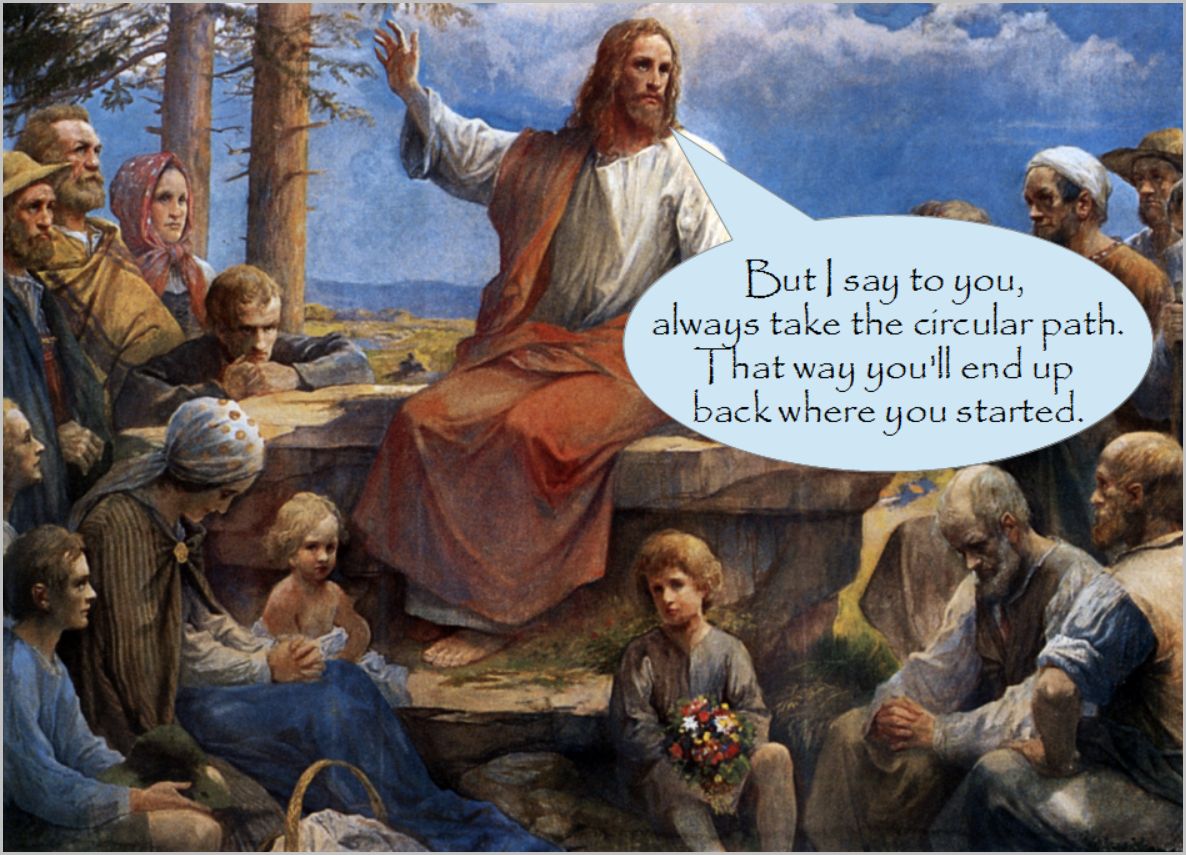
Being a religious believer means you can’t be a free thinker. Your conclusions are already determined for you – in the Bible or Qu’ran or some other holy book – and you are compelled, if you’re fundamentalist in your beliefs, to reach and affirm these conclusions. More than this, you are compelled to begin with them, which is why Ken Ham can say that where you start determines where you end up (though this only applies to those who think magic books have all the answers). So if you believe, because the Bible appears to say so, that the universe and all that is in it was created in six days about 6,000 year ago, then that is the premise from which you begin. You are then highly selective in the evidence you’ll consider, forcing it to support your predetermined conclusion. Christian argument is always this circular and heavily dependent on confirmation bias.

It can’t be anything else:

William Lane Craig ‘knows’ that the Holy Spirit is real because he feels it inwardly; the Bible tells him this kind of feeling is attributable to the Holy Spirit, so consequently the Holy Spirit must be real.

Pastor Mike Ratcliff understands that the Bible says everyone is a sinner; Mike’s confirmation bias means he sees sin and apostasy everywhere; therefore the Bible is right when it says everyone is a sinner.

Pastor Steven Anderson condones slavery. God approves of it in the Bible therefore slavery cannot be morally repugnant, and attempts to eradicate it are misguided. How does he know this? Because the Bible says slavery is okay.

Christians generally argue that God is good (because the Bible says he is) but have to disregard the horrors of his creation and the cruelties of life to reach the conclusion that, yes, God is good.

There really is no arguing with such arrested development, such intellectual dishonesty. Christian are not open to wherever reason and the evidence might take them; the end is always assumed at the beginning. Maybe that’s why comments are rarely allowed on Christian web-sites. You can’t argue with the Truth™ – another premise masquerading as a conclusion.

Big Bang Theory

BigBang

You’re probably familiar with William Paley’s teleological argument for the existence of God. If you haven’t used it yourself then you’ll have been subjected to it by proselytising believers. A couple of days ago I had someone treat me to an updated version of the argument.

I was on the phone with a sales-person, talking about his company’s product, when he decided it would be a good time to dust off the old idea, give it a make-over and use it to convince me of God’s existence.

He started by asking me if I would agree that a computer must have an intelligent designer; I agreed this was so (though I have my reservations.) He responded with ‘how much more then must the universe and life on Earth – being so much more complex than a computer – also have an intelligent designer.’ He said this was ‘something to think about,’ and I agreed it was, though maybe this wasn’t the best answer I could’ve given.

Having ‘demonstrated’ that everything must be intelligently designed, my new friend announced that this was therefore irrefutable proof that Allah must have made everything.

Oops. I’m sure this isn’t what the Reverend Paley had in mind when he devised his watch analogy two centuries ago. His proof, however, is every bit as much a demonstration of Allah’s existence and creativeness as it is Yahweh’s. Or Vishnu’s or Marduk’s or any other of the multitude of deities credited with intelligently creating the universe and life in this insignificant part of it. Any one of them could’ve done it according to the teleological argument. Take your pick and sign up for the set of beliefs that corresponds with your choice.

But wait – complex machines like watches and computers bear no relation to anything in nature. A watch found on a heath, as Paley conjectures, or computers in hedgerows, can only have got there because a human being put them there (fly-tipping again). They would not be there because they’d arisen, like the rocks, grass and other plants that surround them, through the processes involved when nature creates something. Moreover, we know that machines have intelligent creators, because we are they. What doesn’t follow is that because man-made objects are demonstrably the product of intelligence that natural ones, which, remember, bear no relation to computers, watches, cars and CAT scanners, are as well.

We are gaining more understanding of how the universe came to be. Significantly, it doesn’t require that there is intelligence behind it. If it did, we would then need to explain how that intelligence arose, who created it and by what process. To say, as religious believers are wont to do, that this supreme intelligence has always existed is no explanation at all. If we’re to have something that has always existed then it is far more likely to be that which we know really does exist, rather than something we don’t. Conceding the longevity of the components of the universe, which we know to exist, is a far better bet than inventing deities to account for it. A God no more explains life, the universe and everything than do fairies the intricacies of my computer (gremlins maybe, but not fairies.)

For all that, life on Earth does have a creator. The genealogy of the universe tells us that physics begat chemistry begat biology. (‘But if life emerged from physical and chemical processes, then how come there’s still physics and chemistry?’) All life on Earth, including ourselves, is the product of these processes, ‘the blind watchmaker‘ that Richard Dawkins speaks of. They are not intelligent, do not have names like Yahweh or Allah and do not, on their own, create the machines that only humans can design.

Is there anybody out there?

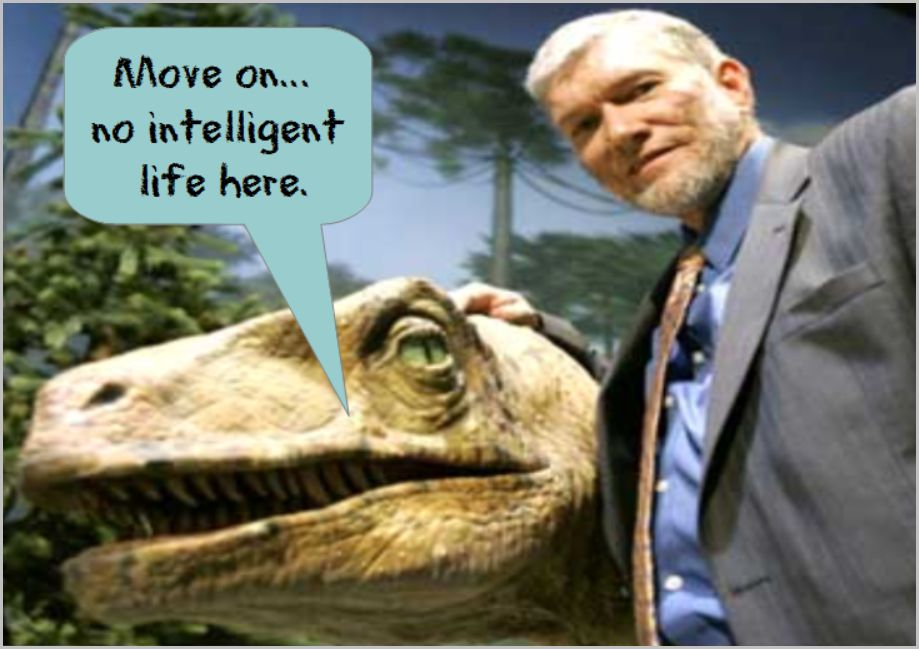
KenAnyone searching for extra-terrestrial life – NASA, SETI and so on – can stop now. We know definitively that there isn’t any out there. How do we know? Because Ken Ham says so. The Bible – Genesis specifically – doesn’t mention life on other planets so that means there isn’t:

(T)he notion of alien life does not square well with Scripture. The earth is unique. God designed the earth for life. The other planets have an entirely different purpose than does the earth, and thus, they are designed differently… where does the Bible discuss the creation of life on the “lights in the expanse of the heavens”? There is no such description because the lights in the expanse were not designed to accommodate life [this is utter gibberish; life within stars? Who has ever suggested that?] God gave care of the earth to man, but the heavens are the Lord’s. From a biblical perspective, extraterrestrial life does not seem reasonable.

But hang on a minute! The Bible doesn’t mention other planets, never mind whether there’s life on them. It doesn’t tell us anything about cultures outside of a small area in the Middle East, doesn’t mention the Americas or Australasia, doesn’t have anything to say about microbes, anti-biotics, computers or technology in general. It must follow, therefore – to use Ken’s logic – that none of these things exist either.

The reason the Bible doesn’t mention any of them, and a myriad of other things, is not because they don’t exist but because the primitive priests and ignorant scribes who wrote Genesis and the rest of Ken’s magic book didn’t know that they did. They had no concept that the Earth is a planet, let alone that there are others; they had no idea that the sun is a star, nor that other stars, which they thought were attached to the inner surface of a canopy surrounding the Earth, are suns. With such a limited cosmology, the possibility that there might be life on other planets was as alien to them as, well, aliens themselves.

Whether there is extra-terrestrial life, and whether any of it is intelligent, we may never know. But either way, Ham’s deity will have no bearing on it, nor it on the Christian God. The existence of aliens, like their absence, won’t breathe life into an already discredited idea.

Primordial Soup for the Soul

CellsA commenter on this here blog thingie, Mike, has challenged me to present him with the evidence for evolution. Mike evidently sees me as something of an expert on the theory because I’m convinced of its validity. I’m no expert, of course – I’m not even a scientist – but having read widely about evolution over the years, I’ve attempted a response. Having spent time creating and evolving it, I thought I’d add it as a post rather than tuck it away in the comments.

Mike wrote: When it comes to the hoax of Darwin’s evolution, I’ve read and observed his tree of evolution. It is TOTALLY and complete without evidence. It is a false theory that humanist ” scientist ” have brainwashed the public with.
If you think it’s hoax then you won’t, I take it, have shots that immunise you against the latest strains of viruses? And you’re not concerned that some microbes have evolved to become resistant to antibiotics? Modern medicine is predicated on the fact that organisms evolve but at least, Mike, you’re consistent and avoid it all, knowing as you do that evolution is a hoax. God keeps you well and heals you when he doesn’t. Doesn’t he?

I have debated and studied how his theory is genetically impossible. DNA cannot gain nor contain information necessary for Darwin to be true.
You’ve studied this have you? On Answers in Genesis? How about what real scientists actually say? Try this New Scientist article which explains how mutations in DNA produce new information and new species. As it concludes, ‘the claim that mutations destroy information but cannot create it not only defies the evidence, it also defies logic.’

I suggest YOU… who claim Darwin is true, produce some evidence to confirm his theory. It should be easy. Certainly the truth would be in the fossils. That is why I requested some transitional fossils that would back up his theory. Why is it up to me to provide you with the evidence you so resolutely refuse to look up yourself? Your original comments were a response to my post about Jesus and Paul’s gospels, so I can’t see why I’m under obligation to enlighten you about evolution. However, I have attempted to do so by directing you to material you might read. Of course I’m betting that even if you do, you’ll conclude it’s wrong, because… you know, God and stuff.

There should be millions (of transitional fossils). Should there be? Why? Because you say so? You do realise that not every creature who ever lived became a fossil? Very few did, only where the conditions were right, and of all the fossils we have, only 1% are of land animals. However, this still leaves us with plenty of examples of transitional forms. Take a look here, here and here.

There is however a problem with presenting the fossil record to creationists: say, for example, there are two related creatures, which we’ll call A and C, that lived a few million year apart. There appears to be a gap between them – a missing link if you like. One day a fossil is discovered which provides the link between A and C – let’s call it B – and the link is missing no longer. ‘Ah, but hold on,’ says the creationist, ‘where previously we had one gap, now we have two; the one between A and B and the one between B and C. Darwin disproved!’ The scientist cannot win when the more gaps the fossil record fills the more gaps the creationist thinks he can see.

Certainly if every living creature came from ONE swamp of micro organisms billions of years ago…. we should have SOME evidence that a single cell can eventually divide into ALL and every creature on earth. Overlooking your strange idea that it was just ‘a single cell’ that ‘divided’, we do know that all life evolved from those original formations, as presented in the article above as well as here and here.

I’m sure science can take a swamp of micro organisms, and produce… Yes, it can. It did so first in1953! And it didn’t even begin with micro-organisms, just chemicals and electricity.

…and show us different creatures coming out of the slop. As I’ve already explained, this is not how it works. Giraffes, peacocks and lizards did not clamber out of primordial soup fully formed. Millions of years were needed for very elementary lifeforms to evolve in the ‘slop’. These eventually migrated to the oceans and eventually onto land. Millions of years and still no giraffes or peacocks and certainly no humans. Billions more years were need before those appeared. To look at it another way, today’s life forms did not come directly from the single-celled creatures that first emerged in the chemical mix. They evolved from creatures not too dissimilar from themselves, which in turn evolved from creatures not too dissimilar from themselves, ad infinitum back through billions of years. Try Dawkins’ The Ancestor’s Tale for a clearer picture of the long, painstaking process.

But first explain how life can come from nothing? I’ve already explained life didn’t come from nothing. It’s likely it emerged from groups of organised chemicals, which eventually evolved into RNA, then DNA, then, as this video explains, amino acids – the building blocks of organic life. A number of other scientific possibilities are explored here. Just because we don’t yet know precisely how the process worked, doesn’t mean everything we do know about the origin of life is rendered invalid. And it certainly doesn’t mean that a god must’ve done it.

Let’s say though that evolution is completely wrong. Does that make creationism – God creating life as we know it in six days, 6,000 years ago – the only alternative explanation? Of course not. The writers of the two creation myths in Genesis had no idea how life appeared on the Earth, suggesting as they do that humans had been around since a few days after its start. They may not even have regarded their stories as factual when what they were trying to explain was man’s apparent isolation from God. Science was as alien to them as the modern medicine I mentioned at the start of this post. I regret to tell you, but Genesis is not a scientific treatise.

You’re right about one thing – there’s no evidence for evolution as you perceive it. You condemn your own very limited understanding, not the theory itself. There is far more evidence for evolution than there is for a supernatural creator. There is no anti-God agenda to science or the theory of evolution. There is instead an attempt to discover how everything works, to get at the truth wherever the pursuit leads. That this has led away from gods and God is because of the nature of that truth, not to mention the nature of gods themselves.

There Is No God. And Here’s Why

adamSometimes I wonder why I continue writing this blog. There seems to be little that can shake believers from their delusions; what I write here doesn’t appear to be it. When they do respond it’s to tell me that I’m in for a shock when, after my death, I stand in front of the the throne of God and have to give an account of myself. I’ll not be smiling then, they tell me. They’re right, I won’t be. Not because of any ‘judgement’, but because dead people don’t smile. Not of their own volition anyway.

Christians can’t seem to see the ludicrousness of their post-mortem proposals. Religion, all religion, is wrong about most things at most levels; it denies death, which does exist, and replaces it with fantasies about supernatural beings, eternal life and judgements, none of which does. Christianity offers false promises, failed prophecies and an impossible morality, which Christians themselves can’t even manage. By and large they don’t even try to (see previous posts on all of this) yet they stick uncritically, unthinkingly, blindly to the fantasy elements of their ‘faith’ because they’re frightened of their own extinction and want to live forever. Christianity deceitfully promises them that they will – the ultimate false promise.

So let’s cut to the chase. There is no God. This is an indisputable fact, though believers will dispute it anyway. Even now, any Christians who are reading this will be muttering something about the fool saying in his heart there is no God; another tired, cliched response, which I’ve already considered here. But there is no God, not because of any foolishness on my part but because of the evidence. Or rather the absence of it. There is no evidence there is anything other than the physical universe or that life came about as the result of anything other than physical processes (it is not the case that scientists do not know how life emerged from non-life; they do and it did) or that humans evolved by any means other than blind, mindless natural selection. God is not required to explain any of this; not necessary to explain anything at all to do with life, the universe and ‘why there is something rather than nothing’. That being the case, we can know for certainty that he wasn’t in any way involved.

Let’s take a more down-to-Earth parallel to illustrate the point: we do not need to resort to stories of the tooth fairy to explain dentistry. I’m guessing that even Christians would agree with this; the tooth fairy has no part in matters of dental hygiene, orthodontist training or even the payment sometimes made by indulgent parents when their child’s tooth falls out. Trying to force the tooth fairy into any of these scenarios is not only entirely unnecessary, it’s erroneous and unhelpful. Dentistry is far better explained without reference to a mythical sprite. The tooth fairy not being needed, we can safely conclude that she doesn’t actually exist; she is a figment invented for children intended to take the away the pain of tooth loss, nothing more.

So it is with God in explanations into which he too is shoe-horned. He’s not needed, he’s superfluous to requirements. That being so, we can similarly conclude that he isn’t real either. A being that isn’t needed to explain anything is one that doesn’t exist.

This is not, note, a rejection of a figure who, even now, is sitting up in the sky somewhere feeling sad or angry because we’re ‘shaking our fist’ at him. If that’s what you’re seeing, you’re still believing in God, even if it is one you might be in the process of rejecting. It’s worse than that, Jim (or better): there is no super-being in the sky, or anywhere else. The universe is devoid of gods and of God; it always has been and always will be. There are none to be found because there are none there; not your pet god, nor those of other faiths, ancient or modern. None. There is only the physical universe itself and for the brief time we are here in it, we are lucky to be here in it. Which is more than any god has ever managed.

Christians’ Favourite Delusions 28: Evolution says we are no more than animals

AngryHere we go again. Christians claiming that evolution reduces human beings to being ‘just’ or ‘no more than’ animals.

Does it? Where? The ‘just’ and ‘no more than’ are unnecessary and invalid value judgements. They’re not there in Darwin, who goes out of his way to avoid making any such statement, while Richard Dawkins explicitly rejects the idea that we are ‘just’ gene carriers.

Evolutionary theory recognises that humans are indeed animals – with no ‘just’ or ‘no more than’ to qualify the fact. How can we not be animals? We do everything they do; like them, we have – indeed are – physical bodies that breath, eat, sleep, excrete, bond, mate, experience pain and pleasure and fight; we are, like most other animals, territorial and also like them, we put a great deal of effort into ensuring our own survival and that of our offspring. Even Christians who deny the body and its demands engage in these kinds of animal behaviour.

Of course, we also do things other animals don’t, or don’t to the same extent; we have remarkably complex social arrangements, which have resulted in our developing systems of morality and sophisticated ways of dealing with each other (though our morality is remarkably flawed); we have achieved much in the fields of culture, technology and in our understanding of the world and the universe beyond our tiny planet. We have also made a mess of our environment.

Our intelligence, our self-awareness, is the evolutionary equivalent of adaptations developed in other species. Our characteristics may seem to us to be somehow superior to those of other animals, but really they’re not. They have enabled our continued survival and allowed us to achieve all that we have, both good and bad. But in evolutionary terms, they are no different from the refinements that have enabled other animals to do the equivalent in their environments. This doesn’t mean, however, we are ‘just’ or ‘no more than’ animals. No creature is ‘just’ an animal and human achievements are all the more remarkable because we’re animals.

What Christians usually mean by their ‘just’ and ‘no more than’ is that as animals we are not extra-special to God, not ‘made in his image’. And of course, we’re not; there’s no God to be extra special to or made in the likeness of. Even if there were, he doesn’t seem to be particularly pre-disposed towards us; we exist as physical bodies that are as susceptible to the same hunger, disease, illness, injury, weakness, infirmity and death as any other animal. We are not immaterial, spiritual beings – though presumably the Christian God could have made us that way if he’d wanted to. To say, as some Christians do, that we are spiritual beings temporarily trapped in material bodies, or that we must deny the body and its demands to become spiritually perfect, is the grand perversion that is the Christian faith. It denies the reality of this physical, material world and our own natures. Any spirituality we might claim for ourselves is a projection of our intelligence and self-awareness; any morality the result of those complex social arrangements.

So, we are not ‘just’ animals, nor are we ‘no more than’ animals in any way that makes sense biologically. We are animals, remarkable perhaps in rising above our biology from time to time, but animals nonetheless, whether Christians want to believe it or not. ‘Just’ and ‘no more than’ don’t come into it.

Christians’ Favourite Delusions 27: The Bible Is The Ultimate Authority On All Things

Biblereader* Mark Twain

Since writing my posts about the Bible, I’ve stumbled across a few assertions out in Blogland that the Bible is the ‘ultimate authority’ on some subject or other. ‘The ultimate authority on the issue of homosexuality is the Bible’ says Tim Brown, while Marsha West claims ‘the Bible’s the final authority in all matters of faith’ and the snappily titled ‘Ethics & Religious Liberty Commission of the Southern Baptist Convention’ insists that ‘as Christians we must affirm our commitment to divine revelation, the written Word of God— the Bible—as our ultimate authority base.’ 

You might wonder how a book, written largely by bronze and iron-age tribesmen and first-century zealots who thought their world was going to end any day soon, could produce anything authoritative. Especially when these men (and they were all men) get it wrong about –

How the world was created. Genesis 1 tells us how Yahweh formed the Earth pretty much as it is today. In this made up explanation, light, night & day and plant life all precede the creation of the sun, and the order in which animal life appears is completely wrong.

How humans came into beingas fully formed adults. No messy evolution here. Moreover, woman is created from man, even though all foetuses are female to begin with and male comes always from female.

How the world got to be the mess it’s in. Sin, apparently; this first couple fucked the whole thing up. There was no death before they ate some fruit. After, there was.Move along. No understanding of evolution here.

How old the Earth is. The Bible’s genealogies imply the Earth is now 6000 years old or thereabouts. Actually it’s about 4.5 billion, but that doesn’t stop Ken Ham and other wingnuts insisting it can’t be, because, you know, the Bible.

How important the Israelites were. They weren’t; they were a relatively obscure and insignificant tribe. Their only ‘achievement’ seems to have been creating the idea of there being only one God, and even that took time to develop. Little of what the Torah/Old Testament claims for them has been supported by archaeological and other evidence, and much has been soundly refuted.

How the Israelites were slaves in Egypt. There is no evidence at all that they were. Moses and the whole of the ‘let my people go’ story appear to be complete fabrication.

How the world really works. According to Bible animals can sometimes talk (Genesis 3.1; Numbers 22. 23-30); humans once lived to be well over a hundred years old (Genesis 7.6;, 23.1 etc); the sun goes round Earth (Ecclesiastes 1.5); the sun can be stopped in the sky (Joshua 10.12-13); the Earth is flat (Isaiah 40.22 etc); Heaven is in the sky (Psalm 103.11 etc) and Hell is under the Earth (Psalm 63.9 etc)

How God’s Kingdom was going to come to the Earth in the first century. You’ve probably spotted that it didn’t. Yet the belief that it would drove both Jesus and Paul, and accounts for the very existence of Christianity (see previous posts). How wrong can you get?

How believers would never ‘perish’ (John 3.16). From the very first convert to the Christians who will die today, every believer has ‘perished’. There is no evidence whatsoever that any of them has been resurrected or that they enjoy eternal life. Like the end of the rainbow, this promise is perpetually out of reach, always somewhere in the future – even though Jesus and Paul were telling their followers 2000 years ago that it was all going to happen real soon.

How Jesus was coming back any minute. See above. Always going to happen just about now. Never does.

And so it goes.

That’s some ‘authority’, I’m sure you’ll agree. The Bible is wrong about practically everything, except when a preacher needs it to support his bigotry and/or prejudices. Then, miraculously, it’s the ultimate authority.

What would this world look like if there was no God?

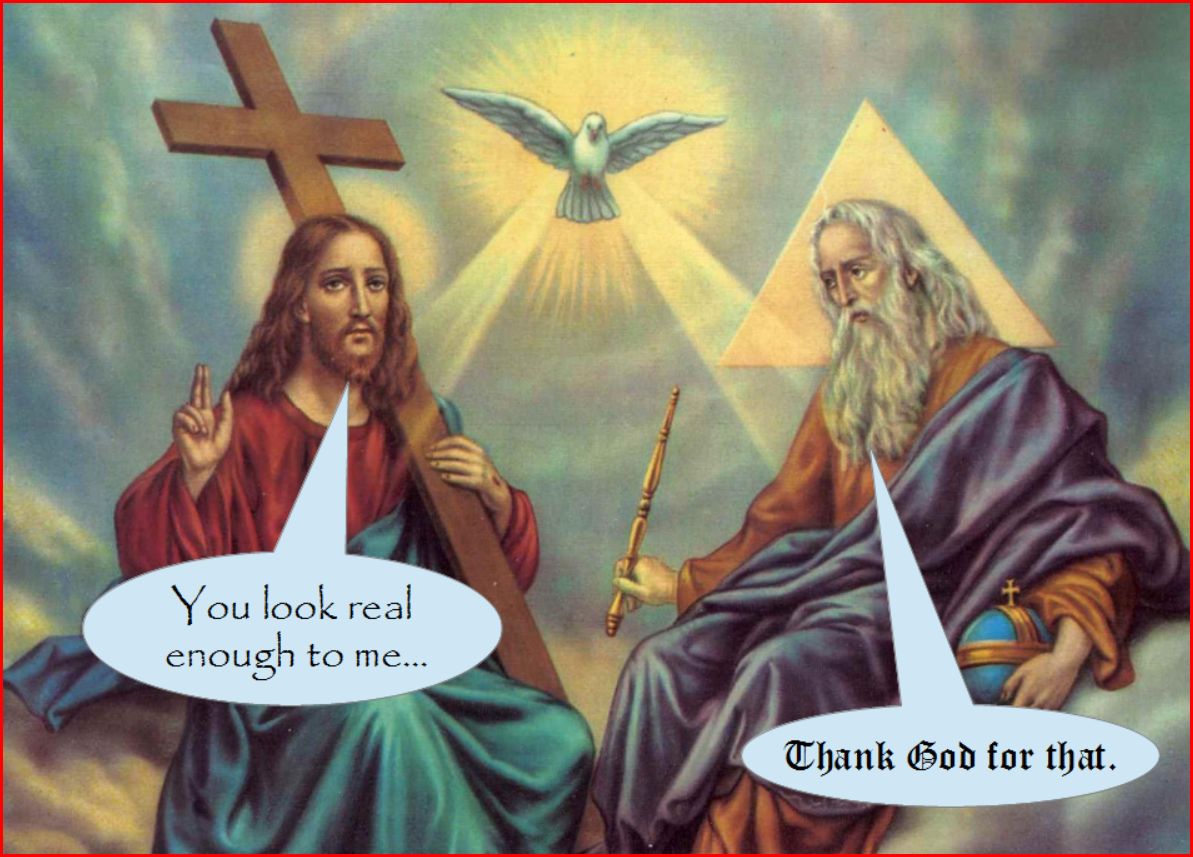
TrinityIf God did not exist –

Human beings would frequently behave like territorial primates;

Nature would be the result of a mindless and heartless process;

Sex and death would be the drivers of its development;

Life would be a cruel struggle for most living creatures, including many humans;

Disease and illness would be pervasive, except where humans themselves had eliminated them;

The world would be largely indifferent to human aspiration;

The brain would find pattern and impose order where none existed;

Progress would be due entirely to human endeavour;

People would adopt the beliefs of their culture and be entirely convinced they alone were right.

Hang on a minute! Isn’t this the world we already have? It’s just like Julia Sweeney says: ‘The world behaves exactly as you expect it would if there were no Supreme Being, no Supreme Consciousness, and no supernatural’. A world without God is exactly the world we’ve got. And the world we’ve got is evidentially a world without a God.

Surely that’s no bad thing.

Christians’ Favourite Delusions 20: The Lord God Made Them All

creation

The poster outside a church in my neighbourhood informs all who pass by that ‘the Earth is the Lord’s and everything that is in it’ (Psalm 24.1). Christians seem to think it’s important that their deity is the one who made the universe and life in this particular small part of it. Some even go so far as to say their God (though being Jewish he wasn’t their God back then, of course) made the world and all of its occupants including ourselves, literally within 6 days, about 6,000 years ago. I suppose that’s where you end up if your premise is that mythical beings, like ol’ Jehovah, actually exist. A third of Americans believe in Creation, innumerable web-sites insist an Intelligent Designer is responsible for life on Earth and street preachers are happy to tell you that evolution is a lie. ‘Were you there?’ asks Ken Ham of Answers in Genesis, as if this clinches the deal.

But let’s be generous. Let’s concede that we don’t know how life started on this planet – because we don’t – and let’s jump to the conclusion that therefore it must’ve been the Christian God. It’s not a very convincing line of reasoning, I know, but I’m being generous as I say. So let’s acknowledge that the Lord did indeed make hummingbirds and butterflies, roses and angel fish, lambs and tygers and all other bright and beautiful things, more or less in their present form.

But that means we’ll also have to concede that he made mosquitoes, flies, lice, ring-worms, parasites of all descriptions, E-Coli, pneumacoccus, all manner of harmful bacteria, viruses, AIDs, cancer – and on and on. The naturalist David Attenborough points out that Creationists are quick to give credit to their God for hummingbirds but that he himself sees ‘a little child in east Africa with a worm burrowing through his eyeball. The worm cannot live in any other way, except by burrowing through eyeballs. I find that hard to reconcile with the notion of a divine and benevolent creator.’

How do Christian creationists square their loving God with such harmful creatures?

There are only four possible ‘explanations’ available to them:

1. Harmful bacteria, viruses and parasites were ‘good’ when God first made them (Genesis 1.31). Then, like everything else, they become perverted when Adam and Eve ate some forbidden fruit.

But this creates more questions than it answers. What were these creatures like in their original forms? How did they live, when their ‘life-cycle’ depends on them infecting other forms? How did they change from being ‘good’ into the creatures they are today? It can’t have been by the process we know as evolution because, of course, evolution is a lie.

2. The Devil made them to plague mankind. He even made sure they survived Noah’s flood – no doubt in the bodies of Noah’s family and the animals supposedly on the Ark.

But if Satan did create them, doesn’t that make him as clever as God in his own way? (I know, I know, the devil doesn’t exist either but I’m trying to think like a Christian here). In any case, why would God let him? Ultimately, he’s responsible for his creation.

3. God made them because, even from the beginning, infections, infestations and disease were all part of what he considered ‘good’.

If this is the case, what an evil bastard he is, indistinguishable from Satan himself.

4. God, the Intelligent Designer just set things in motion at the beginning before leaving evolution to do his work for him.

But, as Darwin pointed out, evolution is a mindless, haphazard, wasteful process that relies heavily on sex and death. What is a supposedly loving, intelligent designer doing using it to bring about his creation? Did he forget that evolution is lie?

Which leaves us with the fact that if God designed and created all life intelligently, as many Christians want to believe, then much of his creation shows little sign of either his love or his intelligence. It does, however, show every sign of having come about as the result of a mindless, haphazard, wasteful process, in which all life-forms occupy their own particular niche to which they have adapted and have evolved, through an infinite amount of sex and death, into the life-forms we see today – hummingbirds and eye-burrowing worms included.