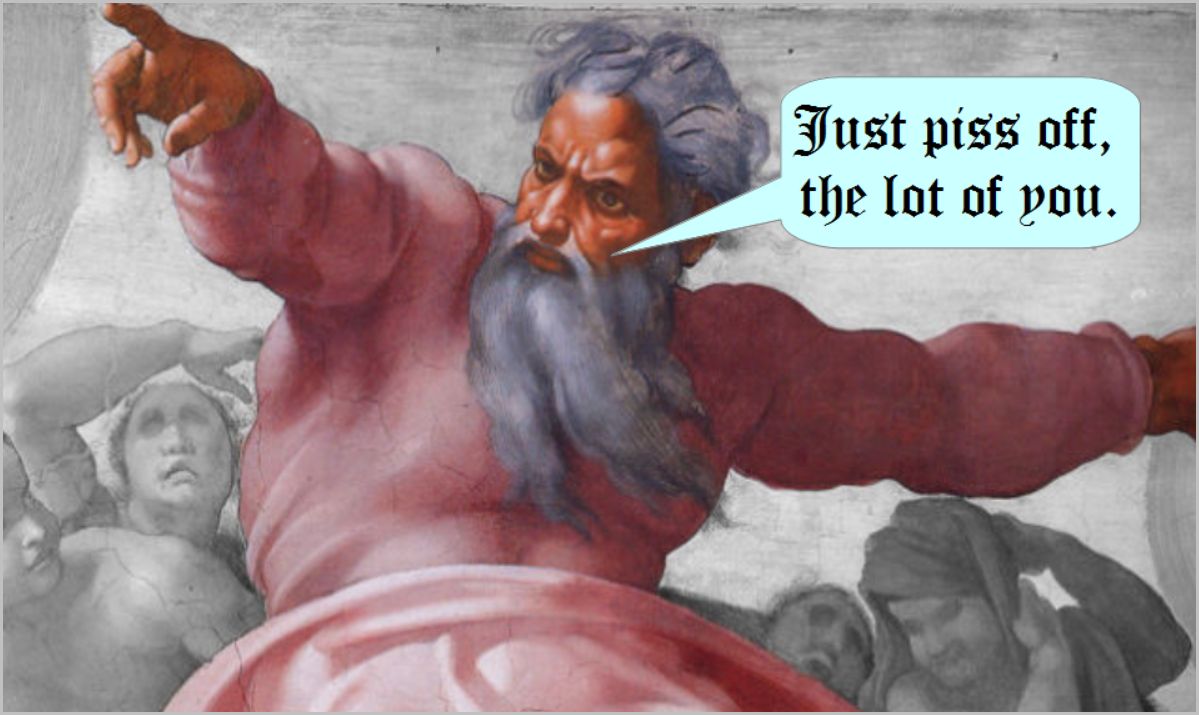
Our Operators are Waiting to Hear from You!

ApostlesHi! You’ve reached the Salvation Hotline. Calls may be recorded for training purposes. All offers are validated by our six day guarantee.* Please listen carefully to your options:

Press 1 for Matthew. With one of our less popular offers (but don’t let that put you off!) Matthew is waiting to explain our buy-one-get-one-free offer! Keep the Jewish law and be saved, plus, forgive others and be forgiven yourself!

Press 2 for John who will tell you how you can get your very own get-out-of-Hell just by believing! Eternal life awaits!

Press 3 for Luke. Luke wants to let you know you how you can be saved simply by asking for forgiveness. Note: this offer cannot be used in conjunction with any other.

Press 4 for Luke’s bargain Family Ticket! Only one family member need sign up and the rest go free!

Press 5 for Paul and to hear about a unique special offer! ‘God’s grace’ can save you without you making any real effort on your part! Not to be missed.

Press 6 for Paul’s great alternative offer: get saved for free! No need to do anything! (Offer good for Jews only. Terms and conditions apply.)

Press 7 for a special operator who passes himself off as Paul but isn’t. And he has a great offer for our female callers! He’ll tell you about how, just by having babies, you can be saved! It really doesn’t get any better than this, ladies! Get saved just by doing what comes naturally!

Press 8 for a very special guy of ours who wants to stay anonymous! But he will show you how you can escape death by buying into Jesus’ cosmic defeat of evil!

Press 9 for James who will tell you how you need to do good if you want to be saved. So, okay, Paul doesn’t think so, but we want to make sure you hear all our offers!

Please note: these offers are mutually incompatible so you might just want to hang up now and forget all about them.

*Our guarantee isn’t worth the paper it’s written on but for legal reasons, here it is anyway:
Press 1: Matthew 5.17-19 & 6.14.
Press 2: John 5.24.
Press 3: Acts 2.36-38.
Press 4: Acts 16.30-31.
Press 5: Romans 10.5; Ephesians 2.8.
Press 6: Romans 11.26-27.
Press 7: 1 Timothy 2.15.
Press 8: Hebrews 2.14-15.
Press 9: James 2.14-17, 24

Searching for Answers

TrustA tiny pamphlet is thrust into my hand by the street preacher’s confederate. Searching For Answers? it says, the question mark meaning, I suppose, ‘are you searching for answers?’, to which the answer is probably ‘no’. I’m not even sure I know the questions, which rules out, I can’t help feeling, finding the answers. It is badly printed and has a picture of a sunset on the front; inside shoddy grammar and misspelling tell me, not entirely to my surprise, that I need God.

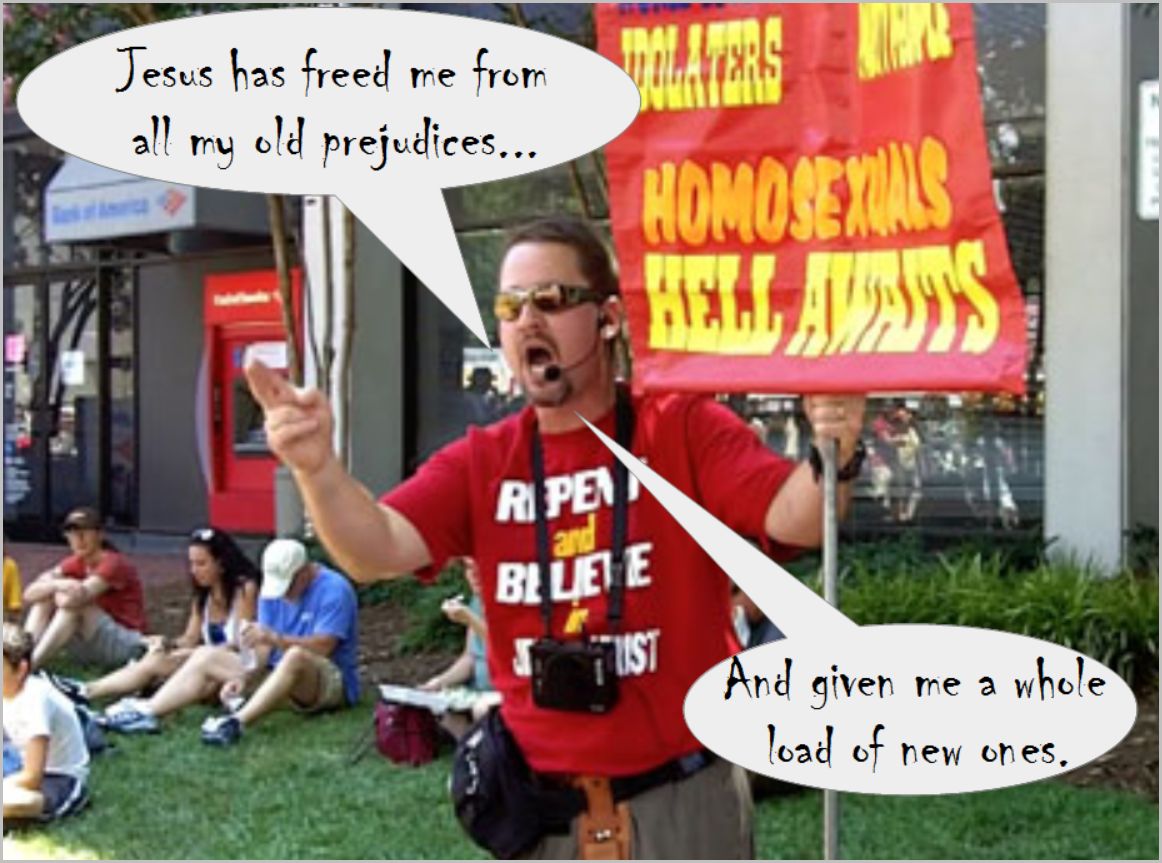
The preacher is in full flow. Evolution, he’s saying, is a hoax, though he doesn’t tell those passing by why it is. Unless we repent of our sins and accept Christ, he insists, we’re all going to Hell and waves his Bible to prove it. A woman sitting on one of the nearby benches shouts something back at him – I can’t quite hear what, though it’s something about love – and he, with the advantage of his microphone and loudspeaker, bellows at her that there’s no arguing with God’s Word. Plus, he’s only telling her what a terrible person she is because he loves her.

I’ve made the mistake of slowing down to hear what’s going on and as I attempt now to walk on, to return to the reality of Saturday afternoon shopping, the man with the tracts catches me again.

‘So,’ he says, ‘what do you think? Will you let Jesus into your life?’

‘Not today,’ I say, ‘we’ve both got better things to do.’

‘There’s nothing better than turning to Jesus. And he likes nothing better than saving another lost sheep. Are you a lost sheep?’ he adds.

‘No,’ I say. ‘I’m not a sheep and I’m not lost. I’m on my way home right now, in fact.’

‘Ah, but do you have a home in heaven?’ he asks. He’s good; whatever I say, however light I try to make it, he turns it round into another impertinent question.

‘I thought you had all the answers,’ I say to him, glancing down at the tatty bit of folded paper in my hands. ‘Don’t you know?’

‘I’m telling you, my friend, you don’t,’ he says earnestly. ‘You are lost in your sin and because God cannot tolerate sin you have no place in Heaven. Not unless you repent and accept Christ.’

‘Jesus!’ I mutter under my breath. ‘Look, I don’t believe in your Christ or any of this stuff.” I push his tract back at him, ‘and I’m not your friend either.’ He looks crestfallen, but only for the briefest of seconds. His ally, still performing for the crowd, is shouting that Jesus is coming back soon to judge the world.

‘And you’d better be ready,’ my new best pal tells me, reinvigorated. I shake my head and step round him, apologising that I have to go; why? I wonder, when it was he who accosted me? So, despite not searching for any answers, I now have them. They just don’t seem to match any questions I might have, like why there’s so much suffering in the world and why human beings do such terrible things to each other (often in the name of religion) and what am I going to have for my tea? Now there’s a question worth answering.

I Don’t Believe It

Fabric‘When you think about it’, the taller of the two men said, ‘there is no evidence whatsoever that God, nor indeed any supernatural being.

‘I suppose you’re right’, said the other.

‘With that realisation, my faith began to dissipate. I mean if there’s no God, no angels, demons or Christs, no Holy Spirit, devils, fairies or Santa Claus, then it must mean they’re just figments of the imagination. Take that human element out of the equation and what you’re left with is… well, the natural world and nothing else’.

‘I suppose not’, said the other.

‘From there one realises there is no point in praying – I mean, talking to a being who only exists in your own head. Or reading the Bible; one begins to see it as a very human book, which of course it is’.

‘I suppose so’, said the other.

‘It means too that Jesus can only have been a mortal man – of course he was – and that a good deal of his teaching – if we can believe it really was his and not simply invented by his followers – makes no sense whatever. It was only the eyes of misplaced faith that made it appear so’.

‘I suppose it doesn’t’, said the other.

‘I mean, “pray for whatever you need and God will supply it”. Who has ever believed that sort of thing anyway? No-one. Not really. We all know that doesn’t work; Jesus himself, one suspects. And as for the resurrection, well, if you read those accounts at face value all they saw – Mary Magdalene, Paul and the rest of them – all they saw were visions, not a real person. All in their minds, you see’.

‘I suppose I do’, said the other.

‘No, Christianity is nothing but false promises, failed prophecies – Jesus saying he’d return within his disciples’ lifetime – and impossible morality: “be perfect as your father in heaven is perfect”! Well, I’ve never met anyone who is, Christian or otherwise. Good people are good whether or not they’re Christians and the mean-spirited are mean-spirited whichever side of conversion they’re on.

‘I suppose so’, said the other, before seeing his chance to add, ‘well, that’s £1.80 for your Church Times, Archbishop. Will there be anything else?’

When it’s Gone, it’s Gone

JudgementAs you’ll see in comments to previous posts, Christians like to encourage gambling. Recycling Pascal’s wager, they say things like ‘if I am wrong then I have based my life on a false premise and have ceased to exist. I won’t even have the opportunity to express regrets. However, if you are wrong, having rejected Christ, you, sadly, will have quite a while to weep, wail and gnash your teeth.’

The old faith-as-insurance-policy argument. Rather like the Chance card in Monopoly that lets you avoid jail, it offers you the chance to escape hell, where all this gnashing is supposed to occur, by the simple expedient of holding a particular set of beliefs in your head.

Surely this hedging of bets doesn’t impress God, the supposed creator of the universe, Father of mankind and judge of all the Earth. He won’t really be taken in, will he, on that great and dreadful Judgement Day when we admit, ‘actually, I only believed in you so you wouldn’t send me to hell’? Maybe he will, being a God without discernment or insight. It’s certainly all that evangelical Christianity has to offer – just ask my preacher friends – a Get Out Of Hell Free card. Which is a long way from what Jesus taught about the coming Kingdom and how to be part of it; not, in his case, by believing the right things but by doing them (Matthew 25.31-36).

What if I am wrong, though, as Christians think? Then I could be in trouble. But so might they; they could find they’ve gambled on entirely the wrong God (curse you Pascal for not thinking of that!) and find themselves up before Allah or Vishnu once they’ve miraculously survived death. ‘Wrong God, mate,’ Allah will have to tell them: الله خطأ، تتزاوج . What then?

And given that they think eternal life awaits them, why are so many Christians fearful of leaving this life? Could it be because they’re not convinced that the gamble is going to pay off? They know intuitively that this life is the only life they’ll be getting – and that when it’s gone it’s gone, as it says in Poundland. That will be why they mourn their brothers and sisters in Christ who ‘pass away’; “sorry to hear about your loss,” they say, when according to their magic betting slip it’s no loss at all but an immortal gain.

So I’m confident I’m not wrong. The odds are in my favour; the evidence is on my side. Consider, if you will, Christians:

  • Every single human who has ever lived has died, or will die, and has ceased to be in their entirety;
  • No human has ever lived again after death (not even Jesus who wasn’t, according to you, properly human anyway and so doesn’t qualify.)
  • No human has ever lived forever;
  • There’s nothing on the other side – no judgement, no Heaven, no Hell, no eternal life – because there is no ‘other side’.

If any of you would like to demonstrate that these assertions are wrong, please do. All I ask is that you bear in mind that insisting they’ll happen at some point in the future because the Bible says so, is not evidence; it’s wishful thinking. Which is pretty much where we came in.

All is vanity.

Invasion of the Body Snatchers

PissImagine the outcry there would be from Christians if having decided to hold an open-air service, a group of atheists turned up and started shouting through tannoys at them as they attempted to enjoy their celebration. Imagine those atheists shouting ‘Hypocrites!’ and ‘Losers. You need to come to your senses!’ Imagine if they said they were only doing this out of love to break the spell the Christians were under, the spell of religion. Imagine they held up signs the entire time with text inspired by Richard Dawkins and Christopher Hitchens, like ‘Free yourself from your God Delusion’ and ‘ Religion Poisons Everything’.

Yes, imagine the outcry; the Christians would see themselves as persecuted by ‘militant atheists’ out to spoil their day. And, who knows, perhaps they’d be right, though perhaps persecution is overstating it, though we all know Christians like their martyrdom. So long as it doesn’t entail any actual… erm… martyrdom.

This didn’t happen at the weekend in my home town – I doubt it happens anywhere – but pretty much the opposite did. A bunch of Christians, complete with loud speakers and placards with scripture verses on them, turned up at the Gay Pride celebration in the centre of town and proceeded to tell those out to enjoy their day that they were sinners in need of Christ and his salvation. They kept this up, because, they said, they loved the people whose afternoon they were trying to disrupt, for at least two hours. These were not members of a local church; according to the young man I spoke to they had come from various parts of the UK and from the States specifically to interfere with the event, or ‘preach the gospel’ as he put it.

The LGBT people at the Pride were having none of it, of course, and drowned out the tired old rhetoric with whistles and good natured chanting until the Righteous Ones accepted the futility of their mission and packed up to go home… but not before they transplanted themselves near the stage to show off their signs again.

Now, how is this different from the scenario we started with?

Christians would object if others gate-crashed their events and attempted to disrupt their celebrations; yet they think they have the right to do just that to others, with their message of hell and damnation. They’d cry ‘persecution’ and see the same kind of actions as militant (when they have no idea what the word ‘militant’ actually means) and part of an ‘anti-Christian agenda’, if it was they on the receiving end.

It’s Christians themsleves who have the agenda – to judge, impose on and convert those with different beliefs and philosophies. They think they have special knowledge of The Truth that no-one else has and which has never been heard before when all they really have is a superstition, a belief in a sky god and magical incantation, much like any other superstition. Even if this weren’t the case, even if their beliefs were what the Christians think they are, that does not give them the right to exercise their arrogant, shouty agenda by rudely imposing themselves on others’ special days.


Update: Evangelist Dale Mcalpine says it wasn’t his merry little brand of preachers that invaded Pride. Oh no. According to Dale, a bunch of irresponsible LGBT people tried to spoil a bona fide Christian event that just happened to be going on nearby at the same time.

These people’s self-delusion knows no bounds.


Spontaneous Conversion

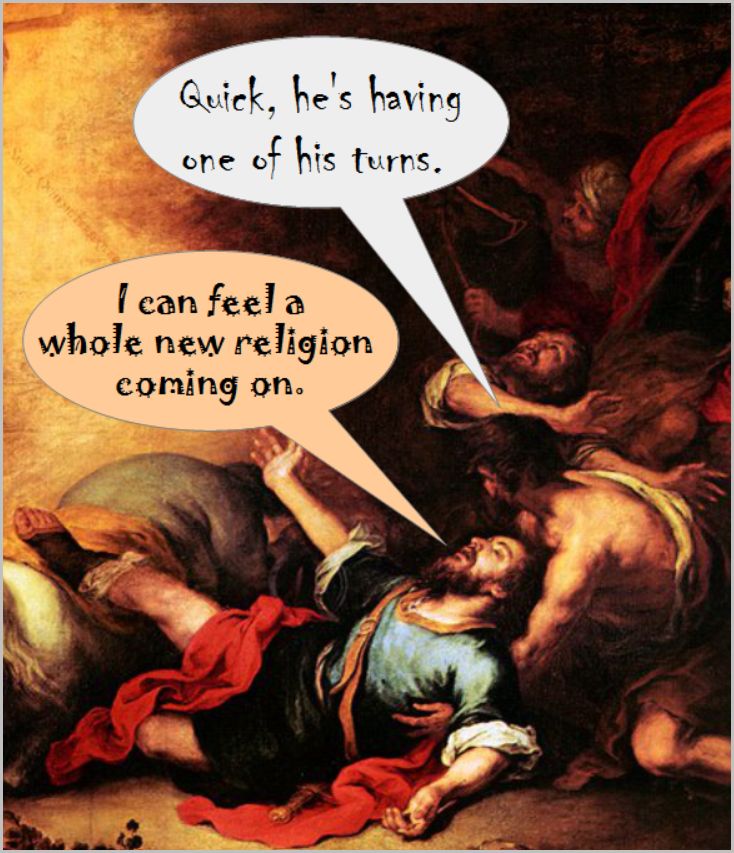
st-paul-conversionThe missionaries pressed on into the Amazonian jungle. They were now in uncharted territory. No-one had ever been this far in. And then, sounds from somewhere not too distant; human sounds, human voices – singing even. The missionary troupe emerged into the clearing to an amazing sight. Groups of Amazonian natives gathered together, a rudimentary cross in front of them, towards which they were undeniably directing their worship. These people, whose existence had hitherto been unknown, and who had never before encountered Westerners, were Christians!

Weeks later once basic communication had been established, the tribe’s chief priest and the head missionary communed together. The priest explained how, long ago in the past, his ancestors had recognised God’s presence in the incredible world around them and had opened their hearts to him. As a result – Miracle of Miracles! – God sent them a vision of Christ himself, much as he had to St Paul and the other disciples, and the whole tribe came to believe in Jesus. Ever since then, the tribe had worshipped the one true God and his only son, that same Jesus Christ.

“Amazing,” said the missionary, “so it looks like St Paul was absolutely right when he said God reveals himself in nature and speaks to our hearts to make himself known to us. It’s not as if we ever needed the Bible, or to go round telling people how to be saved. God is more than capable of doing it for himself. Praise the Lord and pass the communion wine!”

What a story! And it happened time and time again as the world was opened up by explorers and missionaries.

Or maybe not. Definitely not, in fact. But it should have happened if what Paul says in Romans 1.18-21 is right, as Ken Ham believes it to be:

For the wrath of God is revealed from heaven against all ungodliness and wickedness of those who by their wickedness suppress the truth. For what can be known about God is plain to them, because God has shown it to them. Ever since the creation of the world his eternal power and divine nature, invisible though they are, have been understood and seen through the things he has made. So they are without excuse; for though they knew God, they did not honour him as God or give thanks to him, but they became futile in their thinking, and their senseless minds were darkened.

If God is so obvious in the world that (supposedly) he created and if we humans can see and understand him through it, then why do Christians need to proselytise? Why doesn’t God make his personal presence felt just that tiny bit more clearly – with the odd ‘revelation’ like the one he provided Paul, say – so that people come to believe in him more fully? And by ‘him’, of course, I mean the proper God – the Jesus one. Why does he leave it so that folk seemingly pick up on the special vibes he’s placed in their hearts but then worship a ‘counterfeit’ god, like Allah or Jah or, back in Paul’s day, Zeus? Why doesn’t he provide revelations like he used to, to ensure everyone knows just who it is who’s standing at the door knocking?

If he did that, if God did indeed plant clues to his presence both around us and in us as Paul says he does, then the Bible wouldn’t be needed to convert people. But that’s not what we find, which is that the Bible is essential in perpetuating the God-myth. We wouldn’t even be aware of Paul’s ridiculous claims if they were not preserved in that ramshackle collection of writings.

The indoctrination of others is utterly reliant on two things and two things only. Not God-in-nature or inner prompting or visions, but on ‘the scriptures’ and those who are driven to spread the Jesus-meme. Now does that not strike you as odd? It strikes me as something entirely human, with nothing supernatural about it. If people have to be told, evangelised to and indoctrinated into Christianity, then it can hardly be the case that they see the one true God in nature or have an intuitive feel for him. If that were the case, then we would have discovered hitherto unknown groups of humans who already knew of him and the nonsensical clutter of beliefs that surround him. And we haven’t. Ever.

Christians’ Favourite Delusions 33: Atheists know in their hearts that God exists

DenyTwo tried cliches trotted out by evangelising (i.e. aggressive) Christians are that ‘atheism is a religion‘ and that in their ‘heart of hearts atheists know there really is a god’. Ken Ham of Answers In Genesis is fond of both assertions, as are other equally desperate promoters of unsupportable beliefs. We’ll come to the first in a later post, but here’s how Ham expresses the second:

They (atheists) know in their hearts that God exists, but they are actively suppressing this belief in unrighteousness (Romans 1:18). They fight so hard against a God that they claim doesn’t even exist because they know that He really does! We need to pray that, instead of fighting against God, these lost individuals will repent and put their faith and trust in Christ and in what He did for them.

Romans 1.18 that he cites says: For the wrath of God is revealed from heaven against all ungodliness and wickedness of those who by their wickedness suppress the truth.

Assuming Paul is saying here what Ham claims he is (it’s doubtful from this verse alone) both he and his hero are demonstrably wrong – as they are about so much. The evidence suggests that while young children look for meaning and assume agency, they do not necessarily attribute these to a god until they are taught to do so by others. The god they then come to acknowledge is the one already prevalent in their social environment. In a predominantly Christian context, they will come to be acquainted with – and may go on to develop a full-blown belief in – the interpretation of the Christian God common within their particular culture.

It is the same for conversion generally. You are more likely to be a Mormon in Salt Lake City, a Roman Catholic in East Timor. If raised in a Jewish environment, it’s more likely you’ll subscribe to YHWH; in an Islamic one, an interpretation of Allah; Buddha – not strictly speaking a god – in a Buddhist one. Statistically, those who adopt a religion and a belief in a god, almost always opt for that which is prevalent in the society into which they are born. This is not god ‘writing a knowledge of himself’ in their hearts, it is a cultural, human phenomenon.

Ham and others see this as evidence for their belief that we all have some sort of ‘god-shaped hole‘ in our psyche that we can just as easily fill with false gods as with the real one (theirs). But this is a shift in the argument; it’s not now that God makes himself known to everyone but that we all find a need for a god. This is not the same thing, nor is it true. Certainly humans have a history of creating gods to explain the strange, magnificent and sometimes hostile universe in which we find ourselves; but this does not mean these many gods exist, as Ham would be the first to admit (c’mon, there’s only one real God – his.) It means only that the human brain seeks pattern and meaning, and has often drawn the wrong conclusions in its quest for them. The gods – and God – are part of these wrong conclusions.

And what of Ham’s assertion that atheists deny their awareness of God because of ‘unrighteousness’ – because, he implies, we just want to live a life of rampant ‘sin’? Well, I admit, I like a bit of a sin as much as the next man, but that’s not why I’m an atheist. I’m an atheist because, like most others, I find no evidence for gods or God either in my ‘heart’, nor in the way the world works nor in collections of iron age stories. Morality doesn’t come into making this assessment. In any case, those who buy into a god don’t have a monopoly on ‘righteousness’, as their weak morals, judgemental attitudes and destructive behaviour regularly demonstrate. More than this, and as Ham admits, Christians are only concerned about others because the Bible says they should be: ‘The reason I care about poverty,’ he says, ‘is because God’s Word instructs me to care, and all humans are made in the image of God as God’s Word tells me.’ This is not righteousness, nor a morality that comes from any real concern for fellow human beings.

Finally, atheists don’t, as Ham claims, ‘fight so hard against’ a non-existent God that we secretly believe in. We oppose Christians and other purveyors of supernatural nonsense when they try to impose their irrational beliefs on others, when they condemn fellow human beings, seek to control them and try to limit their rights in the name of God and the cause of ‘righteousness’.

So, no, don’t condescend, Christians, to tell us we all know that there’s a God that we wilfully ignore. You’re wrong, and I’ll show you even more reasons why you are, next time.

A new creation? Or same old same old?

Preaches3Over at Answers In Genesis, John C. P. Smith (who?) argues that Christianity must be true because of ‘the testimony of countless Christians to the efficacy and potency of the gospel to radically change people’s lives for the better.’ Supposedly, this change is the result of a radical take-over of the individual by the Holy Spirit. As Paul explains in 2 Corinthians 5.17:

Therefore, if anyone is in Christ, he is a new creation. The old has passed away; behold, the new has come.

Even as we speak, Christian Voice’s Stephen Green is proposing, in one of his more spiteful and petty blog posts, that this is only way a young activist can be saved from a selfish, insensitive and deluded – talk about the pot impugning the kettle! – ‘gay lifestyle’, whatever that is. But do such changes really happen and are they ‘for the better’?

Speaking from personal experience and observation, I’d have to say they do. Sometimes they entail an apparent overhaul of the convert’s view of life, mindset and values. It’s as if the possibility of a spiritual aspect to life takes them by surprise and everything in their psychology shifts to accommodate new ideas. For others, the change is superficial and merely accentuates characteristics they already possess.

Having said that, many people have life-changing experiences without a religious catalyst; when they survive a bad accident or a potentially fatal illness, for example, or win lots of money; when they come to a full realisation of who they are or ‘come out’; when they first have sex or a baby; when they lose a loved one or experience an out-of-body experience or start a new job or move to a new area… and on and on.

None of these transformations involves Jesus, his Holy Spirit or ‘the gospel’. Humans are capable of the most drastic and radical of psychological change all on their own. How many times have you heard it said that someone isn’t themselves? Or that no-one knows what’s got into them? Or they’re acting out of character? Some even transform themselves without any external event playing a part. You may have done so yourself.

I would suggest that religious conversion is like that. The change can be real, but it has nothing to do with an external, supernatural agent. The human personality or psyche, whatever you want to call it, is much more fluid and pliable than we care to admit. Your self, values and thought patterns are in fact undergoing constant change, sometimes radically and rapidly so. The consistency you feel you maintain, the unchanging ‘you’, is an illusion. You are regularly updated, like the operating system on your computer. You’re not the same ‘you’ that you were last year and are certainly not the same as a decade ago or when you were a child. What you regard as ‘you’ is constructed from constant change.

The change that comes from religious conversion is no different. More, it doesn’t necessarily change you for the better; it can harden attitudes and make you less sympathetic towards others by transplanting values that are not conducive to empathy and generosity. You become one of ‘us’ and no longer one of ‘them’ as your chosen place of worship and the collective influence of fellow believers make a significant contribution to the process. This is why evangelists and those who are driven to convert others always insist you become part of a church (mosque or synagogue) afterwards – provided, of course, it’s one with the right sort of teaching (theirs). Your new attitudes and values are then reinforced by those who already have them, entrenching them further and convincing you that they, and now you, are ‘right’. This is how the ‘new creation’ you’re becoming is constructed and moulded.

As I’ve argued before, conversion can often reinforce behaviours that have already become habitual for individuals. Every church and Christian movement has adherents who are petty and spiteful, as well as those who are generous and considerate. But what becoming a new creation never entails, is making converts more intelligent, rational or stable. Why not? If it’s a miracle we’re talking about – and undoubtedly we are if God’s spirit suddenly or gradually takes up residence within a person – then surely it would result in a little cognitive rewiring so that the new Christian reaches their full intellectual potential. The fact it doesn’t bring about the ‘renewal of the mind’ (Romans 12.2) in anything like this sort of substantive way is the equivalent of the missing limb that no amount of prayer and laying on of hands can regenerate.

All of which suggests – no, more than suggests; demonstrates – that neither God nor his ‘Holy Spirit’ nor a dead Jewish preacher, nor ‘the gospel’, has anything to do with it. And perhaps that’s because an increase in intelligence, rationality or stability would run counter to the process which depends on blind faith and a submission to the very social forces that reshape the self.