Do You See What I See?

Christianity with its visions of God, angels and resurrected god-men, is not distinctive. It emerged from a culture in which such epiphanies were commonplace and highly esteemed. Appearances of deities, other supernatural beings and dead people were valued as genuine encounters with a reality on the other side of this mortal life. Paul was a Hellenised Jew and a Roman citizen (if Acts 17 can be believed); it was perfectly natural for him and his contemporaries to see and hear things that weren’t there.

Not only was the fledging Christ-cult influenced by the superstitious culture around it, but was born too of Judaism, itself awash with visions, apparitions and revelations. How could the new religion fail to be when its originators existed in such a milieu. One or other of these ‘visionaries’ believed they’d seen a resurrected Jesus. Of course they did. This is how gods manifested themselves then; everyone knew it. There were even those who hadn’t really had any inner-visions but wanted to be regarded as mystics themselves so would pretend they too had had direct contact with the deities.

The human mind has always been susceptible to illusions, to the potency of dreams and to misinterpreting what is going on around it. It’s also prone to a spot of fantasising now and then. This propensity didn’t cease once Christianity established itself. Muhammed claimed to have been visited by angels who revealed new truths about the nature of God – not least a change in name.

In the 19th century, a young farmer, Joseph Smith, living during a widespread and particularly intense religious revival, imagined (or pretended) he’d been visited by God and Jesus. Later, he said he’d been visited by a hitherto unknown angel with the unlikely name of Moroni. The result of course was multiple wives for Smith and the foundation of the Church of Jesus Christ of Latter Day Saints. Sufficient numbers of people believed Smith’s cockamamie stories about his alleged visions to commit to Mormonism. Smith wasn’t alone; others had visions of deities, including but not restricted to the Big Two, Jesus and his Father God. Hundreds recently saw the Virgin Mary hovering above New York City. They couldn’t all be wrong could they? Of course not, but they were all be deluded. Just like Joshua Mhlakela whom Jesus appeared to and told him the date of the Rapture was 22nd September, or possibly the 23rd, then with ‘billion percent’ certainty 7th October. Or maybe 8th…

This is how religions are made, changed and adopted: on a bed of illusory sand. If we need any further evidence that such experiences are illusory, created by the mind itself, then consider this: each time God, his angels or his Son appear in the religion-soaked brains of mystics and fraudsters, they reveal a message at odds with that revealed to previous visionaries. Each revelation has to be different of course. There would be no reason for such ‘visits’ otherwise.

Hence Abraham (or his script writer) imagining YHWH promising an eternal covenant and a new land.

Moses (or his script-writer) claiming YHWH had issued new laws while at the time commanding the slaughter of tribal enemies.

Cephas thinking he’d seen a risen Jesus who may or may not have told him of the imminent the End of the Age.

Jesus himself reportedly talking with his ‘Father’ about the necessity of his execution.

Paul flying to heaven so that Jesus could explain in great detail a new covenant, negating the original ‘eternal’ covenant with Abraham.

John of Patmos envisaging Jesus coming to Earth to slaughter the enemies he purportedly instructed his followers to love. (And Christians claim the Bible presents a unified message!)

All of these are manifestations of, and within, the minds of fantasists. Such manifestations are a naturally occurring malfunction of the brain.

And so it continues. Beware anyone who claims to have seen or heard from a deity of any sort. They, like their biblical counterparts, are deluded and almost certainly ill.

James, brother of the Lord

Let’s take a look at some of the problems that need to be addressed in recognising that Jesus the Christ was always a mythical being.

The first is, that despite the vast majority of what Paul writes talking about Jesus only as a divine super-being seen in visions and worked out through ‘revelations’, there are a couple of instances where he appears to be alluding to a real person.

The first is Galatians 1:19, where, in this literal translation, Paul refers to ‘James, the brother of the Lord’:

Then after three years I went up to Jerusalem to make acquaintance with Cephas and I remained with him days fifteen. Other, however, of the apostles none I saw if not James the brother of the Lord (‘adelphon’). In what now I write to you, behold before God, I lie not!

In context, Paul is asserting that his knowledge of ‘the Lord’ comes directly from the Lord himself in visions and revelations and ‘not from any man’ (Galatians 1:12) He did not, he asserts here, meet with Cephas and James until 3 years after his conversion. (His insistence he is not lying is curious, wouldn’t you say?)

His mention of James, ‘the brother of the Lord’ is potentially a problem for those who see Jesus as primarily a mythical figure. Richard Carrier accepts that the reference is an indicator in favour of historicity. However he goes on to say that Paul, Cephas, James and all fledgling Christians,

were brothers because they were at baptism the adopted sons of God. Literally. Paul explicitly says that. And this made them all brothers of the Lord Jesus. Again, Paul explicitly says that.

He explicitly says these things in Galatians 4:3-7 and Romans 8:15-17 respectively. Undoubtedly the term ‘brother of the Lord’ could refer to the fact that all Christians are brothers of the Lord through adoption. But then why is Cephas not also referred to as a brother of the Lord? Carrier demonstrates that Paul distinguishes between Apostles, who by definition have, like himself, had the risen Christ revealed to them (in other words have imagined they’ve seen him in their own heads) and those who haven’t. These less fortunate individuals, however well placed in the cult hierarchy, are, like all Christians, brothers of the Lord. Paul uses the term in this sense frequently, for example in 1 Corinthians 1:26 & 16:20; Romans 10:1 and 1 Thessalonians 1:4. He also calls his fellow Jews ‘brethren’ in Romans 9:3. His strange construction that he saw Cephas and ‘none other of the apostles, if not James’, does not imply he saw James as an apostle.

Nor does Paul say James is ‘the Lord’s brother’, which implies a familial connection. The Greek quite clearly employs the phrase ‘the brother of’, which suggests a looser, cultic connection; James is one of the adopted brotherhood.

Furthermore, Paul does not say James is the brother of ‘Jesus’ as Bart D. Ehrman falsely assumes. Paul says James is ‘the brother of the Lord’, ‘the Lord’ being the term he uses when referring to the heavenly saviour who was been ‘revealed’ to him. There’s no reason to suppose that Paul means anything other than this when he calls James the brother of the Lord. Again, what he is actually saying is, ‘I saw James, he of the brotherhood of our Heavenly Saviour.’ The term ‘brother’ for a fellow (male) Christian persists, in this very same way, in the present day.

I am not of the view, therefore, that Paul’s use of the term for James undercuts the likelihood that Jesus was then, as he is now, a mythical heavenly being.

A New Kind Of Christian


You’ll be overjoyed to hear that Jordan B. Peterson has a new book out. He’s been busy promoting the not at all pretentiously titled We Who Wrestle With God. He was interviewed about it recently in British magazine The Spectator. The interview has to be read to be believed. The introduction can be read here but the rest, alas, is behind a paywall. Don’t worry though, I’ll supply you with the highlights. The article is a goldmine of stupefying statements about God and how Jordan is the only one who really understands the Bible’s stories. They need ‘arranging’, you see, and their underlying ‘hypotheses’ understood:

The Bible presents a series of hypotheses. One is that there’s an underlying unity that brings together all structures of value. The second claim is that there’s a relationship between the human psyche and that unity and each of the main biblical stories casts that unity in a different light, accompanied by the insistence that, despite those differences, what is being pointed to is one animating principle. As far as I can tell, that’s correct.

You got that? As ol’ Jordan humbly admits, this ‘revolutionary realisation’ is his and his alone. Of course, none of this sort of thing is original; the idea that characters, events and stories in the Old Testament prefigure realities in the New is as old as the hills. Typology can be imposed on any set of myths. The gospel writers and Paul did it, seeing Jesus prefigured in Jewish scripture and inventing stories about him so that he complied with these earlier types. There’s nothing ‘revolutionary’ about spotting this, but like so many before him, Peterson gets it back to front and falls, quite literally, for the oldest trick in the Book. Continue reading

A World When Revelation Was Possible

Greek and Roman cultures of the ancient world were obsessed with seers, oracles, prophets, muses and the fates. Politicians, priests and ordinary people were desperate to know how to keep on the right side of capricious gods and what the future held. Word from the supernatural realm, channelled through seers and prophets, was sought after and valued. Visions, dreams, portents and auspices that revealed secrets and mysteries were highly prized. It was a world saturated in superstition. Jewish culture, operating within this milieu, was no different.

Jews too revered prophets, dreams, visions and divination. This is apparent in both the Jewish scripture, the Old Testament, and also in the New, the writing of the early Christian cult birthed from Judaism in a Greco-Roman world. There are in the New Testament:

6 instances of god-induced dreams;

11 visions of heaven and heavenly beings;

578 new prophecies;

300 or so supposed fulfilments of earlier ‘prophecies’;

An abundance of revelations’ (Paul’s phrase) as well as those of Revelation itself (one long revelation or a series of shorter ones?);

113 visits from supernatural agents (Satan, demons, angels);

Assumptions that dead people can reappear (Jesus mistaken for Elijah and Jeremiah; Elijah and Moses manifesting themselves);

Multiple ‘resurrections’ both before and after Jesus’s.

People believed this kind of stuff! The supernatural, prophecy, ‘revelation’ and resurrection were regarded as entirely plausible, a given in the culture in which early Christians lived. The pagans around them may not have subscribed to the new cult’s reworking of these superstitions, nor accepted that Jesus was the Messiah, but they would not have found anything amiss with the idea and presence of the supernatural, with its attendant revelations, visions and prophecies. These were the currency of the day.

That such manifestations were mistaken or misinterpreted by the new cult would have been the point of disagreement for most people (though its important not to over-estimate how many actually knew of the Jesus cult in its early days), not that it manifested and incorporated them in the first place.

In the first century world, revelations, prophecies, visions and the like were considered to be gifts from the gods. Paul insisted that what he ‘received’ was from the supernatural realm, specifically from the heavenly Christ (Galatians 1:12). Accepting this was a prerequisite for believing what he went on to say about salvation, resurrection and Christ’s descent from the clouds. The supernatural world and its ability to communicate with ordinary mortals had to be accepted as real before anything Paul said could even be considered. Fortunately for him, the culture in which he operated embraced the idea that this was a reality.

If, however, there is no supernatural – and let’s be honest, we know there isn’t – there can’t ever have been revelation, prophecy or God-given visions. With no heavenly realm to transmit revelation, prophecy and visions into the brains of seers, prophets and visionaries, from where did – and do – their revelations, prophecies and visions originate? From brains conditioned in an environment infused with irrational, magical beliefs, whether that of the first-century or one of the many Christian, Bible-soaked bubbles that exist today. ‘Revelation’, ‘prophecy’ and visions emanate entirely from the human brain. It is this which originally created revelations and now sustains ideas like heavenly saviours and supernatural resurrections. These things have no independent existence outside of the human imagination.


The End of Days

A friend of mine was recently given the book The Dragon’s Prophecy: Israel, the Dark Resurrection and the End of Days by Jonathan Cahn. My friend, already concerned about the state of the world, said how much the book had disturbed her. She had become convinced that the time we live in had been predicted in the Bible, in Revelation in particular. ‘It’s all there in the Bible,’ she said to me. ‘It’s all happening just as it says.’

I tried to reassure her that Revelation was written by someone who, 2000 years ago, believed that the situation then couldn’t get any worse, what with the Roman occupation, the destruction of Jerusalem and the persecution of Christians (as the writer saw it.) This, together with his belief that the Lord would soon be coming on the clouds (Revelation 1:7), convinced him he was living in the world’s last days. I told my friend that because of the mess the world is in today (and when is it not a mess?) the book of Revelation resonates with some people; a voice from the past echoing down the ages. In no way, however, was it written about today.

My friend was unconvinced so I took it upon myself to read The Dragon’s Prophecy. Coincidentally, I had just begun to read Bart D. Ehrman’s Armageddon: What the Bible Really Says About the End, dealing with the same concerns. The comparison between the two books couldn’t be more striking.

Ehrman’s is a measured analysis of Revelation and other ‘prophetic’ books of the Bible. He demonstrates from the outset that Revelation was written for believers of the late first/early second century and that its symbolism represents individuals and events of that time. John of Patmos, whoever he may have been (a cult leader, Ehrman suggests) expected, like most early Christians, that the End was going to materialise soon, in the first or early second century, emphatically not in the 21st.

Ehrman warns that ‘professional prophecy writers’ (he doesn’t name Cahn) think ‘the way to use the Bible is to assemble the pieces to reveal the big picture, which until now no one has seen before’ (p17). He’s right. This is precisely what they do. In his book, Cahn promises ‘to put together the pieces of the mystery’ (p11) and claims ‘We (sic) will now begin assembling the pieces of the puzzle’ (p36). He then proceeds to jump around the Bible like a grasshopper on steroids. He’s one of the ‘prophets’ who, as Ehrman puts it, sees the Bible as ‘a great jigsaw puzzle with one piece hidden in this place, one in another and yet a third somewhere else’ (p17).

Cahn opens his argument with a series of bald, unsupported assertions: ‘Behind the perceivable realm lies another, beyond our ability to measure or quantify’ and ‘Behind the history of this world lies another, unrecorded, unrecited (sic), unknown,’ his readers evidently not expected to ask how he knows any of this codswallop. He goes from there to build his argument, such as it is, with a bombardment of ridiculous questions and pseudo-profundities:

What is evil? And how did it come into existence? It is both a mystery and a problem. The mystery is the problem (p9).

Then there are the propositional statements of the ‘If… then we’d expect’ variety. There’s rarely any evidence for the ‘if’ and none at all for the proposed expectation. Here’s the two – rhetorical question and propositional statement – rolled into one: ‘If evil is uncreated, how did it come to exist?’ (p32). Naturally, Cahn is going to answer this question and all the others like it, with a series of unfounded assertions, non-sequiturs and a smattering of unrelated Bible verses.

A central premise of The Dragon’s Prophecy, the dragon being that of Revelation 12:9 and therefore the devil, is ‘the dark resurrection’ of its subtitle. This Cahn explains, pretending the idea comes from the Bible when it doesn’t, is the re-emergence of the Israelites’ old, (extinct) enemies, the Philistines. Like the Israeli nation they too have now been resurrected: as the Palestinians. Under the control of the dragon/devil, they re-enacted on October 7th last year one of the many ancient Philistine attacks recorded in the Bible, only this time with ‘guns and explosives’:

On that October morning, the ancient drama replayed. The resurrected Philistines had again invaded the land, and the resurrected Israelites had again gone into hiding, keeping silent and still in fear of their pursuers (pp99-100).

How do we know this is a replay of an ancient invasion? Because some of those under attack on 7th October went into hiding, just as the Israelites did in 1 Samuel 13:6. As if no other group of besieged civilians hasn’t tried to hide at any other point in history. That and the ‘fact’ there were, according to Cahn, exactly 3,000 invaders on each occasion. Yes, the book really is this bad.

And so, Cahn says, the stage is set for the final battle and the return of Christ who will knock a few heads together, torture and slaughter everyone who isn’t a Christian and set up his faithful followers in a new Jerusalem made of gold and fancy stuff. As Ehrman says, this is indeed what Revelation promises – for the world 2,000 years ago. Ehrman argues that the author of this revenge porn, (he doesn’t use the term: that’s my contribution – you’re welcome) creates a Christ so unlike those of the gospels that he can only be a fiction (aren’t they all?)

Revelation barely made it into the canon and we would all be better off if it hadn’t; certainly my friend would be, and as Ehrman shows, human society and the planet in general would be too. He warns us to read what the Bible actually says, instead of, as Cahn does, forcing it to say what we want it to (to sell books). Irritatingly, Ehrman consistently refers to the Christ’s prophesied appearance on the clouds as his ‘Second Coming’ when the Bible never uses the phrase. Read what it says Bart!

I don’t know whether I’ll finish Dragon’s Prophecy. Its cover blurb boasts that Cahn is a New York Times best seller so clearly there’s an audience for such poorly argued, alarmist nonsense – which is itself alarming. While Bart D. Ehrman has also made the NYT list in the past, Cahn easily outsells him. Nevertheless, I’ve bought my friend a copy of his Armageddon in the hopes it might serve as an antidote to the dire The Dragon’s Prophecy.

And now, the Conclusion

It’s a game you can play all day.

  • First, choose a story – any story – from the gospels.
  • Look for all the metaphors in the story.
  • Note its allegorical elements.
  • Find either the myth from Jewish scripture and/or the part of Paul’s fantasy that the story is based on.
  • Read the story in light of these insights.

Once you’ve done this a few times – which you can, literally, till Kingdom come – you’ll realise that all the stories in the gospels are literary inventions. Stories that are replete with metaphor, reliant on earlier mythical sources and that read like allegory would be considered, in any other context, to be fiction.

And what will you conclude from this?

That just because the stories are from the gospels doesn’t grant them a free pass. Stories that fulfil all the criteria of fiction, as the gospel stories do, are elsewhere considered to be fiction: think Romulus, the non-canonical gospels, King Arthur, the Book of Mormon, the Chronicles of Narnia. So why not here?

That calling the stories ‘pericopes’, in an attempt to elevate their status, merely disguises the fact they are just stories.

You’d acknowledge that History, as in the recording of past events, is not written as allegory. It doesn’t depend on metaphor and symbolism to reveal hidden meanings. Historians reject or are highly sceptical of any accounts that depend on such literary techniques. They usually conclude these are not history, whatever else they might be.

You could, I suppose, try arguing that history in ancient times wasn’t the discipline it is now and did indeed incorporate elements from fiction. But you’d be wrong. Historical accounts of the first century have survived and do not confuse historical fact, however interpreted, with fiction. Writing that relies on allegory and hidden meanings is not considered to be history. You would then have to concede that the gospel narratives do not qualify as history. You would then be in agreement with the majority of scholars who think this.

Then you’d ask, why? Why, if Jesus was such an incredible guy, did so much have to be made up about him? You could, I guess, argue that an itinerant first-century preacher successfully manipulated events so that he fulfilled ‘prophecy’, complied, at least in Mark, with Paul’s (future) teaching and managed to make himself some sort of living breathing metaphor. Or you could conclude, applying Occam’s razor, that the stories are simply made up. And if you did, you’d be agreeing with Mark when he reveals that ‘everything is in parables’ (Mark 4:11).

You’d then ask yourself: if the miracles, the healings, the profundities, hyperbole, nativity tales, angels, demons, zombies, the transfiguration and much else besides are all fiction, then why not too the resurrection? Is it one of only a few episodes in the gospels – the crucifixion is often cited as another – that isn’t fiction? Is it the one of only a few stories in that’s factual and true? The empty tomb, the angels, the sightings by Mary, the disciples and Thomas, the fish breakfast, the ascension: are these historical when everything else is not? You’d have to ask on what criteria you were salvaging this particular story as historical when all that precedes it patently is not.

Then you’d have to start wondering if there really was a Jesus. The versions of him who appear in the gospels are constructs, characters created from metaphor, Old Testament stories and the teaching of the early Christian cult. If there really was a man who trailed around Palestine with an apocalyptic message, he is long gone. Indeed, he had vanished by the time the stories about him that we know as the gospels came to be written.

The Feeding of the 4000

Mark 8:1-15 has the credibility-defying story of Jesus feeding 4000 people. The story is in fact one of numbers, all of which have symbolic significance. Numbers, bread and fish.

At first reading the account seems to be little more than a retelling of the earlier feeding of the 5000 in Mark 6:30-44. However its numerology is different and Mark has Jesus explicitly compare the two stories in verses 8-21. Both are intentional inclusions in his gospel, not an editorial oversight.

The events almost certainly didn’t happen in reality; significant numbers of people, 5000 and 4000 respectively, following an itinerant preacher around for – magic number alert! – three days would not have escaped the attention of the Romans. Nor would the men (Matthew 13:58 insists 4000 was the number of men) have been able leave their livelihoods for this length of time to follow Jesus around the distant countryside.

Then there’s the repetition of the bread and fish motif. In both stories the entire crowd fails to bring a single thing to eat. On both occasions, the disciples somehow, from nowhere at all, come up with a few loaves and some fish. Symbolic food for symbolic crowds.

Bread, while a staple food of the first century always has spiritual significance in the bible. From manna from heaven in Exodus 16:17 to the Body of Christ in Paul’s teaching. Fish likewise: Mark has it that several of the disciples were fishermen and makes Jesus declare they’re ‘fishers of men’ (Mark 1:17). John will later take bread and fish symbolism to extremes.

The bread in the feeding of 4000 is spiritual manna. Jesus is not feeding a real crowd with real bread. He is ‘feeding’ those who follow him, the early cult, with himself: ‘Jesus took bread… and said this is my body which is for you’ as Paul has him say in 1 Corinthians 11:23-24. So satisfying is this heavenly Bread that there is a great abundance left even after his followers have taken their fill.

There’s more: the numerology signifies that the crowd following Jesus in the story aren’t any old rag tag collection. They are specifically Gentile. Mark alludes to this when he mentions they have come ‘a long distance’ (8:3) and again when he has Jesus explain, in typically obtuse fashion, the meaning of the miracle (8-21):

Jesus asked (the disciples): “Why are you talking about having no bread? Do you still not see or understand? Are your hearts hardened? Do you have eyes but fail to see, and ears but fail to hear? And don’t you remember? When I broke the five loaves for the five thousand, how many basketfuls of pieces did you pick up?”

Twelve,” they replied.

And when I broke the seven loaves for the four thousand, how many basketfuls of pieces did you pick up?”

They answered, “Seven.”

He said to them, “Do you still not understand?”

Seven loaves with seven baskets left over, seven being the number of the Gentile nations. In the earlier feeding of the 5000 the twelve leftover baskets represent the twelve tribes of Israel.

And still the dumb old Jewish disciples don’t understand. The story is about how the early Jesus cult was open to anyone, Gentiles as well as Jews, who recognised and accepted Jesus as the Bread of Heaven, the Saviour. As Mark was aware, Paul had already expressed this universality:

when we break the bread, aren’t we sharing in the body of Christ? And though we are many, we all eat from one loaf of bread, showing that we are one body. (1 Corinthians 10:18).

For his next miracle, the healing of a blind man in Mark 8:22-26, Jesus/the cult/Mark go on to hammer home the point still further.

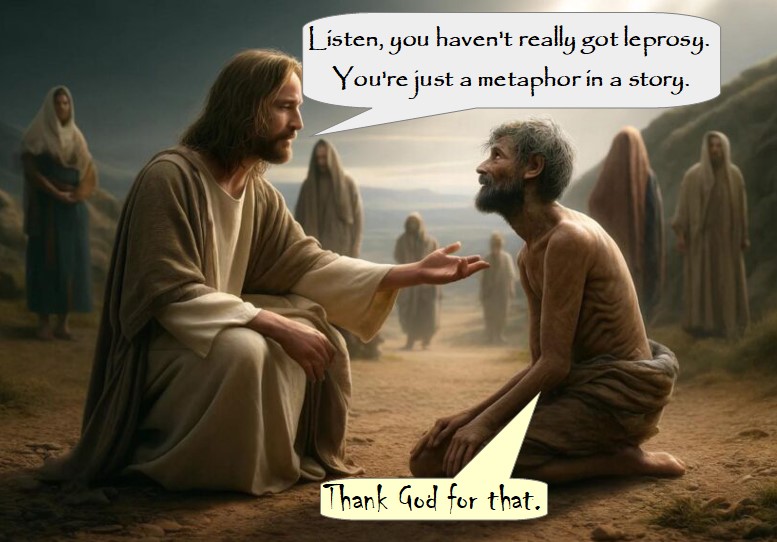
Jesus and the Leper

I thought we might share a couple of Bible studies these next couple of weeks. Some of you will remember these from your Christian days, when you’d gather with other eager believers so that a self-appointed expert could tell you what a particular story in the Bible really meant. I’m no expert, just someone who subjected myself to such indoctrination while all the time wondering if what I was being told was really what the passage was about. Doubts, however, were ‘of the devil’ so any such critical thinking needed to be suppressed. Since my eyes were opened to the allegorical nature of much of what is in the Bible and in the gospels in particular, I now see these same passages in a completely different light. I hope you’ll allow me to share my insights with you.

First off, it’s Mark 1:40-45, in which Jesus (seemingly) heals a leper:

 A man with leprosy came to him and begged him on his knees, “If you are willing, you can make me clean.” Jesus was indignant. He reached out his hand and touched the man. “I am willing,” he said. “Be clean!” 

Immediately the leprosy left him and he was cleansed. Jesus sent him away at once with a strong warning: “See that you don’t tell this to anyone. But go, show yourself to the priest and offer the sacrifices that Moses commanded for your cleansing, as a testimony to them.” 

Instead he went out and began to talk freely, spreading the news. As a result, Jesus could no longer enter a town openly but stayed outside in lonely places. Yet the people still came to him from everywhere.

The giveaway phrase here is ‘make me clean’. The man does not ask Jesus to heal him which, suffering from a debilitating disease as he was, would have been the most obvious, most pressing request to make. Instead, he asks to be ‘cleansed’ with all its ritual connotations, the word used here, καθαρίζω (katharizo), also meaning ‘purify’. According to Leviticus 4: 11-12, leprosy was a condition that was spiritually unclean. Only by making the prescribed offerings – the usual doves, lambs and ‘crimson stuff’ – could a leper who was already healed become ritually pure.

Who, according to the New Testament, replaces all the sacrificial offerings of the old covenant? Why, it’s Jesus himself of course (1 Corinthians 11:25, Ephesians 5:25-26 etc). Jesus cleanses and purifies the leper in the story, just as he is able to cleanse and purify sinners. This is what the early cult believed: ‘Ask Jesus, the heavenly Christ, to cleanse you of your sins and, just like he does for the leper in this parable, he’ll do it for you. As a penitent believer, you are the leper. Not only are you cleansed of your sin, you are purified.’

This also explains why Jesus is ‘indignant’ when the leper first approaches him. On the surface it makes little sense for him to be indignant with the man, which is why some translations change this verse to say Jesus ‘felt compassion for him.’ Jesus’ metaphorical annoyance is for those who have allowed the man’s spiritual condition to have deteriorated to a state comparable with leprosy. The Jewish priestly system, symbolised anachronistically in Mark as the Scribes and Pharisees, the later arch-enemies of the new cult.

Jesus commands the leper to visit the Jewish priest to demonstrate that he, Jesus, is the new cleanser of sins, replacing the priesthood itself. Instead, the leper goes against Jesus’ and the early cult’s wishes. My God, how could the cult remain secret and exclusive if newly cleansed converts behaved like this!

So there you have it. The leper is a metaphor for the sinner in need of the heavenly Jesus’ cleansing. His leprosy is a metaphor for the sin itself. The healing is a metaphor for the penitent’s spiritual purification. The man’s by-passing of the Jewish law is a metaphor for Jesus replacing the law. The cleansed leper’s shouting about it is a metaphor for the early cult’s desire to keep its rituals and teaching secret. Its parables like this one were designed to enlighten cult members while obfuscating and confusing the unbeliever (Mark 4:11-12).

As a literary creation, an allegory replete with metaphor, this event need never have happened in reality. Given its literary nature, it’s highly unlikely it did.

Whatever Happened To Pontius Pilate?

While indisputably a real person, we know only a little about Pontius Pilate, primarily from Philo, writing circa 41CE, and also Josephus (writing 75-79CE). Pilate was appointed as prefect, or governor, of Judea in 26CE and after ten years of insensitive and brutal control was, according to Philo, recalled to Rome in 36 ‘to stand trial for cruelty and oppression, particularly on the charge that he had executed men without proper trial.’ (On the Embassy to Gaius)

Described by Philo as having ‘an inflexible, stubborn and cruel disposition’, Pilate was not the kind of man who would entertain in his private residence those marked out for crucifixion, nor one who would feel remorse at the execution of thieves, insurrectionists and general trouble makers. It is likely he had hundreds if not thousands of them crucified during his time as prefect.

Would a man known for ‘his venality, his violence, his thievery, his assaults, his abusive behaviour, his frequent executions of untried prisoners and his endless savage ferocity’ (Philo), have a prisoner over for a chat about the nuances of the meaning of Truth? Almost certainly not.

Would he have suffered mental anguish because he might be about to execute an innocent man? Absolutely not.

Would he have symbolically washed his hands to ease his conscience? He would not.

Would he have offered a rabble the chance to free Jesus or the bandit Barabbas? Again, absolutely not. There was no such ‘tradition’ and the episode is clearly symbolic.

If Jesus was crucified ‘under Pontius Pilate’, the Prefect himself would, in all probability, not have been aware of it. Jesus would have been one more seditionist among many. Nor would Pilate have granted a member of the Sanhedrin, unrelated to the crucified criminal, the right to remove his corpse from a cross to give it a decent burial in compliance with Jewish ritual. Pilate was known for his insensitivity to such niceties.

Jesus’ encounters with Pilate in the gospels are so entirely implausible they can only be fictional. The two would never have met. Even if they had, none of the gospel writers would have known the details of their exchanges, different in each gospel. In all of them, the cruel and savage Pilate behaves entirely out of character.

While no records survive of any trials conducted by any prefect of the area (because there were none in the first place?) it is perhaps surprising that details of Jesus’s trial were not preserved, when only a few days later, reports that he had returned from the dead began to circulate. Yet, say apologists, this is one of the few indisputable, ‘minimal’ facts we know about the historical Jesus: ‘he was crucified under Pontius Pilate.’ It’s there in both the Nicene creed (325CE) and the so-called Apostles’ creed (circa 341). Yet Paul, writing close to the time of Pilate’s supposed involvement, doesn’t mention him, ever. When he’s not blaming ‘the Jews’ for Jesus’ death (forgetting he is a Jew himself) Paul is insisting demonic powers are responsible:

Yet among the mature we do speak wisdom, though it is not a wisdom of this age or of the rulers of this age (‘Archons of this Aeon’), who are being destroyed. But we speak God’s wisdom, a hidden mystery, which God decreed before the ages for our glory and which none of the rulers of this age understood, for if they had, they would not have crucified the Lord of glory. (1 Corinthians 2:6-8)

While Paul doesn’t refer to either Pilate or the Romans in his teaching about the crucifixion, he does refer to the latter in his letter to believers in Rome itself. in Romans 13 he tells them they must obey Roman authority because God himself has put it in place. What an incongruous, unreasonable directive if the Romans had indeed been responsible for the execution of the Messiah.

The only other mention of Pilate outside the gospels is in 1 Timothy, which was not written by Paul but forged long after Mark had written the Prefect into his gospel as the embodiment of Paul’s demonic powers. (Mark’s gospel is in fact awash with demons, not to mention Satan himself. It’s essentially an allegory of their defeat at the hands of the Messiah.) 1 Timothy 6:13 merely repeats a tradition developed from Mark’s gospel that Jesus made ‘a good confession’ in front of Pilate. 

The ‘fact’ that Pilate had Jesus executed is therefore poorly attested. Mark is the first to mention it, circa 70CE, and we know Matthew and Luke lifted their timelines and much of their detail from Mark. A growing number of scholars think John also relied on Mark for the general outline of his gospel. It is likely therefore there is only one source for Pilate’s involvement in Jesus’ death: Mark.

Outside the Bible, there is no evidence that Pilate was responsible. Josephus’s Testimonium Flavianum is widely accepted as an interpolation (i.e. later Christian tampering) and Tacitus’ mention of Pilate is far too late (c. 116CE) to be an independent source.* There is therefore no contemporaneous, independent, reliable evidence that Jesus was crucified under Pontius Pilate. That myth came later and then only from Mark.

Legend has it that Pilate either killed himself in 37CE on the orders of Caligula or retired and faded into obscurity. Whichever it was, would he, in his last days, have regretted his excessive cruelty? Would he have suffered remorse for executing an innocent man? Would he even have remembered? It all seems so unlikely.

*See chapter 3 of Michael Alter’s The Resurrection and Its Apologetics, 2024)

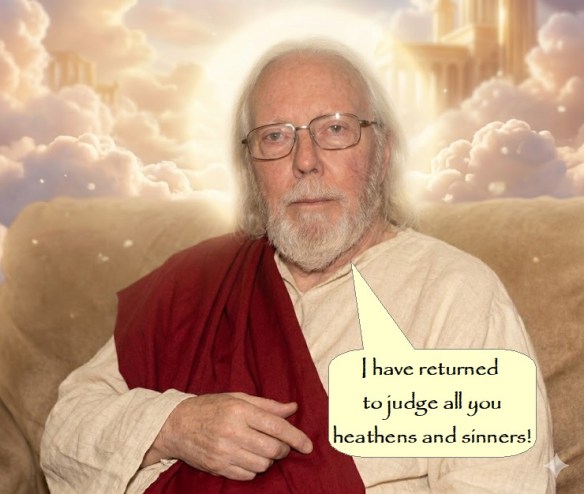
Homelander created by Garth Ennis and Darick Robertson. Image of Antony Starr from Amazon Prime’s The Boys.

If not Metaphor, then what?

I’ve been arguing that everything in Mark’s gospel is metaphor (because he says so) but there are some pronouncements credited to Jesus in the synoptic that do seem to read as if they’re not. These look as if they are meant to be taken at face value: 

Mark 9:1 And he said to them, “Truly, I say to you, there are some standing here who will not taste death until they see the kingdom of God after it has come with power.”

Mark 10:21. Go, sell everything you have and give to the poor, and you will have treasure in heaven. Then come, follow me.

Matthew 5:39. But I tell you, do not resist an evil person. If anyone slaps you on the right cheek, turn to them the other cheek also.

Matthew 5:40. And if anyone wants to sue you and take your shirt, hand over your coat as well.

Matthew 5: 43-44. You have heard that it was said, ‘Love your neighbour and hate your enemy.’ But I tell you, love your enemies and pray for those who persecute you,

Matthew 6:24. No one can serve two masters. Either you will hate the one and love the other, or you will be devoted to the one and despise the other. You cannot serve both God and money.

Matthew 6.25. Therefore I tell you, do not worry about your life, what you will eat or drink; or about your body, what you will wear. Is not life more than food, and the body more than clothes?

Matthew 7:6. Do not judge, or you too will be judged. For in the same way you judge others, you will be judged, and with the measure you use, it will be measured to you.

Luke 6:30. Give to everyone who asks you, and if anyone takes what belongs to you, do not demand it back.

Luke 14:26 If anyone comes to me and does not hate father and mother, wife and children, brothers and sisters – yes, even their own life – such a person cannot be my disciple.

Perversely, these are the very commands that most Christians insist are intended metaphorically. This includes those who oppose the idea that, Jesus’ parables excepted, the gospels are in any way symbolic. I know from experience that they have any number of unconvincing arguments of why Jesus doesn’t really mean what he is made to say. For example: ‘these pronouncements are too severe and impractical to be taken literally’; ‘the verses are being taken out of context’, and ‘they have a deeper spiritual meaning’ (oops – that’d be metaphor, wouldn’t it?). Ask these same folk if the statements are therefore metaphorical and you can expect to be met with barrage of abuse.

If they’re not metaphorical, why do we not find Christians striving to live according to them: renouncing wealth, giving to all who ask, selling all they have, resisting no-one, judging no-one, hating family, becoming a slave and having no care for their own welfare for the sake of the kingdom that Jesus promised was imminent.

Because they don’t believe him. Easier to disregard his words about the kingdom arriving within his disciples’ lifetime and the instructions for living in the short time until then. The hard stuff is treated as metaphorical when it makes demands on Christians themselves.

Possibly they’re right. I’d suggest that the pronouncements like those above were not Jesus’s at all. They’re cult-speak; the extreme demands of cult leaders seeking to control their acolytes. In case this sounds like an about face on my part, let me assure you it isn’t; I’ve long argued that among the metaphor and the reworking of Jewish scripture, the gospels include copious amounts of early cult rules.

Whether they’re metaphor or extreme demands once imposed on cult members, no-one today takes much notice of Jesus’ commands. What does this tell us about their worth? What does it tell us about Christians from the earliest days until now? What does it say about their willingness to crucify themselves (definitely a metaphor) in order to follow him?