Have Faith

reason

So there we were in court. First time I’d been on a jury. Pretty serious case too. If it went against the defendant, he’d be facing the death penalty. So I suppose it was pretty serious for him too.

First up was the arresting officer. ‘Oh, yes,’ he said. ‘I have every faith this guy’s the culprit.’

‘How much faith?’ said the judge. ‘Is it real, deep-down, sincere faith?’

‘Oh, yes,’ said the cop. ‘Really unshakeable, supernatural faith. That’s him okay. We’re not looking for anyone else. Genuine conviction, you see.’

‘Yes, I do see,’ the judge said. ‘And very commendable it is too.’

‘But…’ spluttered the guy in the dock.

‘Wait your turn,’ the judge snapped. ‘We gotta hear the expert testimony before we get to you.’

The expert took the stand. ‘I believe it was this guy,’ he said, pointing to the man in the dock. ‘Yes sir, I’m sure it was. I have a really good feeling about it. This is him, definitely.’

‘You really, really truly believe?’ the judge asked and the expert nodded. ‘Well, that’s good enough for me,’ the judge said. ‘So… anybody got anything to add before I pass sentence?’

‘Er, yeah,’ said he guy in the dock. ‘What about the evidence?’

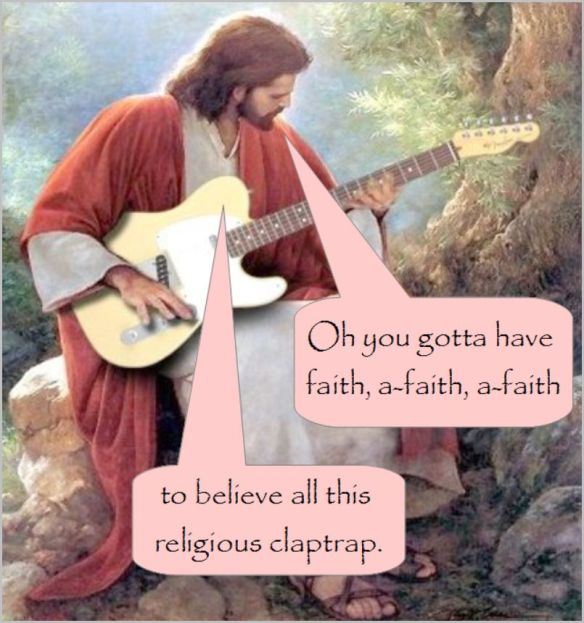
‘The evidence?’ said the judge. ‘Who needs evidence when we’ve got all this belief, faith and deeply held conviction?’

‘Well,’ the guy said, ‘far be it from me to say so, but isn’t the evidence important?’

‘Important?’ snorted the judge, resulting in guffaws all around the courtroom, including from my fellow jurors.

‘Yes,’ said the accused. ‘Important evidence like my watertight alibi. Like the DNA and finger prints that weren’t mine. Like the CCTV footage. Like… that other guy’s confession.’

‘Oh, come on,’ said his defence lawyer jumping up. ‘We’ve been over this. It means nothing. What’s really important is what people believe. Faith, like the officer here said.’

‘Well,’ said the guy in the dock, ‘I have my doubts about that.’

‘Oh, but doubt is of the devil,’ said his lawyer, ‘It’s faith that matters – faith and right belief.’

‘That hardly seems reasonable to me,’ said the man. ‘After all, it’s my life that’s on the line here.’

‘Now you’re just being absurd,’ said the judge. ‘What has reason got to do with anything?’

‘But I thought…’ began the accused, looking more perplexed than ever.

‘We’re none of us here to think,’ said the judge, ‘least of all you. How many more times must we tell you? Faith is all that matters.’

‘Well,’ said the defendant doubtfully, ‘if you say so…’

‘Great!’ said the judge, jumping in quickly. ‘I’m glad you’ve finally seen the light.’ Then he turned to us, the jury, and said: ‘I’m going to direct you to find the defendant guilty. The belief and faith of those here today is all we need to convict him.’

So we did, and the judge passed the death sentence. The condemned guy didn’t seem too pleased and as they led him away, started yammering all over again about evidence. I guess some people never learn. But I mean, faith, belief, conviction – call ’em what you will – they trump evidence any day.
Angels & Demons

angel

Last time, Benjamin Corey was feeling rather pleased with himself that he’s able to take a more considered, adult approach to the Bible. He doesn’t interpret it like those dim-witted fundamentalists. Instead, he consults ‘scholars’ to tell him what the Bible’s really about. And in case we’re in doubt, that is never (ever) anything to do with myths or fairy tales.

Which makes me wonder: what do mature, clever Christians like Benjamin make of the Bible’s supernatural fantasies and its cast of invisible beings?

Do they, for example, dismiss the demons that are all over the New Testament? Jesus, you see, believed in demons; he thought some illnesses were caused by them and had a repertoire of incantations for exorcising them from their victims. There are cranks today who believe the same sort of thing, but that’s a bit too much of a fundie approach for the kind of serious-minded Christian I’m talking about here. They probably don’t care that the Bible says in Ephesians 6.12 (written by fake-Paul) that demons are all around us, engaged in invisible spiritual warfare in equally invisible heavenly realms.

I can’t help but think that if only a demon would make itself visible and show us what it looks like, we would know that fake-Paul and Jesus were right and not just religious fanatics inculcated with the unscientific notions of their primitive cultures. But no, no demons have ever shown themselves in person (as opposed to ‘in a person’) except, of course, in third-rate horror films.

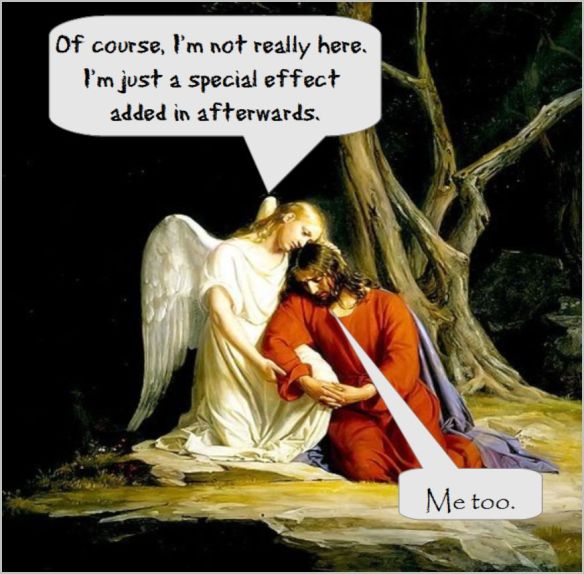
So how about angels? Maybe we could see an angel – an undeniable, indisputable, bona fide angel. According to the Bible, they were often seen back when people didn’t know any better. Mary, shepherds watching their flocks, the disciples, Mary Magdalene, Paul and even Jesus himself encountered angels in the flesh. So why don’t we see them now? Why don’t they make themselves known, outside of people’s imaginations? According to fundies they do, but alas, there’s no evidence this is true, which is convenient to say the least.

Still, I’m sure you can be a Christian without believing in angels and demons, even if the Bible is sure they’re real. You don’t have to believe everything it says (right, Dr Corey?)

So what about the rest of the Bible’s fantasies, its invisible creatures and make-believe places? Next time we’ll take a look at the evidence for them and ask, are they really just the low-fi special effects of a book well past its sell-by date?

Things a Christian Wishes (Some) Atheists Would Stop Doing (And Saying)

corey

On his blog recently, Doctor Benjamin Corey offered up a post called ‘S%#t I Wish (Some) Atheists Would Stop Doing (And Saying)’. I discovered it via the Friendly Atheist blog and naturally felt compelled to respond to Doctor Corey’s four bits of S%#t. The comment I posted on The Official Blog of Benjamin L. Corey is as follows:

S%#t 1: Please stop saying or insinuating that we’re a bunch of uneducated or unenlightened idiots.

Do atheists say or insinuate this? I’m not sure they do. I would suggest atheists find it difficult to understand why people of evident intelligence choose to believe propositions for which little or no evidence exists, that are rooted in myth and which, in reality, fail to deliver on their promise. It’s not that believers are necessarily unintelligent or idiots – clearly many are not – it’s that they are prepared to disengage their intelligence, critical faculties and rationality in order to believe all manner of spurious nonsense.

S%#t 2: Please stop insisting that we read our Bible like right-wing fundamentalists.

I’m surprised you offer this as something you wish atheists would stop ‘insisting’. First of course, atheists don’t insist that anyone read the Bible the same way as anyone else. We would prefer it if no-one read it at all. It is well past its sell-by date and has nothing to offer people living nearly two thousand years after its creation; it is after all a testimony to the failure of the beliefs that spawned it (the Son of Man ascending to the Earth to establish the Kingdom of God here).

Second, implicit in this demand is that there is an intelligent way to read the Bible and there’s the ‘ring-wing fundamentalist’ way. In fact, you don’t even insinuate that certain Christians are ‘ignorant’ and ‘unenlightened’ because of how they read the Bible, you say so explicitly when you talk, ungrammatically, about the ‘unenlightened, ignorant nonsense that fundamentalists do with the Bible.’

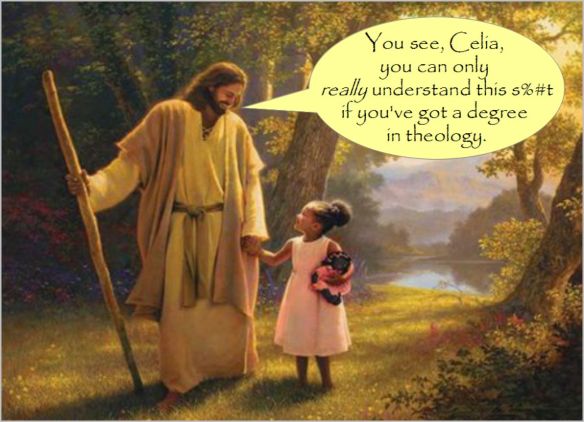
But at least fundamentalists regard the Bible as the Word of God (agreed they cherry-pick it and don’t behave according to it precepts) and claim it is ineffable and infallible. Perhaps, as you suggest, more enlightened Christians are free to interpret it in more liberal ways, dismissing that which is context-bound and so on. But then, where does that leave it? Is it authoritative or not? Does it speak directly to people or can it only ‘really’ be understood through the exegesis of scholars? If the latter, as you imply, then can it only be read and understood by those with above average intelligence? How does this square with Jesus’ insistence that his Kingdom was for those with child-like trust?

S%#t 3: Please stop referring to our belief system(s) as fairy tales.

Difficult this one. It depends whether myth and fairy tale are synonymous. Having taught English literature for many years at a university in the UK, I would argue they’re not. To the layman, however, they probably are in that both involve fantasy beings, implausible events, symbolic characters, sacrifice and enlightenment – just like religion really. So no, there is definitely a case here, Dr Corey, that if the cap fits… if your ‘belief-system’ walks, talks and smells like a myth (or fairy tale) then it probably is. You are stuck with atheists pointing this out to you, I’m afraid.

(By the way, your examples of Mickey Mouse and the Old Woman in the Shoe are not fairy tales. One is a commercial enterprise involving anthropomorphised animals and the other a nursery rhyme. I suggest you consult scholars who can explain to you what a fairy tale is, and the differences and similarities between it and myth.)

S%#t 4: Maybe lay off the whole, “religion hasn’t done any good for humanity” type of argument, because it’s obnoxiously untrue.

Reference for this quotation or did you just make it up? Sam Harris perhaps comes closest to saying this sort of thing – comes close but doesn’t actually say it. He says on balance that the good religion has done is outweighed by the evil perpetrated in its name. He doesn’t, though, say no good has come from religion. Sorry, Benjamin, but this is a straw man ‘argument’ you’re presenting here and is itself ‘obnoxiously untrue’.

Would we be better of without religion? Without the myth, the deadening of critical faculties and the adversarial nature of ideologies (even within Christianity)? Of course we would. Without precepts like ‘love your neighbor, love your enemies’? No, but then these are not exclusively religious. Far too many believers disregard them anyway.


To Hell and back

jesusguitar2

The self-righteous have taken it upon themselves this week to indulge in a little rejoicing, and not a little bit more gloating, at the death of George Michael. They are particularly pleased that, in all likelihood, he has gone to Hell, what with him being gay and all. Because of his sexuality – and this is how their damaged minds work – some of these Christians have also decreed George must also have been a ‘paedophile’, a victim of AIDs and possessed by evil spirits. Incredibly, he still managed to fit in a singing career. He was, these true-believers say, an enemy of God and is now frying in Hell forever. Yippee!

Here’s how the Christ-like Steven Anderson puts it:

First of all, George Michael’s burning in Hell right now. He was a very wicked, God-hating sodomite reprobate, and he’s getting the punishment that he deserves right now… If you just look at the lyrics to one of his most famous songs, one of his biggest hits, you can just totally tell this is written by a paedophile… It’s clearly written by a sick pervert because that’s what these homosexuals are. They’re a bunch of paedophiles… Quit mourning the death of this filthy pervert. He’s rotting in Hell right now for being a God-hating homosexual reprobate.

George Michael was none of the things these Christians claim he was. His post-mortem was inconclusive, but even if he had died of an AIDs related illness it would not be a cause for celebration. He was not a paedophile nor demon-possessed, but Christians, having happily embraced today’s post-truth world, think it’s absolutely fine for them to say he was.

They see evil spirits and demons everywhere, particularly in people who don’t share their primitive views; homosexuality is caused by their malevolent presence, and so, apparently, are depression, eating disorders, insomnia, self-harming and sex before marriage. Little wonder, of course, when that first-century ignoramus they claim to follow regarded Satan’s little helpers as the source of sickness and disease (when it wasn’t sin itself that was doing it). It hardly matters there’s absolutely no evidence that such beings exist; Christians are more than happy to take on the demonisation of others themselves.

As for Hell itself, it isn’t real either, as I discuss here. George Michael isn’t there, nor is anyone else who’s died. But let’s humour all those fanatics gentle souls who have persuaded themselves that it does. What does the Bible say about it?

First, it doesn’t claim that individuals go to Hell after death. Rather, it sees Hell as a pit into which Satan and his minions will be thrown at the end of time (Revelation 20.10). No mention humans will go there with them. Instead, the whack-job who wrote Revelation suggests (20.7-9) that the unrighteous dead, once resurrected, will be consumed by the fire God is going to destroy the Earth with at the end of time. You might wonder why God would bother resurrecting bodies only to murder them again, but he’s God, and you know, mysterious ways and all that. Still, he doesn’t seem to have perpetual torment in mind, even so.

Second, Paul tells us that after they’ve died, the dead sleep until the final judgement (1 Thessalonians 4.15-17). So even if they are eventually to be consigned to Hell it certainly won’t be immediately after death. As the final judgement has yet to occur – and won’t ever – dead souls, including George’s, still slumber. (It’s possible of course that for the dead time ceases to exist and the period between death and judgement appears, from their perspective, instantaneous. But this is not what the Bible teaches. It’s not nearly as imaginative as that.)

Third, Jesus is made to imply (it’s all very vague) that those with whom he is displeased will, after death, simply be discarded – thrown on some sort of metaphorical rubbish tip (Matthew 23.33). In fact, he tells only one parable about the after-life (Luke 16.19-31) in which a resurrected rich man finds himself excluded from God’s presence Abraham’s bosom. Not, you’ll note, because he failed to accept Jesus as his personal saviour but because of his disregard for the poor. So, given his philanthropy, it doesn’t look as if George Michael will be spending his eternity in the Hell that Jesus imagined either.

All of those who threaten us with Hell, and who think George Michael is already there, don’t know, and probably don’t care, what God’s Word™ has to say about the place where they’d be happy to see the rest of us suffer everlasting torment. It hardly matters when it doesn’t exist, being a fantasy of primitive zealots, but it does make you wish those who delude themselves into thinking it does would shut the hell up about it. Yes, you Franklin, Stephen, Bob, Kim and Keith. You’re only showing yourselves up for the ignorant hypocrites you are.


God sends New Savior!

jesuscity

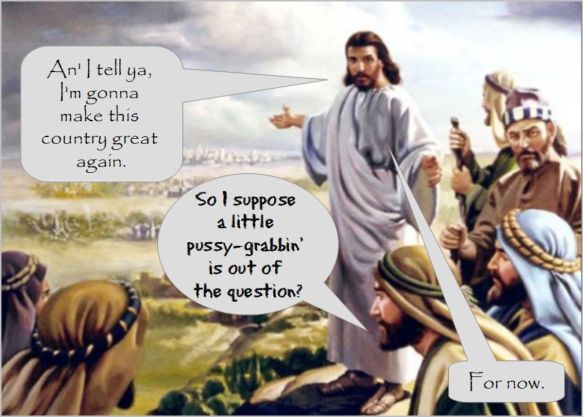
Well, Stateside Christians, you got your man. Donald Trump will be president come January and you’re largely responsible for that. 81% of you voted for him. By my reckoning that’s about 50% of his total vote; he couldn’t have done it without you. Now he’s going to be your nation’s savior. He’s going to make America great again. He’ll return the nation to Christian values and morals. He’ll honour God and bring him back into the public arena, just like you want him to.

Or will he? How do you get God-fearing Savior from a petulant, misogynistic individual who has repeatedly shown himself to be racist, sexist, xenophobic, divisive, adulterous, abusive, ignorant, vitriolic, dishonest and avaricious; a man who denies climate change, is full of his importance (and nothing else), who makes promises he can’t keep and probably had no intention of keeping even as he made them. A man who couldn’t name a single verse in his ‘favourite book’, the Bible; who admits he’s never asked God for forgiveness and who has shown no sign of any kind of Christian humility, compassion or morality; a man who is even now appointing the most reactionary, right-wing extremists to his transitional team (so much for draining the swamp!) How can this man be the one who is going to restore America to a glorious Christian past it never really had, and make it a truly God-fearing nation once again?

Someone with these ‘qualities’ cannot possibly turn America into the promised land, even though you’ve convinced yourselves he’s another King Cyrus, the heathen king in the Old Testament who helped God’s people in their time of need. Trump is no Cyrus, even if he is the 45th president and Cyrus’s story is told in Isaiah 45 (yes, some of you think this is significant). You have been duped, again, American believers. But it is not Trump who has deluded you; it is you yourselves. You have persuaded yourselves that despite all of the evidence, Trump is man who can be greatly used by God.

There was no divine guidance behind Trump’s campaign and God won’t be manipulating him into doing his bidding once he takes office. This is because, primarily, there is no God to do any these things, but even if there were, why would he? Why would he ensure a man whose values are the direct antithesis of all (you say) he stands for, became the leader of the free world? Why would he be interested in making a silk purse out of the sow’s ear that is Donald Trump? Wouldn’t your God of Reason start with someone who is already one of his own? Someone who is genuinely a Christian; someone, say, who has tacky pictures of himself and Jesus hanging in his house? Or an evangelical – let’s call him Mike Pence – who comes pre-packaged with genuine, and genuinely vicious, Christian faith and a necessary anti-abortion, anti-gay agenda?

It’s you and you alone, Christians, who have turned Trump into a Savior. It is you who have created the silk purse. You’ve ignored what has been in front of you throughout the presidential campaign and have projected on to an individual who has done nothing but tell you what you wanted to hear, a spiritual significance he does not have. You have made of Trump an artificial Man of God, just like your predecessors did two thousand years ago with that other imposter, Yeshua Bar Joseph. Like them, you’re going to find out that the man you’ve elevated to savior status is anything but, because the Donald Trump you’ve elected is a construct of your collective imaginations. You’re about to discover that the real Donald Trump is not the man you’ve deluded yourselves into thinking he is.

I Know What It’s Like To Be Dead

lazarus

And you do too.

We experienced what it was like last night and, you know, it really wasn’t too bad.

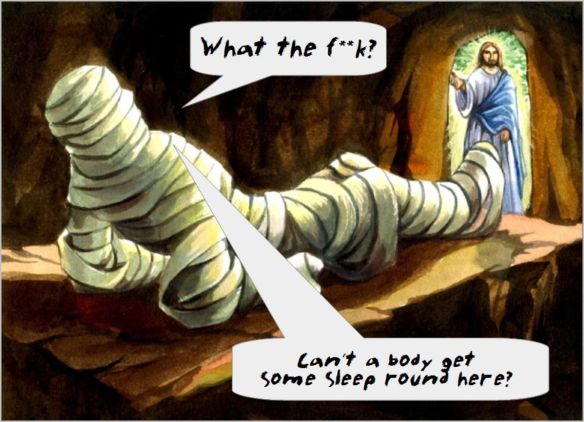
We entered, at some point, a deep, dreamless sleep (we dream for only a quarter of the time we’re asleep and even then often can’t remember what we’ve dreamt about) and the rest of the time we were, as far as subjective experience was concerned, dead to the world. During that deep sleep, our conscious mind was completely switched off; we did not experience anything while we were in this state and as far as awareness is concerned, we did not exist. And when we woke this morning we were none the worse for our period of non-existence. We booted up reasonably satisfactorily and the memories we had yesterday, before our deep sleep, were restored and the entity we call our self began to interact with the day.

This period of deep sleep, this unconscious oblivion, is precisely what it is like to be dead. Of course, in death we switch off permanently; there’s with no reboot afterwards, either in our beds, our graves or in heaven. The oblivion that is death is permanent. But, and this is my point, being dead is no more painful or unendurable, and no more to be feared, than the deep sleep you had last night and that you will enjoy tonight. We might not much like the idea that once we fall into the ultimate sleep there will be no waking up, but that is only a concern, if it’s a concern at all, of the living. I guarantee that it does not cross the minds of those who are already dead. They have no minds, the same as you didn’t last night, for it to cross.

Being dead, to paraphrase Mark Twain, does not trouble us at all. Its prospect, while we remain on this side of it, should encourage us to enjoy life and live it to the full. It shouldn’t cause us to worry about being dead, because there’s nothing we can do about it and, in any case, it’s no worse than being in deep sleep. Nor should we be concerned about whether we’ve subscribed to the right incantation, appeased the right God in the right way or lived a good enough life, in order to avoid death. There’s no avoiding death and the promises of religions that we can if only we believe the right magic, are utterly false. Understandable perhaps, but false.

Oh death, where is thy sting, says Paul in 1 Corinthians 15.55. Well, death still has its sting. It has it in its inevitability – every organic creature, of which we are one, must die – and it has it, depending on your perspective, in our individual obliteration. (Though, frankly, why anyone should think their own personal bundle of thoughts, impulses and prejudices merits everlasting existence is a mystery). Most significantly, however, it has it in the dying process, which for many of us can be debilitating and painful. This is the way of it for all of us, including those who believe religions’ false promises. They are not spared the suffering, even though modern medicine can help alleviate much of it. Christians, Muslims and Hindus, despite their belief that a deity smiles benevolently upon them, are not guaranteed a comfortable passage from this life to non-existence.

Death is the great leveller; we all experience dying in much the same way and we none of us experience anything after it. One of these – maybe both if we’re lucky – isn’t too bad. Just like deep sleep in fact.

Until then, we should make the most of life while we still have it.

Sleep well.


Rejecting Jesus the Christian way

jesus2

I’m sometimes taken to task for pointing out that Christians don’t make much effort to live as their saviour says they should. The title of my first book, Why Christians Don’t Do What Jesus Tells Them To …And What They Believe Instead sums it up. Since the very beginning, believers have replaced the radical commands attributed to Jesus with mythology, mysticism and magic formulae, none of which he’d recognise and all of which are far less demanding than going the extra mile, turning the other cheek and loving enemies. So today, when confronted with what Jesus says is expected of his followers, believers are inclined to say, ‘what right have you to tell us how we should be living?’ to which the answer is, ‘it’s not I, nor any other commentator, who tells you how to live; it is your Lord and Saviour. All we do – all I do – is remind you of what that is.’

Christians don’t like this, primarily because they don’t like what Jesus commands – it’s too exacting, too radical, too impractical – and they want to go on disregarding it. It’s damned annoying being reminded of it and being challenged on how far they are from complying with it.

Have those of us who point out Christians’ failings any right to do so? Well, of course. Christians spend their time judging, castigating and condemning others and as Jesus himself points out, judging others leads to being judged in return (Matthew 7.1-5). He sees this as something of a natural consequence, a yin for a yang. But ‘judge not that ye be not judged’ is another of his commands his followers like to ignore. Even so, if Christians are going to insist on pointing out the speck in others’ eyes, they must expect others will have something to say about the plank in theirs. That’s the way it works – Jesus says so.

So, Christians, if you don’t like me and others challenging you on how far you fall short of your Lord’s expectations maybe you need to lay off atheists, LGBT people, those you consider to be sinners, those of other faiths and even fellow Christians you think haven’t got the right theology. Put your own house in order first and then maybe we’ll listen to you (or maybe not). But don’t say we’ve no right to look at how far you measure up to Jesus’ standards. We’ve every right to ask whether the so-called Salt of the Earth (Matthew 5.13) has any of its flavour left.


Call yourself a Christian?

jc-prays

So you think you might be a Christian? Try this handy-dandy checklist to see if you’re a true follower of Jesus or just someone who’s paying lip-service. You’ll need to score big if you’re ever going to get into his exclusive club!

1) Have you relinquished all worldly goods as Jesus tells you to in Matt 19.21 & Luke 12.33?

If not, better get to it. It’s pretty important to him – he mentions it at least a dozen times in the gospels.

2) Have you forsaken your loved ones, taken to hating them even, the better to serve him and his Kingdom?

No? Than what are you thinking of? Not Luke 14. 26 & 33 that’s for sure.

3) Do you constantly go the extra mile, turn the other cheek, give to all who ask, love your enemies and forgive others repeatedly (Matthew 7.12; Luke 6.27 & 29; Matthew 6.14; Matthew 5.38 etc)? In short, are you perfect as he says you should be?

Some work to do here then, to come up to the expected standard?

4) Do you sacrificially serve others – the sick, the imprisoned, the homeless, the hungry, the naked (Matthew 25.34-46)?

Better get round to it as the only way to avoid Jesus’ blacklist.

5) Do you work tirelessly and exclusively to bring about God’s Kingdom on Earth (albeit in the first century) like Jesus commands in Matthew 6.33?

Why not? Get with the programme!

6) Have you stayed single, never marrying, and certainly never getting divorced?

You haven’t? Shame on you, because you can’t into the Kingdom with a spouse and definitely not with one you’ve discarded along the way (Luke 20.34-35).

7) Have you given up judging others?

If not, you can expect to be on the receiving end of a hell of a lot of judgement in return (Matthew 7.1-2).

8) When you throw a party do you invite the poor, the crippled, the lame and the blind instead of your friends (Luke 14.12-14)?

I think we know the answer to this one.

9) Are you tireless in denigrating, campaigning against and ranting about same-sex relationships and marriage?

Well, good for you though this has nothing to do with being a follower of Jesus (see 7 above).

10) Do you believe in a magical incantation that is going to preserve the essential ‘you’ in Heaven forever?

Jesus didn’t.

So how did you do? Are you someone Jesus would say, ‘Well done you good and faithful servant’ to (Matthew 25.21), or would he insist he never knew you (Matthew 7.23)? –

0-2: Pathetic, especially if the two in question are 9 & 10.

3-7: You’re neither hot nor cold. Expect to be spewed out of his mouth (Revelation 3.16).

8-10: You’re getting there, but then, you didn’t really answer truthfully, did you? Your yes didn’t mean yes (Matthew 5.37).

Never mind, you can always get back to singing songs, waving your arms about and condemning others because they have a speck in their eye (Luke 6.42). Everybody knows that’s what being a Christian is really all about.

The stuff Christians say… God Gave Us Free-will

freewill

Did he really? He doesn’t mention it in his ineffable, infallible, inerrant Word and you’d think he would when it’s so important. It’s a favourite cliché of Christians whenever they’re challenged about why God has let the world get in such a mess, why he allows children to die, why there are hurricanes and earthquakes, that kind of thing. These are all, they like to tell us, the result of humans using the ‘free-will’ God gave them to make the wrong choices – which are anything that’s not God himself. When that happens, he deserts us, abandoning any idea of a duty of care. But that’s not his fault – oh, no – it’s ours for using the free-will he gave us… freely.

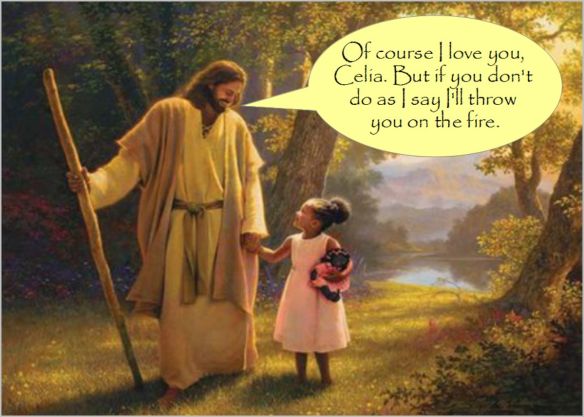
So even though we have free-will, we’re in big trouble if we use it any other than the way God thinks we should. Of all the options available to us, only one is any good; there are so many penalties for choosing anything other than him. It’s as if he says to us, ‘obey me or I’ll abandon you, make everything shit and ultimately torture you’. And you’d be right to ask how this is in any way ‘free’ will. Imagine a human father saying, ‘Now, kids, choose to do as I say or else I’ll throw you on the fire.’ Would children presented with a choice of this kind really be ‘free’ to make their decision?

Still, apparently we are, and wouldn’t you know it, we choose the wrong things. This might have something to do with there being far more ‘wrong’ things than ‘right’ ones, but that’s how God has set things up and who are we to point out the inconsistency of his mysterious way?

More than this, God has handicapped us by making us ‘slaves of sin’ and ‘servants to corruption’ (John 8.34 & 2 Peter 2.19) which naturally disposes us to use our free-will in such a way that almost always leads to the wrong decisions. How about that? Not only does he say ‘obey me or I’ll abandon you, make everything shit and ultimately torture you’, God has given us up to our base desires and so impaired our ability to make the ‘right’ choices.

Ultimately, the idea of ‘free-will’ is a Gordian knot created by Christians, who, finding themselves unable to explain why a loving God would allow everything to be far from perfect, added it to their already shaky theology. But free-will isn’t scriptural; as we’ve seen, the Bible teaches that God does the choosing not us. Nor does it stand up to  scrutiny in the real world. Science tells us that free-will doesn’t exist, it’s an illusion. Our subconscious mind makes our decisions before informing our conscious mind of what these are. This means our decision-making is neither free – our subconscious mind is shaped and constrained by environment, genes and upbringing – nor the product of our conscious mind, our ‘will’.

Still, this is of little interest to Christians who cling tenaciously and blindly to the notion of ‘free-will’. They’ve made the right decision by opting for God and in so doing have surrendered the free-will they otherwise insist is crucial in explaining the state of the world. They’re not going to need it in heaven, I don’t suppose, sitting around praising God all day long. Given though that they’ve made the right decision, why is it the world continues to be such a muddle? Why is life for believers not noticeably better than for the rest of us? Why are they as subject to life’s tragedies and calamities – cancer, disease, death – just the same as the rest of us? Shouldn’t their free-will decision nullify the disasterous effects of rejecting God so that we can see some overall improvement in the state of the world, or at the very least in the lives of God’s Chosen themselves? Why doesn’t it? What good is ‘free-will’ which, even when exercised in the ‘right’ way, appears to make no difference at all?

God’s Election

church4

As we saw in the previous post, the Bible tells us that God chose his ‘Elect’* before the creation of the world (Ephesians 1.4-6). Which begs the questions –

1: On what basis did God select the favoured few untold aeons before they were born? Did he decide by looking at their dress sense, as Jesus’ parable in Matthew 22.1-14 suggests? I guess it must be, given the Bible is the ‘literal’ word of God.

Or did God assess ahead of time just how righteous his Chosen would turn out to be? In Matthew 25.31-46 Jesus says righteousness is the yard stick (though naturally Christians don’t believe him because Paul says something different).

Or did God decide in advance – Paul says he ‘foreknew’ – who would repent and turn to Jesus, free-will be damned? Maybe, but then Jesus suggests that not everyone who does even this will make it into God’s Kingdom (Matthew 22.1-14).

What a bummer! Looks like God’s decision is/was purely arbitrary. You make it, or not, on the whim of a capricious monster.

2: What’s the point of evangelism? If God chose who was going to have eternal life/enter the Kingdom/live in Heaven before the creation of the world, then there can be absolutely no need for anyone to tell anyone else about Jesus, sin and salvation. Why? Because it makes no difference; God’s Chosen will remain his Chosen, as they were long before they were born, and he’ll be sure to rescue them once they die. Those who haven’t been pre-selected will stay lost and will go to Hell whether or not they’ve heard or responded to the gospel.

‘But how will the unsaved Chosen hear the message if we don’t tell them?’ ask our zealous evangelical friends, still not getting the point. Jesus, lads! The Chosen don’t need to hear the gospel: God – has – already – chosen – them. They will go to Heaven, live in the Kingdom or whatever, regardless of your efforts. You and your evangelism are superfluous.

3: How can you be sure, if you’re a Christian, that you’re of the ‘Elect’ and so destined for Eternal Life? Yes, you’ve chosen Jesus – but has he chosen you? How can you know? Your own sense of righteousness, your faith, self-sacrifice and adherence to sound doctrine (whatever that is) are no guide to whether or not you’ve made the grade. Only God knows that, and he’s not telling.

Not yet, anyway, so you’d best make sure you’re buried in your very best clothes, just in case.

* Jesus is made to call the chosen few ‘the Elect’ in Matt 24.22, 24 & 31; Mark 13.20, 22 & 27 and Luke 18.7.