Where was God?

GodGod

While they were communing with God, gunman Dylann Roof sat among them for forty-five minutes. Then he opened fire and killed nine of them. That’s forty-five minutes during which time God could have warned the Christians who believed he was listening to them that something terrible was about to happen. But he didn’t. The communication was all one way. They talked to him but he didn’t talk to them. He didn’t even listen. Why not? Because either he doesn’t care what happens to his people, despite what Jesus promised, or he isn’t there.

After the massacre, Christians across America resorted to pleading with this negligent God to comfort the bereaved and to help police find the killer. We can be sure God didn’t do any such thing because if he cared at all, he wouldn’t have let the massacre happen in the first place. 

Presidential hopeful Mike Huckabee declared that if only some of those at the prayer meeting had been ‘pistol-packing’ themselves, they could have taken out Roof before he did too much damage. And he’s right – absurd as it sounds, one of them could have done. So why didn’t the God who never forsakes his people prompt one of them to take a gun to church? Perhaps because, unreasonably, he thinks it’s better to turn the other cheek. Either way, mark God down for another fail.

Fellow crank, the ‘reverend’ E. W. Jackson, blamed the shootings on liberals, gays and Obama. So, God – pissed with those who don’t support ‘Christian values’ –  allowed a gunman to mow down nine of his own. Makes sense.   

Debbie Dills, meanwhile, spotted the killer’s car on the freeway and informed the police. She later claimed this was God’s doing; the very God incapable of warning his loved ones they were about to be murdered. This God, who allowed his people to be massacred, directed Debbie Mills, who cannot see that she was just happened to be in the right place at the right time, to notice the killer’s vehicle and report his whereabouts.

Let’s get real: a God who can’t prevent the murder of nine of his children but then behaves like a third-rate Jessica Fletcher is no God at all. He is an impotent creation, a being of trivial pursuits, who fails to materialise when he’s really needed; a mythical figure who keeps his super-powers to himself, except in the most insignificant and coincidental of occurrences; a figment of believers’ imaginations.

Show us he’s not, Christians, why don’t you. Show us how he loves you, never forsakes you and protects even the hairs on your heads. Where is he? Where’s the evidence he exists, outside your inconsistent, fallacious scriptures and your own wishful thinking? Where in this real world? The people of Charleston really need to know.
Idiotic Stuff Jesus Said 12: My words will never pass away

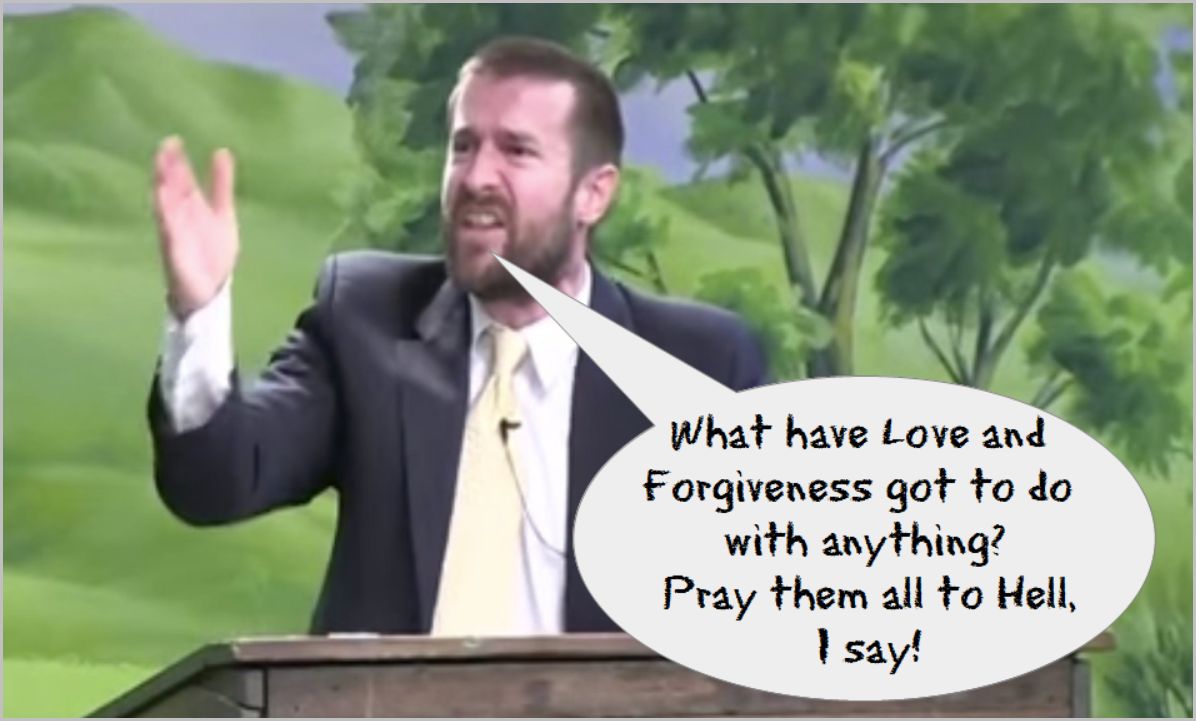
AndersonThe premise of my first ‘Jesus’ book* is that while Christians profess to believe in Jesus, they choose to ignore most of what he taught while he was alive. While they claim a vapid super-hero Christ as personal saviour, they replace what the human Jesus had to say with words of their own choosing. In reality, they have about as much time for Jesus’ ‘eternal words’ as the average non-believer or atheist. You don’t have to look very far to see how much his words have already ‘passed away’:

Jesus said, ‘Don’t judge so that you won’t be judged’ (Matthew 7.1). Our representative Christian says, ‘LGBT people are filthy and wrong.’

Jesus said ‘Love your enemies, pray for those who persecute you’ (Matthew 5.44). Our representative Christian says, ‘I’m gonna pray a transgender person dies and goes to Hell.’

Jesus said, ‘Love your neighbour as yourself’ (Mark 12.31). The Christian says, ‘The way to show love is to tell other people they’re going to Hell.’

Jesus said, ‘sell all you have and give to the poor’ (Mark 10.21). The Christian is concerned about where to buy jewellery: ‘…somewhere other than Tiffany’s, because Tiffany’s is gay friendly.’

Jesus said, ‘Forgive those who sin against you so you can be forgiven yourself’ (Matthew 6.14). Our believer rants, ‘LGBT people should be executed.’

Jesus said, ‘Don’t commit adultery and don’t get divorced’ (Matthew 5.27-28 and 19.9). Significant numbers of Christians , including our own Stephen Green, say, ‘that doesn’t apply to me.’

See what I mean? Christians regard the words of their saviour, not as having everlasting value, but as if they’re nothing more than worthless bits of fluff. Even if God were real, every word of the Bible true, every aspect of the Great Salvation Plan genuine, it wouldn’t change the fact that believers treat as optional almost everything Jesus commanded and live as if he never had.


* Why Christians Don’t Do What Jesus Tells Them To …And What They Believe Instead is available from Amazon worldwide (UK here, US here) but not, alas, from Tiffany’s.

The picture shows the deplorable Pastor Steven Anderson (linked above). He knows better than Jesus ever did.


Idiotic Stuff Jesus Said 11: Build Your Lives on the Things I Say

WhoDoJesus demanded you base your life on his teaching. It’s the only way, he said, that you’re going to find meaning, as well as the principles you’ll need when the going gets tough:

Everyone then who hears these words of mine and acts on them will be like a wise man who built his house on rock. The rain fell, the floods came, and the winds blew and beat on that house, but it did not fall, because it had been founded on rock (Matthew 7.24-25).

And what exactly were those words of his? Here’s what he taught:

  • The Son of Man was coming to the Earth to establish God’s Kingdom within the lifetime of his original followers (Matthew 16:27-28; Matthew 24:27, 30-31, 34; Luke 21:27-28, 33-34);
  • His own people needed to be more ‘righteous’ in order to be part of this Kingdom (Matthew 5.20; Matthew 6.33; Matthew 13.49 etc);
  • Being righteous entailed some extreme behaviour; loving your enemies, giving away all you had, turning the other cheek, forgiving repeatedly, being perfect (Matthew 5.44; Matthew 5.42; Luke 6.29; Luke 6.37; Matthew 5.48; Matthew 19.21);
  • It was crucial to obey Jewish law, even if some of it could be reinterpreted (Matthew 5.17-18; Matthew 12.1-7);
  • Once the Kingdom arrived Jesus himself would be King of the world, aided and abetted by his pals (Matthew 19.28; Luke 22.30);
  • His followers would do even greater miracles than he did himself. Given he controlled the weather, healed the sick and raised the dead, that’s going some (John 14:12).

Anybody know anyone who believes all of this or lives this way? Anyone who operates on these exacting principles? I don’t know of anyone and never have. I didn’t even when I was Christian myself. Jesus demands are impossible. No-one can live according to them. ‘Of course not,’ say Christians. ‘You need supernatural help to live like this.’ So why don’t they, when they have God’s spirit living within them (John 14.16-17)? Why don’t we see Christians who perform spectacular miracles, who constantly go the extra mile, who give away everything they have, who are, as Jesus tells them they should be, perfect?

We don’t because no-one can live as Jesus insisted they should. Nor do we see Christians who believe his prophecies either, particularly the one about the Son of Man bringing God’s Kingdom to Earth two thousand years ago. Christians pretend he didn’t really say it, or if he did, that he meant something else entirely. They’ve changed his very words – the ones they should be building their lives on – to claim Jesus himself will be returning any time now (the synoptic gospels are confused about whether Jesus is this Son of Man, or someone else). When he does, they say, true believers will be going with him to Heaven. Never mind that Jesus teaches nothing of the kind and there’s absolutely no foundation for these beliefs in his words. As such, they’re the faith built on sand he tells them is worthless:

And everyone who hears these words of mine and does not act on them will be like a foolish man who built his house on sand. The rain fell, and the floods came, and the winds blew and beat against that house, and it fell—and great was its fall! (Matthew 7.26-27).

So, if Christians don’t do what Jesus tells them and don’t believe his promises or prophecies, then in what way can it be said they take his words as the foundation of their lives? Don’t they, rather, base them on Paul’s teaching, about a supernatural Christ who bears little resemblance to the zealous Jewish preacher they pretend is their ‘Lord’? Teaching that has nothing to do with that of the man who demands his pronouncements be the very basis of life? Paul doesn’t quote any of Jesus’ teaching.  The foundation Jesus speaks of is of no interest to him; so, naturally, this is whom Christians follow – not Jesus, but Paul and his mythical Christ.

Christians have no time for Jesus’ words – and who can blame them? All he offers is impossible morality, false promises and failed prophecies. Far better to go with what Paul offers, because that’s about what’s in it for them. But even Paul didn’t believe anyone was going to Heaven, so they ignore that bit in his teaching too.

Money, Money, Money

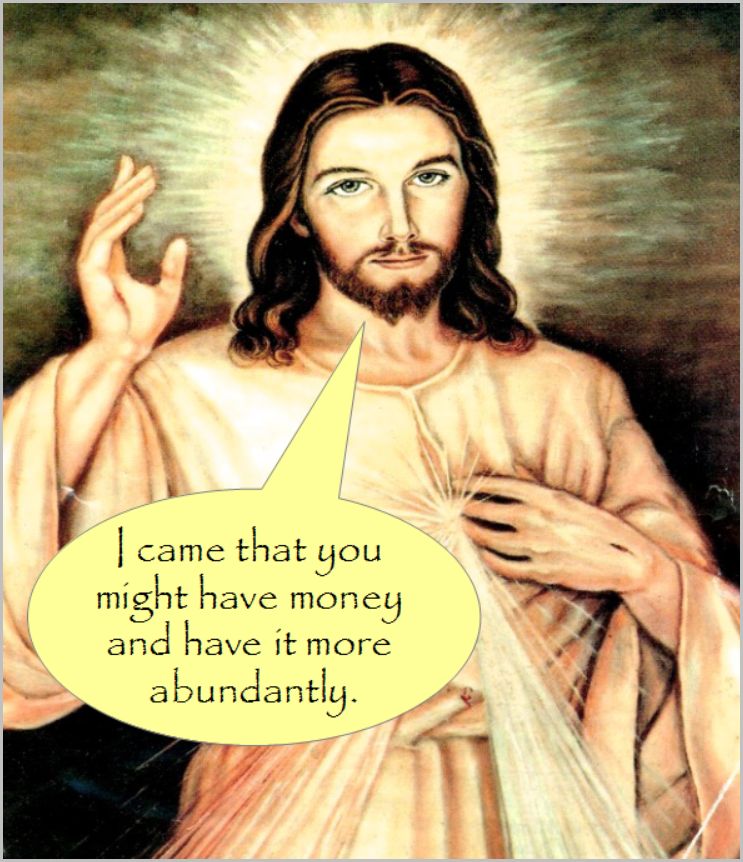
MoneyAfter the Kingdom-that-never-comes, what does Jesus talk about more than anything else? Love? Forgiveness? Marriage? Sin? No. While he does mention all of these, more of his teaching is to do with money and wealth. When he isn’t speaking about money specifically he’s using it as the background to a parable. Eleven of his thirty-nine parables involve it.

He had a thing about money. He resented the wealthy to such an extent he said it was unlikely they’d find a place in his new world order – the famous ‘camel through the eye of a needle’ saying of Matthew 19.24.

Come the revolution, he implied, the rich would have their wealth stripped from them (Luke 6.24-25).

He consigned the wealthy to Hell, not because they weren’t ‘saved’, but because they were rich and ignored the poor (Luke 6.19-25).

He seemed to think being poor was a virtue and that those who were, were especially favoured by God (Luke 6.20).

He preached against what he saw as the dangers of wealth and on more than one occasion (Matt 19.21 & Luke 12.33) and advised those with money and possessions that if they wanted God’s approval they’d have to give them away to the poor.

“No one can serve two masters,” he’s recorded as saying in Matthew 6.24. “Either he will hate the one and love the other, or he will be devoted to the one and despise the other. You cannot serve both God and Money.”

Jesus was no capitalist.

So what do Christians make of Jesus’ evident contempt for money? They certainly don’t give it all away as he said they should. Nor do they see it as an impediment to their salvation, even though Jesus was clear it is (Matt 13.22). As far as today’s Christian are concerned you can serve God and mammon, which is good news – just not Jesus’.

Most Christians in the modern west are incredibly wealthy in comparison with the rich of the first century whom Jesus castigated. Take a look too at the incomes of well known pastors and evangelists – Billy Graham is estimated to be worth $25 million, for example; Creflo Dollar $27 million (but he can still beg his flock for $60 million more to buy a new jet) and Benny Hinn $40 million (who did the same a few years ago). You can see why it’s imperative rich Christians get round Jesus’ injunctions about the evils of wealth somehow.

What is a Christian to do? What they always do when they don’t like what Jesus has to say: ignore him, or try to explain away what he actually said. So, enter the usual excuses: he was only speaking metaphorically/shouldn’t be taken literally/’really meant’ something else. And what did Jesus ‘really mean’ when he denigrated money? That it’s the love of money that’s the problem – doesn’t 1 Timothy say so? Indeed it does, but 1 Timothy was written a hundred years after Jesus. Already his message about wealth was being diluted; Jesus doesn’t make any nice distinction between possessing wealth and loving it. According to Jesus, having money is to love it (Matthew 6.21).

In that case, say those who really can’t countenance surrendering their wealth, money and/or the love of it is really only a problem when it comes between the believer and God. But to believe this necessitates overlooking Jesus’ repeated point that it always comes between the individual and God. Money, according to the radical, demanding Jesus of the synoptic gospels cannot be trifled with; it will always turn those who have it away from God, as well as from those who don’t have any (Matthew 6.21).

And that’s the problem, isn’t it. Jesus is – or was – just too radical and too demanding for those who profess belief in him. He can’t possibly mean that they should surrender their wealth and possessions for the sake of their spiritual well-being. And so they do exactly what he said they’d do: they put their money before God.

Never mind. They can always campaign against others’ so-called sin or whinge about the supposed loss of religious liberty, about which Jesus says nothing. Just so long as they don’t have to do what he says with their wealth because in an area where they have all the religious freedom in the world, they definitely don’t want to exercise it.