Jesus: Practically Perfect In Every Way?

Was Jesus a gracious, gentle and humble as Christians like to claim or was he intolerant, self-important and frequently wrong? What do the gospels say?

He’s intolerant and self-important when:

He insists people should love him more than their own families (Matthew 10:37).

He says he’s not a peacemaker but intends creating strife (Luke 12:51).

He claims anyone who doesn’t follow him deserves to be burnt (John 15:6).

He wants the world to be destroyed by fire (Luke 12:49).

He commands people not to call others ‘fools’ (Matthew 5.22) but tells those he doesn’t care for that they’re ‘swine’, ‘dogs’, ‘snakes and vipers’, ‘whitewashed tombs’, and, yes, ‘fools’ (Matthew 7:6; 15:26; 23:33; 23:27; 23:17 & Luke 11:40).

He deliberately speaks in riddles so that people won’t understand him and won’t find forgiveness (Mark 4:12).

He tells his followers to love their enemies but says he’d have his own killed (Luke 19:27 & Matthew 13:41-42).

He endorses slavery and the cruel treatment of slaves (Luke 12:47-48).

He says people would be better off if they cut off their hands, plucked out their eyes and castrated themselves (Mark 9:43-48 & Matthew 19:12).

He endorses the Jewish law that demands the death penalty for those who disrespect their mother and father (Matthew 15:4-7).

He disrespects his mother (Matthew 12:48-49).

He tells people not to get angry but loses his own temper (Matthew 5:22 &Mark 3:5).

He callously kills a herd of pigs and, in a fit of pique, destroys a fig tree (Matthew 8:32 & Matthew 21:19).

He takes a whip to people (John 2:15).

He tells his mates he’ll soon be king of the world and promises them that they’ll rule alongside him (Matthew 19:28).

Are these the marks of a tolerant, compassionate man? Or the characteristics of an unpleasant, delusional megalomaniac?

As for frequently wrong: first, the false promises –

I will do whatever you ask in my name, so that the Father may be glorified in the Son (John 14:13).

Very truly, I tell you, if you ask anything of the Father in my name, he will give it to you (John 16:23).

These signs will accompany those who believe: …they will lay their hands on the sick, and they will recover’ (Mark 16:17).

Therefore do not worry, saying, “What will we eat?” or “What will we drink?” or “What will we wear?” But strive first for the Kingdom of God and his righteousness, and all these things will be given to you as well (Matthew 6:25-7.1).

and then there’s the failed prophecies –

For the Son of Man is going to come in his Father’s glory with his angels… I tell you the truth, some who are standing here will not taste death before they see the Son of Man coming in his Kingdom (Matthew 16:27-28). Just in case we don’t get this the first time, he tells us again in Matthew 24:27, 30-31, 34 and in Luke 21:27-28, 33-34.

Did he return with the angelic host and establish God’s kingdom on Earth before his disciples died? He did not.

Christian zealots unable to accept the evidence of the gospels themselves will no doubt have a hundred and one clichéd, implausible excuses for Jesus’ many failures: ‘he was speaking metaphorically’; ‘you lack the spiritual insight to see what he really meant’; ‘you’re quoting him out of context’, blah blah, blah.

All I ask is that they please, please don’t inflict these excuses on us here when we’ve heard them all so many times before.

Sowing seeds

The early church had multiple problems, many of which Paul and other New Testament writers refer to. Any reasonable person would have taken these problems as a sign that the faith they were pushing really didn’t work; didn’t produce new creations powered by a holy spirit. Some, including a number of the very earliest followers (Matthew 28.17), were leaving the church, disappointed and disillusioned. How were leading figures in the cult to explain this? Having supposedly encountered the supernatural Jesus these people were now having doubts that he was real and were turning their backs on him. This shouldn’t have been happening!

The writer of 1 John accounts for the departure of those who had come to their senses by suggesting they were never really true believers:

They went out from us, but they were not of us; for if they had been of us, they would have continued with us. But they went out, that it might become plain that they all are not of us. (1 John 2:19)

It’s significant that the writer of this letter doesn’t allude to Jesus’ parable about the sower of the seeds from Matthew 13. Not one of the letter writers in the New Testament who address the problem of defections does so. This can only be because none of them knew of it when they were writing decades after it was supposedly told. The reason they don’t mention it is because it had yet to be written.

The parable of the sower is Matthew’s attempt to have Jesus address the problem of those who fell away from the cult. Matthew’s explanation is it’s because the good news – the imminent arrival of God’s kingdom on Earth – only takes root in the spiritually astute. Others, who might initially accept the gospel, are like stony ground on which birds gobble up the seed. They are those who allow the cares of this world – metaphorical weeds – to choke the message before it can flourish.

It’s a very colourful explanation designed to reassure those persisting in the faith that they are the favoured, while those who have defected have fallen prey to the shallow soil, birds and weeds. It’s neat and it gives reassurance and encouragement to remaining cultists.

Jesus could not possibly have known what was to become of his ‘church’ and the (non)arrival of God’s Kingdom – his good news – following his death. The parable was created for him, or more specifically, as Matthew makes abundantly clear in 13:11-12, for devotees of the early cult decades later. What it emphatically is not, is a story originally delivered by Jesus.

Show Me Heaven

On the radio this Sunday, a couple of presenters were discussing a woman’s Near Death Experience. Lynda Cramer claimed that in 2021 she had been clinically dead for 14 minutes when she visited Heaven for five years. You can see her raving about it on YouTube, while the Amazon synopsis of her book, Five Years In Heaven (of course there’s a book; four in fact) reads:

In May 2001, Dr Lynda Cramer died. This is the story of her Near Death Experience, outlining the five years that she spent in Heaven. Starting when she found herself “floating” in the living room for over 45 minutes, she then went on a journey where she entered Heaven, she then processed her Life Review prior to meeting her great-great-great-great grandmother who explained what Life Lessons, Life Contracts and Reincarnation are all about. Backed up by Medical Records as well as diagrams she drew, this is her personal account for anyone intrigued by what happens in the afterlife…

So, is this real? Did Lynda Cramer visit Heaven while she was dead for 14 minutes? She’s a doctor, after all, so superficially at least, she has credible credentials. Until you see that her PhD was obtained researching Near Death Experiences  themselves. Vested interest or what?.

But, let’s not be cynical; she has diagrams too, for God’s sake. What more proof could we ask for? We know too, because our resident Christian tells us, that dreams and visions like this are most definitely from God. Lynda’s experience ticks all the boxes, no matter what we sceptics might think.

Except, no. Lynda was not dead for 14 minutes. We have only her word for it that she was declared clinically dead, while she describes her experience as a Near Death Experience. The clue is in the name. If she was near death, she was not dead; her brain was still alive, if only just. Her mind was still active, creating, if this happened at all, a reassuring experience for itself as it came close to shutting down. There is well documented evidence that this is what the brain is capable of doing when it is close to death (but not actually dead).

Significantly, the scenario her mind created was informed by cultural, quasi-Christian images of Heaven, just as believers’ dreams of God are informed by the same images and characters that occupy their waking minds. My own dreams, for example, are populated by people I know and places I’m familiar with (though sometimes only vaguely; my subconscious fills in the details often in bizarrely imaginative ways.)

Nonetheless, Lynda’s life-changing 5 years visit to Heaven (during which she seems to have done nothing except admire mountains and buildings while blue balls, hijacked from science-fiction, danced around her) is just as real, just as divine, just as valid as the God-given dreams and visions Christians claim they sometimes have. Naturally, we sceptics can’t possibly appreciate these until we’ve experienced them for ourselves.

Lynda’s experience was a subjective, emotional experience while she was unconscious. But such ‘spiritual’ inner experiences are ‘real’ according to at least some Christians, and we can’t argue with that which we have not experienced  for ourselves.

Right, Don?


Jesus: not worth the paper he’s printed on?

There is broad consensus amongst respected scholars that the Jesus of the gospels didn’t exist. This is hardly surprising. Gospel Jesus, as I hope I’ve demonstrated over the past few weeks, is constructed from fragments of Jewish scripture and Paul’s (and others’) visions and dreams. There is also good evidence, which I’ve not discussed, that some Jesus stories are recreations of legends and tales of other god-men (turning water into wine and the Road to Emmaus story*, for example).

All of which raises the question suggested by David Fitzgerald in Nailed, that if there was a real Jesus who was so incredible that he gave rise to an entire religion, why was almost everything about him invented? Why could his story not have been told as it was? Why didn’t his inspiring, dynamic personality speak for itself? Personally, I don’t care whether Jesus existed or not, but if the supposedly remarkable Jesus of history did once exist, he has been totally obscured by the stories, legends and myth that were constructed around him not long after he died. The celestial Jesus that today’s Christians claim to know personally, who they say inhabits their hearts while simultaneously living in heaven, is emphatically not the man who lived, but a myth. A different myth, even, than that of the New Testament. A non-existent star-man, waiting in the sky.

Jesus belongs with all those other heroes who may or may not have existed prior to their being turned into myth and legend: Abraham, Moses, Buddha, Confucius, Saint Nicholas, Robin Hood, Paul Bunyan. There is very little evidence, apart from stories and legends, that any of these figures actually existed. More, it’s entirely conceivable that Jesus belongs to a still different group of super-beings: those who were created as mythic characters, including but not confined to, Osiris (and the entire Egyptian panoply), Apollo (and all the Greek gods), Romulus, Circe, Attis, the angel Gabriel, Mithras, Aladdin, the angel Moroni, Superman, Harry Potter…

There is meagre evidence there was an historical Jesus who, even if he did exist, is now buried beneath layers of make-believe. The Jesus who has come down to us through the gospels and the rest of the New Testament is fictional. From his fairy-tale origin to his fantasy ascension and beyond, he’s completely imaginary.

I’m conscious I’ve written other posts making this same point. I find that, whatever starting point I take, invariably I end up here. Whether it’s ‘prophecy’, prayer, promises, miracles, the second coming, any aspect of the faith, none has any substance. They’re ineffectual, empty and have no bearing on reality. The character who supposedly embodies and promotes them becomes, as a result, similarly void. Either Jesus was transformed into a fantasy figure soon after he lived or he was imagined, by the likes of Paul, as a magical being to begin with. Whichever it was, from the earliest days of Christianity, there was no way for people to hear of or know about a man who actually walked the Earth.

*See Carrier, On the Historicity of Jesus: Why We Might Have Reason to Doubt, pp 480-81

No Sign of Life

For what I received I passed on to you as of first importance, that Christ died for our sins according to the Scriptures, that he was buried, that he was raised on the third day according to the Scriptures. (1 Corinthians 1:4)

This, apparently, is what early Christians believed; Paul is thought to be quoting an early creed here. What an incredible statement it is. Incredible because of its demonstrable falsity.

Christ died for our sins according to the Scriptures’: just where, in which scriptures, does it say this? Presumably Paul, or those he’s quoting, thinks it’s Isaiah 53, where it says:

…the Lord was willing to crush (his servant), and he made him suffer. Although you make his soul an offering for sin, he will see his offspring, and he will prolong his days, and the will of the Lord will triumph in his hand. ‘the Lord makes his life an offering for sin’ (Isaiah 53:10)

Unfortunately for Paul, most scholars agree that Isaiah 53 is not about the Messiah at all, but about the Jewish nation. It looks as if it neatly fits the much later ‘Christ’ because the Christ is a construct built on a handful of believers’ visions and this very chapter, which seemed, but only superficially, to validate their inner experiences.

Paul goes on to say, ‘he (Christ) was buried (and) was raised on the third day according to the Scriptures. Here he is on even shakier ground. The Messiah was not going to die for his people – he would be a triumphant warrior king – and he certainly wasn’t predicted to rise from the dead. There are no references at all, anywhere in the Scriptures, to the Messiah being raised from the dead and certainly not ‘on the third day’. Paul is wrong. At best, he’s mistaken, at worst he’s deliberately perpetuating a falsehood.

When Paul wrote this, the gospels were still many years away from being written. All that new believers, in as faraway a place as Corinth, could rely on was the testimony of preachers who came to tell them about the Christ. Some of these preachers may have known Jesus personally (though I doubt it) but most, like Paul, had limited means of persuading those they aimed to convert that Jesus had died for their sins and had risen again. Not unlike today’s evangelists, all they offered was their own and others’ inner spiritual experiences and visions, together with ‘evidence’ from scripture. Paul admits this is all he’s offering here: ‘what I received’ and ‘according to scripture’. But there is no evidence from the scripture available at that time.

What’s a gospel writer to do? When Mark created his gospel, he undoubtedly knew of Paul’s teaching about the resurrection and he may have known of this early creed. Yet he knew also that there was no prophecy about Jesus rising ‘on the third day’, on which to build his story. Consequently, he has Jesus declare in Mark 8:12 that ‘no sign will be given’ (= ‘there’s nothing in the scriptures about this’) and he omits the resurrection from his story.

Not so Matthew. As is his way, Matthew scoured Jewish scripture till he alighted, in the absence of anything resembling a prophecy, on the story of Jonah. Jonah 1.17 claims preposterously that this ancient prophet spent ‘three days and three nights’ in the belly of a great fish – and Matthew decided, ‘that’ll do!’. He has his Jesus refer to the tall tale as a ‘sign’ that he too will spend three days and nights in the belly of the earth:

Then some of the scribes and Pharisees told Jesus, “Teacher, we want to see a sign from you.” But he replied to them, “An evil and adulterous generation craves a sign. Yet no sign will be given to it except the sign of the prophet Jonah, because just as Jonah was in the stomach of the sea creature for three days and three nights, so the Son of Man will be in the heart of the earth for three days and three nights…” (Matthew 12:38-40)

Contradicting Mark’s Jesus (‘no sign will be given’), Matthew also modifies the original belief that Jesus rose on the third day. Now it’s after ‘three days and three nights’, which does not mean the same as ‘on the third day’. According to Matthew’s own gospel, Jesus was in the tomb – the belly of the earth? Really? – from Friday ‘as the evening approached’ (Matthew 27:57) till before dawn on Sunday morning (Matthew 28:1). This only just qualifies as being ‘on the third day’, given that days are counted from evening to evening in the Jewish calendar; it certainly isn’t ‘three days and nights’. Jesus lay dead in the tomb for no more than 36 hours. The damn ‘sign’ Matthew is so eager to use doesn’t even fit his own story.

What a mess. It’s what you get when you lift any old tall tale from ancient scripture and use it as a symbol for your own made-up story.

A Funny Thing Happened On The Way To The Forum

So I’m saved now.

Saved? From what?

My sins.

Your sins. Right. How’d this happen then?

My friend Marcus told me about a new Saviour.

And how did Marcus know about a new Saviour?

Gaius told him.

And Gaius?

His neighbour Livia told him.

And where’d she hear it?

She said she was told it by a travelling preacher.

Well, travelling preachers are always reliable, so sure.

Paûlos I think she said he was called. Anyway, Livia heard him talking about the new Saviour in the forum and she told Gaius, Gaius told Marcus and he told me.

Right. So what did this Paûlos say?

That he’d had a vision or something and had seen this new Saviour in his vision. I think he said he was called Iesous. Something like that.

So a Jewish Saviour then. I take it this Paûlos was Jewish?

I don’t think Livia said.

So what’s a Jewish Saviour to you? Or Livia and Gaius and Marcus for that matter?

Well, that’s the great thing. Marcus said that Gaius said that Livia said that Paûlos said that this particular Jewish Saviour is for everyone, not just Jews.

And Paûlos worked this out from his vision, did he?

Yes. Iesous told him all about it.

In his vision.

Yeah. He told Paûlos that anyone who wanted to could ask him to save them from their sins. So Livia did, and then when she told Gaius, he did too, and then Marcus.

So, Paûlos. He ever meet this Iesous? In the flesh, I mean.

Oh, I don’t think so. Paûlos didn’t need to, you see. Iesous talked to him from Heaven. He didn’t need to meet him.

He say whether he’d met anyone who had actually met him?

No. He knew of some fellas who’d seen Iesous same as him, in marvellous visions, but he said he didn’t need to meet them either. Like I said, Iesous the Saviour spoke to Paûlos direct. You don’t need any more than that. I’m hoping he’ll speak direct to me before long.

So, how’d you know this Iesous existed if nobody knows anyone who’s seen him in the flesh?

I told you, Paûlos saw him right there in his head and Iesous told him all he needed to know. The Saviour said that when he comes down from the sky, which he will real soon, those of us he’s saved will live with him forever, right here on Earth.

Live forever, you say?

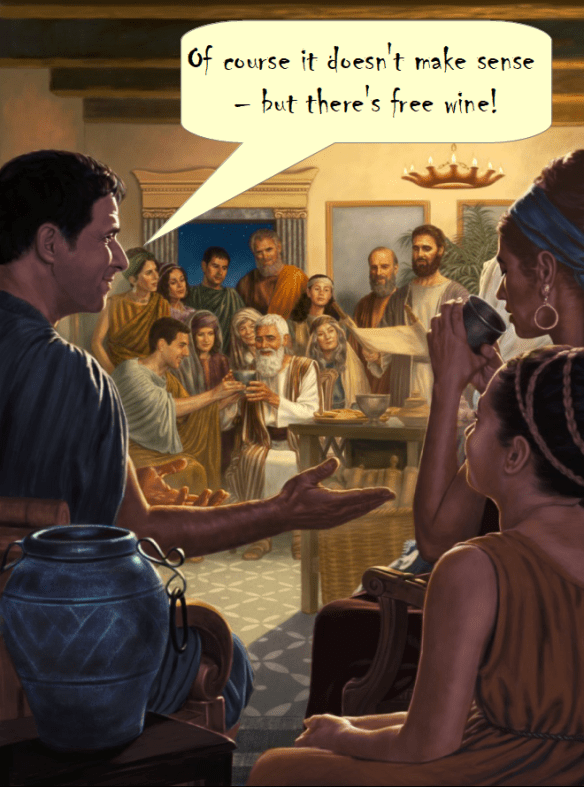
Sure. And there’s free wine while we wait.

Free wine? Why didn’t you say? Where do I sign up?


The Walking Dead

Let’s take a look at another of the stories from the gospels. This time the miraculous rising from the dead of ‘saints’ at the time of Jesus’ death (or maybe at the time of his resurrection…): 

And Jesus cried out again with a loud voice, and yielded up His spirit. And behold, the veil of the temple was torn in two from top to bottom; and the earth shook and the rocks were split. The tombs were opened, and many bodies of the saints who had fallen asleep were raised; and coming out of the tombs after His resurrection they entered the holy city and appeared to many (Matthew 27:51-53).

Yes, it’s another case of Matthew making up a story from bits of Jewish scripture. We know it’s made up not only because of its fantastical nature, but because no-one else thought to record it; no eye-witness, no Roman official, no Jewish priest, no writer of Q. Not Paul, who says Jesus was the first to be resurrected; not even Mark, who doesn’t include it and therefore probably didn’t know of it; nor Luke, who omits it when he copies chunks of Matthew; nor John, who invents his own raising-the-dead story, the one about Lazarus.

So where does Matthew find his inspiration? There are many verses in Jewish scripture that declare YHWH will resurrect his people; Ezekiel 37: 12-14 for example:

Therefore prophesy and say to them: ‘This is what the Sovereign Lord (YHWH) says: My people, I am going to open your graves and bring you up from them; I will bring you back to the land of Israel. Then you, my people, will know that I am the Lord, when I open your graves and bring you up from them. I will put my Spirit in you and you will live, and I will settle you in your own land. Then you will know that I the Lord have spoken, and I have done it, declares the Lord.’”

And Isaiah 26:19:

But your dead will live, Lord; their bodies will rise – let those who dwell in the dust wake up and shout for joy!

Matthew ignores the fact that ‘prophecies’ like this are about the revival of the Jewish nation. He rips them out of context and creates his bizarre, Jesus-related story from them. Bizarre not only because of resurrected dead bodies, but because he has the tombs crack open as Jesus dies, only for the revived occupants to wait more than 36 hours to emerge from them. The poor buggers lie around in their tombs, alive again for a day and a half before they make it out into the outside world (Some scholars think the delay is an interpolation introduced by a later scribe who didn’t want the dead guys getting ahead of Jesus.)

Of course, the story is symbolic. It didn’t happen (though there are those who insist that it did); Matthew invented it, like most of his gospel. It’s another literary recreation of ‘prophecies’ from scripture, intended this time to show that Jesus was the Promised One who was about to bring about the great resurrection of the dead. The verses in their original context say nothing of the sort, of course. There’s no verse in the Jewish scriptures that does (though no doubt there are those who believe there is.)

So, yet another story, yet another symbolic fantasy. We could play this game endlessly: name the gospel story – the resurrection included – and it can be shown to have been created around lines lifted out of context from the Jewish scriptures.


,


The Return of the Annual Christmas Quiz!

Back, due to popular demand! The annual Christmas quiz, last seen in 2014. Ten questions on Biblical trivia. Answers at the bottom of the page.

Good luck. You’ll need it.

1. Where did Mary and Joseph live prior to Jesus’ birth?

a) Bethlehem

b) Nazareth

c) Galilee

2. How did Mary conceive?

a) By the power of the Holy Spirit

b) She didn’t. It’s a story.

c) How’d you think?

3. What was the relationship between John the Baptist and Jesus?

a) They were second cousins

b) They didn’t know each other and didn’t meet until they were adults

c) Jesus originally belonged to John’s baptism cult

4, When was Jesus born?

a) When Herod I was alive

b) After Herod had died and Quirinius was governor of Syria

c) Perhaps he wasn’t

5. How did Mary end up giving birth in Bethlehem?

a) There’s no evidence she gave birth in Bethlehem

b) She and Joseph had to go there because of the Roman census

c) She lived there anyway

6. The Lord tells Mary to call her child

a) Jesus

b) Immanuel

c) Yeshua

7. Where did the family go following the birth?

a) They went home to their house in Bethlehem

b) Egypt

c) Nazareth

8. Who preserved the songs of Zechariah, Mary and Simeon (Luke 1 & 2)?

a) They were preserved orally word-for-word for 50 years

b) They were recorded in Q

c) They were created in their entirety by Luke, based loosely on Jewish scriptures

9. Where is the prophecy, quoted by Matthew (2:23), that Jesus would be called a Nazarene?

a) Micah

b) Isaiah

c) Nowhere: there is no such prophecy in Jewish scriptures or anywhere else

10. Which is the most unbelievable part of the nativity stories of Matthew and Luke?

a) a host of singing angels hovering in the sky

b) the wand’rin’ star

c) a virgin giving birth

d) Herod’s re-enactment of a story from Exodus

e) All the angelic visitations, dreams and visions that are needed to make the stories function

Answers:

1. Where did Mary and Joseph live prior to Jesus’ birth? All of the answers here are correct, so the Holy Bible say. According to Matthew, Mary & Joseph lived in Bethlehem. According to Luke they lived in Nazareth. According to Mark, it was known that Jesus hailed from Nazareth though he doesn’t say Jesus was born there. John refers to Jesus being from Galilee and acknowledges he comes from Nazareth (1:46).

Matthew and Luke insist Jesus was from Bethlehem to make him ‘fulfil’ the prophecy that the Messiah would come from there. Mark and John apparently don’t care.

2. How did Mary conceive? Matthew and Luke have the Holy Spirit do the deed. Matthew says merely that Mary ‘conceived by the Holy Spirit’, while Luke really goes to town with a ridiculous story involving an angel and Mary being orgasmic about the coming of the Lord. Mark hasn’t heard of either account, because neither had been invented, and fails to invent his own. John is only interested in Jesus as The Logos prior to his time on Earth. Actually, Jesus could only have been conceived by the only method we know that works: boy and girl hoochie-coochie.

3. What was the relationship between John the Baptist and Jesus? All are correct. Luke says Jesus and John were second cousins (1:36) and their mothers were close (1:56). The Gospel of John (1:31) says that John the Baptist didn’t know Jesus personally. Some scholars think Jesus was originally a member of John’s baptism cult.

4, When was Jesus born? a) and b) are both correct according to the gospels. Matthew places Jesus’ birth in Herod I’s reign, which ended when he died in 4BCE. Luke meanwhile dates it to Quirinius’ governorship of Syria, which was in 6 and 7CE. No wonder there are those who think Jesus may never have existed, so encrusted with myth and make-believe is he.

5. How did Mary end up giving birth in Bethlehem? The census is a contrivance to shift the birth to Bethlehem. There wasn’t a census of the kind described when Quirinius was governor of Syria, nor in 4BCE. Quirinius’ census was of property and would not have entailed the (mass) movement of people. Matthew seems to think M&J lived in Bethlehem all along. No-one else thinks so.

As the Bethlehem connection derives only from prophecy (Micah 5:2), it is likely Matthew and Luke located the birth there to show the ‘fulfilment’ of that prophecy. In other words, they invented it, as they do other ‘fulfilments’. It looks like a) is the only viable answer.

6. The Lord tells Mary to call her child… According to Matthew. Mary is meant to call the baby Immanuel, which, as the text helpfully informs us, means ‘God with us’. This is to make the story comply with Isaiah 7:14 which claims the Messiah will be called Immanuel. But Mary doesn’t call her baby Immanuel. She calls him Yeshua, meaning ‘God Saves’, which is not the same thing. How Matthew thinks this is a fulfilment of the Immanuel prophecy is anyone’s guess. When the gospels came to be written, Yeshua was rendered in Greek as Iesus and eventually in English as Jesus. Neither he nor his mother would have recognised this rendering.

7. Where did the family go following the birth? Again, all are correct according to the gospels. The family went on living in Bethlehem according to Matthew (2:7-11) but fled to Egypt according to Luke. Mark doesn’t appear to know either the Bethlehem or Egypt stories and refers only to Jesus coming from Nazareth.

8. Who preserved the songs of Zechariah, Mary and Simeon (Luke 1 & 2)? c) is correct. No oral tradition could possibly preserve the three carefully structured poems verbatim for 50 years. The hypothetical Q is conjectured to be a collection of Jesus’ sayings so the songs don’t come from there either. Luke or his community made them up.

9. Where is the prophecy, quoted by Matthew (2:23) that Jesus would be called a Nazarene? There is no such ‘prophecy’ anywhere in Jewish scripture nor in any extant writing: c) is correct once again.

10. Which is the most unbelievable part of the nativity stories of Matthew and Luke? That’s right. All of them are completely unbelievable.

How did you do? If you’re confused, don’t be. It’s the gospel writers who were. They made up stories about Jesus so that he complied with parts of Jewish scripture that seemed to them to be speaking of the Messiah. (John’s stories are a little different; they and Jesus’ tedious monologues were created to make him seem more like a Greek demi-god.)

Perhaps though I’m taking it all too literally, ‘like a fundamentalist’ as my self-appointed chief critic likes to say. I should perhaps accept it’s all just a metaphor, as he advises. Of course, when I do, he objects to that too; ‘A metaphor for what?’ he asks, forgetting he’s the one who believes the stories are ‘intended’ to be deeply meaningfully symbolic.

The muddled accounts arose as each gospel writers attempted to make an origin story for their hero based on scraps from Jewish scripture, Paul’s teaching and the emerging beliefs of their particular brand of the cult. They’d have got away with it too if some clever-dicks hadn’t decided, many decades later, to put their efforts side by side so their differences were laid bare for all to see: all the contradictions, inconsistencies, fallacies, anomalies and incompatible flights of fancy. Thank god the church kept their writings hidden away from most folks by preserving them in a language they couldn’t read.

That same critic will no doubt tell me I’m wrong again. ‘Everything happened as Matthew and Luke relate. There are no contradictions between them and the other two, Mark and John, had different priorities anyway.’ (See comments to this post here). He’ll tie himself in knots rather than admit the nativity stories are myth, as is everything that follows.

Have a happy Christmas, ya’ll. See you on the other side.

 

Miracles made to order

Mark makes his Jesus perform all the deeds the scriptures say will be performed by the Messiah. He doesn’t spell out that this is what he’s doing. He wants those who hear his gospel being read aloud (as it would have been to the cult’s members) to work it out for themselves: ‘he who has ears let him hear’ and all that.

This isn’t good enough for Matthew, however. He wants to make it obvious what’s going on, so he invents a story to draw attention to it. To do so, he has to have John the Baptist, who has previously acknowledged Jesus as the Messiah and heard God say as much from Heaven, doubt all of it. Matthew considers it worth it to make the more important point that Jesus is truly God’s Chosen One:

John (the Baptist) heard in prison about the works of Christ, and he sent his disciples to ask Him, “Are You the One who was to come, or should we look for someone else?”

Jesus replied, “Go back and report to John what you hear and see: The blind receive sight, the lame walk, the lepers are cleansed, the deaf hear, the dead are raised, and the good news is preached to the poor. Blessed is the one who does not fall away on account of Me.” (Matthew 11:2-6)

Matthew makes Jesus refer to several scattered verses from the scriptures that appear to say that once God’s Kingdom arrives on Earth the deaf shall hear, the blind see and the lame walk. Now you can believe, if you like, that Jesus really did make the blind see and the lame walk because the Kingdom had arrived (though -oops – it hadn’t!) or you can recognise that Matthew (and Mark before him) was aware of these references and made up a hero to embody them. Which is more likely, when every one of the miracles Jesus alludes to in Matthew 11 illustrates specific verses from scripture?

The blind see, the deaf hear, the lame walk (Isaiah 35:4-6) is brought to life in Matthew 9:27-31; 15:31-37 and 9.1-8.

Lepers cleansed: Leviticus 14 materialises as Matthew 8:1-4. The ability to heal a ‘defiling skin disease’ had long been thought to be a sign of the Messiah, so naturally Jesus has to be able to do it.

The dead rise: Daniel 12:2 is resurrected as Matthew 9.18-26.

The good news preached: Isaiah 52:7 becomes Jesus’ message.

A man called Jesus didn’t do these looked-for amazing things. These looked-for amazing things gave rise to a character constructed by myth makers: gospel Jesus. 


Cruci-fiction

Given the birth, baptism and wilderness narratives are fiction, why not then the other parts of Mark and Matthew? We’ve already seen how the trial and crucifixion in Mark are literary creations, which Matthew lifts and embellishes. The resurrection stories are also invented, which is why the different accounts are confused and contradictory. The likelihood that everything between the beginning and the end – Jesus’ ‘ministry’, miracles and preaching – is invented too, either by the authors of the gospels themselves or by those who preceded them. My money would be on the former; the stories are so carefully arranged, forming an integral part of a clever literary construct.

I have a growing, sneaking admiration for what Mark and Matthew, and later Luke and John, achieved. They consciously set about creating myth. When Paul and others preached that their Christ had died and risen again ‘according to the scriptures’ that’s literally what they meant; the Christ was discernible in Jewish scripture, his story laid out there for those with eyes to see it. Mark tells us as much in Mark 4:9: ‘He who has ears to hear, let him hear.’

What he and, to an even greater extent, Matthew did, was construct a Saviour story from these elements. They saw him, or thought they did, all over the place. Whether or not there was an actual Jesus is beside the point. as is the extent to which the gospel writers may have used existing stories about him. Gospel Jesus is their imaginative creation from start to finish. His life, deeds and many of his sayings are put together by cutting and pasting scripture.

Cite any episode in Mark and Matthew’s gospels and it will have a precedent in scripture, either a prophecy (that invariably isn’t a prophecy) or episode (that was never about a future suffering Messiah) or character (usually legendary in their own right.) You can believe, as many True Believers do, that these ‘Old Testament’ episodes foreshadow the events of Jesus’ life. That he miraculously fulfilled prophecy through everything he did and said while here on Earth. Or you can take the view that doesn’t rely on faith in the miraculous, and recognise that he’s merely written that way. He’s the literary embodiment of scattered scraps of scripture.

On this much more realistic view, everything Jesus is made to do, particularly his miracles and crucifixion, is symbolic; a fictional enactment of scripture. Other aspects are drawn from Paul (the Last Supper/Eucharist, for example), claims of inner-visions (the resurrection) and early cult rules (behavioural expectations.) The events of Jesus’ earthly existence, as created by the gospel writers, have no historical basis; they didn’t really happen. I maintain that all of the gospel writers were fully cognisant of this as they created their respective symbolic lives for him.