Ken Ham’s ‘Five Evidences that the Bible is True’

cut

Yes, that’s what he says: ‘evidences.’ Good use of English there, Kenny. Actually, the article is anonymous, but as it’s on Kenny’s site, and as it features inside his Noah’s Ark vanity-project, we can safely assume he authorised and approved it. That being the case, he can take responsibility for it.

Anyway, here are those ‘evidences’. Be prepared to be underwhelmed:

1. The Bible Is God’s Word

The ‘reasoning’ here is that God inspired the writers so, ipso facto, the Bible must be God’s words.

How do we know God inspired the Bible? Because the Bible appears to say so. But how do we know we can trust what the Bible claims about this and everything else? Duh… because God inspired it. Circular reasoning that gets us nowhere.

But wait, more ‘evidence’ from Kenny: ‘the Bible is authoritative in every subject it addresses’. I guess that’s so long as you exclude all the areas where it isn’t, like those that are scientifically, historically and geographically inaccurate, including the early chapters of Genesis that Kenny loves so much. Then there are those parts that are evidently myth, legend or fantasy.

Yes, apart from all those bits, the Bible is accurate and authoritative.

Isn’t it?

2. The Bible is Unique and Unified

Two claims in one. The Bible is far from unique; there are many religious texts in the world – the Qur’an, the Vedas, the Pali Canon, the Book of Mormon… many with evidence of several authors at work in them. Neither is the Bible unique because it is ‘unified.’ It is not unified. It is contradictory and inconsistent: the so-called ‘new covenant’ cuts across the ‘everlasting’ agreement God allegedly made with the Jews and YHWH himself evolves, even having a personality transplant somewhere between the Old and New Testaments. Most significantly, for what is supposedly its central message, the Bible offers several, frequently mutually exclusive, ways to salvation.

3. The Bible Has Been Faithfully Passed Down.

This is empirically, demonstrably false. Many books of the Bible were written decades, even centuries, after the events they purportedly describe; the oral tradition is an unreliable means of transmission; texts were altered both by accident and on purpose; some books are patent forgeries; ninety percent of surviving manuscripts were created 800 years or more after the originals, and none of these ‘autographs’ survive for anyone to determine how ‘faithful’ later copies might be.

4. The Bible Contains Fulfilled Prophecy

It does? Where? Is it in the gospels where Jesus prophesies that the Son of Man will, in the lifetime of his listeners, return through the clouds to judge the tribes of the Earth and establish God’s Kingdom? Is it in the contrived symbolic events imposed on Jesus’ life to make it look like he fulfilled prophecy, even when the earlier ‘prophecies’ were not prophecies at all? Is it in Paul’s letters where he promises the rapture will be coming while those in his churches still live? Is it in the many prophecies that were written after the events they were supposedly predicting? Is it in the innumerable prophecies that didn’t come to pass?

That’s right; not one of these bits of malarkey constitutes ‘fulfilled prophecy’.

5. The Bible Holds the Key To Eternal Life

No, it doesn’t because there’s no such thing. This is the great swindle at the heart of Christianity; a fantasy dreamed up by fanatics, fantasists and psychotics, and preserved in the Bible. Christians are singularly unable to provide any evidence that anyone has ever gone on to have a life after death, nor that they ever will. We know now, as we may always have suspected, that when the body dies ‘we’ die with it. End of.

So, every one of Ham’s ‘evidences’ is false; a sham like his beliefs and the book from which they spring. You’ll struggle to tell him so, however, because like so many Christian web-sites, there’s no posting of comments; Kenny broaches no dissent. That’s how confident he is of his case. Best not to entertain any views other than your own weak, unfounded assertions.


The disciples would not have died for a lie (part two)

Rule

As we have seen, the available evidence does not support the idea that Jesus’ original followers subscribed to a miraculous physical resurrection. It suggests instead that their beliefs centred on the promises Jesus had made about returning from heaven as ‘the Son of Man’ to establish God’s Kingdom on Earth, which they would then rule with him.

Elements of this promise survive in the gospels as we have them, even if there are, in all four, obvious concessions to Paul’s Christ figure; the gospels were, after all, written after Paul’s version of Christianity had begun to take hold. Significantly, the promise of the triumphant appearance of the Son of Man ‘within this generation’ is present in Q, the source of many of the sayings common to both Matthew and Luke’s gospels that they didn’t get from Mark. It’s also there in the sources (L and M) peculiar to each of the gospels. Obviously L, M and Q pre-date the gospels that later made use of them. Scholars think Q could have been written as early as 40CE, a few years after Jesus’ death, with some sayings earlier than that. It pre-dates Paul too and reflects a tradition that has nothing to do with him or his convoluted theology.

Q, in fact, has no sayings attributed to the resurrected Jesus, nor anything from his trial, the crucifixion or resurrection.1 How can that be? Were they not important to the early believers who compiled it? The answer can only be, no, they weren’t. For the creators of Q what mattered was what Jesus said – his ethical teaching and his promise to return as the Son of Man, within his hearers’ lifetime, to inaugurate the Kingdom of God on Earth in which the disciples would reign alongside him (Matthew 19:28). To be part of this Kingdom, people had to become righteous, not have it gifted to them (Matthew 5.20 & 48). This was the ‘good news’ for Jesus’ earliest followers, the gospel as it is preserved in the Q source.2 The lie that the disciples were to rule the world with Jesus inspired them to spread the news of the coming Kingdom; they demonstrate little interest in a reanimated dead man or a magical salvation formula.

So, did the disciples die for their faith in the Risen Jesus? Highly unlikely. They don’t seem, despite the later stories in which they feature, to attach any importance, at least in Q, to visions of a resurrected god-man.

How did they die, then? The simple answer is that, for most of them, we don’t know. They could have met their end when the original church community in Jerusalem was annihilated by the Romans in 70CE. The Romans didn’t particularly care what a minority group of fanatics believed – they were rebellious Jews who needed to be taught a lesson.

If not slaughtered by Romans in their capture of Jerusalem, then perhaps the disciples died for their seditious belief in the imminent arrival of the Kingdom of God, just as Jesus had before them. The Bible records the deaths of only two of them: Judas, who appears to have committed suicide using two different methods depending on which account you believe (Matthew 27:5-8 or Acts 1:18-19), and James, brother of John, who, according to Acts 12.1-2 was executed by Herod Agrippa 1. By the time Acts was written, however, somewhere between 80-90CE, the beliefs of the original followers had been swallowed up by Paul’s alternate version of the faith; we have no way of knowing how accurate the report of James’ death is. It’s hard to believe it was merely because he thought an old pal had risen from the dead. It is hard to believe this of any of them. For the other disciples there are only traditional accounts of how they died ‘for their faith’ with nothing to corroborate these legends.

It is quite possible Jesus’ original followers died for reasons unconnected with their outlandish beliefs in an imminent supernatural kingdom. They could just as easily have died of natural causes. One thing seems probable – they did not die because they believed in a resurrected Messiah. It’s not that they didn’t believe in a physical resurrection – they did – but they were convinced it would only happen with the arrival of God’s Kingdom on Earth, as prophesied in Daniel 12.1-4.

That it had already happened to their former leader did not figure in their beliefs, their writing or even their thinking.


1 Bart D. Ehrman, Jesus Before the Gospels, p279-280

2 ‘But for Q, Jesus was indeed principally remembered as a teacher of great wisdom and high moral demands, as an apocalyptic prophet anticipating the imminent end of the age, and one whose miraculous activities showed that the day of judgement was soon to come. For the author of Q, Jesus’ teachings provided the goal of the Christian life. Followers of Jesus are those who adhere to his directives for how to live, in anticipation of the coming kingdom of God.’ Bart. D. Ehrman, Jesus Before the Gospels, p280

Updated to include link to Matthew Ferguson’s celsus blog.


The disciples would not have died for a lie (part one)

SonOfMan

The disciples would not have died for a lie, or so Christians like to argue.

Would they not?

Fanatics today do and it is more than likely the disciples believed their lie was true, if indeed they died for it at all. There’s not much evidence that they did. But if they did, maybe the lie they believed to be true was not the one today’s Christians think it was.

There is no evidence anywhere that Jesus’ original followers were martyred because of their faith in a physically resurrected Jesus – for their beliefs, maybe, but not necessarily because they believed Jesus had returned in bodily form from the dead. On the contrary, the evidence suggests that they holed up in Jerusalem to await his return through the clouds as the Son of Man, with a phalanx of hostile angels by his side (Heaven was, after all, just on the other side of those clouds). This was the crux of their beliefs.

How do we know?

There was significant tension between the disciples and Paul, which Paul himself relates, not only because he was convinced his message should be taken to the Gentiles but because of the very nature of that message. Paul and the disciples meant different things by ‘the gospel’. Paul’s irritation that others were preaching a different gospel is apparent in 2 Corinthians 11 & 12 where he calls the original disciples, ‘false apostles, deceitful workers, disguising themselves as apostles of Christ’ and bitterly refers to them as ‘the most eminent apostles’. He is arrogant enough to suppose, and to proclaim, that he has it right and they are wrong.

Paul’s good news was about the resurrected Christ of his visions, who magically made those who put their faith in him righteous in God’s eyes. As he puts it in 2 Corinthians 5:21, ‘God made him who had no sin to be sin for us, so that in him we might become the righteousness of God.’ Paul also believed this supernatural being would soon descend from the skies when he would give believers new bodies (Philippians 3.20) but this is a very different figure, and agenda, from the Jesus known to the disciples.

What then of Paul’s insistence, in 1 Corinthians 15.5 (written circa 55CE), that ‘the Twelve’ experienced the Risen Christ in much the same way he did? Firstly, of course, we have only Paul’s word for this. We have no first-hand corroboration (just the opposite in fact) and Paul had a vested interest in showing how significant his own experiences were. What better way to do so than by claiming Jesus’ original followers had had the same sort of hallucinations? Secondly, we don’t know what these ‘visions’, if they had them, meant to the disciples. Their belief would undoubtedly have been in a physical, bodily resurrection (cf: Daniel 2.12; Matthew 27.52), not in the beam-of-light manifestation of hallucination; this was much more Paul’s thing. Perhaps this is why any words uttered by vision-Jesus (for surely he would have spoken to his old chums) were not considered significant enough to be included in the earliest written record, ‘Q’.

The fully-realised resurrection appearances found in the gospels, then, in which Jesus declaims ‘blessed are they that have not seen, and yet have believed’ and ‘go and make disciples of all nations,’ are very clearly later developments, based, not on Q but on the visions suffered by Paul and others of influence and ‘written back’ into the gospel accounts.

Despite claiming that the Twelve experienced the Risen Christ in much the same way he did, Paul is critical of the disciples for preaching a different gospel, a different Jesus even, from the magical salvation-formula gospel he expounds. So what did the disciples believe – what was this other gospel that Paul disparaged so much?

We’ll see next time.


How much of the Bible was written backwards?

We know for a fact the book of Daniel was. The term for creating a prophecy after the event it purportedly predicts is Vaticinium ex eventu (Latin for ‘devious sleight of hand’). The creators of the Book of Daniel in the Old Testament were rather fond of Vaticinium ex eventu. Daniel’s prophecies, supposedly written in the sixth century BCE during the Babylonian exile about events that would occur later – much later – were actually created during the second century BCE. This was, of course, after most of them had occurred, which is how Daniel manages to predict most of them with reasonable accuracy. The remaining prophecy, however, written before the events it purportedly predicts is hopeless, completely way off; it foresees the resurrection of God’s people and the establishment of his Kingdom on Earth in the early part of the first century. As we know, this didn’t happen, though Daniel’s madcap ideas influenced the creators of the Jesus cult who all thought they were living in the end times. Jesus’ term for himself, ‘Son of Man’, is lifted straight from Daniel.

This is how most prophecy in the Bible works; it’s either written after the event, Vaticinium ex eventu style, or, when it’s genuinely written beforehand, doesn’t – surprise, surprise – ever come to pass.

Which bring us to Jesus own predictions of the destruction of the Jewish Temple in Jerusalem. He explains to his disciples in some detail in Mark 13 what to expect. He suggests too that soon after the destruction, the Son of Man will arrive through the clouds to establish God’s Kingdom on Earth, once and for all (well, maybe not all – just for ‘righteous’ Jews). It is no coincidence that Mark’s gospel was written about 70CE, just after the temple was destroyed, which makes it easy for Jesus to outline in some detail what the event would like, describing, as he is, what it was like.

Did I say Jesus? No, not Jesus, but the anonymous author of ‘Mark’s’ gospel who implants his knowledge from 70CE back to 30CE and on to Jesus. He – the gospel writer – also has Jesus refer to the opposition some believers were experiencing in the 70s and to the ‘reader’ of his warning. As David Madison notes in Ten Tough Problems in Christian Thought and Belief , ‘reader’ is an anachronism too; Jesus had no ‘readers’ when he was alive. The whole prophecy is later fabrication. Its author is typically less successful – completely unsuccessful in fact – in his prediction that soon after the events he describes, the Son of Man would return to put everything right (Mark 13.26-27). So, as we might expect, there is a reasonable degree of accuracy from the bit of the ‘prophecy’ written after the event, but none at all when it genuinely looks to the future.

But it’s not just prophecy this affects. It looks very much that key episodes in the Jesus story were invented (long) after his death, assuming he existed in the first place, and were added into the gospel stories many more years later. John’s gospel is almost entirely like this. The Jesus of the fourth gospel bears no relation to that in the synoptic gospels; in John he has morphed into the Christ of late first-century Christian belief, spouting fantastical gibberish about himself, like ‘I am the Way, the Truth and the Life’ and ‘I and the Father are One’. The Christ of faith is superimposed on the itinerant Jewish peasant executed for sedition.

It happens in the synoptic gospels too. In Matthew 28.19, the post-mortem Jesus commands his followers to ‘Go therefore and make disciples of all the nations, baptising them in the name of the Father and the Son and the Holy Spirit,’ undoubtedly quoting a later liturgical formula; the notion of the Trinity explicitly referenced here was unknown in Jesus’ own time and indeed in Paul’s. Similarly, the disputes with the scribes and Pharisees represent the writing back into the gospels of later Christians’ difficulties with the religious hierarchy.1 Jesus’ Sermon on the Mount meanwhile is demonstrably a later creation, not translated from Aramaic but written in Greek.2 Other absolutely crucial aspects of the Jesus story – it is easy to see how a case can be made for his not having existed at all – are also retrospective additions. We will come to them next time.

__________________________________________________________________

1 ‘Perhaps the best way to explain Matthew’s extensive criticism of the Jewish authorities is to say that his own community continued to experience opposition from non-Christian Jews, especially influential scribes and rabbis of the local synagogue(s), who accused them of abandoning Moses and the Law, of becoming apostate from the Jewish religion through their ill-advised faith in Jesus.’ Bart D. Ehrman, chapter 6, The New Testament: A Historical Introduction to the Early Christian Writings.
2 Richard Carrier, On the Historicity Of Jesus, pp 465-466, cited in Madison, p300


How not to love your neighbour

preachersImagine: a group of health-fascists set themselves up on a soap box in the city centre from where they lambaste everyone going past, with language that is abusive and demeaning, about the poor state of their health, their out-of-condition bodies and that many of them are  significantly over-weight. But, the speakers insist, a bottle of a magic potion they just happen to be selling will solve all their health problems overnight! All anyone has to do is commit to swallowing some every day for the rest of their lives.

Unsurprisingly, people are upset about this; they’ve come to town for all sorts of reasons, but not to be lectured about their health and size, which, for most of them are both perfectly fine. Some of these folk challenge the snake-oil salesmen, shouting back at them (not having the benefit of a tannoy system) and demanding to know what gives them the right to harass passers-by. In response, one of the salesmen pulls out a copy of last Tuesday’s Daily Mail; ‘it’s all in here,’ he declares, ‘all in black and white, and we believe it. The Daily Mail wouldn’t lie to us. Its Word is Truth. So get your magic potion now before it’s too late, ya depraved, ignorant slobs!’

Acceptable or not?

While you think about – if you even need to – the picture above was intended to accompany the previous post. It shows street preachers Michael Overd, Michael Stockwell and Adrian Clark before their trial for ‘public order offences’, which started last week and concluded on Tuesday this week. I felt it couldn’t be used while the trial was ongoing (contempt of court and all that) and so had it replaced with one of rabid American nutcase Franklin Graham.

Two of the three preachers, Overd and Stockwell, were found guilty and fined. Naturally, there’s an outcry from Christians and assorted fruitcakes everywhere about how the two have been denied their freedom of speech (though there is no protection of free speech under UK law) and how – oh calamity! – it’s no longer possible to ‘preach the gospel’ in the Britain. Absolute nonsense, of course, and while some more liberal commentators feel the case should never have reached the courts (let the nutjobs condemn themselves by spouting in the streets, suggests one) an example has been made of people who think the way to show love for your neighbour is setting out, in the judge’s words, to ‘insult, humiliate, demean (and) belittle’ them in public using a loud speaker in a shopping centre.

As Andrew Calibre pointed out in the previous post, haranguing and provoking people like this has nothing to do with love, nor is it ‘the gospel’. Shouting, as Overd did, about how your neighbour is ‘depraved and ignorant’ and how those who have sex outside marriage and gay people (of course) are ‘filthy, depraved and perverted’ is not, by any stretch of the imagination, ‘the good news’.

Perhaps the confusion is understandable when the Bible and God’s people™ are so muddled themselves about what ‘the good news’ actually is; God’s Kingdom arriving on Earth, as Jesus seems to have thought? Paul’s magical salvation formula? Or maybe it’s that there’s a free pass to heaven? One thing’s for sure, verbally abusing your neighbours and other strangers it isn’t. Even if street preachers justify their arrogance and rudeness by claiming they’re only conveying what (they think) the Bible says – so what? Their tawdry little book has no more authority than any other collection of ancient (or modern) fantasy, prejudice and supposition.

So, no, it’s not acceptable that hypothetical, self-appointed health experts verbally abuse strangers in the street. And as the court ruled this week, nor is it when religious zealots do the same. Passers-by and by-standers have every right to feel irritated, annoyed and offended, just as Christians would be if a group of Muslims propounded their beliefs with the same aggression, informing all and sundry how wicked they are and how they are destined to spend eternity in whatever hell Islam envisages. Nor would ‘we’re only preaching what the Qu’ran teaches’ be any justification.

But the issue isn’t only the irritation that people feel when religious extremists abuse them. It’s the one in a hundred, or whatever the percentage is, who takes them seriously, accepts the confederate’s tract, shows interest and is ultimately sucked into one of the many versions of the mind-numbing Jesus cult. Far worse than selling people magic potions, or insurance they don’t need, there is something obscene about cranks taking to the streets to recruit the gullible and unsuspecting to their (lost) cause. We wouldn’t tolerate it if it were anything other than religion, why should we accept it when it is? The prosecution of presumptuous con-artists does us all a service.


What’s Love Got To Do With It?

franklinA guest post by Andrew Calibre.

So there’s this smart-arse who thinks he’ll catch Jesus out by asking him a tricky question like, is it true microbes cause illnesses? Or, is Ken Ham right that the universe is only six thousand year old? But he bottles it, maybe ’cause he knows JC won’t have a clue what he’s talking about, and asks him an easy one instead – simple stuff about Jewish rules or something. “What is the greatest commandment?” is the best he can come up with (Matthew 26.32-40).

Jesus takes his chance and says, “Love the Lord your God with all your heart and with all your soul and with all your mind.” Predictable or what, even if he does make a big mistake: whoever heard of ‘the mind’ having anything to do with religion! Still, JC can’t resist elaborating on it. “This is the first and greatest commandment,” he says, as if everybody round him doesn’t know that already when it’s in their old magic book (Deuteronomy 6.5). He’s on a roll now and on he goes: “And the second is like it: ‘Love your neighbour as yourself.’ Clearly a cock-up, but there’s no stopping him: “The whole bloody religion” – he’s talking about the Jewish stuff, not the Christian fantasy that he knows nothing about on account of it not being invented yet – “is about these two things, nothing more,” he says.

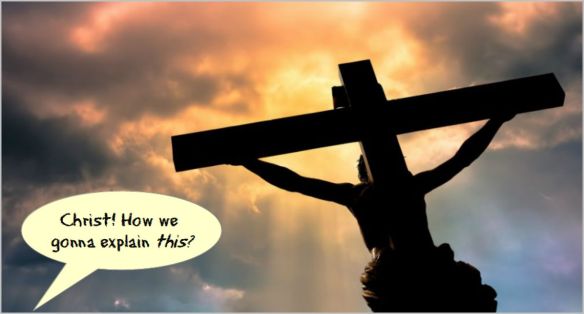
Christ! How could he have got it so wrong? Love your neighbour as yourself! Whoever heard such crap? I know, a nice idea, but I ask you. Everybody knows that being religious, being a Christian, is about believing the right stuff (having the right doctrine, I think it’s called), trashing other Christians who believe the wrong stuff, and dumping on everybody else, specially if they’re sinners (and they’re all sinners), foreigners, LGBTI or transgender. Now that’s real Christianity. I know it is, because that’s how Christians do it, and they’re the ones who should know.

Apart from Jesus, nobody thinks loving others like you love yourself is a good idea. Even he wasn’t very good at it (Matthew 15.22-28 etc). What ‘your neighbour’ is for, is pointing out how sinful/lost/degenerate they are, how they’ve f**ked up their lives, how God’s going to punish them for all eternity for not being the same as you and how they’re just about single-handedly bringing about the end of the world on account of being so perverted/evil/foreign.

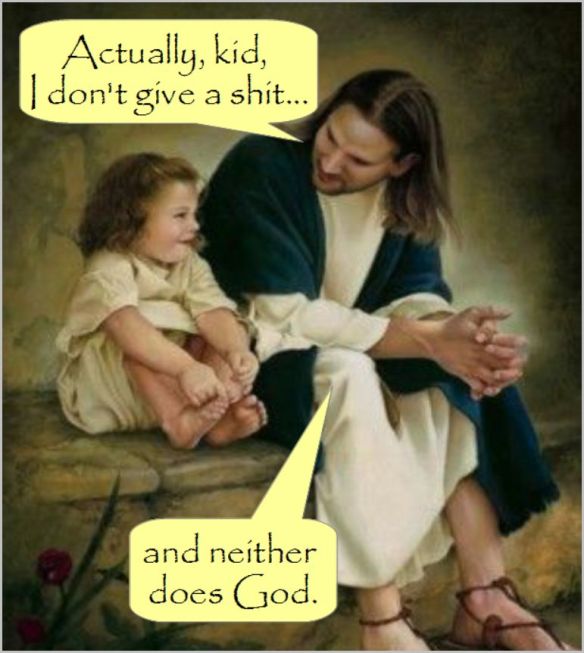
That’s how you love your neighbour! You can’t even claim to be loving them properly unless you’re telling them about Jesus, over and over again, and, in the process, denigrating, dismissing and damning them to hell over and over again. This is what truly loving your neighbour is about! I know because Christians say so endlessly: ‘you’re only really loving others if you’re telling them what shite they are and how they need Jeeesus to wipe it all away.’ So, okay, this isn’t exactly how you love yourself, but what’s that got to do with it?

If only Jesus had listened to his mouthpieces today. They know far more than he did about what’s important.

And love it isn’t.


Faith by any other name (is still a waste of time)

celia3Faith; the brand name for ‘wishful thinking’. In what other area of life, other than the religious, do we have faith in faith? Christians like to say we do – we have faith, they say, in the pilot who’s controlling the aircraft we’re flying in, or we have it in the surgeon who’s operating on us. But this is not faith in the sense religious people usually use the term. ‘Faith’ in pilots, surgeons and even our own abilities is more like trust or confidence; trust that the pilot is qualified to fly the plane, confidence that the surgeon is trained and skilled or that we have the ability to complete the task we’ve set ourselves. This is not faith in the sense of ‘belief in things that can’t be seen and for which there’s no evidence’. It’s not faith in the sense of wishing and hoping there really is a God and that he cares enough about us to grant us eternal life, much in the manner of the magic fountains and wish-granting genies of folk tale.

Religious faith – Christian faith particularly – is of this latter kind. It’s not trust in a real person’s capabilities, be it our own or a specialist’s. It’s a blind belief in a God who evolved from being one tribal deity among many into the everlasting, omniscient creator of all things. A God who, if he did create everything, set us on the Earth together with viruses, microbes, infections, disease, sickness, cancer, AIDs and Alzheimer’s. A God who thought putting us in an environment so frequently hostile to our well-being on an insignificant planet in the corner of a vast and indifferent universe was just the right place for us.

This is a God who doesn’t seem to understand us but who is swift to punish us while he himself stands by as half of his favoured creation endures poverty, starvation and the cruelty of much of the other half. His ways are not our ways, believers say, making what they surely know is a flimsy excuse – the flimsiest – for his failure to interact with us in any meaningful way.

Faith is the wishful thinking that despite the evidence, this neglectful, capricious God really does care for us. He cares so much he has devised an illogical, incomprehensible plan (or two) that, with its blood sacrifice and magical overtones, we must believe if we want his forgiveness for the way he made us in the first place.

We need to have faith that this cosmic madman will bring us back to life us after we’ve died and take us to Heaven to live with him, but we must first have the right sort of belief, even if it’s difficult to work out what that is. Faith is necessary for all of this because there isn’t a scrap of evidence anyone has ever been returned to life after they’ve died, or that Heaven exists, or that anyone has ever gone there. That’s why it takes, not trust, but a great wallop of wishful thinking that this fantasy is not only real but more real than the reality in front of us.

As for me, I can’t believe any of it.

  – I can’t believe the claims of those who even today say they’ve seen or heard from God or Jesus or Mary, who reckon they’ve had visions the same way Paul or Peter, Joseph Smith or Mary Baker Eddy did.

  – I don’t believe those who say they almost died and went to Heaven, because what these visions of fantasy figures and make-believe places have in common is that they take place, so far as they occur at all, entirely within people’s heads.

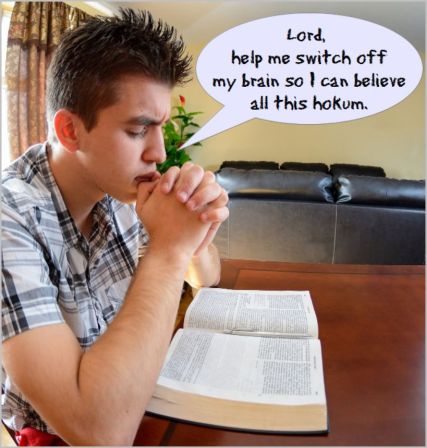
  – I won’t believe that those who say all of this magic, hallucination and mumbo-jumbo is true because it’s in the Bible, when the creators of that book were men far more ignorant and superstitious than any reasonably educated person today.

  – I am unable to believe muddled nonsense that is designed to appeal to our vanity and fear of obliteration.

  – And I really don’t care that some say they get comfort, joy and morality from their belief; their morality no more derives from God as mine does from Superman and emotions don’t make any of it true.

So, faith – what good is it? If your answer is it enables you to believe the impossible, then isn’t it just another word for delusion?


The Kingdom Comes

This guy they think is going to save the world – or at least make his country great again – is one smug bastard. An egotistical megalomaniac who carries on as if he’s God Almighty.

He expects to be obeyed at all times, issuing orders he demands everyone follow, regardless of how reckless or impractical they are, and making promises he can’t possibly keep. He’ll countenance no dissent, argument or protest, lambasting those who challenge him with petty name calling and abuse. Being hyper-sensitive and childishly petulant, he takes offence easily, abandoning any semblance of rationality and becoming malicious and spiteful in his condemnation – damnation, even – of those he regards as his enemies. Despite this obnoxiousness, he can’t understand why he isn’t universally loved. That he isn’t, is, he tantrums, the fault of those who wilfully, stubbornly, refuse to recognise his magnanimity.

He says he’s pro-God, but what really matters to him is his own legend. His first love is himself. He’s self-focused and self-promoting, racist and xenophobic, divisive and irritable, obsessed with his own status and what he sees as his God-given mission to revitalise his nation and return it to those he regards as his own. To this end, he’s surrounded himself with acolytes, cranks like himself, who will serve as his yes-men and women, who’ll do whatever he tells them. In return, he offers them a share in the power he’s assumed, together with the privilege of enjoying a little of the glory he’s convinced is his. Naturally, these sycophants do his bidding; they know that if they don’t, they’ll be out, ejected from the inner circle as energetically as Porky Pig from a bar Mitzvah.

But enough of Jesus.

If only there were some sort of parallel in the world today that would help me convey what a delusional, controlling, self-aggrandising individual he really was. Sadly, I can’t think of any.

bannon


Experts in make-believe

pence

As it is in the secular world, so in the Kingdom of Heaven. Entirely self-appointed experts abound in the religious sphere: priests, pastors, preachers, imams, rabbis. Some have degrees in theology; some have a degree of enlightenment (or so they claim) from personal encounters with the supernatural; some have learnt at the feet of the experts who have gone before them.

But what are religious experts expert in? Unlike our politicians who have at least a degree in a legitimate subject (even if not the one they now profess to know all about) the only thing religious experts are knowledgeable about is a collection of fantasy stories. That’s the Bible, of course, for Christian ‘experts’, with its supernatural beings, monsters, giants, magical incantations, transformations and resurrections.

If these experts were to encounter the same sort of fantastic notions in any other book, they would readily acknowledge that what they were dealing with was myth and legend. Not so their own ‘holy’ text! Oh no. This, of all the books of magic that exist, is, they say, the real deal because in amongst the far-fetched stories is some moralising about being extra-nice to fellow Jews and loving your enemies.

All that Christian experts are expert in is myth. That is their specialist subject. They’re not really interested in the injunctions about serving others; the mythical stuff they refuse to acknowledge as myth is much more to their liking: the eternal God-man, living forever, fantasy heaven, fantasy hell. The expertise of priests, pastors and preachers is in this smorgasbord of twaddle – and even then they frequently get it wrong. Those who offer their ‘spiritual’ experiences as demonstration of its veracity (‘I know it’s true because I commune with the eternal God-man’) add nothing of substance to their claims; all they’ve done is internalise myth, nothing more. Myth it remains. And just how useful is expertise in made-up stories in this day and age?

Like politicians who are skilled in one area but assume expertise in another, Christian experts also think that their knowledge of myth makes them experts about all sorts of other things: psychology, morality, the state of the world, politics, science, history and pre-history – even the future. They know all about these, they like to tell us, because by extrapolating from their book of myths and legends, they have an understanding that surpasses that of the real experts in these areas (we can exclude the future here; no-one in the real world claims to know with any certainty what the future holds. Naturally, Christians like to pretend they do).

You think this isn’t the case?

Because of what they think the Bible says:

Mike Pence, ‘evangelical Catholic’ and vice-President, thinks God will heal America only if ‘his people, who are called by his name, humble themselves and pray’ (quoting 2 Chronicles 7.14). He wants to end state-funded abortion rights into the bargain and disputes climate change;

Franklin Graham, who said prayers at the recent inauguration, insists that God himself engineered Donald Trump’s election;

Pastor Robert Jeffress, who provided a private church service for Trump prior to the inauguration, thinks so too, so that America can have ‘one more chance’.

Jim Bakker, ex-felon, televangelist and guest at the inauguration, claims he was responsible for Trump’s election because he ‘bound’ hell-spawned demons who opposed Trump.

Pastor Rick Wiles, meanwhile, is too busy enjoying being sprayed with the golden showers of God’s Grace that even now are ‘oozing’ from Heaven because of Trump;

Steve Bannon, Trump’s Chief Strategist & Senior Counselor and one of the architects of the immigration ban, is pushing hard for a return to ‘Judeo-Christian traditionalism’ (which hasn’t stopped him from being married and divorced three times);

Betsy DeVos, Trump’s anti-gay Education Secretary, thinks schools should be used to build God’s Kingdom on Earth and wants Creationism taught alongside Evolution;

Ken Ham continues to influence people like Betsy, by teaching that the earth was created 6,000 years ago, Adam and Eve really existed and humans co-existed with dinosaurs;

Jerry Falwell jr, appointed by Trump to reform higher education, sees no contradiction between being a pro-life creationist and an arms advocate;

Religious Rights leaders are urging Trump to reverse the rights granted to LGBT people under President Obama, both in America and worldwide. At the time of writing it looks like he might;

Anne Graham Lotz, Billy Graham’s alabaster daughter, asks what the Bible has to say about the Women’s March in Washington last week and concludes that women who protest are ‘loud, undisciplined and without knowledge’;

Sandy Rios of the religious ‘American Family Association’, agrees, saying feminists are ‘people who live in filth’;

Steven Anderson thinks people in need are ‘lazy bums’, just like the Bible says (2 Thessalonians 3:10) and continues to call for LGBT people to be executed;

A million and one other preachers and pastors think they have your psychology all worked out – you’re nothing but a sinner in need of Jesus’ saving grace.

By any rational standard this is all lunatic stuff. These people know no more than you or I about any of the subjects they spout about. They think they do – and worse still others believe they do – because of what (they think) is in their collection of myths; ‘I know what I’m talking about because it’s in my magic book!’ And who are we to doubt such credentials?

It is all fallacy. Christian experts are experts only in the ephemeral, the unproven, the mythical. Yet they claim to know so much about everything else as a result. They claim they know how you should live your life and what, for you own good, you should be allowed to do and what you should not.

People such as these have now come to power in America.


It’s Only Make Believe

godsatan

All you have to do to become a Christian/be saved from sin/gain eternal life is to accept Jesus as your Lord and Saviour.

Except, it isn’t.

You’ve also to put your faith in the Bible, acknowledging it’s God’s word in some form or other. It would be impossible to be a Christian without it; you’re required  to read it, let the Holy Spirit or one of God’s chosen instruments here on Earth interpret it for you and you’ve to live by it.

And this, in turn, entails believing in the menagerie of supernatural creatures and invisible realms the Bible assumes exist. Angels and demons we considered last time, and then there’s –

The Risen Christ who sits at the hand of the Father. He sits? He’s like a real body, but at the same time not a real body? A spiritual body, then, who metaphorically ‘sits’ next to –

God the Father, whom no human has ever seen (confirmed by John 1.18 but contradicted by Genesis 32.20) who abides in –

Heaven, a place no-one has ever seen. No, really, no-one. Not even those people who have hallucinated about being there. Hallucinations, dreams, visions, even so-called out of body experiences, are not evidence Heaven exists. They’re evidence that people sometimes hallucinate, dream and have visions and out of body experiences. The same is true of ‘sightings’ of God himself and of –

The Holy Spirit. That’s the part of God Christians dupe themselves into thinking has moved in inside them to guide them through their Christian life. That’s the same Holy Spirit who’s guided God’s Chosen to create 34,000 different distinct interpretations of the Truth. Even now, the Spirit is leading church after church down the road of apostasy, according to those he also leads to condemn them. Confused yet? It all makes sense if you recognise that it’s all imaginary, created by human beings who didn’t and don’t know any better. Like –

Satan is. He’s the character who evolves during the course of Bible until he’s a cross between Lex Luthor and the Joker; God’s arch-enemy. He only ‘exists’ to get God off the hook. All the bad in the word can’t be God’s fault now, can it? Somebody’s got to carry the can and it sure isn’t YHWH. So Satan, the devil, gets to be the embodiment of evil. Which isn’t to say evil doesn’t exist because it does, but it’s not caused by this third-rate Dick Dastardly. Nor is –

The Anti-Christ. This is the guy Christians believe will appear at the end of the age, some time around AD 100 according to Revelation 14.9-10. Never mind his creator there calls him something else entirely (‘the Beast’ as it happens); unless he’s finally arrived in the shape of Donald J. Trump, he’s no more real than –

Those who’ve died (‘the saints’ according to Catholics) and have been given new, magic bodies in Heaven or –

Those who’ve died and have gone to Hell to be tortured forever. That’s because –

Hell doesn’t exist either.

Nor do seraphim (Isaiah 6.2), cherubim (Hebrews 9.5), dragons (Psalm 148.7), satyrs (Isaiah 13.21) or unicorns (Numbers 23.22 etc) .

How do we know these beings, places and states don’t exist? Well, they’re all invisible, intangible, undetectable, unverifiable, supernatural (literally, ‘outside nature’), and, ultimately, unconvincing. They’re rejects from far more interesting mythologies that abounded in the ancient world. Today’s mythologies – of Middle Earth, Game of Thrones and the innumerable virtual worlds of computer games – are far more plausible (and even then, not very).

The supernatural doesn’t exist; everything we know is part of a physical universe. There is no evidence anything exists outside, alongside or in addition to that universe. (Though if you think there is evidence for the supernatural – and I mean evidence, not ‘feelings’, personal experiences or ancient texts – then please make it known in the comments).

There is an abundance of evidence, however, that –

Human beings are rather good at inventing stories and mythologies;

Their psychology inclines them to inner imaginings;

They are largely irrational and with a tendency to attribute agency to inanimate objects, phenomena and the chimera of their own imagining;

They have a fear of death and their own personal extinction.

How could religion, with all of its make-believe, not fail to materialise under such conditions? And how can anyone in this day and age take it seriously, knowing what we do now?

I know I can’t.