Jesus just isn’t up to it

A brief diversion from considering why God couldn’t possibly have created the universe…

Falls

Billy Graham’s grandson, Boz Tchividjian, has been addressing the issue of child abuse in the protestant church. He concludes his considered comments with the claim that,“there was no greater defender of children than Jesus.” Presumably he bases this on the few things Jesus is made to say about children in the gospels – all two of them: ‘suffer the little children’ (Luke 18.15-17) and that stuff about ‘whoever leads a little one astray’ (Mark 9.42), which is really more about the precariousness of faith than children. And, according to Boz, this qualifies Jesus as the greatest defender of children ever. No-one has ever done anything ‘greater’ for them. Not Dr Barnardo, not Save the Children, not the NSPCC, not foster carers or ordinary mothers and fathers. Nope, Jesus is the best ever child protector. The same Jesus in whose name both Catholic and Protestant churches have systematically abused young people down the years.

I never cease to be amazed at the willingness of Christians to superimpose every conceivable virtue, and quite a few prejudices, on a long dead itinerant preacher. But this is no modern phenomenon. It began within a few years of Jesus’ death, when religious zealot Saul decided that a peculiar turn he’d had was really Jesus returned from the dead. On the back of this, Saul – newly rebranded as ‘Paul’ – invented all manner of nonsense about a man he’d never met, his entire, tortured theology bearing little relation to any individual who had ever actually lived. We know this is what happened because of the disciples’ objections to Paul’s ideas and the very different ways in which Jesus was later to be portrayed in the synoptic gospels.

Then the crank who wrote Revelation added even more to the Jesus legend; he was now an avenging warrior-king, ready to fight dragons and smite his enemies right, left and centre.

And still it goes on: Christians insist Jesus was perfect, that he did not ‘sin’ or do anything immoral, when the figure in the synoptic gospels is alternately misogynistic, xenophobic, insulting, prone to anger, supportive of slavery and megalomaniacal. Far from perfect, in fact.

Not so, say other Christians who make it up as they go along; Jesus is a great protector and defender, looking after his flock from Heaven. But in reality, his protection is non-existent, as those who implored him to divert hurricane Harvey recently discovered. (We can be sure his uselessness as an insurance policy won’t change the way any of them regard him.)

Even if Jesus isn’t perfect or a great defender, he is, according to extremist nincompoop, Kevin Swanson, a divine punisher, inflicting natural disasters as a result of people’s ’embrace of sexual perversion’. Yet at the same time, he has a special affection for the good ol’ US of A, steering Donald Trump into the presidency and pulling his strings to Make America Great Again.

Or maybe Jesus is really a financial wizard; proponents of the ‘prosperity gospel’ say so, despite Jesus’ repeated repudiation of wealth in the gospels. On the other hand, he’s a sensitive little snowflake, easily offended by anything and everything we do down here on Earth, to the extent he gets upset by what’s on the TV.

Jesus can barely bear the weight of the incredible claims made for him in the gospels (miracle worker, prophet, healer), even though this is a great deal less than the characteristics he’s had projected on him since. Jesus was not eternal, nor the ultimate sacrifice as Paul claimed; he was not God himself as later Christians determined; he was not perfect, nor the greatest defender of children ever; he was not a super-hero warrior-king, nor was he patient, meek or mild. He did not have a preference for a nation that did not exist in his time nor was he explicitly anti-gay. Despite how he’s invariably shown in devotional material produced by western Christians, he certainly wasn’t white. He wasn’t even a Christian.

All of these attributes have been added to him, long after his death, by those who need and want him to be these very things, who need a saviour in their own image. The many Christs that exist, from those invented in the first century to those worshipped today, are, every one, figments of the human imagination.


Why God couldn’t possibly have created the universe (pt 1)

Preacher

I’m doing some thinking aloud here in an attempt to address the Christian claim that atheists are somehow compelled to believe the universe arose from nothing. Nothing can’t create something they say, so a creator is required – and what do you know? This creator turns out to be their very own pet god, YHWH, in one of his many incarnations. Definitely not Allah, Ra or any of the other hundreds of creator gods dreamed up by mankind through the millennia.

I’m not convinced atheists do claim that the universe can only have come from nothing. It’s an argument put into the mouths of atheists by some Christians who say, in effect, ‘if you don’t accept that our God made the universe then you have to believe it came from nothing.’ But it is the result of a false dichotomy (or false witness) because the position is not the only alternative to claim that a supernatural entity made everything. Lawrence Krauss, for example, demonstrates how something can arise from nothing and he and other scientists tell us that in any case there is no such thing as nothing – there’s always something, if ‘only’ at the quantum level.

The notion then, that in God’s absence the universe can only have come from nothing is a straw man, created by Christians desperate to diminish, dilute and dismiss scientifically viable alternative explanations.

It’s patently dishonest. (Christians being intellectually dishonest? Whoever heard of such a thing?) It’s dishonest because, in fact, it is Christians who believe the physical universe was created from nothing. I’m going to attempt to show you that they do and in the process dismantle their claims that their God was the one who magicked up everything from this nothing.

1. God too would have had to have create something from nothing.

Here’s the problem. God had nothing to go on. No raw materials with which to create the universe, and no raw materials from which to make the raw materials. There was only him and nothing. It is not unreasonable to ask, therefore, where the material from which he made the universe came from. The necessary ingredients for a universe – gravity, black holes, dark matter, dark energy, vast quantities of chemicals and what-have-you – are all physical phenomena, none of which existed before god allegedly made them. So, from what did he make them?

Perhaps he used parts of himself, in which case, he’s been depleted ever since, missing those bits of himself he used to make matter. Or maybe he turned part of himself into the physical universe so that he retained his integrity while integrating the universe into his very being – like a divine dream, say, or a tattoo.

The bible, however, doesn’t support either of these propositions. It makes clear that God created the earth and that which surrounds it (it has little concept of the universe as we now know it) as entities entirely separate from himself. His creation did not deplete him, nor was it a part of him (though he wasn’t, in the early days, averse to making guest appearances in it). Which bring us back to my original question; with what did he make it when there was only himself and nothing? Everything, Christians tells us, is made from something, so if God did not make the universe out of himself then he can only have made it from nothing. Everything there is, everything there has ever been – from gas clouds to planets, bugs to brains – God apparently produced from nothing.

Those who argue for this – and everyone who says God made everything is doing just that whether they realise it or not – does not advance our understanding of how the universe came into being one iota. All it does is introduce a sentient being into the equation, long before sentient beings existed. Moreover, the presence of such a being is superfluous, adding only unnecessary complication while explaining… absolutely nothing. Applying Occam’s razor we can just as easily take God out of the equation and be no worse off. There is a far greater probability that phenomena that do actually exist created the universe, not one that is mere conjecture.


Next time we will look at an empirical and logical impossibility that also means (a) God can’t have had anything to do with it.


God approves of slavery

slavery

Over on his blog site, Biblical Musing, Don Camp is trying to justify why God appears to condone slavery. It’s not the first time Don has tried to defend the indefensible; he’s recently been arguing much the same thing on Debunking Christianity.

The fact the Old Testament appears to endorse the keeping of other human beings as slaves is a problem for Christians. It’s a problem compounded by the fact that Jesus in Luke 12.47-48 and the imposter-Paul, in Ephesians 6.5, both support the practice. How can it be that God approves, or at least raises no objection to it? Wouldn’t an omniscient, all-loving God have outlawed slavery, as he outlaws so much else, in one of his innumerable laws and commandments?

Instead, he provides instructions about how to keep and look after slaves; what to do, for example, when you flog one to within an inch of his life so that he later dies (Exodus 21.20-21) or when you deliberately blind your slave – she’s your property after all – or rape her (Exodus 21.26; Numbers 31.17-18).

Don’s answer is that, despite God involving himself in the minutiae of slave treatment, he knew it would be a waste of time telling his people slavery was wrong. Why? Because he took the trouble to tell them lying and stealing were wrong and yet they ignored him. So, hey, why should he bother telling them about slavery? They’d just ignore that too.

But the point is – disregarding the fact that not everyone steals and lies – ‘God’ did issue laws prohibiting stealing and lying (and eating shellfish, and wearing garments of mixed fabric). It seems it was important to him to tell his pet-tribe that these were wrong, even though he must have known many of their number, and many more subsequently, would ignore him.

What can we conclude from this? Only this: that God didn’t feel the same way about slavery as he did about lying and stealing, which is why he didn’t bother making even the same token effort to prohibit slavery.

Or, and much more likely: the tribes who wrote the laws didn’t think slavery was wrong. In fact, they thought it quite useful to have slaves. Given this utility, they were unlikely to have devised laws preventing their ownership. The enslaved themselves no doubt thought differently, but then they didn’t get to write the rules.

We don’t find a commandment prohibiting slavery in the bible because those who wrote it liked having slaves. For this reason too, we find all those inhumane instructions about keeping slaves and what should happen if you maim or kill them.

Of course God didn’t write these laws. People did. And they wrote them according to their understanding of what was moral, fair and legitimate within their own primitive milieu. Thus it was that slavery got a free pass.

Gilead – just a stone’s throw away

Stone3

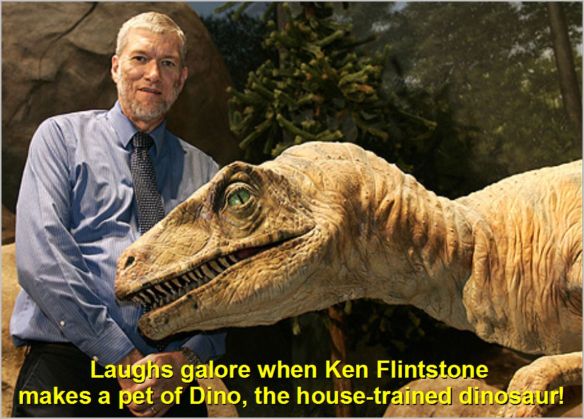
Ken Ham’s Answers In Genesis thinks it’s okay to stone people. Specifically, your wayward kids. The bible says so and AiG’s Elizabeth Mitchell is eager to defend whatever the bible says, on account of it being ‘God’s Word’. She does warn us that we need to read Deuteronomy 21:18–21, where you’ll find this particular bit of parenting advice, in context, because although the bible is the fallible, eternal, literal word of the Creator of the Universe it needs interpreting, and has to be understood in terms of the time it was written.

The context is of course that Deuteronomy and all of the Old Testament was written by primitive, superstitious bronze-age tribesmen who had the same mentality the Taliban and Isis have today. But this isn’t good enough for ‘Doctor’ Mitchell. No, her context is altogether different; she tells us in an article recently posted on the Answers In Genesis Facebook page that Deuteronomy 21 isn’t talking about children. No, it’s referring to uppity teenagers, which makes it okay. And not just teenagers, but really, really troublesome ones, which makes it doubly okay. These really, really troublesome teenagers are the scourge of society and can be stoned with impunity. The bible says so.

And yet, they’re not. Christians don’t stone awkward family members, thankfully. Perhaps, despite articles like Mitchell’s and others’, Christians don’t really believe the brutality promoted in and by the bible. Mitchell offers no explanation for this inconsistency of belief. Instead, her article peters out with some incoherent rambling about Jesus; the same Jesus who declared his undying support for these brutal, Old Testament laws (Matthew 5.17-19).

I suggested in the comments on Facebook that it doesn’t matter how much one takes context into account, the command of Deuteronomy, that rebellious youths be stoned to death, is utterly indefensible. It is cruel, barbaric and belongs in the past when, presumably, unfortunate young people were actually killed in this way by their families and tribal elders. I suggested morals and standards have evolved for the better since the days when people considered that murder was the best way to deal with youthful bad behaviour.

And for that I was metaphorically stoned myself. How dare you challenge God and his Word! How ridiculous to suggest we have better moral standards today when clearly we are in an immoral abyss worse than any before! Last Days! God’s standards are inviolate and if he says the best way to deal with miscreants is to stone them to death then it is!

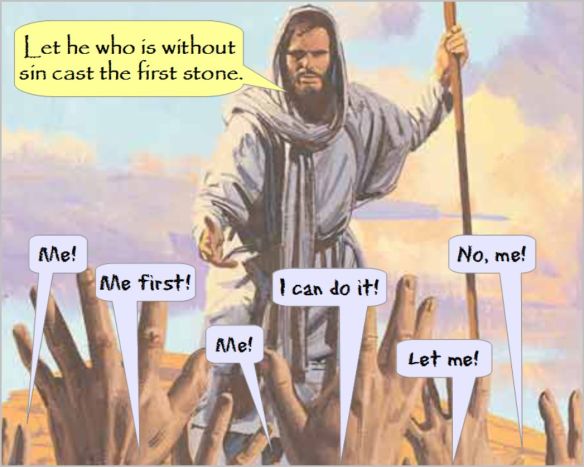
The Gilead regime envisaged by Margaret Atwood in The Handmaid’s Tale, where Old Testament sanctions are stringently applied in contemporary society, is closer than we think. People like those who hang around on Answers In Genesis’ Facebook pages, like flies around a corpse, would be more than happy to see the death penalty for those who infringe God’s barbaric laws. They’d be only too willing to throw the first stone, not only at difficult teenagers, but at all the others ‘God’s Word’ says merit the death penalty: couples who have sex when the woman is on her period (Leviticus 18.19); women who are not virgins on their wedding nights (Deuteronomy 22.13-14; 20-21); gay people (Leviticus 20.13); those who work on the Sabbath (Exodus 35.2; Numbers 15.32-36); blasphemers (Leviticus 24.16) and worshippers of other gods (Deuteronomy 13.6-9).

I am not an advocate of censorship but some form of censure is necessary for those who, either in speech or writing, advocate that others be put to death. Calling for the execution of those with whom you disagree or who have different moral codes cannot – must not – be tolerated in a civilised society. Pronouncements like those of Elizabeth Mitchell, her supporters and other religious crackpots who defend the indefensible, should be flagged up as hate speech, carrying a warning that the views expressed are themselves immoral, insupportable and, ultimately, illegal in civilised society. Ideally, their poisonous rhetoric should not be provided with an online platform. This wouldn’t, before anyone suggests otherwise, violate their right to free speech; they would still be free to express their unpalatable views in their churches, Creation Museums and own homes. Excluding them from Twitter, Facebook and YouTube, however, would deprive them of their wider audience – they’re only showing off, after all – and confine their hateful rhetoric to where it can do least harm.

These people are not merely ‘causing offence’ – offence is not the issue. They are inciting violence against others, influencing fellow believers to adopt their repellent views as their own. The standards of bronze-age tribes are not ours today; those who think they are abuse free speech and forfeit their right to be heard publicly.


Some fairly random, half-formed thoughts on Evolution

ew

Ken2

1. On Sex

‘Evolution is a Lie’ read the placard in the town centre the other day as Christian preachers took to ranting, again, about how everyone’s a sinner in need of Jesus.

I thought, if evolution is a lie then why is there sex? What would be the point of it in a world created by God?

While sex makes abundant sense in the context of evolution, it is difficult to explain in terms of Creationism. Why? Because sexual reproduction (as opposed of any other sort) exists specifically to ensure the shuffling and recombining of genes to produce variation in offspring. Why would a Creator (say the God of the bible, so beloved of Ken Ham and every other Christian) create the very mechanism that makes natural selection, and therefore evolution, possible? Why would he introduce a process that has no purpose but to serve as the engine of evolution? There wouldn’t be any need to, unless this deity specifically planned to develop life through evolution, or a process very like it.

But Christians like those street preachers and Answers in Genesis and its sycophants, reject the Darwinian model of evolution. So how do they explain sexual reproduction when it’s not only incongruous in a creationist scenario, but completely unnecessary? If not to drive evolution, why does sexual reproduction exist at all? It’s not, if I might pre-empt one possible response, because God thought we’d enjoy it; most living creatures reproduce sexually and ‘enjoyment’ is not part of their perfunctory copulation. Not to mention the fact that the Creator God of the bible spends most of his time objecting to and condemning sex.


2. On Life from Non-life

I’ve been told many times by Christians that, without God, life could not have got underway and subsequently evolved. Their argument goes like this: ‘inanimate chemicals are incapable of organising themselves into complex, self-replicating organisms,’ which makes me think, not of sex, but of viruses; non-living groups of chemicals that are highly organised self-replicators.

I’m not saying life necessarily developed from viruses, but they are evidence that inanimate chemicals are capable of acting as if alive, organising themselves to serve a collective purpose, namely self-perpetuation. The earliest viruses would not of course have been as complex as those today (viruses evolve too), but next time you have a viral infection, consider whether the difference between non-life and life is as great as it might seem. From what we do know, it wouldn’t need much, and certainly not a god, to turn one into the other.


More random thoughts on Evolution next time.


How the bible gets almost everything wrong: volume 3

Paul4

So there we have it. The bible is historically, scientifically, medically, morally, and psychologically inaccurate. It is a muddle of contradiction and confusion, written by pre-scientific, bronze-age tribesmen and religious zealots who made guesses about how the world worked. In almost every respect they got it wrong.

So what does this mean for the central premise of the book, its claim that the Creator of the universe, the Father of mankind speaks through it? Why should we suppose that when it gets everything else wrong, it manages to get this right?

We shouldn’t. The bible’s knowledge of God comes from the same source as the rest of its information: the wild imaginings of men who knew no better. The bible itself tell us so, many times. By its own admission, it is a catalogue of dreams, visions and inner ‘revelations’. In the New Testament alone there are at least twenty ‘meaningful’ fantasies of this sort, including the entirety of its final book, the aptly named ‘Revelation of St John’. The bible comes from an era when dreams and other subjective internal experiences were widely regarded to have significance as messages – revelations – from the gods, not the routine and not-so-routine workings of the human mind we now know them to be. Every era, before the scientific, regarded them in this way.

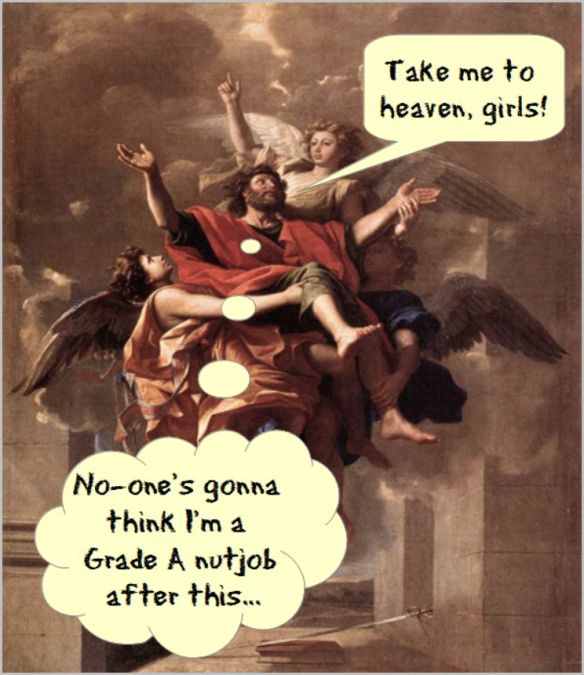
So Paul interpreted his psychotic episodes, depicted as a disembodied voice and bright light in Acts but far more dreamlike and hallucinatory in Paul’s own descriptions, as experiences of the risen Jesus himself (1 Corinthians 9.1 & Galatians 1.11-12) and of heaven (2 Corinthians 12.1-4). From these he built up all of his fanciful ideas of ‘the Christ’, not one of them based on anything demonstrable or real. All of them mere notions in his head, notions that others were all to willing to accept as the words of a god. After all, wasn’t that how the Almighty always communicated with mere mortals?

Still today people surrender to these ‘revelations’; Paul’s theology built on out-of-body experiences, the disciples’ grief-induced visions, John’s hallucinogenic ‘bad trip’. These are the foundation of Christianity as we have it, providing all we know of God, Christ and salvation, and all of them without any basis in reality. Some believers even claim to have the same sort of ‘revelations’ themselves; God speaking to them, Christ bathing them in light, visions of Heaven. All of these, again, entirely within their heads and no more real than the occasional appearances of my long dead grandfather in my own dreams. However much Christians might insist on a rational basis for their beliefs, it is an inescapable fact that the faith has its origins in ancient people’s dreams and hallucinations. Rationalising after the fact doesn’t alter this.

I don’t know about you, but I’m not interested in basing my life on others’ emotionally-induced inner visions, whether those of a Paul, or a Joseph Smith or a contemporary whack-job. I don’t want to learn about the world and life from people whose understanding and knowledge derive from their sub-conscious and hallucinatory fantasy life. Give me science any day, with its attempts to minimise subjective, human biases from its exploration of how things are. Give me its discoveries that have enhanced life, however imperfectly, in the here and now. Above all, give me honest rationality over sub-conscious imaginings and psychoses.

I have no interest in a god, or a saviour, constructed from other people’s dreams, visions or hallucinations, even, or especially, when they’re recorded in that most unreliable of sources, the bible.


How the bible gets almost everything wrong: volume 2

bible-questions

The bible’s moral inconsistencies:

As we saw here and here, the bible’s morality is confused and frequently contradictory. Jesus himself adds to the confusion with pronouncements like:

You have heard it said (in Exodus 21.24), ‘Eye for eye, and tooth for tooth.’ But I tell you, do not resist an evil person. If anyone slaps you on the right cheek, turn to them the other cheek also. (Matthew 5:38-39)

and

You have heard it said, ‘You shall not commit adultery.’ But I tell you that anyone who looks at a woman lustfully has already committed adultery with her in his heart (Matthew 5.27-28).

God’s ‘standards’ change depending on who thinks they’re channelling him:

In Joel 3.8 he advocates slavery but in Exodus 21.16 he forbids it.

In Matthew 6.1 Jesus insists good deeds should be done secretly forgetting he’s already said, in Matthew 5.1, that they should be done openly to impress others.

In Matthew 7.1-3 Jesus says judging others is to be avoided while in 1 Corinthians 6.2-4, Paul gives it the go-ahead; judging others is fine.

In Matthew 19.10-12 Jesus disparages marriage but the writer of Hebrews approves of it (13.4)

God allows divorce in Deuteronomy 21.10-14 but in Matthew 5.32 Jesus doesn’t.

And on and on. Like everyone else’s, Christians’ morality is socially determined. Unlike everyone else’s, their morality reflects the bible’s own confusion and inconsistencies. To accommodate its contradictions, Christians cherry-pick from it to bolster their pre-existing prejudices and biases. The rest of us are then measured – judged – against the resulting pick’n’mix morality and, boy, are we found lacking. ‘Biblical morality’ is nothing if not projectile.


The bible’s weak understanding of psychology:

Many of those who wrote the bible had a particularly bleak view of human beings. To these men we are totally depraved and our every thought is ‘continually evil’ (Genesis 6.5) Our ‘hearts’ are supremely deceitful and desperately sick (Jeremiah 17.9) and we’re under the control of the devil (Ephesians 2.1-3). We are incapable of doing good (Romans 3.10-13) and as Jesus himself puts it:

That which proceeds from a person, defiles that person. For from within, out of the heart, proceed the evil thoughts, fornications, thefts, murders, adulteries, deeds of coveting and wickedness, as well as deceit, sensuality, envy, slander, pride and foolishness. All these evil things proceed from within and defile a person. (Mark 7.20-23).

I don’t recognise this as a description of myself and I’m sure you don’t of yourself. Of course human beings are capable of terrible acts (I’m writing this not long after a fanatical Muslim murdered 22 young, innocent people in a terrorist bombing in Manchester, here in the UK) and, on a more mundane level, we can behave in thoughtless or vindictive ways, entirely out of self-interest.

But we’re also capable of great kindness, compassion and concern. We are a complex mixture of these traits, the good and the bad. The biblical view that we are only ever hateful, devoid of any good, is jaundiced and unnecessarily negative. If parents were to spend their time telling a child he or she is only ever bad, wicked and evil, they would rapidly deprive the child of their self-worth, self-confidence and ability to relate in positive, loving ways to others. The description would become self-fulfilling. This is what the God of the bible does to his children.

Neither are we awash with sin. Sin is a religious idea, used to describe how humans fall short of the glory of God. It need not concern us here. There is no God to fall short of; sin therefore is a concept without any traction in the real world.


The bible’s fantasy perspective of the world:

Did you know this world is controlled by the devil and his demons? That powers and principalities of the air are at war with God and the powers of holiness all around us? In fact, the devil is always looking for ways to discredit the bible and is constantly trying to weaken Christians’ faith. He smuggles false doctrine into the church in order to mislead believers, and uses the hoax that is evolution to prevent unbelievers from accepting Christ as their saviour. He gives women ideas above their station, which God says is to be submissive, and has unleashed a wave of homosexual behaviour and gender confusion to blind people to God’s goodness and to kindle his wrath.

Did you know, though, that this fallen world and the ‘heavens’ above it are soon to be destroyed and replaced by a new earth and new heavens, where Jesus will reign over the select few God decides to raise from the dead? Despite Satan thinking he’s in control, it’s actually God who is. God only allows the devil to think he’s top-dog while he, God, is secretly pulling the strings.

If you do know these things, and if you believe them, then you have a ‘biblical worldview’. Or, to put it another way, you’ve bought into third-rate hokum that bears no relation to the world – the universe, even – as it is.


How the Bible gets almost everything wrong: volume 1

Jesus7

Scripture is under attack! Yes, really. Answers in Genesis says so, so it must be true. The Enemy with a capital letter is out to undermine its authority. That Satan and his school-boy pranks! What will he think of next?

It doesn’t, though, need an all-powerful personification of evil to undermine the bible. It does it all by itself. In any aspect we might care to mention; scientific, medical, historical, moral, psychological – even how the universe operates- the bible is mistaken, confused and just plain wrong. The truth is not in it.

Let’s take look at some examples:

The bible’s scientific blunders

According to the bible:

the Earth was created before the sun (Genesis 1:9-16)

Stars are points of light in the canopy – ‘the firmament’ – that surrounds the Earth (Genesis 1:16-17)

Beyond this canopy is water (water comes for the sky doesn’t it? I guess the canopy leaks. God opens its ‘windows’ during Noah’s flood) (Genesis 1:6-7)

The sun moves, though it can be made to stop in its tracks with the right magic (Joshua 10:12-13)

Genetic characteristics can be changed by whatever animals look at while they’re copulating (Genesis 30:37-39)

Hares and coneys chew the cud (Leviticus 11:5-6) and flying insects sometimes have four legs (Leviticus 11:20-23)

The value of Pi is 3 (1 Kings 7:23-26)

More here if you can bear it: http://skepticsannotatedbible.com/science/long.html

The bible’s historical inaccuracies

The ‘history’ of the Old Testament is largely fabricated. Much of it is myth and legend, created centuries after the events it purports to describe. There is no evidence, for example, that the Israelites were slaves in Egypt, wandered the wilderness for forty years and then invaded the land of Canaan. Historians are now fairly sure that the people who would later fashion themselves as the Israelites were rabble-rousers within Canaan and that they set about eliminating, by one means or another, other populations that lived there. The ‘great kings’ of Judaism – David, Solomon – were no more than tribal leaders; think ‘Taliban commanders’ and you’ll have a pretty accurate picture of what they were really like.

There’s no evidence either for Noah’s ark and a global flood, the events of the tower of Babel, Joshua’s destruction of the walls of Jericho, Daniel’s adventures in the palace of Nebuchadnezzar… you name it. Each and everyone of these stories was created to make theological points, to aggrandise the people who created them.

There are similar problems when it comes to the historicity of Jesus’ life.

The bible’s medical ignorance

According to Jesus – God Incarnate, no less – many disabilities and diseases are caused by demons:

A man in the crowd answered, “Teacher, I brought you my son, who is possessed by a spirit that has robbed him of speech… Jesus rebuked the unclean spirit, saying to it, “You deaf and dumb spirit, I command you, come out of him and do not enter him again.” (Mark 9:17 & 25)

The way to cure illness therefore is to ‘drive out the unclean spirits’ that cause it. Jesus does so many times (Matthew 12.22 etc) and sends his chums out to have a go as well (Matt 10.1). Now, is this because God knows that sickness and disease really are caused by supernatural baddies, or is it because Jesus’ understanding of illness was as limited as that of any other first-century peasant? You got it – Jesus (and his later script-writers) merely reflect first-century ignorance about the causes of illness. However, if, as today’s Christians believe, Jesus was somehow God himself, then why don’t they opt for exorcism every time they’re ill? There are some nut-jobs who do, of course, but why don’t all of them trust their lord and saviour on the matter?

There’s equally ludicrous medical advice elsewhere in the New Testament: James 5.14-15 tells us that the cure for any ailment is prayer:

Is anyone among you sick? Let him call for the elders of the church, and let them pray over him, anointing him with oil in the name of the Lord. And the prayer of faith will save the one who is sick, and the Lord will raise him up.

Sure enough, some believers have taken this ridiculous advice seriously. Instead of medical treatment, they’ve done as the bible commands and prayed for their sick children, frequently with fatal consequences.

More next time…


Sin

Sin

During the recent election in the UK, the leader of the Liberal Democrat party, Tim Farron, was asked if he thought gay sex was a sin. Farron is a born-again Christian and instead of answering the question, he hedged round it. Predictably, this meant that journalists returned to it, with the politician dodging it each time.

In all probability, Farron does regard gay sex as a sin. The bible teaches that all behaviour that offends God is sin, causing a rift between mortals and the deity. This, biblically speaking, is what defines sin. Tim Farron would have been better being honest, saying that his faith leads him to believe that sex between people of the same sex is sinful but that personally he is a supporter of equal rights for all. His voting record indicates this to be the case; he has consistently voted in favour of LGBT rights while, presumably, maintaining his faith. Perhaps if he had answered in this way, he might not have felt the need resign as Lib-Dem leader on the grounds that his role as party leader conflicted with his personal beliefs. Predictably, evangelical groups have claimed he was hounded out of office because of his beliefs, but it seems far more likely he was, as he said himself, finding it difficult to reconcile his faith-induced worldview with his public duty. It must be difficult defaming your colleagues when you’re supposed to be demonstrating Christ’s love.

Whatever the reason, those who believe that human behaviour is sinful are wrong. Nothing humans do is a sin. Nothing we do, gay sex included, offends God because there is no God to offend. Sin is an entirely religious concept that has outlived its usefulness, if it ever really had any. Which is not to say human behaviour cannot be immoral. It can, but immoral behaviour and sin are not the same thing. As a rule of thumb, morality is determined by the extent to which our behaviour adversely affects others. Deliberately harming them physically, materially or emotionally is (likely to be) immoral behaviour. Murder, theft and abuse are immoral – but they are not ‘sin’.

Morality is not always clear cut, however; arguably it would not be wrong to murder a terrorist or suicide bomber before he can embark on a killing spree. Aborting collections of cells in a woman’s uterus, if that is what she wants, is also not an immoral act. Similarly, victimless behaviours such as sex – both hetero and homosexual – between free, consenting adults is neither wrong nor immoral. Nor is masturbation, gender fluidity or transgenderism. And as for the betes noir of the church of my youth (and who knows, they may still be) – listening to rock music, having the odd drink and dancing – they’re not either.

On the other hand, some of the activities indulged in by religious people are immoral: attempting to impose their beliefs on others; misrepresenting and denigrating those different from themselves; pressurising gay people to deny their sexuality; advocating the death penalty for homosexuality; covering up fellow-believers’ criminal activity; teaching children that creation myths are true; dismissing science; persuading people that prayer works; convincing others they are sinners.

We all behave immorally, thoughtlessly and carelessly, from time to time. But we are not, as a consequence, destined for hell, nor are we in need of a saviour to magically wash away any wrong-doing; if that really worked, we would see no immoral Christians. No, when we have behaved immorally we need to make reparation to those we have harmed, not ‘repent’ by begging forgiveness of some irascible god. What we should never do, whatever the Righteous ones tell us, is regard ourselves as sinners. We are not: it is impossible to offend a deity that doesn’t exist.


Making Excuses for Jesus

jesus-jw

Excuse 5. When Jesus said the ‘Kingdom of God is coming soon’, what he meant to add was ‘but only in heaven and then in 1874. Or 1878. 1914? Er… 1975. After 2017?’

So say the Jehovah’s Witnesses. In 1897 they claimed that Jesus had started on his comeback tour in 1874:

Our Lord, the appointed King, is now present since October 1874, A.D., according to the testimony of the prophets, to those who have ears to hear it: and the formal inauguration of his kingly office dates from Apr 1878, A.D. Studies in Scriptures Series IV (p.621)

and

The year A.D. 1878 … clearly marks the time for the actual assuming of power as King of kings, by our present, spiritual, invisible Lord… The Time is At Hand (1911 ed) p.239

When there was no sign this had happened – and goodness knows what sort of sign there could possibly be – the JWs changed their minds again and said the real date for the start of the ‘full’ kingdom was to be 1914:

In view of this strong Bible evidence concerning the Times of the Gentiles, we consider it an established truth that the final end of the kingdoms of this world, and the full establishment of the Kingdom of God, will be accomplished near the end of A.D.1914. Studies in the Scriptures Series 2: The Time is at Hand (1889 ed) p.99

and

October, 1914, will witness the full end of Babylon, “as a great millstone cast into the sea,” utterly destroyed as a system. Watch Tower (Jun 15 1911) p.190

Alas, over a century later there’s no sign of the Kingdom’s ‘full establishment’, while the old, corrupt system (Babylon) carries on as normal. So, after another change of heart, and a quick, futile stab at 1975 as the right date, Jehovah’s Witnesses came up with a revised plan. Here’s how it looks:

Jesus will return while the generation alive in 1914 is still around, when he will finally get the Kingdom underway. This is the ‘generation’ to which he refers in his prophecies in the bible; his return and the Kingdom coming to the earth will definitely happen while the 1914 generation  is still alive.

But hang on! A person born in 1914 – and there are some still around – is now 103, while those who were already adults in 1914 are long dead. In other words, the 1914 generation has almost gone and there’s still no sign of Jesus or his Kingdom. Either he’s going to return real soon, before the last of the 1914 generation depart, or he’s going to miss the deadline yet again (Guess which it’s going to be).

But worry not, Jehovah’s Witnesses have this one covered too! When Jesus referred to ‘this generation’ he didn’t just mean one generation, but to the generation that ‘overlaps’ with that generation. There’s nothing biblical about ‘overlapping generations’, of course. Jesus didn’t say, ‘the Kingdom will come while this generation and those that overlap with it are still alive,’ but like mainstream Christians, Jehovah’s Witnesses need to give Jesus and themselves an excuse if they’re to avoid admitting that he and they have got it wrong.

So, an overlapping generation would be one like my own, whose grandparents were children in 1914. But we can extend this – and we can be sure JWs will once Jesus fails to return on time – because, using the same ‘reasoning’, my grandchildren’s generation ‘overlaps’ with my grandparents’ through me. My grandchildren’s grandchildren too will be connected with all previous generations, including that from 1914, because of those who have preceded them… and on and on, ad infinitum. In fact, Jesus could come back at any time in the future so long as someone is alive who can trace their ancestry back to 1914.

But he’s not going to. He wasn’t talking about a ‘generation’ almost 2000 years after he lived. He was certain the Kingdom of God was coming to his time and his people. All of these convoluted and ultimately unconvincing explanations of what he ‘really’ meant when he preached an imminent heavenly Kingdom on earth simply won’t do. While mainstream Christians mock Jehovah’s Witnesses for their silly conjecturing about Jesus’ return, they share the belief Jesus is coming back. Most won’t venture a date (though there have been plenty who have) because, they will tell you, Jesus also said ‘no-one knows the precise day or hour’ when the Son of Man and the Kingdom will appear (Mark 13.32). Nevertheless, they remain certain that Jesus will return: this year, next year, sometime… any time other than that which he actually predicted.

While evangelical Christians and others insist that the bible, where all Jesus’ failed prophecies appear, is the literal and infallible word of God, they refuse to take literally his pronouncements about the coming of the Kingdom. While he might have said he didn’t know exactly when it would arrive, he was certain it would be while his own generation lived. As he is made to say in Matthew 16.28, ‘some who are standing here will not taste death before they see the Son of Man coming in his kingdom’.

All of which is a problem for Christians: if these predictions are not to be ignored, then they must be interpreted, explained and, eventually, explained away. The last thing believers want to do is accept them for what they are; the demonstration of Jesus’ failure. The Kingdom didn’t arrive when he said it would and, given how far it is past its sell-by date, it’s certainly won’t be now.