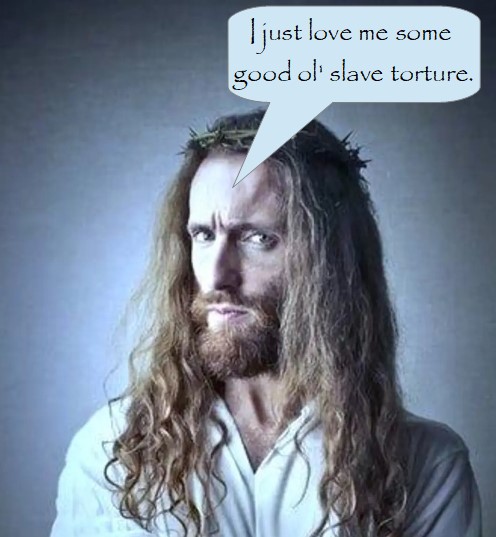
Jesus’ Ungrateful Slaves

Jesus really liked telling stories about slaves. It’s as if he’d no objection to the inequitable arrangement of one person owning another. You’d think, if he really was the Son of God, he wouldn’t be quite so ready to assume unquestioningly, the zeitgeist of his day that decreed slavery was acceptable; necessary even. His being a man of his time, incapable of thinking beyond the assumptions and indoctrination of his culture might suggest he wasn’t a heavenly being at all. Either that or his creators, the writers of the gospels and the likes of Paul, were incapable of seeing beyond the zeitgeist and so made their god-man in its image.

In any case, they have Jesus tell a parable in Matthew 18:21-35 about forgiveness, which is populated once again with slaves and a slave owner. The story, in which a slave is forgiven by his master but fails in turn to forgive a fellow slave, ends with the following:

…after he had summoned him, his master said to him, ‘You wicked slave! I forgave you all that debt because you begged me. Shouldn’t you also have had mercy on your fellow slave, as I had mercy on you?’ And his master got angry and handed him over to the jailers to be tortured until he could pay everything that was owed. So My Heavenly Father will also do to you if each of you does not forgive his brother from his heart.”

Of course, the slave owner, referred at the start of the tale as ‘the king’ is – predictable metaphor alert – Jesus himself. He’s fond of casting himself in the role of kingly slave owner, with ordinary mortals his slaves. As we’ve seen already, this is the favoured analogy of New Testament writers to describe the relationship between their manufactured saviour and themselves.

Actually, the moral of the tale in this instance isn’t too bad; if you’re forgiven much it’s not unreasonable to suppose you could, in turn, forgive others their more minor offences. But this isn’t quite enough for Jesus’ script writers who have him drag jail, torture and retribution into the story. These, Jesus concludes, are the very things his wonderful Heavenly Father – based on the despotic rulers of the time – will inflict on anyone who doesn’t forgive as generously as they might.

What hypocrisy! Forgiveness is all according to Jesus but his Heavenly Father, he says with relish, will torture unforgivably anyone who doesn’t comply. What were the cultists who created this awful malicious character thinking? Jesus and everything to do with him is anti-human and soul-destroying.

As for me, I’d recommend forgiving others where you can, learning from the experience (once bitten twice shy and all that) and moving on. You won’t, whatever you do, be tortured by a fictitious, vindictive slave owner and his bullying idea of a god.


A Reply to a Slave

I’ve discovered this new gizmo that lets me look stuff up on the Interweb. Goober or somesuch. I used it to find the meaning of ‘doulos’ that the absence of dictionary prevented you from doing. All of the results Goober brought up described doulos thusly:

Doulos (Ancient Greek: δοῦλος, Greek: δούλος, Linear B: do-e-ro) is a Greek masculine noun meaning “slave”. Wikipedia

Doulos (a masculine noun of uncertain derivation) – properly, someone who belongs to another; a bond-slave, without any ownership rights of their own. Biblehub (Christian site)

…anyone could become a slave, in a sense. However, once someone was sold into slavery, they remained a slave for life, and all of their offspring automatically became slaves as well. The only standard way of obtaining freedom was to earn enough money to pay your owner back as much as he had paid for you in the first place. This was a nearly impossible task to accomplish because slave owners did not often facilitate their slaves ability to earn money on the side. As such, most slaves, and their offspring remained slaves for the totality of their lives. Slavesandsons (Christian site)

Doulos is a Greek word in the Bible that has only one true historical option for accurate translation into English, which is slave. It literally means to be owned by someone for a lifetime. This word is found at least 127 times in 119 verses in the New Testament scriptures. It is used in the context of human slavery, which, sadly, was very common throughout the ancient Roman Empire for hundreds of years. Recorder.com (Christian site)

You’ll see none of them say what you say, Don. None think slavery was a nice amicable arrangement. Christian sites especially emphasise how slavery was a downright awful thing so’s they can sermonise about how Jesus saves us from slavery to sin.

If you’re going to reduce real world, God-approved slavery to something akin to a nice comfortable arrangement, you diminish the metaphor of Christ’s redemptive work to… not much at all. (Which of course it isn’t.) I noticed you didn’t comment on this point when I mentioned it in an earlier post and here you are digging yourself in deeper with your ‘slavery wasn’t really all that bad’. Good work, Don!

You’re certainly enslaved to all this Christian mumbo-jumbo. To Christ though, not really. There’s no such being and you certainly don’t give the impression of being a slave in any real world sense. Perhaps that’s because you have no understanding of what slavery was and is.

Jesus Shows How To Treat Slaves

Jesus’ parable of the talents

Three slaves are given money by their owner, two invest it while the third buries his share. He is castigated by his master (yes, it’s Jesus as his favourite metaphor: slave master) who says to him on his return:

I tell you that to everyone who has, more will be given, but from the one who has not, even what he has will be taken away. But as for these enemies of mine, who did not want me to reign over them, bring them here and slaughter them before me. (Luke 19:26-27)

I know, that last sentence doesn’t fit the rest of the story, but it tells us what a despicable s**t Jesus was, quite happy to see those who didn’t want a peasant with delusions of grandeur lording it over them exterminated. Thank God the Romans got to him first (if indeed he existed.) No-one likes a dictator, specially not another dictator.

How about the conclusion to the actual parable, the one about the slaves and the money? The talents are evidently a metaphor for something or other. According to Christianity.com, it’s that the third slave, ‘didn’t take joy in the promise of the master’s return but instead wasted his time, his opportunities, and the master’s money.’

In other words, it’s fanatic talk aimed at those with a lack of commitment to the cult and its beliefs, including the ‘master’s’ imminent return, when wastrels will be in big trouble. As Christianity.com puts it:

Those who are not (faithful) may face the harsh reality of being called a wicked and lazy servant. Worst of all, they may not share in the joy of their master’s presence when he returns.

And there we have it, the softening of Jesus’ dictatorial original: ‘will’, as in ‘will lose everything’ becomes the hedging-your-bets ‘may’ while ‘slave’ (doulos again) becomes the watered-down ‘servant’. After all, we wouldn’t want to draw attention to how much of a cruel bastard Jesus was originally conceived as being. (Because, yes, these stories were invented by the early Jesus cult.)

The cult took no prisoners; in terms of commitment. It was all or nothing. Waiver in that commitment and you risked expulsion when the slave-master returned. So much for being redeemed unto salvation, so much for salvation by grace alone. If you weren’t utterly committed you stood to lose it all. What the original cultists weren’t to know, of course, was that the master would never return. The whole sorry parable was as irrelevant then as it is now.

God’s Agents?

Christians are agents of God or so we’re informed. I’ve tried to locate where in the Bible it says that the Lord appoints fallible humans to be his 007s, but alas, I can’t find it anywhere. The best I can do are the claims in the fourth gospel that Jesus was God’s agent on Earth, but that’s not the same thing.

What about the idea then, also touted by Christians, that they are somehow God’s ‘partner’? No, that’s not there either. God regards himself as so far above us, his creators, that it would be like you or I partnering one of the ants crawling around in our gardens.

So how does the Bible describe the Christian’s relationship with God? It refers to it as master and servant. The word usually translated as ‘servant’ however, is doulos, which actually means ‘slave’. God doesn’t want you as an agent, partner or servant. He expects you to be his slave. Christian blogger, Sam Storms, explains what this means:

I, in the totality of who I am, have been purchased by Jesus Christ. He literally owns me. I belong to him, body, soul, spirit, mind, affections, abilities, talents, heart, will, and emotions. There is nothing in me or about me that belongs to me.

As a slave of God you are stripped of the very agency other Christians claim they gain from aligning themselves with the divine despot. And when you’ve done all he requires of you he’ll barely acknowledge you. As Jesus puts it in Luke 17:5-10:

Suppose one of you has a slave (doulos) ploughing or looking after the sheep. Will he say to the slave when he comes in from the field, ‘Come along now and sit down to eat’? Won’t he rather say, ‘Prepare my supper, get yourself ready and wait on me while I eat and drink; after that you may eat and drink’? Will he thank the slave because he did what he was told to do? So you also, when you have done everything you were told to do, should say, ‘We are unworthy slaves; we have only done our duty.’”

Whatever you do as God’s or Jesus’ slave won’t be enough, they’ll still regard you as a worthless slave.

I didn’t know about you, but this isn’t for me. I have more self-respect than to submit to a life as a slave. So have you. So in fact has everyone.

Most Christians agree. Almost all of them disregard the expectation that they become slaves. We know this because –

  • The majority don’t act as if they’re slaves, serving their fellow human beings till they’re fit to drop (Matthew 25 etc).

  • Most seem unaware even that Jesus insists they must be slaves when successive translators have deliberately altered the unsavoury ‘slave’ to the more palatable ‘servant’.

  • Those who are aware of his expectation seem to regard it as a metaphor; always a good get-out. And doesn’t Paul remark in his letters that believers are sons of God? That’s much more acceptable.

  • They omit the slavery element from their evangelising because no-one is going to be attracted by the offer of life-long servitude; far better to present Jesus as a would-be friend, big brother and all round good guy with whom people can be in ‘partnership’ or a fellow special ‘agent’.

  • They talk about free will when a slave, either of sin (John 8:34) or of Christ’s, has no freedom and no free will to exercise.

  • They convince themselves that sitting at a computer arguing with atheists online is the kind of slavery Jesus had in mind.

  • They turn a blind eye to the fact that the Bible teaches slavery is what they can expect not just now but for all eternity (Revelation 22:3-4).

It’s almost as if they don’t really believe such self-abasing, masochistic nonsense themselves.


God’s Obsession

The first of a series of posts by guest contributor YHWH who posts on AllMadeUpandImaginary.com.

______________________________________________

Hi guys! And gals too though I have to confess I’m not really as interested in gals. I like cocks. I’m obsessed by them. I like them cut, and the sooner the better. I’m a bit of a perfectionist, you see. I made the first cock for the original human male, a beefcake called Adam. His name was a little joke on my part. You see, I knew the Hebrews would become my best buddies in few millennia’s time and that they’d use the word ‘Adam’ to mean ‘man’. Good pun, don’t you think?

Admittedly, it only works in the long term.

Anyway, Adam had the first. Cock that is. I’d made it so he was hung like a horse, and I thought he’d get some fun out of it with the female I’d thoughtfully supplied him with, though not for reproductive purposes. I hadn’t predicted at that stage how much trouble Adam and the woman were going to be, so when they were, I had to rethink my plan and invent procreation. I didn’t want to start again from scratch so I just repurposed the penis, shrunk it down a little and got the Adam prototype to cover it up. I didn’t want to get rid of it entirely because of course I was so pleased with it. Also it had some other function at the time, though I can’t recall now what that was.

After watching humans copulate for what seemed like an eternity (in what they imagined was privacy, which still makes me laugh), I felt that I hadn’t got the design of the dick quite right. It looked, well, comical with all that superfluous skin at the end that folded away anyway when the damn thing raised itself up in praise. I thought I could do better, but you know, by then I’d already restarted the whole damn project for a second time and to be honest, I couldn’t be bothered going back to the drawing board a third time.

So first chance I got, I came up with a contingency plan. I would find some way of getting them to cut it off. Not the whole cock, don’t get me wrong, ’cause as I say, I like that. No. The extra skin on the end. I figured they just didn’t need it and the whole thing would look more streamlined without it. Sure, they might lose some sensitivity when fucking, but so what. 

So I wait for the right dickhead (see what I did there?) to come along. Someone who’d be daft enough to sacrifice his offspring to me if I told him to. Sure enough, one soon comes along and I actually have to stop him from murdering his own son because, despite my reputation, I’m not really into that kind of thing. Well, not much. No, the cock’s the thing. So I tell him he can be my extra special buddy if only he’ll cut the skin off the end of his penis. I tell him that this’ll show me and the world that we have a special pact. In return, I promise that I’ll look after him and his descendants forever and ever. Not that he was gonna get to show his cock to the world, you understand, but you get my drift. And whaddya know, the idiot agrees to it and there and then takes an old rock to his old man, and his kids’, his slaves’ and anyone else he could lay his hands on, and hacks off the ends. I tell you, there’s one born every minute.

It wasn’t a pretty sight, I admit, what with all the blood and ragged skin, but it had more or less healed after a few months, infections notwithstanding, into something presentable. I took a look, ’cause I like looking at cocks and anything humans do with them, and I decided I approved. It looked more like I should’ve made the thing in the first place.

So for the next few hundreds years I’m happy with all the mutilated penises. I give their owners instructions about what they can and can’t do with them:

Slice off the top: That’s a must.

Rape female captives and slaves: Of course.

Fuck as many women as you can afford to keep: Naturally.

Have sex with your daughters: Well, okay but only if you’re pissed and they make the first move.

Don’t play around with other men’s cocks: Oh now, come on! Only I’m supposed to have an interest in other males’ members. So that’s a no. There are limits!

Then along comes some twerp who starts saying that anyone wants to be my buddy doesn’t have to crop their foreskin. I mean, who the hell does he think he is? I nudge a couple of my old mates and get them to tell this killjoy that I’m dead against the idea. But he ignores them and pretty soon there’s a whole bunch of fanatics who won’t get their dicks out for me. I ask you.

Thank God Me, there are still those who will though, including that other lot of God-botherers I’ve been keeping my eye on. They’re more than happy to slice and dice their young son’s willies. That’s what I like to see: commitment. And a nice bit of genital mutilation.

______________________________________________

Thanks YHWH for a really enlightening blog. Next time, His Almightiness will be talking about what he calls ‘The Spare Rib Problem: the Dickless Chicks.

The Power of Figments

Since his death, no-one has seen the itinerant preacher now known as Jesus. Some dispute he existed in the first place and certainly the character depicted in the gospels is a fictional creation. Assuming, however, that there was a real individual on whom this character was based, no-one has seen him in the flesh for 2000 years.

This includes all or most of those who wrote about him in the early years of the cult and whose writing now forms the New Testament. They either learnt about Jesus by word of mouth, as most converts throughout history have done, or they had a vision within their own heads of – what exactly? Those who write of such visions are either vague about what they claim they saw (Paul in Galatians 1: 15-16), are evidently making it up (John of Patmos in Revelation) or their visions are related by third parties many years down the line (Peter and Mary in the gospels, Stephen in Acts.)

Either way, the character believers claim to have seen or have heard about is a fantasy figure, not the rabbi who may or may not have existed. It’s this fantasy who lives in heaven snuggled up to his equally fictitious father, monitoring people’s behaviour, listening into their thoughts while simultaneously observing ‘the destruction the world is bringing on itself’ and doing not a thing to help.

All this from the heaven no Christian can locate: in another unspecified, invisible, undetectable dimension is the best they can offer. Nonetheless, if only more people would turn to him, Super-Jesus would help us solve the problems we face.

Because theocracies have always been so effective. They’ve led to a more just, fairer world as wise compassionate religionists have listened to their heavenly leaders – God, Allah, Jesus, Muhammed – and have applied the principles of their holy books to the running of their societies. Only obstinate sinners have had anything to fear from the arrangement: the degenerate, like those who have sex outside marriage and want access to contraceptives; gay people (especially); women who don’t know their place; women who seek abortions; the powerless; other, ‘inferior’ races; those of other religions, non-believers and atheists. None of these would have a place in Jesus’s new perfect world either, just as they don’t in societies controlled by Muhammed’s holy ones. Jesus’ agents will be happy to exterminate them, just as he instructs.

Magic Jesus as a figment of his followers’ imaginations can be made to say whatever they want, just as he was when he was being created by Paul and the gospel writers. He is a perpetual work in process, constantly changing to conform to what those who claim to know him want him to be. It’s easy to achieve this with a non-existent being from a non-existent place.

The Guilt Legacy

A couple of nights ago I watched a programme called Jehovah’s Witnesses and Me fronted by Rebekah Vardy. I know nothing about Rebekah apart from the fact she’s a footballer’s wife who was recently involved in a social media scandal, but her reflections on being brought up in a Jehovah’s Witness household were honest and sincere. She said one of the legacies of her mother being ‘disfellowshipped’ when she, Rebekah, was 8 was that she felt, and still feels, guilty about much in life. The teaching of the organisation was, as it is in many evangelical churches, that the individual is a hopeless sinner who cannot please Jehovah, though must nevertheless endeavour to work out their own salvation. For JWs this involved (and still does, as you may know from personal encounters with them) going door to door and standing for hours on end in public spaces with a trolley-full of Watchtower publications.

I could relate to Rebekah’s feelings of guilt. While not a Jehovah’s Witness (I was never that gullible) my years as a Christian left me with a legacy of guilt. For many years it was the dominant emotion of my life. While a Christian I constantly felt I was letting God down: not as good a Christian as those around me, not witnessing enough, listening to pop music instead of worship songs – practically anything could trigger my not-good-enough feelings. I also felt responsible for anything that went wrong, even when I couldn’t possibly be, and guilt about my secret sexual feelings and, most especially that I wasn’t been a good enough father. To this day, I feel awful if I’m unable to help with my grown-up children’s problems. I am moving away from such fruitless thinking, and recognise that possibly I am naturally inclined to blame myself for events both within and outside my control. Christianity nonetheless exacerbated the problem, with its emphasis on the sinful worthlessness of the individual who is nothing without Jesus. I have, I’m pleased to say, got a lot better since abandoning its negative anti-human philosophy.

What scars has religion left those of you who are escapees from religion with? I’d be more then pleased to hear it’s none, but most of the ex-Christians I know have not come away unscathed. Feel free to share in the comments.

Real Christianity v Catholicism

I visited a Catholic cathedral in Santa Cruz, Tenerife, while on my latest adventure. Not, I hasten to add, as a worshipper but as a tourist. One of the Canary Islands, Tenerife is a Spanish territory with a long association with Catholicism. Its name means Holy Cross, reflecting its history and the pervasiveness of the church. The cathedral’s altar can be seen in the picture above, highly ornate and completely over the top, with a statue of Mary, the Holy Mother, as its centrepiece. .Her son, you’ll note, plays only a bit part in the picture above her.

Real Christians™ of course don’t regard Catholics as true Christians. They point to their reliance on the Pope, when Jesus himself says his followers should call no-one Father apart from God; the army of dead saints that intercedes in heaven when all people really need is Jesus; the need to confess sins to a priest and the worship of Mary as the immaculately conceived ‘Mother of God’, who works miracles on their behalf.

People – Catholics – who believe these things can never be part of the club. ‘Their ideas are as ridiculous as they are unbiblical. No-one in their right mind,’ Real Christians™ say, ‘should believe such fanciful stuff. Stick resolutely to what we know to be true: the resurrection of a dead man; the Virgin birth and the promise of eternal life. These things are biblical and as such we can know and trust them. Not rubbish about saints in… erm, heaven living forever, having to ask for our sins to be forgiven and thinking Mary was conceived free from the scourge of sin.’

It seems to me that it’s only a short hop from believing one lot of far-fetched rubbish to believing still more. Maybe the Catholic stuff isn’t strictly biblical (though at a stretch it could be said to have been drawn from the make-believe found there) but then there’s nothing particularly special, plausible or reasonable about that which has found its way into God’s Word. Just because something is in there doesn’t make it true. Those who invented Jesus’ Virgin birth, his resurrection and the promise of everlasting life were making it all up, just as those who, further down the line, created the phantasmagoria that is Catholicism.

Santa Cruz is nice though.


What Happens When We Die (According to the Bible)

Street preacher Dale McAlpine was busy regaling the shoppers of my home town yesterday with the good news that they’re all sinners destined for hell. The God who created them will, Dale assured them, face an eternity of torture unless they turn to Jesus.

Dale didn’t have many (any) takers for this wonderful good news. One brave person, a young woman, asked him why, if people are resurrected, the cemeteries remain resolutely full. Good point! Dale, armed with his megaphone and hectoring ignorance, responded that it is the soul that survives death and is taken up to Heaven to live eternally with God. For those without Jesus, their souls will be consigned to hell where they will burn for eternity.

How unbiblical is that? The Bible does not teach that believers will go to live forever with God in heaven. Eternity in Heaven is not on offer. The New Testament writers anticipated the arrival of Heaven – God’s new Kingdom – on Earth. When it did, they believed, the dead would be resurrected: the saints to everlasting life in new spiritual bodies on a regenerated Earth (Revelation 21:1-4), the rest to eternal damnation.

Paul has some vague ideas about what will happen to those who die before the general resurrection – he thinks their souls will be kept safe ‘in Christ’ (whatever that mean but doesn’t suggest they will be living it up in Heaven. Rather, he describes them in 1 Thessalonians 4:14-15 and 1 Corinthians 15:20 as being ‘asleep’. Many Christian ‘thinkers’ really take exception to this idea, though Paul says this intermediate state won’t last for long; the Kingdom on Earth was imminent. He believed it would arrive while most of those he was writing to were still alive (1 Thessalonians 4:17; 1 Corinthians 15: 51-52).

It’s all tosh, of course. Paul had absolutely no idea what happens to people after death. He invented everything he said about it, from the independent existence of sleeping souls to Jesus arriving on the clouds to resurrect the dead in new spiritual bodies. These bizarre ideas come from a fevered brain convinced it had seen a dead person alive again and thought it had once taken a trip to the third heaven (whatever that is).

How do we know Paul invented it all? Because of the aspects of his teaching that should by now be history: the arrival of God’s Kingdom on Earth, the resurrection of the dead and Christians being supplied with new spiritual bodies ( while the rest of us roast in hell.) None of these things happened when he said they would, or indeed at all. We know it too because we are aware both instinctively and empirically that there is no continuation after death. When the body ceases to function so too does the ‘self’, which can be generated only by a living brain. We have no ‘soul’ that goes on alone after death and which will one day be clothed in a new sparkly body.

Here’s my challenge then to those who believe and propagate such nonsense; the Dales, the evangelicals, the fundies and the oxymoronic intellectual Christians of this world: provide evidence of one individual who has survived death in the way Paul said they would. Show us one believer who has been resurrected or whose soul is currently sleeps in Christ or who now lives in Heaven. The only proviso is that this must be a real person who is 100% human; not a mythical demi-God, not a character in a story, not someone for whom the evidence of a resurrection is extremely poor. Not, in short, Jesus. Where is the evidence anyone else has experienced a resurrection or embarked on their eternal life in heaven? Billions of believers have died since Paul created his fantasy. Surely there must be someone

Jesus: Practically Perfect In Every Way?

Was Jesus a gracious, gentle and humble as Christians like to claim or was he intolerant, self-important and frequently wrong? What do the gospels say?

He’s intolerant and self-important when:

He insists people should love him more than their own families (Matthew 10:37).

He says he’s not a peacemaker but intends creating strife (Luke 12:51).

He claims anyone who doesn’t follow him deserves to be burnt (John 15:6).

He wants the world to be destroyed by fire (Luke 12:49).

He commands people not to call others ‘fools’ (Matthew 5.22) but tells those he doesn’t care for that they’re ‘swine’, ‘dogs’, ‘snakes and vipers’, ‘whitewashed tombs’, and, yes, ‘fools’ (Matthew 7:6; 15:26; 23:33; 23:27; 23:17 & Luke 11:40).

He deliberately speaks in riddles so that people won’t understand him and won’t find forgiveness (Mark 4:12).

He tells his followers to love their enemies but says he’d have his own killed (Luke 19:27 & Matthew 13:41-42).

He endorses slavery and the cruel treatment of slaves (Luke 12:47-48).

He says people would be better off if they cut off their hands, plucked out their eyes and castrated themselves (Mark 9:43-48 & Matthew 19:12).

He endorses the Jewish law that demands the death penalty for those who disrespect their mother and father (Matthew 15:4-7).

He disrespects his mother (Matthew 12:48-49).

He tells people not to get angry but loses his own temper (Matthew 5:22 &Mark 3:5).

He callously kills a herd of pigs and, in a fit of pique, destroys a fig tree (Matthew 8:32 & Matthew 21:19).

He takes a whip to people (John 2:15).

He tells his mates he’ll soon be king of the world and promises them that they’ll rule alongside him (Matthew 19:28).

Are these the marks of a tolerant, compassionate man? Or the characteristics of an unpleasant, delusional megalomaniac?

As for frequently wrong: first, the false promises –

I will do <em>whatever</em> you ask in my name, so that the Father may be glorified in the Son (John 14:13).

Very truly, I tell you, if you ask <em>anything</em> of the Father in my name, he will give it to you (John 16:23).

These signs will accompany those who believe: …they will lay their hands on the sick, and they will recover’ (Mark 16:17).

Therefore do not worry, saying, “What will we eat?” or “What will we drink?” or “What will we wear?” But strive first for the Kingdom of God and his righteousness, and all these things will be given to you as well (Matthew 6:25-7.1).

and then there’s the failed prophecies –

For the Son of Man is going to come in his Father’s glory with his angels… I tell you the truth, some who are standing here will not taste death before they see the Son of Man coming in his Kingdom (Matthew 16:27-28). Just in case we don’t get this the first time, he tells us again in Matthew 24:27, 30-31, 34 and in Luke 21:27-28, 33-34.

Did he return with the angelic host and establish God’s kingdom on Earth before his disciples died? He did not.

Christian zealots unable to accept the evidence of the gospels themselves will no doubt have a hundred and one clichéd, implausible excuses for Jesus’ many failures: ‘he was speaking metaphorically’; ‘you lack the spiritual insight to see what he really meant’; ‘you’re quoting him out of context’, blah blah, blah.

All I ask is that they please, please don’t inflict these excuses on us here when we’ve heard them all so many times before.