The Seventeen Commandments

mosesQuick – can you name the sixth of the ten commandments? That was the question in a quiz I went to last night. We got it wrong, but I have to to tell you, so did the quiz-master. If you Google ‘the Ten Commandments’ – which I can assure you we didn’t during the quiz – what you get is the list of injunctions from Exodus 20. You know the ones: thou shalt not kill, steal, commit adultery or covet thy neighbour’s ass. Read them all here if you feel inclined.

When, in a fit of pique, Moses destroyed the stone slabs on which these ‘commandments’ were written, God generously offered to provide him with a replacement set. The Almighty even made a point of saying, in Exodus 34.1, that the two sets would be identical. But they’re not. Here’s the lot from Exodus 34:

1. You shall worship no other god, because the Lord, whose name is Jealous, is a jealous God.
2. Do not make any molten gods (idols).
3. Keep the Feast of Unleavened Bread.
4. The first born of every creature shall belong to me.
5. Work for six days and rest on the seventh.
6. Observe the Feast of Weeks.
7. Present all your male children to the Lord God three times a year.
8. Do not offer the blood of sacrifices to God with leaven and don’t leave the sacrifice of the Feast of the Passover until the morning.
9. Give the first of the first-fruits of the land to the house of the Lord thy God.
10. Do not boil a kid in his mother’s milk.

Far from being identical, only three commandments are the same in the two sets; missing from the Exodus 34 group are those about adultery, theft and killing, replaced with stipulations about ancient Jewish festivals and boiling baby goats (of great eternal significance, that one.) Just to complicate matters, this second lot is the only one referred to in the Bible as ‘The Ten Commandments’ (Exodus 34.28). The more familiar injunctions from Exodus 20 – the ones Google brings up – are not.

What is going on here? It’s as if ‘The Ten Commandments’ are not as immutable as Christians claim. What are they to do? Should they pick and mix between the two sets? Should they reject one and use only the other? Obey both lots – The Seventeen Commandments? It’s far from clear and yet, according to Jesus, their eternal existence depends on getting it right (Matthew 19:17).

All of which makes me think how a single seamless garment has been created out of a ragbag of scraps and patches. The church and believers in general have told us that the shambolic writings stitched together as the Bible tell a consistent story. This deceit is a major accomplishment of the Christian faith because the seamless garment is an illusion, created by pretending there are no discrepancies or inconsistencies and by glossing over all the significant differences within God’s Word™.

This is why we never hear of the second set of commandments – they’re put away like a mad woman in the attic. The church doesn’t want people seeing them or hearing about them. Best to shut them away and make out they don’t exist. Same with the second account of creation in Genesis 2. It’s different from that in Genesis 1, though both are embarrassingly wrong about the means and order of creation. When Christians do acknowledge that there are two accounts (as Ken Ham does) they insist, that, of course, there are no real differences and they can all be explained (away). If there are no differences, why then do they need explaining?

Then there are the disparate accounts of Jesus’ life. Even where they share the same material each gospel presents it differently or gives it a spin that frequently contradicts the other gospels’ versions of the same events. Every one of the stories about the resurrection, for example, is radically different in both detail and significance from all the others.

There are even greater problems for Christians in explaining how Jesus’ supposed sacrifice on the cross brings about salvation. The writers of the New Testament aren’t clear themselves, suggesting at least a dozen largely incompatible ways between them. The four gospels alone have conflicting ideas about how it works (more on this next time), all of which differ from Paul’s salvation formula.

I suppose if Christians want to deceive themselves about their faith and their magic book, it’s up to them. But, please, righteous ones, don’t try and tell the rest of us it has a clear consistent message when it doesn’t. Don’t tell us it’s a seamless garment when it has tangles of loose threads and you’ve had to throw away all the material that doesn’t fit the pattern you pretend you can see.


Oh, and that sixth commandment? ‘Observe the Feast of Weeks’. But of course you knew that.

Idiotic Stuff Jesus Said 13: We Don’t Need No Educashun

MegaBut you are not to be called rabbi (teacher), for you have one teacher, and you are all brothers. And call no man your father on earth, for you have one Father, who is in heaven. Neither be called instructors, for you have one instructor, the Christ. The greatest among you shall be your servant. Whoever exalts himself will be humbled, and whoever humbles himself will be exalted. Matthew 23:8-12

Evidently these words were put into Jesus’ mouth by the community that produced Matthew’s gospel and reflect the egalitarianism and communism that characterised it. The phrase that gives away their origins is ‘you have one instructor; the Christ’. ‘The Christ’, as we know, was a creation of the early church and it is highly unlikely Jesus would have referred to himself in such a way. In the synoptic gospels he is reticent even about claiming the Jewish title of Messiah for himself. In any case, the reference is patently to a third party, and is by an author or interpolator who subscribes to the later, supernatural Christ.

In the unlikely event, then, that these words emanated from Jesus himself, all they achieve is to demonstrate his lack of understanding of human psychology. Even as ‘Matthew’ set about recording them, the newly founded church was already ignoring them, which is perhaps why he felt the need to have Jesus say them. Here’s Ephesians 4.11, written by someone pretending to be Paul round about 80-100CE, contradicting them:

Christ gave (us) the apostles, the prophets, the evangelists, the shepherds and teachers…

The imposter who wrote 1 Timothy (5:17) up to a hundred years after Jesus’ death goes further, endorsing the exaltation of those who teach and rule others:

Let the elders who rule well be considered worthy of double honour, especially those who labour in preaching and teaching.

Why? Because human beings like hierarchies. Almost all human societies are hierarchical in nature and groups invariably arrange themselves hierarchically. There will always be people who see themselves as leaders and teachers and still others who look to those who’ve set themselves up as authorities to tell them what to do.

Despite what Jesus or ‘Matthew’ might have preferred – everyone being equal while those who ‘exalt’ themselves are humbled – it just doesn’t happen in human culture. It certainly wasn’t happening in the movement that emerged following Jesus’ death, in the church that existed by the time Matthew was making Jesus say that the only authority Christians should recognise was God’s and his own. The institution that was appearing in place of the end of the age – an institution that Jesus neither anticipated nor instigated – could not function effectively as the simple band of ‘brothers’ he is made to suggest. It was in need of structure, and a hierarchy was it.

And so it was that, before long, the first popes emerged – ‘pope’ deriving from the Latin for ‘papa’. Each of these exalted figures would come to be referred to as ‘Holy Father’, a title still in use today. With complete disregard for Jesus’ instructions, other priests (meaning ‘elders’) in the Catholic church also assumed the title ‘father’. Evangelical churches, lest they think the Catholic church is the only guilty party, have their ‘pastors’, meaning ‘shepherds’, who, by definition, lead others. A common or garden ‘clergyman’ is a ‘learned man’, while a bishop is one who ‘looks down from above’. An archbishop is chief look-downer and exalted indeed. Elsewhere, showmen preachers in mega-churches ‘teach’ with a mixture of anecdote, wild conjecture and stuff they make up as they go along; tune into TV’s God channels for a taste of this particular brand of humility. The church in all its manifestations has, from the beginning, been hierarchical from top to bottom.

Jesus, however, didn’t want there to be a top or bottom; if Matthew 23.8-12 is to be believed, he commanded there shouldn’t be. He envisaged his followers living in harmony with everyone equal under his and God’s authority. No-one was to set themselves up as teacher or leader; no-one was to exalt themselves above others. If any did, they would need to be humbled. But this isn’t how human beings organise themselves, and never how the church has conducted itself. Shouldn’t he have known that?

Always and Forever

nurseGod is trustworthy and true. He always keeps his promises. We know this because Christians, either in person or on web-sites, like to tell us so.

Let’s take a look at some of the promises God made back when he only liked Jewish people. How well do they hold up?

As part of his promise (covenant) with Jewish patriarch, Abraham, that he would look after his descendants in perpetuity, Yahweh came up with a particularly gross way for them to sign up:

I will always keep the promise I have made to you and your descendants, because I am your God and their God… Abraham, you and all future members of your family must promise to obey me. As the sign that you are keeping this promise, you must circumcise every man and boy in your family. This will be a sign that my promise to you will last forever. Any man who isn’t circumcised hasn’t kept his promise to me and can’t be one of my people… The promise I am making to you and your family will be for (your son) and his descendants forever (Genesis 17.7, 9-13, 21; my emphases).

‘Always’ and ‘forever’ obviously meant only until God changed his mind – which he did when he came up with the new ‘covenant’. You know the one: ‘believe in Jesus to be saved, no primitive surgery required.’ Of course, Jews still feel the original promise is in force and so keep up the old slicing’n’dicing membership requirement. So who’s right? Jewish people who feel that a promise is a promise? Or Christians who insist God eventually lost interest in mutilating penises? It’s hard to tell, but if it’s the Christians, then God, being omniscient and all, must have known he would change his mind eventually. So why tell ol’ Abe the agreement with him was ‘always’ and ‘forever’?

Then there’s the one where God promises there’ll be a descendant of King David’s on the throne forever:

I will establish your royal throne over Israel forever, as I promised David your father when I said, ‘You shall never fail to have a successor on the throne of Israel’ (1 Kings 9.5).

Oops. David’s line ceased ruling over Israel when the Assyrians defeated it in 586BCE. Since then there has been no king of the Davidic line ruling over Israel. Why didn’t God see this coming? And if he did, why’d he make a promise, with ‘forever’ and ‘never fail’, that he knew he wasn’t going to keep? Yes, I know Christians like to claim that Jesus took over the kingship when he came along, but he didn’t, not really. His descent from David is highly questionable and there’s still that awfully long gap between 586BCE and Jesus’ time that blows a hole in ‘never fail’ and ‘forever’. In any case, Jews, by definition, have never seen Jesus as their king and they’ve got a point: it’s difficult to see how someone dead and/or totally invisible can be king of anything.

Never mind, let’s try another. This time God’s promise that everything’s going to work out okay:

(The Lord) will judge between the nations and will settle disputes for many peoples. They will beat their swords into ploughshares and their spears into pruning hooks. Nation will not take up sword against nation, nor will they train for war anymore (Isaiah 2.4).

Safe to say this didn’t happen either. Not while people were still using swords and spears anyway.

Finally, what about the promise that’s trotted out every Christmas? –

For to us a child is born, to us a son is given, and the government will be on his shoulders. And he will be called Wonderful Counsellor, Mighty God, Everlasting Father, Prince of Peace. Of the increase of his government and peace there will be no end. He will reign on David’s throne and over his kingdom, establishing and upholding it with justice and righteousness from that time on and forever (Isaiah 9:6-7).

Whatever Christians might claim for these verses, they’re not about Jesus. At the risk of repeating myself, I’ll repeat myself: Jesus did not and does not reign on David’s throne. He said he would, it’s true, believing himself to be the fulfilment of ‘prophecies’ like this, but he was wrong, as events went on to demonstrate. He didn’t, in any case, fit the description of whoever it is who’s being spoken of here; an earthly ruler who – yes, you guessed it – has still to show up. We’d have spotted him if he had. Some Jewish scholars think they might have done, pointing to King Hezekiah who ruled Israel in the 8th and 7th centuries BCE, for almost 30 years. That’s hardly ‘forever’ though, is it. Yet more evidence that ‘prophecy’ doesn’t ever work, principally because it’s impossible to know the future.

God’s promises are like those of politicians: you just can’t trust them. There has to come a time when those who believe in them must face up to the fact they’re not promises at all, just ancient wishful thinking.

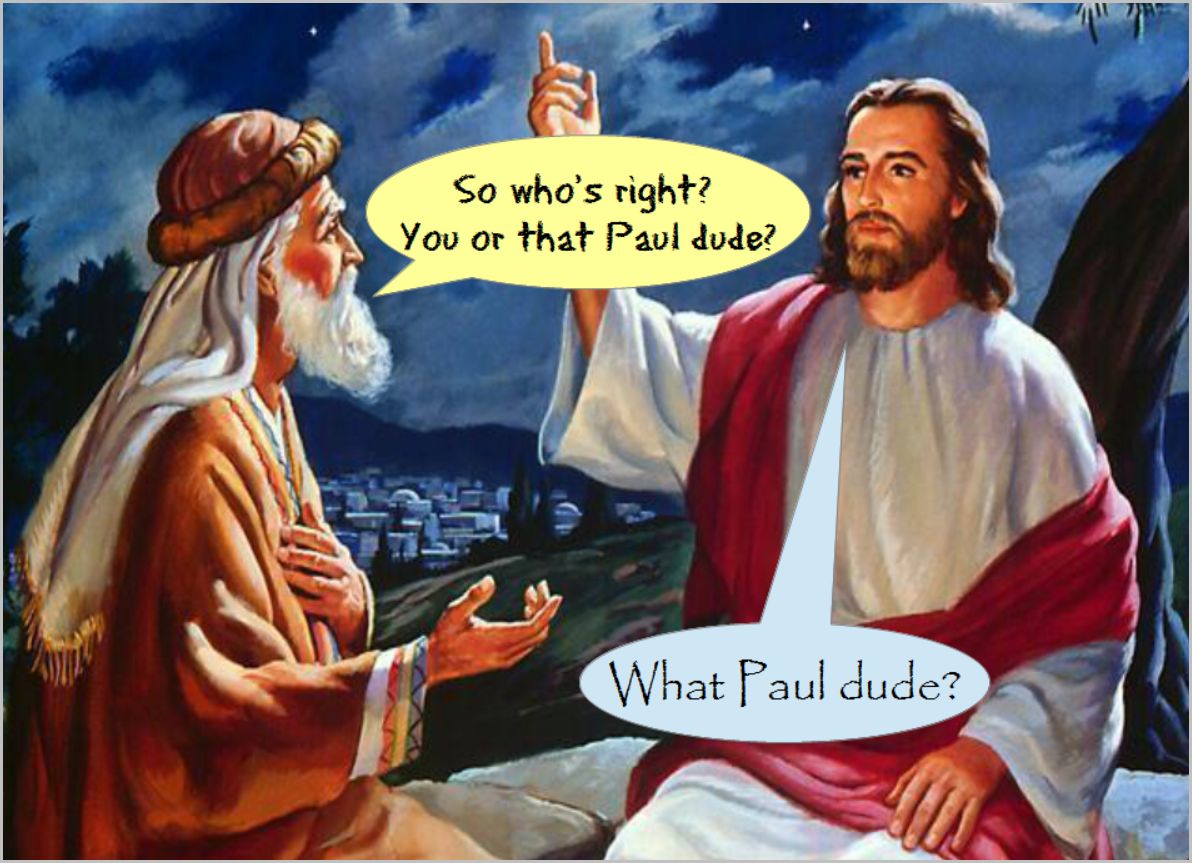
Jesus v. Paul Round 2: And the winner is…

Make-overI’m re-reading Barrie Wilson’s excellent How Jesus Became Christian. Wilson makes the case that Paul’s Christianity was, and is, an entirely different religion from that of the historical Jesus. He shows how Paul’s ‘Christification’ changed the original mission of Jesus – to alert his fellow Jews to the imminence of God’s kingdom on Earth – ‘from one focused on the teachings of Jesus to one about the Christ’ (p242).

How right he is. This very the dichotomy troubled me in my own church-going days when evangelical Christianity, as it still does, consistently excluded the demanding, extreme and human Jesus of the synoptic gospels to focus instead on this illusory supernatural being. They preach sermons about him, sing hymns to him and intone creeds that skip glibly over everything Jesus said and did when he was alive. The Christ was, I came to see over time, an invention of Paul’s, the product of his strange hallucination sketchily recounted in Galatians 1.11-12 and 1 Corinthians 9.1 & 15.45. The Jesus he talks about is a sort of cosmic super-hero, a god-man of the type found in pagan religions in the first century. He has little or nothing to do with Jesus the Jew preacher and would-be Messiah, preserved – just about – in the three synoptic gospels.

So, the differences between Jesus and the Christ are profound. Here are a few of them, that I’ve drawn up, demonstrating that Christianity as we know it – essentially Paul’s ‘Christified’ version with inconvenient bits removed – bears little relation to the ‘good news’ of Jesus:

Jesus’ good news: God’s Kingdom on Earth imminent (Mark 9.1 etc)
Paul’s good news: Salvation through a dying/rising god-man (Romans 3.19-26; 4.24; 5.1-2; 5.10 etc)

Jesus presents as: Jewish Messiah claimant: ‘Son of Man’; Self-appointed judge and king in near future (Matthew 16.28; 13.41; Luke 22.30 etc)
Paul presents: Mystical saviour: The Christ, who saves those who ‘share’ in his death and resurrection; Christ as judge and ruler of mankind in near future (Romans 3.25; 6.1-11; 13.11-12; 1 Corinthians 15.20-28; Philippians 3.20)

Jesus’ qualifications: Teacher, preacher and healer; ideas rooted in Jewish prophecy; full of his own importance (Matthew 5.17; 7.12; 9.35; 25.40)
Paul’s qualifications: Builds entire religion on single hallucination; borrows heavily from pagan cults; full of his own importance (1 Corinthians 15.8; Galatians 1.15-16)

Jesus’ position: Adherent of Jewish Law; emphasises its importance (Mark 6.2; Matthew 5.19)
Paul’s position: Disregards Jewish Law; implies it is ‘dung’ (Romans 3.28; Galatians 5.6; Philippians 3.7-9)

Jesus insists on: Obedience to Jewish Law (Matthew 5.17-20)
Paul insists on: Faith in Christ and his resurrection (Romans 1.16-17; 3.22)

Jesus’ salvation requirement: Be righteous/perfect (Matthew 5.48; 13.43)
Paul’s salvation requirement: Faith (Romans 5.1; Galatians 2:15-16)

Jesus expects: Right behaviours and attitudes (Matthew 5.38-48)
Paul expects: Right belief (Romans 10.10-13)

Jesus’ teaching: Measure for measure morality (Matthew 6.38; 7.2; Luke 6.37); Forgive in order to be forgiven (Matthew 6.14); Show mercy in order to be shown it (Matthew 5.7); Give in order to receive (Matthew 6.38); Treat others as you wish to be treated (Matthew 7.12)
Paul’s teaching: Profess right belief (Romans 10.9)

Jesus’ commands: Love God (Matthew 22.37); Love your neighbour (Matthew 22.39); Love your enemy (Matthew 5.44)
Paul’s commands: Embrace Christ (Romans 8.35-38; Galatians 3.27); Be filled with the Holy Spirit (Romans 5.5; Galatians 5.16-18); Avoid those with different teaching (Romans 16.17; Galatians 6.6-9)

Jesus’ extremism: Give up everything you have (Mark 10.21; Luke 14.33); Give to all who ask (Matthew 5.42); Turn the other cheek (Matthew 5.39); cut off own hands, remove eyes (Mark 9.43-47); Consider castration (Matthew 19.12)
Paul’s extremism: No interest in anything Jesus taught when was alive; intolerance of Jesus’ original followers (Galatians 2.11-21)

Jesus’ guarantees: Resurrection/eternal life through demonstration of one’s personal righteousness once the Kingdom comes (Matthew 25.31-36)
Paul’s guarantees: Resurrection/eternal life for those with right belief and faith when Christ returns soon to judge mankind (1 Corinthians 15.20-28; 51-52)

Jesus’ outcomes: No Kingdom on Earth; no appearance of the Son of Man or a returned Jesus; disappearance of the movement that subscribed to Jesus’ ‘good news’
Paul’s outcomes: No appearance of the Christ; no rapture; no resurrection; no cosmic judgement

Jesus’ result: Failure
Paul’s result: Becomes mainstream Christianity; Paul wins!

As Wilson makes clear, the two are, despite some small overlap, very different belief systems. The Christ Christians worship is not the same as the Jesus they ignore. Nonetheless, they continue to pretend they are one and the same, unable to see that the join is, and always has been, a gaping hole.

 
Notes:
i) Biblical references are by no means exhaustive; there are many others that support each point and difference.

ii) Details of Wilson’s book are:
Wilson, B. (2008) How Jesus Became Christian: The Early Christians and the Transformation of a Jewish Teacher into the Son of God. Weidenfeld & Nicolson, London.

What Christians Believe: Part One

A very special guest post by Thea Lojan.

PilateThe Creed

I’m very pleased to have this opportunity to share my testimony with you and give you an idea of what I and millions of other Christians believe. We call this the Apostles’ Creed and it goes like this:

I believe in one God. Actually no… three. Three Gods. One really, but he’s like three, a buy-one-get-two-free kind of God. Yes, okay, he says he’s the one and only God back in the Old Testament, but that’s before he knew he was really three. This doesn’t make him/them anything like those collections of ancient Greek Gods, though, because he’s still only one God really. That’s what’s called the Trinity and I hope I’ve made it clear for you .

Anyway, I believe in one God and in two others besides, creator, or creators, of Heaven and Earth. Yes, he/they definitely did this even though scientists think the universe was created billions of years before the Bible says it was and that God probably wasn’t even involved. But these scientists are all anti-Christian, that’s why they say that. If you have faith you know that of course God was involved. Other people who are also anti-Christian just out of spite say that if God made the Earth and all that is in it therein, then he must’ve made parasites and poisonous bugs and harmful bacteria and disease. But I’ve an answer to all that. Just don’t think about it.

And I believe in Jesus Christ, his only son, our Lord. Yes definitely this, even though Jesus says he’s not really anything like God’s son in three of the eye-witness accounts of his life in God’s Word. I expect he was just a bit muddled when he said this, being away from home and down here instead of up in Heaven with his Heavenly Father. He probably meant to say he was God’s son because it’d be too weird if he really was God’s Son and didn’t know it. We should be grateful to those people who came after him who realised exactly who he was.

And then there’s that bit somewhere about him being ‘begotten not made, of one substance with the father’, or something, which I think means he was more than God’s son. That he was, like, God himself. You’d think he’d remember that, wouldn’t you, when he was down here on Earth. What confuses me though is, if he was God, then who was he praying to all those times? I can’t get my head round that. But anyway, it’s a good job there were even more people who came after him who knew better than him and could tell he really was God.

He was conceived by the Holy Spirit, born of the Virgin Mary. Well, you’ve got to believe this haven’t you, even though some people say ‘virgin’ should really just say ‘young woman’. A young woman might or might not be a virgin, especially if she wasn’t a Christian to begin with. It does make me wonder that if she was pregnant then it’s more than likely Mary wasn’t a virgin, ’cause we all know how babies get made. Still, if God’s Word says it was the ‘Holy Spirit’ that was the father then that’s what we should believe. If you want to know more about the Holy Spirit that can make people pregnant, well, we’ll get to it soon.

He suffered under Pontius Pilate, was dead and was buried. He descended into hell and on the third day he rose again. I think a bit got missed out here – all the stuff Jesus said and did in between being born and suffering under Pontius Pilate. Isn’t that important? You bet it is. Pontius Pilate, by the way, was a Roman perculator who worked for Julius Caesar. I can’t find anything about Jesus ‘descending into hell’ in my Bible but I suppose it must be right. I definitely believe though that after three days and nights in the tomb he rose again from the dead. I mean, that’s a really important bit. I know he wasn’t in the tomb for a full three days and nights, even though he said he would be, but a day and a half is close enough. I guess that’s why we say ‘on the third day’ instead; it sounds like three days when it was only a day and half. But, you know, Friday night till Sunday morning – it’s legit to say ‘on the third day’.

And we know he rose from the dead because Saint Paul said so – he saw him himself, in person. Well, not exactly in person but in his head. He was like an amazing flash of light in Paul’s head, a bit like an epileptic event, except, you know, like really real. And then other people started seeing him but not in their heads, as a real person, but one who could walk through walls and disappear if he felt like it. Totally real. Amazing.

I’ll be back next time to tell you what else Christians believe. In the meantime, keep praising the Lord!


Thea was talking about the Apostles’ Creed, though she also mentions the Nicene Creed. The Apostles’ Creed was created prior to 390CE and the Nicene Creed in 325, both quite a bit after Jesus’ lifetime. Three hundred years after, in fact.

Oh, and Pontius Pilate was a Roman procurator or prefect during the reign of the Emperor Tiberius.

Jesus or Paul?

Nicodemus

Jesus is asked a few times in the gospels about how a person can find eternal life – like that’s the most obvious things to ask a travelling snake-oil salesman. Maybe it is, I don’t know. It was in the first century anyway, if the gospels are to be believed.

Jesus gives a variety of answers in the three earliest gospels: in Matthew 19.17 it’s ‘keep the commandments’ – those terrible, brutal laws I talked about last time. In Mark 12.30-31 he says the way to eternal life is to love God with all your heart and soul, and your neighbour as yourself. In other places he tells his audience that if you want to be forgiven by God then first you must forgive others (Matthew 6.14); if you want God’s compassion then first you must be compassionate (Matthew 25:31-46); if you don’t want to be judged, then you shouldn’t judge others (Luke 6.37).

Jesus is particularly fond of this kind of measure-for-measure salvation; it’s the lynch-pin of his good news – do unto others as you would have God do unto you. And almost every time he mentions it, he connects it with the Law and commandments.

Never does he say, anywhere in the gospels, that if you want to gain eternal life, or find favour with God, or be saved, then what you have to do is believe in the redemptive power of his own imminent death. Even when he could have done so, when he could have worked a little bit of Christian dogma into his teaching, he doesn’t. And that’s strange really, when you consider that Paul’s brand of Christianity – the one that’s come down to us today – is built entirely on the idea that the death and resurrection of Christ is the only thing can save us from God’s wrath.

Paul’s alternative gospel, which is expounded in Romans and summarised in Galatians 3.10-13, goes something like this:

Paul looks at the old Jewish Law and says, ‘actually it’s impossible. None of us can keep it. We’re all under a death sentence for some tiny infringement of it, because any and all infringements lead to the death penalty. But,’ he goes on, ‘Christ has taken that penalty for us by dying in our place. So although the law demands we should die and then suffer for eternity, we won’t, because he died for us. Then he rose again, just as those who believe in him will.’ That last bit – about believers rising from the dead – really doesn’t follow from his premise that the Law is impossible, but this is Paul talking, a man with only a passing acquaintance with logic. He doesn’t, either, have any evidence that Jesus took the penalty for the rest of humankind – he made that bit up too.

And that, in a nutshell – I do mean nut shell – is Paul’s ‘good news’. It bears no relation to the good news that Jesus preaches in the synoptic gospels. Admittedly, the Jesus who wanders his way through the first three gospels is for the most part a pre-death Jesus. You could argue, as a result, that he wouldn’t talk about redemption through his death before it had happened… but then again, why not? He talks about all sorts of other things he thinks are going to happen after he dies and rises again; he’s going to return pretty damn soon in a blaze of glory, through the clouds with an army of angels; heaven and earth are going to pass away; God is going to unleash his kingdom on the new earth.

But in spite of these mad speculations, he doesn’t mention even once in the synoptic gospels that people can be saved merely by accepting that he has paid – or will pay – the penalty for their infringements of the law, their sins if you will. Never. All the more odd when you consider that Mark, Matthew and Luke were putting their gospels together long after Paul preached his particular brand of salvation. Yet they don’t put this message into Jesus’ mouth, nor do they add it to the narrative.

It’s just not there.

So… were the gospel writers not aware of it? If they did know of it, was it that they didn’t like it? Did they know, in fact, that Paul’s formula didn’t square with what Jesus himself had said, or what they at least believed he’d said?

Whatever it was, the result is there are two conflicting versions of the ‘good news’ in the New Testament: Paul’s and Jesus’. One is easier than the other; in Paul’s plan all you have to do is believe. The other is difficult (and if we’re honest, really only designed for Jesus’ fellow Jews); it entails things like forgiving repeatedly, showing compassion, putting others first, turning the other cheek and, especially, following the six hundred and odd commandments that make up the Law.

So guess which one Christians today prefer.

Here’s a clue: it’s not Jesus’ gospel – the one without the magical incantation but with the barbaric Jewish law. But if, as Christians believe, Jesus was the Son of God – maybe even God himself – then why do they always accept Paul’s reinterpretation over and above everything their Lord said? Why do they disregard all that Jesus demands of those who would follow him, and take instead Paul’s easy path?

In the end, though, what Jesus and Paul (as well as the gospel writers and different factions of the early church) are in dispute about is the highly improbable and the absolutely impossible. It doesn’t matter whether they thought you could gain ‘eternal life’ by obeying the commandments or by letting someone else take your punishment for you; humans do not live forever. Just because a zealous first-century preacher thought they could does not make it so. Just because a different fanatic from roughly the same time believed it doesn’t make it happen either. There’s no evidence any human has ever, after this brief earthly existence, gone on to live forever. Equally, there’s no evidence that a deity exists, so those rules that are so important, in different ways, to Jesus and Paul can’t have originated with him. They’re man-made too.

So, with no God and no eternal life, Jesus and Paul might as well have been discussing whether the tooth fairy wears a pink dress or a green dress. What does it matter when she doesn’t exist?

How much more were they wrong about?

How long you got?

Answers to this year’s all-new Christmas Quiz

saving-christmas-posterGod save us all from this, this Christmas time.

1. Where does the word ‘Christmas’ come from?
The answer is b, the name comes from the Catholic Mass held on the supposed date of Jesus’ birth. So all you anti-Catholic Christians need to find a new name for it fast.

2. When was Christ born?
a) is the answer here: Christ wasn’t born. Maybe Jesus was, but ‘the Christ’ is an invention of later Christians (Paul, for example, in Romans 8.3 and John’s gospel, written up to a century after Jesus lived.) The Christ is a mythic, supernatural being who’s always existed. He bears little relation to the itinerant Jewish preacher Yeshua who wasn’t born on 25th December or in the year 0.

3. Which gospel writers didn’t think the nativity story worth including in their accounts?
Mark and John (b & c) don’t bother including it. Did they not know it? The two gospels that do have bits of the story – Luke and Matthew – contradict each other.

4. How well attested are the events surrounding the birth in historical documents of the time?
a) Not at all. You’d have thought the Romans, who were pretty good at keeping records (lots of which have survived) would have noted Herod’s massacre of little boys or the appearance of a new, magic star in the sky – they were, after all, a superstitious lot. Not even Josephus, who, in the late first century, acknowledges the existence of Christians, sees fit to mention any of it.

5. Following the miraculous events of Jesus’ birth, what did Mary do?
According to Luke 2.19, she treasured them in her heart. However, the answer is c) because only a few verses further on, she hasn’t a clue about what her son is up to (Luke 2.48). Later still, she is part of the family’s efforts to ‘restrain him’ (Mark 3.21 & 31). Why, on these occasions, doesn’t she recall his miraculous beginning and think, ‘oh yes, I remember now. He behaves like a lunatic because he’s the son of the Most High.’ She certainly didn’t write down the details of his miraculous birth for later use in the gospels. No-one did. On account of them not really happening. Just sayin’.

6. How many times does Jesus refer to his miraculous birth?
a) Never. Strange that.

7. How many times does the rest of the New Testament refer to Jesus’ miraculous birth?
c) Never, even more strangely. Evidently the story hadn’t been invented when the rest of the New Testament was written.

8. When did Christians first start celebrating Christmas?
a) hundreds of years later.

9. Which of these Christmas traditions originate in the Bible?
None of them. Despite what Kirk Cameron might think, Christmas trees, kissing under the mistletoe and giving presents all have pagan origins. The giving of gifts did not come about because the wise men did it first. The tradition pre-dates Christianity.

10. Which of these groups has benefited the most from Jesus’ birth?
Yes, you’re right; none of them. Not women, not black people and not LGBT people. Christianity has a history of oppressing all three groups.

Speaking of which…
11. What does Pastor Steven Anderson want for Christmas?
c) he’d like to see the execution of all homosexuals so that AIDS – which, as far as the reverend understands it (I use the term loosely) only gay people get – might be wiped out. Peace and joy to you too, Stevie.

12. How will Christians celebrate Christmas this year?
The answer is a, b and c: by fighting the War On Christmas, putting the Christ back into Christmas and by telling us that Jesus is the Reason for the Season. Just like they do every year. As you can see, Kirk Cameron’s disaster of a movie, Saving Christmas, has two of these blessed clichés on its promotional poster alone.

So how did you do?
If you scored –
between 10-12: well done. Betcha don’t believe in Santa Claus either.
Between 7-10: your cynicism needs a little work. Order my book for Christmas – it’ll help.
Between 4-6: oh dear. You’re new around here, aren’t you. There’s hope for you though, so stick around. Oh yeah, and order my book for Christmas – it’ll definitely help.
Between 1-3: Like Christmas, you are in need of saving, my friend. May the scales fall from your eyes this holiday period. Amen.

This Year’s All-New Christmas Quiz!

SantaBack by popular demand (well, mine anyway), try this year’s all-new Christmas quiz!

Answers in the Bible or not, as the case may be. Real answers next time.

1. Where does the word ‘Christmas’ come from?
a) the Bible
b) the Catholic Mass held on the supposed date of Jesus’ birth
c) the Greek, meaning to pull the wool over people’s eyes

2. When was Christ born?
a) he wasn’t
b) 25th December
c) in the year 0

3. Which gospel writers didn’t think the nativity story worth including in their accounts?
a) Luke
b) Mark
c) John

4. Following the miraculous events of Jesus’ birth, what did Mary do?
a) she remembered them all in her heart
b) she wrote them down for later use in the gospels
c) she forgot all about them

5. How many times does Jesus refer to his miraculous birth?
a) never
b) twice
c) he doesn’t shut up about it (well, would you?)

6. How many times does the rest of the New Testament refer to Jesus’ miraculous birth?
a) repeatedly, showing how important it was
b) only when making an important theological point
c) never

7. How well attested are the events surrounding Jesus’ birth in historical documents of the time?
a) not at all
b) quite substantially
c) as you’d expect when mass murder and strange astronomical events are involved, they’re mentioned everywhere

8. When did Christians first start celebrating Christmas?
a) hundreds of years after the event
b) not long after Jesus died
c) immediately

9. Which of these Christmas traditions originate in the Bible?
a) Christmas trees
b) kissing under the mistletoe
c) giving presents

10. Which of these groups has benefited most from Jesus’ birth?
a) women
b) black people
c) LGBT people

11. What does Pastor Steven Anderson want for Christmas?
a) his two front teeth
b) peace and joy
c) the execution of all homosexuals

12. How will Christians celebrate Christmas this year?
a) by fighting the War On Christmas
b) by telling everyone that Jesus is the Reason for the Season
c) by putting the Christ back into Christmas


Picture from memegenerator.net


Idiotic Stuff Jesus Said 6: The ‘I Am’ sayings

CampLet’s be clear from the outset here; Jesus never actually made any of the seven ‘I am’ claims put into his mouth in John’s gospel. You know the ones: ‘I am the Way, the Truth and the Life’, ‘I am the True Vine’, ‘the Good Shepherd’, ‘the Light of the World’ and so on. So it is a little unfair to lump them with all the idiotic things it’s more likely Jesus did say (see previous posts.)

How do we know he didn’t say them? Lots of reasons. Firstly, they’re not in the other three gospels all of which were written earlier than John’s, and are therefore closer to the time Jesus lived (though the earliest, Mark’s gospel, was probably put together thirty to forty years after Jesus lived.) If Jesus had really made all those grand ‘I am’ claims, wouldn’t the other gospel writers have recorded them too? Yet none of them mentions even one.

Secondly, in the synoptic gospels – Matthew, Mark and Luke – Jesus has a different message from the one given to him in John’s gospel. The earlier gospels have Jesus talk about himself only very rarely. Instead, he goes on at length about the coming of the Kingdom of God (or Heaven) and how y’all better get ready for it ’cause it’s a-coming soon. Was he wrong about that one! On the odd occasion he does refer to himself in the synoptic gospels, he often does it in a sort of coded way, calling himself ‘the son of man’. He hardly ever uses ‘I’, let alone makes grandiose claims about himself.

Thirdly, all three of the synoptic gospels rely on earlier sources, now lost to us, and none of those has Jesus make ‘I am’ statements either. How do we know? Because, again, they’re not there in any of the three accounts – Matthew, Mark or Luke – that are built up from them. Significantly, one of these sources is an early record of Jesus’ sayings; that’s a ‘sayings gospel’ that doesn’t relate any ‘I am’ sayings.

Fourthly, John’s gospel is late – at least sixty years after JC’s death and also after Paul’s supernatural Christianity had gained a foothold among the gullible. The Jesus of John’s gospel is a reworked version, more in-line with the ‘Christ’ that Paul preached and much less like the Jewish peasant who had lived and preached the Kingdom of God. Despite what Christians claim, John’s gospel is not another eye-witness report (none of the gospels is) that differs only in minor details from the other three accounts. It is total reworking of the story, with its central figure transformed into a sort of divine Superman, and the idea of the coming Kingdom relegated to a single mention. This change of agenda renders the fourth gospel utterly unreliable as an historical record of anything the earthly Jesus might have said.

Fifthly, Christians claim John’s gospel differs from the others because in it Jesus reveals special, secret truths about himself to ‘the disciple whom he loved’, traditionally the John whom the gospel is named after. But again, the problem with this explanation is that the synoptic gospels don’t mention Jesus favouring one particular disciple over the others (unless it’s Simon Peter). In these, John, a loud, brash fisherman, plays only a minor role. Why don’t the synoptics refer to the special, more intimate relationship that John’s gospel refers to? Largely because there wasn’t one – not until the fourth gospel came to be written and ‘John’, who led the community that produced it, wanted to bump up his part.

So, idiotic as it would have been for an itinerant Jewish preacher and ‘prophet’, whose mission ended in failure, to make these claims about himself, Jesus never did. He didn’t say he was ‘the Way, the Truth and the Life’. Or ‘the Vine’. Or ‘the Good Shepherd’. These are claims made for him long after he lived, by people who were persuaded by a snake-oil salesman that a God-man had mystically ‘saved’ them. They ‘re-imagined’ Jesus, sayings and all, to fit their idea of what he must have been like – and John’s gospel was born.

Its Jesus, if he was being honest, should really have said, ‘I Am… nothing but Pure Invention.’

Christians’ Favourite Delusions 26.2: The Bible is the Word of God

WritingRight on cue, after my post on the Bible as ‘the Word of God’, Mike Ratcliff over at the intense Possessing the Treasure, posted his own item on the forged 2 Timothy 3.16-17, using it to show how the Bible is truly God’s Word.

You should know that Mike will not be contradicted in any way. You’re wasting your time posting a comment about his ‘exegesis’ of biblical texts because his musings – and there are many, many of them – are without any sort of error. Mike doesn’t make mistakes! He explains in his post how the Bible is ‘inspired, infallible and inerrant’. Many evangelical Christians hold this view of the Bible, which is as mistaken as it is idolatrous.

Infallible literally means ‘incapable of failure’ and ‘trustworthy’, but as I’ve attempted to show in many of my previous posts, the Bible fails in all sorts of ways:

It fails as science. It claims light existed before the sun was created; it claims the sun goes round the Earth, which it thinks is the centre of the universe. It has no idea about the order in which life-forms developed; no idea about evolution; no idea about life-forms that cannot be seen with the naked eye. It describes insects as having four legs and gives animals the power of speech.

It fails morally. It endorses slavery, polygamy, rape, incest, genocide and cruelty to both animal and human life. It denigrates women, children, the disabled and gay people. It prescribes brutal and barbaric punishments for those who infringe its petty laws.

It fails in its promises and prophecies. None of its promises ‘work’, none of its prophecies have come true (except those made after the event they’re meant to be predicting.)

Can something that fails so spectacularly and consistently be considered trustworthy? Yes, say Christians like Mike. No, says anyone capable of a little elementary reasoning.

Inerrant means incapable of error. As if the errors in the ‘failure’ category aren’t enough, the Bible is littered with mistakes and contradictions. The gospels, for example, all have different visitors to the tomb of the supposedly risen Jesus. These visitors are all met by different strangers – one man, two men, angels and their dog, Spot. More importantly, the New Testament can’t decide how a person is saved. Paul’s formula is radically different from Jesus’, and different again from the message Luke puts into his mouth in Acts. In total, there are eight different and conflicting ways to find salvation in the New Testament*.

Inspired literally means ‘breathed out’; Mike Ratcliff and others insist that the Bible is ‘breathed out’ by God. Apparently, he ‘breathed out’ his confused, contradictory message into and through fallible tribesmen, and first-century hallucinatory zealots, causing the former to exaggerate their own importance and success and the latter to create those eight different routes to salvation. He didn’t, however, see fit to give them a clear picture of who Jesus actually was, nor a precise formulation of the so-called Trinity (that fanciful nonsense had to be worked out much later), nor of what would happen to believers after death. He did, though, inspire forgeries and fakes like 2 Timothy and left it forty to a hundred years to prompt four individuals who had never met Jesus to write the muddled tales of his adventures on Earth. He didn’t think it important to preserve the originals of any of the manuscripts he’d inspired, nor did he take steps to prevent them from being altered both deliberately and accidentally throughout the ensuing years**. Perhaps he ‘breathed out’ the alterations and errors too.

The real problem with the inspiration argument is though that it is circular; the Bible ‘proves’ God and God proves the Bible.

No, the Bible is not infallible. Nor is it inerrant, nor inspired. It is an all too human creation, fallible and error-ridden. There is greater consistency and style in the works of Shakespeare than there is in the shambolic collection of books cobbled together as the Bible in 397CE. Those who see it as something more, see what they want see and are wilfully blind to its many failings. God’s Word it isn’t.


Notes:

* For the eight (at least) salvation plans in the New Testament see my book, Why Christians Don’t Do What Jesus Tells Them To …And What They Believe Instead, chapter 6.

** For errors, alterations and the non-preservation of any original documents see Bart Ehrman’s Misquoting Jesus: The Story Behind Who Changed The Bible And Why.