Another problem with Heaven

HeavenEndNo Christians met last time’s challenge of showing us where the Bible says they’re going to Heaven when they die. Looks like they won’t be. Who knew.

Let’s say though that, despite the odds, they’re right after all; which of their ever-changing selves will be the one that makes it to ‘the other side’?

Does the Christian who passes away suffering from a dementia that has entirely dissolved his personality, his very self, find himself living for eternity in this condition?

Does a deceased child-convert find herself existing as a perpetual 9 year old?

What about all of those aborted foetuses many Christians feel so strongly about, maintaining that they too have souls; do they remain embryos for their heavenly existence?

Or does God change each arrival into the very best they could have been while on Earth? If he does, and everyone lives in their prime as, say, a permanent 28 year old, how much of who they really were and are survives in Heaven? It doesn’t sound like it can be very much.

Perhaps that’s why inviting dead believers to Heaven to live with him there has never been part of Jesus’ and his Father’s great plan.

Christians’ Favourite Delusions 4: Heaven Awaits

Heaven2Quite a few Christians are now following this blog and I’d like to issue them with a challenge: show me where Jesus or the gospel writers or St Paul or any of the New Testament authors promise you that you’ll go to Heaven when you die.

Because, you see, the Bible doesn’t make any such promise.

Jesus was adamant that ‘the righteous’ (he’s not even talking about Christians!) would soon transfer into God’s new Kingdom on Earth. When you say the Lord’s prayer, Christians, this is exactly what you’re asking for: ‘Thy Kingdom come – on Earth as it is Heaven.’ As the former bishop of Durham, Tom Wright, puts it, ‘at no point do the resurrection narratives in the four Gospels say, “Jesus has been raised, therefore we are all going to heaven.” It says that Christ is coming here, to join together the heavens and the Earth in an act of new creation’… in the first century, we might add.

Paul, with a version of Christianity that bears little resemblance to Jesus’ own, doesn’t teach that the believer will go to heaven either. In attempting to explain why the Kingdom is late in arriving – so late, in fact, that Christians were dying without seeing it – he invents the idea that the deceased will be woken up by Jesus when he returns to Earth (1 Thessalonians 4.14-16. And yes, he really did make up as he went along).

And after Paul? It was becoming increasingly apparent to later Christians that Jesus really wasn’t coming back any time soon. So they invented the idea that they would go to be with him. As Bart Ehrman puts it ‘with the passage of time, the apocalyptic notion of the resurrection of the body becomes transformed into the doctrine of the immortality of the soul’. But this is not what Jesus himself promised – and you’d think as ‘the Son of God’ he’d have known how it all worked – it’s not what St Paul taught and it’s not even what the trippy writer of Revelation claims. He too insists that everything is going to happen here on a recreated Earth (Revelation 21).

So the choice for you today, Christians, is whether you believe ‘God’s Word’ where, for once,  Jesus and Paul say much the same thing, or you go along with those later, post-biblical believers with their altogether different idea of what happens when we die.

Of course, you opt for the latter – even you have doubts that the Kingdom will come at this late stage – instead of facing the fact that when we die, we are just that: dead.

Ehrman D. Bart (2009) Jesus Interrupted: Revealing the Hidden Contradictions of the Bible. Harper Collins: New York, page 266.

What use is religion?

SavedI went to church on Sunday. Not because I wanted to, but to help someone out. It was an interesting experience. There were some really nice people there – good people even. They would say they were good… no, they wouldn’t, they would dispute they were good… they would say any good qualities they had were the result of Christ and the indwelling of the Holy Spirit.

But such a claim doesn’t account for all the other good people we encounter in life who don’t believe in Christ or the Holy Spirit or any of the other aspects of the Christian faith. It doesn’t account either for the mean-spirited, spiteful and obstructive folk that we find in churches. If Christians have been regenerated through faith in Christ – the Bible calls them ‘new creations’ in 2 Corinthians 5.17 – then there shouldn’t be any unpleasant, unloving folk in church, should there?

The minister on Sunday made much of Christians being ‘works in progress’, but this sounds like a nice way of making excuses for difficult people. Some folk manage to be good and loving without faith, without ever being a ‘work in progress’. A Christian commenter on another blog I read, ‘Why There Is No God‘, argued the other day that we shouldn’t judge a religion by the way its adherents behave. But what other way is there to judge it? If a religion doesn’t make individuals more loving – and this is what Jesus claims distinguishes his followers (John 13:35) – then of what use is it?

It seems to me – and I’m aware I’m resorting to personal experience here, mainly because there don’t appear to be any empirical studies of individuals pre- and post-conversion – that good people are good whichever side of the conversion experience they’re on, and hateful types are hateful whether they’re believers or not. Religion doesn’t, in spite of its claims, change people very much. At most it brings out their true natures. Much the same as alcohol, really.

Multiplicity

MultiJesus

Ever see the film Multiplicity starring Michael Keaton as Doug, a man who clones multiple copies of himself? There’s a perfectionist Doug, a slob Doug, a macho Doug, a gay Doug, a romantic Doug… you get the picture. If you haven’t seen the film, you should. Or you could read the Bible for much the same experience.

It’s the original Mulitiplicity, with Jesus as the Michael Keaton character. There’s a Jewish Messiah Jesus, a demanding zealot Jesus, a Greek god-man Jesus, an intangible spirit Jesus and, just like in the movie, having so many clones about leads only to trouble and hilarious consequences. Well, maybe not so much the hilarious consequences, but certainly trouble.

Christians really have time for only one these Biblical Jesuses, the superhero creation of ‘Saint’ Paul’s who goes by the name – the title, no less – of ‘the Christ.’ This Greek god-man makes few demands of his adherents – he does everything for them – and provides them with a free-pass to Heaven (though Paul neglects to mention this particular super-power – you’ll search in vain for promises of Heaven in Paul’s writing.) Supernatural Christ Jesus always proves a better option than the earthy Jesus of the synoptic gospels because ‘gaining a right standing with God’ is a far easier game to play than serving others.

Synoptic Gospel Jesus preaches the coming of the God’s kingdom on Earth in the first century; tells his followers they should sell all they have to give to the poor; commands them to love their enemies and pray for those who persecute them. He insists they should lend without expectation of any return, cut off body parts that offend them and attend to the log in their own eye rather the speck in their neighbours’. No wonder Christians have no time for Gospel Jesus! He’s far too demanding, far too radical, like the super-perfectionist Doug in the film. Oh, they’ll protest they really do believe in Gospel Jesus, but if they did, we would see them doing all the things he tells them they should. And we don’t.

The demanding, Gospel Jesus loses out too to Ephemeral Mystic Jesus, the Jesus found in John’s gospel, the one who just can’t stop talking about himself. Then there’s Avenging King Jesus of the psychedelic nightmare that is Revelation. He’s the one who’s going to come back to Earth at some point (allegedly) to massacre his enemies.

It’s impossible to tell which of the multiple Jesuses is the ‘real’ one. Maybe it’s none of those in the Bible – move over Christ Jesus, Gospel Jesus, Mystic Jesus, Avenging King Jesus; the only Jesus Christians are really interested in is the one of their own making. The one they say lives in their hearts and who once, apparently, lived in mine. This is the best Jesus of all because he can be whatever you want him to be.

Maybe, in the end though, none of the Jesuses, not even the one Christians imagine lives inside them, is real. They’re all just imaginative interpretations of a long-dead, charismatic zealot whose mission went badly awry. And if the Bible hasn’t got a grip on what its central figure is really all about – Jewish Messiah, Greek Christ, intangible spirit – then what else is it confused and wrong about?

Christians’ Favourite Delusions 3: Jesus is Perfect

buddyjesus1Jesus – practically perfect in every way.

Or was that Mary Poppins?

Christians go to great lengths to present Jesus as perfect. They do this by ignoring the evidence, such as we have it in the gospels, and by believing blindly in a false version of the god-man perpetrated by those who’ve gone before them. They call it ‘faith’; the rest of us know it as cognitive dissonance. Step out from behind it, look at the Biblical record without preconceptions and what you will see is that Jesus was an unmitigated disaster.

His prophecies were wrong, his promises untrue, his morality, as his followers demonstrate to this day, impossible. His mission, to herald the arrival of the Kingdom of God for the Jewish people, was a failure that led, ultimately, to untold evil being committed in his name. He was responsible for the stultification of mankind’s cultural and intellectual development, and, still today, the suppression of reason, autonomy and equality. The world would have been a better place if he had never lived, or at least if those who followed him hadn’t made a religion out of his failure. He believed that the root cause of illness was sin and demonic possession: he was uneducated and unsophisticated. He was inconsistent, unpleasant to those who opposed him and dismissive of those outside his own circle. He was arrogant, abusive and divisive.

He was, in all of this, thoroughly human. He was not God, nor the Son of God, and he was not delivering any divine salvation plan. He was a charismatic, Jewish fanatic from a superstitious backwater of the first century. He has, or should have, no more relevance to the lives of people today than any of the other itinerant preachers of the time. I say this not because I’m choosing to ‘reject’ him; in spite of the name of this blog he can no more be ‘rejected’ than other ‘divine’ figures like Mithras, Krishna and Superman. Nor do I say it because I want to revel in my own ‘sin’, as Christians assert of those of us who really don’t see what all the fuss is about. I say it because this is what the evidence shows us.

Read the synoptic gospels for yourself, ignoring the interpretive gloss invented by Paul and later Christians, and this flawed individual is the Jesus you’ll see.

Christians’ Favourite Delusions 2: Prayer works.

CaptureThe Bishop of Honolulu, Larry Silva, is upset. He wants true believers to pray away the gay. He’d really like God to stop same-sex marriage from coming to Hawaii. And prayer is the answer, because, without it, God might not be inclined to bother himself.

It worked so well in the UK. Groups of Christians muttering about abomination, sin and damnation petitioned God to stop equality from happening here too. Which is why, last month, the same-sex marriage bill passed into law.

So what went wrong?

According to those who know God better than the rest of us, he’s pretty uncool about the gay (Leviticus 20:13, 1 Corinthians 6:9-11 etc) so we might wonder why he didn’t just veto same-sex marriage and have done with it. Maybe, though, he couldn’t be trusted to do the Right Thing, and needed reminding, by the most fallible of human beings, of what it was he was required to do.

Still he didn’t take the hint and even though they told him, God decided in the end – or maybe it was In The Beginning – not to bother preventing same-sex marriage in the UK and in other parts of the world.

So what does this tell us about all those unanswered prayers Christians sent heavenward? There are four possible explanations of why they failed miserably.

Either:

1. God has other plans. Namely, he wants to use same-sex marriage to bring about the End Times (yes, really).

2. The faithful didn’t pray hard enough, – though why intensity of prayer should have any bearing on whether God decides to grant petitions is never explained. Be that as it may, on this occasion Christians just didn’t pray with sufficient feeling to persuade their Heavenly Father to buy them the chocolate bar at the check-out er… prevent gay marriage. (Yes, it’s completely nonsensical, but I’m trying to give them the benefit of the doubt here).

3. God doesn’t give two hoots about human politics, institutions, social arrangements… and has no interest in who marries who.

Or,

4. God doesn’t actually exist. How else to explain his unresponsiveness, his perpetual invisibility, his total absence from any sphere of existence outside human imagination?

Whichever alternative applies in this scenario – and let’s be honest, there are no others – it is evident that prayer doesn’t work in the way Jesus said it would (Matthew 18.19, John 14.13 &16.23). Not even the most devout Christians can get it to, demonstrating emphatically that, actually, it doesn’t work at all.

So good luck, Bishop Silva. Looks like we can expect to see same-sex marriage in Hawaii some time soon.

New series: Christians’ favourite delusions!

Number 1. My version of Christianity is the only true version

GodHates

It’s very easy for the believer to convince himself that his particular set of beliefs is the Absolute Truth and that this Truth needs defending from the ‘man-centred’ philosophies and heresies that threaten his false security. He is compelled to declare to the ever-contracting walls of his make-shift reality, ‘there’s only one Truth: mine!’

There are 34,000 different, distinct churches, groups and sects within Christianity, all claiming that they alone possess the absolute Truth. Their insistence that only their doctrines are based on ‘inerrant’ scripture demonstrates just how imprecise and wide-open to interpretation ‘God’s Word’ is. Take a look at Possessing The Treasure, Apprising Ministries and Slaughter Of The Sheep for a flavour of the delicious in-fighting. And don’t forget the Westboro Baptist Church, whose repellant views I’ve added to the picture above. These are, according to the church’s website, all Biblically based.

To the outsider, all Christian groups – from evangelicals and Roman Catholics, to Methodists and Baptists – differ very little. They all believe fantastic, unsubstantiated ideas so that their arguments between themselves are no different from disputes about whether the tooth-fairy wears a pink dress or a green one. What they don’t seem to realise is that it’s irrelevant what she wears when she doesn’t exist.

The one thing that all dissenting groups do appear to agree on, however, is that the more demanding and unpalatable aspects of Jesus’ teaching should be ignored. Instead of trashing each other, Christians might set about selling all they have and giving to the poor, just like their leader told them to. That, and not petty doctrinal squabbles loosely based on books of the Bible, many of which we know to be forged, would be real Christian living.

Jesus’ false promises

I'llBeBackIf Jesus was the Son of God, or maybe God himself, as Christians like to claim, then it wouldn’t be unreasonable to see his promises come true.  After all, if God says he’ll do something, we should expect to see it happen… shouldn’t we?

The fact is, though, that so many of Jesus’ promises have turned out to be false. They haven’t materialised in the time-frame Jesus set for them. Here are just five that turned out to be a complete let down:

1) I’ll be back…

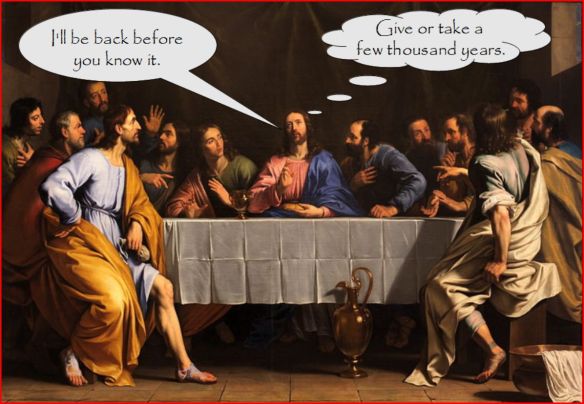
For the Son of Man is going to come in his Father’s glory with his angels… I tell you the truth, some who are standing here will not taste death before they see the Son of Man coming in his Kingdom. (Matthew 16:27-28) 

Just in case we don’t get this the first time, he tells us again in Matthew 24:27, 30-31, 34 and Luke 21:27-28, 33-34, while ‘Saint’ Paul peddles the same nonsense in 1 Thessalonians 4.15-17 and 1 Corinthians 15.51-52. Did JC return with the angelic host for company to establish God’s kingdom on Earth before his disciples died? Nope,’fraid not.

2) Anything I can do…

Very truly, I tell you, the one who believes in me will also do the works that I do and, in fact, will do greater works than these, because I am going to the Father. (John 14.12)

Do we see Christians walking on water? Changing water into wine? Raising the dead? Doing feats even more remarkable than these? We should, if Jesus is telling the truth here. I guess the fact we don’t means this is another fib.

3) Ask and it’s yours…

I will do whatever you ask in my name, so that the Father may be glorified in the Son. (John 14.13)

Very truly, I tell you, if you ask anything of the Father in my name, he will give it to you. (John 16.23)

Does he? When Christians ask of him, does he always provide what they ask, as he says he will here and again in Matthew 18.19? Absolutely not, which is why Christians like to tell us God’s answer to prayer is often ‘no’ or ‘maybe’ or ‘in a while’. But that’s not what Jesus says here; looks like he got it wrong again.

4) Signs and wonders…

These signs will accompany those who believe: …they will lay their hands on the sick, and they will recover’ (Mark 16.17).

Clearly, this why we’ve had no need for medicine or hospitals these last two thousand years. The Christians have been taking care of it all. Or perhaps not.

5) God will provide…

Therefore do not worry, saying, “What will we eat?” or “What will we drink?” or “What will we wear?” But strive first for the Kingdom of God and his righteousness, and all these things will be given to you as well. (Matthew 6.25-7.1)

Which is why true believers don’t need to go out to work to earn money to provide for themselves or their family. Everything they need, the good Lord provides – so long as they ‘strive’ for the kingdom, whatever that entails. Except no amount of chasing the Kingdom of God is going to manifest food and clothing. Jesus must know this because he acknowledges in Matthew 25 that there are people who are hungry, thirsty and without clothes. So why doesn’t God provide for them? It must be that they don’t strive strenuously enough for the Kingdom.

The gospels are full of these empty promises of Jesus’. He fails to deliver on every one, even for those who worship him as God. How would we react if a supposed friend lied to us as often as Jesus does? If we’d any sense, we’d recognise them as a fraud and a failure and send them packing.

Time to do the same to this old con-artist.

Throwing stones

WomanNew laws in Putin’s Russia have seen a wave of persecution directed at gay people. Christian websites have been quick to condemn the torture, beatings and murders that have taken place in recent weeks, pointing out that this isn’t the way to treat others (Matthew 7.12) or to show love for one’s neighbour (Mark 12.31) or to support a minority group (Matthew 25.45).

Oops. I interrupt this post for a reality check.

Needless to say, no Christian website has done this. Some have come out in support of Russia’s punitive new laws, because – well – God hates all that gay stuff, and, as we know, the odd Bible verse that grumbles about it trumps anything Jesus had to say about being nice to each another. Other Christian sites have ignored the subject entirely.

Our very own Christian Voice, while avoiding any mention of the Russian situation, has posted yet another anti-gay piece. Two thirds of their posts are on the subject, because this is what ‘the gospel’ is really all about. Upset that same-sex marriage is now law – even though they prayed really, really hard to the baby Jesus to stop it – Stephen Green’s sidekick, Robin (had to be really) points out that our bodies matter and, though it will come as some surprise to them, gay people don’t understand this.

You can read the full thing here, where you’ll note C.V. tries to avoid the word ‘gay’ and always puts inverted commas around same-sex ‘marriage’; pathetic doesn’t even begin to describe it .

I’ve attempted to comment on the article on the Christian Voice site, but so insecure are the dynamic duo in their faith, they can’t bring themselves to publish dissenting views. So here, with some slight amendment, are the points I made:

Oh, if only those pesky homosexuals were more like heterosexuals – always monogamous, faithful and never divorcing or remarrying.

If only all gay people were Christians, then the morality you espouse – but which not all Christians live by – might apply to them. As it is, it doesn’t.

If only they could have an encounter with Jesus then they’d be cured of their same-sex attraction.

If only there was some proof of this magical cure or that homosexuals need to be ‘cured’ in the first place.

If only gay people could be celibate, because that worked out so well for the Catholic Church.

If only they’d marry a person of the opposite sex and involve them in living a lie.

These are the options. So what is it you want homosexuals to do, Robin?

What indeed? I suspect he and the other Christians who rant about gay people would be happy only if they disappeared from the face of the Earth or if the great Jehovah were to smite them out of existence. What so many Christians seem unable to do is accept and show the love to their gay brothers and sisters that Jesus demands of them.

Morality Tale

Preaches   A man who believes in the impossible – and it is a man more often than not – appears as a moral authority every morning on national BBC radio. This same man is frequently asked by television networks to give his views on moral issues of the day, be they assisted suicide, pay-day loans, same-sex marriage & adoption, abortion or capitalism. And even when he hasn’t been asked, the views he expresses on these subjects are widely reported, sometimes all around the world. The man can, in one of his roles, sit in the second most important legislative body of the land, again as a moral authority, influencing laws that are binding on everyone else whether they believe in the impossible or not. Indeed, the man has an automatic, unelected right to be part of this august body.

   Where, you might ask, does this man’s moral authority come form? Is he a psychologist with a profound understanding of human behaviour? Or a geneticist with knowledge of the biological bases of our decision making? Maybe a philosopher who has analysed the cognitive processes that lead to moral decisions? An ordinary, educated person, then, who has given much rational thought to how we might best treat one another?

   No, he’s none of these. He’s just a man who believes in the impossible and wears funny clothes to prove it. Invariably, it is true, he has become quite an expert in believing the impossible and he’s even been granted a special place in society that allows him to encourage others to believe the impossible. As a result, he has somehow made the leap into thinking that, because he believes in the impossible, he must therefore be a moral authority.

   Now, we may not object to the man believing in the impossible in the first place – it’s a free country after all – but we don’t accept, surely, that because he does, it means he knows much more than the rest of us about morality?

   Yes, I’m sorry to report that we do. We acquiesce to the man and say ‘because you believe in the impossible, and for no other reason, you must know more about morality than we do.’ And when we are looking for moral guidance, we turn to him – whether we are the BBC, the rest of the media or the government – and we say, ‘what do you say about this? What should we think about it, because, after all, you are the authority here by virtue of the fact that you believe in the impossible?’ And the man, in whatever guise he appears – pope, archbishop, bishop, reverend, imam, rabbi – says, ‘this is what it says in my magic book (even when it doesn’t) and you should follow it, even though you might not believe in either the magic book or in the impossible.

   And we say, ‘Well, you’re the expert and we respect that you should tell us how to behave, if for no other reason than you believe in the impossible.’