Surviving 2026

It’s that time of year when, according to the media, we need to consider what our strategies might be for surviving the 12 months ahead. I thought I’d share with you some of my thoughts along these lines:

1. Have the lowest expectations of politicians that you can muster. That way you’ll only be mildly disappointed when they fail to live up to them.

2. Have a sense of proportion. The universe has existed for 13.8 billion years, the earth for 4.54 billion, life for 3.8 – 3.5 billion, humans for a mere 300,000 years and you for a miniscule fraction of even this final statistic. None of these events has been directed by a sentient power. They are all the result of natural forces. With this perspective you’ll recognise how nonsensical it is to attribute anything to a tribal deity.

3. Reserve your respect for people who merit respect. You do not have to respect those who espouse nonsense and/or don’t respect you. You certainly don’t have to genuflect in front of ideologies, whether religious, philosophical or political. Ideologies are not people.

4. Party like it’s 1999. That way you can pretend the world isn’t being run by septuagenarian megalomaniacs.

5. Resist the Newspeak that is daily foisted upon us. Call a spade a shovel, an Islamist a Muslim, and send the Thought Police packing when they turn up at your door because someone somewhere is offended by something you’ve said, on someone else’s behalf.

6. Spend lots of time with friends. Studies repeatedly show that socialising contributes significantly to living a longer, happier, healthier life. Even talking to strangers helps. I know that other people can sometimes be  challenging (see below) but being with them is, on balance, pleasurable and rewarding. They do you good (and you them).

7. Stop anyone who starts a sentence with ‘Me and partner’. Point out that this is grammatically incorrect and reflects badly on both their education and personal integrity.

8. Read comic books.

9. Take pride in your country. It belongs to you, not just to politicians and billionaires. Other countries quite rightly take pride in their country’s achievements, culture and values. We need to as well. .

10. Write to your MP/Congressperson to tell them what you think of the job they’re doing. Tell them what they should be doing instead, like keeping their promises. Do this while trying not to use swear words.

11. Do something you might not normally do. Keep it legal. Or at least don’t get found out.

12. Question everything, including everything that’s written here.

I hope 2026 turns out to be a great year for you.

An Exclusive Interview

So what I say is if people had listened to me from the start a lot of these problems wouldn’t ever have happened. I think people know that now cos I’m indisputerbably the best there’s ever been. And haven’t I always been telling you that? Cos I am the best. [Note to Editor: you can cut out a lot of this]. What I’ve accomplished is the best, not like anything any of those other guys ever managed. The best.

And I’ve got plans, you know, cos the best is yet to come. All people have to do is show me the respect I deserve for doing all the good things, the really great things, I’ve done. But you know, they don’t all do that. Some of them, a lot of them, don’t appreciate all the great things I’ve done and all the great things I’m still gonna get done. And all I ask in return is a little respect. Maybe some appreciation, you know. Cos, and I know people know this, I’m the best there is. I’ve seen off my enemies, I’ve had my agents see off our enemies, like they deserve. I’ve had them all killed and more. Horrible, horrible people. I’ve had to punish some of my own people too. Horrible, horrible people, all of them.

I’m like the most wonderful king there’s ever been. I know, I know that some people don’t like the idea of a king but when you’ve done all the wonderful, really wonderful things I’ve done, like killing all our enemies dead and taking over all their shithole countries, which, trust me, they never really did much with anyway – it’s hard not to see yourself as a king, when you’ve done all that I’ve done, and that’s what I am, a really wonderful, really caring King. The best ever. [Edit this too]

So listen, Piggy, be sure to quote me word for word. Cos you know, I get really pissed – some people say far too easily, but of course they don’t really know me, how caring I am – when horrible people put my words in my mouth and make me say things I never said. And you wouldn’t like me to get pissed cos I can be really difficult to deal with then. So don’t do it, you hear?

Now if you don’t mind I gotta get to some meeting. I need a nap. Word for word, you hear. [Edit]

This interview with YHWH, Lord of Hosts and Best God Ever is brought to you completely unedited by Juan Isaiah Thanthe-Other.

A Big Myth-take

The nativity story is evidently a myth. The evidence?

The virgin conception and birth (similar to other myths);

Angels everywhere;

Warnings in dreams;

The wand’rin’ star;

Events created from out-of-context scraps of Jewish scripture (the virgin birth again; the shoe-horning of Bethlehem; Herod’s massacre; the flight and return from Egypt);

The heavy-handed symbolism (shepherds and their gifts; the magi and theirs);

Historically inaccurate details (disparate dates, the Roman census, Herod’s massacre);

Discrepancies between the two accounts;

The absence of the nativity and its events in the other two canonical gospels,

Disparity with later events in the gospels (Mary treasures the nativity events in Luke 2:19 only to seemingly having no knowledge of them later (Mark 3:12); John and Jesus are second cousins… or not).

And on and on.

Yet the story is analysed endlessly – two thousand years (almost) and counting – as is all that follows in the gospels. There’s a whole lot of jargon to intellectualise this , of what is, in the end, just myth: exegesis, hermeneutics, soteriology, apologia, discourse analysis, close reading. All exist to expose the truth embedded in the text and to defend it. Even those who acknowledge that the nativity story is myth (quite an attractive, cosy myth admittedly) want to confine this admission to the nativity alone. The rest – the symbolic miracles, unfulfilled prophecies, literary sermons, the metaphorical pericopes (more jargon!), the trial, crucifixion and resurrection – they want honoured as historical, factual and mystically embodying Truth. Unfortunately, all of these stories bear the same hallmarks of myth as the nativity tales. Why should these other stories be regarded as anything different?

**********

Christmas is upon us. I’m happy to call it Christmas; the name has a long pedigree and ‘Holidays’ has, in any case, its own religious connotations. Dennis and I will be spending it with my daughter and her family. I hope you too are able to enjoy it in whichever way suits you best.

A happy Christmas to you, both my readers.

A Special Christmas Bible Study

An angel of the Lord appeared to (the shepherds), and the glory of the Lord shone around them, and they were terrified.

But the angel said to them, “Do not be afraid. I bring you good news that will cause great joy for all the people. Today in the town of David a Saviour has been born to you; he is the Messiah, the Lord. This will be a sign to you: You will find a baby wrapped in cloths and lying in a manger.”

Suddenly a great company of the heavenly host appeared with the angel, praising God and saying, Glory to God in the highest heaven, and on earth peace to those on whom his favour rests.” (Luke 2:9-16)

Another chunk of scripture that will be proclaimed from pulpits and in nativity plays again this year. Let’s take a closer look at the scenario Luke creates. Does it bear any relation to something that might occur in reality?

First, an angel. Doesn’t this tell us from the outset that we’re in the realms of fantasy fiction? You can’t fault Luke for trying though, he does his best to impress by adding a whole host of them. You can hear him thinking that ‘a great company of angels’ should convince all but the most hardened of hearts. He’s inventing freely, throwing in the tropes of the genre with abandon. Doesn’t he know angels are fierce, two-faced, six-winged creatures (Ezekiel 14:18; Isaiah 6), not handsome youths in glowing white robes? There’s a reason they prefaced their every appearance, including this one, with ‘Do not be afraid’.

Good news that will cause great joy for all the people: All? Even as Luke wrote this paean to wishful thinking he knew that the Jesus myth had not brought joy to ‘all people’. Most had rejected the claims of the new cult and joy was hardly the prevalent emotion in some of the churches Paul wrote to.

This will be a sign to you: You will find a baby wrapped in cloths and lying in a manger. A baby wrapped in cloths, as was the custom, and lying in an animal feeding trough is a ‘sign’? A sign that the Messiah had arrived? Really? Granted a manger is not a conventional place for a new-born but it’s hardly miraculous. And what if by the time the shepherds had abandoned their flocks to the night and its marauding wolves, Mary had, say, picked up the child or found a better place for it? Imagine the confusion! Sorry, Luke but this is a very poorly constructed story. You just didn’t think it through.

As for the angels’ last proclamation, what does it really mean?

Glory to God: this of course is fawning to a God whose ego is more inflated and fragile than Donald Trump’s. He demands continual praise not only from his heavenly messengers but from those here below, or else he’ll go off on one. You really want to spend eternity with such a tyrant, Christians?

…in the highest heavens: a reference to the fact that early Christians believed in different layers of heaven; Paul writes about them too. God resides, as acknowledged here, in the highest, the top floor executive suite. No-one ever gets to go up there. Emails are sent down from on high.

And on earth peace to those on whom his favour rests: what sort of peace? Certainly not the absence of conflict or war. We’ve now had two more millennia of these, some in the past initiated by Christians themselves. Do people who are at peace with themselves start wars? Peace within then. Do Christians know greater peace than anyone else? Hard to say when it’s not something that can be measured but I’m sure Christians will claim it’s so.

On whom his favour rests: who exactly is this? Who enjoys the favour of a capricious deity? How do they know when he visits all manner of trials and tribulations, testing and tempering on those who count themselves as his. I’m sure the early Christians who helped write the angels’ speech thought it was they who enjoyed the Lord’s favour. Today’s Christians probably think the same. YHWH has always played favourites. Everyone else can go to hell.

So, the heralds of Jesus’ birth didn’t exactly bring good news, did they. Not even in Luke’s imaginary, completely invented, never-happened-in-reality and isn’t-even-a-decent-metaphor scenario.

Like a Virgin. Or Not


To arrive at the nativity story most of us grew up with and which your kids and grandkids might well be performing this Christmas (mine are), the one with a stable, shepherds and wise-men, involves some cunning sleight of hand, not to mention a liberal dollop of invention.

The biblical ‘account’ of the story is spread across two gospels, Matthew and Luke. Mark hadn’t heard of it when he wrote his gospel so you won’t find it there. In fact, Mark’s Jesus doesn’t become God’s son until his baptism. Paul, writing earlier still, thinks God adopts Jesus only at his resurrection. Paul has no knowledge either of the nativity myth. John has no time for it: his Jesus is an eternal being who has existed with God from the beginning.

For Matthew, however, Jesus comes into existence when the Holy Spirit impregnates a virgin. Luke likes the idea and so copies it into his gospel. And now we have a problem: the idea that a virgin will bear the Messiah is lifted from the Septuagint, the Greek translation of the Jewish scripture, which renders Isaiah 7:14 as –

Therefore YHWH himself will give you a sign: the virgin (almah) will conceive and give birth to a son, and will call him Immanuel.

In the Septuagint, the Hebrew word almah, meaning ‘young woman’, is translated as virgin. However, the word for virgin in Hebrew is betulah, an entirely different word. Isaiah 7:14 is not a prophecy that a virgin will bear a son: only that a young woman will do so; in other words, a commonplace event. Matthew allowed himself to be misled: in his eagerness to find prophecies of Jesus in Jewish scriptures, he alighted on a mistranslation. He wrote his story accordingly, riffing freely on the error. Luke picked up on it a decade later, adding his own embellishments.

Neither does Isaiah 7:14 suggest the child being talked about will be the Messiah, nor that he will appear hundreds of years in the future. As subsequent verses make transparently clear, a short period of time is all that is suggested; no more than a few years:

He (the child) will be eating curds and honey when he knows enough to reject the wrong and choose the right, for before the boy knows enough to reject the wrong and choose the right, the land of the two kings you dread will be laid waste. YHWH will bring on you and on your people and on the house of your father a time unlike any since Ephraim broke away from Judah – he will bring the king of Assyria (Isaiah 7:15-17).

These are all events contemporaneous with the writing of this part of Isaiah. All that is being said is that a young woman will become pregnant and produce a child in the near future. Even before this child properly knows right from wrong, YHWH will bring Israel’s enemies down upon it. (Because he’s such a caring God.)

None of this has anything to do with a virgin becoming pregnant, nothing to do with a Messiah, nothing to do with Jesus. It is not a prophecy about him, even if Matthew persuaded himself it was. Shamefully, almost all modern ‘translations’ of Isaiah retain ‘virgin’, when they know perfectly well it is not the word used, and that the context neither supports it’s use nor makes it necessary. They do so to maintain the lie that Isaiah 7:14 is about Jesus and to give credibility to Matthew and Luke’s ridiculous fiction that he fulfilled ‘prophecy’ by being born of a virgin. It’s a deception that will be repeated in church services around the world over the next couple of weeks.

The Anunciation: A Ghost Story for Advent

The Nativity in Matthew and Luke begins long before Jesus’ birth. Matthew introduces Mary and Joseph once the former has been impregnated with The Holy Sperm. He doesn’t go into any detail about how this happened, he just drops in, in Matt 1:18, that the deed is done. Mary has had sex with a ghost.

This isn’t good enough for Luke though, who after reading Matthew’s tall tale, decides it needs some expansion. A lot of expansion, in fact. He takes the story back to before Mary’s non-consensual encounter with the Holy Spirit and picks on Elizabeth and Zechariah, an elderly couple well past the age of having kids. All the same, they do enjoy a tumble in the sack every now and then, and the Lord – ever the voyeur – decides he’ll bless one such union with fruitfulness. (There is much wrong with the details of this unbelievable yarn, some of which I consider here; I won’t reiterate them now for fear of awakening any amateur theologians who might be lurking here in the wings.)

Suffice to say, Luke – for it is he, lest we forget, who is making this stuff up – decides that Elizabeth is a long lost cousin of Mary’s, like in one of those soaps where long lost relatives pop up all the time, usually to no good end. In this particular episode, however, all goes well and Mary visits Elizabeth, whose baby is, in a strange twist of fate, destined to be John the Baptist from the earlier two gospels. In this story his embryonic self jumps for joy inside his mother once he realises his uterine Saviour has come to visit.

But were getting ahead of ourselves. First Mary has to go through the rigmarole of getting pregnant. Obviously as a good Catholic girl she can’t have sex with her betrothed prior to their wedding and just when she’s considering when that might be, an angel appears unto her. It’s Gabriel who has quite a bit to do in the Nativity story as a whole. As angels do, he annunciates to Mary all about the pregnancy part of the plot and she acquiesces to the Lord getting her with child by magically transferring his seed into her womb. I’m guessing it was by magic. It’s possible some sort of actual rumpy-pumpy occurred but Luke delicately passes over the intimate parts. As apparently the Holy Spirit does too.

Mary is so overjoyed to be pregnant before her 13th birthday that she bursts into song on the spot and spontaneously produces a hymn based on the Psalms and the future teaching of the baby she has only just conceived. It’s hard to believe that no actual time travel was involved. It is instead, a miracle, as her impromptu ditty flourishes into the literary masterpiece now known as The Magnificat, which is not, it turns out, a feline super-hero. Fortunately, she can remember it all, word for word, decades later when Luke decides he needs to invent record it. Honestly, the whole thing puts Cole Porter to shame.

You’d think then Mary would dash off to tell her betrothed, Joseph, the wonderful news that she is pregnant without his or any other man’s assistance, but Luke makes no mention of it. Luckily, it’s covered by Matthew, where an angel drops in on Joseph, a person of great gullibility faith. On hearing what the angel has to say, he swallows the story hook, line and stinker.

Then it’s back to where we came in. Mary’s sets off down the road to see the cousin, the wonderful bearer of John. She pitches up there for three whole months, perhaps to avoid Joseph, who, it turns out, was not as gullible as she thought.

**********************************************

Honestly, this is really what happened. Would I lie to you? No, but someone would, and did. We’ll see what else he has in store in his over-worked imagination, next time.

**********************************************

PS. Don, I know you like indulging in a bit of biblical exegesis. If you’d like to borrow this totally respectful effort for your blog, get in touch and we’ll work something out.

What Is Truth?

I’m sceptical (or skeptical if you’re in the US). It’s a legacy of my years of believing the promises of Christianity. Preachers, pastors, Bible study leaders told me for 25 years that the promises of the bible, of Jesus himself, were all true. And like a fool I believed them. Jesus had made a new creature out of me; he loved me; he was guiding my life; he was returning soon; I’d be resurrected; I’d live in heaven forever… and on and on.

What a preposterous set of propositions! It took my Great Realisation, my own personal revelation that there was no God, to make me see how ridiculous they were.

It is this that left me with a legacy of scepticism. If I’d been misled all this time by people I respected and admired, what else was I accepting as true that very well might not be? I wasn’t going to be fooled again and so began to question practically everything I was told by authorities, experts and the media. If it seemed ‘off’, as we say these days, not quite right or too good (or bad) to be true I asked, ‘Who says so?’, ‘How do they know this?’, ‘What is the evidence?’, ‘Do they jump to conclusions or is their reasoning sound?’, ‘Why should I believe what they say?’ It’s exhausting, I assure you, having to search out the evidence – the primary sources of information – and to sift through it, recognising any bias that has been imposed on it. It’s either this or I must accept without question that everything I’m told is true. I can’t do that any more.

Here are a few examples of claims that I’ve been sceptical of on the recent past:

We are being guided by the science, said politicians during Covid to ensure compliance with whatever lockdown measures were being imposed. Did this really just mean was ‘we are being guided by our interpretation of some rather suspect data’? It became clear after we emerged from the hysteria surrounding the pandemic that this was the case.

Tens of thousands will die of Covid unless you comply: this based on computer predictions which turned out to be very far from accurate: the suspect data that ‘guided’ politicians.

A woman can have a penis. A man can have cervix. Yes, our politicians told us this during our recent fixation with transgenderism. Whatever you think of people changing sex, these two statements, designed to change hearts and minds, if not penises and cervixes, are patently false. Whatever was guiding those who said such things, it certainly wasn’t ‘the science’.

No more irresponsible, undeliverable promises. So said the Prime Minister exactly a year ago. I’m not going to be sceptical or cynical about this. I feel sure it’ll turn out to be true. Is he implying though that promises made earlier than this were indeed ‘irresponsible and undeliverable’. Surely not.

We will not raise taxes on working people (and energy prices will fall by £300 in the long term), Labour politicians, now the government, said only last year in an attempt to gain our votes. I was sceptical about this, as with much they said, and for the first time in many years Labour did not get my vote. Taxes have increased considerably for working people and everyone else in the last year and are set to rise again this week. The price of energy has risen too, by 18%, and will do so again in January. A £300 reduction by 2030, if it happens at all, is not really going to offset this by much. This was all very predictable; since when do politicians tell us the truth in order to get us to vote for them?

Anything Donald Trump says. Insert your selection here.

The NHS is the envy of the world. Pundits and politicians are very fond of this one. They like to add too that the NHS is underfunded. But the NHS is expensive, management heavy and wasteful. Is it really the envy of the world, and if it is, so what, when it’s constantly in crisis at home?

The BBC is the envy of the world. It is impartial and balanced. Is it? A number of independent reviews have determined that it has its own agendas and biases. During lockdowns it fuelled hysteria and now contributes to climate change panic. Rather than reporting facts, it tells us too often what we’re meant to think about issues. It has also been rocked over the past dozen years by sleaze and scandals.

Islam is a religion of peace. So many questions about this one. Many Western politicians have claimed something like it. President George W. Bush did, shortly after 9/11. Perhaps ordinary Muslims are committed to peace but there are many Islamists (the term now used for Muslim extremists) are evidently not: as well as 9/11 there have been acts of Islamist terrorism in London (7th July 2005), at Charlie Hebdo in Paris, in Manchester, the slaughter in the street of an off duty soldier, the massacre of Israeli young people in October 2023, the killing of Christians and others in Nigeria.. Is ‘Allahu Akbar’ really a cry of peace?

We can halt or reverse the climate changes we ourselves have caused. Can we? Who says? (Greta Thunberg, yes, but no actual scientists that I can find.) We can perhaps mitigate and slow down the change, and we should. But the climate will continue to change. Are these changes solely the fault of us humans – we’re contributing to the pace of change, certainly – when the climate has been in constant change from time immemorial?

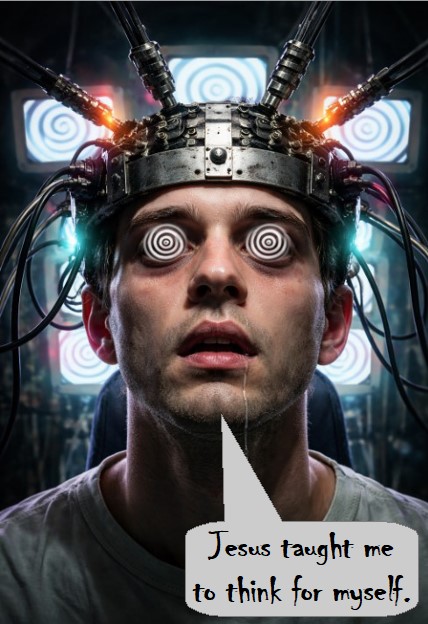
I was accused of trying to be a maverick in a recent comment on an old post. Honestly, I’m not. It’s more a case of ‘once bitten, twice shy’; I’m not going to be told ever again what to think, especially not by those who don’t present good reasons why I should (I’ve Jesus to thank for this). Everything needs to be questioned, otherwise our minds are not our own. Be sceptical.

Two Ways of Knowing

A Christian friend told me recently that there are two ways of knowing: science and faith. I don’t agree with him of course and, while I expressed my scepticism, I didn’t argue. It seemed unlikely he would change his mind.

Faith and science have different, incompatible concepts of reality. The first – and faith was first historically – is that there is an invisible realm beyond this one, populated by powerful beings who influence and manipulate the humans who live here below. This reality, though invisible and largely undetectable, is actually more real than the one we see around us. Glimpses have been had of it, however, by those finely attuned to it, in dreams, visions and messages delivered during heightened emotional states. These visionaries – prophets – then pass on to others what the beings of the hidden realm expect of them. Life is then to be lived according to the instructions so conveyed, which usually consist of attempts to appease these gods by doing their bidding. In return for this obsequience, you’re allowed to believe you will live on after death

The other epistemology – actually the only true epistemology in this instance – is empirical, knowledge-based science. A later arrival, historically speaking, than the gods of the invisible realm. The scientific method is the best tool we have for sifting knowledge from superstition and emotion. These, particularly the latter, often impede us in our pursuit of knowledge, which is why science strives to eliminate them from its investigations, taking an objective approach to evidence. Unfortunately, the findings of science are occasionally contradictory (can a man become a woman or not?) and very often misinterpreted by non-scientists. Politicians and the media frequently over-simplify science’s findings and interpret them in ways that suit their own agendas.

Then there are those who masquerade as scientists but are not. During the pandemic, the UK was locked down for almost two years on the basis of computer predictions of what might happen if certain conditions prevailed. These predictions were taken as a scientific conclusion when in fact they were hypotheses, which by their very nature, could not be tested. Needless to say, they turned out to be drastically wrong. Computer projections are not, in themselves, science.

Science, through its practical offspring, medicine and technology, has undoubtedly been a boon to humankind, in a way religion never has. It has also sometimes been a curse too, inflicting us with, amongst other things, an arsenal of ever deadlier weapons, the means of destroying the environment and Covid itself. Science is a tool and like any tool can be wielded both constructively and destructively.

So, perhaps the gods will save us from our own folly after all. If only they and their invisible realm existed. Alas (or thankfully) they don’t; there is zero evidence for them, and visions, dreams and wishful thinking as reliable means of knowing about them. We’re on our own. Science is the best hope we’ve got, our only sure-fire way of knowing. If only politicians and the media understood it more than they seem to.

There May Be Trouble Ahead…

Prophets, from left to right: Elijah, Julie Stephens,
Cindy Jacobs and er... Ed Miliband

Prophets don’t exist. A bunch of people intoxicated by religious fervour who think God has given them a special message that they must deliver to whoever will listen, are not prophets; they are a collection of extremists intoxicated with religious fervour.

We know this because no God exists. He can’t, as a result, drop messages, special or otherwise, into the heads of fanatics.

That’s it, really. No more to be said.

But so-called prophets exert quite an influence on our modern world. According to Abraham (I know, he’s a mythical figure but bear with me), God selected an ancient Jewish tribe to be his favourite buddies, so long as they did whatever he demanded of them, including hacking off their foreskins and that of their sons. What sort of prophet – what sort of God – comes up with this kind of lunatic fetishism?

Later the creators of a new prophet, whom they called Moses, came up with a story in which their hero encountered God in a bush (the symbolism is lost on us today.) This time he wanted his special buddies to invade their neighbour’s territory, slaughter them and take their land for themselves. This his favourite, de-foreskinned tribe did (modern genetic analysis of the peoples in the region suggests this isn’t what happened.)

After these fictional madmen came some potentially real fanatics who thought God had assigned them to lambast their fellow Jews for their shortcomings. These prophets promised the rubes rewards if they behaved as the prophets thought they should. These guys also came up with the idea that God would send a warrior Messiah to help his special little tribe take over the world. This is what happens when fanatics are allowed to get a hold of things.

A couple of centuries later, another self-proclaimed prophet turned up (or is invented) who seemed to think he’s the most special-est of all the prophets so far. This guy, called Yeshua (meaning ‘salvation’, so obviously not in any way symbolic) prophesied that the Messiah would be arriving real soon to sort the world out. He’d then hand it over to the Jewish people to manage. This guy’s script writers weren’t sure if Yeshua was talking about himself or some other supernatural character called the Son of Man. It doesn’t matter really. Nothing he prophesied happened when he confidently predicted it would: there was no Messiah who flies down from heaven, no final judgment, no great reset for the Earth. He was an absolute failure as a prophet; evidence, if more is needed, that those who claim to speak for God don’t know what they’re talking about. Don’t worry, though, this guy was recast as a resurrected Godman, just like the ones in pagan myths.

A few other prophets appeared around about the same time. In fact, the extremist who changed his name to Paul seemed to think that just about anyone could become one so long as they ‘edified’ the brethren. It was a few years though before the next really big so-called prophet came along.

In the 8th century, a guy called Muhammad said he was told by an angel who represented a different version of God that, amongst other things, Islam would spread worldwide and there would be an increase in senseless murders. These rather nebulous and self-fulfilling predictions are even now coming to pass. Muhammad’s future followers are indeed spreading Islam across the globe while senseless murders continue being committed, a good many of them by Muslims themselves.

While Muslims have made it clear that Muhammad is the final prophet, history has blessed us since with a few more. Joseph Smith in the 1880s was commanded by a different God (or maybe by the same one who’s changed his mind again) to start a new church and to obliterate anyone who stood in his way. He was successful in this enterprise, despite managing to get himself killed in the process.

You’d think, wouldn’t you, that given their abysmal success rate and the number of people who have suffered or perished as a result of their endeavours that we’d have had enough of prophets. While churches cannot agree on whether ‘genuine’ prophecy still exists, the prophets keep coming. Fanatics the world over, every bit as barmy as their predecessors, appoint themselves some deity’s spokesperson, and the ‘prophetic’ pronouncements begin: meaningless theobabble spattered across the Internet.

Who Has Seen The Wind, Or Cause and Effect

The first time I encountered this poem was when Yoko Ono intoned it, as only she could, on the B-side of John Lennon’s Instant Karma!, back in 1970.

I noticed at the time (because I always read such things, while playing the B-sides of singles) that the poem’s composer was someone called ‘Rossetti’. Back then I knew nothing about him or her. Years later, I came across Dante Gabriel Rossetti, the Pre-Raphaelite artist but it turned he didn’t write the poem either. His sister Christina did.

Christina Rossetti was profoundly religious. She set about helping fallen women: ‘fallen’ according to the sexual mores of the day. A number of these young girls may well have been ‘led into sin’ in the first place by her hell-raiser brother, Dante. Her poem Who Has Seen The Wind, written in 1847, is an allegory of the work of the Holy Ghost: as the wind itself can never be seen, only detected by its effects, so too the Holy Ghost can be sensed only by its invisible workings in the real world. It’s an old argument, hinted at in Psalm 19:1, which says the heavens declare the handiwork of the Lord. Modern versions of the argument exist, based on the philosophical assertion that every effect must have a cause, including one that equates God with a murderer, 

It’s a terrible idea in all its forms. First, we know the wind, and murderers too, exist. The wind can be measured and the processes involved in creating winds of various strengths are well understood. Likewise murderers (as tempting as it is to equate God with a callous killer.) The inference that the cause of any given effect must be supernatural – a Ghost, a god, an angel – is mere primitive instinct. Even more unjustifiable is the leap that says this supernatural cause is The First Cause, which itself has no cause. A further leap into the absurd is the assumption that this uncaused First Cause is a God who was first imagined by middle-eastern tribesmen and later reshaped by early Christians and the church.

Which brings us to God: The Science, the Evidence, a new book by a Christian scientist, Olivier Bonnassies and industrialist Michel-Yves Bolloré, proposing that because we don’t fully understand how the universe came into being, it must have been God. Bonnasaries explains how they arrived at this conclusion:

It’s the fact that this (piece of paper) exists. And that because it exists, it needs a cause, and that (cause) needs another cause, and at the end, you need what we call a primary cause in order that everything exists. Because nothing can exist by itself.

Except, apparently, that cause designated, without evidence, the First Cause: God.

It is this, Bonnasaries and Bolloré claim as a scientific hypothesis. Bonnasaries must surely know as scientist that it is far from scientific. ‘God did it’ is a conclusion, arrived at without evidence; there is nothing observable, testable or measurable about it. It is philosophical conjecture at best, theology at worst. Christina Rossetti put it so much better, all those years ago (but still she got it wrong).