
We Will Judge Angels

The guy in this video has had his mind bent by Paul’s crazy assertion in 1 Corinthians 6:3 that Believers will judge the angels at the Final Judgement.

This is pretty mind bending, I think you’ll agree, not to mention totally insane. The video incidentally turned up in my Facebook feed; I didn’t go looking for it. I’m not that masochistic. My Facebook is back to being inundated with posts and videos from evangelicals. That algorithm certainly needs attention. Just because I write about Jesus doesn’t mean I want to receive wacky posts about him from Christians.

Anyway, Mr Mind-Bent (I can’t track down his name) got me thinking what this judging will be like. For a start, and despite the video’s claim, Paul doesn’t specify that the judgement will be part of the Final Judgement. This is what he actually says:

…do you not know that the Lord’s people will judge the world? And if you are to judge the world, are you not competent to judge trivial cases? Do you not know that we will judge angels? How much more the things of this life! (1 Corinthians 6:2-3)

My God, the Lord’s people will not only judge angels: they’ll judge the world too. We’re really in trouble if God is going to hand the job over to some of the most unstable people in existence. They are also, as the video claims, going to be unleashed on the angels. You might wonder, as I did, what the angels might need to be judged about. The Masked Singer maybe, or which of them farted in the elevator? It could be the Lord’s people will be required to sit in judgement on the Bad Angels: Satan and his minions who rebelled against God back at the beginning of time. Paul doesn’t specify, though elsewhere in the infallible, never-contradictory scriptures, the devil has already been judged (John 16:11) and his fate sealed (Revelation 20:10).

Why in any case would beings who can never sin merit judgement? Sin doesn’t exist in heaven. The presence of God makes it impossible, which doesn’t account for how Satan and his mob managed it. I’m sure there’s a Bible verse somewhere that gets round it some way or other.

Of course none of this judging of the world and angels is ever going to happen. Angels, God, Heaven: none of them exist. Our man in the video has had his mind bent for nothing. While he admits he doesn’t fully understand Paul’s claim, nevertheless he believes it. He has faith in it, he preaches it (‘preach it brother, preach it!’) and wants other people to believe it. He’d be better thinking it through then he’d realise – maybe just maybe – that the Bible is full of crap.
Falling By The Wayside

Bob Dylan’s conversion to Christianity was short lived. Those who trumpeted his being ‘saved by the blood if the lamb’* in 1979 were strangely silent about his leaving the faith in 1982.

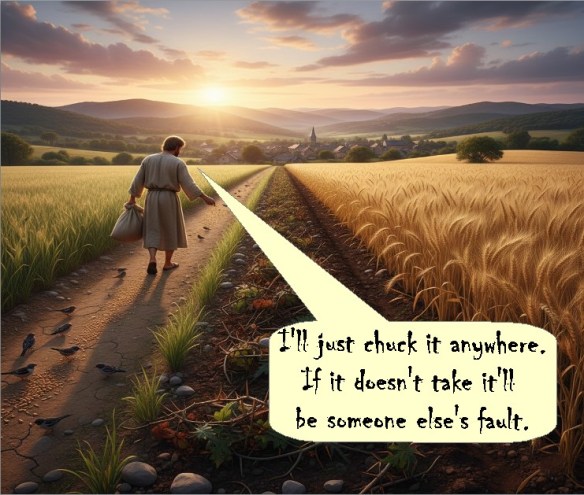
Didn’t Jesus say this sort of thing would happen? Sure he did. In Mark 4:1-20 he warns that not everyone who heard ‘the word’ about the coming of the Kingdom of God would take it to heart. He dressed it up as a story about a sower who scattered seed willy-nilly so that most of it was wasted. Some fell by the wayside, some in shallow soil, some the birds carried away. Only a fraction of the message took hold, and those who in whom it did endured.

It’s as if Jesus knew in advance that many of those who heard his message once he’d gone would lack the resolve to persist in ’the way’. Or did he? Isn’t it more likely that by the time Mark wrote his gospel, 40 years after the cult had got underway, there were may who’d given up on the idea that the Messiah was soon going to come through the clouds to inaugurate God’s Kingdom on Earth. They had abandoned such a ridiculous notion and had left the cult behind.

How then to explain such a destabilising and unexpected course of events? Wouldn’t the Saviour have known this would happen? Of course. And so the parable of the Sower was invented to ensure it looked that way.

The writers of the fourth gospel try a different tack by having Jesus pray for unity (John 17:20-23) which of course they wouldn’t have had to do if there wasn’t already disunity. We know there was division in the early church because Paul and the authors of Hebrews and 1 John (2:!9) write about it. Hence the sticking-plaster solutions to the problem in the gospels – the parable of the Sower and Jesus’ unity prayer. It surely couldn’t be ‘the word’ itself that was the problem. No, it had to be the shallowness and flightiness of those who heard it. Or maybe, as Paul suggests, it was simply that God hadn’t chosen them, back at the dawn of time, to be part of his glee club. They were deluded if they thought so. Nevertheless, they needed a means of letting God and Jesus off the hook.

Bob Dylan and those like him in the centuries that followed didn’t stand a chance with this kind of reverse-engineered thinking.

*Dylan’s own words in his song ‘Saved’ (1980)

Racism? What Would Jesus Do?

The Church Of England recently issued guidelines to its London clergy advising them to preach anti-racist sermons and suggesting how they might go about it. Asked about it on UK TV, the reverend Sam Norton said he was worried that expressing concerns about the number of migrants entering this small island, many of them illegally, might unreasonably be construed as racist. He argued that it is not; I agree. The reverend was at pains to emphasise that racism was abhorrent (again, I agree) and was not something Jesus would condone.

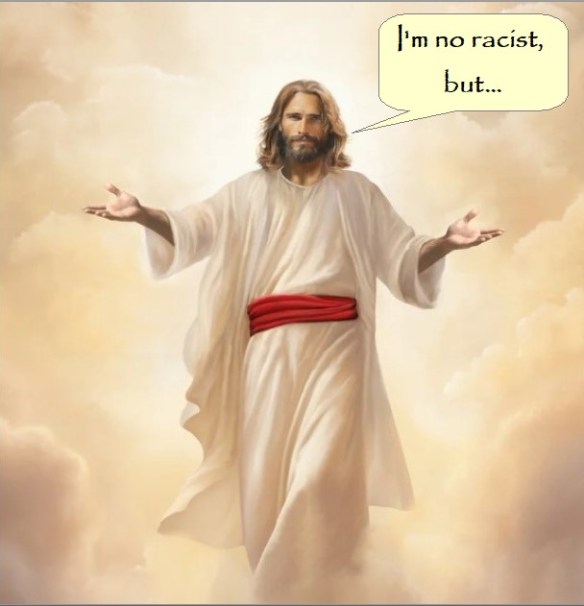
So, again, Jesus gets a free pass. As he’s portrayed in the four gospels, Jesus is racist. Or, rather, the men who made up his script, the early cult members now known as Mark, Matthew, Luke and John, were. They were racist about those who were not part of the new movement, particularly towards those who were hostile towards it. Granted the gospel creators had Jesus say some pretty good things too: love your neighbour as yourself, love and pray for your enemies, the parable of the good Samaritan; all wildly impractical and widely ignored by Christians everywhere.

Many of Jesus’ admonishments were written by cultists anticipating the end of the age for members of their own group; they were all too happy to lash out at those who weren’t part of it. Hence, the Syrophoenician woman of Mark 7:24–37 whom Jesus calls a ‘dog’, dogs being unclean in Judaism. This woman would have had a paler complexion than Jesus, who would not be the fair Caucasian he’s often portrayed as being. His name-calling is racist; it is only the woman’s pluckiness that persuades him to respond to her pleas.

The story is repeated in Matthew 15:21-28 where the woman is said specifically to be from Canaan, Jesus says explicitly that he ‘was sent only to the lost sheep of Israel’. Earlier, in Matthew 10:5, he instructs his disciples not to take his supposed life-saving message to anyone other than his fellow Jews: ‘Do not go into the way of the Gentiles, and do not enter a city of the Samaritans’. Matthew would, of course, have his version of Jesus exclude those who were not Jewish. Jesus’ racism here reflects Matthew’s community intent on preserving their Jewish heritage. Which makes the anti-Semitism Jesus is made to express in the fourth gospel all the more startling;

You (Jews) belong to your father, the devil, and you want to carry out your father’s desires. He was a murderer from the beginning, not holding to the truth, for there is no truth in him. When he lies, he speaks his native language, for he is a liar and the father of lies… Whoever belongs to God hears what God says. The reason you do not hear is that you do not belong to God [‘the right cult’?]

This is the racism of John 8:44, the rift between the new cult and Judaism having widened by the time the fourth gospel was written.

There are those online who argue that even though Jesus was God incarnate, his ‘human side’ and his upbringing in a prejudiced environment account for his narrow views of ethnicity.  This excuses his racism, they say, and shows how like us he really was. It doesn’t. It reflects the prejudices and racism of those who created the various versions of him. (Alternatively, online Christians argue, as here, that the pericope is invariably read ‘out of context’.) And, please, don’t get me started on the overt racism of Jesus ‘Holy Father’, the genocidal tyrant of the Old Testament.

The Bible as a whole is rife with blatant, divinely-inspired racism. Apart from this, I agree with the reverend Norton: having concerns about the scale of immigration is not racism. Just as criticism of Jesus is not blasphemy and censure of Muslim beliefs and practices is not Islamophobic.

Conversion Porn

You’ll recall, I’m sure, all those stories you were told at church, youth group or summer camp about people, almost always the worst of sinners, who had wonderful, supernatural conversions. They turned from debauched lifestyles to Jesus, who set them on the right path and turned their lives around. I’m sure there were people who experienced something like this, but any overpowering emotional experience can produce similar results. Remember those high-profile conversions though? When Jewish Bob Dylan gave his life to Jesus and made gospel albums. My, how we rejoiced! Nicky Cruz of Run Baby Run fame, saved by Jesus from a life of knife crime. Doreen Irvine, one time prostitute, stripper, heroin addict and witch who turned to Jesus to find redemption, not to mention a best-selling book, From Witchcraft to Christ. Joni Eareckson who broke her neck diving into shallow water and, paralysed, called upon the Lord to help and restore her.

Boy, did we love these stories back in the early 1970s. I can’t remember how many times the church youth group was shown The Cross and the Switchblade, with Eric Estrada as Nicky Cruz and Pat Boone as David Wilkerson, the pastor who converted him. I know a dog-eared copy of From Witchcraft to Christ was passed round too and that we took a bus trip to see Doreen Irvine speak somewhere. Likewise Joni Eareckson’s and her best-seller. (I still have some admiration for Joni, who seems the most genuine of them all, despite making a living from her life-changing accident and subsequent conversion.)

Bob Dylan’s gospel albums? Not so much. Who wants to hear him torturing some less than sparkling songs about Jesus? Certainly not me, not now, not even then. Despite claiming he saw Jesus in a vision, Dylan’s love affair with JC was mercifully brief.

What I didn’t do at the time was ask questions of these stories, particularly whether they were really credible. It’s strange how all of their protagonists got best-sellers out of their miraculous conversions. How most hitched a ride on the Christian speaking circuit, not to mention the movies some of them had made of their stories. It seems a good living could be made from meeting Jesus. But credible? Not so much. Certainly Doreen Irvine’s story has been disputed and debunked. I should have asked too why Nicky Cruz and his gang were the only ones saved out of all of the knife gangs in New York in the 1960s. Was Jesus not interested in the others, nor their potential victims? What about their non-conversion stories? And Joni: why did she have to be paralysed for Jesus to get in touch? Was she really restored by him? Certainly not physically; she remains paraplegic to this day, still clinging to stories of how Jesus saved her. Does she not wonder why he didn’t act a few seconds earlier to prevent her terrible accident? (Apparently not: she ‘rationalises’ her accident as God discipline of her in order to bring her to himself. Nice God you got there, Joni).

I wish I had asked these questions back when I was a gullible teenager subject to the church’s propaganda, instead of lapping up the conversion porn they made sure came my way.