Is It Wise To Be An Atheist?

Tract

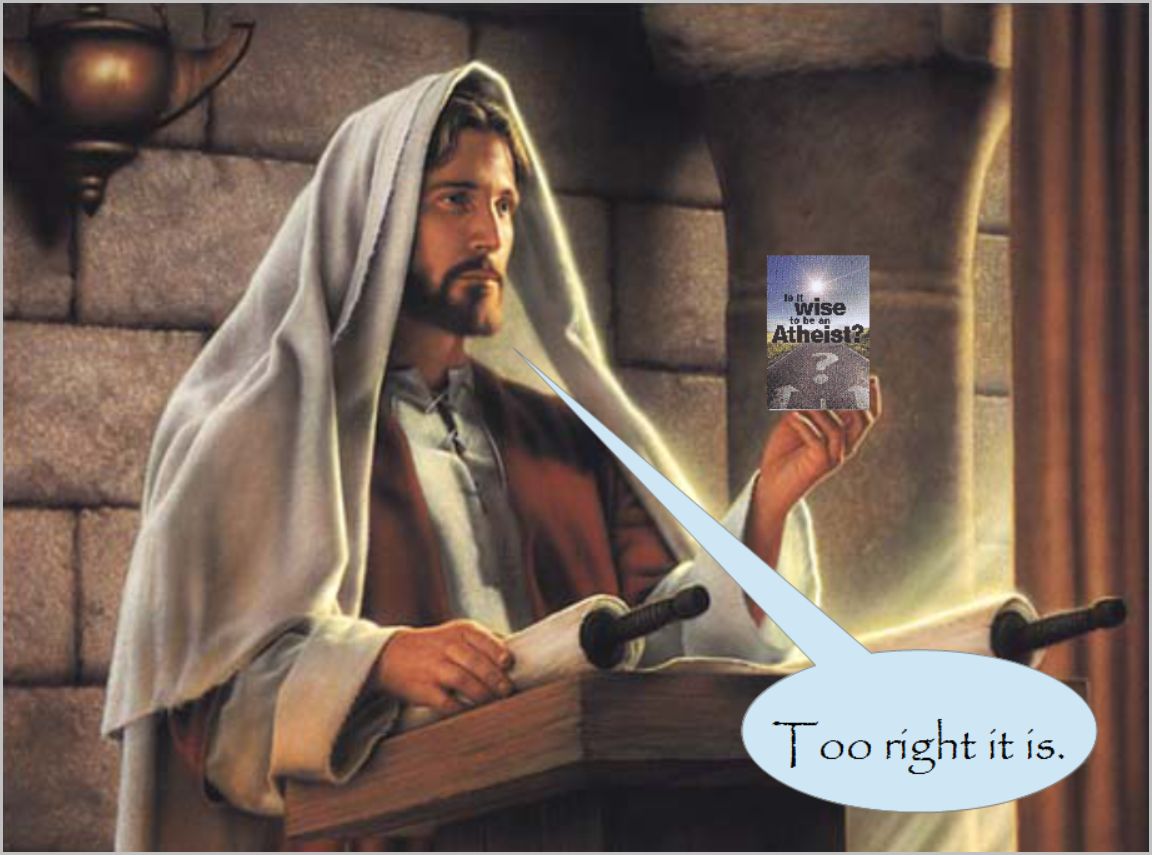
Christians say the funniest things… like ‘atheists can’t possibly know that there’s no God.’

This is the argument expressed in a tract,  Is It Wise To Be An Atheist?, that I was given on the street the other day:

A person cannot really be sure there is no God (unless) they have existed for all time and have identified that God isn’t there; they have been everywhere and have seen that God isn’t anywhere and they know everything and therefore know for certain that God is non-existent.

Safe to say, these are not the same impossible criteria Christians apply when determining whether deities other than their own exist. Even Christians know that Allah, Zeus, unicorns and the tooth fairy don’t really exist. But without being immortal, omnipresent and omniscient, they cannot know for sure. By their own criteria, all mythical/supernatural beings have as much chance of existing as their God. Yet Christians do claim, with reasonable certainty, that other Gods and imaginary entities are not real. This is because determining the authenticity of entities is not about absolute certainty but probability and, yes, reasonable certainty.

For reasons I explore on this blog – here, here and here, for example – the likelihood that a god of some sort exists is low. That that god should then turn out to be the one worshipped by Christians today reduces the possibility still further, on the basis that the more conditions one adds to a proposition, the more improbable it becomes.

To put it another way, the probability that there is no god is already high; that there is no God as conceived by Christians is higher still. Therefore it is reasonable to conclude he does not. This is reasonable certainty; the same reasonable certainty Christians apply when dismissing all other gods.

Better luck next time, Christians.

Arguing for God

God3It’s a funny thing, but there aren’t hundreds of sites on the internet arguing for Barrack Obama’s existence. Nor the Eiffel Tower’s. Nor Australia’s. Nor the moon’s, nor the universe’s.

Why not? Because we have an abundance of empirical evidence that all of these things are real. People have experienced them first hand, can observe them and interact directly with them. There is no need to ‘prove’ or argue for their existence.

There are, however, hundreds of sites – plus books and broadcasts – that argue for the existence of God. This is telling. It is, whether those offering such arguments realise it or not, a blatant admission that there is no empirical evidence for him. If there were, there would be no need for argument and ‘proofs’; no need for apologists to resort to persuasion that is ultimately self-refuting to ‘demonstrate’ his existence. No need for apologists. Their problem is, of course, no-one has ever met God nor observed or interacted directly with him. Not in the same way people have met President Obama, seen him on the television, heard him speak or interacted with him in person. No-one has done anything of the kind with God, not even those who claim they have and feel compelled to tell us all about it. Every encounter with the Almighty has taken place in the mind of the individual experiencing it, just as St Paul admitted. God himself has never made an appearance.

So, yes, it’s very telling, this having to argue for God. If there was clear evidence of him there wouldn’t be any need to devise arguments for his existence; he’s not, or shouldn’t be, a philosophical proposition. An omnipotent, omniscient, omnipresent, creative being would, by dint of his immanence (presence in this world), be somewhat obvious and there would be incontrovertible evidence of his existence. Christians and other god-botherers say there is such proof, citing Nature, Goldilocks universes, Holy Books and personal experience. But these are far from incontrovertible, being much better explained by other means, none of which involve God. His very superfluousness demands that, through the application of Occam’s razor, he be discarded; not, as apologists would have it, rebranded as ‘transcendent’, a sleight of hand allowing them to proffer unreality as the ultimate reality.

The desperation to convince others there’s a God with an existence outside the human imagination is, then, more than adequate demonstration that there isn’t. Christians and others who want us to believe their God is real, protest much too much and in so doing, demonstrate precisely the opposite.

A Long Long Time Ago

ShinyJesusHe was a man of great charisma, a provocative individual who challenged the establishment and the norms of his day. Some said, as he implied himself, that he had come to visit the Earth from a higher plane and that perhaps, again as he occasionally hinted (though maybe he was only being contentious) that he was some sort of Messiah. He certainly inspired and gave hope to others who, like himself, found themselves on the fringes of society, who felt unaccepted and down-trodden. Some of what he said and did may have enabled such people to accept who they were or, better still, who they wanted to be.

He refused to accept that he was ‘good’, and certainly he acted as he did because it suited him to do so, not because he felt any need to impress others. Nevertheless, many found him to be humble and kind. His detractors said he was a charlatan and claimed he was demon-possessed; he was all things to all people.

His death came as a shock, what with its suddenness and the manner in which it happened, but nonetheless he seemed to have been prepared for it. In his final messages he suggested he was returning to the higher place from where, perhaps, he’d originally come.

Those who had followed him mourned him and talked of him as an important figure in their lives. They couldn’t, they said, believe he was gone. Some felt that even though he was no longer a physical presence in the world, what he had meant to them would always live on in their hearts, especially when a few of them would gather together to reminisce about him. Others talked of how they hoped and prayed God would raise him from the dead and allow him to live again.

It wouldn’t be long before someone claimed to have seen him back among the living.

So much for David Bowie (there really is a petition asking God to bring him back to life, in spite of his already having been cremated and there being no God.) Within hours of his death being announced, Bowie was elevated to a sort of godhood, his work and sense of alienation imbued with a kind of profound mysticism. The reaction we’ve seen, particularly in the UK, to Bowie’s demise is a common human reaction to the death of a revered one. It happened when John Lennon was killed (a saint he was not) and with Elvis Presley, who, in the years following his death was frequently seen alive in the supermarket or laundromat, and with Diana, Princess of Wales. Elevating larger than life characters to hallowed status when they die is a human trait that helps us mourn them and deal with bereavement.

Is this not what happened when Jesus died? The profound grief, bewilderment, fear and shared memories of those who idolised him, together with their desperate search for meaning in his pointless end, led to his elevation to quasi-godhood and, eventually, to visions of him, if not in the supermarket and laundromat, then back amongst them somehow. If such a thing can happen still, in the technological world of the twenty-first century, how much more could it happen in the superstitious backwaters of first century Palestine.


What Does Atheism Have To Offer? (Part Two)

Think4. Atheism offers genuine morality
Having no magic book to tell them how to behave (not that Christians derive their morals from theirs) atheists work out their own morality. They don’t do this in a vacuum, however, recognising that morality is culturally derived, evolving as the means by which primates with complex social arrangements relate to one another. It’s likely they adhere to their moral codes imperfectly, as do believers of various stripes. Not having an ideology they feel compelled to impose on others, they don’t regard their fellow human beings as mere conversion fodder. The atheists’ world is big enough to embrace all, though they lament the damage wreaked on it by religion. Atheist terrorists are a much rarer breed than their religious counterparts, while secular societies are among the most peaceful and prosperous in the world today (with the more religious generally at the opposite end of the spectrum.) Nor do atheists attribute their behaviour to supernatural forces; neither god nor the devil inspires them to act. Rather they recognise and take personal responsibility for what they do.

5. Atheism offers authenticity
An atheist is free to be him or herself. There is no striving to maintain the imagined standards of an imaginary god, no need to represent the perspective of a ‘sacred’ book or to defend the indefensible. The atheist does not see themselves or other people as lost, worthless, sinners, suppressors of truth, goy, infidels or any of the other disparaging terms used of non-believers in so-called holy books. The atheist can be a free-spirit, possessed of self-respect, and true to themselves and their nature, whatever that may be. Here’s how pastor-turned-atheist Ryan Bell put it in a recent blog post:

I don’t have secrets anymore, which is a huge mental and moral relief. I also wrestle with less cognitive dissonance than ever. All of this means I’m more at peace and more comfortable in my own skin. I give far fewer fucks about what people think of me and my decisions. My ire is raised, from time to time, by unfair attacks, and I will probably always struggle with my tendency to be a people pleaser, but I am in recovery. I’m learning to tell the truth on a more regular basis and trust that people can handle the truth (whether they actually can or not). I’m learning to trust myself and what I know while remaining open to critique and able to say I was wrong.

6. Atheism offers free thought
Having no dogma to represent or promulgate, no myths to restrict them and no cult leaders, shaman or gurus dictating to them, atheists are free to think for themselves. Religion demands that its adherents begin with myth or dogma, which the facts are then forced to fit. When they don’t, which is invariably the case, the believer is compelled to dismiss the facts to preserve the fantasy (if you think not, you’ve never visited Answers In Genesis). The atheist, on the other hand, can begin with the evidence and reason from it to make up their own mind about ethics, the issues of the day and the human condition.

to be continued…

It’s Baby Jesus time again

Nativity2It’s that time of year again, when we’re expected to worship the baby Jesus and thank God for sending him. I do usually go to a church carol service with friends and sing along for nostalgic reasons, while marvelling at folk’s willingness to believe the fairy story. Plus, there’s always a drink or two afterwards to look forward to.

What would Jesus have made of it? The stories of his miraculous birth have been tacked on to the beginning of two of the gospels but even in Matthew and Luke there is no indication that he was aware of them. Neither he nor his mother mention them when it looks like aspersions are being cast on his legitimacy (eg: Mark 6.3; John 8.41). You’d think one or other would have done so as sure-fire proof that he was an emissary from God. In fact, apart from the two conflicting accounts in Matthew and Luke there are no other mentions of his spectacular nativity in the Bible; Paul, writing closest to Jesus’ lifetime, doesn’t refer to it even when he’s arguing in 1 Corinthians 15.42-52 that Jesus came from Heaven.

How do we account for this? The obvious answer is that the nativity narratives are much later inventions. We know they were not included in Matthew and Luke’s shared source material because the two are significantly different (as I discuss here). However, by the time these gospels were being compiled, in the 80s and 90s, such stories had begun to circulate – then as now, people liked origin stories for their super-heroes – and two such tales were incorporated into their accounts. The birth stories are invention, heavy with symbolism and designed to show that Jesus was not illegitimate but spawned by God in a supposed fulfilment of prophecy.

While the adult Jesus was a egotist who thought he was going to the end the system in which he lived (Matthew 24.34-35) and then rule the world with his mates (Matthew 19.28), he didn’t require that his followers worship him. It’s true that, like any other cult leader, he accepted others’ adulation when it was offered, especially when it was offered by women; one anoints him with expensive perfume in John 12.13, while another Mary – they were evidently short of female names back then – fawns over him in Luke 10.41-42. However, he doesn’t make it part of his mission to demand the worship of others. When early Christians started to think of Jesus as a supernatural-being worthy of adulation, they devised statements about how marvellous he was (Colossians 1.15-20 may be one such) but worshipping him through song does not appear to have been part of their agenda.

Modern Christians’ use of hymns and songs to tell Jesus how much they love him is, then, alien to the faith as it was originally practised, and to Jesus himself. The carols that’ll be sung this Christmas have no equivalent in Jesus’ life nor in that of his earliest followers. Even if he were hanging around in Heaven somewhere, which of course he isn’t, the last thing he’d want to be subjected to would be some badly sung Victorian carols telling him what a great guy he is. He was in no doubt about that when he was alive.

Big Bang Theory

BigBang

You’re probably familiar with William Paley’s teleological argument for the existence of God. If you haven’t used it yourself then you’ll have been subjected to it by proselytising believers. A couple of days ago I had someone treat me to an updated version of the argument.

I was on the phone with a sales-person, talking about his company’s product, when he decided it would be a good time to dust off the old idea, give it a make-over and use it to convince me of God’s existence.

He started by asking me if I would agree that a computer must have an intelligent designer; I agreed this was so (though I have my reservations.) He responded with ‘how much more then must the universe and life on Earth – being so much more complex than a computer – also have an intelligent designer.’ He said this was ‘something to think about,’ and I agreed it was, though maybe this wasn’t the best answer I could’ve given.

Having ‘demonstrated’ that everything must be intelligently designed, my new friend announced that this was therefore irrefutable proof that Allah must have made everything.

Oops. I’m sure this isn’t what the Reverend Paley had in mind when he devised his watch analogy two centuries ago. His proof, however, is every bit as much a demonstration of Allah’s existence and creativeness as it is Yahweh’s. Or Vishnu’s or Marduk’s or any other of the multitude of deities credited with intelligently creating the universe and life in this insignificant part of it. Any one of them could’ve done it according to the teleological argument. Take your pick and sign up for the set of beliefs that corresponds with your choice.

But wait – complex machines like watches and computers bear no relation to anything in nature. A watch found on a heath, as Paley conjectures, or computers in hedgerows, can only have got there because a human being put them there (fly-tipping again). They would not be there because they’d arisen, like the rocks, grass and other plants that surround them, through the processes involved when nature creates something. Moreover, we know that machines have intelligent creators, because we are they. What doesn’t follow is that because man-made objects are demonstrably the product of intelligence that natural ones, which, remember, bear no relation to computers, watches, cars and CAT scanners, are as well.

We are gaining more understanding of how the universe came to be. Significantly, it doesn’t require that there is intelligence behind it. If it did, we would then need to explain how that intelligence arose, who created it and by what process. To say, as religious believers are wont to do, that this supreme intelligence has always existed is no explanation at all. If we’re to have something that has always existed then it is far more likely to be that which we know really does exist, rather than something we don’t. Conceding the longevity of the components of the universe, which we know to exist, is a far better bet than inventing deities to account for it. A God no more explains life, the universe and everything than do fairies the intricacies of my computer (gremlins maybe, but not fairies.)

For all that, life on Earth does have a creator. The genealogy of the universe tells us that physics begat chemistry begat biology. (‘But if life emerged from physical and chemical processes, then how come there’s still physics and chemistry?’) All life on Earth, including ourselves, is the product of these processes, ‘the blind watchmaker‘ that Richard Dawkins speaks of. They are not intelligent, do not have names like Yahweh or Allah and do not, on their own, create the machines that only humans can design.

I Don’t Believe It

Fabric‘When you think about it’, the taller of the two men said, ‘there is no evidence whatsoever that God, nor indeed any supernatural being.

‘I suppose you’re right’, said the other.

‘With that realisation, my faith began to dissipate. I mean if there’s no God, no angels, demons or Christs, no Holy Spirit, devils, fairies or Santa Claus, then it must mean they’re just figments of the imagination. Take that human element out of the equation and what you’re left with is… well, the natural world and nothing else’.

‘I suppose not’, said the other.

‘From there one realises there is no point in praying – I mean, talking to a being who only exists in your own head. Or reading the Bible; one begins to see it as a very human book, which of course it is’.

‘I suppose so’, said the other.

‘It means too that Jesus can only have been a mortal man – of course he was – and that a good deal of his teaching – if we can believe it really was his and not simply invented by his followers – makes no sense whatever. It was only the eyes of misplaced faith that made it appear so’.

‘I suppose it doesn’t’, said the other.

‘I mean, “pray for whatever you need and God will supply it”. Who has ever believed that sort of thing anyway? No-one. Not really. We all know that doesn’t work; Jesus himself, one suspects. And as for the resurrection, well, if you read those accounts at face value all they saw – Mary Magdalene, Paul and the rest of them – all they saw were visions, not a real person. All in their minds, you see’.

‘I suppose I do’, said the other.

‘No, Christianity is nothing but false promises, failed prophecies – Jesus saying he’d return within his disciples’ lifetime – and impossible morality: “be perfect as your father in heaven is perfect”! Well, I’ve never met anyone who is, Christian or otherwise. Good people are good whether or not they’re Christians and the mean-spirited are mean-spirited whichever side of conversion they’re on.

‘I suppose so’, said the other, before seeing his chance to add, ‘well, that’s £1.80 for your Church Times, Archbishop. Will there be anything else?’

Rejecting Jesus – The Book

RJCoverIt’s a miracle! Rejecting Jesus is now in book form! And on Kindle too.

ScrollWell, not quite – sorry JC.

But you can now read Rejecting Jesus posts in the format the Son of God would surely have preferred if books had existed then the way they do now. The pictures are all present and correct too, in glorious B&W, for all first-century messiahs to enjoy.

Available here and here and also all over the world. Go, buy it, make disciples of all nations.


On Being An Agnostic Atheist

GodSo, no evidence offered by Christians – and I know quite a few read this blog – that human beings can, as their religion promises, live forever. No surprise there. Dave did comment, on Facebook, that he knows, because of faith, that he’s promised eternal life, but as I said last time, faith is not evidence.

Moving on. Over at his Northier Than Thou blog, Daniel Walldammit notes how often he comes across apologist sites that say, ‘I don’t believe in atheists.’ I’ve noticed similar statements online and in the hands of street preachers: ‘atheism is a temporary condition’ (quite clever that one, if somewhat overused), ‘atheists are just in rebellion against God‘ and ‘there’s no such thing as an atheist‘.

atheism-1Given that atheism exists whether Christians condescend to believe in it or not, I want to explain how you can be both an atheist and agnostic.

Theism is the belief in a personal god, one that was involved in the creation of the world, has taken an interest in its development and who relates to his principal creation, humankind. This theist god has a personality of his own (they are almost all ‘male’), is hands-on, intimately concerned with people and their behaviour. I see no evidence for this type of god, for reasons I’ve explored here and here. As a result, I am an a-theist, one who denies the existence of such an imaginary being.

‘But,’ say some critics of this argument, ‘absence of evidence is not evidence of absence.’ Not so, as Irving Copi demonstrated long ago:

in some circumstances it can be safely assumed that if a certain event had occurred, evidence of it could be discovered by qualified investigators. In such circumstances it is perfectly reasonable to take the absence of proof of its occurrence as positive proof of its non-occurrence.

Without evidence there is no existence either for my pet dragon nor for the multitude of gods that humans have imagined for themselves throughout history. To claim that ‘absence of evidence is not evidence of absence’ is an appeal to faith and wishful thinking (they’re the same thing). It says in effect that just because I can’t prove my God (or Santa Claus or my dragon) exists, doesn’t mean he doesn’t. But evidence is all: an entity which cannot be demonstrated evidentially does not exist independently from the human imagination that conceives it.

For my part, I’m also an anti-theist, which does not mean, as Christians like to claim it does, that I’m in rebellion against God – just as Christians themselves are not ‘in rebellion’ against Allah, Vishnu or Santa Claus. It isn’t possible to rebel against fictional characters. It is possible, however, to oppose the mumbo-jumbo that has accumulated around them and the irrational belief and unreasonable behaviour which that engenders. This is what it means to be anti-theist.

Deism is the belief in an impersonal god. It is a hypothetical entity that may or may not exist and is entirely unknowable, which is why I use ‘it’ to describe it because it would be impossible to know, if it does exist, whether it is male, female or something else entirely. While there is an absence of evidence for this type of god too, it is more difficult, because of its hypothetical nature, to demonstrate in the same way as for a personal god, that it doesn’t exist. It easier to refute the supposedly known features of a theist god, than it is the unknown qualities of the unknowable. So, I concede this impersonal deity may exist somewhere. I’m almost entirely certain it doesn’t, because absence of evidence is, after all, evidence of absence, but it could and I have to acknowledge that remote possibility. In this minimalist sense I am agnostic. I don’t, I stress, believe in this only remotely possible god; it is so hypothetical and inconsequential it might as well not exist, if it in fact it does. The concession I make that it may have a presence in some distant part of the universe, or possibly out of it, makes no difference to my life, beliefs or behaviour.

So, it is possible to be an agnostic atheist; to deny the existence of personal gods like Yahweh and Allah on the grounds that there is no evidence for them, while admitting to not knowing whether an unknowable god exists.

Even though it doesn’t.


Primordial Soup for the Soul

CellsA commenter on this here blog thingie, Mike, has challenged me to present him with the evidence for evolution. Mike evidently sees me as something of an expert on the theory because I’m convinced of its validity. I’m no expert, of course – I’m not even a scientist – but having read widely about evolution over the years, I’ve attempted a response. Having spent time creating and evolving it, I thought I’d add it as a post rather than tuck it away in the comments.

Mike wrote: When it comes to the hoax of Darwin’s evolution, I’ve read and observed his tree of evolution. It is TOTALLY and complete without evidence. It is a false theory that humanist ” scientist ” have brainwashed the public with.
If you think it’s hoax then you won’t, I take it, have shots that immunise you against the latest strains of viruses? And you’re not concerned that some microbes have evolved to become resistant to antibiotics? Modern medicine is predicated on the fact that organisms evolve but at least, Mike, you’re consistent and avoid it all, knowing as you do that evolution is a hoax. God keeps you well and heals you when he doesn’t. Doesn’t he?

I have debated and studied how his theory is genetically impossible. DNA cannot gain nor contain information necessary for Darwin to be true.
You’ve studied this have you? On Answers in Genesis? How about what real scientists actually say? Try this New Scientist article which explains how mutations in DNA produce new information and new species. As it concludes, ‘the claim that mutations destroy information but cannot create it not only defies the evidence, it also defies logic.’

I suggest YOU… who claim Darwin is true, produce some evidence to confirm his theory. It should be easy. Certainly the truth would be in the fossils. That is why I requested some transitional fossils that would back up his theory. Why is it up to me to provide you with the evidence you so resolutely refuse to look up yourself? Your original comments were a response to my post about Jesus and Paul’s gospels, so I can’t see why I’m under obligation to enlighten you about evolution. However, I have attempted to do so by directing you to material you might read. Of course I’m betting that even if you do, you’ll conclude it’s wrong, because… you know, God and stuff.

There should be millions (of transitional fossils). Should there be? Why? Because you say so? You do realise that not every creature who ever lived became a fossil? Very few did, only where the conditions were right, and of all the fossils we have, only 1% are of land animals. However, this still leaves us with plenty of examples of transitional forms. Take a look here, here and here.

There is however a problem with presenting the fossil record to creationists: say, for example, there are two related creatures, which we’ll call A and C, that lived a few million year apart. There appears to be a gap between them – a missing link if you like. One day a fossil is discovered which provides the link between A and C – let’s call it B – and the link is missing no longer. ‘Ah, but hold on,’ says the creationist, ‘where previously we had one gap, now we have two; the one between A and B and the one between B and C. Darwin disproved!’ The scientist cannot win when the more gaps the fossil record fills the more gaps the creationist thinks he can see.

Certainly if every living creature came from ONE swamp of micro organisms billions of years ago…. we should have SOME evidence that a single cell can eventually divide into ALL and every creature on earth. Overlooking your strange idea that it was just ‘a single cell’ that ‘divided’, we do know that all life evolved from those original formations, as presented in the article above as well as here and here.

I’m sure science can take a swamp of micro organisms, and produce… Yes, it can. It did so first in1953! And it didn’t even begin with micro-organisms, just chemicals and electricity.

…and show us different creatures coming out of the slop. As I’ve already explained, this is not how it works. Giraffes, peacocks and lizards did not clamber out of primordial soup fully formed. Millions of years were needed for very elementary lifeforms to evolve in the ‘slop’. These eventually migrated to the oceans and eventually onto land. Millions of years and still no giraffes or peacocks and certainly no humans. Billions more years were need before those appeared. To look at it another way, today’s life forms did not come directly from the single-celled creatures that first emerged in the chemical mix. They evolved from creatures not too dissimilar from themselves, which in turn evolved from creatures not too dissimilar from themselves, ad infinitum back through billions of years. Try Dawkins’ The Ancestor’s Tale for a clearer picture of the long, painstaking process.

But first explain how life can come from nothing? I’ve already explained life didn’t come from nothing. It’s likely it emerged from groups of organised chemicals, which eventually evolved into RNA, then DNA, then, as this video explains, amino acids – the building blocks of organic life. A number of other scientific possibilities are explored here. Just because we don’t yet know precisely how the process worked, doesn’t mean everything we do know about the origin of life is rendered invalid. And it certainly doesn’t mean that a god must’ve done it.

Let’s say though that evolution is completely wrong. Does that make creationism – God creating life as we know it in six days, 6,000 years ago – the only alternative explanation? Of course not. The writers of the two creation myths in Genesis had no idea how life appeared on the Earth, suggesting as they do that humans had been around since a few days after its start. They may not even have regarded their stories as factual when what they were trying to explain was man’s apparent isolation from God. Science was as alien to them as the modern medicine I mentioned at the start of this post. I regret to tell you, but Genesis is not a scientific treatise.

You’re right about one thing – there’s no evidence for evolution as you perceive it. You condemn your own very limited understanding, not the theory itself. There is far more evidence for evolution than there is for a supernatural creator. There is no anti-God agenda to science or the theory of evolution. There is instead an attempt to discover how everything works, to get at the truth wherever the pursuit leads. That this has led away from gods and God is because of the nature of that truth, not to mention the nature of gods themselves.