Scripture Explained

In truth, when the Lord said, ‘love your enemies and pray for those who persecute you,’ he meant by taking his gospel to them and speaking the truth unto them in love. This, after all, is the highest form of love: sharing the Good News of Jesus. For surely there is no way we can really love someone who opposes us. Therefore this cannot be what the saviour meant when he commanded us to love our enemies. Evidently, he made use of hyperbole to encourage us in our daily journey with him by making salvation known to those whose sin will only lead them unto Hell. There comes a point nonetheless when we must recognise that there are many enemies who will not accept the Word. These we must oppose, denigrate and condemn as the Holy Spirit directs. Does not scripture itself expect as much?   

When the saviour declared that we can’t serve God and money, he again spoke metaphorically. He did not mean the wealthy cannot enter the Kingdom of God. No, what he refers to is priorities. It is perfectly possible to be wealthy and a follower of Jesus so long as we put Jesus first. Where in the world would we be if we had to give away our money and possessions?

When the saviour commanded us to sell all we have to provide for the poor, he did not mean in this world which stands already condemned. Rather, he speaks in metaphor and refers to the emptying of our very selves to better follow him.

When the saviour said we must take up our crosses to follow him even unto death, he likewise spake metaphorically. He loves each according to that which he is able to bear and seeks to bless those who loves him. He speaks here therefore of our dedication to him. He encourages us to ‘die’ to our selves so that we might allow him to transform us into new creations worthy of himself.

When the Scriptures says we become new creations, it does not mean literally nor that it will happen in the twinkling of an eye. No, rather it refers to our being a ‘work in progress’. The Lord of miracle and all creation does not wish to impose on our free will by transforming us instantly. Instead, he seeks to test and purify us in a long almost imperceptible process. Only in heaven will we attain perfection.

When the saviour promised that the End of the Age was nigh for those who stood before him, he did not mean it was nigh for those who stood before him. No, for this was a secret message, a mystery, for those who would worship him in what would be, for those who stood before him, the distant future. What he meant was that when the time was right, when diverse conditions had been met – some of which would only be made known after our Lord’s time on Earth – the Son of Man would descend from the heavens to inaugurate the final judgement and the Kingdom of God.

When the scriptures declare that the Kingdom of God is intended for here on Earth, it speaks only metaphorically, for God promises those who have been saved by the power of Jesus’s blood that they will live forever with him in Heaven itself. This is a mystery known only to those who exegete the Bible correctly and ignore the plain and literal meaning of what it says.

So this, brethren, is how to deal with scripture. You need only apply one simple rule as you read it: if it appears to make demands of you, it is not actually doing so. It is either metaphor, hyperbole or both and must not be taken literally. On the other hand, when scripture is not making demands of you, everything, however unlikely it seems, is real, true and factual.

He who has ears, let him hear.

No God and the Domino Effect

This a response to Don Camp’s comment on my post The Evil of Christianity, in which he tries to isolate ‘the crux’ of our disagreement about the Faith.

You start, Don, from the assumption that there is a God. I, on the other hand, have considered the evidence and concluded that in all probability there isn’t one. Certainly not the Christian God. There may be a god out there somewhere that has no interest in human beings and their affairs, though I doubt it. As far as we humans are concerned such a deity is as good as non-existent, being entirely hypothetical. If it is out there, it certainly won’t be offended at my saying so.

Once I realised some years ago that a personal God did not exist a number of other things followed (or rather, collapsed):

No God means no Son of God or God Incarnate, no Saviour or Christ.

No God means no resurrection (which Paul makes clear was a work of God).

No God means no Holy Spirit.

No Holy Spirit means no regeneration of individuals to become new creations in God (you only have to look at Christians today to see this is the case.)

No God means no grand Salvation plan.

No God means no Heaven, no Final Judgement, no Kingdom of Heaven of Earth, no Eternal Life.

No God means the universe can’t have been created by him.

No God means no manipulation of evolution, no intervention in human history and no prophecy of things to come.

No God means that the world would be just as we find it: messy, beautiful, dangerous, turbulent, indifferent.

No God means prophecy is man-made and comes to pass at no greater rate than chance allows (i.e. practically zero.)

No God means conversations with ‘him’, revelations from him and visions of him are all imagined, generated by and within the human brain, which works in mysterious ways.

No God means no God-given morality. Morality is, as you say, culturally determined and so may and does change over time. (You can see this in the Bible itself where morality supposedly handed down by God for all time evolves throughout the Old Testament and into the new.)

No God means there is neither Sin nor Righteousness. These are religious concepts. The whole spectrum of human behaviour, from destructive to altruistic, is demonstrated by believers and non-believers alike.

No God means assertions like ‘the issue turns on what I perceive as good for me versus what God declares is good for me’ are illusory. What is good for you is what you have worked out, even if you think God had a hand in it. A supernatural being who doesn’t exist cannot be responsible for your well-being, though your church and the bible undoubtedly contributed to your conditioning.

No God means individuals must work out their own meaning and purpose. Some do, some don’t, as you observe, Don. This is as true of believers as it is for non-believers. Many atheists have managed it, or not, without having it imposed by religion. And despite what you say, Christianity is a religion. It is the epitome of religion.

No God means none of the Abrahamic religions are true and therefore Christianity and its ‘holy’ book, being based on an invalid premise, must be false. Most of the posts on this here blog are about demonstrating this fact.

No God means all gods are man-made, not all gods except one.

The crux of the matter is you believe in God while I see how unlikely it is that there is one. I’d agree with you if I could, Don, but then we’d both be wrong.

Jesus Shows How To Treat Slaves

Jesus’ parable of the talents

Three slaves are given money by their owner, two invest it while the third buries his share. He is castigated by his master (yes, it’s Jesus as his favourite metaphor: slave master) who says to him on his return:

I tell you that to everyone who has, more will be given, but from the one who has not, even what he has will be taken away. But as for these enemies of mine, who did not want me to reign over them, bring them here and slaughter them before me. (Luke 19:26-27)

I know, that last sentence doesn’t fit the rest of the story, but it tells us what a despicable s**t Jesus was, quite happy to see those who didn’t want a peasant with delusions of grandeur lording it over them exterminated. Thank God the Romans got to him first (if indeed he existed.) No-one likes a dictator, specially not another dictator.

How about the conclusion to the actual parable, the one about the slaves and the money? The talents are evidently a metaphor for something or other. According to Christianity.com, it’s that the third slave, ‘didn’t take joy in the promise of the master’s return but instead wasted his time, his opportunities, and the master’s money.’

In other words, it’s fanatic talk aimed at those with a lack of commitment to the cult and its beliefs, including the ‘master’s’ imminent return, when wastrels will be in big trouble. As Christianity.com puts it:

Those who are not (faithful) may face the harsh reality of being called a wicked and lazy servant. Worst of all, they may not share in the joy of their master’s presence when he returns.

And there we have it, the softening of Jesus’ dictatorial original: ‘will’, as in ‘will lose everything’ becomes the hedging-your-bets ‘may’ while ‘slave’ (doulos again) becomes the watered-down ‘servant’. After all, we wouldn’t want to draw attention to how much of a cruel bastard Jesus was originally conceived as being. (Because, yes, these stories were invented by the early Jesus cult.)

The cult took no prisoners; in terms of commitment. It was all or nothing. Waiver in that commitment and you risked expulsion when the slave-master returned. So much for being redeemed unto salvation, so much for salvation by grace alone. If you weren’t utterly committed you stood to lose it all. What the original cultists weren’t to know, of course, was that the master would never return. The whole sorry parable was as irrelevant then as it is now.

Redeemed: From Slavery to… erm, Slavery

Thanks be to God, who delivers me through Jesus Christ our Lord! So then, I myself in my mind am a slave to God’s law, but in my sinful nature a slave to the law of sin. (Romans 7:25)

Do you not know that if you present yourselves to anyone as obedient slaves, you are slaves of the one whom you obey, either of sin, which leads to death, or of obedience, which leads to righteousness? (Romans 6:16)

(We are) justified freely by his grace through the redemption that is in Christ. (Romans 3:24)

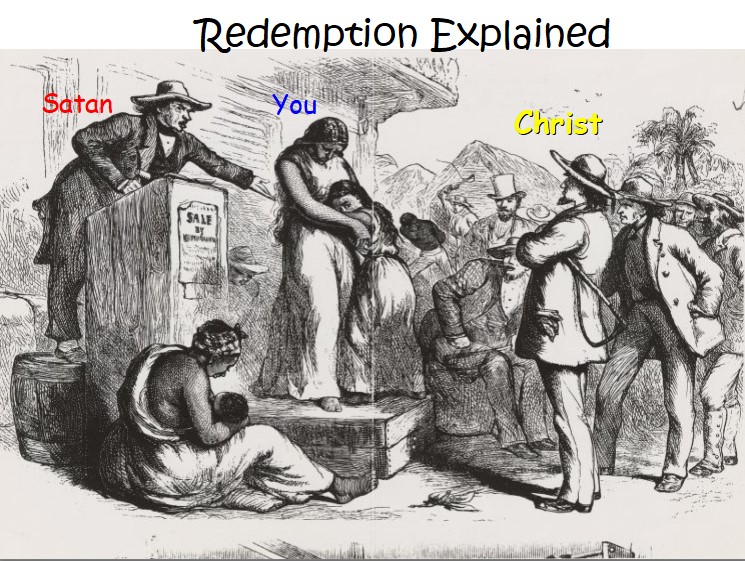
When a slave had served sufficient time and had accumulated sufficient wealth or found a benefactor, he or she could buy their freedom. This seems particularly egregious when their servitude was already, in the case of debt, the means of paying back what was owed. In effect the enslaved individual was paying twice for their freedom. Be that as it may, the act of buying oneself out of slavery was known as redeeming oneself; redemption. Likewise, a third party buying your release was also known as redeeming. We still use the term in this sense today: a pawned item can be redeemed, bought back, for a greater amount of cash than the pawnbroker originally paid for it. The related term ‘ransom’, in Mark 10.45 has the same sense; paying money to secure the release of a captive.

The principle of buying oneself out of captivity and slavery underscores the Christian idea of redemption. It is the analogy Paul and other New Testament writers use, to explain Christ’s paying the price, through his sacrificial death, for the slave’s release. He redeems (or will do at some future point depending on which fantasist you’re reading) in exactly the same way a slave was redeemed, from a life of captive slavery to sin/the Law/Satan and his minions. 

There’s a catch. If a slave was redeemed by a third party, he was likely to find himself not free at all but the property of whoever had redeemed him. His debt having been paid off to his first owner, he might very well find himself in hock to a new one. So it is with Christian redemption. Christ may have paid off your perceived debt to your original owner (sin, Satan or whoever) but now you’re indebted to him. You’re his slave, as we saw in the previous post.

To downplay slavery as it was practised in the centuries before the cult adopted it as an analogy, is to undercut redemption as Paul and early cultists perceived it. Arguing that slavery was a relatively benign practice removes the basis of Christian redemption; if being a slave wasn’t really too bad then neither can being a slave of sin/the Law/Satan be too serious either. There’s really no great need to be redeemed and what Paul says in Romans and elsewhere counts for nothing.

But we knew that anyway.


The Guilt Legacy

A couple of nights ago I watched a programme called Jehovah’s Witnesses and Me fronted by Rebekah Vardy. I know nothing about Rebekah apart from the fact she’s a footballer’s wife who was recently involved in a social media scandal, but her reflections on being brought up in a Jehovah’s Witness household were honest and sincere. She said one of the legacies of her mother being ‘disfellowshipped’ when she, Rebekah, was 8 was that she felt, and still feels, guilty about much in life. The teaching of the organisation was, as it is in many evangelical churches, that the individual is a hopeless sinner who cannot please Jehovah, though must nevertheless endeavour to work out their own salvation. For JWs this involved (and still does, as you may know from personal encounters with them) going door to door and standing for hours on end in public spaces with a trolley-full of Watchtower publications.

I could relate to Rebekah’s feelings of guilt. While not a Jehovah’s Witness (I was never that gullible) my years as a Christian left me with a legacy of guilt. For many years it was the dominant emotion of my life. While a Christian I constantly felt I was letting God down: not as good a Christian as those around me, not witnessing enough, listening to pop music instead of worship songs – practically anything could trigger my not-good-enough feelings. I also felt responsible for anything that went wrong, even when I couldn’t possibly be, and guilt about my secret sexual feelings and, most especially that I wasn’t been a good enough father. To this day, I feel awful if I’m unable to help with my grown-up children’s problems. I am moving away from such fruitless thinking, and recognise that possibly I am naturally inclined to blame myself for events both within and outside my control. Christianity nonetheless exacerbated the problem, with its emphasis on the sinful worthlessness of the individual who is nothing without Jesus. I have, I’m pleased to say, got a lot better since abandoning its negative anti-human philosophy.

What scars has religion left those of you who are escapees from religion with? I’d be more then pleased to hear it’s none, but most of the ex-Christians I know have not come away unscathed. Feel free to share in the comments.

Is Jesus the Saviour, the Messiah and the Son of God?

Is Jesus the Saviour, the Messiah, and the Son of God?

No, no and no.

We know he’s not the Saviour because he hasn’t saved anyone. Every single person who has believed in him over the last 2,000 years has died and stayed dead. He hasn’t resurrected a single one of them and hasn’t ushered anyone into the heavenly mansion he (supposedly) said he was preparing for his Elect. Neither has he saved them from the trials of this life: illness, pain or suffering. His followers are no more saved from these than the rest of us.

Of course, Christians claim that what he saves people from is ‘sin’. But sin is an empty and peculiarly religious concept signifying the separation of ‘man’ from God. If there’s no God to be separated from there can be no sin. If, however, we’re talking about morals – ‘sinning’ – then it’s evident that believers are no more or less moral than anyone else. Jesus, it turns out, doesn’t save anyone from their own bad behaviour.

He’s not the Messiah (I’m resisting the temptation to add the Monty Python completion of that sentence) which is why most Jews do not believe in him. He doesn’t demonstrate any of the characteristics of the Messiah prophesied in Jewish scripture. He didn’t overturn the oppression his people endured under Roman rule and he hasn’t been there for the Jewish people in all their subsequent suffering. He certainly didn’t rescue them from the Holocaust. Only by redefining what is meant by ‘Messiah’, as early Christians did when they made the term synonymous with ‘saviour’, could Jesus even be considered a contender. In reality, he is an utter failure as a Messiah.

He’s not the Son of God. Even in the synoptic gospels he doesn’t claim to be; he’s cagey whenever the subject arises. It’s as if his early followers couldn’t make up their minds about how divine he actually was. Later Christians were more emphatic, claiming that the resurrection demonstrated Jesus’ divinity. Paul, however, doesn’t think so, saying only that Jesus’ return from the dead elevated him to a favoured position in God’s hierarchy (Philippians 2:9). Even this is going too far when the evidence of Jesus’ physical resurrection is so poor; the gospel stories do not  qualify him for Sonship. Nor do his failed promises and prophecies; if he were the Son of God, he’d have known the appearance of Son of Man (he himself?), the last judgement, the Kingdom of God on Earth, the inversion of the social order and the meek inheriting the Earth would not happen when he said they would. Or indeed at all. He was ignorant about so much! What sort of Son of God was he, to get so much so wrong?

In fact, we can be certain Jesus was no more the Son of God than Alexander the Great was Son of Ammon-Zeus or Augustus the ‘Son of the Most Divine’. How? Because like Ammon-Zeus and ‘the Most Divine’, the likelihood YHWH exists is ridiculously low; so low it’s reasonable to conclude he doesn’t. And no God = no Son of God.

To be continued.

God: more reasons why not

Blog403

The third reason it’s unlikely God exists (see the previous post for the first two) is that he is a mass of contradictions; omnipotent and yet vulnerable to his creation’s ‘sin’. Loving yet unable to stop himself from meting out savage justice. Interventionist yet conspicuously absent when actually needed. Distant and mysterious and yet intimately involved with a select number of humans. Oblivious to the thousands who starve to death each day yet overly concerned with how others dress, spend their money or have sex.

The God of the Bible is everything a badly conceived character in a third-rate novel might be. Not surprising really, when that’s what he is. The all-too-human authors of that most mixed, muddled and deplorable book creating and recreating him in their own image, modifying and evolving him until he is a transparently human creation. He is a product of their misinterpretation of reality, wishful thinking and vindictiveness, human traits he reflects throughout the so-called ‘holy book’ and in his church throughout history.

Four, God is ineffectual in the real world. He demands the love and devotion of his creation and gives next to nothing in return. Warm fuzzy feelings possibly, and a ludicrously nonsensical ‘salvation’ plan that undercuts his supposed omnipotence. That’s it. That’s all he offers. Oh, and eternal life spent as an automaton, forever worshipping him. Nothing in the here and now. Nothing to alleviate poverty, feed the starving, eliminate disease or rescue us from viral pandemics. He doesn’t even do this for those whom have pledged allegiance to him, however much they claim he has or will do. This leaves us with two options: he is either an absolute failure or he doesn’t exist. I conclude the latter.

Five: Jesus. Jesus is the prime evidence there is no God. Not one of the claims Jesus made for God was realised. God doesn’t answer prayer; he doesn’t give whatever is asked of him (Mark 11.24; Matthew 21.22); he didn’t bring his kingdom to the earth in the first century (Luke 9.27; Matthew 24.29-31 & 34); he didn’t set Jesus and his disciples up as rulers of the world (Matthew 19:28). In short, he didn’t do a damn thing his supposed son said he would. Jesus was sadly mistaken, deluded, about his Father. In terms of delivery, Jesus’ God did nothing for him, nor for those, like Paul, who came after him. The New Testament is nothing but testimony to its own failure, its God mere make-believe.

To be continued, again. I mean how many more reasons can there be that demonstrate God is unlikely to exist?

Bathwater

Blog392

While putting together the ‘Can You Be a Christian and…’ series, I encountered on more than one occasion the line of reasoning (I use the term lightly) used by moderate Christians that, essentially, certain parts of the Bible are no longer relevant. So you can, they said, be both a free thinker and a Christian; you can be gay, so long as you disregard what the bible says about homosexuality; you can be a Christian woman if you dismiss Paul’s denigration of women; you can acknowledge evolution provided you reinterpret what the bible says about creation; you can be a realist if you ignore the bible’s supernaturalism.

But if you’re going to disregard anything the bible teaches that appears incompatible with what we know about psychology, sexuality, biology and reality, then how does the Bible’s central objective truth, as one commenter on here calls it, survive? What makes its core message (that, in some way, Jesus’ death and resurrection is capable of saving humankind) an immutable, eternal truth, while almost everything else can be compromised, deemed to be ‘culture-bound’ and metaphorical, to the point of irrelevance?

I recognise, of course, that fundamentalist Christians don’t do this. For them the bible is inspired, infallible and immutable. They’re prepared to compromise themselves, science and reality in order to honour and preserve what the book says. For them evolution, feminism, homosexuality and independent thinking will always be wrong. The alternative is to acknowledge that the bible doesn’t get everything right and to take the approach of the liberal progressive Christian who is prepared to adjust and adapt what it says; to emasculate it.

Which brings us back to asking where this process stops. If progressive Christians are prepared to dilute to the point of meaninglessness what the bible has to say about creation, women, sexuality and reality itself then why not what it teaches about Jesus and salvation?

It’s a fact that almost all varieties of the Faith, including fundamentalism, are happy to ignore completely Paul and Jesus’ teaching that the Kingdom of God was due to arrive, in all its glory, in their own time. It’s the same with Jesus’ moral extremism (giving to all who ask, loving enemies, turning the other cheek.) So why not the rest of it?

Why are Paul’s muddled theology and selected bits of the Jesus stories considered to be the baby while the rest of the bible is the disposable bathwater? On what basis do progressive Christians decide what is inessential and what is crucial, critical, indispensable? Ideas about angry deities, blood sacrifice, the sins of the people and the resurrection of god-men are every bit as culture-bound as the bible’s perspective on all those other issues.  

Because really, in the end, it’s all bathwater.


Can you be a Christian and… a rational thinker?

Blog390

This is the first in a series of posts that pose the question, ‘Can you be a Christian and..?’ It seems to me that certain ways of being are incompatible with religious belief. Any religious belief, that is, though here I’ll limit myself to the Christian faith as that’s the belief system I know best and the one on which I wasted a great deal of my life.

Conversion is, I’ve become convinced, an emotional response to being told God loves you (who doesn’t want to be loved?) and that Jesus sacrificed himself so that you – yes, you – can enter into a full and meaningful relationship with God. It’s an intuitive, gut-reaction to the ‘promise’ that once you’ve accepted Jesus as Lord and Saviour, he will  be with you always, guiding you through life and guaranting you’ll survive death.

What is rational about this? Nothing; it’s muddled supernaturalism, magic based on others’ dreams and visions, that appeals to your need to be wanted, to matter and your hope that your life means something and will go on beyond death.

The rationalisation comes after you’ve made this response and after your commitment. It’s rather like buying something incredibly expensive you’re not sure you actually need but which makes you feel good momentarily as you hand over your cash. On the way home, as doubts start to assail you, you start trying convince yourself that you were right to buy it, on the basis you deserve it, so that by the time you’re home you feel completely justified. Psychologists tell us we do this often: act first and then come up with the rationalisation for why we’ve behaved the way we have.

So it is that once you’ve made the emotional response to what Christianity purports to offer, you start justifying your decision to yourself. You know there’s really no evidence for what you’ve started to believe. All there is is the bible and other people’s enthusiasm for what it teaches, but still, there must be some sort of justification for it; all those others, including the guys who wrote the bible, can’t all be wrong. You’re helped in your rationalisation of the irrational by sermons in which a respected pastor explains what certain teachings mean, the warm and fuzzy feelings you get from fellowship with other Christians and from reading the bible with the aid of a study guide that smooths out its many inconsistencies and contradictions. You start reading too those devotional books that have been recommended to you, which give your new-found faith a respectable gloss. All after the event.

And before you know it you are fully invested in an entirely new belief system. Not only have you accepted the central mystery (magic) of salvation but you find yourself entertaining the notion that there exist all manner of supernatural beings; angels, demons, devils, spirits all engaged in spiritual warfare in higher places. You convince yourself, even when your intellect is telling you to exercise caution, of the existence of Heaven and Hell. You become persuaded that talking to yourself inside your head is communicating with the God of the Universe and that your very thoughts can change his mind. You assume what you are told is biblical morality and alter your world view so that it conforms to the bible’s: sin everywhere, yet miracles happen; God creating humans and not just (or even) evolution; Jesus returning at any time soon to change the word so it is more to your liking.

Yet there is no evidence for any of this. A book written by Iron Age tribesmen and first century religious zealots is not evidence. Nor is any of it rational. You know this, but you hold fast to your belief that God’s ways are not our ways. He likes, it says somewhere in the bible, to conceal his plans from the worldly wise. Like many other believers you are not stupid but you’ve happily sublimated your intellect to assume irrational, unsupported beliefs. You’ve subjugated your capacity for rationalisation in deference to these beliefs. If and when a rational objection forms itself in your mind, you dismiss it as a doubt, or worse still, a Satanic attempt to snatch you away from your salvation.

How do I know? Because I did so myself.

So, can you be a Christian and rational thinker? No. Because once you’ve tethered your intellect to ancient superstition you’ve denied yourself the possibility of independent thought. Rational thinking can go then in only one direction, towards the conclusions already established by the Faith. It isn’t possible to be an independent thinker and to adopt a worldview based on others’ emotions, dreams and visions. It isn’t possible to believe irrational things and be a rational thinker.

God’s Very Good Creation

Blog385

I’m recovering from a viral condition that’s affecting people in these parts. It’s set me thinking about how many diseases and conditions humans are susceptible to. An online search suggests the figure is unquantifiable. There are, for example, over 5,000 viruses known to affect human health, including the 200 that cause various versions of the so-called common cold. Of these 5000, we understand only a few hundred. There are also some 6,000 diseases caused by single-gene defects, and even more by other genetic disorders. In case that’s not enough, there are also hundreds of infectious diseases caused by bacteria, fungi and parasites. While some of these cause only minor discomfort, it remains the case that almost every one of us will die, or has already died, from one or other of these diseases, conditions or illnesses.

How does Christianity account for all of these horrors? Here’s the cerebrally challenged Ken Ham to explain:

We need to start with the fact that God created everything perfect, and this perfect creation was then marred by sin. This is the only way the gospel makes sense. You need the foundation of the history in Genesis in order to fully understand the gospel!

Yup, God made everything perfect and a pair of mythical humans messed it up by ‘sinning’. Everything that’s bad about the world is the result of Adam and Eve’s one-off disobedience. That single act opened the floodgates not only to all of the illnesses to which we and the animal kingdom are prone, but also to natural disasters and the brutality we inflict on one another.

But don’t worry, God has a cunning plan! Ken wants us to teach our children about it:

Teach them about God’s original “very good” creation. Instruct them that mankind’s sin broke God’s creation and brought death and suffering into it. Teach them that we needed someone to pay the penalty for our sin, and that’s why Jesus stepped into history… and now offers the free gift of eternal life to all who will put their faith and trust in him.

You see, as Ken likes to say, only this explanation makes sense of our susceptibility to disease and illness. Only this explanation makes sense of the gospel too; the good news that Jesus sacrificial death will put everything right.

                   Eventually.

                            No rush.

                                   Whenever…

It also demonstrates what a complete and utter bastard the biblical God is, that he condemns his ‘very good’ creation to a disease ridden, disaster stricken existence, simply because he himself made the first humans as fallible as he did.

But no. Neither this explanation nor its concomitant ‘gospel’ makes any sense, whichever perspective you look at them from. The development of innumerable diseases, and the viruses, bacteria, parasites and genetic conditions that cause them, are clear evidence of evolution; of an unsupervised arms-race in which the best-adapted invader or host survives to reproduce/replicate. Having then had the chance to transmit their DNA/chemical data, their purpose is served. They die. They stay dead.

The men who created Genesis 1 & 2 did not know about evolution, microbes or viruses. They did, however, see the deficiencies of the world in which they lived, the struggle for existence, illness and death, and found these impossible to square with the benign creator God they imagined existed. And so were formed the Genesis myths of a perfect creation spoilt by the only agent whom these men believed capable of causing such havoc; they themselves. There is no denying their accounts have been remarkably influential, and also completely wrong.

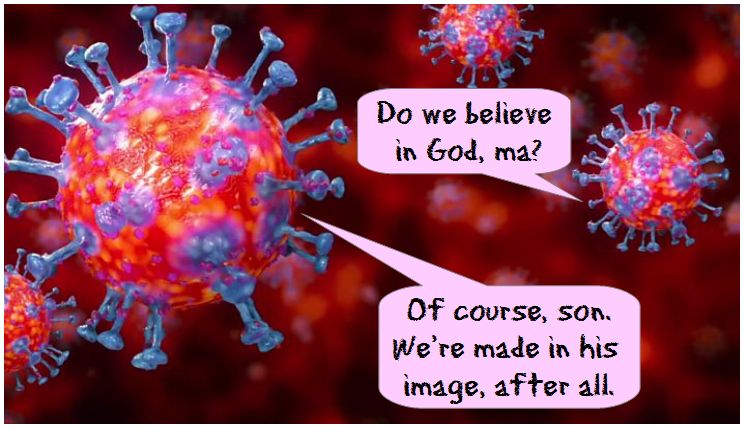
No gospel is needed to put right a fallen creation. It isn’t fallen, it is what we should expect if life evolved; if each species, organism and virus that exists today has spent millions of years constantly adapting in order to survive. Jesus’ supposed sacrifice has no bearing on any of this; it is superfluous, unnecessary and entirely irrelevant. The salvation myth is a virus in its own right, existing, like the meme it is, merely to perpetuate itself.

Jesus can’t save you from the common cold, let alone death.