Mystic Revelations

What do the three ‘great’ Abrahamic religions have in common?

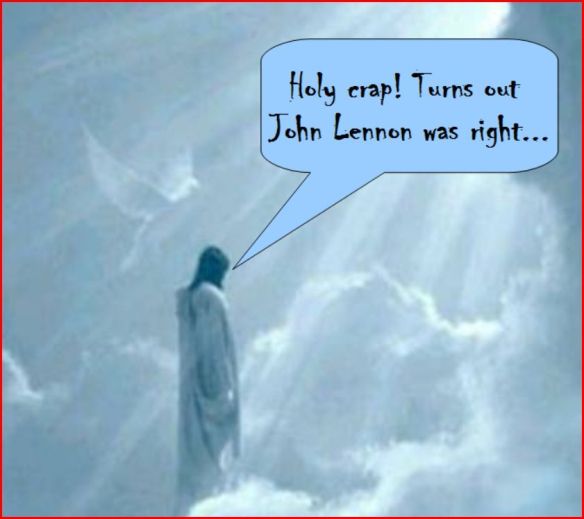
They all started with visions, hallucinations, dreams and mystic revelations. They’re not only based on these but owe their very existence to encounters with the supernatural that took place entirely within people’s heads. This of course is if they happened at all; many of these encounters with angels and God’s revelations take place in stories that have all the characteristics of myth or legend. Even so, they reveal much about the primitive state of mind (still around today) that believed God frequently revealed himself to, and in the minds of, chosen individuals.

First, the grand-daddy of the Abrahamic religions, Judaism: 

When Abram was 99 years old, YHWH appeared to him. He said to Abram, “I am El Shadday. Live in my presence with integrity. I will give you my promise, and I will give you very many descendants.” Immediately, Abram bowed with his face touching the ground, and again Elohim spoke to him, My promise is still with you. You will become the father of many nations. So your name will no longer be Abram [Exalted Father] but Abraham [Father of Many] because I have made you a father of many nations. I will give you many descendants. Many nations and kings will come from you. I will make my promise to you and your descendants for generations to come as an everlasting promise. I will be your Elohim and the God of your descendants. (Genesis 17)

Then Moses:

The Angel of YHWH appeared to (Moses) in a flame of fire from the midst of a bush. So he looked, and behold, the bush was burning with fire, but the bush was not consumed.

Then Moses said, “I will now turn aside and see this great sight, why the bush does not burn.”

So when YHWH saw that he turned aside to look, Elohim called to him from the midst of the bush and said, “Moses, Moses!” And he said, “Here I am.” (Exodus 3)

Notice how the inner voice goes from being that of ‘the angel of YHWH’ to YHWH himself (or one of his aliases). The entire scenario is preposterous of course, as is the Abraham episode before it. I’ve omitted the other occasions YHWH is said to appear to Abraham, including the infamous Genesis 22, where YHWH instructs Abraham to sacrifice his son. These stories are legends written, created from whole cloth, centuries after Abraham purportedly lived. He, like the later Moses, is almost certainly mythical, a character created to represent the beginnings of the Jewish faith. Even his names are symbolic. In truth, no one knows how Judaism began.

Onto Christianity:

The angel said to (Mary), “Don’t be afraid, Mary; God has shown you his grace. Listen! You will become pregnant and give birth to a son, and you will name him Jesus. He will be great and will be called the Son of the Most High. The Lord God will give him the throne of King David, his ancestor. He will rule over the people of Jacob forever, and his kingdom will never end.” (Luke 1)

Did this happen? If you believe angels exist then possibly, but we know they do not. We also know that this is myth. However, Luke wanted his readers to know that Jesus’ birth was miraculous so invented a story in which Mary encounters a heavenly being. The gospel writer anchors the divinity of Jesus to an implausible event which at best can only be a young woman’s vision (though it most certainly isn’t.)

The same is true of the resurrection appearances. Here’s Matthew 28:1-8:

Now after the Sabbath, as it began to dawn toward the first day of the week, Mary Magdalene and the other Mary came to look at the grave. And behold, a severe earthquake had occurred, for an angel of the Lord descended from heaven and came and rolled away the stone and sat upon it. And his appearance was like lightning, and his clothing as white as snow. The guards shook for fear of him and became like dead men. The angel said to the women, “Do not be afraid; for I know that you are looking for Jesus who has been crucified. He is not here, for He has risen, just as He said.”

More angels (they multiply in later gospels); again at best, though still highly improbable, the angel(s), if seen at all, can only be a vision or an hallucination (or mistaken identity.)

Onto the only first hand account of an encounter with the divine that the bible includes, Paul’s:

God was pleased to reveal His Son in me so that I might preach Him among the Gentiles… I want you to know, brothers and sisters, that the gospel I preached is not of human origin. I did not receive it from any man, nor was I taught it; rather, I received it by revelation from Jesus Christ. (Galatians 1)

I know a man in Christ who fourteen years ago—whether in the body I do not know, or out of the body I do not know, God knows—such a man was caught up to the third heaven. And I know how such a man—whether in the body or apart from the body I do not know, God knows— was caught up into Paradise and heard inexpressible words, which a man is not permitted to speak. (2 Corinthians)

This is all there is. This is the extent Paul talks about his heavenly encounters. In Galatians he admits that God revealing whatever it was he revealed was ‘in’ him, that is, in his own head. The bizarre tale he relates in 2 Corinthians reads like an hallucination (Paul says he doesn’t know whether it was in the body or out of it) which is all it could’ve been; there is no paradise or ‘third heaven’.

And finally, there’s Mohammed:

while I was sleeping last night, the keys of the treasures of the earth were brought to me till they were put in my hand.”… 

The angel came to him and asked him to read. The Prophet replied, “I do not know how to read. The Prophet added, “The angel caught me (forcefully) and pressed me so hard that I could not bear it any more. (Sahih Bukhari 6998)

Encounters with heavenly beings in dreams, ‘revelations’, visions, hallucinations and invented stories: these are central to Judaism, Christianity and Islam. The religions would not exist without them. Written as myth long after they supposedly occurred or referred to obliquely by those who claim to have experienced them, they are the products of fevered pre-scientific minds.

Post-script: I’ve searched in vain for Darwin’s admission that an angel revealed the process of evolution to him. I can only find his collection of evidence, his scientific observations and his careful analysis of his findings. Likewise Mendeleev who calculated the existence of elements that were at the time unknown. Likewise Crick, Watson and Franklin who discovered the structure of DNA. Strangely, none of these people relied on visions, dreams or divine revelations in uncovering truths about reality.

You don’t have to imagine: there is no Heaven

From an Anonymous commenter:

How do you know there is no Heaven or an afterlife? I have no proof Heaven or an afterlife exists either, but where is your proof that they don’t? I don’t think I will ever understand how atheists can be so certain of something that they can’t prove any more than I can understand fundamentalist Christians who say if you don’t accept Jesus Christ as savior you’re doomed to hell. You’ve got something in common. 

And my response:

Thanks for the comment, Anonymous. I’ve copied it here from the old post you added it to.

First, it isn’t up to those of us who question the existence of things like Heaven to ‘prove’ they don’t exist. It’s up to those who claim they do exist to demonstrate that this is the case. A negative proposition such as ‘there is no Heaven’ or ‘there’s no such thing as unicorns’, can’t be ‘proven’ as such, simply because its impossible to present evidence for a no-thing. A positive assertion, however, such as ‘there is a Heaven’, is theoretically demonstrable. But this particular claim never has been. No one has demonstrated where Heaven is (it has to exist somewhere, right?) No-one has ever returned from Heaven with empirical evidence of its existence. No-one has ever survived death to experience Heaven. No evangelical seems to understand that Heaven is exclusively God’s abode and no human will be resurrected into eternal life until the Final Judgement. That’s the Final Judgement Paul and Jesus said was just round the corner but which has never arrived.   

The problem is worse than this, however. There is so little evidence that a god exists, and even less the Christian God (see my previous post, as well as here and here). If there’s no God – and it is highly likely there isn’t – then all contingent beliefs are wiped out: there’s no Heaven, Saviour, Resurrection, Final Judgement, Hell or Eternal Life.

So this is how I know there is no Heaven: it all comes down to probability. The probability there is a Heaven is so infinitesimally small – its highly improbable in fact – that it’s to safe to assume there isn’t one.

Despite first impressions suggesting this view has a lot in common with evangelical belief, I think you’ll find it is actually the opposite. While evangelicals accept on faith that Heaven must exist – because the Bible says so – the fact that its existence is both highly improbable and indemonstrable allows for the 99% certainty that it does not.

Finally, Anonymous, no-one other than mathematicians and lawyers deal in proof. Scientists most certainly don’t: they are concerned with evidence and demonstrating something is or is not the case. You’d do best to drop ‘proof’ from your arguments. Unless you can prove something mathematically, you’re not going to provide or find proof, certainly not when contending with religions. Second, how about giving yourself an online name? Commenting as ‘Anonymous’ suggests you don’t have the courage of your convictions and also adds you to the numerous other Anonymous commenters who pop up on blogs. There’s no way of distinguishing between you.  


Conclusions

So what do we see when we arrange the books of the New Testament in chronological order?

  1. In all probability, Jesus was first experienced in visions experienced by a few Jewish zealots looking for the arrival of the Messiah. His name – Yeshua – is symbolic and means ‘The Lord is Salvation’.

  2. These visions led to ‘revelations’ that convinced these zealots that the Messiah would soon arrive on the Earth to set God’s plans in motion.

  3. A small number of Jews were convinced of the veracity of these claims and sought to spread the message that the Messiah/Jesus was soon to arrive on Earth.

  4. A few years later, a Hellenized Jew who called himself Paul, argued that the Messiah – ‘Christ’ in Greek – had died in the heavenly realm and been raised from the dead by God. His sacrifice, Paul insisted, was a propitiation for human sin, both Jew and Gentile.

  5. Also according to Paul, the Christ’s arrival would trigger the resurrection of the dead, prophesied in Daniel 12:1-3 and Isaiah 26:19-20, the final judgement (Daniel 7:22) and the establishment of God’s kingdom on Earth, governed by God’s Chosen (Daniel 7:27). Regrettably, he drew most of these conclusion from a book, Daniel, now known to be fake.

  6. Paul ‘proved’ that the Messiah-figure he’d seen in his visions really was the Messiah prophesied in Jewish scripture by quoting from them extensively.

  7. Soon after Paul died, the original group of visionaries, who had had their differences with Paul, were all but wiped out when the Romans destroyed Jerusalem.

  8. Around the same time, an unknown cultist took it upon himself to write an allegorical history of the Christ’s activities. He based this allegory on Paul’s teaching about the Christ as well as events from Jewish scripture. He set his story in Galilee some forty years earlier and has his fictional Christ, Jesus, prophesy the arrival on Earth of the real Messiah whom he calls the Son of Man, after Daniel 7:13-14.

  9. Two other cultists set about altering and improving this original history. One re-establishes the Christ’s Jewish credentials, and extending references to and allegorising aspects of Jewish scripture.

  10. A completely imaginary history of the early cult was created by one of these writers, smoothing over the differences between the beliefs of the earliest visionaries and Paul.

  11. Other writers, including some pretending to be the late Paul, continue to write of Jesus the Christ as a celestial saviour.

  12. A fourth history of the Christ was created, this time providing Jesus with a bodily resurrection (contrary to Paul) and discarding some of the cult’s earlier beliefs, the imminence of God’s kingdom on Earth included. The authors of this account imply that dead believers will awaken to new life in heaven (John 14:2)

  13. The idea that the Messiah will arrive imminently was, however, kept alive by other writers. One anticipated the Christ would soon purge the world of evil-doers and bring a holy, bejewelled Jerusalem down to Earth.

  14. Others soon abandoned the idea that any of this would happen soon. The arrival of the Christ was postponed indefinitely.

  15. The notion the Son of Man/Messiah/Jesus had yet to appear was also dropped as the church adopted the allegorical gospels as real history. It began to expel those who disputed the gospels’ veracity and denied that Jesus was the Christ incarnate.

  16. While the term is not used in the New Testament the Christ’s delayed arrival was, from the early second century, thought of as a second coming.

  17. The church, once well established went on to embellish doctrine, adding the Triune God; eternal life in Heaven; the elevation of Mary and the saints; the New Testament as the Word of God and the infallibility of the Bible as a whole. Some of these were, and are, in direct contradiction of the beliefs of the earliest Christians.

  18. Believers today, if they read the New Testament at all, take its traditional order at face value, which distorts the evolution of its ideas. They allow their preachers to smooth over what now appear to be random contradictions (hermeneutics).

  19. Today’s Christians believe primarily in the heavenly Christ, who forgives their sins and guides their lives from Heaven. They also hold on to the belief that he was manifested as a human, and vociferously oppose the idea he was and is only an imagined supernatural being.

  20. At the same time they prioritise Paul’s teaching about him over anything he is made to say in the gospels .

That how I see it anyway. The more time I spend looking at the New Testament books in their correct order, as well as what this reveals about the beliefs of early Christians, the more I’m driven to these conclusions. They’re the only ones that make sense of all that we find in their writings. I realise this is contentious. Mythicism is not widely accepted but it is the only position that explains the recorded facts as we have them. The original Jesus was seen (in the mind of the first visionaries and by many later) as a heavenly Messiah. While the gospels were generally accepted as historical many decades after they were written, they are anomalies in the expression of the early faith. They can only be seen as allegories of the living, dying and rising of a cosmic saviour, a sequence not uncommon in the mythologies of the ancient world.

I recognise too that there may well be other problems with this position, which I’ll get to soon.

This Must Be Heaven

In the last week or so my Facebook feed has been bombarded with posts and memes of a religious nature. Every other one is of this sort. Most are Evangelical though some are evidently Roman Catholic, what with Jesus and his mom with their hearts pinned to their blouses. All of them inform me in the schmaltziest of terms how wonderful Jesus/God/Heaven is. Just about every one is followed by comments consisting single word: Amen! Some have a ‘Praise Jesus’ and occasionally there’s profound philosophical insight (kidding).

Last time my FB was invaded, about six months ago, I had to go into each post separately to blocked them. For a while FB complied. Now that my period of grace (pun intended) is over, they’re back with a righteous vengeance. Before I block them all over again, I’d like to share one with you. Its picture is at the top of this post. Some bright-spark has given it the title First Moments in Heaven, which is patently not what it’s called; not even the nuttiest fantasist would include gravestones in heaven. None of the undiscerning commenters seemed to have spotted their inclusion. Having had this pile of old cobblers dumped on my FB page, I felt obliged to point out the problem. As if a single drooling commenter cared. Here’s a sample of what they went on to say:

I despair that this saccharine banality is the best many Christians have to offer. It really can’t be argued with; people who enthuse over such slush are immune to reflection, reason and critical thinking. A staggering 13,000 of them reposted the damn thing.

The picture evidently depicts the general resurrection here on Earth and, as I thought when I first saw it, is a Jehovah’s Witness creation, originating in a Watchtower magazine. Not a single one of the thousands of born-again geniuses who orgasmed over the picture noticed it was the product of a sect they detest. Again, I felt compelled to alert them to the fact.

Now to block the lot of them. Amen! Praise Jesus!


Back by unpopular demand – it’s the New Year Pop Quiz!

All set? Here we go!

1. Which one of these fantasy figures actually exists?

2. For which one of these ideas is there refutable/verifiable, corroborative scientific evidence?

3. Which one of these events is demonstrably historical?

4. Which one of these phenomena is verified and corroborated by psychology?

5. Applying logic and reasoning, which of the following scenarios is most likely to be true:

6. Which of these statements is verifiably true?

Answers:

Question 1. The answer is none of them, though C, Donald Trump, comes closest. 10 points if you put C, none if you plumped for any of the others: despite the volumes written about them there isn’t an iota of  evidence that they exist.

Question 2. Award yourself 10 points for B, though if you’re a True Believer this is the only one you think isn’t true. There is an abundance of refutable/verifiable, corroborative scientific evidence that it is. You can only wish there were for the other three.

Question 3. A is correct – 10 points. There is a considerable amount of evidence that the moon landing occurred on 20th July 1969. There is absolutely none at all that the other three are historical. For the sake of argument, let’s say they’re mythical. Nul points if you think otherwise.

Question 4. The answer is all of them. Oh no, wait… that’s my cognitive dissonance speaking. D is the only one of those listed recognised by psychologists. My bad and 10 points to you.

Question 5. The answer is of course E. Award yourself another 10 points if you thought outside the box on this one. (You can also have 10 points if you said they’re all equally likely, as in ‘not at all’.)

Question 6. 10 points for D

Scores: 

If you scored 50 or more, congratulations! If you scored nothing at all, you are confirmation that question 6’s answer – D. Human beings are capable of believing just about anything – is true. Well done.

A happy new year to you all.


When A Child Is Born… Supernaturally

To what extent are the conflicting nativity stories in Matthew and Luke historical? That depends on whether or not you believe in the supernatural.

There is no evidence of a supernatural realm nor the beings who are said to inhabit it: God, heavenly Jesus, the Holy Spirit, angels and those they are constantly at war with: Satan and his demonic hordes. It is not as Jonathan Cahn describes it in The Serpent’s Prophecy:

Behind the perceivable realm lies another, beyond our ability to measure or quantify. Behind the history of this world lies another, unrecorded, unrecited, unknown. And behind that which moves and transforms the world lie unseen forces, causes, agents, undying and primeval (p3).

Cahn cannot possibly know any of this, any more than fake-Paul could when he wrote Ephesians 2,000 years ago (6:12). A reality that exists above and beyond nature – the meaning of supernatural – that is ‘unseen’, undetectable and ‘unknown’ is one that doesn’t exist, except in the imagination of a few fantasists.

Yet the supernatural is the basis of Christianity. Without it, its agents, as Cahn calls them, could not have interacted with the only reality there is. The Holy Spirit could not have impregnated Mary; angels could not have materialised to announce Jesus’s birth to a group of credulous shepherds; a divine being could not have communicated through dreams with Joseph and the Magi; a magic star could not have been manoeuvred into place over Jesus’ house. Most significantly, a non-existent God could not have sent his ‘son’ into this world.

It is futile to argue whether Matthew or Luke’s nativity narrative is the more historically accurate. Nor is there any point in trying to harmonise the two accounts. Neither is historical: the involvement of the supernatural rules out their being factual.

The inclusion of the supernatural in everything that follows is also fatal to claims made for the gospels’ historicity. The clues are there in the text: God’s pronouncements from the sky; the inexplicable miracles and healings; the presence of angels, demons and Satan; the dead rising; visions, prayers and prophecies. These tell us that what we’re dealing with is fantasy material. The creators of the gospels and other books of the New Testament had no more evidence than Cahn does that secretive super-beings existed, even if they did take them for granted. God and his interventions no more exist than Santa Claus and his magical Christmas deliveries.

Paul tells us that God raised Jesus from the dead (Romans 8:11). But there is no God, so he didn’t. There was no supernatural resurrection and without a resurrection there were no encounters, like those in the gospels, with a reanimated body.

Remove the supernatural from the Jesus story and there’s nothing left. Some wise advice lifted from Jewish scripture perhaps, plus a few cult rules, but that’s all. Paul’s experience of the risen Christ, like that of Cephas before him (described nowhere in the New Testament but allegorised in the gospels) and John of Patmos after him, were as Paul himself says, a ‘revealing’ in their own heads.

I hope none of this spoils Christmas for you. The Nativity isn’t a bad story, indeed it’s quite beautiful in places. But it is not historical. Like much in gospel Jesus’ life, and the resurrection itself, it is a fantasy generated by irrational and superstitious minds.

A very happy Christmas to both my readers.

A World When Revelation Was Possible

Greek and Roman cultures of the ancient world were obsessed with seers, oracles, prophets, muses and the fates. Politicians, priests and ordinary people were desperate to know how to keep on the right side of capricious gods and what the future held. Word from the supernatural realm, channelled through seers and prophets, was sought after and valued. Visions, dreams, portents and auspices that revealed secrets and mysteries were highly prized. It was a world saturated in superstition. Jewish culture, operating within this milieu, was no different.

Jews too revered prophets, dreams, visions and divination. This is apparent in both the Jewish scripture, the Old Testament, and also in the New, the writing of the early Christian cult birthed from Judaism in a Greco-Roman world. There are in the New Testament:

6 instances of god-induced dreams;

11 visions of heaven and heavenly beings;

578 new prophecies;

300 or so supposed fulfilments of earlier ‘prophecies’;

An abundance of revelations’ (Paul’s phrase) as well as those of Revelation itself (one long revelation or a series of shorter ones?);

113 visits from supernatural agents (Satan, demons, angels);

Assumptions that dead people can reappear (Jesus mistaken for Elijah and Jeremiah; Elijah and Moses manifesting themselves);

Multiple ‘resurrections’ both before and after Jesus’s.

People believed this kind of stuff! The supernatural, prophecy, ‘revelation’ and resurrection were regarded as entirely plausible, a given in the culture in which early Christians lived. The pagans around them may not have subscribed to the new cult’s reworking of these superstitions, nor accepted that Jesus was the Messiah, but they would not have found anything amiss with the idea and presence of the supernatural, with its attendant revelations, visions and prophecies. These were the currency of the day.

That such manifestations were mistaken or misinterpreted by the new cult would have been the point of disagreement for most people (though its important not to over-estimate how many actually knew of the Jesus cult in its early days), not that it manifested and incorporated them in the first place.

In the first century world, revelations, prophecies, visions and the like were considered to be gifts from the gods. Paul insisted that what he ‘received’ was from the supernatural realm, specifically from the heavenly Christ (Galatians 1:12). Accepting this was a prerequisite for believing what he went on to say about salvation, resurrection and Christ’s descent from the clouds. The supernatural world and its ability to communicate with ordinary mortals had to be accepted as real before anything Paul said could even be considered. Fortunately for him, the culture in which he operated embraced the idea that this was a reality.

If, however, there is no supernatural – and let’s be honest, we know there isn’t – there can’t ever have been revelation, prophecy or God-given visions. With no heavenly realm to transmit revelation, prophecy and visions into the brains of seers, prophets and visionaries, from where did – and do – their revelations, prophecies and visions originate? From brains conditioned in an environment infused with irrational, magical beliefs, whether that of the first-century or one of the many Christian, Bible-soaked bubbles that exist today. ‘Revelation’, ‘prophecy’ and visions emanate entirely from the human brain. It is this which originally created revelations and now sustains ideas like heavenly saviours and supernatural resurrections. These things have no independent existence outside of the human imagination.


The End of Days

A friend of mine was recently given the book The Dragon’s Prophecy: Israel, the Dark Resurrection and the End of Days by Jonathan Cahn. My friend, already concerned about the state of the world, said how much the book had disturbed her. She had become convinced that the time we live in had been predicted in the Bible, in Revelation in particular. ‘It’s all there in the Bible,’ she said to me. ‘It’s all happening just as it says.’

I tried to reassure her that Revelation was written by someone who, 2000 years ago, believed that the situation then couldn’t get any worse, what with the Roman occupation, the destruction of Jerusalem and the persecution of Christians (as the writer saw it.) This, together with his belief that the Lord would soon be coming on the clouds (Revelation 1:7), convinced him he was living in the world’s last days. I told my friend that because of the mess the world is in today (and when is it not a mess?) the book of Revelation resonates with some people; a voice from the past echoing down the ages. In no way, however, was it written about today.

My friend was unconvinced so I took it upon myself to read The Dragon’s Prophecy. Coincidentally, I had just begun to read Bart D. Ehrman’s Armageddon: What the Bible Really Says About the End, dealing with the same concerns. The comparison between the two books couldn’t be more striking.

Ehrman’s is a measured analysis of Revelation and other ‘prophetic’ books of the Bible. He demonstrates from the outset that Revelation was written for believers of the late first/early second century and that its symbolism represents individuals and events of that time. John of Patmos, whoever he may have been (a cult leader, Ehrman suggests) expected, like most early Christians, that the End was going to materialise soon, in the first or early second century, emphatically not in the 21st.

Ehrman warns that ‘professional prophecy writers’ (he doesn’t name Cahn) think ‘the way to use the Bible is to assemble the pieces to reveal the big picture, which until now no one has seen before’ (p17). He’s right. This is precisely what they do. In his book, Cahn promises ‘to put together the pieces of the mystery’ (p11) and claims ‘We (sic) will now begin assembling the pieces of the puzzle’ (p36). He then proceeds to jump around the Bible like a grasshopper on steroids. He’s one of the ‘prophets’ who, as Ehrman puts it, sees the Bible as ‘a great jigsaw puzzle with one piece hidden in this place, one in another and yet a third somewhere else’ (p17).

Cahn opens his argument with a series of bald, unsupported assertions: ‘Behind the perceivable realm lies another, beyond our ability to measure or quantify’ and ‘Behind the history of this world lies another, unrecorded, unrecited (sic), unknown,’ his readers evidently not expected to ask how he knows any of this codswallop. He goes from there to build his argument, such as it is, with a bombardment of ridiculous questions and pseudo-profundities:

What is evil? And how did it come into existence? It is both a mystery and a problem. The mystery is the problem (p9).

Then there are the propositional statements of the ‘If… then we’d expect’ variety. There’s rarely any evidence for the ‘if’ and none at all for the proposed expectation. Here’s the two – rhetorical question and propositional statement – rolled into one: ‘If evil is uncreated, how did it come to exist?’ (p32). Naturally, Cahn is going to answer this question and all the others like it, with a series of unfounded assertions, non-sequiturs and a smattering of unrelated Bible verses.

A central premise of The Dragon’s Prophecy, the dragon being that of Revelation 12:9 and therefore the devil, is ‘the dark resurrection’ of its subtitle. This Cahn explains, pretending the idea comes from the Bible when it doesn’t, is the re-emergence of the Israelites’ old, (extinct) enemies, the Philistines. Like the Israeli nation they too have now been resurrected: as the Palestinians. Under the control of the dragon/devil, they re-enacted on October 7th last year one of the many ancient Philistine attacks recorded in the Bible, only this time with ‘guns and explosives’:

On that October morning, the ancient drama replayed. The resurrected Philistines had again invaded the land, and the resurrected Israelites had again gone into hiding, keeping silent and still in fear of their pursuers (pp99-100).

How do we know this is a replay of an ancient invasion? Because some of those under attack on 7th October went into hiding, just as the Israelites did in 1 Samuel 13:6. As if no other group of besieged civilians hasn’t tried to hide at any other point in history. That and the ‘fact’ there were, according to Cahn, exactly 3,000 invaders on each occasion. Yes, the book really is this bad.

And so, Cahn says, the stage is set for the final battle and the return of Christ who will knock a few heads together, torture and slaughter everyone who isn’t a Christian and set up his faithful followers in a new Jerusalem made of gold and fancy stuff. As Ehrman says, this is indeed what Revelation promises – for the world 2,000 years ago. Ehrman argues that the author of this revenge porn, (he doesn’t use the term: that’s my contribution – you’re welcome) creates a Christ so unlike those of the gospels that he can only be a fiction (aren’t they all?)

Revelation barely made it into the canon and we would all be better off if it hadn’t; certainly my friend would be, and as Ehrman shows, human society and the planet in general would be too. He warns us to read what the Bible actually says, instead of, as Cahn does, forcing it to say what we want it to (to sell books). Irritatingly, Ehrman consistently refers to the Christ’s prophesied appearance on the clouds as his ‘Second Coming’ when the Bible never uses the phrase. Read what it says Bart!

I don’t know whether I’ll finish Dragon’s Prophecy. Its cover blurb boasts that Cahn is a New York Times best seller so clearly there’s an audience for such poorly argued, alarmist nonsense – which is itself alarming. While Bart D. Ehrman has also made the NYT list in the past, Cahn easily outsells him. Nevertheless, I’ve bought my friend a copy of his Armageddon in the hopes it might serve as an antidote to the dire The Dragon’s Prophecy.

Heretic

Let me recommend a film to you: Heretic starring Hugh Grant, Sophie Thatcher and Chloe East (opens in the US today.) Ostensibly a horror film, it’s actually a dissection of religious faith: what we believe, why we believe it, its origins and how we might break free from it.

While there are a couple of grisly bits in it, it is actually a psychological thriller, with Grant’s character, Mr Reed, intent on breaking down the faith of two Mormon missionaries who have the misfortune to pay him a visit. Despite the hapless women being LatterDay Saints, his arguments apply to all religious belief. The film is a vehicle for this breakdown and demolition of faith. It veers into unpleasantness only in its final quarter, after taking a cynical swipe at the idea of resurrection.

I’m usually averse to horror films and only went to see this one because of the plaudits Hugh Grant’s alternately fatherly and menacing performance received from critics. He really is superb and Sophie Thatcher and Chloe East are excellent as the missionaries, sustaining a Mormon sensibility until it becomes, well, unsustainable. Scott Beck and Bryan Woods’ script is incisive and engaging (if you like your religion ruthlessly dissected and exposed.) Heretic is highly recommended.

Dying For A Lie, part 94

Over on Gary Marston’s Escaping Christian Fundamentalism, he has been arguing, along with some of you, about the resurrection with Joel Edmund Anderson, self-professed expert on all things Biblical. Joel – he has a PhD in Biblical Studies, don’t you know – has twice said in the discussion that the disciples would not have died for a lie, meaning they wouldn’t have let themselves be martyred if they hadn’t really seen Jesus alive again in the flesh.

I’ve addressed the assertion that they wouldn’t have died for a lie several times already on this blog: here, here and here for example, though some of my thinking about the Jesus phenomenon has changed since then. Nonetheless, I added my penny’s worth to Gary’s discussion (it’s difficult to get involved in real time because of the time differences between the US and UK):

And there it is again: ‘they wouldn’t suffer death and persecution for what they knew to be a lie.’

While you (Joel) mention the execution of James there is no evidence even in your hallowed text that this was because he believed in the bodily resurrection of Jesus.

The later legends of the martyrdoms of Peter and Paul are just that: legends. (And Paul wasn’t even a disciple! Moreover, he is clear in Galatians that his experience of the risen Jesus was ‘in’ his head.) There is no evidence, none at all, for your claim that ‘the disciples’ (all of them?) died or were even persecuted because of their belief in a bodily resurrection.

If some were put to death, it could equally have been because of their abandonment of conventional Jewish beliefs; their provocation of religious authorities (there’s plenty evidence of this in the gospels); their replacement of emperor worship with a deified itinerant preacher or for political reasons. We simply do not know.

That said, there are zealots today prepared to die for lies (think 9/11, Islamist terrorists) so there is no reason to think it didn’t also happen 2,000 years ago.

This line of argument, as ‘proof’ of the resurrection is exceedingly weak, Joel, yet it appears to be all you’ve got.

Joel did not respond. I feel sure he will make the claim again at some point in the future because it’s what he, like many other Christians, want to believe, which is really what ‘faith’ is all about.