Experts in make-believe

pence

As it is in the secular world, so in the Kingdom of Heaven. Entirely self-appointed experts abound in the religious sphere: priests, pastors, preachers, imams, rabbis. Some have degrees in theology; some have a degree of enlightenment (or so they claim) from personal encounters with the supernatural; some have learnt at the feet of the experts who have gone before them.

But what are religious experts expert in? Unlike our politicians who have at least a degree in a legitimate subject (even if not the one they now profess to know all about) the only thing religious experts are knowledgeable about is a collection of fantasy stories. That’s the Bible, of course, for Christian ‘experts’, with its supernatural beings, monsters, giants, magical incantations, transformations and resurrections.

If these experts were to encounter the same sort of fantastic notions in any other book, they would readily acknowledge that what they were dealing with was myth and legend. Not so their own ‘holy’ text! Oh no. This, of all the books of magic that exist, is, they say, the real deal because in amongst the far-fetched stories is some moralising about being extra-nice to fellow Jews and loving your enemies.

All that Christian experts are expert in is myth. That is their specialist subject. They’re not really interested in the injunctions about serving others; the mythical stuff they refuse to acknowledge as myth is much more to their liking: the eternal God-man, living forever, fantasy heaven, fantasy hell. The expertise of priests, pastors and preachers is in this smorgasbord of twaddle – and even then they frequently get it wrong. Those who offer their ‘spiritual’ experiences as demonstration of its veracity (‘I know it’s true because I commune with the eternal God-man’) add nothing of substance to their claims; all they’ve done is internalise myth, nothing more. Myth it remains. And just how useful is expertise in made-up stories in this day and age?

Like politicians who are skilled in one area but assume expertise in another, Christian experts also think that their knowledge of myth makes them experts about all sorts of other things: psychology, morality, the state of the world, politics, science, history and pre-history – even the future. They know all about these, they like to tell us, because by extrapolating from their book of myths and legends, they have an understanding that surpasses that of the real experts in these areas (we can exclude the future here; no-one in the real world claims to know with any certainty what the future holds. Naturally, Christians like to pretend they do).

You think this isn’t the case?

Because of what they think the Bible says:

Mike Pence, ‘evangelical Catholic’ and vice-President, thinks God will heal America only if ‘his people, who are called by his name, humble themselves and pray’ (quoting 2 Chronicles 7.14). He wants to end state-funded abortion rights into the bargain and disputes climate change;

Franklin Graham, who said prayers at the recent inauguration, insists that God himself engineered Donald Trump’s election;

Pastor Robert Jeffress, who provided a private church service for Trump prior to the inauguration, thinks so too, so that America can have ‘one more chance’.

Jim Bakker, ex-felon, televangelist and guest at the inauguration, claims he was responsible for Trump’s election because he ‘bound’ hell-spawned demons who opposed Trump.

Pastor Rick Wiles, meanwhile, is too busy enjoying being sprayed with the golden showers of God’s Grace that even now are ‘oozing’ from Heaven because of Trump;

Steve Bannon, Trump’s Chief Strategist & Senior Counselor and one of the architects of the immigration ban, is pushing hard for a return to ‘Judeo-Christian traditionalism’ (which hasn’t stopped him from being married and divorced three times);

Betsy DeVos, Trump’s anti-gay Education Secretary, thinks schools should be used to build God’s Kingdom on Earth and wants Creationism taught alongside Evolution;

Ken Ham continues to influence people like Betsy, by teaching that the earth was created 6,000 years ago, Adam and Eve really existed and humans co-existed with dinosaurs;

Jerry Falwell jr, appointed by Trump to reform higher education, sees no contradiction between being a pro-life creationist and an arms advocate;

Religious Rights leaders are urging Trump to reverse the rights granted to LGBT people under President Obama, both in America and worldwide. At the time of writing it looks like he might;

Anne Graham Lotz, Billy Graham’s alabaster daughter, asks what the Bible has to say about the Women’s March in Washington last week and concludes that women who protest are ‘loud, undisciplined and without knowledge’;

Sandy Rios of the religious ‘American Family Association’, agrees, saying feminists are ‘people who live in filth’;

Steven Anderson thinks people in need are ‘lazy bums’, just like the Bible says (2 Thessalonians 3:10) and continues to call for LGBT people to be executed;

A million and one other preachers and pastors think they have your psychology all worked out – you’re nothing but a sinner in need of Jesus’ saving grace.

By any rational standard this is all lunatic stuff. These people know no more than you or I about any of the subjects they spout about. They think they do – and worse still others believe they do – because of what (they think) is in their collection of myths; ‘I know what I’m talking about because it’s in my magic book!’ And who are we to doubt such credentials?

It is all fallacy. Christian experts are experts only in the ephemeral, the unproven, the mythical. Yet they claim to know so much about everything else as a result. They claim they know how you should live your life and what, for you own good, you should be allowed to do and what you should not.

People such as these have now come to power in America.


It’s Only Make Believe

godsatan

All you have to do to become a Christian/be saved from sin/gain eternal life is to accept Jesus as your Lord and Saviour.

Except, it isn’t.

You’ve also to put your faith in the Bible, acknowledging it’s God’s word in some form or other. It would be impossible to be a Christian without it; you’re required  to read it, let the Holy Spirit or one of God’s chosen instruments here on Earth interpret it for you and you’ve to live by it.

And this, in turn, entails believing in the menagerie of supernatural creatures and invisible realms the Bible assumes exist. Angels and demons we considered last time, and then there’s –

The Risen Christ who sits at the hand of the Father. He sits? He’s like a real body, but at the same time not a real body? A spiritual body, then, who metaphorically ‘sits’ next to –

God the Father, whom no human has ever seen (confirmed by John 1.18 but contradicted by Genesis 32.20) who abides in –

Heaven, a place no-one has ever seen. No, really, no-one. Not even those people who have hallucinated about being there. Hallucinations, dreams, visions, even so-called out of body experiences, are not evidence Heaven exists. They’re evidence that people sometimes hallucinate, dream and have visions and out of body experiences. The same is true of ‘sightings’ of God himself and of –

The Holy Spirit. That’s the part of God Christians dupe themselves into thinking has moved in inside them to guide them through their Christian life. That’s the same Holy Spirit who’s guided God’s Chosen to create 34,000 different distinct interpretations of the Truth. Even now, the Spirit is leading church after church down the road of apostasy, according to those he also leads to condemn them. Confused yet? It all makes sense if you recognise that it’s all imaginary, created by human beings who didn’t and don’t know any better. Like –

Satan is. He’s the character who evolves during the course of Bible until he’s a cross between Lex Luthor and the Joker; God’s arch-enemy. He only ‘exists’ to get God off the hook. All the bad in the word can’t be God’s fault now, can it? Somebody’s got to carry the can and it sure isn’t YHWH. So Satan, the devil, gets to be the embodiment of evil. Which isn’t to say evil doesn’t exist because it does, but it’s not caused by this third-rate Dick Dastardly. Nor is –

The Anti-Christ. This is the guy Christians believe will appear at the end of the age, some time around AD 100 according to Revelation 14.9-10. Never mind his creator there calls him something else entirely (‘the Beast’ as it happens); unless he’s finally arrived in the shape of Donald J. Trump, he’s no more real than –

Those who’ve died (‘the saints’ according to Catholics) and have been given new, magic bodies in Heaven or –

Those who’ve died and have gone to Hell to be tortured forever. That’s because –

Hell doesn’t exist either.

Nor do seraphim (Isaiah 6.2), cherubim (Hebrews 9.5), dragons (Psalm 148.7), satyrs (Isaiah 13.21) or unicorns (Numbers 23.22 etc) .

How do we know these beings, places and states don’t exist? Well, they’re all invisible, intangible, undetectable, unverifiable, supernatural (literally, ‘outside nature’), and, ultimately, unconvincing. They’re rejects from far more interesting mythologies that abounded in the ancient world. Today’s mythologies – of Middle Earth, Game of Thrones and the innumerable virtual worlds of computer games – are far more plausible (and even then, not very).

The supernatural doesn’t exist; everything we know is part of a physical universe. There is no evidence anything exists outside, alongside or in addition to that universe. (Though if you think there is evidence for the supernatural – and I mean evidence, not ‘feelings’, personal experiences or ancient texts – then please make it known in the comments).

There is an abundance of evidence, however, that –

Human beings are rather good at inventing stories and mythologies;

Their psychology inclines them to inner imaginings;

They are largely irrational and with a tendency to attribute agency to inanimate objects, phenomena and the chimera of their own imagining;

They have a fear of death and their own personal extinction.

How could religion, with all of its make-believe, not fail to materialise under such conditions? And how can anyone in this day and age take it seriously, knowing what we do now?

I know I can’t.

Things a Christian Wishes (Some) Atheists Would Stop Doing (And Saying)

corey

On his blog recently, Doctor Benjamin Corey offered up a post called ‘S%#t I Wish (Some) Atheists Would Stop Doing (And Saying)’. I discovered it via the Friendly Atheist blog and naturally felt compelled to respond to Doctor Corey’s four bits of S%#t. The comment I posted on The Official Blog of Benjamin L. Corey is as follows:

S%#t 1: Please stop saying or insinuating that we’re a bunch of uneducated or unenlightened idiots.

Do atheists say or insinuate this? I’m not sure they do. I would suggest atheists find it difficult to understand why people of evident intelligence choose to believe propositions for which little or no evidence exists, that are rooted in myth and which, in reality, fail to deliver on their promise. It’s not that believers are necessarily unintelligent or idiots – clearly many are not – it’s that they are prepared to disengage their intelligence, critical faculties and rationality in order to believe all manner of spurious nonsense.

S%#t 2: Please stop insisting that we read our Bible like right-wing fundamentalists.

I’m surprised you offer this as something you wish atheists would stop ‘insisting’. First of course, atheists don’t insist that anyone read the Bible the same way as anyone else. We would prefer it if no-one read it at all. It is well past its sell-by date and has nothing to offer people living nearly two thousand years after its creation; it is after all a testimony to the failure of the beliefs that spawned it (the Son of Man ascending to the Earth to establish the Kingdom of God here).

Second, implicit in this demand is that there is an intelligent way to read the Bible and there’s the ‘ring-wing fundamentalist’ way. In fact, you don’t even insinuate that certain Christians are ‘ignorant’ and ‘unenlightened’ because of how they read the Bible, you say so explicitly when you talk, ungrammatically, about the ‘unenlightened, ignorant nonsense that fundamentalists do with the Bible.’

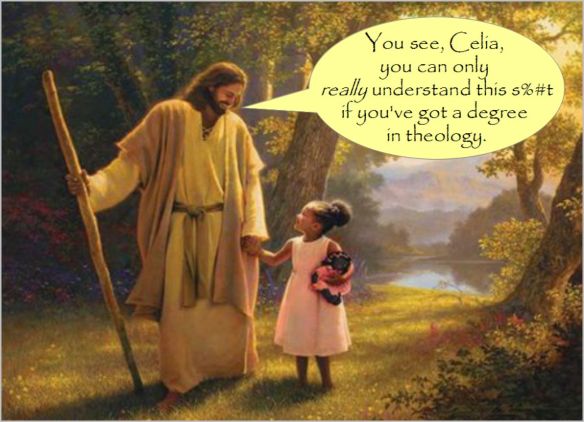
But at least fundamentalists regard the Bible as the Word of God (agreed they cherry-pick it and don’t behave according to it precepts) and claim it is ineffable and infallible. Perhaps, as you suggest, more enlightened Christians are free to interpret it in more liberal ways, dismissing that which is context-bound and so on. But then, where does that leave it? Is it authoritative or not? Does it speak directly to people or can it only ‘really’ be understood through the exegesis of scholars? If the latter, as you imply, then can it only be read and understood by those with above average intelligence? How does this square with Jesus’ insistence that his Kingdom was for those with child-like trust?

S%#t 3: Please stop referring to our belief system(s) as fairy tales.

Difficult this one. It depends whether myth and fairy tale are synonymous. Having taught English literature for many years at a university in the UK, I would argue they’re not. To the layman, however, they probably are in that both involve fantasy beings, implausible events, symbolic characters, sacrifice and enlightenment – just like religion really. So no, there is definitely a case here, Dr Corey, that if the cap fits… if your ‘belief-system’ walks, talks and smells like a myth (or fairy tale) then it probably is. You are stuck with atheists pointing this out to you, I’m afraid.

(By the way, your examples of Mickey Mouse and the Old Woman in the Shoe are not fairy tales. One is a commercial enterprise involving anthropomorphised animals and the other a nursery rhyme. I suggest you consult scholars who can explain to you what a fairy tale is, and the differences and similarities between it and myth.)

S%#t 4: Maybe lay off the whole, “religion hasn’t done any good for humanity” type of argument, because it’s obnoxiously untrue.

Reference for this quotation or did you just make it up? Sam Harris perhaps comes closest to saying this sort of thing – comes close but doesn’t actually say it. He says on balance that the good religion has done is outweighed by the evil perpetrated in its name. He doesn’t, though, say no good has come from religion. Sorry, Benjamin, but this is a straw man ‘argument’ you’re presenting here and is itself ‘obnoxiously untrue’.

Would we be better of without religion? Without the myth, the deadening of critical faculties and the adversarial nature of ideologies (even within Christianity)? Of course we would. Without precepts like ‘love your neighbor, love your enemies’? No, but then these are not exclusively religious. Far too many believers disregard them anyway.


How It Works: God

Let’s see. If there’s a God – and how could there not be? – he’d have to be perfect. And powerful and really, really good. Not like all those pagan Gods who are just a bit too much like us. No, the most bestest God of all would have to be big and powerful, and good and perfect. I mean, why bother otherwise?

Oh, oh… first problem. If he’s good and perfect, how to explain us and the fact life can be pretty crap and not good or perfect at all? That can’t be his fault, can it? He’s perfect, so he couldn’t possibly make something that isn’t. Soooo… only logical conclusion – the crap must be our fault. Something we do, or maybe something we are. Yes, that’s what it must be (plus we get to bump up our part.)

And shit happens. Tsunamis, earthquakes, the crops fail, the rains don’t come. Life can be tough and seem pointless. It’s all depressing, then we die. It can feel like we’re being punished. Wait! Maybe we are being punished! For things we’ve done, or for what we are. That would fit wouldn’t it? A good and perfect God would surely want to punish us, with death and destruction and stuff. So that’s what these things must be!

Let’s get all this written down, that this is how things are. This good and perfect God finds us offensive and that’s why life is so shit. Except, except… surely God’s a reasonable bloke at heart and can be appeased? We could wheedle our way back into his good books and then life wouldn’t be quite so bad. Not sure how, though. Maybe sending him presents would do the trick, though how to get them to him when we can’t see him or anything…

I know! Let’s eviscerate some animals and then burn them and that way, he’ll be able to smell our efforts up where he lives, in the sky. That’s bound to work. And to be doubly sure, let’s mutilate our genitals and keep our women subjugated – because he can’t fail to like that.

Or maybe not. Maybe life will still be shit and we’ll still be shit. Maybe we need something more… imaginative. So let’s pretend that this God of ours puts together a rescue package. And what this means is he zaps us with some magic that obliterates the bits of us he can’t stand, which is pretty much all of it. And – here’s the good bit – we get to keep some of the eviscerating and sacrifice stuff.

Let’s get that written down too. And, and… maybe we can have it that this God is really going to rescue us and make everything not shit any more. He’s going to shake things up down here… no, no, wait – better than that, we’re going to go and live with him in the sky once we die, which gets rid of how shit death really is, and we’ll all live happily ever after, those of us he’s zapped anyway. Everyone else he can torture and burn forever! Yes that’s it! That’s how it’s got to be. God can still be good and perfect, even though he murders just about everyone, and some of us will get to be good and perfect too, and all the crap will just disappear, as if by magic.

That’s it. That’s how it really is. I can see it all now.

Oops. Gotta go. Time for my medication.

straitjacket

I Know What It’s Like To Be Dead

lazarus

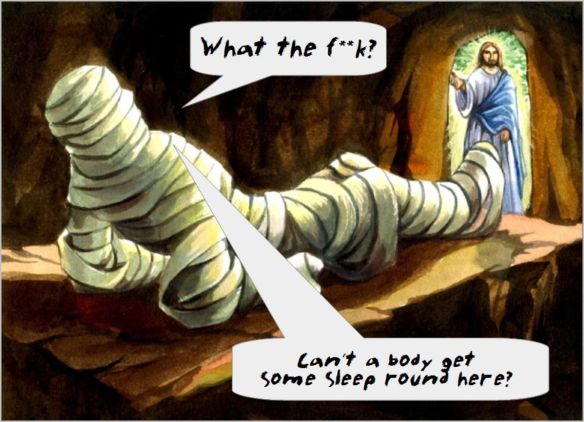
And you do too.

We experienced what it was like last night and, you know, it really wasn’t too bad.

We entered, at some point, a deep, dreamless sleep (we dream for only a quarter of the time we’re asleep and even then often can’t remember what we’ve dreamt about) and the rest of the time we were, as far as subjective experience was concerned, dead to the world. During that deep sleep, our conscious mind was completely switched off; we did not experience anything while we were in this state and as far as awareness is concerned, we did not exist. And when we woke this morning we were none the worse for our period of non-existence. We booted up reasonably satisfactorily and the memories we had yesterday, before our deep sleep, were restored and the entity we call our self began to interact with the day.

This period of deep sleep, this unconscious oblivion, is precisely what it is like to be dead. Of course, in death we switch off permanently; there’s with no reboot afterwards, either in our beds, our graves or in heaven. The oblivion that is death is permanent. But, and this is my point, being dead is no more painful or unendurable, and no more to be feared, than the deep sleep you had last night and that you will enjoy tonight. We might not much like the idea that once we fall into the ultimate sleep there will be no waking up, but that is only a concern, if it’s a concern at all, of the living. I guarantee that it does not cross the minds of those who are already dead. They have no minds, the same as you didn’t last night, for it to cross.

Being dead, to paraphrase Mark Twain, does not trouble us at all. Its prospect, while we remain on this side of it, should encourage us to enjoy life and live it to the full. It shouldn’t cause us to worry about being dead, because there’s nothing we can do about it and, in any case, it’s no worse than being in deep sleep. Nor should we be concerned about whether we’ve subscribed to the right incantation, appeased the right God in the right way or lived a good enough life, in order to avoid death. There’s no avoiding death and the promises of religions that we can if only we believe the right magic, are utterly false. Understandable perhaps, but false.

Oh death, where is thy sting, says Paul in 1 Corinthians 15.55. Well, death still has its sting. It has it in its inevitability – every organic creature, of which we are one, must die – and it has it, depending on your perspective, in our individual obliteration. (Though, frankly, why anyone should think their own personal bundle of thoughts, impulses and prejudices merits everlasting existence is a mystery). Most significantly, however, it has it in the dying process, which for many of us can be debilitating and painful. This is the way of it for all of us, including those who believe religions’ false promises. They are not spared the suffering, even though modern medicine can help alleviate much of it. Christians, Muslims and Hindus, despite their belief that a deity smiles benevolently upon them, are not guaranteed a comfortable passage from this life to non-existence.

Death is the great leveller; we all experience dying in much the same way and we none of us experience anything after it. One of these – maybe both if we’re lucky – isn’t too bad. Just like deep sleep in fact.

Until then, we should make the most of life while we still have it.

Sleep well.


Religion poisons the well. Again.

dye

The shooting in Orlando of people in a gay night club (50 dead, 53 wounded) is yet another example of religion as the antithesis of human flourishing. Not Christianity this time, of course, but that other ‘great’ religion, Islam, the religion of peace. But Christians cannot distance themselves from atrocities like this, carried out in the name of God, when the influence of even moderate religion is a pervasive, unhealthy presence in our society.

It’s true that Christians don’t, as rule, rampage in the streets or fly planes into buildings but they do contribute to the medium in which more extreme forms of religion grow:

Westboro Baptist Church, for example, with its own peculiar brand of Bible-based homophobia – ‘God hates fags’ and all the rest – is, like it or not, an expression of Christianity;

Right-wing evangelicals who interfere in the churches and governments of Africa and South America, actively encouraging them to take a homophobic stance and to pass anti-LGBT laws, are equally culpable; Scott Lively, Pat Robertson, Sharon Slater, you too are people filled with hate;

Likewise, those Catholic bishops who use their influence to denounce gay and transgendered folk as ‘mentally disordered’;

Christian bloggers who trot out the old, ‘Woe to those who call evil good and good evil’ (Isaiah 5.20) and misapply it to homosexuality, together with those who quote Leviticus 18.22 (‘abominations!’) and Romans 1.26-27 (‘unnatural and indecent!’)…

All of these contribute to the animus directed towards fellow human beings whose ‘sin’ is merely to be different. Religions, or more specifically their adherents, contribute significantly to the levels of misery in the world today, though Christians will cry ‘foul’ here (or ‘persecution’ even, because how they love claiming they’re being persecuted when asked to demonstrate some empathy and a little love.) After all, it wasn’t a Christian who gunned down the people in the Pulse nightclub this weekend. No it wasn’t. But every time religious bigots –

tell others what despicable sinners they are,

misrepresent and denigrate minorities,

promote ‘gay cures’,

attack same-sex marriage,

add quotation marks around the words gay and gay marriage, as if they’re somehow not real,

assert homosexuality and transgenderism are synonymous with ‘moral decay’,

claim natural disasters are God’s response to gay people’s very existence,

boycott businesses that support equality,

‘take a stand’ against transgendered people using the appropriate restroom and

refuse to serve gay couples –

every time, in short, they say LGBT people are evil, sick or worthless, the self-righteous prepare the ground for individuals like Omar Mateen to do what he did in Florida on Sunday. Religious leaders condemning such atrocities after the event is too little, too late, when they’ve failed to take charge of their acolytes and  do nothing to stem the tide of hatred flowing from their churches, mosques and temples. 

To those of us on the outside, religions are all of a kind; harmful superstitions. If a ‘faith’ entails belief in supernatural beings and puts allegiance to such imaginary figures above fellow human beings, it is without merit. It is the evil among us.