
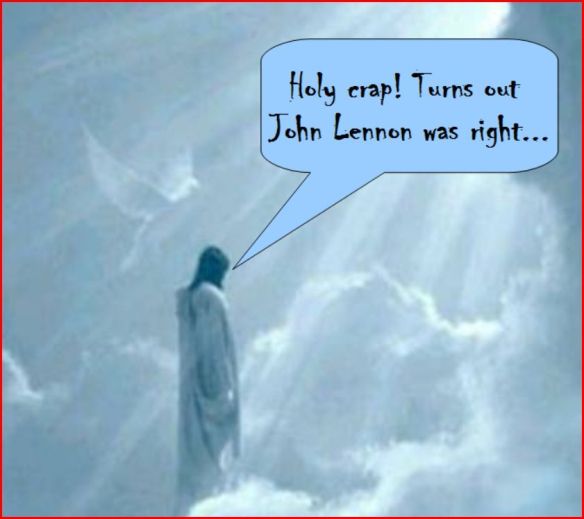
You don’t have to imagine: there is no Heaven

From an Anonymous commenter:

How do you know there is no Heaven or an afterlife? I have no proof Heaven or an afterlife exists either, but where is your proof that they don’t? I don’t think I will ever understand how atheists can be so certain of something that they can’t prove any more than I can understand fundamentalist Christians who say if you don’t accept Jesus Christ as savior you’re doomed to hell. You’ve got something in common. 

And my response:

Thanks for the comment, Anonymous. I’ve copied it here from the old post you added it to.

First, it isn’t up to those of us who question the existence of things like Heaven to ‘prove’ they don’t exist. It’s up to those who claim they do exist to demonstrate that this is the case. A negative proposition such as ‘there is no Heaven’ or ‘there’s no such thing as unicorns’, can’t be ‘proven’ as such, simply because its impossible to present evidence for a no-thing. A positive assertion, however, such as ‘there is a Heaven’, is theoretically demonstrable. But this particular claim never has been. No one has demonstrated where Heaven is (it has to exist somewhere, right?) No-one has ever returned from Heaven with empirical evidence of its existence. No-one has ever survived death to experience Heaven. No evangelical seems to understand that Heaven is exclusively God’s abode and no human will be resurrected into eternal life until the Final Judgement. That’s the Final Judgement Paul and Jesus said was just round the corner but which has never arrived.   

The problem is worse than this, however. There is so little evidence that a god exists, and even less the Christian God (see my previous post, as well as here and here). If there’s no God – and it is highly likely there isn’t – then all contingent beliefs are wiped out: there’s no Heaven, Saviour, Resurrection, Final Judgement, Hell or Eternal Life.

So this is how I know there is no Heaven: it all comes down to probability. The probability there is a Heaven is so infinitesimally small – its highly improbable in fact – that it’s to safe to assume there isn’t one.

Despite first impressions suggesting this view has a lot in common with evangelical belief, I think you’ll find it is actually the opposite. While evangelicals accept on faith that Heaven must exist – because the Bible says so – the fact that its existence is both highly improbable and indemonstrable allows for the 99% certainty that it does not.

Finally, Anonymous, no-one other than mathematicians and lawyers deal in proof. Scientists most certainly don’t: they are concerned with evidence and demonstrating something is or is not the case. You’d do best to drop ‘proof’ from your arguments. Unless you can prove something mathematically, you’re not going to provide or find proof, certainly not when contending with religions. Second, how about giving yourself an online name? Commenting as ‘Anonymous’ suggests you don’t have the courage of your convictions and also adds you to the numerous other Anonymous commenters who pop up on blogs. There’s no way of distinguishing between you.  


How the Bible tells us the Resurrection was nothing more than Visions

I’ve written about this before, but want to pull together some strands that demonstrate the risen Jesus was a vision or hallucination. He appeared only in the mind of others: the New Testament tells us as much.

Exhibit 1. Paul writes of the appearance of the risen Jesus, whom he sees as a ‘life-giving Spirit’, being ‘in’ him (Galatians 1.16). Paul has more than one such vision, including his trip to heaven recounted in 2 Corinthians 12.2, which he refers to as his ‘revelations’.

Exhibit 2. Paul implies in Corinthians 15.5-8 that others who have experienced the post-mortem Jesus ‘saw’ him in exactly the same way he did. For Paul, there was no difference between his inner-visions and those experienced by the so-called apostles.

Exhibit 3. The author of Acts creates a story out of Paul’s first vision, the famous account of his conversion on the road to Damascus. It’s a fabrication of course, told differently each time it’s referred to Even so, Luke retains the visionary nature of the experience: Jesus is a bright light and a disembodied voice.

Exhibit 4. The other sightings of the risen Jesus in Acts are visions. When, for example, Stephen is about to be stoned (Acts 7:54-56) he sees in his mind’s eye the heavens open and Jesus sitting at the right hand of god. Other New Testament encounters of the resurrected Jesus, such as John’s Revelation, are explicitly said to be visions.

Exhibit 5. Many of the sightings of the risen Jesus in Matthew and Luke are not of a real, physical human being. Those who experience him see him materialising in locked rooms, vanishing at will and floating up into the clouds. None of these events actually happened; they are the gospel writers’ literary realisations of visions experienced decades earlier, and they retain the hallucinatory qualities of those experiences.

Exhibit 6. Remaining with the gospels’ accounts of the risen Jesus, there is the strange phenomenon of those experiencing him failing to recognise him. Mary in the garden thinks he’s the gardener; the disciples on the road to Emmaus don’t know its him until he breaks bread; the disciples mistake him for someone else on the shore until he tells them how to fish properly. Most damning of all, some of the inner circle of disciples doubt it’s Jesus they’re seeing in their collective visions (Matt 28:17-18). Again, these stories preserve the tradition that the earlier visions weren’t always recognised as Jesus. And why wasn’t he? Because he was an hallucination

Exhibit 7. The risen Jesus has to prove who he is. According to Acts 1:1-3, he ‘presents himself’ his followers, some of whom have wandered around aimlessly with him for three years, and has to convince them he is who he appears to be. And, the text suggests, it takes him forty days to do it. This makes no sense. A far better explanation of this story (and it is a story) is that having experienced their visions of something-they-took-to-be-the-resurrected-Jesus (bright lights? Disembodied voices?), his followers set about convincing themselves that what they experienced really was their former Master. This they did by scouring the scriptures to find ‘proof’ that the Messiah would die and rise again. We know this is how their thinking worked. The same process was used to create the gospels and is evident throughout the New Testament.

Exhibit 8. Dead people stay dead. They do not resurrect.. This is not an a priori assumption. No corpse has ever revived after 36 hours or indeed any other period of time. We know this experientially, statistically and scientifically. Only in stories and religious myth do the dead return. This is what we are dealing with here: stories and myth that flesh out the visions and hallucinations of a few religious zealots.

Arguing for God

God3It’s a funny thing, but there aren’t hundreds of sites on the internet arguing for Barrack Obama’s existence. Nor the Eiffel Tower’s. Nor Australia’s. Nor the moon’s, nor the universe’s.

Why not? Because we have an abundance of empirical evidence that all of these things are real. People have experienced them first hand, can observe them and interact directly with them. There is no need to ‘prove’ or argue for their existence.

There are, however, hundreds of sites – plus books and broadcasts – that argue for the existence of God. This is telling. It is, whether those offering such arguments realise it or not, a blatant admission that there is no empirical evidence for him. If there were, there would be no need for argument and ‘proofs’; no need for apologists to resort to persuasion that is ultimately self-refuting to ‘demonstrate’ his existence. No need for apologists. Their problem is, of course, no-one has ever met God nor observed or interacted directly with him. Not in the same way people have met President Obama, seen him on the television, heard him speak or interacted with him in person. No-one has done anything of the kind with God, not even those who claim they have and feel compelled to tell us all about it. Every encounter with the Almighty has taken place in the mind of the individual experiencing it, just as St Paul admitted. God himself has never made an appearance.

So, yes, it’s very telling, this having to argue for God. If there was clear evidence of him there wouldn’t be any need to devise arguments for his existence; he’s not, or shouldn’t be, a philosophical proposition. An omnipotent, omniscient, omnipresent, creative being would, by dint of his immanence (presence in this world), be somewhat obvious and there would be incontrovertible evidence of his existence. Christians and other god-botherers say there is such proof, citing Nature, Goldilocks universes, Holy Books and personal experience. But these are far from incontrovertible, being much better explained by other means, none of which involve God. His very superfluousness demands that, through the application of Occam’s razor, he be discarded; not, as apologists would have it, rebranded as ‘transcendent’, a sleight of hand allowing them to proffer unreality as the ultimate reality.

The desperation to convince others there’s a God with an existence outside the human imagination is, then, more than adequate demonstration that there isn’t. Christians and others who want us to believe their God is real, protest much too much and in so doing, demonstrate precisely the opposite.

Christians’ Favourite Delusions 14: You can’t prove God doesn’t exist

Santa-JehovahThere’s a difference between ‘proving’ something – technically this can only be done in mathematics and, arguably, the law – and ‘demonstrating’ it. Atheists can’t ‘prove’ God doesn’t exist, any more than believers can prove he does. But it is relatively easy to demonstrate how unlikely it is that there’s a God. We can apply the scientific method. Science doesn’t ‘prove’ either – it demonstrates the likelihood of something being the case by looking at the evidence and determining from it whether a phenomenon is probable or improbable.

This is in fact what Christians (and Muslims and Hindus and Jews) do when they decide whether the tooth fairy, Santa Claus and Zeus exist; from the evidence they conclude, quite rightly, that it’s highly improbable.

What believers don’t do, though atheists do, is apply the same test to their own god. They say, ‘well of course these other supernatural beings don’t exist. There’s no evidence for them whatsoever. But as for my God, well, I’m not going to apply the same rigour. I know he exists because, erm, I believe in him, I have faith.’

But faith and belief are not evidence. Warm fuzzy feelings are not evidence of God. Books written by ancient tribesmen and other superstitious people aren’t either. Even the universe itself is not evidence, when its existence can be explained without recourse to him. Similarly the development of life on Earth and human beings themselves; all are better explained by other means, none of which require God.

It is fairly safe to conclude as a result that the reason they don’t require him is because he wasn’t involved. And he wasn’t involved because he doesn’t exist, in just the same way Santa Claus wasn’t involved when you received your Christmas presents this week. This may not be the ‘proof’ Christians and others would like, but it does demonstrate, more than adequately, the improbability of God’s existence.