Death’s Sting

supermancry-e1457347480705

Image copyright DC Comics

A long time friend of mine died suddenly a couple of days ago. Tom was in his comic shop, putting together orders, and, it appears, suffered a heart attack. He died there alone.

Death still has its sting – for both those who die (which is all of us) and those who are left behind. Paul’s rhetorical question, ‘Oh death, where is thy sting?’ (1 Corinthians 15:55) has always seemed to me to be particularly fatuous, not to mention deceitful. He said it, of course, in the belief that faith in his Christ meant life would resume on the other side of the grave. Even if this were so, dying would not be without its pain, and grieving not without deep sorrow.

And what about that word ‘sting’? The Greek Paul uses, ‘κέντρον’, means ‘a sharp point’ as if death is nothing more than a pin prick, a short sharp shock no more troublesome than an injection. In my experience, spending time with people who are dying, it is far from that. The body’s shutdown is often slow, relentless and unbearable. Morphine helps, not Jesus.

Mourning too is persistent; an emptiness and a profound sense of loss, as we often acknowledge when offering condolences. It takes time to subside, but never truly disappears. Every death, especially of loved ones, depletes us. As John Donne puts it:

Any man’s death diminishes me, because I am involved in mankind; and therefore never send to know for whom the bell tolls; it tolls for thee.

God Nature, whose product we are, is insensible and indifferent to our suffering. It neither knows nor cares that we are self-aware, emotional beings who grieve and suffer. Death, which troubles us so much, is one of the engines of evolution. Once we have passed the stage at which we might viably reproduce we are programmed to decline and  die. We must make way for new creations, which is not, despite what Christians claim, in a brand new body on a new earth or in heaven. The new creations are those who follow us. Paul, as he was in so many respects, is wrong to say that because of the futile hope of resurrection, death has lost its sting and the grave its victory. Death will never lose its sting, its pain and finality.

Tom will be remembered by those to whom he mattered in life. This is the best we can do; this and living our lives to the full while we’re still here, loving others and being kind.

Farewell Tom, my friend.

Why Jesus can’t possibly have known he’d ‘rise from the dead’.

Blog340JC&Peter

I said at the start of this series of posts about the date of Jesus’ crucifixion that the gospel writers perhaps felt unable to exclude Jesus’ predictions about rising from the grave after three days because these were too well-known. On reflection, it seems more likely that Jesus didn’t make any such prophecies. It is more probable that the gospel writers introduced them into their stories about him decades later.

I’ve written before about how the Resurrection appearances were nothing more than visions and dreams. Paul’s experience of the risen Jesus most certainly was – he says so himself – and Mary’s encounter with angels, telling her Jesus was no longer in his tomb, is described as ‘a vision’ in Luke 24.23. The subsequent accounts of Jesus’ post-mortem appearances also bear all the hallmarks of hallucinations; he disappears at will; passes through closed doors; isn’t always recognisable, drifts up into the sky and so on.

These mystical experiences, those that really happened anyway (it’s safe to say some – the Emmaus story, for example – are complete inventions: see Alter, pp536-8) quickly became a conviction among Jesus’ early followers that he had somehow risen from the grave. By the time of Luke’s and John’s gospel, 50 to 70 years later, this idea had evolved into a full-blown bodily resurrection.

The question is, did Jesus know that this was what was going to happen? Could he have had foreknowledge that he would be seen again after his death? Could he, during his life, have predicted he would rise bodily from the grave?

Christians will tell you that as God or God’s Son, Jesus was omniscient and therefore of course he knew these things in advance. There are, however, several good reasons why we can be sure he didn’t:

  • According to Paul, it was the resurrection that elevated Jesus to his god-like status, not his divinity that enabled the resurrection. Christians who argue that Jesus rose from the dead because he was divine have it back to front. Paul says clearly that Jesus ‘was appointed the Son of God in power by his resurrection from the dead‘ (Romans 1.4; my italics). Without the resurrection, Jesus was, Paul argues, of no great significance (1 Corinthians 12.15-19). However, the only ‘evidence’ for the resurrection is the contradictory, incompatible accounts offered by only three of the gospel writers and by Paul himself. So implausible is this evidence that we can safely conclude, with Michael J. Alter, that there was no such event. How, then, could Jesus possibly ‘know’ he’d rise from the dead when in fact he didn’t?
  • While he suffered from the delusion that he was going to rule God’s imminent Kingdom, it is unlikely Jesus thought he would have to die and be resurrected in order to do so. There was nothing in the Jewish scriptures to suggest either the Son of Man (a figure from Daniel with whom Jesus appears to have claimed some affinity) or the Messiah would be put to death only to rise again. This wasn’t what these characters were about and it wouldn’t have been how Jesus thought.
  • The Kingdom of God did not come about in the way Jesus believed. His death therefore did not bring about the apocalypse, judgement and rule of God he predicted and anticipated. In fact, his death took his cult off in a completely different direction, thanks mainly to Paul’s intervention. Jesus, and to a significant degree, the synoptic writers appear to have little awareness of this seismic shift. The Jesus they portray has little cognisance of events following his demise. Any suggestion he foresaw the creation of the Church is anachronistic, written back retrospectively into the accounts of his life. This was not what his ‘good news’ was about.

  • From their reactions preserved in the gospels, Jesus’ execution evidently came as a shock to both himself and his followers. None of them appear to have been expecting anything like a resurrection. Immediately following his death and burial, not a single one of his followers recalled his supposed predictions of his resurrection, nor did they express the sure and certain hope he would be returning. Even the discovery of the empty tomb (if it happened at all) failed to elicit such an expectation, nor any recollection of his words. The gospels say all those who witnessed the empty tomb were ‘frightened’, ‘astonished’ or ‘amazed’ that the body was missing, but not that they believed he must have risen from the dead. All those who witnessed the empty tomb behaved as if they’d never heard Jesus’ predictions that he’d be returning – probably because they hadn’t

  • It wasn’t until the ‘visions’ started that some of them began to consider the possibility that Jesus had ‘risen’. Not all were convinced, however. Matthew 28.16 notes how a number ‘doubted’ that the apparition they were seeing was Jesus. Significantly, at no point do any of those who think they’re seeing the risen Jesus say, ‘I remember him predicting this would happen.’ On every occasion, either angels or the risen Jesus himself has to explain it to them. (Of course, it’s the gospel writers doing the explaining for those hearing these stories decades later.)

All of this points to the fact that, while he was alive, Jesus didn’t make any predictions about rising from the grave on the third day, after three days, or after three days and nights; these prophecies, incompatible with each other and with the synoptic timeline, were created later, probably much later, after belief in the resurrection had become a central plank – the central plank – of the new cult. They were subsequently written back into the gospels, and placed on Jesus’ lips on the basis to show that of course he knew he’d rise again and knowing would have spoken about it.

The circle was thus complete; his early followers created the myth of Jesus’ return while later ones invented the ‘prophecies’ to bolster the belief that Jesus must have known he would. He said so, didn’t he?

How to work out when Jesus died

Blog338Darkness

When did Jesus die? The year, I mean.

The honest answer is we don’t know. In Michael J. Alter’s The Resurrection: A Critical Enquiry, recommended by John Loftus’s Debunking Christianity blog-site, the author considers twelve different dates that have been proposed, together with the reasons why. Ultimately though, we don’t know.

Which is strange, not only because, as Alter points out, Jesus’ death and resurrection are supposedly the most significant events ever to have happened in the entire history of the world, but because it should be really easy to pinpoint the date. It was the year there was –

  • a total eclipse of the sun that, for over three hours, plunged the whole land (some translations have ‘earth’) into darkness,
  • an earthquake that caused appreciable damage, 
  • the tearing from top to bottom of the four inch thick, 82 feet high curtain in the temple,
  • the dead rising from their graves to make themselves known to the inhabitants of Jerusalem (including, presumably, the extensive Roman presence.)

We know this because the gospels tell us so; these events all took place either just before (Luke) or just after (Matthew) Jesus’ death. Let’s overlook the fact that solar eclipses don’t ever occur at the point of a full moon, while Passover, when Jesus died, happens only when there is one, and take a look at Matthew’s version of events:

From noon on, darkness came over the whole land until three in the afternoon. And about three o’clock Jesus cried with a loud voice… and breathed his last. At that moment the curtain of the temple was torn in two, from top to bottom. The earth shook, and the rocks were split. The tombs also were opened, and many bodies of the saints who had fallen asleep were raised. After his resurrection they came out of the tombs and entered the holy city and appeared to many. (Matthew 27.45, 46, 51-53)

All we need to do, therefore, is look for corroboration of these four cataclysmic events occurring together in the records of the time. (The Romans were particularly good at recording such things; we know, for example, there was an eclipse in AD29, though that lasted a measly 2 minutes.) Once we’ve found this corroborative evidence, we’ll know for certain the year in which Jesus died.

But you’re ahead of me: there is no record anywhere, apart from the gospels, of these events ever taking place, certainly not in combination. No record of a widespread darkness, nor of an accompanying earthquake nor of the temple veil tearing from top to bottom, nor of the dead emerging from their tombs. Which isn’t to say they didn’t happen, but you’d think someone, somewhere would have noticed and would have written about them. Josephus maybe, or Plutarch, Greek or Roman authorities, or even Paul; anyone writing at the time or soon after; any of those whose history of the period has survived.

But no.

It’s enough to make you think these earth-shattering events didn’t really happen; that they’re all made up for theological reasons.

And you’d be right.

God is revealed in Jesus… or not


Blog335CompositeOn his blog-site, humbly named after himself, Roger E. Olson trots out the tired old cliche that there’s no such thing as atheism. Atheists, Rog tells us, know in their hearts that God exists, they just choose to ignore him. As a result, Rog has little time for atheism. (I discovered Roger’s wonderfully smug site through Bruce Gerenscer’s excellent one.)

Rog says that if we want to see what this heart-implanted God looks like, then we shouldn’t look to the Old Testament and the tribal warlord we find there – goodness me, no; we can safely discard him! That God just doesn’t match up to our twenty-first century sensibilities. No, if we want to see God then what we must do is look at Jesus, for in Jesus we see what God is really like.

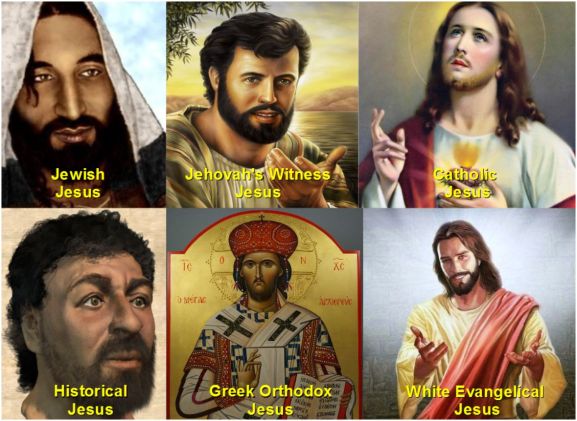
Oops! We’re right back at the problem I’ve been discussing these last few posts: just which Jesus are we talking about? There are so many. There’s the Jesus of the synoptic gospels (though he’s neither consistent nor pleasant), who is nothing like the self-obsessed Jesus of John’s gospel. Paul’s Christ is different again; he’s a complete invention, much like the Jesus of Hebrews who has morphed into a Jewish High Priest. The Jesus of Revelation meanwhile is an Evil Mutant straight out of the Marvel Universe, what with swords coming out of his mouth and all. So which Jesus has Rog got in mind? I think we should be told.

There are so many discrepancies in the various interpretations of Jesus in the New Testament, that it’s hard to see a clear, consistent picture of anything, let alone God, in such a shifting kaleidoscope of images. I’ve recommend that Rog should take atheism a little more seriously; the often incompatible Jesuses of the bible don’t reveal ‘the true nature of God’ anywhere as clearly as he claims. I’d go further: none of them show – can possibly show – what the non-existent is ‘really’ like. What they reveal instead are ideas about a God and a saviour made entirely in the image of the men who tasked themselves with creating them.

The Christian blog that knows better than Jesus

Triablogue-Header-240x1080 (1)

The superior intellects at Triablogue responded to my comment (see previous post below) by telling me they’d already dealt with the claim that Jesus believed the arrival of the Son of Man/the End of the Age/the Final Judgement and God’s Kingdom on Earth were imminent.

They directed me to one of their articles, Misdating the Second Coming, which argues that neither Jesus nor Paul really believed the end was nigh and that the texts which suggest they were need to be interpreted carefully (i.e. to get round what they clearly say to make them say something else.)

I can’t find any other instance of Triablogue contributors proposing that Jesus didn’t really say what the gospels have him say. They don’t dispute, for example, the so-called great commission in Matthew 28.19 (‘Therefore go and make disciples of all nations, baptizing them in the name of the Father and of the Son and of the Holy Spirit‘) even though, with its Trinitarian formulation, Jesus almost certainly didn’t say it. Instead, the know-alls at Triablogue  reserve their hedging for the prophecies that patently failed to materialise, on the basis that Jesus couldn’t possibly have been wrong so he must have meant something else.

I’ve written several posts under the banner Making Excuses for Jesus, on the varied and feeble attempts Christians make to get round the fact the synoptic gospels consistently have Jesus say the Kingdom of God, and all that accompanies it, are just around the corner. His early followers all believed this and his eschatological pronouncements are recorded in all of the earliest texts. Mark’s gospel includes his prophecies about the Son of Man while Matthew and Luke include material not found in Mark from their ‘M’ and ‘L’ (oral?) sources that warn it is the ‘eleventh hour’. The entire thrust of the synoptic gospels is that the Kingdom is about to arrive and therefore people need to be prepared for it: ‘The time is fulfilled, the kingdom of God is at hand; repent and believe the good news’ (Mark 1.15).

The sayings gospel ‘Q’, which predates Mark and was probably in circulation only a few years after Jesus died, preserves several Son of Man sayings; he would be appearing soon to kick-start the Kingdom. Paul, writing decades before the gospels, tells his readers to expect the Second Coming – the Son of Man having become Jesus himself – while he and they are still alive (Thessalonians 4.14-15). Likewise, the anonymous writer of Hebrews believed he lived in the ‘last days’ (1.1-2) while the nutjob who concocted Revelation claimed he was quoting the Risen Jesus promising he would ‘surely come quickly’ (22.20). The imminence of God’s Kingdom on Earth is the consistent message of the New Testament.

And what do the cerebral Christians at Triablogue do when confronted with a summary of these facts? They don’t approve my comment, that’s what. I guess that’s all you can do when you really don’t have an answer for why your Savior™ got everything so drastically wrong; dishonestly pretend he didn’t and silence those who show that he did

Young men’s visions, old men’s dreams

Stephen4

In Acts 2.17, Luke (mis)quotes a prophecy from Joel 2.28:

In the last days, God says, I will pour out my Spirit on all people. Your sons and daughters will prophesy, your young men will see visions, your old men will dream dreams.

I was always taught that the Acts version was a prophecy in its own right, predicting what would happen in the very last days before Jesus returned, some time in the future (his future, though maybe not ours.) But it isn’t. Luke, or whoever wrote Acts, is claiming the fulfilment of the prophecy in his own time. He’s not saying,’ this is what will happen at some point in the next few millennia.’ He’s declaring – or he’s making Peter declare – ‘this is what’s happening right now.’ Luke, like all members of the cult in its early days, believed the last days had arrived; God was about to impose his Kingdom on the Earth, in a display of power and glory (Luke 21.27).

The dreams and visions of which Luke speaks were, he believed, happening then, as he was writing. To prove it, he relates numerous dreams and visions in Acts; Stephen’s vision of God and Jesus; Paul’s ‘sighting’ of the risen Christ on the road to Damascus and Peter’s encounter with, erm… a table-cloth to name only a few. Elsewhere, Paul himself refers obliquely the innervision that led to his conversion (Galatians 1.16) and recounts his ‘visit’ to ‘the third heaven’ (2 Corinthians 12.2); he’s kind of embarrassed about this one though – as well he might be – and relates it in the third person.

Luke knows that the new cult is built on dreams and visions. He believes such hallucinations are genuine revelations from God himself. Moreover, Luke tells his readers explicitly and directly in Acts 2.17 that such visions and dreams were how the cult’s founders experienced the risen Jesus. How do we know this is what he means? Because he puts the quotation about young men having visions and old men dreaming dreams into the mouth of Peter. That’s the disciple Peter whom the gospels tell us was one of the first to experience the risen lord. Luke has Peter reveal the nature of that experience. ‘This is how it was for me,’ he confesses. ‘I had a god-given vision, just as the scriptures promise.’

Luke is proud of the fact that the new faith is based on young men’s visions and old men’s dreams. Proud enough to include it in Acts 2.17 and proud enough to make Peter of all people declare it. Christianity owes its existence to these hallucinations and delusions, nothing more.


What A Dream I Had

Resurrection3

Last night.

I dreamt I was troubled and anxious about something or other, even though I’m not aware of being this way in reality.

In the dream, a couple of people drop by to console me. One of those people is my dad. He asks what’s wrong, listens and offers advice. He’s concerned and wise, positive and supportive. I have no doubt this is my father; he looks and sounds like him, but he’s an idealised version of him. I’m dimly aware in the dream that he’s behaving differently from the way he would in life – we rarely had heart-to-heart talks – but I’m so grateful for the help he’s offering, and it’s good to feel close to him.

In reality, my father died over ten years ago. I’m not sure I was aware of this in the dream or perhaps I just ignored it. I certainly ignored the way he was acting slightly out of character; I just was glad to see him again. I woke this morning feeling invigorated by the time spent with him (or the illusion of time spent with him) and with other friends who appeared in the dream to offer support.

I don’t for minute believe that the father I experienced in my dream was really my dad, returned from wherever he’s been these last ten years to offer words of comfort. My real dad has been nowhere for the past decade. He ceased to be in 2007. The version of him in my dream was a construct of my own mind, made from memories, wishful thinking and – okay, I admit it – a glass or two of wine. He was an image of how I’d like my dad to have been, perhaps – not that I give that much conscious thought. Nevertheless, this version of him is evidently buried somewhere in my head, waiting to be resurrected when the dream circumstances are right.

This is what it must surely have been like for those few individuals who, in visions and dreams, experienced Jesus after his death. In their grief and turmoil, the need to embrace the dream version of their friend must have been overwhelming. They would have persuaded themselves it really was him, communicating with them from beyond the grave. The fact one or two others had a similar experience can only have reinforced the compulsion to believe: ‘You saw him too? Then it must really have been him.’

It wasn’t, of course. What those who witnessed the risen lord experienced was, as Paul suggests in Galatians 1.16, a creation of their own minds, constructed from religious fervour, wishful thinking and a powerful need to believe.

From this, all else followed.

The Sect Hiding in Plain Sight

Condemning-Pharisees

With thanks to David Eves.

Back at the start of Christianity, the cult was divided into numerous factions; not unlike its modern counterpart. Acts’ claim that all the new converts – the church – got on famously, sharing all they had and generally taking part in one big love-in is spin, a lie concocted by its author, ‘Luke’. Its not the only lie he invents; later in Acts he tries to present the new faith’s ambassadors, Paul and the original apostles, as being largely in agreement about what the Christian message was about. We know from Paul’s own writing that this wasn’t so.

Likewise the united church. We know that there was part of the cult that had a very different theology and soteriology (doctrine of salvation) from Paul. They didn’t subscribe to his incantational magic about a dying god-man who would save them if they claimed his death for themselves. Instead, this group believed that the way to find favour with God was to be ‘righteous’, by doing good works and generally expending oneself on others. Its members promoted, and probably practised, a yin and yang measure-for-measure philosophy: God would show forgiveness, mercy and compassion, they said, only to the same extent that a believer demonstrated them him or herself. Because they believed Jesus had commanded it and God favoured it, they denounced wealth and advocated a self-deprecating way of life. They were predominantly Jewish. They believed Jewish Law was still valid and should still be followed by cult members. They were, however, hostile towards those who, unable to see any value in the new cult, remained within Judaism. The sect invented anachronistic stories about Jesus sparring with the Jewish leaders of their time, half a century or more after Jesus died.

Though it is unlikely any of members of this sect had ever encountered Jesus in person, they believed he was going to return to the Earth while they were still alive in order to judge humankind. Naturally he would vindicate them while condemning all others, particularly the rich and powerful. He would do this because they were the ones who were doing as he commanded – helping the sick, the hungry and the homeless – which would ensure the returning Lord would look on them favourably. None of them had seen the resurrected Jesus but nevertheless they valued the stories they heard about those who supposedly had, and they promoted these stories themselves.

How do we know this? Because this particular sect left behind a record of their beliefs. They imbued them with authority by putting them into the mouth of a preacher who had lived more than fifty years earlier. Who knows, maybe he did say such things. The sect either believed that Jesus had actually contradicted Paul’s notion that the Jewish Law was no longer valid or they felt it necessary to to make Jesus say so themselves. Likewise, they rejected the magical mysticism preached by Paul that was beginning to take hold in those early days. The group’s beliefs were radically different and their writing specifically designed to counteract ideas they opposed with a passion.

Where will you find this group’s writings? In the bible, at the very start of the New Testament in the book called ‘The Gospel According to St Matthew’; this book is their writing, give or take the odd bit of tampering from later on. Matthew’s gospel details the sect’s beliefs about Jesus, their measure-for-measure morality, their recipe for righteousness and their beliefs about salvation and the coming judgement.* So different are these from Paul’s ideas that the gospel can only have been created to counteract his doctrines. The community that produced Matthew had no truck either with Paul’s theology or his soteriology.

Read Matthew for yourself and see how much it is at odds with Paul. The discrepancy is there for all to see, yet Christians have always convinced themselves, if they’ve thought about it at all, that not only is Matthew’s gospel compatible with the mumbo-jumbo that follows it, but that its ‘good news’ and Paul’s are identical. Nothing could be further from the truth.


* I’m happy to provide chapter and verse from Matthew’s gospel to support all I say about it.

Man imagines he sees Jesus

Congregation

Just last Friday, a pastor saw the Risen Lord.

I wonder: how different is Pastor Stovell Weems’ sighting from those of the disciples and Paul? Would you say it was just as real? Less real? Completely inauthentic? How do we decide?

For me, his encounter is every bit as real as those experienced by the disciples. I defy anyone to demonstrate otherwise.

Of course, accounts of visions, hallucinations and dreams, however old or however new, are not evidence that the resurrection really happened. Paul happily admits that his experiences were in his head (Galatians 1.16). It is entirely reasonable to conclude that Pastor Weems’ encounter with an apparition-like Risen Lord is exactly the same as Paul’s, and identical to that experienced by Mary, Peter and John in the gospels. Like theirs it’s vague – “I could sense his personality”, “I didn’t see his face” – and dream-like.

There is a difference though: the nutty pastor recounts his hallucination first-hand. The disciples’ encounters were reported third, fourth, fifth… hand, decades down the line.


Christianity: a failure from the very beginning

Celia5

Christianity just doesn’t deliver. Jesus doesn’t deliver. None of his promises that I outlined last time have ever produced the goods. Not surprising really when he’s been dead for the past two millennia. He’s no more likely to deliver than anyone else who’s been regarded as a god by misguided devotees (and there’s plenty of them).

Yet for those 2000 years Christians have insisted that he does, even when there isn’t a scrap of evidence he’s listened to a single word they’ve said, answered even one of their prayers, enabled them to heal the sick or helped them move mountains – any of the stuff he promised he’d do. So why do they insist he really does? Partly because many of them haven’t a clue that he even said these things. Discussing their faith with Christians online, they often tell me that Jesus never said, for example, that God would give them whatever they ask for or would make their lives better or give them the ability to do miracles greater than Jesus did himself (which of course he does, in Mark 11.24, Matthew 11.28 and John 14.12-14 respectively). In short, they are ignorant of what the bible actually says and all the preposterous magical promises it makes.

Those who do know of its promises have a range of excuses for why they never happen; they were only meant for the early church; today’s believers don’t have enough faith; they were only ever intended metaphorically; God is currently withholding his good will (usually because Christians are too tolerant of everyone else’s ‘sin’). The fact is the promises of Christianity have never delivered.

I’ve been reading Bart D. Ehrman’s The Triumph Of Christianity, where, for entirely different reasons, he lists the problems that beset the church in Corinth (p291) that Paul addresses in his first letter to them. Here’s a summary:

Serious divisions within the church, with different members following different leaders (1 Corinthians 1.12)

Various forms of sexual immorality (1 Corinthians 5)

Men in the church visiting prostitutes and bragging about it (1 Corinthians 6)

Other men under the impression they shouldn’t have sex at all, not even with their wives (1 Corinthians 7)

Fractious arguments about whether Christians should eat meat from animals sacrificed to pagan gods (1 Corinthians 8 & 10)

Some women attending meetings without their heads covered (1 Corinthians 11)

The wealthy greedily eating the shared meals and leaving none for the less well-off (1 Corinthians 11)

Worship that was chaotic because those speaking in tongues were trying to show spiritual one-upmanship (1 Corinthians 12-14)

Members not using their spiritual gifts for the benefit of the community (1 Corinthians 12 & 13)

Some claiming they had already experienced ‘resurrection’ and so were more ‘saved’ than others (1 Corinthians 15)

Apart from one or two specifics, this could be the church of the 21st century! Paul, though, wrote his letter to the relatively small group of believers in Corinth around 54-55CE, a mere twenty or so years after Jesus’ death. Already by then, Christian communities were overcome with problems. There’s no indication they were experiencing the miracles Jesus promised, nor were they behaving like the ‘new creatures’ Paul’s says the Holy Spirit makes of believers:

If anyone is in Christ, the new creation has come: the old has gone, the new is here! (2 Corinthians 5.17)

The behaviour of the Christians at Corinth was, by any standard, appalling; they seem to have no more understanding of morality, no more sense of charity, no more demonstration of brotherly love than the ‘heathens’ around them. And yet they were new creatures ‘in Christ’, believers in Jesus, vessels of the Holy Spirit. With all this supernatural support they really should have been doing better – much better – than they were.

I’ve often wondered why Paul didn’t just give up at this point, especially when other churches he wrote to had similar problems. Any rational person would have looked at how these new converts were behaving and would have concluded that the new religion simply wasn’t working. The promises Jesus made (if Paul was even aware of them) and the changes he himself said accompanied conversion simply weren’t happening. None of them had materialised, even at this early stage.

But instead, Paul soldiered doggedly on. He travelled far and wide drawing others into the cult and then had to write to them too, to tell them how to behave and what faith in his Christ actually entailed (see his letter to the Galatians, for example, and that to the church at Philippi). Didn’t Paul ask himself where the Holy Spirit was in all this? Where was the guidance and supernatural assistance promised by Jesus? Despite the airbrushed version of the early church presented in Acts, Paul’s letters tell us what it was really like: a complete disaster.

And so it continued. As Ehrman shows, people converted to Christianity in part because of its promises that believers would avoid hell and live forever in heaven instead. Many convert for the same reason today. With the zero success rate of all of its other promises, it’s not difficult to predict how Christianity’s assurances of eternal life are going to pan out.