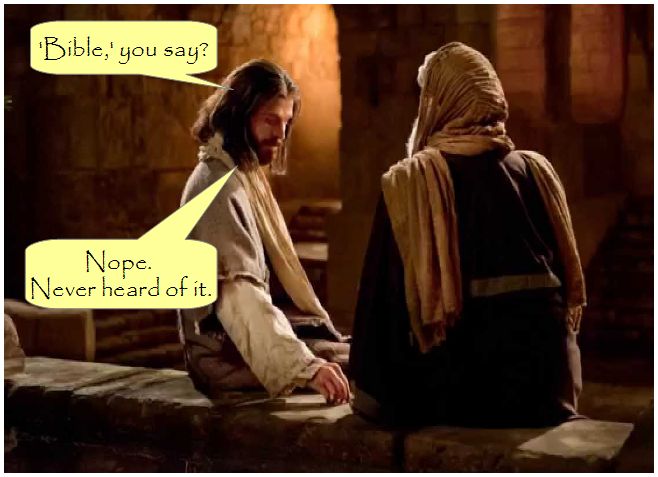
How To Read The Bible

A step by step guide to reading God’s Word, courtesy of Don Camp.

Always read passages in context. This is the only way you can understand what they mean.

Synthesise different passages from a range of contexts so that collectively they say something else.

Read the Bible with all the discernment of a fifth grader.

Always take what is being expressed at face value.

Work out what the original author intended. (Note: ignore the Intentional Fallacy for this purpose.)

Scrutinise what the author intended until he says what you think he should say.

Because the Bible is made up of stories, poems and other literary forms, make sure you recognise the genre you’re dealing with and process it accordingly. (Note: different genres may be synthesised if it suits your purposes.)

Always assume that the improbable, implausible or ludicrous parts of the bible are metaphor, allegory or hyperbole.

Interpret metaphor and allegory in a way that eliminates their obvious ludicrousness.

Do not apply the metaphor/allegory principle to the gospels. The gospels are 100% historical documents, untainted by metaphor and allegory.

Ignore any of Jesus’ commands that are expressed as metaphors.

Dismiss any of Jesus’ more extreme commands – give away all you have, love your enemies, turn the other cheek etc – with the assurance that they’re hyperbole and/or metaphor.

Read the Bible like a first-century believer, even though the Bible didn’t exist in the first century.

On no account concede that Carrier, Ehrman or any other scholar with a book to sell has reached a far more valid conclusion than you have yourself.

To appreciate fully the nuances of New Testament theology, learn Ancient Greek.

Above all, remember that cognitive dissonance is one of the most powerful tools at your disposal.

(Continues in similar vein for 86 pages.)

Thank you, Don. I appreciate how you’ve collected together the many and varied points you’ve made in your recent voluminous comments, synthesised them and presented them here to equip us to read the Bible the Don Camp way. I can’t help but think that, as a result, we’re all that much closer to a personal encounter with Jesus.

The Bible Is Fantasy

The Bible contains:

113 appearances of angels, usually interacting with human beings;

50+ visions, on which all of Christianity hangs: those of Daniel; Cephas and others who ‘saw’ the risen Christ; Paul and John the Elder in Revelation. 

21 supernatural dreams, including those experienced by Jacob, Technicolor Joseph, NT Joseph, the Magi, Pilate’s wife and Paul

Numerous apparitions and ghostly appearances, including that of the resurrected Jesus as well as Moses and Elijah and, in the Old Testament, the spirit of Samuel, conjured up from the grave by the witch of Endor.

Innumerable resurrections: not only that of Jesus but several Old Testament characters, and, in the New, Lazarus, Jairus’ daughter, the young man of Nain and the hordes who rose from their graves at the time of the crucifixion.

Multiple impossible astronomical events, ranging from the sun stopping in its orbit(!); a star wandering and hovering over a small house; a solar eclipse lasting several hours; stars that one day will fall from the sky; a God who lives just above the clouds and a ‘firmament’ between the Earth and the heavens that holds back water;

Several events in which nature is magically controlled: the parting of the Red Sea; Moses’ magician’s staff becoming a snake; the Nile turning to blood; Jonah being swallowed but not digested by a ‘great fish’ and Jesus calming a storm.

An abundance of fantastic beasts and fairy tale creatures: Giants (Genesis 6:1-4, Numbers 13:33); Leviathan the sea monster (Isaiah 27:1 etc); the Behemoth (Job 40:15-24); the Cherubim monsters (Ezekiel 1:4-21); the dragon and other beasts from Revelation

Many characters who are clearly legendary, from Adam & Eve, Noah, Lot and Abraham to Moses, Job, Daniel and gospel Jesus. Some of the Bible’s fictional characters lived to a literally incredible age: Adam 930 years, Seth 912, Methuselah 969, Noah 950, Abraham 175, Moses a pitiful 120. Jesus holds the record being now either 2,000 years old or eternal, depending on how you count it.

5 mythical places: Eden at the beginning of the book; New Jerusalem at the end; Heaven, the abode of God; Sheol the Old Testament place of the dead; Hades (Sheol mark II?) which Jesus visited while supposedly dead in his tomb (Acts 2:27, 31; Matt 16:18).

2 sentient ‘pillars’: one of cloud, one of fire (Exodus 13).

2 talking animals: the serpent in Eden and Balaam’s ass.

1 talking plant (Exodus 3:3).

0 science. No understanding whatsoever of what we now call astronomy, meteorology, germ theory, genetics, evolution, psychology… you name it.

So how do we read all of this? As the ancients themselves would, with an understanding of the world that regarded the supernatural, magic, miracles and monsters as real? We’re told often enough that this is how we should interpret scripture, not from a modern perspective. Perhaps we might credit the creators of the many books of the bible with greater skill, however, and interpret the inclusion of magic and miracle as allegorical or metaphorical; literary pieces, if you will. But then we have to decide which far-fetched stories are myth and which are historical accounts,. There really is no way to do this. A New Testament story awash with impossible events, implausible characters and symbolic tropes is every bit as allegorical or metaphorical as the same kind of story in the Old Testament (or, indeed, in Egyptian, Greek and Roman myth.) The reader who wants to see stories in the Old Testament as carefully crafted allegories has to concede that the Jesus narratives are of the same order.

It looks like we have to read the Bible as 21st century readers, because that is what we are. After all the Bible is supposedly a book for all time. We can, however, recognise the way in which its many creators saw the world – populated with fantasy creatures and subject to impossible events – and accept that they were wrong. Reality is not as they perceived it. What we cannot do is claim that the Jesus story is an oasis of truth in the midst of all this fantasy . 

If The Resurrection Had Really Happened

Somehow this repost unposted itself after the first few comments. I’m reinstating it and will post something new soon

Don thinks I ‘exaggerate’ when I bring up what the New Testament says are supposed to be the direct consequences of the resurrection. As he seems to have no knowledge of the things Paul and others promised would follow, I offered to provide him with chapter and verse. The easiest way to do that is to republish this post, slightly amended, from 2018. (Alternatively, there’s this rather more flippant take on the subject.)

I’m willing to bet Don now tells me I don’t know how to interpret prophecy like an ancient Jew would, that the promises are really metaphors and despite being written for members of the nascent cult they’re really meant for people thousands of years in the future. 

The Christian faith rests entirely on the resurrection of Jesus. As Paul says in 1 Corinthians 15.17 & 19:

 …If Christ has not been raised, your faith is futile; you are still in your sins. Then those also who have fallen asleep in Christ are lost. If only for this life we have hope in Christ, we are of all people most to be pitied.

Of course neither Jesus nor Paul’s invention, the Christ, were raised from the dead; those encounters with him, described in the gospels are, like Paul’s, visions and sensations of his presence (later ‘the Holy Spirit’) embroidered in the 40 or more years between when they occurred and when they were recorded.

Let’s though, suppose that Jesus really did rise from the dead and work backwards from there. What difference did it make? More specifically, what does the bible say were the results and consequences of Jesus being raised?

The Coming of the Kingdom

According to the New Testament (Matthew 25.34; Romans 15.12; Revelation 20.4-6), the resurrection was a clear sign that the Final Judgement and Yahweh’s Kingdom was finally arriving on Earth. Jesus is made to predict it:

Was God’s wonderful reign established here on Earth back in the first century? Was there a final judgement then? Were all wrongs righted, the social order inverted, and war and suffering abolished (Mark 10.31; Matt 5.2-11; Rev 21.4)? New Testament writers believed that following the resurrection, all of this would be happening –

in reality, none of it happened; not then and not since.

The Resurrection of the Dead

Did Jesus’ resurrection result in even more people rising from the dead? Paul said it would; he said Jesus was the ‘first fruits’, meaning the first of many, with others following him in being raised from the dead (1 Corinthians 15.20-21). Has any ordinary person – anybody at all – ever returned from the dead, long after they passed away? Not one; never mind the hundreds or thousands Paul and other early cultists had in mind. No Pope, no shining example of Christian piety, no activist or worker in the Lord’s vineyard has ever been resurrected during Christianity’s entire history. The dead have always remained stubbornly dead.

So no, this didn’t happen either.

New Creatures

Did the resurrection result in those who believed becoming ‘new creatures’? Paul said it would (2 Corinthians 5.17). He also said members of the new cult would be loving, forgiving and non-judgemental (1 Cor 5.12 & 13.14). There’s no evidence, from his letters, that they were, nor is there evidence from the long and often cruel history of the church. Christians today don’t always radiate loving-kindness either. Those who are caring and gentle before they become Christians remain so; those who are self-gratifying, vindictive or exploitative find a new context in which to be so. As I’ve said before, religion is like excess alcohol; it exaggerates the essential characteristics of a person, for good or for bad.

What it doesn’t do is make shiny ‘new creatures’.

So, what conclusions can we draw from this? Perhaps that nothing went to plan in post-resurrection Christianity. The promised results all failed to materialise. If the effects of the resurrection were and are not what they should have been, what does this say about their supposed cause?

If a storm is forecast and yet, when the time comes, there is no rain, wind or damage, wouldn’t we say that there was no storm?

If a woman said she was pregnant but during the ensuing nine months there was no physical evidence of pregnancy and ultimately no baby, wouldn’t we say she wasn’t pregnant at all?

If God’s Kingdom on Earth, brand new creatures, the resurrection of ordinary believers and the final judgement failed to materialise, wouldn’t we say there can have been no resurrection? The supposed causal event of all these non-effects really can’t have happened. Jesus died and like all dead people stayed dead. The visions, dreams and imaginings of his early followers gave rise to a cult in his name, one that, ultimately failed on all levels to deliver what it promised.

There was no resurrection.

Ring-a-ding-ding

Don has responded to my challenge that I set him in the last post. His full response is in the comments section but I’m going to address what he says here:

It is not the fine points of doctrine but the essential points of doctrine that John is talking about…

Really, Don? Where does John say this? Certainly not in the following verse which you cite. Be honest, you just made it up.

This issue rose when you proposed that the Book of Mormon could just as easily by received as scripture as the Bible.

Well, not quite. I asked you why you are not a Mormon, given that the Book of Mormon has, superficially at least, as much credibility as the Bible, perhaps more, given its supposed origin and the eye-witnesses who affirmed its creation. (I’m not a believer in its baloney, just as I’m not in the Bible’s.)   

When I read BoM I do not find a Jesus that is like the Jesus of the Bible. That is sufficient to reject it. I don’t have to worry about baptisms or temples or anything else. If Jesus in the BoM is not the Jesus of the Bible, nothing else matters.

The same is true of the Ken Hams, Douglas Wilsons, and Dillon Awes and Neil Robinsons. If they proclaim a Jesus who is not the Jesus of the Bible, what they have to say about creation, women, homosexuality, or the return of the Lord makes no difference. If they agree with the Bible about Jesus, then we might get down to using out God-given ability to read and interpret. And we might differ. And that won’t matter. Wherever we land on these issues, they are far less important than who Jesus is.

And here we hit some real problems.

You fudge around the issue of whether you agree with the preachers and teachers I quoted, eventually implying that you don’t. (Don’t you get tired of being the only one in step, Don?) You insist that interpretations of Bible verses and the claims Christians make must always be measured against Jesus. But which Jesus is this, Don? The one in your imagination: the meek and mild Mr. Nice Guy that you’ve constructed in your head from a lifetime of conditioning and cherry-picking the Bible? Because if we compare the Jesus in the gospels and the version of him that supposedly inspired Paul and the other NT writers, we find the prattling and general ignorance of Awes, Ham and Wilson matches up perfectly.

For example, Jesus – the man who reputedly said ‘love your enemies’ – tells us what he’d like to do to his own enemies:

But as for these enemies of mine, who did not want me to reign over them, bring them here and slaughter them before me. (Luke 19.27)

And according to Revelation 9, he’ll do just this when he returns with his sword in his mouth. He will unleash plagues of locusts to torment and torture non-believers. However,

(those) not killed by these plagues still did not repent of the work of their hands; they did not stop worshiping demons, and idols of gold, silver, bronze, stone and wood—idols that cannot see or hear or walk. Nor did they repent of their murders, their magic arts, their sexual immorality or their thefts.

Later, while the Son of Man watches on, these poor souls get trampled to death:

The angel swung his sickle on the earth, gathered its grapes and threw them into the great winepress of God’s wrath.  They were trampled in the winepress outside the city, and blood flowed out of the press, rising as high as the horses’ bridles for a distance of 1,600 stadia. (Revelation 14.19-20)

Not hard to see how Ames can justify what he’d like to see done to LGBT+ people, is it. Murderous-Jesus endorses him.

(I know Don, these are among ‘the fine points of doctrine’ your anointed lie-detector doesn’t work on, so you ignore them. Alas, crackpots like Awes do not.)

What about Ham’s contention that dinosaurs and humans co-existed? He’s made a career, not to mention an ark, out of believing such crap. Does your cuddly-Jesus endorse him? Why, yes, he does. He believed in a literal Adam and Eve and a six day creation (Mark 10.6). If he’d have known about dinosaurs, which of course he didn’t, he would have had to fit them into this scenario, just like Ham does.

And how about Jesus’ views of women? While he side-lines them in his pronouncements about divorce (also Mark 10) he consistently ‘reveals’ to Paul and other NT writers that women must submit in all things. The word and its derivatives occur in almost all the passages that discuss women – ‘submit’ and ‘submission’. Easy to see how Wilson believes this applies to sex as well as every other context. Unless of course the Jesus in your head has told you differently. 

So there we have it. Any extremist, despicable view can be justified by appeal to Jesus. To say these differences don’t matter because only Jesus matters is laughably disingenuous. Jesus supports any and all claims made in his name. To paraphrase Paul, he is all things to all men. 

As for me, I’m always careful when discussing Jesus to quote the gospels, as I do above, and where relevant other parts of NT. I realise you don’t like this, because I don’t have your imaginary supernatural radar, but I’m happy to show Jesus in his true light and use his own words to condemn him.


How We Got The New Testament

Recycled pictures, new post.

Once upon a time, there was, possibly, a bloke called Yeshua Bar Yosef. Maybe there was, maybe there wasn’t, but either way, a couple of other blokes, one called Simon (or maybe Cephas or maybe Peter), came to believe that Yeshua had returned from the dead and had appeared to them, alive. This was probably all in their heads and what they saw was at most a blinding light, if they saw anything at all. This was certainly the case for a different bloke, Saul (or maybe Paul) who came along later. He wrote about his experiences and admitted they were all in his mind.

This Simon-Peter-Cephas and maybe one or two others convinced themselves that Yeshua was God’s special emissary and would save them from something, somehow or other. They told other people this and, being gullible, some of these other people believed that Simon-Peter-Cephas and his mates really had seen Yeshua alive again. They started to believe Yeshua would save them too. Saul-Paul, meanwhile, wrote letters to the people he’d persuaded to believe in his version of events – it was a bit different from what Simon-Peter-Cephas and co believed – and, writing in Greek, rendered Yeshua as Iesous (‘Jesus’ came much later when the ‘J’ was invented in the 16th century.) Paul thought Iesous was a celestial being he called ‘the Christ’. He taught that this Christ would soon be coming down to the Earth to set up God’s Kingdom here. Even though they were obviously a bit rubbish, Saul-Paul’s letters were copied multiple times by hand, which is when errors began to creep in. In some places, the letters were deliberately altered.

Other people wanted to get in on the act, so they wrote letters too, pretending they were Saul-Paul. Sometimes these letters said the exact opposite of what the real Saul-Paul wrote. His weren’t the only letters to be forged either. Fifty or more years after the entire scam had got underway, someone pretending to be Simon-Peter-Cephas sent letters as if they were from the man himself. Needless to say there were cultists daft enough to believe it. There were others who wrote letters too, people like James and John. James didn’t see eye-to-eye with Saul-Paul and contradicted many of the things he said.

About 40 years after Simon-Peter-Cephas thought he’d seen the dead-but-alive Yeshua-Iesous-Jesus, somebody in a different country decided to write a back story for the character. He didn’t know much about Yeshua-Iesous-Jesus, what he’d said and done and whatnot, but that didn’t deter him. He borrowed bits from Saul-Paul’s letters and Greek myths and set about it. He scoured the Jewish scriptures for anything that sounded like it might be a prediction of Yeshua-Iesous-Jesus and his supposed escape from death. He made up episodes for him based on these completely unrelated scraps of scripture. He forgot to sign his work, however, and it wasn’t until years later that someone else decided this author’s name should be ‘Mark’.

A couple of other anonymous dudes liked what ‘Mark’ had done when inventing his Yeshua-Iesous-Jesus story but thought they could make a better job of it themselves. The first of these, who would later be called Matthew, lifted most of Mark’s effort (which is how we know ‘Matthew’ wasn’t an eye-witness; an eye-witness wouldn’t plagiarise most of the story from someone who wasn’t) and then went overboard with the prediction/prophecy thing that Mark had started. He found even more spurious bits of scripture and made up a whole lot of new stories about Yeshua-Iesous-Jesus from them. Later still, ‘Luke’ wrote his version of the story, using Mark and Matthew’s accounts and inventing a few new episodes himself. This same person went on to write a fabricated history of the Yeshua-Iesous-Jesus cult, making up stories and speeches for caricatures of Simon-Peter-Cephas and Saul-Paul.

The fourth person to try his hands at writing a script for Yeshua-Iesous-Jesus decided to completely reimagine the character. Strictly speaking, this ‘gospel’ was produced not by a single person but by a collective of cult members. Their Jesus was nothing like the one in the other three gospels. He was more a super-hero, whose special power was boasting about himself. This is the Jesus that, 70 years on, the cult wanted to believe in. Eventually, the name John would be attached to this fantasy, though this isn’t the same John who wrote letters nor the one who created the hallucinatory nightmare that would become the final book of the Bible.

These various letters and stories circulated round the Roman Empire wherever members of the new cult met. Eventually, someone hit upon the idea of collecting them together as one volume. The first we hear of this is when a guy called  Marcion produced his own collection, round about AD140. Stupidly, he didn’t include the right ‘books’ and it wasn’t until AD367 that the collection we now know as the New Testament was first mentioned. This was ratified later that century by a group of men who had elevated themselves to positions of authority in the Church, as the cult was now calling itself. Despite claiming they had been guided by the Holy Spirit, these learned men endorsed the inclusion of several forgeries. Neither did they see fit to arrange the books in the order they’d been written, giving the impression that the accounts of Yeshua-Iesous-Jesus’ life existed before Simon-Peter-Cephas and Saul-Paul’s innervisions that had sparked the whole thing in the first place.

Jump forward a few hundred years and the New Testament, as it was now known, had come to be regarded, by some, as the infallible, inerrant and authoritative Word of God, which clearly it is not. These epithets stuck, however, and are still held to be accurate descriptors of the New Testament by people who have stopped thinking for themselves.

So there we have it: how we got the New Testament –

  • It wasn’t written by eye-witnesses.
  • Its accounts of Jesus’ life are largely fictional.
  • It owes much to fanatics who were prone to visions.
  • It is given to wild speculation, offered without a scrap of evidence.
  • It contradicts itself.
  • It includes many fakes and forgeries.
  • It was banged together by men who didn’t really know what they were doing.

And after that, everyone lived delusionally ever after. The End.

Battle Of The Magic Books

Don Camp replies (in blue) to my previous post. My responses are in black.

There are multiple reason for rejecting Mormonism. The primary reason is similar to discerning between a fake $20 bill and the real thing. The fake just doesn’t feel like the real thing. Of course, that test requires that one knows what a $20 bill feels like. Anyone who does not know is easily fooled.

In fact, if you don’t know what the real thing is like, it is impossible to identify a fake. You might notice an ink smudge and a difference in paper, but who is to say one is fake and the other is not?

This presupposes that your version of Christianity is ‘the real thing’. For a Jew, Judaism is the real thing and Christianity the Johnny-come-lately fake. All you’re saying here is that you ‘feel’ your version of Christianity is the real thing and you ‘feel’ Mormonism isn’t. This isn’t persuasive. I know, for reasons other than intuition, that Christianity isn’t the real thing. To use your analogy, it is the twenty dollar bill received in change when in the UK a twenty pound note is the ‘real thing’.

But since you have a knowledge of literature, Neil, why not apply those standards? Nice concession there, Don. The Bible is indeed literature and as such deserves to have the same standards applied to it as any other work of fiction.

Is the Bible and the narrative in the Bible coherent?? No. Its central character is ridiculously inconsistent. Described as an unchanging God, he changes from book to book and most noticeably between the Old and New Testaments. As someone commented on Debunking Christianity recently, it’s as if he ate a Snickers bar between the two. (He does get hungry again towards the end of the NT, when he reverts to being an omnipotent Putin.)

As the protagonist undergoes his major rewrite, the plot also suddenly deviates, becoming a completely different story. It starts by being about this poorly conceived character’s ‘everlasting covenant’ with his chosen people, but then two thirds of the way through, this everlasting covenant is scrapped and replaced with a new, largely incoherent deal involving a human sacrifice that the unchanging God has previously said he finds abhorrent.

Does it stick together and develop a single theme across the whole? No, it doesn’t ‘stick together’, not unless you ignore the gaping inconsistencies in character and plotting, and its overall implausibility.

Do you know what the theme of the Bible is, Neil? Yes, thank you, Don. Condescending of you to ask. Any apparent consistency is because the writers of the second part of the story had access to the first part. They plundered it for their own purposes, drastically altering it so that it suited their new theme. That is why much of the Jesus story appears to be foreshadowed in the Old Testament. The Jesus story – and it is a story – is built on events and episodes they found there.

Remember that the Mormons tell us that the Book of Mormon is an extension of the Bible and that the people of the Americas were related to the Jews and held to the basic truths of the Jews. (Remember also the Mormons believe that Jesus appeared to these people in the New World shortly after his resurrection.) So if you put the Torah and the Book of Mormon together, is the narrative coherent? Does it develop a single theme? The Old testament and the New Testament are a coherent whole, but I do not think the Old Testament and the Book of Mormon are. As you can tell, I dispute that the Old and New Testament are a coherent whole. The Old Testament and the Book of Mormon aren’t either. That lack of coherency becomes even more obvious when we compare God in the Old Testament with God in the Book of Mormon. The person of Jesus is also inconsistent in the Book of Mormon with the Bible.

But they’re inconsistent within the Bible too, Don. Compare John’s Jesus with Mark’s. Compare Paul’s beatific Christ with Revelation’s grotesquely super-powered warlord.

Of course, the standard explanation by Latter Day Saints is that the Bible has not been adequately translated, though I know of no place where they can demonstrate that claim. There are significant translation problems with the Bible, which mainstream scholars consider at length. Mormon desperation to resolve these conflicts is the same as that demonstrated by Christian theologians.

Finally, there is a matter of provenance. We know in very good detail where the Bible came from.

We do? We know who Matthew, Mark, Luke and John actually were? No, we don’t nor do we know where they wrote or what their sources were. We don’t have the autographs (originals) of any of the New Testament documents but we do know some of them are forgeries and others have been tampered with.

There are many copies, especially for the New Testament, and there are many commentaries of both the OT and NT from very early in the their history. Proving what? Only that they were copied, frequently inaccurately. The copies are all much later than the probable time of composition. The commentaries are similarly far removed from them; there are commentaries on the Book of Mormon much closer to its composition.

What is the provenance of the Book of Mormon? It apparently appeared magically out of nowhere pretty recently. No mention in any other literature of its existence. It did appear magically! Oh ye of little faith! God sent an angel, like he does numerous times in the Bible, and told Joseph Smith to translate the golden tablets. The NT books were similarly created, with God breathing his word into cult followers as they wrote. God, angels, Holy Spirit, magic – all of a muchness, don’t you think?

No copy is available to examine. Nor of the original copies of anything in the Bible.

That is not to speak of the total lack of any archaeological evidence for the Mormon claims of Jews in the Americas. Mormons dispute this, of course. There are similar problems with some locations mentioned in the Bible. More fatally, most of what the Bible promises has proven false. For example: Jesus’ imminent return, his guarantee of miracles, believers becoming new creations. (Paul spends much of his time ticking off these ‘new creations’ who remain resolutely unreformed.)

So, I would say the Book of Mormon fails on all levels.

I would too. As does the Bible for the reasons I’ve outlined, and despite your special pleading. You don’t apply the same rigour in your consideration of the Bible that you do to Latter Day Saint fiction. Why is this, Don?

What are the Odds?

To look at it another way…

The stories of the Old Testament are largely fictional. They’re myth, legend and otherwise fabricated. There was no Eden, no world-wide flood, no slavery in Egypt, no Exodus. There’s no evidence that the characters around which events supposedly took place actually existed: no Noah, Abraham, Moses, Job, Jonah or Daniel. Their stories were created long after the time they purportedly lived; centuries later. The stories written about kings – which, if they existed, were no more than half-remembered tribal chiefs – and the so-called great prophets are constructed from folktales. In short, nothing we read in the Old Testament actually happened.

When we get to the New Testament, we find convoluted exposition of Paul’s ‘revelations’ about Jesus; visions and imagined sightings of a celestial being he had in his own head. It’s the same for the fruitcake writer of Revelation who envisaged an unreal comic book Jesus; invention every bit of it. The Acts of the Apostles offers a fanciful and wholly inaccurate ‘history’ of the early church, including angels, teleportation and fatal miracles. Of the 21 letters in the New Testament, at least 11 are forgeries, known to have been written by anonymous authors who were not who they claimed to be. The other 10, including Paul’s genuine letters and the likes of Hebrews, make up all sorts of mystical stuff about an angelic Godman-cum-high priest.

 And yet, in the midst of these myths and legends, made-up characters and stories, forgeries and fantasies and mystical musings stands the indisputable truth of the gospels. Or so Christians and theologians would have us believe. These particular stories, surrounded as they are by fiction on all sides are historical, factual and true.

What are the odds?

What Jesus didn’t know

Blog416

Creating the picture for the previous post reminded me of how little Jesus, assuming he actually existed, knew of the consequences of his ‘ministry’. Here’s a few of the things he either didn’t do or had no knowledge of while he lived.

  • Jesus never read a single word of the New Testament. The earliest of its books, I Thessalonians, was written about twenty years after he died. The New Testament did not appear in its entirety until the end of the 4th century.
  • He never read any of the accounts of his life, the first of which didn’t appear until about forty years after his death.
  • He had no control at all over what went in any of the gospels.
  • He did not endorse them in any way, nor verify their accuracy.
  • He never met Paul nor was he aware of the fantastical claims Paul would make about him.
  • He had no idea he would come to be regarded as God.
  • He did not know that soon after his death, people would worship him as God.
  • He would not have anticipated that his teaching would be adapted for a Gentile audience. It is unlikely he would have approved if he had.
  • He had no idea a new religion would be created in his name.
  • He did not know anything about, nor did he anticipate, the Church. His apparent acknowledgement of it is a fabrication.
  • He did not know the damage those who followed him would do in his name.
  • He did not know that the Kingdom of God would never arrive on Earth, nor that the Romans would continue to dominate it for a further 400 years.
  • He did not know the world would continue pretty much as it was for another 2000 years.
  • He did not know of the scientific discoveries that would be made in those years that would invalidate his beliefs and worldview.
  • He did not know that, forty years after his ‘ministry’, the Jerusalem temple would be destroyed by the Romans. His ‘prophecy’ of it is a fabrication written after the event.
  • He did not know of the world beyond the Roman Empire, if he was aware even of that. He certainly did not know of the American continent.
  • He had no knowledge of the United States, founded more than 1,700 years after he died.
  • He had no concept of most, if not all, of the concerns of today’s evangelicals: religious liberty, right-wing politics, guns, abortion, ‘the homosexual agenda’.
  • He had no idea what his legacy would be: the arrested development of millions and of western society itself; pogroms, persecutions and inquisitions; a corrupt and abusive church; the psychological damage caused to innumerable people; his name hi-jacked for political causes he had never heard of and almost certainly would not have approved of.

None of this is what he saw for himself. He thought he would be ruling the world with his besties on behalf of Yahweh. Like every other mortal, he had no idea of anything that would happen after his lifetime. What does this tell us about him?

Believe what you want to believe

Blog415

I’ve been responding to some comments of Don Camp’s over on Cross Examined.  First off, Don objected to the claim someone made that the Bible is ‘full of errors’. He went on to make a number of assertions that I felt compelled to challenge. I’ve also added here a number of other points in italics, where, it seems to me, Don is trying to bluff with guff.

Don: “Full of errors” is an overstatement. There are errors, which is obvious when one looks at the critical apparatus of the USB Greek text. (What is this ‘apparatus’ of which Don speaks? Critical scholarship? Can’t see Don bothering much with that. Magic seer stones, then?) But if you know how to read the apparatus (ah, we must have insider knowledge to know how to read the manuscripts [which ‘manuscripts?] the way Don does) you will notice that the differences between manuscripts is minor and do not impact the message (we will? How?) The doctrine of “inerrancy” speaks to the original manuscripts (autographs). (We don’t have the original manuscripts so we can’t verify their accuracy or otherwise. Even if we did have access to them, how would we know they said what God wanted them to say? How would we know if what they said was true? We wouldn’t. They’re both hypothetical and irrelevant, and this is all meaningless theobabble.)

Don: I don’t subscribe to a strong inerrancy… (The examples you cite are) nitpicking and, I suspect, avoidance. (What is ‘strong inerrancy’? I’d have thought something was either inerrant or it wasn’t. The presence of one error in a document means it isn’t inerrant. If Don doesn’t subscribe to ‘strong inerrancy’ there’s nothing else – only the presence of error.) 

And then we’re off on a tangent – call it ‘sleight of hand’ – about how marvellous the Bible is:

The Bible is a remarkable book. There is none like it in all of literary history. It is the story of man and God and explains not only why things are the way they are but how God acted to reconcile man to himself. That message throughout the Bible is the same. In that sense, the Bible is unified.

And then another unfounded assertion, to which I sent the reply that follows:

Don: The Bible is also coherent. The message is logical and consistent. The third chapter of Genesis contains the message in brief as a narrative. It is sometimes called the proto-evangel. The rest of the Bible unfolds that message and explains how God accomplished his purpose and how we can respond to his mercy and grace […]

Me: Okay, let’s disregard the numerous ‘minor’ inconsistencies and contradictions. There’s insurmountable disunity between the old and new covenants: God in the Old Testament (OT) promises Abraham his contract with him and his seed is ‘always and forever’ (Genesis 12). He negates this completely in the New Testament (NT) when he declares, or so Paul would have us believe, that the only way to find favour with him is through faith in his saviour. Yes, the Bible’s unchanging God changes his mind and presents two irreconcilable ways to be reconciled with him.

Or how about the differences between Paul’s theology – salvation through faith alone – and Matthew’s Jesus who says salvation is through personal righteousness achieved by doing good works (Matthew 25)? For God’s sake, Don, there’s only about forty years distance between these two schemes and yet they don’t agree on what God’s plan is for mankind.

You want more? How about the differences between the OT and NT perspectives of the afterlife? Jesus’ (and Paul’s) conviction about the imminence of the End of the Age and that of later NT writers? The views of Heaven in earlier and later writing?

You’re deluding yourself, Don, if you think there’s a unity to these central doctrines in the Bible. There evidentially isn’t. Please don’t take us for fools with your attempts to delude us too.

To which I’d add that Christians’ dishonest attempts to prop up that book of  suspicion and make-believe, the Bible, as something it isn’t are tiresome in the extreme. Words like ‘apparatus’ and ‘original manuscripts/autographs’, are meaningless, while ‘inerrancy’, ‘coherence’ and ‘consistent’ are used in ways that strip them of any of their meaning. There is no ‘apparatus’ that magically removes the serious discrepancies in the Bible, no pristine, error-free original manuscripts to which we can refer. As in many of its minor details, the Bible’s central messages lack unity, coherence, consistency – and anything approaching sense. The American Bible Society reported recently that through lockdown, Christians haven’t – shock! horror! – been reading their Bibles with any regularity. Given they don’t read them much anyway, this can only be a good thing.

In which Paul takes a trip to the third heaven

Blog408

In the New Testament, there are:

8 or more supernatural ‘visions’;

18 or so ‘appearances’ of angels;

about 6 significant dreams, through which God talks to people;

a dozen apparitions of dead people and

at least 3 significant ‘revelations’, in which individuals sense God in their heads (Paul, Jesus and John of Patmos).

The man who is largely responsible for Christianity as we know it, Paul, alludes only briefly to his magical conversion to the faith, describing it as ‘in’ his head in Galatians 1.16. It’s up to the writer of Acts to elaborate and embroider this non-event. Paul does, however, give rather more detail about another hallucination he has, in 2 Corinthians 12.1-4. To avoid boasting, he says boastfully, he refers to himself in the third person:

I must go on boasting. Although there is nothing to gain, I will go on to visions and revelations from the Lord. I know a man in Christ who fourteen years ago was caught up to the third heaven. Whether it was in the body or out of it I do not know, but God knows. And I know that this man—whether in the body or out of it I do not know, but God knows— was caught up to Paradise. The things he heard were too sacred for words, things that man is not permitted to tell.

This is evidently a psychotic episode; seeing things that are not there, experiencing events that are not happening. Paul himself admits he doesn’t know whether it was a real experience, nor does he know if he was in his body or not (definitely in it, just out of his mind.) He heard, he says, things he can’t possibly repeat, which makes you wonder why he bothers mentioning the whole bizarre episode in the first place: ‘I had this fantastic experience, unlike anything I’ve experienced before – but I can’t tell you a thing about it.’ It sounds like a dream he’s having trouble remembering or, like, man, a really freaky hallucinogenic trip.

From psychotic episodes like this – his conversion is another one – Paul spins his entire theology. Yes, the faith of Christians everywhere is founded on the hallucinations of a first century nutcase visionary.

I don’t know about you, but I’ve better things to do with my life than base it on the dreams and visions of a psychotic who lived 2000 years ago.