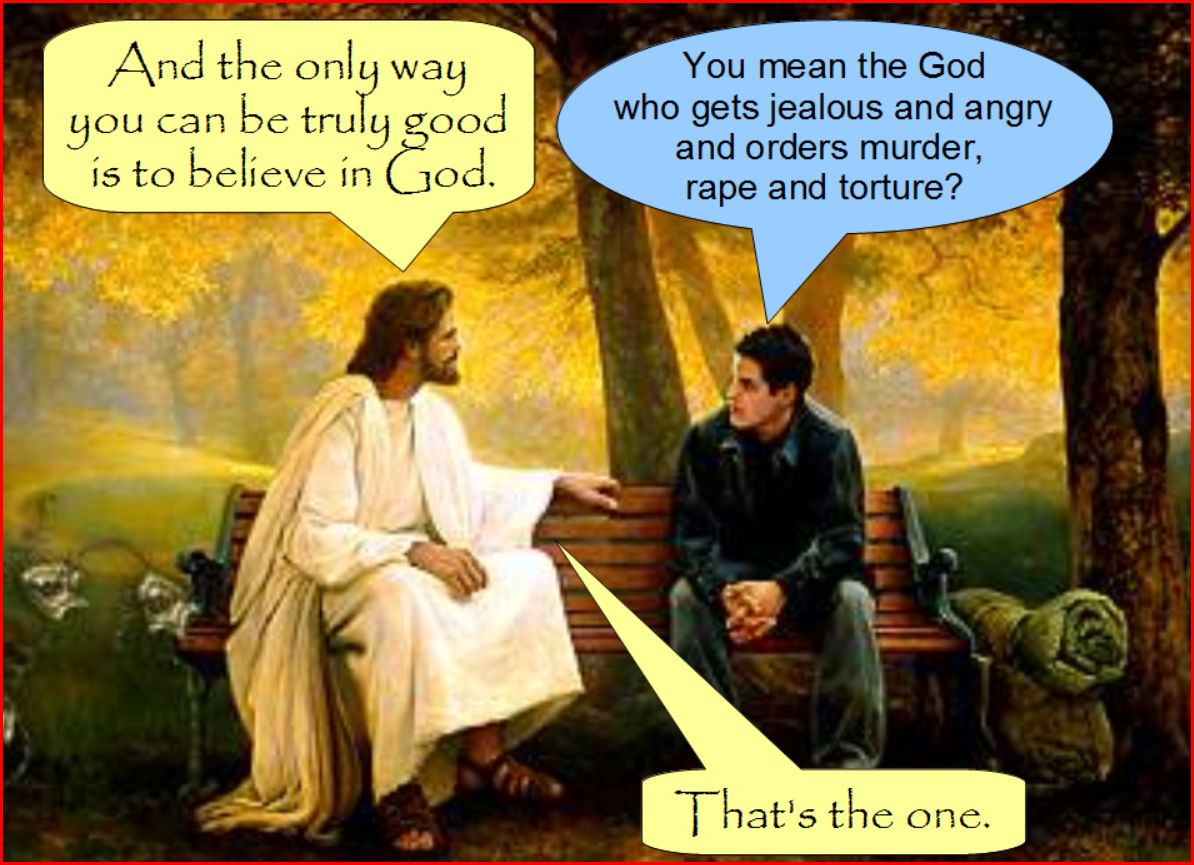
Christians’ Favourite Delusions 8: Atheists can never be moral or happy

moral

Christians regularly exercise these dishonest sound-bytes; here, here and here, for example.

There’s no need to argue with them. All we need to do is look at the evidence:

Good, moral atheists

Immoral Christians

Happy atheists

Miserable Christians

(click all of the above for examples)

If it’s true that only those with a direct line to God can be good and happy, then we shouldn’t see any of these categories. Christians should be supremely happy all, or at least most, of the time – St Paul says that believers are characterised by love, joy, peace, kindness and generosity (Galatians 5.22) – but they’re not. They should be moral and good all the time too – after all, Jesus commands them to be ‘perfect’ and tells them how to achieve it (Matthew 5.43-48) – but they’re not.

According to Christians moral, happy atheists shouldn’t exist. And yet they do. Christians, when they achieve it, are only good and only happy because they think God is watching over their shoulder. When atheists are good and happy it’s because they can be.

Morality Tale

Preaches   A man who believes in the impossible – and it is a man more often than not – appears as a moral authority every morning on national BBC radio. This same man is frequently asked by television networks to give his views on moral issues of the day, be they assisted suicide, pay-day loans, same-sex marriage & adoption, abortion or capitalism. And even when he hasn’t been asked, the views he expresses on these subjects are widely reported, sometimes all around the world. The man can, in one of his roles, sit in the second most important legislative body of the land, again as a moral authority, influencing laws that are binding on everyone else whether they believe in the impossible or not. Indeed, the man has an automatic, unelected right to be part of this august body.

   Where, you might ask, does this man’s moral authority come form? Is he a psychologist with a profound understanding of human behaviour? Or a geneticist with knowledge of the biological bases of our decision making? Maybe a philosopher who has analysed the cognitive processes that lead to moral decisions? An ordinary, educated person, then, who has given much rational thought to how we might best treat one another?

   No, he’s none of these. He’s just a man who believes in the impossible and wears funny clothes to prove it. Invariably, it is true, he has become quite an expert in believing the impossible and he’s even been granted a special place in society that allows him to encourage others to believe the impossible. As a result, he has somehow made the leap into thinking that, because he believes in the impossible, he must therefore be a moral authority.

   Now, we may not object to the man believing in the impossible in the first place – it’s a free country after all – but we don’t accept, surely, that because he does, it means he knows much more than the rest of us about morality?

   Yes, I’m sorry to report that we do. We acquiesce to the man and say ‘because you believe in the impossible, and for no other reason, you must know more about morality than we do.’ And when we are looking for moral guidance, we turn to him – whether we are the BBC, the rest of the media or the government – and we say, ‘what do you say about this? What should we think about it, because, after all, you are the authority here by virtue of the fact that you believe in the impossible?’ And the man, in whatever guise he appears – pope, archbishop, bishop, reverend, imam, rabbi – says, ‘this is what it says in my magic book (even when it doesn’t) and you should follow it, even though you might not believe in either the magic book or in the impossible.

   And we say, ‘Well, you’re the expert and we respect that you should tell us how to behave, if for no other reason than you believe in the impossible.’

And another three things…

Following on from last time’s post, here, below the picture, are some more points I hold to be true.Image

Human behaviour, not sin.
There is no such thing as sin and we don’t need God’s forgiveness for it. Sin is a Christian construct with no purchase in the real world. There is only human behaviour – good, bad and indifferent. Most of it is indifferent (or neutral if you like) including what consenting adults may do with each other sexually. Some of it is good, in the sense that it benefits others significantly; some of it is bad – evil even – because of the harm it causes others. None of it is offensive to God, because there isn’t a God, and none of it is forgiven by him for the same reason. We are moral or not, without the assistance of a God. This seems to me to be self-evident: if there is no God and yet we are capable of behaving morally then any goodness cannot come from him. Similarly, immoral behaviour, of which the religious are as capable as the rest of us, is also entirely human.

We can draw two conclusions from this:

  1. No sin = nothing to be saved from = no redemption.

  2. The Christian claim that because atheists don’t acknowledge God they have no grounds for behaving morally is demonstrably false. The golden rule of ‘do unto others…’ is of value to us as social animals, which is why it pre-dates Jesus by millennia. Non-believers are as capable of behaving morally as believers, and sometimes a darn-sight better.

It is impossible to know the future.
No-one can know the future. The same Christians who castigate scientists for not being there when the Earth came into existence, have the temerity to claim they know what will happen at some indeterminate time in the future. There will be, they tell us, an anti-Christ, a rapture and Jesus will return from Heaven. They cannot know this of course, even if their holy book seems to predict it. It too was created by human beings with no more ability to read the future as anyone else. People have long wished they could tell what the future holds, which is why fortune tellers, astrologers, priests who read auspices, oracles and prophets have been with us throughout history. They’ve never been right, except by chance, for the simple expedient that humans are not gifted with accurate foresight. Biblical prophecies are no exception and have already failed, as we’ll see in future postings.

(Scientists do of course predict what the consequences of certain actions might be, but scientific predictions are subject to amendment as more information becomes available and are always open to refutation. They are not in the same category as prophecies purportedly from a deity who doesn’t actually exist.)

We are all humanists.
We are all utterly reliant on other human beings, not God, to help us fulfil our needs. Believers do not turn to God when they are hungry, because if they did they would starve (in spite of what Jesus says in Matthew 6.25). They don’t turn to him when they are ill, but look to medical science to help them (yes, there are a small minority of extremists who, because of faith in God and the likes of Mark 16.18, let their children die. But most believers don’t; they have faith in other humans, in science and technology). Christians and believers of all stripes demonstrate their faith, not in God but in human endeavours every time they get dressed, put on spectacles, catch a bus, board a plane, buy a house, switch on a computer, television or oven, use a phone, listen to music, admire art and marvel at architecture. None of this is God-given, it is all human, and believers, whatever else they may claim, are all humanists at heart, having far more faith in the human than the divine.