Whatever Happened to Yeshua bar Yosef?

What happened to the real Jesus? The itinerant Jew who trudged around Palestine with a small group of followers, preaching who knows what. How to survive the imminent end of the world perhaps. His name wasn’t really Jesus. That’s a Hellenised version of the Jewish name Yeshua: Ἰησοῦς’ pronounced ‘Yay-soos’, which means (suspiciously) ‘YHWH is salvation’. The bar Yosef part means son of Joseph, not son of God. Whatever he was about, this Yeshua was crucified by the Romans and soon after his death, one or two of his friends convinced themselves they’d seen him alive again. Or so the story goes.

The earliest information we have about Yeshua includes very little of what we now think we know of him. The crucifixion/resurrection are the only parts of the story that interest Paul, and then only because he thinks he too has seen the risen Yeshua inside his own head. But this Yeshua, whom Paul does indeed call Jesus, is no itinerant preacher. Paul seems unaware of any of his story, his parables, aphorisms or miracles. Instead he consistently describes Jesus as a heavenly being who speaks to him through ‘revelation’, explaining in convoluted terms how his death leads to salvation. This Jesus, now with appended ‘Christ’, Greek for Messiah, is an amalgam of elements from mystery religions, resurrection myths and Paul’s own fanciful ideas. He is hard to reconcile with a real man who walked the Earth years earlier.

Verdict: Paul’s celestial Christ isn’t Yeshua bar Yosef. Paul’s Christ never existed.

The accounts of Jesus that appear decades later attempt to ground Paul’s imaginary being historically and geographically. In this, the gospels are superficially successful but even a cursory analysis reveals serious fault lines. The gospels rely heavily on myth, metaphor and the misapplication of ‘prophecy’, rather than historical fact. They are a form of midrash. The first, written anonymously round about 70CE and later attributed to someone called Mark, is, as today’s TV dramas often say, based on an idea by Paul. It is unlikely it reflects an historical Yeshua. Subsequent gospels, also anonymous but known later as Matthew and Luke, are themselves based on Mark’s, importing its flaws and introducing spurious material of their own. In neither is Jesus the son of Joseph; he’s the son of God, born of a virgin

Verdict: the Jesus of the synoptic gospels is not Yeshua bar Yosef. He’s a literary construct, a fantasy figure.

When the fourth gospel appears, sixty to seventy years after Yeshua is supposed to have lived, the Jesus character has evolved yet again. John’s supremely confident, egotistical creation equates himself fully with God: ‘I and the Father are one,’ as he puts it. This Jesus bears little relation to Mark’s central character who keeps his mission and identity secret (as well he might as a literary construct created primarily for cult members in the know.)

Verdict: the fourth gospel’s Jesus is not Yeshua bar Yosef. He’s constructed from the beliefs of later versions of the cult.

By the time of Revelation (95-96CE), Christ has become a Game of Thrones reject, overseeing the destruction of demons, dragons and other non-existent creatures. Any semblance of reality has been left far behind.

Verdict: Revelation’s Christ isn’t Yeshua bar Yosef. He’s as imaginary as Paul’s Christ, another fanatic’s ‘vision’.

Can Yeshua bar Yosef be rescued from all these accretions? Can a historical figure be detected beneath the layers of fantasy constructed around him (or the idea of him at least)? The attempts made in the last 150 years suggest not. He is lost for good underneath layers of myth and magic.

Does it matter? Not really. None of his followers today would be interested even if he could be unearthed and resurrected. They are content with the Jesus of imagination: Paul’s, the gospel writers’, the creators of creeds, ministers who interpret the stories about him and their own emotional need. Today’s Christ is an imaginary being, a heavenly superman as unreal as the sky gods who preceded him; a faith-created myth.

Verdict: the Jesus worshipped by today’s Christians isn’t Yeshua bar Yosef either. That character is lost to us. So early did cultists lose sight of him, he may as well have not existed.

Perhaps he didn’t. 

Whatever Happened to Mary Magdalene?

(The risen Jesus) appeared to Cephas, and then to the Twelve (1 Corinthians 15:12)

When Jesus rose early on the first day of the week, he appeared first to Mary Magdalene, out of whom he had driven seven demons. (Mark 16:9)

Mary Magdalene and the other Mary went to look at the tomb… Suddenly Jesus met them. “Greetings,” he said. They came to him, clasped his feet and worshipped him. (Matthew 28: 1 & 9)

Mary Magdalene went to the tomb and saw that the stone had been removed from the entrance… she turned around and saw Jesus standing there. (John 20: 1 & 14)

Whatever happened to Mary Magdalene? I mean, where did she go? She’s everywhere in the gospels: following Jesus and his entourage around the place, funding his layabout lifestyle (Luke 8:1-3) and being first to see him after he returned from the dead. After that, nothing. Luke doesn’t even bring her back for his sequel and no one else in the New Testament so much as mentions her. When, in 1 Corinthians 15, Paul lists those who, like him, have had a vision of the risen Christ, she’s conspicuously absent. Mary is the first person to see Jesus resurrected according to three of the four gospels, yet in the far earlier tradition mentioned by Paul, she doesn’t get a look in. Her place is taken by Cephas.

The neglect of Mary Magdalene in early tradition could of course be because she was a woman, and a woman’s testimony, back in those less than enlightened times, was worth far less than a man’s. However, it’s far more likely that whoever created the creed had never heard of her. Why not? Because the gospels didn’t exist when they came up with it. They had no idea that a woman was supposedly the first to see Jesus alive again. As far as they were aware, it was ‘Cephas’ who’d had the first vision of the risen Lord. Yet Peter – assuming he and Cephas are the same person – isn’t the first to see the risen Jesus in any of the gospels.

Mary Magdalene is side-lined like this because when the creed was created, and later still when Paul quotes it in 1 Corinthians 15, the stories about her hadn’t yet been invented. It’s safe to say, she hadn’t been invented.

In fact, Mary Magdalene and most of the rest of the support cast from the (future) gospels aren’t referred to anywhere else in the New Testament. This includes at least eight of the disciples from the slightly differing lists in the gospels, the Virgin Mary, Joseph, the angel Gabriel, the Magi, Nicodemus, Lazarus, Martha & Mary, Judas (apart from Luke’s side-splitting story about him in Acts), Barabbas, Joseph of Arimathea and Doubting Thomas. Likewise, fictionalised versions of historical figures with key roles in the gospel stories aren’t referred to either: Herod, Pilate, Caiaphas and John the Baptist(?) are all absent, even from epistles written and forged after the appearance of the gospels’ ‘cunningly devised fables’ (2 Peter 1:16).

Decades after the early creed of 1 Corinthians 15 and Paul’s letters, Mark invented Mary Magdalene, as well as many other characters who appear in his gospel. His allegory then became the basis for the other three canonical gospels, whose authors added their own imaginary characters.

And just as they invented the earthly Jesus’ companions and adversaries, they created too his miracles, teaching, cryptic parables, bodily resurrection and ascension. Mary Magdalene was but one small aspect of their ingenuity.


Jesus’ Ungrateful Slaves

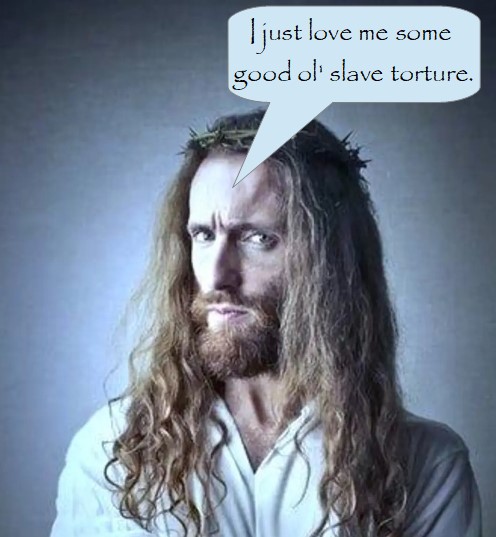
Jesus really liked telling stories about slaves. It’s as if he’d no objection to the inequitable arrangement of one person owning another. You’d think, if he really was the Son of God, he wouldn’t be quite so ready to assume unquestioningly, the zeitgeist of his day that decreed slavery was acceptable; necessary even. His being a man of his time, incapable of thinking beyond the assumptions and indoctrination of his culture might suggest he wasn’t a heavenly being at all. Either that or his creators, the writers of the gospels and the likes of Paul, were incapable of seeing beyond the zeitgeist and so made their god-man in its image.

In any case, they have Jesus tell a parable in Matthew 18:21-35 about forgiveness, which is populated once again with slaves and a slave owner. The story, in which a slave is forgiven by his master but fails in turn to forgive a fellow slave, ends with the following:

…after he had summoned him, his master said to him, ‘You wicked slave! I forgave you all that debt because you begged me. Shouldn’t you also have had mercy on your fellow slave, as I had mercy on you?’ And his master got angry and handed him over to the jailers to be tortured until he could pay everything that was owed. So My Heavenly Father will also do to you if each of you does not forgive his brother from his heart.”

Of course, the slave owner, referred at the start of the tale as ‘the king’ is – predictable metaphor alert – Jesus himself. He’s fond of casting himself in the role of kingly slave owner, with ordinary mortals his slaves. As we’ve seen already, this is the favoured analogy of New Testament writers to describe the relationship between their manufactured saviour and themselves.

Actually, the moral of the tale in this instance isn’t too bad; if you’re forgiven much it’s not unreasonable to suppose you could, in turn, forgive others their more minor offences. But this isn’t quite enough for Jesus’ script writers who have him drag jail, torture and retribution into the story. These, Jesus concludes, are the very things his wonderful Heavenly Father – based on the despotic rulers of the time – will inflict on anyone who doesn’t forgive as generously as they might.

What hypocrisy! Forgiveness is all according to Jesus but his Heavenly Father, he says with relish, will torture unforgivably anyone who doesn’t comply. What were the cultists who created this awful malicious character thinking? Jesus and everything to do with him is anti-human and soul-destroying.

As for me, I’d recommend forgiving others where you can, learning from the experience (once bitten twice shy and all that) and moving on. You won’t, whatever you do, be tortured by a fictitious, vindictive slave owner and his bullying idea of a god.


Jesus Is Cool With It

I was handed a sticker the other day that read ‘Jesus is cool with it’. Just what the hip Jesus of the sticker was cool with was explained by an accompanying leaflet, and the fact I was at a Pride event at the time.

I worked out from the leaflet and his rainbow flag, that what Jesus is cool with is homosexuality and all that goes with it. He might also be cool with transgenderism and other variations in human sexuality, but who knows; the leaflet didn’t say so directly. It did, however, have a list of websites that support those who are religiously afflicted and gay, transgendered or of unorthodox sexuality. It suggested that through these sites it might be possible to find a gay affirming church in the local area.

I was at first pleased to see that Jesus had had a change of heart. That he had in fact made a complete u-turn from his previous position, which evangelicals have long assured me, is that homosexuality is a heinous sin and a ‘violation of God’s design for human sexual behaviour’.

Eagerly, I logged into my favourite – I use the word loosely – Christian sites to see how they were celebrating this new revelation from the Lord. Unfortunately, they had yet to be updated and so weren’t conveying the news that Jesus was now ‘cool’ with gayness and the like.

That was over a week ago. I’ve just checked again only to find that they’re still not proclaiming this particular piece of good news. In fact, some have published even more rants well considered pieces about the evils of homosexuality, drag acts, people who are changing sex and the rest. They are so uncool about it that they’re still quoting the Bible: the Old Testament verses where it says that for a man to lie with another man is an abomination, and Paul, who, channelling Jesus (or so he’d have us believe) insists that homosexuals won’t make it into God’s Magic Kingdom. Some sites also mention Jesus’ pronouncement in Matthew 19:14 (yawn) that God made only male and female and the only time they’re allowed to get jiggy with each other is when they’re married.

I’m left wondering who is right. The ‘Jesus is Cool’ brigade or the great preponderance of evangelical churches that say he isn’t cool, not one jot or tittle, with same-sex doings.

The thing I’ve learnt through this, is that Jesus can be whatever you want him to be: a really cool guy who gives the thumbs up to whatever consensual sex you enjoy or a grouch who didn’t die just so you could continue in your old sinful ways. Take your pick. He’s both, depending on which bits of the Bible you prefer.

I wouldn’t care one way or another if it weren’t for the damage done by those who think they speak for the grouch.

Jettisoned

It’s all very well discussing how the gospels came to be, but are they true and do Christians adhere to what Jesus purportedly tells them there? Let’s take a look at one of his instructions from Matthew 23.8-10:

But you are not to be called ‘Rabbi,’ for you have one Teacher, and you are all brothers. And do not call anyone on earth ‘father,’ for you have one Father, and he is in heaven. Nor are you to be called instructors, for you have one Instructor, the Messiah. 

Context: Matthew’s cult community is moving away from synagogue worship and so supplies Jesus with words condemning Pharisaic practices. Instead, because the new cult at this point is egalitarian, they have him endorse its practice. One teacher: the heavenly Christ. One church: the brotherhood. One Father: God in heaven. One Instructor: the heavenly Christ again.

How quickly the church jettisoned this advice! By the time of Ephesians (written in the late 1st or early 2nd and certainly not by Paul who was long dead) the church is awash with ‘the apostles, the prophets, the evangelists, the pastors and teachers, (given by Christ) to equip his people for works of service, so that the body of Christ may be built up (Ephesians 4.11-12)

A little later still, 1 Timothy – again, not written by Paul – speaks of hierarchical structures of overseers (‘bishops’), leaders, teachers and instructors (the two words have the same meaning), while later in the first century, and in direct contravention of Jesus’ admonition, the Roman church started calling its priests ‘father’. The Pope, – the term means Father or Papa – soon became the Father of all fathers.

Did the early church not really believe that Matthew 23.8-10 recorded the words of Jesus? (They’d be correct if so.) Or did they think that they didn’t matter; were, in fact, optional? (Parenthetically, what is it with gospel-Jesus habitually referring to saviour-figures in the third person? He does it here – ‘one instructor: the Messiah’ – and when he refers to ‘the Son of Man’. Why should we suppose he means himself when he does this? He’s not afraid to talk at length in the first person about himself in John’s gospel, but in the synoptics he’s apparently too timid to do so and feels compelled to use the third person and hide behind alter-egos. Unless of course fictional gospel-Jesus, or his script writers, regards ‘the Messiah’ and ‘the Son of Man’ as beings other than himself.) 

Then there’s the modern church, with its pastors (‘shepherds’), bishops (‘overseers’), teachers, instructors and priests (‘elders’). Does it too consider that gospel truths about brotherhood, no father but God and no teacher except the Christ, to be optional – insignificant even? Apparently so.

Which other words of Jesus do believers feel free to jettison? We’ll take an occasional look in the weeks ahead.


God’s Megaphone?

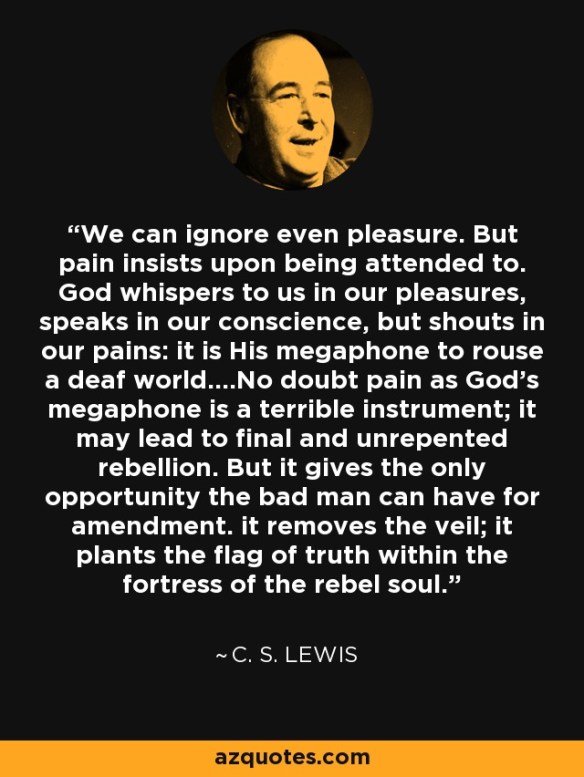
from his book, The Problem Of Pain

Does the Christian God use pain to draw people to himself? Assuming for a moment that such a God exists, does he use human suffering to make followers for himself?

There is no evidence in the Bible to suggest he does. To be sure, the Bible has a fair amount to say about pain. It claims that suffering is a means by which God either chastens Christians (Hebrews 12.7) or strengthens them (Romans 5.3-5), but this is exclusively for people who already believe. The Bible does not say non-believers are afflicted as a means of drawing them closer to God; the idea is unbiblical.

Let’s assume then that while this notion finds no support in the bible, Christians have learnt over the centuries, perhaps though extra-biblical revelation, that God does use pain in this way. What does this tell us about God? That he’s a being whose principal way of making human beings pay attention to him is by causing (or allowing) them to suffer frequently unbearable pain and anguish.

What sort of God is this? Not one who loves the world and cares for humans far more than he does mere sparrows (Matthew 6.26). He’s more an unpleasant, sadistic bully: the jock who backs you up against the wall, grips your balls and squeezes hard.

Maybe that’s how it is. The God who created the universe is just such a being; a moral monster, as commenter koseighty puts it. It’s easy to see how he might be: human beings suffer, yet there’s (supposedly) a God who loves them; therefore pain and suffering must at the very least be sanctioned by God, or, more likely, delivered by him. This, after all, is the story of the Old Testament. The God so arrived at though is a thoroughly human creation, a means of minimising cognitive dissonance by reconciling human suffering and a God who supposedly cares.

One more assumption is needed. Let’s assume this time that despite the odds, this character really exists. Does his strategy work? Does inflicting pain and anguish on people make them, as Lewis suggests, cry out to the One doing (or allowing) the inflicting and compel them to love him? It seems unlikely; I can’t find any evidence online of anyone claiming that pain or anguish brought them to God. From a personal perspective, I can honestly say that in times of distress or suffering I have never, post-deconversion, called out to God or any supernatural entity for help. I’ve never interpreted my suffering as his calling me closer and have never, since escaping Christianity, succumbed to his malicious charms. (What I did do occasionally, following my deconversion, was to convince myself that my suffering was a punishment from God – for leaving him behind, being gay or something I’d done. These feelings disappeared when I embraced fully the fact that the Christian God isn’t real.)

Where does this leave the Christian with, as Lewis puts it, ‘the problem of pain’? How do they reconcile a loving God who allows or even causes human beings to suffer? They can’t. Instead they spout empty platitudes that they think let their indifferent, imaginary God off the hook. Just look at the meaningless theo-babble religious leaders came up with in 2004 after a tsunami hit Indonesia, killing 227,898 people.

Leave God out of the equation, however, and there are far better explanations for why humans suffer. ‘Shit happens’ is far more convincing than anything the religious have to offer. Physical pain is the body’s reaction to damage. It is an imperfect system that frequently overreacts or fires up even after damage is repaired (I know this having fibromyalgia). That’s what it is to have, to be, a physical body. Anguish comes from random acts of nature, the violence and cruelty we inflict on each other and the death of loved ones, much of which is beyond human control. ‘Thoughts and prayers’ are useless in ameliorating this kind of suffering. Measures to restrict people’s access to weapons undoubtedly helps, as it has in countries with politicians with sufficient strength and intelligence to enact gun-control legislation. Without it, as in Ulvalde recently, more children will die, more parents will experience terrible anguish and another massacre is inevitable. God won’t stop it.

Suffering is not symbolic of something else; it is not ‘God’s megaphone’ or an opportunity for others to point those afflicted to Christ’s light (or any other bullshit that involves the supernatural.) Pain simply is. It is our lot as physical bodies to endure or alleviate it as best we can.

More Matthew Make-Believe

Don Camp and other Christians contest that Matthew’s gospel was constructed by snippets from the Old Testament. Those snippets, they say, however unrelated to the use to which Matthew puts them, are prophecies about Jesus, written centuries before his birth. This is the direction of travel: from ancient text to fulfilment in the first century. They refuse to see that for random verses in the scriptures to foreshadow later events involves significant amounts of magic.

Don talks about the bible authors’ use of foreshadowing, which is a recognised technique in literature. A single author in control of their text from start to finish can plant hints early in the narrative that only come to fruition much later on. Don cites Neil Gaiman’s use of the technique, but then equates the use of foreshadowing by a single author over the restricted amount of time it takes to complete a novel, to its apparent use in the bible. But there’s no equivalence. Yes, the bible is largely fiction too, but that’s where similarities end. In the case of the bible, we have to believe that over many, many years, multiple authors set about planting clues – prophecies – for events that would not occur until centuries later. But this just doesn’t work; not without a controlling agent, like a single author who creates and manages the entire narrative. Of course, Don believes that as far as the bible is concerned, that single author is YHWH. He’s not alone in this wishful thinking; there is a whole industry dedicated to arguing that God controlled the subconscious of everyone who contributed to the biblical texts.

But this scenario makes no sense. In the first instance because many of the so called prophecies are nothing of the sort. As we’ve seen, some are random lines in a story about something else entirely. Let’s look at another example of that, again from Matthew’s gospel:

In Hosea 11.1 YHWH is being made to boast about how he rescued the Israelites from Egypt:

When Israel was a child, I loved him, and out of Egypt I called my son.

God’s ‘son’ in context and as plainly stated, is Israel (note the use of parallelism again.) All the verse is saying is that YHWH brought his son, Israel, out of captivity of Egypt, which is itself a fiction. Nothing more; nothing about the future. Yet years later, Matthew (2.16-18) rewrote the verse as an event in the young Jesus’ life:

So (Joseph) got up, took the child and his mother during the night and left for Egypt,  where he stayed until the death of Herod. And so was fulfilled what the Lord had said through the prophet: “Out of Egypt I called my son.”

Matthew expects us to believe that what the Hosea verse really means is that the baby Jesus would flee to Egypt and would be ‘called out’ again only when it was safe. That is, after Herod stopped massacring baby boys, another event that never happened but is itself a rewrite of Exodus 1.22. Only Matthew has this preposterous Egypt story, because only Matthew invented it. Luke simply has Mary & Joseph returning to their home in Nazareth.

Matthew is dishonest on two counts. He knows the original line is not a prophecy and he also knows his fable about the family’s escape to and return from Egypt is not a fulfilment of prophecy. And he knows this because it didn’t happen. He made it up.

Secondly, even if we grant that the bible contains what appear to be more precise prophecies, a God who has engineered their inclusion is mere speculation. One cannot offer up fulfilled prophecy as evidence of that God’s existence and then argue that prophecy comes to be fulfilled only because God is its controlling agent. That is circular reasoning. In any case, most, if not all, of these less indistinct predictions are the very ones that have never been fulfilled. We’ll take a look at some of these next time.

So, which is more likely? A supernatural entity who controls the entire narrative of a collection of books written over centuries, who hides unlikely clues to the future in a select number of verses, or a first century author who plunders ancient scriptures to find snippets that he thinks might parallel his hero, and then rewrites them to furnish his narrative?

An interfering but non-existent God looking forward or a duplicitous author looking back? Even Don knows which it is.

The Meaning Of Matthew’s Mistakes

So Matthew likes quite a lot of what he finds in Mark. Likes it so much he decides to lift over 90% of it into his own Jesus story. Of course he’ll tweak it a bit because, disappointingly, Mark hasn’t emphasised Jesus’ Jewishness enough. That definitely needs bumping up; it’s what his readers will expect. And Mark has missed a trick or two: he starts his story with Jesus’ baptism, when, as everyone knows, every godman needs a magical origin. Just look at Tammuz, Horus, Romulus and, according to some, the Jewish high priest Melchizedek. So Matthew sets about scouring the scriptures for a prophecy or fable, anything really, that hints that the Messiah would have a miraculous birth. And he comes across this in Isaiah (7.14):

Therefore, the Lord, of His own, shall give you a sign; behold, a virgin is with child, and she shall bear a son, and she shall call his name Immanuel.

It’s not really a prophecy about the Messiah as the context makes clear, but that’s okay. There’s enough of a hint that it could be about a future Messiah that it’ll do. So Matthew sets about creating a birth narrative for his godman based on this verse, yanked from its context. His godman is going to have a virgin birth too.

What Matthew doesn’t realise, however, is that he’s made a mistake. He’s picked up the verse in the Septuagint, a Greek translation of the scriptures. If he’d checked, or even been able to read the original Hebrew, he would have soon seen that the verse actually reads:

Therefore, the Lord, of His own, shall give you a sign; behold, the young woman is with child, and she shall bear a son, and she shall call his name Immanuel.

The Hebrew word for ‘young woman’ is alma and that is the word used in Isaiah 7.14. The word for virgin is betulah. It does not appear. The use of it in the Septuagint is a mistake, a mistake that Matthew is not aware of. So he misappropriates the mistranslated verse to create a miraculous birth for Jesus and the myth of his virgin birth is born.

But Matthew hasn’t finished scouring the scriptures for prophecies that appear to be about Jesus. This time he alights on Zechariah 9:9:

Rejoice greatly, Daughter Zion! Shout Daughter Jerusalem! See your king comes to you, righteous and victorious, lowly and riding on a donkey, on a colt, the foal of a donkey.

Incredibly, this time Matthew has stumbled upon a prophecy about the Jewish Messiah! According to Zechariah, the Messiah-King’s victorious entry into Jerusalem will follow the defeat of his enemies and the establishment of universal peace. Matthew likes the sound of this. If he can shoehorn an episode into his story where Jesus rides into Jerusalem on a donkey, this will show his readers that Jesus really is the long-awaited Messiah-King. Never mind that the Jesus version bears little resemblance to the scenario predicted by Zechariah: Jesus is not an anointed king, he has not recently defeated his enemies nor has he just established universal peace. The only thing the original prophecy and Matthew’s version have in common is that the two principle figures, Zechariah’s Messiah-King and Jesus, ride into Jerusalem on a donkey.

Oh, no, wait. That’s wrong. According to Matthew Jesus approaches on two donkeys; a mother and her colt. He’s made another mistake. He doesn’t know that the use of ‘donkey’ and ‘colt’ in the prophecy refers to the same animal. He thinks there has to be two: a larger one and a smaller one. He is not familiar with the practice of parallelism, common in Jewish writing to emphasise a point by repeating it  but using alternative terminology. There aren’t two animals on which Jesus sits lop-sidedly, there’s one: a donkey, otherwise known as a colt which, to state the bleedin’ obvious, is also the foal of a donkey. Matthew misses all of this and places Jesus precariously on two mismatched animals.

What does this tell us? That Matthew is not describing an actual event. He has, rather, created a story based on a prophecy, designed to illustrate to his readers that Jesus is the Messiah-King prophesied by Zechariah. There is nothing historical about this story; it is an actualisation-in-fiction of a prophecy. A prophecy,  which, incidentally, still has not been fulfilled.

So Matthew is caught out at least twice. There are more examples in his gospel of his forcing an episode from the scriptures into his Jesus fable: other aspects of his birth narrative are clearly based on elements of Moses’ story; Judas’ thirty pieces of silver are based on a story from Zechariah 11, which has no relevance at all to the use he makes of it. There is also evidence that Matthew invented prophecy that he could then show Jesus ‘fulfilling’ (Matthew 2.23, for example.)

What all of this demonstrates is not that Jesus was foreshadowed in the Jewish scriptures, (foreshadowing being a technique beloved of some authors who use it to hint at future events in their fiction) but rather that many aspects of the Jesus story are literary re-imaginings of ‘prophecies’ and often unrelated episodes from the scriptures.

And if some, why not all?

Goodbye, Jesus

The Jesus narrative is a made-up story, originally created by a member of one of the many branches of a first century cult centred on a supernatural being experienced in visions. We call this cult member ‘Mark’. His ‘gospel’ was not written to convert anyone – I doubt any of them were – it was written as a ‘what if?’ story for fellow cult members: ‘what if our celestial saviour had lived on Earth?’ It is made up of St Paul’s teaching, Old Testament mythology, and ideas taken from pagan dying-god myths (probably in that order). It amalgamates the cult’s rules with what cultists believed about the end of the age: that their celestial saviour would very soon be coming down to Earth to save them and annihilate their enemies.

Ten or fifteen years later, another writer took Mark’s fiction and rewrote much of it for his branch of the cult. This was a group who saw themselves as still firmly within Judaism, so ‘Matthew’ toned down Paul’s teaching, eliminating a good deal of it. He heightened Jewish teaching for his co-religionists, and created a Jesus who was a manifestation of prophecy, as he saw it, from the Jewish scriptures. This construct had no time for any magic salvation-formula; like the cult who created him, he taught obedience to Jewish Law and believed that serving others was the way to eternal life.

A few years on and a third sect found Mark and Matthew’s stories weren’t entirely to their liking. They didn’t quite get Jesus right. So they took them and altered them again. Their scribe, known now as Luke, created a third Jesus. It’s possible this sect didn’t realise the original story was fiction. There’s some evidence Luke thought Jesus had really existed, 50 years or so before he remodelled him.

Later still, the creators (plural) of a fourth gospel created a Christ totally unlike the other three. This branch of the cult had ceased to believe, perhaps because it hadn’t happened when earlier believers said it would, that the saviour would be coming through the clouds at any minute to set up God’s kingdom on Earth. That part of the original idea was dropped; this Jesus is made to preach an internalised salvation, and everlasting life in heaven is beginning to be hinted at.

And that’s it. The adventures of Jesus on Earth began as a ‘what if?’ story created for existing cult members. Other branches of the cult took it and reshaped its central character so that he suited their needs and beliefs. A real Jesus was not necessary for any of this to happen. Just as it was for Paul, whether one existed or not is immaterial,. Even if he did, we can know nothing about him. The Jesuses created by each sect is a product of what they imagined their saviour to be, just like the various Christs that are worshipped today.

So, I’m saying a final goodbye to Jesus – or rather to all the Jesuses, Christs and made-up Messiahs spawned by the visions, fantasies and fan-fiction of the first century. I don’t need them, and neither do you.

This blog will be taking a new direction in the new year. Next time, though, I hope you’ll read one of my Christmas stories, as featured on the BBC.

Stay safe. 

The Ten Rules of Cult Club

Blog417

Which cult?        

        Any.

            All of them.

Let’s call this one The Brotherhood of the Lord.

Rule 1. Give your heart and soul to the Brotherhood.

Rule 2. Separate yourself from you family. They’ll just be a drag on you. They won’t understand you’ve found the Truth.

Rule 3. Treat other Brothers and Sisters as your family instead. Put them first.

Rule 4. Be prepared to die for your Brotherhood family. It’s not too much to ask.

Rule 5. Renounce your ego! You can’t enter fully into Truth until you let go of self.

Rule 6. Don’t criticise your brothers and sisters, specially not the leadership. The leaders know better than you; you are mere sheep and little children.

Rule 7. Sell everything you own; you won’t need it now. Give what you make to the poorest members of the group.

Rule 8. Listen to your leaders. They will tell you secrets about life that no-one outside the Brotherhood can possibly understand.

Rule 9. Don’t stop believing: if you’re obedient to the cult, your sins will be forgiven and you will live forever.

Rule 10. Be prepared: God is coming real soon to rescue you from this wicked world and elevate you to a place of glory

Or, as Jesus put it:

Rule 1. Any one of you who does not renounce all that he has cannot be my disciple (Luke 14.33). No one who puts his hand to the plough and looks back is fit for the kingdom of God. (Luke 9.62).

Rule 2. If anyone comes to me and does not hate his own father and mother and wife and children and brothers and sisters, yes, and even his own life, he cannot be my disciple (Luke 14.26).

Rule 3. Who is my mother and who are my brothers?” And stretching out his hand toward his disciples, he said, “Behold my mother and my brothers! For whoever does the will of my Father who is in heaven, he is my brother and sister and mother.” (Matthew 12.48-50).

Rule 4. Greater love hath no man than this, that a man lay down his life for his friends (John 15.13).

Rule 5. If anyone wants to come after me, let him deny himself, and take up his cross, and follow me. For whoever wants to save his life will lose it. But whoever loses his life for my sake will find it. (Luke 9.23).

Rule 6. Judge not, and you shall not be judged. Condemn not, and you shall not be condemned. Forgive, and you will be forgiven (Luke 6.37). Anyone who is angry with his brother without a cause will be subject to punishment. And whoever says to his brother ‘Raka!’ will be subject to the Council. And whoever says, ‘You fool!’ will be subject to hell fire (Matthew 5.22). Unless you change and become like children, you will never enter the kingdom of heaven (Matthew 18.3).

Rule 7. Go, sell everything you have and give to the poor, and you will have treasure in heaven. Then come, follow me (Mark 10.21).

Rule 8. This is why I speak to the crowds in parables: although they see, they don’t really see; and although they hear, they don’t really hear or understand (Matthew 13.13)

Rule 9. My sheep hear my voice, and I know them, and they follow me: and I give them eternal life; and they shall never perish (John 10.27-28)

Rule 10. Whoever exalts himself will be humbled, and whoever humbles himself will be exalted (Matthew 23.12). I am the resurrection and the life. He who believes in Me, though he may die, he shall live. And whoever lives and believes in Me shall never die. (John 11.25-26).

Two questions:

1. How many Christians today do all the things demanded by Jesus?

2. Who decided he said these things? Did Jesus say them – or was it the cult that arose in his name who put them retrospectively in his mouth?

Next time…