Jesus outside the New Testament

So what about other 1st century writing? Doesn’t this provide extra-biblical evidence for an historical Jesus?

The Jewish historian Josephus wrote his Jewish Antiquities around 93/94CE. In the section known as the ‘Testimonium Flavianum’, he appears to talk about Jesus in glowing terms:

Now there was about this time Jesus, a wise man, if it be lawful to call him a man, for he was a doer of wonderful works, a teacher of such men as receive the truth with pleasure. He drew over to him both many of the Jews, and many of the Gentiles. He was the Christ; and when Pilate, at the suggestion of the principal men amongst us, had condemned him to the cross, those that loved him at the first did not forsake him, for he appeared to them alive again the third day, as the divine prophets had foretold these and ten thousand other wonderful things concerning him; and the tribe of Christians, so named from him, are not extinct to this day.

I’m not here going into great detail about why many scholars believe this to be an interpolation; suffice to say they do. A later Christian added the entire passage in the middle of an account Josephus is relating about Pontius Pilate that has nothing to do with Jesus. It employs language and a style alien to anything else Josephus wrote and appears to be a rewrite of the appearances of the resurrected Jesus on the road to Emmaus in Luke 24:13-35. None of it is testimony to any Earthly Jesus.

Josephus’ apparent second reference to Jesus is in a later section of Jewish Antiquities. There he relates a story about the execution of a certain James who happens to have a brother called Jesus. Unfortunately, despite the two names corresponding to gospel characters, the two are, as the context makes clear, two entirely different people. This James is a Jewish High Priest who, Josephus mentions incidentally, had a sibling called Jesus. They lived at a later time. Unfortunately, at some point, a scribe or someone else added the phrase, ‘called Christ’ after the second mention of this Jesus. This may have been accidental when a marginal note (who wrote it and why?) was transferred to the main text. This Jesus is not remotely ‘the Christ’.

Josephus, therefore, tells us nothing about Jesus, neither as a celestial super-being nor as a real person. 

Around the same time as Josephus’s Antiquities, the document now known now as 1 Clement appeared. Thought to have been written circa 95CE (though Carrier thinks it might be as early as 65), 1 Clement appears to quote gospel Jesus:

(Be) especially mindful of the words of the Lord Jesus which He spoke teaching us meekness and long-suffering. For thus He spoke: ‘Be merciful, that you may obtain mercy; forgive, that it may be forgiven to you; as you do, so shall it be done unto you; as you judge, so shall you be judged; as you are kind, so shall kindness be shown to you; with what measure you measure, with the same it shall be measured to you.’

Certainly this sounds like the things Jesus is reported as saying in the gospels, Matthew in particular. Nevertheless, it is not identical to anything Jesus does say there. These words sound suspiciously like an exposition of the behaviour the early cult expected of its members (though didn’t always experience, 1 Clement addressing this very issue). Similar words had already been put into the mouth of Jesus in Matthew’s gospel allegory. Of course if Carrier is right with his dating, Matthew might easily have appropriated them from 1 Clement itself. Whichever it is, they could as easily have been ‘spoken’ by an imaginary saviour in heaven than from a man who had lived on Earth several decades earlier.

Outside of these ‘words of the Lord Jesus’, every other reference in 1 Clement is to the Jewish scriptures. Its author makes all of his points using the scriptures, even when a reference to Jesus’ teaching, miracles or parables would be far more apposite. Like almost all of the New Testament writers, Clement appears not to know any of these details. When he addresses suffering, he uses Peter and Paul’s deaths as his examples, not Jesus’ crucifixion, which gets no mention at all.

Clement’s ‘Lord Jesus’ is, like that of Paul and other New Testament writers, a supernatural superman, whose existence is exclusively proven by ‘prophecies’ in ancient scripture.

And that’s it. No first century writer outside the Bible tells us anything about an Earthly Jesus. Those who appear to mention him, do so only briefly and offer no information about his life. The majority of first-century writing about Jesus then, both inside and outside the Bible, speak only of a mythical Christ who had cultic followers.

We’ll take look at some early 2nd century documentation next time.

You can already guess what this offers though, can’t you.

Whatever Happened To Pontius Pilate?

While indisputably a real person, we know only a little about Pontius Pilate, primarily from Philo, writing circa 41CE, and also Josephus (writing 75-79CE). Pilate was appointed as prefect, or governor, of Judea in 26CE and after ten years of insensitive and brutal control was, according to Philo, recalled to Rome in 36 ‘to stand trial for cruelty and oppression, particularly on the charge that he had executed men without proper trial.’ (On the Embassy to Gaius)

Described by Philo as having ‘an inflexible, stubborn and cruel disposition’, Pilate was not the kind of man who would entertain in his private residence those marked out for crucifixion, nor one who would feel remorse at the execution of thieves, insurrectionists and general trouble makers. It is likely he had hundreds if not thousands of them crucified during his time as prefect.

Would a man known for ‘his venality, his violence, his thievery, his assaults, his abusive behaviour, his frequent executions of untried prisoners and his endless savage ferocity’ (Philo), have a prisoner over for a chat about the nuances of the meaning of Truth? Almost certainly not.

Would he have suffered mental anguish because he might be about to execute an innocent man? Absolutely not.

Would he have symbolically washed his hands to ease his conscience? He would not.

Would he have offered a rabble the chance to free Jesus or the bandit Barabbas? Again, absolutely not. There was no such ‘tradition’ and the episode is clearly symbolic.

If Jesus was crucified ‘under Pontius Pilate’, the Prefect himself would, in all probability, not have been aware of it. Jesus would have been one more seditionist among many. Nor would Pilate have granted a member of the Sanhedrin, unrelated to the crucified criminal, the right to remove his corpse from a cross to give it a decent burial in compliance with Jewish ritual. Pilate was known for his insensitivity to such niceties.

Jesus’ encounters with Pilate in the gospels are so entirely implausible they can only be fictional. The two would never have met. Even if they had, none of the gospel writers would have known the details of their exchanges, different in each gospel. In all of them, the cruel and savage Pilate behaves entirely out of character.

While no records survive of any trials conducted by any prefect of the area (because there were none in the first place?) it is perhaps surprising that details of Jesus’s trial were not preserved, when only a few days later, reports that he had returned from the dead began to circulate. Yet, say apologists, this is one of the few indisputable, ‘minimal’ facts we know about the historical Jesus: ‘he was crucified under Pontius Pilate.’ It’s there in both the Nicene creed (325CE) and the so-called Apostles’ creed (circa 341). Yet Paul, writing close to the time of Pilate’s supposed involvement, doesn’t mention him, ever. When he’s not blaming ‘the Jews’ for Jesus’ death (forgetting he is a Jew himself) Paul is insisting demonic powers are responsible:

Yet among the mature we do speak wisdom, though it is not a wisdom of this age or of the rulers of this age (‘Archons of this Aeon’), who are being destroyed. But we speak God’s wisdom, a hidden mystery, which God decreed before the ages for our glory and which none of the rulers of this age understood, for if they had, they would not have crucified the Lord of glory. (1 Corinthians 2:6-8)

While Paul doesn’t refer to either Pilate or the Romans in his teaching about the crucifixion, he does refer to the latter in his letter to believers in Rome itself. in Romans 13 he tells them they must obey Roman authority because God himself has put it in place. What an incongruous, unreasonable directive if the Romans had indeed been responsible for the execution of the Messiah.

The only other mention of Pilate outside the gospels is in 1 Timothy, which was not written by Paul but forged long after Mark had written the Prefect into his gospel as the embodiment of Paul’s demonic powers. (Mark’s gospel is in fact awash with demons, not to mention Satan himself. It’s essentially an allegory of their defeat at the hands of the Messiah.) 1 Timothy 6:13 merely repeats a tradition developed from Mark’s gospel that Jesus made ‘a good confession’ in front of Pilate. 

The ‘fact’ that Pilate had Jesus executed is therefore poorly attested. Mark is the first to mention it, circa 70CE, and we know Matthew and Luke lifted their timelines and much of their detail from Mark. A growing number of scholars think John also relied on Mark for the general outline of his gospel. It is likely therefore there is only one source for Pilate’s involvement in Jesus’ death: Mark.

Outside the Bible, there is no evidence that Pilate was responsible. Josephus’s Testimonium Flavianum is widely accepted as an interpolation (i.e. later Christian tampering) and Tacitus’ mention of Pilate is far too late (c. 116CE) to be an independent source.* There is therefore no contemporaneous, independent, reliable evidence that Jesus was crucified under Pontius Pilate. That myth came later and then only from Mark.

Legend has it that Pilate either killed himself in 37CE on the orders of Caligula or retired and faded into obscurity. Whichever it was, would he, in his last days, have regretted his excessive cruelty? Would he have suffered remorse for executing an innocent man? Would he even have remembered? It all seems so unlikely.

*See chapter 3 of Michael Alter’s The Resurrection and Its Apologetics, 2024)

Homelander created by Garth Ennis and Darick Robertson. Image of Antony Starr from Amazon Prime’s The Boys.

The Gospels and Other Fiction, part 2

The gospels were written as history. Their writers did not make things up.’

History, as koseighty has reminded us, is not littered with angels, devils, demons, spirits, apparitions, miracles, voices from the sky and resurrected corpses. Real history was being written at the same time as the gospels, by Josephus and Suetonius for example, who do not include the supernatural but do reference their sources, something the gospels never manage.

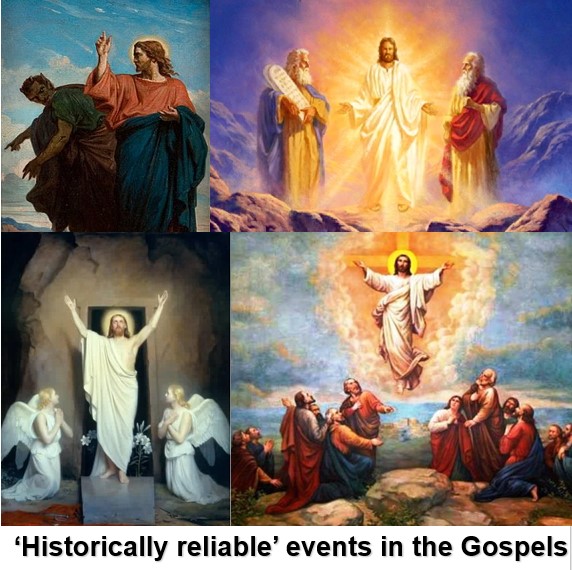
And of course the gospel writers did make things up. They invented numerous stories for Jesus to make it appear he is fulfilling prophecy (even when that ‘prophecy’ wasn’t prophecy to begin with.) This included making up ‘history’; Herod’s Massacre of the Innocents (a rewrite of a fiction about the infant Moses), the crucifixion eclipse, the rending of the temple curtain and more. These are all symbolic events. They didn’t really happen. Jesus’ own resurrection can safely be added to the list. It’s ironic that those who defend the gospel authors against the charge they made stuff up are the same who invent stories themselves: Mark and Luke knew each other? Mark proof-read Luke’s first draft? There were people who would fact check the gospels and point out any errors? But the original Christians wouldn’t do such a thing. Except they did.

There are no Inconsistencies, contradictions and inaccuracies in and between the gospels, but if there are, these are irrelevant. It’s the bigger picture that counts.’

Jesus is different in all four gospels. Despite Matthew and Luke’s plagiarising of Mark, they alter him to reflect the Jesus they believe in. John’s Jesus is so far removed from Mark’s that he’s a different character altogether. The inconsistencies do matter: did Jesus perform signs and wonders or not? Was he crucified on Thursday or Friday? Was it Peter, John or Mary who was first to see him resurrected? Did he hang around for one day or for 40? These conflicting details tell us that the creators of the Jesus story were more than happy to alter it when it suited their purposes. This is not how history is written. It is how propaganda is created. The ‘bigger picture’ is, in any case, made up of these smaller details. They work collectively and cumulatively to create the bigger picture. If we can’t rely on their being accurate how can we be sure the bigger picture is? When the gospel writers are unreliable in the smaller details, how can we be certain they’ve got the bigger picture right, given they’re all copying it from the same source, Mark, and giving it their own spin?

There is corroborating evidence of the gospels’ accounts’.

There is? Where? Just because there is some evidence that Nazareth existed doesn’t mean Jesus performed miracles, any more than Dunsinane castle’s existence proves Macbeth murdered King Duncan (he didn’t). Just because Pilate was a real historical figure doesn’t mean he crucified Jesus, any more than the existence of King’s Cross Station means Harry Potter catches his train there. And these, surely, are merely the small details. There is no corroboration at all for the bigger picture. Mention of the followers of Chrestus in Suetonius confirms at best that there were Christians in Rome at the time of Claudius, but no-one is disputing that. At worst, for the apologist, this curious reference has nothing whatever to do with Jesus. Later references to incidents from his story, by the much vaunted Church Fathers, are derived from the gospels and are therefore dependent on them. As such, they don’t constitute independent corroboration.

Everything Jesus prophesies or predicts in the gospels will come to pass, then sceptics will see that everything in the Jesus story is true.’

This one is from a commenter on Don’s blog. (I only went there by accident, honest.) The problem with this one is that everything Jesus is made to promise should already have come true, two thousand years ago. The Son of Man should have appeared in the sky with the heavenly host to usher in God’s Kingdom on Earth, while sending most of mankind to the fiery pit or outer darkness or some other damn place. Both he and Paul claimed that this would happen within their and their followers’ lifetimes. The trouble with Christianity is it is always winter and never Christmas. Its fulfilment God’s – God’s Kingdom on Earth, life after death, the final judgement – is always going to be at some indeterminate time in the future, a time and fulfilment that never quite arrives. It never will; part of ‘the big picture’ we can be confident we will never see.

More to come (unlike Jesus). 

How to work out when Jesus died

Blog338Darkness

When did Jesus die? The year, I mean.

The honest answer is we don’t know. In Michael J. Alter’s The Resurrection: A Critical Enquiry, recommended by John Loftus’s Debunking Christianity blog-site, the author considers twelve different dates that have been proposed, together with the reasons why. Ultimately though, we don’t know.

Which is strange, not only because, as Alter points out, Jesus’ death and resurrection are supposedly the most significant events ever to have happened in the entire history of the world, but because it should be really easy to pinpoint the date. It was the year there was –

  • a total eclipse of the sun that, for over three hours, plunged the whole land (some translations have ‘earth’) into darkness,
  • an earthquake that caused appreciable damage, 
  • the tearing from top to bottom of the four inch thick, 82 feet high curtain in the temple,
  • the dead rising from their graves to make themselves known to the inhabitants of Jerusalem (including, presumably, the extensive Roman presence.)

We know this because the gospels tell us so; these events all took place either just before (Luke) or just after (Matthew) Jesus’ death. Let’s overlook the fact that solar eclipses don’t ever occur at the point of a full moon, while Passover, when Jesus died, happens only when there is one, and take a look at Matthew’s version of events:

From noon on, darkness came over the whole land until three in the afternoon. And about three o’clock Jesus cried with a loud voice… and breathed his last. At that moment the curtain of the temple was torn in two, from top to bottom. The earth shook, and the rocks were split. The tombs also were opened, and many bodies of the saints who had fallen asleep were raised. After his resurrection they came out of the tombs and entered the holy city and appeared to many. (Matthew 27.45, 46, 51-53)

All we need to do, therefore, is look for corroboration of these four cataclysmic events occurring together in the records of the time. (The Romans were particularly good at recording such things; we know, for example, there was an eclipse in AD29, though that lasted a measly 2 minutes.) Once we’ve found this corroborative evidence, we’ll know for certain the year in which Jesus died.

But you’re ahead of me: there is no record anywhere, apart from the gospels, of these events ever taking place, certainly not in combination. No record of a widespread darkness, nor of an accompanying earthquake nor of the temple veil tearing from top to bottom, nor of the dead emerging from their tombs. Which isn’t to say they didn’t happen, but you’d think someone, somewhere would have noticed and would have written about them. Josephus maybe, or Plutarch, Greek or Roman authorities, or even Paul; anyone writing at the time or soon after; any of those whose history of the period has survived.

But no.

It’s enough to make you think these earth-shattering events didn’t really happen; that they’re all made up for theological reasons.

And you’d be right.