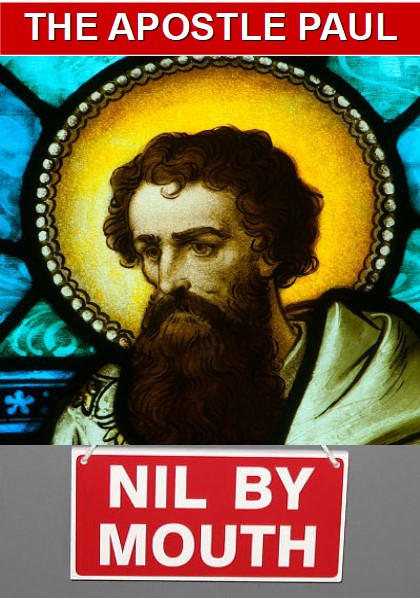
Where are those stories?

Those opposed to the idea that Jesus was only ever a mythical figure are generally dismissive of those who point to the evidence of the New Testament that this is precisely how the earliest Christians saw him. These critics lambast as ‘amateurs’, ‘pseudo-historians’ and ‘fringe’ enthusiasts those who don’t see any evidence for an historical Jesus. But such ad hominems are not arguments and they’re certainly not evidence that a human Jesus existed. When the books of the New Testament are arranged in chronological order, the very earliest writing about Jesus – Paul in the 50s and the creed of 1 Corinthians 15 – appear to view him only as a scripture-fulfilling spiritual manifestation.

So, was Jesus actually an itinerant preacher who traipsed the Earth in the 30s before rapidly evolving into Paul’s mythical Christ or was he a mythical being to begin with, only later to be cast as an historical figure?

It has to be one or the other. 

Within twenty years of his supposed death, Paul and others had experienced dreams, visions and hallucinations (Acts 2:17) that convinced them Jesus was a supernatural being in heaven. This doesn’t of course rule out that a human Jesus had actually existed, but it makes it unnecessary for him to have done so. Paul and almost all the creators of the New Testament books treat his earthly existence as irrelevant. Even when ‘proving’ their celestial Superman is the promised Messiah, they refer not to his activities on Earth, but appeal exclusively to what they believed Jewish scripture revealed about the Messiah.

According to these men, this is how they knew the Jesus of their dreams was truly the Saviour: the ancient scriptures. Not a single one of them says, ‘I refer you to Jesus’ miraculous birth in Bethlehem; I remind you that he changed water into wine, controlled the elements and miraculously multiplied food.’ Not one of them references his many healings, exorcisms and raising of people from the dead. Not one mentions the historical details surrounding his crucifixion, the empty tomb or the women who first saw him alive again. Not one relates a single resurrection appearance (beyond their own visions) nor do they mention the ascension or a looked for ‘second’ coming. Why not? Surely these would be the definitive indicators that Jesus was the Messiah, instead of, or at least alongside, the so-called prophecies of ancient scriptures.

The ‘why not?’ is because these stories – the birth, the miracles, the healings, the empty tomb, the bodily resurrection, the ascension and the rest – had, at the time Paul was writing, not yet been created. Consequently, they couldn’t be passed on to Paul when he met Cephas and James. There was no much-vaunted ‘oral tradition’ for him to call upon to fill in the gaps in his knowledge about an Earthly Jesus. There was no oral tradition because there was no Earthly Jesus to relate stories about when Paul was active in the 50s. This version of Jesus, created from Jewish scripture, Paul’s teaching and cult rules, didn’t appear until the early 70s. Even after Mark’s gospel and its copycat sequels, most of the writers of later New Testament continued to believe in and refer only to a heavenly saviour verified by ancient Jewish scripture.

But, apologists say today, no-one at the time would be taken in by talk of a Messiah who existed only in the heavenly realm. And that’s true; despite the Bible’s claims to the contrary, very few people were persuaded. But some bought into it, just as others at the time bought into Mithras. Mithraism was, for a while, more successful than the fledgling Christian cult. Yet its adherents knew Mithras himself manifested only in the heavenly plane. This didn’t stop multitudes of military men from joining the cult to worship him. It was the same for the other deities of the day. They too didn’t exist even if stories about their adventures on the Earth were widely circulated and, in all probability, believed by the gullible.

If, however, Jesus’ life on Earth had happened in the early part of the first century, how was it that 20 years after his death he had already become an angelic being without a past? Why had Paul, the writer of Hebrews, the pseudo-Pauls, James and John of Patmos never heard any of the stories about him, or didn’t care about them or felt they weren’t really evidence of Jesus’ Messiahship? Where are those stories? Outside the later gospels they don’t exist. It’s as if, when Elvis Presley died, no one cared any more about all the hit records he’d made and were instead only interested in his post-mortem sightings in laundromats and shopping malls. The process just doesn’t happen this way round.

No, it is far more likely that Jesus went from being a celestial saviour to having stories written about him, stories that are based on prophecies in Jewish scripture and Paul’s ‘revelations’. They are allegorical and metaphorical, wholly made up as the writer of Mark 4:11-12 tells us with the equivalent of a Clark Kent wink:

The secret of the kingdom of God has been given to you. But to those on the outside everything is said in parables so that ‘they may be ever seeing but never perceiving, and ever hearing but never understanding; otherwise they might turn and be forgiven!’
 

Jesus outside the New Testament

So what about other 1st century writing? Doesn’t this provide extra-biblical evidence for an historical Jesus?

The Jewish historian Josephus wrote his Jewish Antiquities around 93/94CE. In the section known as the ‘Testimonium Flavianum’, he appears to talk about Jesus in glowing terms:

Now there was about this time Jesus, a wise man, if it be lawful to call him a man, for he was a doer of wonderful works, a teacher of such men as receive the truth with pleasure. He drew over to him both many of the Jews, and many of the Gentiles. He was the Christ; and when Pilate, at the suggestion of the principal men amongst us, had condemned him to the cross, those that loved him at the first did not forsake him, for he appeared to them alive again the third day, as the divine prophets had foretold these and ten thousand other wonderful things concerning him; and the tribe of Christians, so named from him, are not extinct to this day.

I’m not here going into great detail about why many scholars believe this to be an interpolation; suffice to say they do. A later Christian added the entire passage in the middle of an account Josephus is relating about Pontius Pilate that has nothing to do with Jesus. It employs language and a style alien to anything else Josephus wrote and appears to be a rewrite of the appearances of the resurrected Jesus on the road to Emmaus in Luke 24:13-35. None of it is testimony to any Earthly Jesus.

Josephus’ apparent second reference to Jesus is in a later section of Jewish Antiquities. There he relates a story about the execution of a certain James who happens to have a brother called Jesus. Unfortunately, despite the two names corresponding to gospel characters, the two are, as the context makes clear, two entirely different people. This James is a Jewish High Priest who, Josephus mentions incidentally, had a sibling called Jesus. They lived at a later time. Unfortunately, at some point, a scribe or someone else added the phrase, ‘called Christ’ after the second mention of this Jesus. This may have been accidental when a marginal note (who wrote it and why?) was transferred to the main text. This Jesus is not remotely ‘the Christ’.

Josephus, therefore, tells us nothing about Jesus, neither as a celestial super-being nor as a real person. 

Around the same time as Josephus’s Antiquities, the document now known now as 1 Clement appeared. Thought to have been written circa 95CE (though Carrier thinks it might be as early as 65), 1 Clement appears to quote gospel Jesus:

(Be) especially mindful of the words of the Lord Jesus which He spoke teaching us meekness and long-suffering. For thus He spoke: ‘Be merciful, that you may obtain mercy; forgive, that it may be forgiven to you; as you do, so shall it be done unto you; as you judge, so shall you be judged; as you are kind, so shall kindness be shown to you; with what measure you measure, with the same it shall be measured to you.’

Certainly this sounds like the things Jesus is reported as saying in the gospels, Matthew in particular. Nevertheless, it is not identical to anything Jesus does say there. These words sound suspiciously like an exposition of the behaviour the early cult expected of its members (though didn’t always experience, 1 Clement addressing this very issue). Similar words had already been put into the mouth of Jesus in Matthew’s gospel allegory. Of course if Carrier is right with his dating, Matthew might easily have appropriated them from 1 Clement itself. Whichever it is, they could as easily have been ‘spoken’ by an imaginary saviour in heaven than from a man who had lived on Earth several decades earlier.

Outside of these ‘words of the Lord Jesus’, every other reference in 1 Clement is to the Jewish scriptures. Its author makes all of his points using the scriptures, even when a reference to Jesus’ teaching, miracles or parables would be far more apposite. Like almost all of the New Testament writers, Clement appears not to know any of these details. When he addresses suffering, he uses Peter and Paul’s deaths as his examples, not Jesus’ crucifixion, which gets no mention at all.

Clement’s ‘Lord Jesus’ is, like that of Paul and other New Testament writers, a supernatural superman, whose existence is exclusively proven by ‘prophecies’ in ancient scripture.

And that’s it. No first century writer outside the Bible tells us anything about an Earthly Jesus. Those who appear to mention him, do so only briefly and offer no information about his life. The majority of first-century writing about Jesus then, both inside and outside the Bible, speak only of a mythical Christ who had cultic followers.

We’ll take look at some early 2nd century documentation next time.

You can already guess what this offers though, can’t you.

James, brother of the Lord

Let’s take a look at some of the problems that need to be addressed in recognising that Jesus the Christ was always a mythical being.

The first is, that despite the vast majority of what Paul writes talking about Jesus only as a divine super-being seen in visions and worked out through ‘revelations’, there are a couple of instances where he appears to be alluding to a real person.

The first is Galatians 1:19, where, in this literal translation, Paul refers to ‘James, the brother of the Lord’:

Then after three years I went up to Jerusalem to make acquaintance with Cephas and I remained with him days fifteen. Other, however, of the apostles none I saw if not James the brother of the Lord (‘adelphon’). In what now I write to you, behold before God, I lie not!

In context, Paul is asserting that his knowledge of ‘the Lord’ comes directly from the Lord himself in visions and revelations and ‘not from any man’ (Galatians 1:12) He did not, he asserts here, meet with Cephas and James until 3 years after his conversion. (His insistence he is not lying is curious, wouldn’t you say?)

His mention of James, ‘the brother of the Lord’ is potentially a problem for those who see Jesus as primarily a mythical figure. Richard Carrier accepts that the reference is an indicator in favour of historicity. However he goes on to say that Paul, Cephas, James and all fledgling Christians,

were brothers because they were at baptism the adopted sons of God. Literally. Paul explicitly says that. And this made them all brothers of the Lord Jesus. Again, Paul explicitly says that.

He explicitly says these things in Galatians 4:3-7 and Romans 8:15-17 respectively. Undoubtedly the term ‘brother of the Lord’ could refer to the fact that all Christians are brothers of the Lord through adoption. But then why is Cephas not also referred to as a brother of the Lord? Carrier demonstrates that Paul distinguishes between Apostles, who by definition have, like himself, had the risen Christ revealed to them (in other words have imagined they’ve seen him in their own heads) and those who haven’t. These less fortunate individuals, however well placed in the cult hierarchy, are, like all Christians, brothers of the Lord. Paul uses the term in this sense frequently, for example in 1 Corinthians 1:26 & 16:20; Romans 10:1 and 1 Thessalonians 1:4. He also calls his fellow Jews ‘brethren’ in Romans 9:3. His strange construction that he saw Cephas and ‘none other of the apostles, if not James’, does not imply he saw James as an apostle.

Nor does Paul say James is ‘the Lord’s brother’, which implies a familial connection. The Greek quite clearly employs the phrase ‘the brother of’, which suggests a looser, cultic connection; James is one of the adopted brotherhood.

Furthermore, Paul does not say James is the brother of ‘Jesus’ as Bart D. Ehrman falsely assumes. Paul says James is ‘the brother of the Lord’, ‘the Lord’ being the term he uses when referring to the heavenly saviour who was been ‘revealed’ to him. There’s no reason to suppose that Paul means anything other than this when he calls James the brother of the Lord. Again, what he is actually saying is, ‘I saw James, he of the brotherhood of our Heavenly Saviour.’ The term ‘brother’ for a fellow (male) Christian persists, in this very same way, in the present day.

I am not of the view, therefore, that Paul’s use of the term for James undercuts the likelihood that Jesus was then, as he is now, a mythical heavenly being.

Dying For A Lie, part 94

Over on Gary Marston’s Escaping Christian Fundamentalism, he has been arguing, along with some of you, about the resurrection with Joel Edmund Anderson, self-professed expert on all things Biblical. Joel – he has a PhD in Biblical Studies, don’t you know – has twice said in the discussion that the disciples would not have died for a lie, meaning they wouldn’t have let themselves be martyred if they hadn’t really seen Jesus alive again in the flesh.

I’ve addressed the assertion that they wouldn’t have died for a lie several times already on this blog: here, here and here for example, though some of my thinking about the Jesus phenomenon has changed since then. Nonetheless, I added my penny’s worth to Gary’s discussion (it’s difficult to get involved in real time because of the time differences between the US and UK):

And there it is again: ‘they wouldn’t suffer death and persecution for what they knew to be a lie.’

While you (Joel) mention the execution of James there is no evidence even in your hallowed text that this was because he believed in the bodily resurrection of Jesus.

The later legends of the martyrdoms of Peter and Paul are just that: legends. (And Paul wasn’t even a disciple! Moreover, he is clear in Galatians that his experience of the risen Jesus was ‘in’ his head.) There is no evidence, none at all, for your claim that ‘the disciples’ (all of them?) died or were even persecuted because of their belief in a bodily resurrection.

If some were put to death, it could equally have been because of their abandonment of conventional Jewish beliefs; their provocation of religious authorities (there’s plenty evidence of this in the gospels); their replacement of emperor worship with a deified itinerant preacher or for political reasons. We simply do not know.

That said, there are zealots today prepared to die for lies (think 9/11, Islamist terrorists) so there is no reason to think it didn’t also happen 2,000 years ago.

This line of argument, as ‘proof’ of the resurrection is exceedingly weak, Joel, yet it appears to be all you’ve got.

Joel did not respond. I feel sure he will make the claim again at some point in the future because it’s what he, like many other Christians, want to believe, which is really what ‘faith’ is all about.

Paul and the Oral Tradition

Much is made of the oral tradition that it is said informs the material in the synoptic gospels, and possibly John too. The tradition of conveying the events of Jesus’ life and the things he said goes back to Jesus’ original followers – the disciples and the apostles (the terms are not necessarily interchangeable) – and continues with a high degree of accuracy, at least until AD70 when the first gospel was written. 

Which must be why we find so much detail about Jesus’ life in the letters of Paul, from his first letter, 1 Thessalonians, written circa AD55 to his last, Philippians (now an amalgam of several letters), written about 62. Paul was aware of the stories about Jesus – as all converts were – and affirms so many of the details of his life in his letters, passing on the vital stories and the traditions associated with him, in written form.

But not in our reality. Our Paul knows nothing of the details of Jesus’ life. Not once does he quote him or refer to the events of his life before the resurrection. There is nothing of the oral tradition. Nowhere in his letters does he draw from it; never does he say he knows for a fact that Jesus said or did a specific thing while on Earth.

Even after his meeting with Cephas and James, a full three years after his conversion, Paul relays not a single thing he learnt from them. After the encounter, he continues to promote only his own revelations and says nothing of what he learnt about Jesus from the man who supposedly spent three eventful years with him.

Fourteen years later, Paul meets again with Cephas and encounters other apostles for the first time. On this occasion, he and Cephas argue about justification and Paul comes away grumbling that ‘those leaders added nothing to me’ (Galatians 2:6) What? Not even stories about their time with the Master? Apparently these weren’t as important as disputes about soteriology.

Later still, Acts tells us that immediately after his conversion, Paul stayed with ‘disciple’ Ananias and other ‘disciples’ for several days. Did Ananias not know any of the oral tradition that he could pass on to Paul? Details about Jesus’ life, a saying or two or an account of a miracle? Apparently not. (This might be because the story is pure fabrication. Paul tells us himself, in Galatians 1: 16, that immediately after his conversion he ‘did not rush to consult with flesh and blood’).

Surely, though, he must have heard some of the Jesus story from those he persecuted prior to his dramatic conversion. If he did, he didn’t see fit to include any of it in his letters. Likewise, Paul had contact with cult communities he didn’t himself establish, such as that in Rome. Surely they conveyed some of the stories about Jesus that they had had passed on to them. He appears too to have known at least one other evangelist:  Apollos. If these other believers did pass on stories of Jesus from an ultra-reliable oral tradition, why didn’t Paul see fit to include any of them in his letters?

So what were Paul’s sources? Certainly not the oral tradition, nor Q, the hypothetical sayings gospel, which he likewise ignores. If the gospel was being spread orally from the time Jesus lived, by the apostles and other preachers, and was being passed around the fledgling cult communities, why did Paul know nothing of it? If in fact he did, why did he choose to ignore it in favour of his own inner-visions? Did he consider it of such little value?

These questions matter, as we’ll see next time when Mark decides he’ll set the Jesus story down on paper.

How We Got The New Testament

Recycled pictures, new post.

Once upon a time, there was, possibly, a bloke called Yeshua Bar Yosef. Maybe there was, maybe there wasn’t, but either way, a couple of other blokes, one called Simon (or maybe Cephas or maybe Peter), came to believe that Yeshua had returned from the dead and had appeared to them, alive. This was probably all in their heads and what they saw was at most a blinding light, if they saw anything at all. This was certainly the case for a different bloke, Saul (or maybe Paul) who came along later. He wrote about his experiences and admitted they were all in his mind.

This Simon-Peter-Cephas and maybe one or two others convinced themselves that Yeshua was God’s special emissary and would save them from something, somehow or other. They told other people this and, being gullible, some of these other people believed that Simon-Peter-Cephas and his mates really had seen Yeshua alive again. They started to believe Yeshua would save them too. Saul-Paul, meanwhile, wrote letters to the people he’d persuaded to believe in his version of events – it was a bit different from what Simon-Peter-Cephas and co believed – and, writing in Greek, rendered Yeshua as Iesous (‘Jesus’ came much later when the ‘J’ was invented in the 16th century.) Paul thought Iesous was a celestial being he called ‘the Christ’. He taught that this Christ would soon be coming down to the Earth to set up God’s Kingdom here. Even though they were obviously a bit rubbish, Saul-Paul’s letters were copied multiple times by hand, which is when errors began to creep in. In some places, the letters were deliberately altered.

Other people wanted to get in on the act, so they wrote letters too, pretending they were Saul-Paul. Sometimes these letters said the exact opposite of what the real Saul-Paul wrote. His weren’t the only letters to be forged either. Fifty or more years after the entire scam had got underway, someone pretending to be Simon-Peter-Cephas sent letters as if they were from the man himself. Needless to say there were cultists daft enough to believe it. There were others who wrote letters too, people like James and John. James didn’t see eye-to-eye with Saul-Paul and contradicted many of the things he said.

About 40 years after Simon-Peter-Cephas thought he’d seen the dead-but-alive Yeshua-Iesous-Jesus, somebody in a different country decided to write a back story for the character. He didn’t know much about Yeshua-Iesous-Jesus, what he’d said and done and whatnot, but that didn’t deter him. He borrowed bits from Saul-Paul’s letters and Greek myths and set about it. He scoured the Jewish scriptures for anything that sounded like it might be a prediction of Yeshua-Iesous-Jesus and his supposed escape from death. He made up episodes for him based on these completely unrelated scraps of scripture. He forgot to sign his work, however, and it wasn’t until years later that someone else decided this author’s name should be ‘Mark’.

A couple of other anonymous dudes liked what ‘Mark’ had done when inventing his Yeshua-Iesous-Jesus story but thought they could make a better job of it themselves. The first of these, who would later be called Matthew, lifted most of Mark’s effort (which is how we know ‘Matthew’ wasn’t an eye-witness; an eye-witness wouldn’t plagiarise most of the story from someone who wasn’t) and then went overboard with the prediction/prophecy thing that Mark had started. He found even more spurious bits of scripture and made up a whole lot of new stories about Yeshua-Iesous-Jesus from them. Later still, ‘Luke’ wrote his version of the story, using Mark and Matthew’s accounts and inventing a few new episodes himself. This same person went on to write a fabricated history of the Yeshua-Iesous-Jesus cult, making up stories and speeches for caricatures of Simon-Peter-Cephas and Saul-Paul.

The fourth person to try his hands at writing a script for Yeshua-Iesous-Jesus decided to completely reimagine the character. Strictly speaking, this ‘gospel’ was produced not by a single person but by a collective of cult members. Their Jesus was nothing like the one in the other three gospels. He was more a super-hero, whose special power was boasting about himself. This is the Jesus that, 70 years on, the cult wanted to believe in. Eventually, the name John would be attached to this fantasy, though this isn’t the same John who wrote letters nor the one who created the hallucinatory nightmare that would become the final book of the Bible.

These various letters and stories circulated round the Roman Empire wherever members of the new cult met. Eventually, someone hit upon the idea of collecting them together as one volume. The first we hear of this is when a guy called  Marcion produced his own collection, round about AD140. Stupidly, he didn’t include the right ‘books’ and it wasn’t until AD367 that the collection we now know as the New Testament was first mentioned. This was ratified later that century by a group of men who had elevated themselves to positions of authority in the Church, as the cult was now calling itself. Despite claiming they had been guided by the Holy Spirit, these learned men endorsed the inclusion of several forgeries. Neither did they see fit to arrange the books in the order they’d been written, giving the impression that the accounts of Yeshua-Iesous-Jesus’ life existed before Simon-Peter-Cephas and Saul-Paul’s innervisions that had sparked the whole thing in the first place.

Jump forward a few hundred years and the New Testament, as it was now known, had come to be regarded, by some, as the infallible, inerrant and authoritative Word of God, which clearly it is not. These epithets stuck, however, and are still held to be accurate descriptors of the New Testament by people who have stopped thinking for themselves.

So there we have it: how we got the New Testament –

  • It wasn’t written by eye-witnesses.
  • Its accounts of Jesus’ life are largely fictional.
  • It owes much to fanatics who were prone to visions.
  • It is given to wild speculation, offered without a scrap of evidence.
  • It contradicts itself.
  • It includes many fakes and forgeries.
  • It was banged together by men who didn’t really know what they were doing.

And after that, everyone lived delusionally ever after. The End.

The original ‘good news’ had nothing to with any mystical salvation plan (part two)

Disciples2

Last time, I provided evidence that Jesus’ original ‘good news’ had nothing to do with any mystical salvation plan constructed around his supposed resurrection. My six references demonstrated that, even after his death, the disciples adhered to Jesus’ original message: God’s Kingdom was coming soon and they were going to rule over it. Here are six more reasons we can be sure this was the case:

7. Our earliest sources, Q and the gospel of Mark, do not give much credence to the resurrection as an actual event: Q records no sayings of the risen Jesus and Mark has no resurrection appearances; it ends with the women who discover the empty tomb deciding not to tell the disciples about it. In Mark’s gospel, then, the disciples are not even aware the tomb is empty, let alone that Jesus has returned from the dead. We can conclude from this that the community that produced Mark’s gospel, the supposed resurrection was not significant in and of itself.

8. Paul tells us that the disciples’ gospel was not the same as his, despite the fact he too believed the Kingdom wasn’t far off (1 Thessalonians 4:17). The disciples, he says in 2 Corinthians 11.4-5 and Galatians 1.6; 2.11-21, were preaching ‘a different gospel’. Different from his, certainly, but the same as the ‘good news’ Jesus proclaimed: Jewish people should prepare for the imminent arrival of God’s Kingdom on Earth (Mathew 9.35; 15.24), when, as Jesus himself had promised them, the disciples would judge the restored tribes of Israel and rule over them. It is, as we have seen, out of the question that they would jettison this aspect of the ‘good news’, given to them by Jesus himself.

9. Because the disciples – and Jesus’ brother James – saw the new Kingdom as intended for Jews only, as Jesus had before them (Matthew 10.23), they insisted that any Gentile converts must be circumcised; must become Jewish (Galatians 2.7). Paul, of course, objected to this requirement and throws tantrums about it in his letters (Galatians 5.1-12; Philippians 3.3). But like Jesus, the disciples saw no place for Gentiles, the unrighteous, in the new age; those who didn’t convert would, of necessity, be dispatched to eternal punishment (Matthew 25.31-46).

10. As far as the disciples were concerned, therefore, it was entirely for their own good that converted Gentiles be circumcised (Galatians 6.12-13) as this was their only guarantee of a place in the new Kingdom. What this tells us is that a salvation formula, such as that dreamt up by Paul, had no part in the disciples’ ‘good news’.

11. Wherever they appear – in Paul’s writing, the gospels, Acts – the disciples are portrayed as being at odds with an incantational, faith-based Christianity. The Bible attests, even with Paul’s new religion superimposed, that they held to a different gospel, a different sense of what Jesus’ life meant and a different notion of their place in the coming Kingdom. And wouldn’t they be the ones to know? They knew Jesus, spent time with him, listened to his teaching, bought into his misguided mission and had sufficient understanding of it to spread his ‘good news’ to fellow Jews, both while he was still alive and afterwards (Matthew 10.23; Luke 9.1-2).

12. The New Testament is testimony to the failure of everything Jesus and the disciples stood for; their ‘news’ that God was soon to turn the Earth over to the meek and that they would then rule the only people who mattered, the twelve tribes of Israel, with everyone else thrown into outer darkness (Luke 13:28). Jesus himself, of course, would return at some point to be top dog, God’s representative on Earth – his anointed one. None of this happened.

If only it had been allowed to rest there, we might not know today of Jesus and his mad ideas. Instead, Paul stepped in, reinterpreted the whole ridiculous enterprise and bequeathed the world a set of different but equally absurd beliefs. And the rest is history: religious wars, pogroms, inquisitions, suppression, superstition, clerical child abuse, Pat Roberston. Is this the Kingdom that Jesus and his closest associates foresaw? Decidedly not. But it is their legacy.

Our Operators are Waiting to Hear from You!

ApostlesHi! You’ve reached the Salvation Hotline. Calls may be recorded for training purposes. All offers are validated by our six day guarantee.* Please listen carefully to your options:

Press 1 for Matthew. With one of our less popular offers (but don’t let that put you off!) Matthew is waiting to explain our buy-one-get-one-free offer! Keep the Jewish law and be saved, plus, forgive others and be forgiven yourself!

Press 2 for John who will tell you how you can get your very own get-out-of-Hell just by believing! Eternal life awaits!

Press 3 for Luke. Luke wants to let you know you how you can be saved simply by asking for forgiveness. Note: this offer cannot be used in conjunction with any other.

Press 4 for Luke’s bargain Family Ticket! Only one family member need sign up and the rest go free!

Press 5 for Paul and to hear about a unique special offer! ‘God’s grace’ can save you without you making any real effort on your part! Not to be missed.

Press 6 for Paul’s great alternative offer: get saved for free! No need to do anything! (Offer good for Jews only. Terms and conditions apply.)

Press 7 for a special operator who passes himself off as Paul but isn’t. And he has a great offer for our female callers! He’ll tell you about how, just by having babies, you can be saved! It really doesn’t get any better than this, ladies! Get saved just by doing what comes naturally!

Press 8 for a very special guy of ours who wants to stay anonymous! But he will show you how you can escape death by buying into Jesus’ cosmic defeat of evil!

Press 9 for James who will tell you how you need to do good if you want to be saved. So, okay, Paul doesn’t think so, but we want to make sure you hear all our offers!

Please note: these offers are mutually incompatible so you might just want to hang up now and forget all about them.

*Our guarantee isn’t worth the paper it’s written on but for legal reasons, here it is anyway:
Press 1: Matthew 5.17-19 & 6.14.
Press 2: John 5.24.
Press 3: Acts 2.36-38.
Press 4: Acts 16.30-31.
Press 5: Romans 10.5; Ephesians 2.8.
Press 6: Romans 11.26-27.
Press 7: 1 Timothy 2.15.
Press 8: Hebrews 2.14-15.
Press 9: James 2.14-17, 24