I Don’t Count


I don’t count. You don’t count. Not if, like me you’re an ordinary person quietly getting on with life, perhaps working to support your loved ones or maybe retired now, drawing the pension you’ve paid into all your life and paying your taxes. You don’t count. I don’t count.

Politicians only become interested in you, and then only as a statistic, when election time rolls round. They see us, in the UK at least, as a cash cow, needed only to fund not merely those services that are necessary to a functioning society but also for every other ill-thought-through scheme they devise.

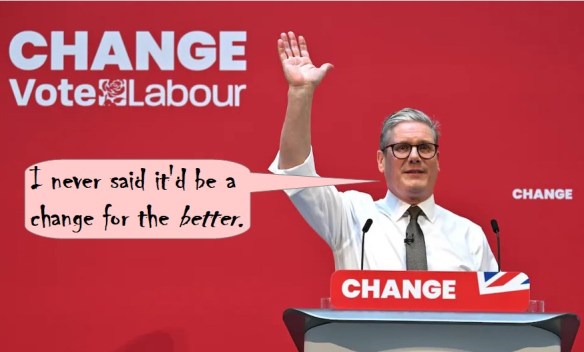
When Labour – the equivalent of the Democrats in the States – came to power last year they suddenly ‘discovered’ that the previous Tory (Republican) government had left them with a £22 billion debt. A number of financial institutions disputed this figure and the government produced no concrete evidence for it. Nonetheless, they took immediate action, shelving most of their pre-election promises until the debt could be repaid. To this end, our politicians, being among the most unproductive members of society, cut out an enormous amount of government waste and immediately cancelled projects of no benefit to the British people. The Spectator magazine estimated that they saved in the region of £200 billion this way. They were quids in!

Except they did nothing of the sort. What they did was keep up their prolific spending, turning to their cash cow – the British tax-payer – to milk it for even more money by increasing taxes all round. Particularly hard hit were high earners (which I am not), the lower paid, businesses and farmers.

A disputed debt, created solely by politicians (much of it by unnecessarily locking down for two years), now has to be paid for by those who had nothing to do with its creation. As if this weren’t bad enough, the new UK government has extended its control of its people by –

  • Deciding what can and can’t be said online and elsewhere (a new, so-called Islamophobic blasphemy law is currently being considered);
  • Encouraging police to investigate ‘non-crime hate incidents’, while ignoring burglaries and shoplifting ‘incidents’;
  • Restricting how much of our own money we can give away to family and friends before the government helps itself to a massive slice;
  • Freezing tax thresholds, meaning individuals will start to pay tax at lower levels of income;
  • Making taxpayers pay for schemes and projects with no proven track record (carbon capture, net zero);
  • Permitting local councils to increase council taxes, some above the legal limit, for fewer services. (Almost a quarter of council tax collected is spent on ‘unjustifiably generous’ staff pensions.)
  • Allowing government agencies access to private bank accounts in order to determine whether benefit recipients are lying about their income (powers that are set to be extended in 2029);
  • Making tax payers fund mass immigration, which successive governments have failed to control.
  • Requisitioning farm land in order to build more houses. In a second blow to farmers, paying them less than the market value. The government seems hell-bent on destroying food production in the UK.
  • Expecting tax-payers to pay Mauritius between £9 billion and £18 billion to take a tiny island in the Indian Ocean off our hands (though Trump might prevent the handover). 

Also under consideration is a two-tier justice system offering greater lenience to those from minorities. Should penalties for criminal acts be determined by ethnicity?

None of this makes us North Korea, but it certainly doesn’t feel like we’re  living in a Western democracy. What happened to government of the people for the people? Why is there growing resentment in the UK that government is now something that is done to the electorate? Beware legislation that is ‘for your own good’ because it never is.

It’s no wonder so many British citizens feel neglected and side-lined by politicians who view them only as a source of income. Can you blame them, and me, for feeling like we don’t count?

Free Speech

The British government is considering making what it describes as Islamophobic remarks, on social media and elsewhere, a crime. It has so far been unable to define what Islamophobia is, but evidently it goes beyond the libel laws that already exist and which were used to jail the idiots who called for violence against immigrants (not exclusively Muslims) in the summer.

Critics say the government’s proposals are the means of introducing a blasphemy law through the back door. They fear it could lead to criminalising legitimate criticism of Islamic beliefs and practices. Should these be immune from criticism when some Muslim beliefs are as absurd as their Christian counterparts, others positively harmful and some antithetical to British democratic and social values? Should these aspects of Islam be immune from criticism or mockery? It would be a mistake if they were. Islam troubles me, and many others here in the UK, by virtue of the fact it is a religion. The imposition of a protected religion – any religion – is not something that would be beneficial for a largely secular society (or any other in my opinion).

And what of other religions? There has been mention that the new law would also protect Jews from anti-Semitism though there are, again, existing laws that do that. It’s difficult too to know what would be considered ‘anti-semitic’. Is criticism of the Israeli government’s actions? Hasidic Jews treatment of women? It’s hard to say, and it seems unlikely the British government will enlighten us any time soon.

You can be sure that if comment deemed Islamophobic or anti-Semitic becomes punishable by law, other religions will soon look to have their beliefs and practices granted the same ‘protections’. It would be perfectly reasonable for them to do so. After all, the criticism and mockery of Christianity and Christians themselves found here and elsewhere on the internet could be seen as being Christophobic, or whatever the Christian equivalent of Islamophobia is called. Of course Mormons and Jehovah’s Witnesses would be entitled to special protection too, as well as Buddhists, Hindus and all fringe religions. It might not be too long before criticism of politicians and politics is similarly curtailed.

Free speech would still exist for the practitioners of religions themselves of course. Our beloved local street preacher would still, presumably, be able shout about the evils of Pride and the sinfulness of homosexuality; his right to do so is, after all, enshrined in law. Muslim groups in Britain would still be able to deny women the same rights as men, while calling out the decadence and immorality of kafir Western cultures that have given them refuge. Terrorist acts carried out by Islamists would be protected from comment and censure. All religions would be able to assert the rightness of their ideologies over the mistaken beliefs of all the others.

Or will they? Will the proposed new law defining criticism of Islam as ‘Islamophobia’ escalate in the way I’m suggesting so that no-one can criticise or mock the beliefs of others? What of free speech then? How long before any such comment would be deemed hate speech, as negative remarks about transgenderism are now. How long before commenting on government policy is deemed to be ‘misinformation’? Questioning its ruinous pursuit of net zero, its immigration policy (or lack of one) and speaking out against whatever the current narrative happens to be might soon be anathema, in the same way questioning approaches to Covid were a few short years ago. How long before such ‘hate speech’ and ‘misinformation’ is punishable by law?

Of course I’m not saying calls to violence against any group of people whether religious, gay or transgender is something that should be tolerated. There are already laws to punish advocates of real hatred, as those who used social media to provoke riots in the UK discovered. Severely restricting free speech on the pretext of controlling hate speech and ‘misinformation’ still further will serve only to extinguish the legitimate criticism of religion, politics and other belief systems. It’s something totalitarian states do.

Respect

Even before the events in Israel and Gaza, there were numerous recent examples of the term Islamophobia being used to suppress freedom of expression or shield wrongdoing.

A recent report by an all party group of UK MPs.

I’ve been told before that I should respect people’s religious beliefs. We all should apparently.

I can’t, I confess, summon respect for patent nonsense, nor for those who subscribe to it. I’m not even going to try.

There have, I admit, been a few believers I’ve met in life for whom I have had respect and even admiration, but this has been for the kind of person they were, not because of their religious beliefs per se. And no; their religion is not what made them admirable people. They were admirable irrespective of, or even despite, their irrational beliefs. I still hold to the theory of my own making, that religious conviction is like alcohol: both accentuate the existing characteristics of the individual, making them more of the person they already were, for better or for worse.

Equally, I’ve met many non-believers (I hate it that we have to describe ourselves as what we are not), LGBT people (for many religionists, the antithesis of admirable) and individuals whose views and outlook on life I haven’t necessarily agreed with, for whom I have also had respect and admiration.

It comes down to the old cliche, a truism nonetheless, that respect has to be earned. Just because someone believes in the supernatural or that Jesus died for our sins or that their deity or prophet trumps all others doesn’t mean I have to respect such views, or indeed those who hold them.

But this is where we’re headed, it seems. We’re expected to respect any old make-believe so long as it comes under the banner of religion and still more that doesn’t. It’s becoming ‘hateful’ to criticise religious belief and those who practise it. Because their views are sincerely held, the thinking goes, they merit protected status.

I commented some time ago on a Christian site (something I rarely do except when incensed) that was insisting ‘sodomites’ would burn in hell, because… the Bible. I countered that gay people were not going to hell because, in fact, no-one was. As well as the subsequent ‘loving’ comments from Christians, I was taken to task by a gay person telling me I was disrespecting the original poster’s Christian convictions.

Likewise when I suggest that we should be more wary of Muslim beliefs I’m told I’m being profoundly unfair, racist and Islamophobic, towards a minority – as a minority of one myself – and I should show more respect for an ancient and sacred tradition as well as those who subscribe to it.

I can’t do it. I can’t respect religious belief. It is no more worthy of respect than astrology, palm reading and spiritualism. It flies in the face of rationality. Not only is it insupportable, it is dangerous, a threat to hard-earned freedoms and rights.

Religiophobia?

Is criticising Christianity and the way some people practise their religion a form of Christophobia? Strictly speaking a phobia is an irrational fear of whatever precedes it, as in homo-phobia, trans-phobia, Islamo-phobia and the like. In the accusations of whatever-phobia we hear today – and they invariably are accusations – ‘phobia’ seems to have come to mean ‘hatred of’; a hatred of Christianity and therefore of Christians; of homosexuality and therefore of gay people; of trans-people; of Muslims and so on.

Reasonable criticism of belief systems is not hatred. I don’t and am sure I never have had a hatred of Christianity or of any other religion. I certainly have views about Christianity as a seriously flawed, cock-eyed superstition (I hope I’m not giving my position away too early.) Reasonable criticism of it, mockery even, is perfectly legitimate, for reasons I’ve outlined before, just as criticism and mockery of any belief in the fantastic is legitimate. Ideologies based on belief in imaginary beings do not automatically merit respect nor do they have a de facto immunity from criticism. The same applies to those who subscribe to such fantasies, particularly when they attempt to force them on others. Calling out believers on their inconsistencies and hypocrisy is perfectly reasonable.

Is it fair then to express critical views of homosexuality and by extension of gay people? Of course. We are not immune from reasoned criticism, though much of it doesn’t qualify as ‘reasoned’; we have suffered much from emotional reactions to our existence and still do. (See Bruce’s recent post in which Republican North Carolina’s lieutenant governor, Mark Robinson rants about godless homos. When comment deteriorates into vitriol it becomes an incitement to hatred and, sometimes, violence. When this happens, the modern sense of phobia is justified.)

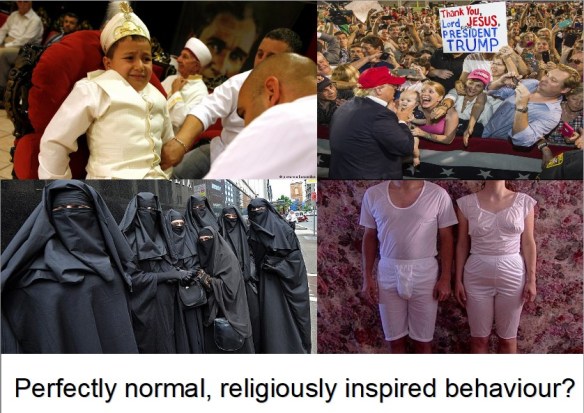
Islam is as irrational as Christianity and other religious belief systems. It is as legitimate to criticise and, when appropriate, to condemn Islam, just as it is Christianity. It is reasonable to question Muslim’s treatment of women, to insist it is inappropriate, particularly in a Western context. It is appropriate to oppose Muslims’ opposition to Western values rather to accede to their opposition to, for example, freedom of speech or the teaching of evolution and sex education in schools. It seems increasingly to me that in Britain we are conceding too much to Islam and to Muslims because we fear both the accusation of Islamophobia and, not entirely irrationally, a disproportionately aggressive response. Reasonable criticism of a belief system and those who subscribe to it is not hateful. We have a duty in a largely secular society to say so. To resist irrational belief in the supernatural when that belief, be it Christianity, Islam, Judaism or any other of the 4,200 religions human beings have dreamt up seeks to impose itself on others is neither hateful nor irrational. It is essential.

I‘d write more about Islam if I knew more about it. I’m disinclined to learn more, however, having already wasted much of my life in thrall to that other ‘great’ religion, the one I spend so much time deconstructing here. Who needs to know more about another? Saviours, Prophets, Gods, angels, signs and wonders – they’re all equally meaningless. Instead of claiming they’re victims of Christo/Islamophobia, religionists would do well to develop thicker skins as we ‘abominations’ and ‘perverts’ have had to do. They should ask themselves whether criticism of their practices and worldview is justified. They might just find it is.