Mystic Revelations

What do the three ‘great’ Abrahamic religions have in common?

They all started with visions, hallucinations, dreams and mystic revelations. They’re not only based on these but owe their very existence to encounters with the supernatural that took place entirely within people’s heads. This of course is if they happened at all; many of these encounters with angels and God’s revelations take place in stories that have all the characteristics of myth or legend. Even so, they reveal much about the primitive state of mind (still around today) that believed God frequently revealed himself to, and in the minds of, chosen individuals.

First, the grand-daddy of the Abrahamic religions, Judaism: 

When Abram was 99 years old, YHWH appeared to him. He said to Abram, “I am El Shadday. Live in my presence with integrity. I will give you my promise, and I will give you very many descendants.” Immediately, Abram bowed with his face touching the ground, and again Elohim spoke to him, My promise is still with you. You will become the father of many nations. So your name will no longer be Abram [Exalted Father] but Abraham [Father of Many] because I have made you a father of many nations. I will give you many descendants. Many nations and kings will come from you. I will make my promise to you and your descendants for generations to come as an everlasting promise. I will be your Elohim and the God of your descendants. (Genesis 17)

Then Moses:

The Angel of YHWH appeared to (Moses) in a flame of fire from the midst of a bush. So he looked, and behold, the bush was burning with fire, but the bush was not consumed.

Then Moses said, “I will now turn aside and see this great sight, why the bush does not burn.”

So when YHWH saw that he turned aside to look, Elohim called to him from the midst of the bush and said, “Moses, Moses!” And he said, “Here I am.” (Exodus 3)

Notice how the inner voice goes from being that of ‘the angel of YHWH’ to YHWH himself (or one of his aliases). The entire scenario is preposterous of course, as is the Abraham episode before it. I’ve omitted the other occasions YHWH is said to appear to Abraham, including the infamous Genesis 22, where YHWH instructs Abraham to sacrifice his son. These stories are legends written, created from whole cloth, centuries after Abraham purportedly lived. He, like the later Moses, is almost certainly mythical, a character created to represent the beginnings of the Jewish faith. Even his names are symbolic. In truth, no one knows how Judaism began.

Onto Christianity:

The angel said to (Mary), “Don’t be afraid, Mary; God has shown you his grace. Listen! You will become pregnant and give birth to a son, and you will name him Jesus. He will be great and will be called the Son of the Most High. The Lord God will give him the throne of King David, his ancestor. He will rule over the people of Jacob forever, and his kingdom will never end.” (Luke 1)

Did this happen? If you believe angels exist then possibly, but we know they do not. We also know that this is myth. However, Luke wanted his readers to know that Jesus’ birth was miraculous so invented a story in which Mary encounters a heavenly being. The gospel writer anchors the divinity of Jesus to an implausible event which at best can only be a young woman’s vision (though it most certainly isn’t.)

The same is true of the resurrection appearances. Here’s Matthew 28:1-8:

Now after the Sabbath, as it began to dawn toward the first day of the week, Mary Magdalene and the other Mary came to look at the grave. And behold, a severe earthquake had occurred, for an angel of the Lord descended from heaven and came and rolled away the stone and sat upon it. And his appearance was like lightning, and his clothing as white as snow. The guards shook for fear of him and became like dead men. The angel said to the women, “Do not be afraid; for I know that you are looking for Jesus who has been crucified. He is not here, for He has risen, just as He said.”

More angels (they multiply in later gospels); again at best, though still highly improbable, the angel(s), if seen at all, can only be a vision or an hallucination (or mistaken identity.)

Onto the only first hand account of an encounter with the divine that the bible includes, Paul’s:

God was pleased to reveal His Son in me so that I might preach Him among the Gentiles… I want you to know, brothers and sisters, that the gospel I preached is not of human origin. I did not receive it from any man, nor was I taught it; rather, I received it by revelation from Jesus Christ. (Galatians 1)

I know a man in Christ who fourteen years ago—whether in the body I do not know, or out of the body I do not know, God knows—such a man was caught up to the third heaven. And I know how such a man—whether in the body or apart from the body I do not know, God knows— was caught up into Paradise and heard inexpressible words, which a man is not permitted to speak. (2 Corinthians)

This is all there is. This is the extent Paul talks about his heavenly encounters. In Galatians he admits that God revealing whatever it was he revealed was ‘in’ him, that is, in his own head. The bizarre tale he relates in 2 Corinthians reads like an hallucination (Paul says he doesn’t know whether it was in the body or out of it) which is all it could’ve been; there is no paradise or ‘third heaven’.

And finally, there’s Mohammed:

while I was sleeping last night, the keys of the treasures of the earth were brought to me till they were put in my hand.”… 

The angel came to him and asked him to read. The Prophet replied, “I do not know how to read. The Prophet added, “The angel caught me (forcefully) and pressed me so hard that I could not bear it any more. (Sahih Bukhari 6998)

Encounters with heavenly beings in dreams, ‘revelations’, visions, hallucinations and invented stories: these are central to Judaism, Christianity and Islam. The religions would not exist without them. Written as myth long after they supposedly occurred or referred to obliquely by those who claim to have experienced them, they are the products of fevered pre-scientific minds.

Post-script: I’ve searched in vain for Darwin’s admission that an angel revealed the process of evolution to him. I can only find his collection of evidence, his scientific observations and his careful analysis of his findings. Likewise Mendeleev who calculated the existence of elements that were at the time unknown. Likewise Crick, Watson and Franklin who discovered the structure of DNA. Strangely, none of these people relied on visions, dreams or divine revelations in uncovering truths about reality.

Featuring the Battle of the Century! Doomsday v. Panacea!

Human beings love doomsday scenarios. We have perpetually convinced ourselves that the circumstances in which we live are the most dreadful ever and, to quote The Beatles, can’t get no worse, The earliest Christians thought it: things were so bad that the end was surely to come. YHWH would tolerate the awful state of affairs no longer. But to the surprise of no-one he did.

Those alive in 17th century Europe couldn’t conceive of a worse time, what with the plague and all, and persuaded themselves that the world was ending. During the Covid lockdown we were told that the human race faced being annihilated by the virus and that whatever we’d previously regarded as normal would never return. Today we’re assured that the planet faces extinction if we don’t stop using fossil fuels. At the same time others claim that democracy/the West/civilisation are in such decline that the world will soon disintegrate into anarchy. Who knows, perhaps one day one of these modern doomsday scenarios will come to pass. Even a stopped clock is right twice a day.

Equally though, we are adept at devising panaceas, universal remedies to our problems. We have an unshakeable belief that by making a few simple changes – a new government/president/policy/ invention/initiative/innovation – we will avert disaster and resolve the challenges we face.

How have the panaceas of the past fared? The Jesus’ cult’s promises of new life and heaven of earth collapsed in the first century when God failed to rescue those who identified as his Chosen Ones from the wickedness that surrounded them. Nevertheless, Christianity bullied its way on to the present day, still offering the same tired solutions to age-old problems. Religion, in all its forms, only makes matters worse.

Revolution is no solution either, as the socially aware songs of the 1970s advised us. The French, American, Russian and Chinese revolutions changed situations but they didn’t usher in an age of peace and prosperity or remedy everything their instigators said they would. History demonstrates again and again that violence fails to improve anything. The freedom and independence that the Baltic states now enjoy came not from revolution but from the foresight of Mikhail Gorbachev who knew Russia could no longer afford to sustain its satellite states. Putin however knows better and seeks to reabsorb them back into his own soviet union.

Other panaceas of the past have similarly failed to deliver. The so-called industrial revolution created our modern world, led to the end of slavery and gave us the standard of living those of us in the West enjoy. Now we must deal with what many perceive as its legacy: world pollution, climate change, dwindling resources. Eliminating these is the new panacea. Once these challenges have been met, or so we’re told, the world will find itself on a much better footing, on course to recover from the damage we’ve caused it. Hence Just Stop Oil and Extinction Rebellion. It’s as simple as that. Except we know that surely it isn’t when the biggest polluters – China, Russia, India and potentially the US (Trump says he will pull out of climate change agreements if returned to the White House) – are not wholly on board.

We are a very long way from eliminating the use of oil: for a long time to come it will be needed to lubricate machinery, engines and windfarms, and for the production of plastics (a panacea in their own right not that long ago), computers, mobile phones and building materials. That’s not to mention the need for oil in the nation’s defence: the navy’s ships, the air force’s planes and the army’s tanks. We do not yet have the means of replacing the oil which fuels and lubricates modern life. We can be sure too that when we do, this new panacea will also have its own drawbacks, which will only become apparent once we have committed to them. We know this already with nuclear power which, once fossil fuels are eliminated, will be the principal means of producing electricity in the enormous quantities required to supply to industry, for heating, lighting and transport, including electric cars, which, if politicians have their way, will be the only kind available. We are already using environmentally-damaging methods’ to extract the rare minerals used for the manufacture of batteries, a process which also, ironically, creates more CO2 than the manufacture of a petrol car (itself a panacea not too long ago): According to MIT’s Climate Lab, one ton of mined lithium emits almost 15 tons of CO2’.

While there are those who claim that EVs cause less environmental damage than petrol (gas) vehicles, damage is still damage. It is not net zero. The dream of worldwide net zero is impossible. The only way it is even approachable is for the car and other forms of transport to disappear altogether – and we all know that isn’t going to happen. Even  hypocritical eco-warriors use the car and other forms of transport dependent on fossil fuels to get themselves to whichever work of art or ancient monument they plan to deface. 

China, which produces two thirds of the world’s electric car batteries, accounted ‘for 95% of the world’s new coal power construction activity in 2023.’ Then there’s the disposal of spent batteries: do we have policies for doing that in an environmentally friendly way? Is there an environmentally friendly way?

As you can probably tell, I’m not a believer in panaceas, whether religious or politically devised. They don’t work and never have. In years to come, the West will be wringing its hands at its plundering of the Congo for cobalt and South America for lithium for electric car batteries. ‘How could we get it so wrong?’ we will cry. ‘There must be a better way, a better panacea. Meanwhile, we must do penance and make reparations.’ I don’t have the answers, but extremist approaches like the half-baked schemes of Ed Miliband, the UK’s Secretary of State for Energy Security and Net Zero (yes, really), and pursuing impossible dreams do not seem to me to be the solution.

Respect

Even before the events in Israel and Gaza, there were numerous recent examples of the term Islamophobia being used to suppress freedom of expression or shield wrongdoing.

A recent report by an all party group of UK MPs.

I’ve been told before that I should respect people’s religious beliefs. We all should apparently.

I can’t, I confess, summon respect for patent nonsense, nor for those who subscribe to it. I’m not even going to try.

There have, I admit, been a few believers I’ve met in life for whom I have had respect and even admiration, but this has been for the kind of person they were, not because of their religious beliefs per se. And no; their religion is not what made them admirable people. They were admirable irrespective of, or even despite, their irrational beliefs. I still hold to the theory of my own making, that religious conviction is like alcohol: both accentuate the existing characteristics of the individual, making them more of the person they already were, for better or for worse.

Equally, I’ve met many non-believers (I hate it that we have to describe ourselves as what we are not), LGBT people (for many religionists, the antithesis of admirable) and individuals whose views and outlook on life I haven’t necessarily agreed with, for whom I have also had respect and admiration.

It comes down to the old cliche, a truism nonetheless, that respect has to be earned. Just because someone believes in the supernatural or that Jesus died for our sins or that their deity or prophet trumps all others doesn’t mean I have to respect such views, or indeed those who hold them.

But this is where we’re headed, it seems. We’re expected to respect any old make-believe so long as it comes under the banner of religion and still more that doesn’t. It’s becoming ‘hateful’ to criticise religious belief and those who practise it. Because their views are sincerely held, the thinking goes, they merit protected status.

I commented some time ago on a Christian site (something I rarely do except when incensed) that was insisting ‘sodomites’ would burn in hell, because… the Bible. I countered that gay people were not going to hell because, in fact, no-one was. As well as the subsequent ‘loving’ comments from Christians, I was taken to task by a gay person telling me I was disrespecting the original poster’s Christian convictions.

Likewise when I suggest that we should be more wary of Muslim beliefs I’m told I’m being profoundly unfair, racist and Islamophobic, towards a minority – as a minority of one myself – and I should show more respect for an ancient and sacred tradition as well as those who subscribe to it.

I can’t do it. I can’t respect religious belief. It is no more worthy of respect than astrology, palm reading and spiritualism. It flies in the face of rationality. Not only is it insupportable, it is dangerous, a threat to hard-earned freedoms and rights.

Who Decides What A Culture’s Values Are?

Did you decide? Would you prefer to live in culture based on Christian, Islamic or Marxist values? According to some Internet Christians, these are the only choices available. Of course anyone with an ounce of sense and a modicum of honesty knows they’re not.

I choose to live in a society that is not dominated by cherry-picked Christian values, or indeed ‘values’ derived from any religion. I reject the claims of them all, including their demonstrably false notion that I and my fellow citizens cannot behave ourselves unless controlled by a morality imposed by an imaginary deity. Likewise, I don’t care to live in a culture determined by an extreme political ideology that serves only one part of society: usually the elites who devise the ideology in question.

Instead I choose, or rather was fortunate enough to be born into, a relatively liberal democracy, capable of determining its own values. These are largely secular and humanistic and include, amongst others, the rule of law, tolerance, and freedom of speech and movement. Of course the UK has never fully realised these aspirations but there has always been a sense, since the 1960s, that we were moving towards them. Perhaps I’m naive to think this, given the turbulence of the Thatcher years and President Blair’s mania for regulation, but overall it used to feel that we were moving gradually towards a fairer, more reasonable society.

It doesn’t now. The elites have embraced a wokeness that benefits a limited few and have redefined terms – ‘woman’, ‘crime’, ‘offence’, ‘hatred’ and ‘phobia’ among them – which has impacted negatively on personal rights and freedoms. They have reinterpreted the law so that it benefits vocal minorities while side-lining the majority. They have repeatedly reneged on promises and over-reacted to the crises of recent years – Covid in particular – by granting themselves greater powers to manage their own over-reaction; powers which, once each crisis has passed, they have declined to relinquish. The values of Britain today, as imposed by the governing classes, are overly woke and authoritarian. In my 68 years, I have never felt as micro-managed in my personal life as I do today.

So, I do understand why there are those who call for the return to what they perceive as Christian values or a cultural Christianity of church bells and hymn singing. I understand too the fear of some that the waning of Christian influence will see extreme Islamic values fill the vacuum. This seems to me to be a real possibility and one that would prove seriously detrimental and damaging to British society. However, attempting to resurrect nebulous ‘Christian values’ in order to prevent more intolerant ones from being imposed is no solution.

We need to be clear about our values and assert those we aspire to: tolerance, liberalism, democracy, freedom of speech, rights for all, equality under the law and, I would add, truthfulness, honesty, fairness, consideration and reasonableness. For a time, this may very well involve being intolerant of intolerance, whether derived from Christianity, Islam, wokeism or political ideology. In particular, we need to stop conceding ground to Islam and resisting the demands of Muslim activists when they conflict with the values and aspirations of the majority.

Perhaps none of this will matter to me, given I’m not going to be around for many more decades (if that). But I would like the Britain my grandchildren grow up in to be one that reflects humane, secular values. I fear for them that it might instead operate on the basis of oppressive, intolerant religious ones.


free speech

Religiophobia?

Is criticising Christianity and the way some people practise their religion a form of Christophobia? Strictly speaking a phobia is an irrational fear of whatever precedes it, as in homo-phobia, trans-phobia, Islamo-phobia and the like. In the accusations of whatever-phobia we hear today – and they invariably are accusations – ‘phobia’ seems to have come to mean ‘hatred of’; a hatred of Christianity and therefore of Christians; of homosexuality and therefore of gay people; of trans-people; of Muslims and so on.

Reasonable criticism of belief systems is not hatred. I don’t and am sure I never have had a hatred of Christianity or of any other religion. I certainly have views about Christianity as a seriously flawed, cock-eyed superstition (I hope I’m not giving my position away too early.) Reasonable criticism of it, mockery even, is perfectly legitimate, for reasons I’ve outlined before, just as criticism and mockery of any belief in the fantastic is legitimate. Ideologies based on belief in imaginary beings do not automatically merit respect nor do they have a de facto immunity from criticism. The same applies to those who subscribe to such fantasies, particularly when they attempt to force them on others. Calling out believers on their inconsistencies and hypocrisy is perfectly reasonable.

Is it fair then to express critical views of homosexuality and by extension of gay people? Of course. We are not immune from reasoned criticism, though much of it doesn’t qualify as ‘reasoned’; we have suffered much from emotional reactions to our existence and still do. (See Bruce’s recent post in which Republican North Carolina’s lieutenant governor, Mark Robinson rants about godless homos. When comment deteriorates into vitriol it becomes an incitement to hatred and, sometimes, violence. When this happens, the modern sense of phobia is justified.)

Islam is as irrational as Christianity and other religious belief systems. It is as legitimate to criticise and, when appropriate, to condemn Islam, just as it is Christianity. It is reasonable to question Muslim’s treatment of women, to insist it is inappropriate, particularly in a Western context. It is appropriate to oppose Muslims’ opposition to Western values rather to accede to their opposition to, for example, freedom of speech or the teaching of evolution and sex education in schools. It seems increasingly to me that in Britain we are conceding too much to Islam and to Muslims because we fear both the accusation of Islamophobia and, not entirely irrationally, a disproportionately aggressive response. Reasonable criticism of a belief system and those who subscribe to it is not hateful. We have a duty in a largely secular society to say so. To resist irrational belief in the supernatural when that belief, be it Christianity, Islam, Judaism or any other of the 4,200 religions human beings have dreamt up seeks to impose itself on others is neither hateful nor irrational. It is essential.

I‘d write more about Islam if I knew more about it. I’m disinclined to learn more, however, having already wasted much of my life in thrall to that other ‘great’ religion, the one I spend so much time deconstructing here. Who needs to know more about another? Saviours, Prophets, Gods, angels, signs and wonders – they’re all equally meaningless. Instead of claiming they’re victims of Christo/Islamophobia, religionists would do well to develop thicker skins as we ‘abominations’ and ‘perverts’ have had to do. They should ask themselves whether criticism of their practices and worldview is justified. They might just find it is.

So it begins…

Jesus Lazes

A true story:

They didn’t see it coming. No-one did. It couldn’t have been predicted. He came into their lives unexpectedly one summer evening and none of them would ever be the same again.

He met Maddy first, then Andrew and soon after that the rest of the group. He was quiet, diffident even, but from the start his personality shone, his smile captivating them all. Some fell in love with him immediately, others later but either way, there was no escape. His zest for life was infectious, his gentle, thoughtful ways drew in all who encountered him. He didn’t demand change or presume to tell them how they should live, but his unaffected presence changed them all and added immeasurably to each of their lives.

And so the cult of Salvatore began, in the way that all cults begin, with a charismatic personality. When that individual seeks to manipulate and control others, particularly if he or she has Messianic aspirations, then before long an agenda emerges: unquestioning obedience; the belief that only this leader has the Truth; the demand that acolytes abandon family, friends and society for the cause; the proselytising to increase followers; the expectation that others acknowledge the leader’s power and glory; the rejection of those who fail to do so. This is how it was with Jesus, Muhammed, the Buddha, Joseph Smith, Mary Eddy Baker and so many others

The Salvatore cult won’t come to this; the man himself is neither controlling nor manipulative, though there are those who would do anything for him. Myself included.

Theology: Much Ado About Nothing

Toothfairy2

I heard Richard Dawkins speak at the Edinburgh Book Festival recently. He suggested that the best way to understand views that are the opposite of one’s own is to study them for oneself. He was then asked by a smart-alec in the audience, that if this was so, how many works of theology he had read. Dawkins responded by saying he wouldn’t waste his time reading ‘pure theology’ because, in discussing the nature of God or the Trinity or the mechanics of the Resurrection, theology presupposes that the supernatural is real. As there is no evidence it is, there is no point in reading books the sole purpose of which is to discuss the nuances of the non-existent.

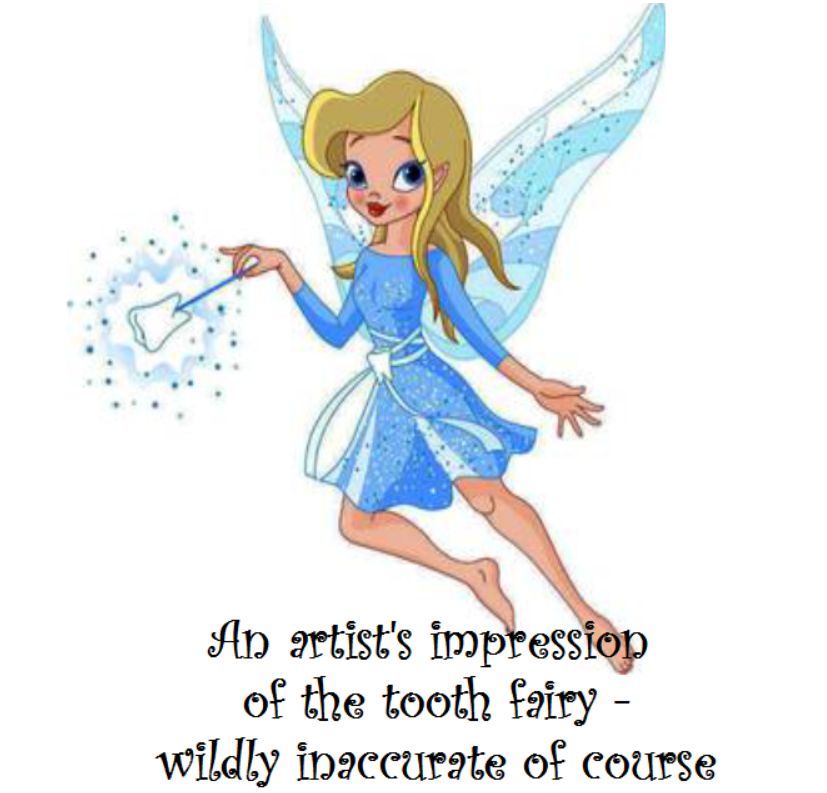
It was a good answer. There is no such thing as intellectual Christianity (or Judaism or Islam, or any religion.) No matter how complex the arguments become, they are essentially ones about nothing. Debates about theological matters, within and between the many versions of Christianity, are, as I’ve said before, as relevant as arguments about the colour of the tooth fairy’s dress.*

*Actually she wears a white dress to symbolise healthy teeth. I know this because of my deeply held faith and personal experience of tooth fairies.

It all comes down to feelings and subjective experience

Faith4

Argue with Christians (Hi there, Jim! Hi there, Don!) about the veracity of their faith and they will tell you it’s true for two reasons: the Bible and their own personal experience. ‘Christianity is true and Jesus is real because the Bible says so – and, whatsmore, I feel it.’

Or, as William Craig Lane likes to put it, the inner witness of the Holy Spirit testifies to the truth of Christianity. It’s a beautifully circular argument: ‘Christianity and its holy book are true; I know this because the Holy Spirit who lives in me tells me so; I know the Holy Spirit lives in me because the Bible says he does; therefore, I know Christianity and the Bible are true because the Holy Spirit tells me so’.

But equally, Mormons claim that they ‘know’ a completely different set of improbable beliefs are true because they experience a ‘burning in the bosom’ that tells them so. Roman Catholics say their faith is true because they experience Christ through the Eucharist, while Muslims know theirs is true because they have a real sense of Allah’s presence.

All of these spiritual convictions are not, as a liberal theologian like Karen Armstrong might claim, evidence that there is Something-Out-There that loves and communicates with us, but more obviously that human beings’ brains are adept at creating whatever ‘inner witness’ is required to support the beliefs and convictions they have arrived at. William Lane Craig concedes this when he acknowledges that

Anyone (or, at least any sort of theist) can claim to have a self-authenticating witness of God to the truth of his religion. But the reason you argue with them is because they really don’t: either they’ve just had some emotional experience or else they’ve misinterpreted their religious experience.

In other words, any experience of ‘self-authenticating witness’ enjoyed by believers in faiths outside Craig’s own brand of Christianity is at best mistaken, at worst fake. But then, how can anyone know, Craig included, that his own conviction isn’t just as much an emotional flush or mere subjective experience? Why is his conviction any more real than that of other kinds of believers? Ultimately, Craig can only say, “because it is”:

a person (possessed by the Holy Spirit) does not need supplementary arguments or evidence in order to know and to know with confidence that he is in fact experiencing the Spirit of God.

In other words, the true believer knows his experience of the Holy Spirit is real because his experience of the Holy Spirit tells him it is. And round the argument goes, though no amount of assertion makes a subjective experience an event in objective reality.

It is impossible for Craig, or any other Christian, to demonstrate that an entity he imagines inhabits his brain, no matter how convincing its presence may seem, has any existence anywhere other than in his brain. What the person who says ‘I believe’ is really saying is that they have no evidence at all for what they are claiming. If they had, they wouldn’t need to believe it; they would know it. They would, whatsmore, be able to point to independent, external evidence for it.

The Bible makes a virtue out of not knowing, of believing when there is no evidence.  It calls the resulting cognitive dissonance, ‘faith’.

Adapted from my book, Why Chrisitans Don’t Do What Jesus Tells Them To …And What They Believe Instead.

I Know What It’s Like To Be Dead

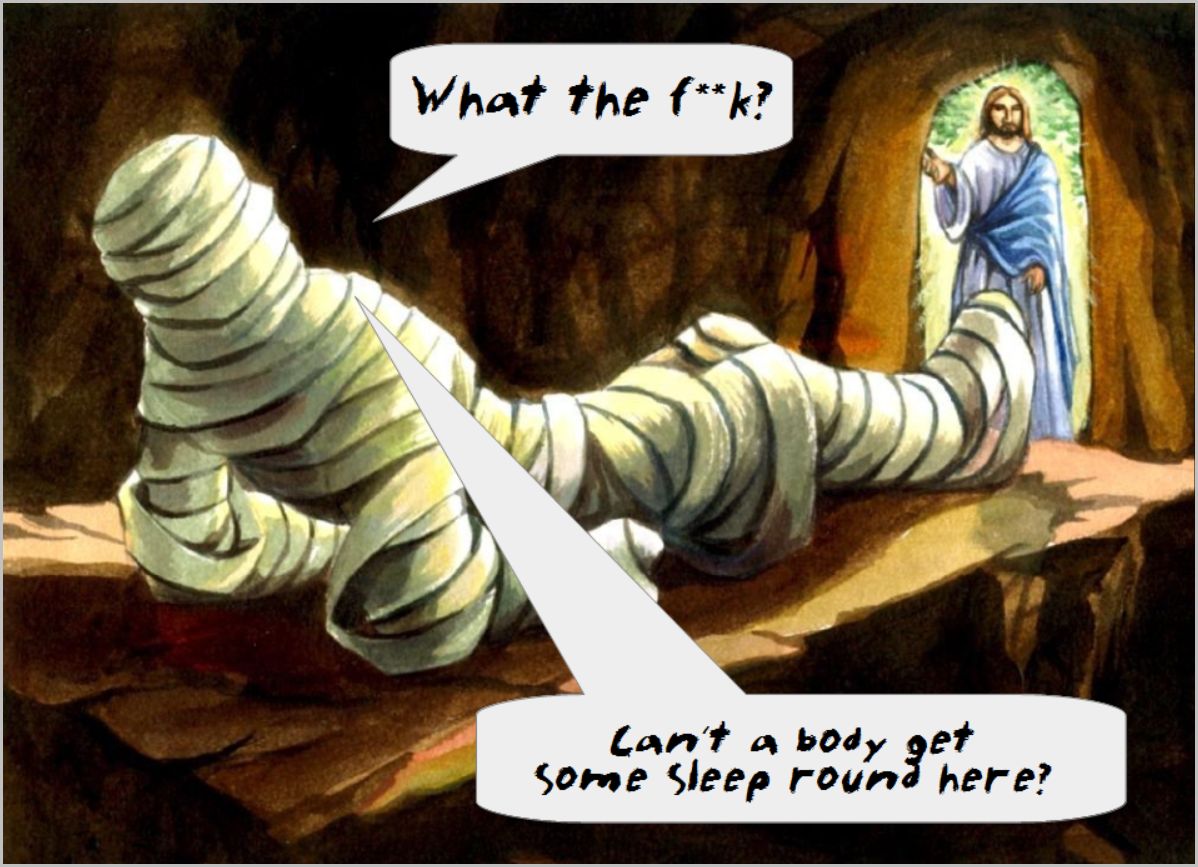
lazarus

And you do too.

We experienced what it was like last night and, you know, it really wasn’t too bad.

We entered, at some point, a deep, dreamless sleep (we dream for only a quarter of the time we’re asleep and even then often can’t remember what we’ve dreamt about) and the rest of the time we were, as far as subjective experience was concerned, dead to the world. During that deep sleep, our conscious mind was completely switched off; we did not experience anything while we were in this state and as far as awareness is concerned, we did not exist. And when we woke this morning we were none the worse for our period of non-existence. We booted up reasonably satisfactorily and the memories we had yesterday, before our deep sleep, were restored and the entity we call our self began to interact with the day.

This period of deep sleep, this unconscious oblivion, is precisely what it is like to be dead. Of course, in death we switch off permanently; there’s with no reboot afterwards, either in our beds, our graves or in heaven. The oblivion that is death is permanent. But, and this is my point, being dead is no more painful or unendurable, and no more to be feared, than the deep sleep you had last night and that you will enjoy tonight. We might not much like the idea that once we fall into the ultimate sleep there will be no waking up, but that is only a concern, if it’s a concern at all, of the living. I guarantee that it does not cross the minds of those who are already dead. They have no minds, the same as you didn’t last night, for it to cross.

Being dead, to paraphrase Mark Twain, does not trouble us at all. Its prospect, while we remain on this side of it, should encourage us to enjoy life and live it to the full. It shouldn’t cause us to worry about being dead, because there’s nothing we can do about it and, in any case, it’s no worse than being in deep sleep. Nor should we be concerned about whether we’ve subscribed to the right incantation, appeased the right God in the right way or lived a good enough life, in order to avoid death. There’s no avoiding death and the promises of religions that we can if only we believe the right magic, are utterly false. Understandable perhaps, but false.

Oh death, where is thy sting, says Paul in 1 Corinthians 15.55. Well, death still has its sting. It has it in its inevitability – every organic creature, of which we are one, must die – and it has it, depending on your perspective, in our individual obliteration. (Though, frankly, why anyone should think their own personal bundle of thoughts, impulses and prejudices merits everlasting existence is a mystery). Most significantly, however, it has it in the dying process, which for many of us can be debilitating and painful. This is the way of it for all of us, including those who believe religions’ false promises. They are not spared the suffering, even though modern medicine can help alleviate much of it. Christians, Muslims and Hindus, despite their belief that a deity smiles benevolently upon them, are not guaranteed a comfortable passage from this life to non-existence.

Death is the great leveller; we all experience dying in much the same way and we none of us experience anything after it. One of these – maybe both if we’re lucky – isn’t too bad. Just like deep sleep in fact.

Until then, we should make the most of life while we still have it.

Sleep well.


Rejecting Jesus the Christian way

jesus2

I’m sometimes taken to task for pointing out that Christians don’t make much effort to live as their saviour says they should. The title of my first book, Why Christians Don’t Do What Jesus Tells Them To …And What They Believe Instead sums it up. Since the very beginning, believers have replaced the radical commands attributed to Jesus with mythology, mysticism and magic formulae, none of which he’d recognise and all of which are far less demanding than going the extra mile, turning the other cheek and loving enemies. So today, when confronted with what Jesus says is expected of his followers, believers are inclined to say, ‘what right have you to tell us how we should be living?’ to which the answer is, ‘it’s not I, nor any other commentator, who tells you how to live; it is your Lord and Saviour. All we do – all I do – is remind you of what that is.’

Christians don’t like this, primarily because they don’t like what Jesus commands – it’s too exacting, too radical, too impractical – and they want to go on disregarding it. It’s damned annoying being reminded of it and being challenged on how far they are from complying with it.

Have those of us who point out Christians’ failings any right to do so? Well, of course. Christians spend their time judging, castigating and condemning others and as Jesus himself points out, judging others leads to being judged in return (Matthew 7.1-5). He sees this as something of a natural consequence, a yin for a yang. But ‘judge not that ye be not judged’ is another of his commands his followers like to ignore. Even so, if Christians are going to insist on pointing out the speck in others’ eyes, they must expect others will have something to say about the plank in theirs. That’s the way it works – Jesus says so.

So, Christians, if you don’t like me and others challenging you on how far you fall short of your Lord’s expectations maybe you need to lay off atheists, LGBT people, those you consider to be sinners, those of other faiths and even fellow Christians you think haven’t got the right theology. Put your own house in order first and then maybe we’ll listen to you (or maybe not). But don’t say we’ve no right to look at how far you measure up to Jesus’ standards. We’ve every right to ask whether the so-called Salt of the Earth (Matthew 5.13) has any of its flavour left.