What Christians Believe: Part One

A very special guest post by Thea Lojan.

PilateThe Creed

I’m very pleased to have this opportunity to share my testimony with you and give you an idea of what I and millions of other Christians believe. We call this the Apostles’ Creed and it goes like this:

I believe in one God. Actually no… three. Three Gods. One really, but he’s like three, a buy-one-get-two-free kind of God. Yes, okay, he says he’s the one and only God back in the Old Testament, but that’s before he knew he was really three. This doesn’t make him/them anything like those collections of ancient Greek Gods, though, because he’s still only one God really. That’s what’s called the Trinity and I hope I’ve made it clear for you .

Anyway, I believe in one God and in two others besides, creator, or creators, of Heaven and Earth. Yes, he/they definitely did this even though scientists think the universe was created billions of years before the Bible says it was and that God probably wasn’t even involved. But these scientists are all anti-Christian, that’s why they say that. If you have faith you know that of course God was involved. Other people who are also anti-Christian just out of spite say that if God made the Earth and all that is in it therein, then he must’ve made parasites and poisonous bugs and harmful bacteria and disease. But I’ve an answer to all that. Just don’t think about it.

And I believe in Jesus Christ, his only son, our Lord. Yes definitely this, even though Jesus says he’s not really anything like God’s son in three of the eye-witness accounts of his life in God’s Word. I expect he was just a bit muddled when he said this, being away from home and down here instead of up in Heaven with his Heavenly Father. He probably meant to say he was God’s son because it’d be too weird if he really was God’s Son and didn’t know it. We should be grateful to those people who came after him who realised exactly who he was.

And then there’s that bit somewhere about him being ‘begotten not made, of one substance with the father’, or something, which I think means he was more than God’s son. That he was, like, God himself. You’d think he’d remember that, wouldn’t you, when he was down here on Earth. What confuses me though is, if he was God, then who was he praying to all those times? I can’t get my head round that. But anyway, it’s a good job there were even more people who came after him who knew better than him and could tell he really was God.

He was conceived by the Holy Spirit, born of the Virgin Mary. Well, you’ve got to believe this haven’t you, even though some people say ‘virgin’ should really just say ‘young woman’. A young woman might or might not be a virgin, especially if she wasn’t a Christian to begin with. It does make me wonder that if she was pregnant then it’s more than likely Mary wasn’t a virgin, ’cause we all know how babies get made. Still, if God’s Word says it was the ‘Holy Spirit’ that was the father then that’s what we should believe. If you want to know more about the Holy Spirit that can make people pregnant, well, we’ll get to it soon.

He suffered under Pontius Pilate, was dead and was buried. He descended into hell and on the third day he rose again. I think a bit got missed out here – all the stuff Jesus said and did in between being born and suffering under Pontius Pilate. Isn’t that important? You bet it is. Pontius Pilate, by the way, was a Roman perculator who worked for Julius Caesar. I can’t find anything about Jesus ‘descending into hell’ in my Bible but I suppose it must be right. I definitely believe though that after three days and nights in the tomb he rose again from the dead. I mean, that’s a really important bit. I know he wasn’t in the tomb for a full three days and nights, even though he said he would be, but a day and a half is close enough. I guess that’s why we say ‘on the third day’ instead; it sounds like three days when it was only a day and half. But, you know, Friday night till Sunday morning – it’s legit to say ‘on the third day’.

And we know he rose from the dead because Saint Paul said so – he saw him himself, in person. Well, not exactly in person but in his head. He was like an amazing flash of light in Paul’s head, a bit like an epileptic event, except, you know, like really real. And then other people started seeing him but not in their heads, as a real person, but one who could walk through walls and disappear if he felt like it. Totally real. Amazing.

I’ll be back next time to tell you what else Christians believe. In the meantime, keep praising the Lord!


Thea was talking about the Apostles’ Creed, though she also mentions the Nicene Creed. The Apostles’ Creed was created prior to 390CE and the Nicene Creed in 325, both quite a bit after Jesus’ lifetime. Three hundred years after, in fact.

Oh, and Pontius Pilate was a Roman procurator or prefect during the reign of the Emperor Tiberius.

No True Christian

WeekendA favourite response of Christians to any criticism is, ‘it doesn’t apply to me. I’m not that sort of Christian. The people who do or believe or think those things are not true Christians.’ This the ‘no true-Scotsman‘ fallacy.

  • You get it when you point out how God’s People™ agitate in Africa and Europe to deprive LGBT people of rights, protection and safety (unless of course you’re talking to a Christian who thinks this is a loving thing to do.)
  • You get it when you challenge Christians about Westboro baptist church’s activities, (the latest of which is claiming that Ebola is God’s punishment for Obama, which must be why he’s smiting poverty-stricken Africans.)
  • You get it when you mention those Christians who believe mumbo-jumbo that’s slightly different from theirs.
  • You get it when you ask them about any of the other deplorable things Christians do in Jesus’ name.

‘These other people are not true Christians,’ they say. ‘Their theology isn’t the same as mine; they’re misinterpreting the Bible; I wouldn’t do those kind of things; you’re picking out extremists.’

And do you know, Christians, those very people you say are not true Christians would say the same about you.

So what defines a Christian? Isn’t it that you accept Jesus Christ as your Lord and Saviour, profess him as such, and avail yourself of the salvation you think he offers?

Indeed it is. And it’s precisely this that you have in common with the Westboro baptist church, with those who peddle the absurd, with those who seek to damage LGBT people, with those who use their positions to abuse others and those with different ideas about what being a Christian is really all about.

You and they have bought into the same fantasy: they, like you, have accepted Jesus; they, like you, have his Holy Spirit in their hearts. That they do things you don’t approve of, or regard as embarrassing or despicable, doesn’t alter that fact. You’re all in it together; they represent Jesus just as much as you do; are as much a part of the ‘bride of Christ’ as you are. The zealots, extremists and wackos are your brothers and sisters in Christ, and if you’re right about Jesus being your Saviour – which of course you’re not; I’m being generous here – you’re going to be spending all of eternity with them.

So time to knock the ‘no true Christian’ excuse on the head – it’s going to be so embarrassing for you when you get to heaven.

Is This It?

AlphaI was disappointed that my local church, when advertising the Alpha Course this year, didn’t use its usual poster. You know the one – and if you don’t it’s like the one above – that asks ‘Is this it?’, meaning both, ‘Is this all there is to life?’ and ‘Is this life all there is?’ Every year, I so much want to answer the question by scrawling ‘Yes’ on the bottom of the poster. I don’t, of course, because I’m too law-abiding to deface someone else’s property. But ‘yes’ really is the answer to the question ‘Is this it?’ and to the other two questions it suggests. This life is all there is. What you make of it is also ‘all there is’ (so better make the most of it).

Of course, the Alpha Course and Christians in general want to persuade you that this life isn’t all there is, that a better life awaits you after death. They want to tell you too that there’s a life that’s better than the one you’re currently living, however interesting, challenging, fulfilling or unhappy that might be. All you have to do to have this better life – and have it last forever – is to give yourself to Jesus. Oh, yes, and sign up for the Alpha Course too, of course.

Will your life really get better if you decide to believe in a mythical figure who magically sacrificed himself to himself to save you from yourself? It might, but not because you’ll have bought into this particular delusion. If it happens at all, life will be better because you’ll have become a member of a community (a church) and will enjoy the support of others who share the delusion. It might seem better too because your church will tell you what to think about particular issues – morality, abortion, homosexuality, evolution, for example – and you will be freed, should you want to be, from the burden of thinking for yourself.

But your life will not assume any cosmic significance, because nothing human beings do, say or believe ever has cosmic significance. Humans, whatever your church or the Alpha Course tells you, simply do not have cosmic significance. So, your decision to follow Christ won’t mean you’ll live forever (because, however much they might wish it, human beings don’t live forever.) It will not transform you into a ‘spiritual creature’; won’t make you beloved of the Creator of the universe; won’t transform you into the likeness of the mythical Christ. You will not have a hot-line to either the Creator nor to this Christ and so you won’t find them answering your prayers. You will not be part of any cosmic battle between God and the devil. You will not have God’s Son or the Son’s Spirit (which is it, Christians?) coming to make their home in you. You will no more be living in the End Times than you were before your conversion and the world will, though you will fail to recognise it, make even less sense than it does now.

What Christianity offers is pure fantasy, the same sort of fantasy that Mormons, Muslims, Moonies and all manner of other religious believers claim as their Truth. The only difference between your fantasy and theirs will be in the detail. Of course, as a Christian you’ll be told that your set of superstitions is the real and only Truth and that all of the others are false (or the lies of the devil, or whatever.) But in reality, yours will be just as absurd, just as impossible, just as disconnected from reality as theirs. And, what’s more, you’ll go on facing the same problems, the same joys, the same pain, the same short lifespan and the same opportunities that your culture offers you, that you’ve always had.

So give the Alpha Course a miss. Give Christianity a miss. Give all religion a miss. Give anything that tells you this life isn’t all there is a miss too, because this IS all there is. And thank God for that.

What did you do today, God?

Duck

What have you achieved today? I finished some illustrations for a children’s book a friend has written. It’s a minor accomplishment, of course, but one I like to think hasn’t added to the sum total of suffering and misery in the world (though you might want to disagree.) There’s every chance that whatever you’ve done today has been productive and positive too. That is, unless you also happen to be a deity.

What are God’s accomplishments today? What has the Omnipotent, Omniscient and All-loving God achieved in the last twenty-four hours?

Has he, for example, eliminated Ebola, Aids or cancer, or even helped those sinful human beings who strive to develop cures for these terrible diseases (which we would be right in thinking God himself created in the first place)? Erm, no. He hasn’t. Ebola, Aids and cancer are still with us today, their cure and prevention a little closer only because of human endeavour.

Has he prevented any further brutal murders by those who claim to operate in his (alternate) name? Has he rushed to the assistance of Christians being persecuted in Syria and Iraq? Erm… that’s another no. You’d think he might, wouldn’t you, given that his own people are among the persecuted, but no. And given that ‘gentle and compassionate’ relief worker, Alan Henning, has today been beheaded by Islamic extremists, you’d be right to wonder just where God is. What does he spend his days doing?

Did he, then, decide that today was the day he’d let us know which of his many manifestations is the real him – Yahweh? Allah? Shiva? Ra? One of the myriad others? None of the above? No, he didn’t do that either. He left us in our ignorance about which of the many religions, groups and sects has got it right about him. He couldn’t find the time today to tell us who it is that worships the real him, and who it is who’s deceived. Just as he couldn’t for all of the days that have so far made up recorded time.

Maybe, however, he hasn’t had time to do this because he’s been too busy sustaining the universe; you know, winding up gravity and giving the Earth those little pushes it needs to make it spin. But of course, the universe doesn’t work like this. It needs no external power source to keep it going. Even if it was God who set the ‘laws of physics’ in motion at the beginning of everything (it wasn’t), they have been self-sustaining ever since. So, no, he hasn’t the excuse that he spends his days making sure everything is ticking over nicely.

Does he spend them instead empowering believers to move mountains, heal the sick, raise the dead and perform miracles even better than those of his ‘son’, just like he had Jesus promise? Not so’s you’d notice. In fact, not at all.

Oh dear. We really are running out of possible things for God to do. Despite the sometimes desperate state of the world, perhaps all of his time is taken up finding parking spaces for Christians and sorting out their career prospects. Perhaps he’s too busy directing the thoughts and words of his ‘chosen instruments’ (see my previous post) so they can express their hatred for non-Christians and gay people. Or maybe all of his energies go into inspiring those Holy Spirit led church services that ‘bless’ Christians but are no more than human emotion run riot. Alternatively, maybe he just spends his time being offended by everything and everybody. If these are his accomplishments over the last twenty-four hours, then, given all the things he could have been doing, doesn’t it all seem rather pathetic? This is all he can manage?

Of course not. All of the triviality, and all of the brutality, attributed to him is entirely human in origin and manifestation; the beheadings, the euphoria, the offence, the vitriol. All part of the self-delusion that is ‘faith’. There is no God doing all these things, no God who manifests himself in the operation of the universe, in human suffering or the pleasures and happy coincidences of life.

It’s possible, I suppose, that there is a god somewhere, one without any interest in human beings and life here on Earth, but then he’d be even more irrelevant than the impotent gods we’ve invented for ourselves.

As Ariane Sherin famously said, ‘There’s probably no God’, with the ‘probably’ looking ever more redundant.

Idiotic Stuff Jesus Said 4: Rivers Of Living Water

Or more precisely: Whoever believes in me, as Scripture has said, rivers of living water will flow from within them (John 7.38).

WoundMe: What does this even mean, this ‘rivers of living water’ stuff?

Christian: It’s a metaphor. Jesus means it symbolically.

Me: Symbolically, how? A metaphor for what exactly?

Christian: The wonderful life-giving message that is the gospel.

Me: Which gospel? Jesus’s or Paul’s?

Christian: Oh, you’re splitting hairs. They’re one and the same.

Me: They most certainly aren’t, but we’ll let that pass for now. So by ‘living waters’ you mean that death-obsessed, rag-bag of negativity that fails to deliver in any way? (See all previous posts).

Christian: Well, I wouldn’t put it quite like that, but when one is reborn of the Spirit, then this wonderful feeling takes hold of you. That’s what we mean by ‘living waters’.

Me: I see. So all it comes down to is how good it makes you feel inside. ‘Living waters’ is just a metaphor for feeling good.

Christian: Oh, no, it’s more than that. It’s the Love that compels us to share the good news with others – that’s really what Jesus means by rivers of living waters.

Me: So banging on about hell and how the world is doomed (because, you know, gay people) and how only you know the Truth, is letting your love flow, is it? Is that what we see on sites like this, and this and this? Living waters of love? Or running sores of bile?

Christian: Well, those sites and those people aren’t representative of true Christians.

Me: That’s funny. They say the same about you.

Christian: Now you’re being unfair.

Me: And what’s more, there’s no reference to ‘rivers of living water’ flowing inside people anywhere else in ‘Scripture’. That’s another bit of made-up nonsense.

Christian: Oh, no, you’re mistaken about that. You must be. Jesus wouldn’t get a thing like that wrong.

Me: You know, maybe none of you have rivers of living water sloshing around inside you. Maybe this is just another of those idiotic things Jesus said, or was made to say about a hundred years after he lived, that means absolutely nothing at all.

Christian: Ma! He’s persecuting me.

New series! Idiotic stuff Jesus said!

This one’s gonna run and run!

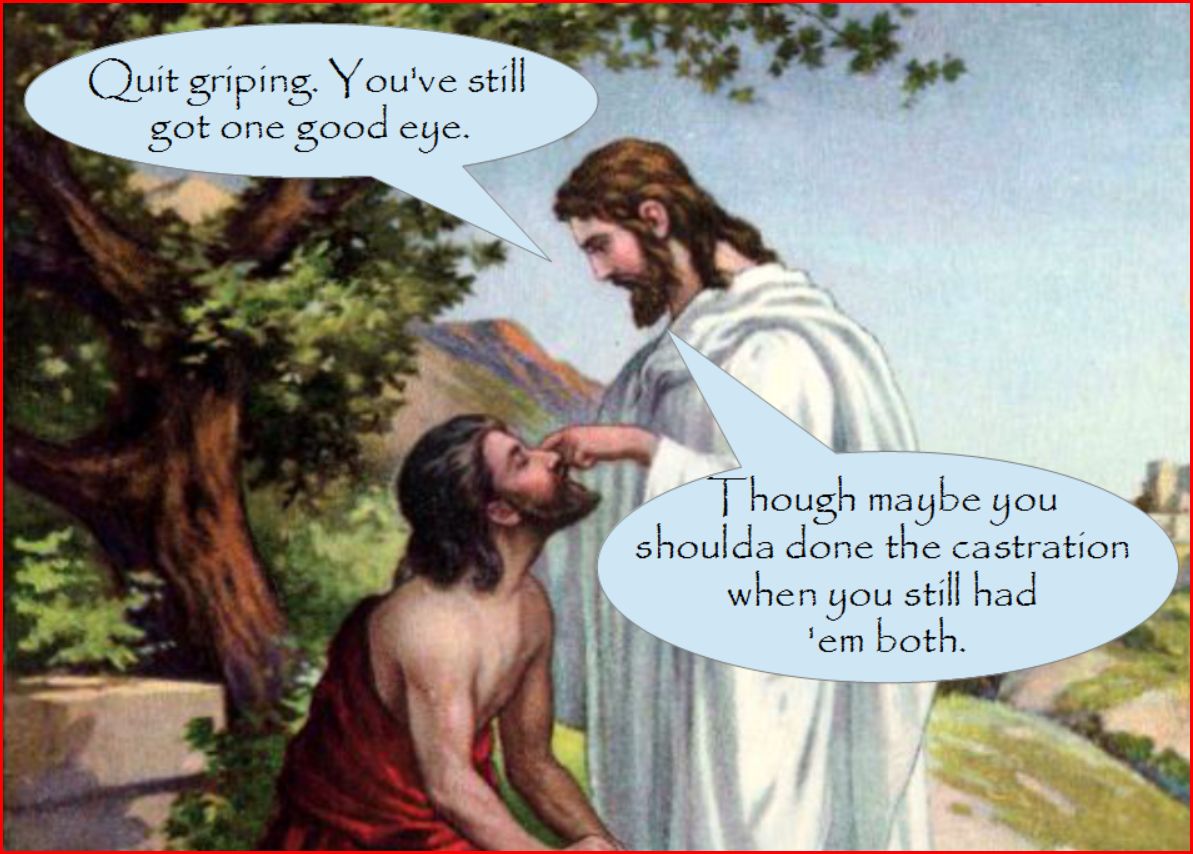
EyesYou hear the one about the blind Christian bloke with only one hand and no balls? And he did it all to himself! Cut off his hand, gouged out his eyes and castrated himself. When asked why he’d done it the man explained, ‘I’m a follower of Jesus and when he tells me to do something, I do it. My self-mutilation is my witness to what a great guy he is. He wouldn’t steer me wrong.’

Sure enough, the normal people who heard him were incredulous, until one of them looked in the Bible and found the very instructions to which the eyeless, testicle-free, one-handed believer referred.

In Matthew’s gospel chapter 5, Jesus is talking about lusting after a woman, which in his eyes (he still had both of his) is as bad as having sex with her. Course it isn’t, not by a long way, but he tells his followers, ‘If your right eye causes you to sin, tear it out and throw it away; it is better for you to lose one of your members than for your whole body to be thrown into hell’ (Matthew 5.29).

A bit drastic perhaps, but there it is; the Son of God is clear about how to avoid the sin of checking out a member of the opposite sex. That’s why you see so many one-eyed Christians around the place because they all take his admonition very seriously.

Except… you don’t. Either Christians ignore him entirely on this one or they never look at the opposite sex with an eye to sexual congress. We all know they’re like the rest of us in this respect – some, as Jimmy Carter once famously did, are honest enough to admit it – and some even act on it; the divorce rate among Christians is not the same as it is for everyone else just because they get tired of being married.

Perhaps though Jesus is being metaphorical when he proposes that gouging out one’s eyes is the best way to deal with lust. Not surprisingly, Christians prefer this possibility. In The Method and Message of Jesus’ Teachings, Robert Stein argues that:

what Jesus was seeking to convey to his listeners by this use of overstatement was the need to remove from their lives anything that might cause them to sin… Jesus is saying in effect, “Tear out anything in your life that is causing you to sin and keeping you from God”.

If that was his intention, Jesus might have actually used these words. If he wants to say ‘in effect’ that the believer should jettison anything from his life that causes him to sin then why doesn’t he?

But eyes are not enough. You gotta get rid of that wanking* hand too (the context of Jesus’ comments is specifically sexual and entirely male orientated throughout these verses): ‘And if your right hand causes you to sin, cut it off and throw it away; it is better for you to lose one of your members than for your whole body to go into hell’ (Matthew 5.30). This must be why we see so many one-handed Christians…

The difficulty with interpreting these and other verses metaphorically is that Christians want to claim that the Bible is the literal ‘word of God’ and then want select parts of it to be metaphorical – and guess who they think should do the selecting. But they can’t have it both ways. Even if they could, how would they know which parts to interpret literally and which symbolically? Perhaps the Holy Spirit tells them, or maybe, and more likely, it’s just their personal preferences. After all, who wants to lose eyes and hands just for being human?

If that’s not enough, Jesus encourages other mutilations for the sake of his Kingdom when he reveals in Matthew 19.12 that ‘there are eunuchs who have made themselves eunuchs for the sake of the Kingdom of heaven. Let anyone accept this who can’. No Christians today seem able to ‘accept’ this recommendation, either; what a truly feeble bunch they are, putting their testicles before the Kingdom!

It seems likely that, given he believed the end of the age was fast approaching, Jesus actually meant what he said, counting on the probability (as he saw it) that anyone who followed his ridiculous suggestions would not be eyeless or handless for long. They would, at the resurrection, be fully restored to live in the Kingdom where, according to Matthew 22.30, they would not be troubled by either impure thoughts or marriage itself (and so wouldn’t need those testicles anyway).

Whichever way you cut it (off) – literally or metaphorically – Jesus words in these verses are remarkably idiotic. Throughout history there have been some individuals, like the dude we started with, who have indeed made themselves eunuchs for the cause. But the vast majority of male Christians have always dismissed this advice or have decided JC was only speaking metaphorically (as he always is when they don’t like what he’s telling them to do).**

So next time True Believers start thundering on about the evils of same-sex marriage and gay sex, tell them to get their own house in order first. A little amputation is all that the Lord requires.


* ‘Jerking off’, for any Americans reading.

**Read more in my (five star reviewed!) book Why Christians Don’t Do What Jesus Tells Them To …And What They Believe Instead, available from Amazon.


Here Be Dragons

dragonChrist The White does battle with the dragon of Revelation 12

Over on Answers in Genesis, one of Ken Ham’s drones is arguing for the existence of dragons. They are, he or she tells us triumphantly, mentioned in the Bible, so they must really have existed.

As we already know, the Bible has more than its fair share of nonsense, but to insist it provides evidence of mythical creatures is to take its credibility to a new low. Don’t Christians care they do this to their magic book? After all, their faith relies almost entirely on the Bible, alongside their own emotional responses to it (no kiddin’, they say this is ‘the Holy Spirit’.)

Christians spend so much time arguing for the Bible’s daftest excesses – the world being created in six days, Jesus returning soon, homosexuality being just the worst sin ever and now dragons – that they haven’t any time left to read what it has to say about how they should be living their lives.

You mean forgiving others, feeding the hungry, giving everything away, not judging (in case you’re judged in return), being compassionate, going the extra mile, turning the other cheek, giving to all who ask and blessing your enemies is in the Bible? Jeez, I never knew.

Yeah, but it’s all secondary to dragons and damning others. ‘By their fruits shall ye know them,’ says Jesus of his followers in Matthew 7.16-20. Turns out there’s no fruit, just a wide assortment of nuts.

Christians’ Favourite Delusions 9: The supernatural exists

Madeup

If you follow any Christian blogs, you’ll know that what many of them enjoy most is slagging off other brands of Christianity. They take the odd swipe at the heathen and at gay people, of course, but most of their bile is reserved for each other. They dispute the smallest matters of doctrine and principle that they are sure other groups of believers haven’t got quite as right as they have. To the outsider, it’s like arguing about whether the tooth fairy’s dress is pink or green while overlooking the fact that there is no tooth fairy.

It’s curious too because there are more similarities than differences between the varieties of Christianity. They have much more in common with each other than with the rest of us.

Most significantly, they all believe in supernatural beings. This, for me, is the greatest difference between myself and those who profess a faith. I see no evidence for supernatural creatures, places or events. The supernatural has no independent existence outside the human imagination. It is the human mind that, over the millennia, has constructed innumerable gods and their attendant mythologies, just as it has created more recently the inhabitants of Narnia, Middle-Earth and Hogwarts.

Being a Christian requires you believe in not one, but a myriad of supernatural beings, events and locations:-

While believers are adamant that there’s one God, they insist at the same time he is made up of three individuals: a Father, a Son and a Holy Spirit.

They believe in angels who wait upon God the Father in Heaven – a supernatural place they mistakenly believe they’ll be going to when they die – and who, some maintain, aid them here on Earth. How many angels are there? We are told in the Bible there’s a ‘host’ of them, which sounds like quite a lot.

There are also seraphim (Isaiah 6.2) and cherubim (Hebrew 9.5 etc), third-rate special-effects creatures who act as God’s heavies.

In addition to them, there are characters from the early days of Judaism – Moses and Elijah – who have survived death and hang about somewhere or other. They make a surprise return visit to Earth in Matthew 17.3. For some, Jesus’ mother, Mary, is another of this elite group of Eternals.

And what about all of the ordinary believers Christians say have already gone to Heaven? That’s millions of dead people who enjoy supernatural existence. Roman Catholics even believe you can chat with these heavenly ‘saints’ and they’ll argue your case for you with the Big Boss.

There’s the cast of characters from the dark-side too: God’s nemesis the Devil (aka Satan, aka Lucifer – though confusingly this last title is also used of Christ in Revelation 22.16) and his armies of demons and evil spirits who have nothing better to do than take over gullible human minds. This lot live in another supernatural place, Hell, though no-one seems to know where this is either (in Luke 10.15, Jesus implies it’s inside the earth, but it isn’t).

And last but not least are the supernatural events that supposedly took place in the real world: talking animals (Genesis 3.1; Numbers 22.28), sticks that turn into snakes (Exodus 4.3), corpses rising from graves (Matthew 27.52) and a man who magically beams up to Heaven (Luke 24.51), to name but a few.

So, Christians, argue all you like about what makes your version of Christianity better than others, but don’t forget all varieties of the faith depend on believing that these supernatural characters and events are real. In fact, they’re no more real than the pantheon of Greek gods and goddesses who inhabited Olympus, and at least they were interesting.

Christians’ Favourite Delusion 7: What a friend we have in Jesus

James

So you’ve decided to follow Jesus and from here on in, Christians tell us, you’ll share real intimacy with your Saviour.

There are many permutations of this belief: having Jesus in your heart; walking daily with the Lord; enjoying a loving relationship with him; letting him speak to you. All rely on the premise that the post-mortem Jesus is an eternal, supernatural being who is able, somehow, to stroll, chat and administer one-on-one therapy. The old spiritual, still much beloved in Christian circles, declares ‘what a friend we have in Jesus’, while Mary Stevenson’s modern parable insists that his footprints are beside the believer’s in the sand – except, that is, when he has to carry them.

However, the concept of Jesus as bosom buddy and occupier of right and left ventricles is nowhere to be found in ‘God’s word’. Yes, there’s the possibility of feeling Jesus’ presence when with other believers; the shared delusion of Matthew 18.20 that over time would morph into ‘the Holy Spirit’. And it’s true too that Paul decides in 1 Corinthians 6.14 that believers’ bodies are sanctuaries or temples of this same Spirit. But these are both a long way from a Jesus who lives within the believer’s heart and, as another old hymn has it, ‘walks with me and talks with me along life’s narrow way’.

The Jesus of the gospels is not looking for people to be his chums. He does say in John 15.14, ‘you are my friends if you do what I command you’, but this is hardly what we’d call ‘friendship’ – ‘you can only be my friend if you do exactly what I say’ is the unreasonable demand of playground bullies and manipulators everywhere. It certainly isn’t friendship in the sense we normally understand it. But even if you’re taken in by this offer, do you do what he says? It’s highly unlikely, given that he insists you sell all you have and give to the poor, turn the other cheek and transform yourself into a slave, working selflessly and sacrificially to bring about the Kingdom of heaven:

…whoever wishes to be great among you must be your servant, and whoever wishes to be first among you must be your slave; just as the Son of Man came not to be served but to serve… (Matthew 20.26-28)

When you’ve turned yourself into a lifetime servant of others, surely then you can expect Jesus to be your best mate? Like the disciples before you, who also wanted to be part of God’s circle of favourites, you miss the point of what it was, and is, to be a slave; to work ceaselessly in demanding conditions with no reward, no wages and no acknowledgement. The most any servant of God can expect, Jesus tells us, is that he will say ‘well done, good and trustworthy slave; you have been trustworthy in a few things, I will put you in charge of many things; enter into the joy of your master’ (Matthew 25.23). That’s it – that’s the extent of your ‘reward’: he’ll recognise your position as a slave and tell you you’ve pleased him, your slave-master. And that’s what you call friendship?

Jesus is not your loving buddy. He never said he would be and you’re just confusing him with James Taylor if you think he did. Even if you want to ignore what the Bible says about being a slave – and I’m betting you do – you can’t have a relationship with someone who has been dead for 2,000 years.

Face facts, Christians: your ‘friendship’ with Jesus, your entire concept of him, is no more than the product of your own imaginations.

What use is religion?

SavedI went to church on Sunday. Not because I wanted to, but to help someone out. It was an interesting experience. There were some really nice people there – good people even. They would say they were good… no, they wouldn’t, they would dispute they were good… they would say any good qualities they had were the result of Christ and the indwelling of the Holy Spirit.

But such a claim doesn’t account for all the other good people we encounter in life who don’t believe in Christ or the Holy Spirit or any of the other aspects of the Christian faith. It doesn’t account either for the mean-spirited, spiteful and obstructive folk that we find in churches. If Christians have been regenerated through faith in Christ – the Bible calls them ‘new creations’ in 2 Corinthians 5.17 – then there shouldn’t be any unpleasant, unloving folk in church, should there?

The minister on Sunday made much of Christians being ‘works in progress’, but this sounds like a nice way of making excuses for difficult people. Some folk manage to be good and loving without faith, without ever being a ‘work in progress’. A Christian commenter on another blog I read, ‘Why There Is No God‘, argued the other day that we shouldn’t judge a religion by the way its adherents behave. But what other way is there to judge it? If a religion doesn’t make individuals more loving – and this is what Jesus claims distinguishes his followers (John 13:35) – then of what use is it?

It seems to me – and I’m aware I’m resorting to personal experience here, mainly because there don’t appear to be any empirical studies of individuals pre- and post-conversion – that good people are good whichever side of the conversion experience they’re on, and hateful types are hateful whether they’re believers or not. Religion doesn’t, in spite of its claims, change people very much. At most it brings out their true natures. Much the same as alcohol, really.