
Jesus and the Blind Man

This time we’ll take a closer look at Mark 8:22-26, a story about Jesus healing a blind man:

They came to Bethsaida, and some people brought a blind man and begged Jesus to touch him. He took the blind man by the hand and led him outside the village. When he had spit on the man’s eyes and put his hands on him, Jesus asked, “Do you see anything?”

He looked up and said, “I see people; they look like trees walking around.”

Once more Jesus put his hands on the man’s eyes. Then his eyes were opened, his sight was restored, and he saw everything clearly. Jesus sent him home, saying, “Don’t even go into the village.”

This parable is doing a lot of metaphorical heavy lifting.

First, it is located in Bethsaida, the home of some of the disciples as well as the place where Jesus does some of his most spectacular miracles, only later to curse the village for its lack of interest in him (Mark 11:21). It is symbolic of those who reject the cult’s message, or are too dim to see that their heavenly Jesus is the Messiah.

Second, the story is sandwiched (no pun intended) between the feeding of the four thousand, in which the hapless disciples fail to recognise Jesus’ miraculous status, and the account of Peter realising that Jesus is in fact the Messiah. The healing of the blind man, neatly placed between the two, is therefore an allegory within allegories about seeing (gettit?) Jesus for who he really is (i.e. what cultists believed him to be.)

Third, the story is a prophecy-fulfilled parable. Isaiah 35:5 says that when the Messiah comes ‘the eyes of the blind will be opened and the ears of the deaf unstopped.’ Jesus has to be made to do these things – he performs some ear unstopping too (Mark 7:31-35) – to show he is indeed the prophesied Messiah.

Fourth, physical blindness is a very obvious metaphor for spiritual blindness. The preceding story reminds those who can’t ‘see’ the cult’s truth for themselves: ‘Do you still not see or understand? Are your hearts hardened? Do you have eyes but fail to see, and ears but fail to hear?’ (Mark 8:18). This is itself a borrowing of Isaiah 6:9-10. Indeed, the entire story, together with that of the deaf man being cured, is a parable of Isaiah’s ‘prophecy’:

You shall indeed hear but never understand, and you shall indeed see but never perceive. For this people’s heart has grown dull, and their ears are heavy of hearing, and their eyes they have closed, lest they should perceive with their eyes, and hear with their ears, and understand with their heart, and turn for me to heal them.

Jesus’ healing of blindness then becomes a metaphor for seeing the light, as Peter does in the subsequent story when he finally recognises him, like the cult has done, as the Messiah.

Fifth, Jesus spits on or in the man’s eyes: a very clumsy metaphor for the streams of living water that emanate from God himself in Jeremiah 2:13. Perhaps too there’s a reference to the baptism ritual beloved of the early cult. (Christian bloggers themselves have trouble explaining this gross detail that Mark sees fit to include in his story.)

Sixth, in order to give sight to the blind man, Jesus (or rather the cult) first removes him – the initiate – from the village, from those who don’t even know they are blind. Next, Jesus/the cult shows him how those who are spiritually blind are no better than trees wandering around aimlessly (yes, Mark really does mix his metaphors). Jesus/the cult then opens the initiate’s eyes to the Truth so that finally he sees ‘everything clearly.’ He can now never return to his former state; his ‘home’ is with the cult, not with the spiritually blind outside it.

The story is evidently metaphorical. That Jesus spits in the man’s face is not, as some Christians claim, evidence that it really happened. It is weighed down by so much symbolism and clunky metaphor, and at the same time strategically placed between two other ‘seeing the light’ stories that its literary origins are apparent. Mark and his fellow cultists knew what they were doing when they dressed their beliefs up in stories like these. As they themselves insist, you need only open your eyes to see it.
Jesus and the Leper

I thought we might share a couple of Bible studies these next couple of weeks. Some of you will remember these from your Christian days, when you’d gather with other eager believers so that a self-appointed expert could tell you what a particular story in the Bible really meant. I’m no expert, just someone who subjected myself to such indoctrination while all the time wondering if what I was being told was really what the passage was about. Doubts, however, were ‘of the devil’ so any such critical thinking needed to be suppressed. Since my eyes were opened to the allegorical nature of much of what is in the Bible and in the gospels in particular, I now see these same passages in a completely different light. I hope you’ll allow me to share my insights with you.

First off, it’s Mark 1:40-45, in which Jesus (seemingly) heals a leper:

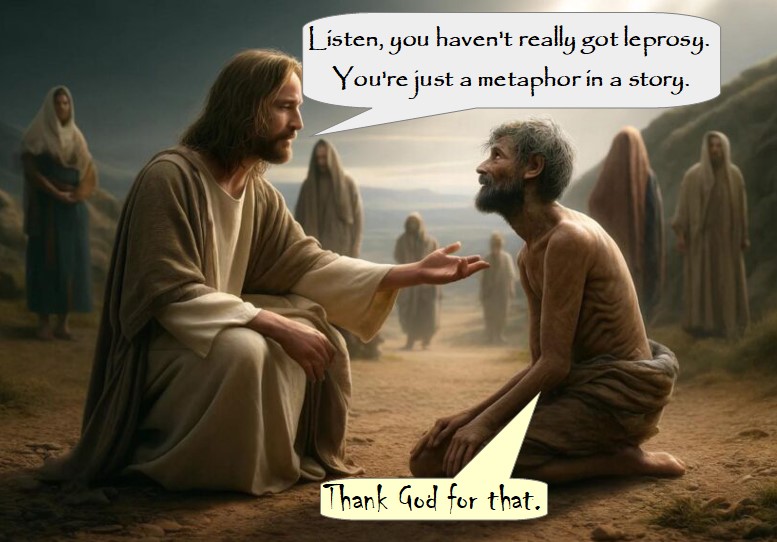
 A man with leprosy came to him and begged him on his knees, “If you are willing, you can make me clean.” Jesus was indignant. He reached out his hand and touched the man. “I am willing,” he said. “Be clean!” 

Immediately the leprosy left him and he was cleansed. Jesus sent him away at once with a strong warning: “See that you don’t tell this to anyone. But go, show yourself to the priest and offer the sacrifices that Moses commanded for your cleansing, as a testimony to them.” 

Instead he went out and began to talk freely, spreading the news. As a result, Jesus could no longer enter a town openly but stayed outside in lonely places. Yet the people still came to him from everywhere.

The giveaway phrase here is ‘make me clean’. The man does not ask Jesus to heal him which, suffering from a debilitating disease as he was, would have been the most obvious, most pressing request to make. Instead, he asks to be ‘cleansed’ with all its ritual connotations, the word used here, καθαρίζω (katharizo), also meaning ‘purify’. According to Leviticus 4: 11-12, leprosy was a condition that was spiritually unclean. Only by making the prescribed offerings – the usual doves, lambs and ‘crimson stuff’ – could a leper who was already healed become ritually pure.

Who, according to the New Testament, replaces all the sacrificial offerings of the old covenant? Why, it’s Jesus himself of course (1 Corinthians 11:25, Ephesians 5:25-26 etc). Jesus cleanses and purifies the leper in the story, just as he is able to cleanse and purify sinners. This is what the early cult believed: ‘Ask Jesus, the heavenly Christ, to cleanse you of your sins and, just like he does for the leper in this parable, he’ll do it for you. As a penitent believer, you are the leper. Not only are you cleansed of your sin, you are purified.’

This also explains why Jesus is ‘indignant’ when the leper first approaches him. On the surface it makes little sense for him to be indignant with the man, which is why some translations change this verse to say Jesus ‘felt compassion for him.’ Jesus’ metaphorical annoyance is for those who have allowed the man’s spiritual condition to have deteriorated to a state comparable with leprosy. The Jewish priestly system, symbolised anachronistically in Mark as the Scribes and Pharisees, the later arch-enemies of the new cult.

Jesus commands the leper to visit the Jewish priest to demonstrate that he, Jesus, is the new cleanser of sins, replacing the priesthood itself. Instead, the leper goes against Jesus’ and the early cult’s wishes. My God, how could the cult remain secret and exclusive if newly cleansed converts behaved like this!

So there you have it. The leper is a metaphor for the sinner in need of the heavenly Jesus’ cleansing. His leprosy is a metaphor for the sin itself. The healing is a metaphor for the penitent’s spiritual purification. The man’s by-passing of the Jewish law is a metaphor for Jesus replacing the law. The cleansed leper’s shouting about it is a metaphor for the early cult’s desire to keep its rituals and teaching secret. Its parables like this one were designed to enlighten cult members while obfuscating and confusing the unbeliever (Mark 4:11-12).

As a literary creation, an allegory replete with metaphor, this event need never have happened in reality. Given its literary nature, it’s highly unlikely it did.

Bible Study

Again he entered the synagogue, and a man was there with a withered hand. And they watched Jesus, to see whether he would heal him on the Sabbath, so that they might accuse him. And he said to the man with the withered hand, Come here.” And he said to them, Is it lawful on the Sabbath to do good or to do harm, to save life or to kill?” But they were silent. And he looked around at them with anger, grieved at their hardness of heart, and said to the man, Stretch out your hand.” He stretched it out, and his hand was restored. The Pharisees went out and immediately held counsel with the Herodians against him, how to destroy him. (Mark 3:1-6)

Greetings, my beloved Brethren. Today we are going to look at God’s Holy Word as revealed to our dear brother in the Lord, the one who will one day be called ‘Mark’. We’re looking specifically at the passage above, because some of you have expressed difficulty in discerning the full import of the text. I have to say I’m surprised at this. You only have to bear in mind Mark’s rule of thumb that everything in his gospel is a metaphor, which, when looked at with discernment, reveals a previously hidden mystery: 

To you has been given the secret of the kingdom of God, but for those outside everything is in parables, so that “‘they may indeed see but not perceive, and may indeed hear but not understand, lest they should turn and be forgiven’” (Mark 4:11-12, referencing Isaiah 6:9)

Our passage today begins with the Lord healing a man with a withered hand, which should straight away alert us to the fact we are dealing with metaphor. All of the healings in the gospels are. They stand for something more significant than any actual healing.

Some of you might already have made the connection between the use of ‘withered’ here, with its use in another story (Mark 11-12-14), where Jesus withers an unfruitful fig tree. Of course, no actual fig trees were harmed during this miracle. The fig tree and its withering are metaphors.

The tree, you see, is a metaphor for the Jewish system of worship, the old Covenant of the Law. This had reached the end of its life. It was fruitless and God was done with it. He was in the process of replacing it with salvation through Grace. All of this is represented metaphorically by Jesus cursing the fig tree and causing it to wither.

So it is in our passage today, except this time, God offers healing to the Jewish nation. He is nothing if not gracious, reaching out and offering acceptance into the new Covenant, expressed here as the healing of a withered hand. You won’t have missed the fact – again symbolic – that the healing occurs in the synagogue, the Jews’ place of worship. We might also remember Deuteronomy (6:8) where the Lord God instructs the Jews to wear his Law on their foreheads and, more significantly, to tie them to the backs of their hands. But now their hands have, metaphorically speaking, withered away, just as the fig tree will.

God knows of course that few will accept his proffered healing, insisting instead of labouring blindly under the old Covenant. The rest of the story reflects this stubbornness and the incalcitrant attitude as the Pharisees – metaphors for the Jews as a whole – round on Jesus and castigate him for breaking the Sabbath laws in healing the man – in spiritual reality the Jews themselves. That Jesus heals on the Jews’ sacred day is metaphorical too, demonstrating as it does that all the old laws are now surpassed. Jesus, and more importantly his followers – you, my dear brethren – are no longer under the yoke of that law but have new freedom serving Jesus under his new yoke, which is easy to bear. At the end of the story, the Pharisees – the Jewish leaders of our own time, lest we forget – leave to plot against the Lord; in reality against us. With his help we will of course bear this persecution stoically.

So you see my brothers, this story was written for you, to remind you that you are saved. You are the New Covenant. The Old has passed away. You can follow Jesus’ example and do good, yea, even on the Sabbath. You need not fear the Jews or others who might persecute you because the Lord is with us. The Jews, on the other hand, will soon be cast into outer darkness when he comes in person. Even so, Lord Jesus, come quickly.

I hope this has made clear to you the mystery hidden in this part of Mark. I know there will be some of you who are not sufficiently advanced in their understanding of the mysteries, being still babes in Christ, and may yet object to this exposition of the deeper secrets of the Lord. So be it. But don’t say you haven’t been made aware of the Truth.

Next time, if there are those who need to know more of the mysteries hidden in God’s new revelation, we can look at the next part of Mark, though I trust that you are, by now, developing sufficient spiritual insight to discern for yourselves the hidden mysteries embodied by the gospel’s metaphors.

The Bible as Metaphor (again)

A few days ago, Dennis and I visited Penrith, a small market town a short distance from the city where we live. What a delight it was to discover that the street preacher who plagues our city – the humourless Dale McAlpine – also inflicts himself on this smaller place. We so enjoyed hearing him bellow out, as we manoeuvered past his confederates handing out poorly written tracts, that we were all sinners – ye, everyone of us – bound for hell.

As we stopped at an ATM we heard Dale announce how Jesus healed lepers and cured leprosy, which patently he did not. He said Jesus’ healing of lepers was a metaphor for what he could do for us all, by removing our sin and making us whole again. His metaphor schtick – an sophisticated one for a simple street preacher – put me in mind of our very own Camp commenter. As Sunday school teacher Don frequently reminds us, the Bible is a) literature and b) largely metaphorical.

In case he’s forgotten and is arguing this week that we should view the bible’s stories as historical accounts (his other favourite tack), here’s what he actually said:

Much of scripture is the kind of literature in which metaphor and other kinds of figurative language is common… you are out of touch with the literary character of ancient literature.

I hope you all feel thoroughly chastised by this. I know I do. Don was taking exception to my post in which I itemised the Bible’s mythical creatures, talking animals and impossible events. So, I’m going to take him, and Dale at their word and take a fresh look at the Bible’s use of ‘metaphor and other kinds of figurative language’

First though, let’s understand that metaphor and figurative language are distinctly literary techniques. In literature and sometimes in speech, metaphors make subtle comparisons and bring to mind a host of associations that the author does not then have to explain. Outside of fiction, they don’t have much of a function. We don’t, for example, attribute metaphorical meaning to human events and interactions in the real world. The present war in the middle east is not a metaphor for something else, like, for example, the warfare that Christians believe rages in the Spirit world. Sleepy Joe Biden’s activity, or lack of it, is not a metaphor for the present condition of the USA (let’s hope not anyway). Our personal relationships are not metaphors for something grander. There is no metaphor embedded in actual events or real world interactions.

No. Metaphor exists almost entirely in literature. While the occasional non-fiction author might add a metaphor for flourish, strictly speaking, metaphor exists in and for fiction and poetry. More than this, when, in fiction, ideas are expressed metaphorically, it signals that the surface meaning is of lesser significance. It is the underlying or hidden meaning that matters. The fiction is the vehicle by which the metaphorical truth is conveyed. Don admits as much in his comment.

Let’s try some illustrations. The underlying metaphor of The Great Gatsby, its truth, is the dark underside of the American dream. Its surface story isn’t real; it is fiction. The metaphor conveyed through Moby Dick – the fictional whale as well as the novel as a whole – is the destructive nature of obsession. Again, as powerful as this is, none of the story that conveys it actually happened. Frankenstein’s central metaphor is the danger that uncontrolled science represents to humankind. The story that carries this message is, however, pure invention. In All The Light We Cannot See, Light is the metaphor, as it frequently is. The characters’ insights into truth are what the author seeks to convey. The fiction is the vehicle of that truth. Choose your own example: fiction embodies metaphor, the ‘truth’ of the story. But the story itself is rarely an actual event. Even when it’s based on one, as the movies say, the narrative is extensively fictionalised.

So, let’s go back to Dale’s leprosy metaphor. In several gospel stories, the authors have Jesus cure lepers precisely to illustrate how he can heal people of their inner leprosy: their sinful nature. Jesus almost certainly did not heal any lepers; this is the fiction. The creators of the gospels designed the story to carry metaphorical meaning, which, in this case, is that Jesus can heal us from sin.

Likewise the stories in which he heals the blind; the blindness is metaphorical. The saviour opens people’s eyes to spiritual truth. He didn’t really cure blind people; that is the fictional vehicle for the metaphor.

He didn’t turn water into wine; the writers of the fourth gospel wanted to convey the spiritual ‘truth’ that the new cult’s beliefs were superseding old Jewish ones; a metaphor was a memorable way to do it.

Lazarus was not raised from the dead; the story is a metaphor to illustrate how God will raise believers at the last day.

The Romans did not execute Jesus; it was the spiritual rulers of the age who, according to Paul in 1 Corinthians 2:8, put the saviour to death. The Romans are the metaphor for the wickedness of these supernatural beings.

Jesus did not rise from the dead. This too is a metaphorical fiction.

How did I do, Don? I’ve interpreted isolated periscopes from the gospels metaphorically. I’ve borne in mind that metaphor and other figurative devices are purely literary, techniques in fiction. I’ve channelled the literary character of ancient literature as defined by you (except of course you never actually do define it.)

You are invited to respond. I offer to post your comment, if it is as lengthy as I expect it to be. You must, however, keep to the point and resist making personal jibes. Choose any of the miracles, healings or pericopes from the gospels and demonstrate that they are real historical events.

It matters to you and to other Christians that the events of Jesus’ life did happen. That they’re not just the invention of clever writers who, taking inspiration from Jewish scriptures, created metaphorical events to convey higher ‘truths’. So persuade us that at least one miracle, healing or episode is more than a literary device, a metaphor for some fanciful theological ‘truth’. Provide the evidence that it really happened. Claiming the disciples witnessed the miracles or healing won’t cut it, when the disciples are themselves characters in the stories, and metaphorical at that.