The Circular Reasoning of Apologists

This is what what we’ve got so far:
Human behaviour is controlled by beings from an invisible, undetectable spiritual realm. We know this invisible, undetectable spiritual realm exists because of the effect it has on human behaviour (even if dumb old atheists can’t wrap their minds round the fact.)

Circular reasoning, not evidence.

The synoptic gospels rely on an earlier oral tradition. We know there was an earlier oral tradition because the synoptic gospels rely on it.

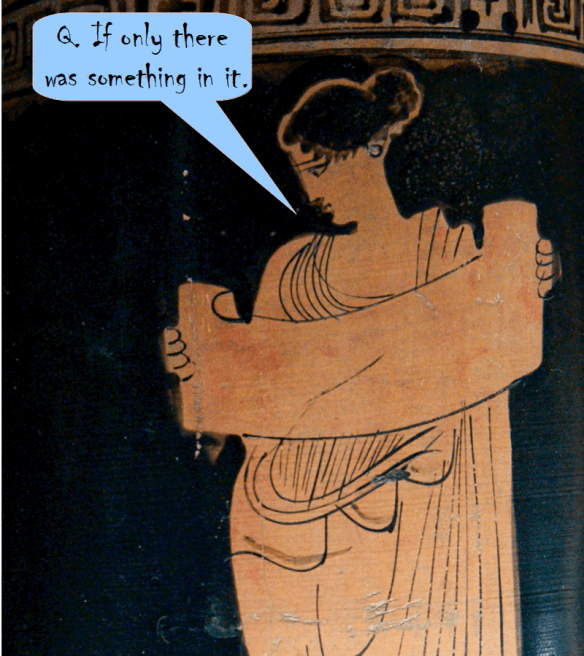
Circular reasoning, not evidence. (The same applies to Q.)

We know the stories about Jesus are indisputably true because they’re in the gospels that no-one at the time disputed. We know the gospels are indisputably true because they tell us stories about Jesus that at the time no-one disputed.

Circular reasoning, not evidence. There is no corroborative, independent evidence for any of the stories about Jesus. (I’ll get to the indisputable claim soon.)


The Gospels and Other Fiction, part 2

The gospels were written as history. Their writers did not make things up.’

History, as koseighty has reminded us, is not littered with angels, devils, demons, spirits, apparitions, miracles, voices from the sky and resurrected corpses. Real history was being written at the same time as the gospels, by Josephus and Suetonius for example, who do not include the supernatural but do reference their sources, something the gospels never manage.

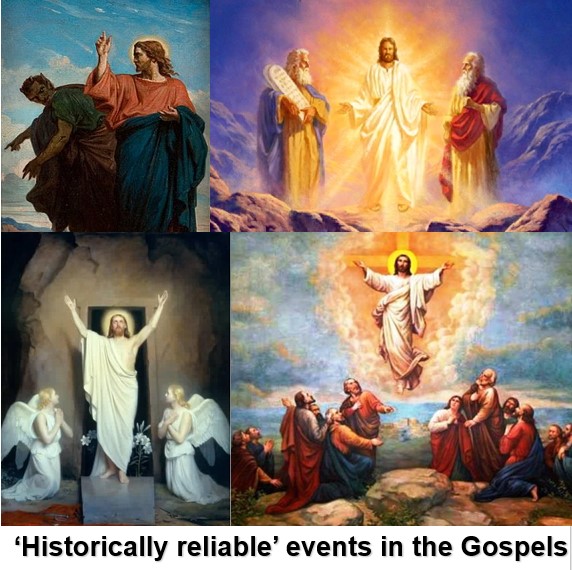
And of course the gospel writers did make things up. They invented numerous stories for Jesus to make it appear he is fulfilling prophecy (even when that ‘prophecy’ wasn’t prophecy to begin with.) This included making up ‘history’; Herod’s Massacre of the Innocents (a rewrite of a fiction about the infant Moses), the crucifixion eclipse, the rending of the temple curtain and more. These are all symbolic events. They didn’t really happen. Jesus’ own resurrection can safely be added to the list. It’s ironic that those who defend the gospel authors against the charge they made stuff up are the same who invent stories themselves: Mark and Luke knew each other? Mark proof-read Luke’s first draft? There were people who would fact check the gospels and point out any errors? But the original Christians wouldn’t do such a thing. Except they did.

There are no Inconsistencies, contradictions and inaccuracies in and between the gospels, but if there are, these are irrelevant. It’s the bigger picture that counts.’

Jesus is different in all four gospels. Despite Matthew and Luke’s plagiarising of Mark, they alter him to reflect the Jesus they believe in. John’s Jesus is so far removed from Mark’s that he’s a different character altogether. The inconsistencies do matter: did Jesus perform signs and wonders or not? Was he crucified on Thursday or Friday? Was it Peter, John or Mary who was first to see him resurrected? Did he hang around for one day or for 40? These conflicting details tell us that the creators of the Jesus story were more than happy to alter it when it suited their purposes. This is not how history is written. It is how propaganda is created. The ‘bigger picture’ is, in any case, made up of these smaller details. They work collectively and cumulatively to create the bigger picture. If we can’t rely on their being accurate how can we be sure the bigger picture is? When the gospel writers are unreliable in the smaller details, how can we be certain they’ve got the bigger picture right, given they’re all copying it from the same source, Mark, and giving it their own spin?

There is corroborating evidence of the gospels’ accounts’.

There is? Where? Just because there is some evidence that Nazareth existed doesn’t mean Jesus performed miracles, any more than Dunsinane castle’s existence proves Macbeth murdered King Duncan (he didn’t). Just because Pilate was a real historical figure doesn’t mean he crucified Jesus, any more than the existence of King’s Cross Station means Harry Potter catches his train there. And these, surely, are merely the small details. There is no corroboration at all for the bigger picture. Mention of the followers of Chrestus in Suetonius confirms at best that there were Christians in Rome at the time of Claudius, but no-one is disputing that. At worst, for the apologist, this curious reference has nothing whatever to do with Jesus. Later references to incidents from his story, by the much vaunted Church Fathers, are derived from the gospels and are therefore dependent on them. As such, they don’t constitute independent corroboration.

Everything Jesus prophesies or predicts in the gospels will come to pass, then sceptics will see that everything in the Jesus story is true.’

This one is from a commenter on Don’s blog. (I only went there by accident, honest.) The problem with this one is that everything Jesus is made to promise should already have come true, two thousand years ago. The Son of Man should have appeared in the sky with the heavenly host to usher in God’s Kingdom on Earth, while sending most of mankind to the fiery pit or outer darkness or some other damn place. Both he and Paul claimed that this would happen within their and their followers’ lifetimes. The trouble with Christianity is it is always winter and never Christmas. Its fulfilment God’s – God’s Kingdom on Earth, life after death, the final judgement – is always going to be at some indeterminate time in the future, a time and fulfilment that never quite arrives. It never will; part of ‘the big picture’ we can be confident we will never see.

More to come (unlike Jesus). 

The Gospels and Other Fiction, part 1

Christian apologists vigorously deny the idea that the Jesus story is fiction even though all of the evidence, both internal and external, points to the fact that it is. I’m not going to rehearse that evidence in this post (I address it in several earlier posts, including here and here, and there are always primary sources that, God forbid, defenders of the faith could read for themselves.) I’m interested here in looking at Christians’ defence of scripture as truth. What arguments do they have and better still, what evidence, that the gospels are historically accurate depiction of events in 1st century Palestine? Most of these arguments have been offered by our resident apologist, Don Camp, and although I’m fairly sure Don makes things up as he goes along, I’ll not reference other sources except where I’m introducing an argument he hasn’t offered.

Church Fathers believed the gospels were accurate, therefore, because they lived closer to the time of the gospels’ composition, they’re more likely to be right.’

Church Fathers, such as the unreliable Eusebius,, Papias, Clement, Ignatius and Polycarp were predisposed to believe the gospels were accurate; they had already converted to the faith and had a vested interest in seeing it promulgated and preserved. They were also steeped in the thinking of the age, typified by Paul and other NT writers, that the Earth was at the centre of a cosmic war between God and the forces of Satan. Above all, the Jesus story was theirs, a new revelation from God that didn’t, as far as they were concerned, belong to Jewish tradition or any other. It was new and it belonged to them: they wanted and needed it to be true. Later scholars, from the 19th, 20th and 21st centuries, did not come with these particular encumbrances and while of course not entirely free of prejudices of their own, considered the texts more dispassionately as history and found them to be wanting.

‘‘Mark’ is an accurate record of the disciple Peter’s time with Jesus.’

There is no evidence at all for this claim. Analysis of Mark (and also Matthew and Luke) demonstrates how the story is constructed around supposed prophecies from Jewish scriptures. Mark also incorporates much of Paul’s gospel to the Gentiles, a feature Matthew is at pains to ‘correct’. His Jesus is distinctly Jewish.

There was an oral tradition that accurately preserved the stories about Jesus until such time as they could be written down.’

There is no evidence that this tradition, if it existed, was accurate. It is, as Bart Ehrman shows in Jesus Before The Gospels, highly unlikely that it was. We know that stories conveyed orally are altered, embellished and modified with successive retellings.

There was an earlier document that preserved sayings of Jesus’ until such times they could be incorporated into the gospels.’

Then it simply vanished so that no fragment of it survived. The Church Fathers don’t appear to know anything about it. Wouldn’t such a priceless document have been preserved somehow, somewhere by someone? Q, as it’s called, is entirely hypothetical. It’s unlikely it existed. Even if it did, it is considered to have been a sayings gospel. It did not preserve details of Jesus’ life, death or resurrection. We’ll get to the so called ‘logia’ in part 3.

The gospels were written by eye-witnesses or associates of eye-witnesses.’

We know with certainty that this is not the case. All of them were written in Koine Greek and are carefully constructed literary creations. None was written in Palestine but much further afield and all reflect the concerns of the later cult. Over a hundred years after they were written, Irenaeus ascribed the names by which they are now known without any evidence that the authors were called Matthew, Mark, Luke or John. Later compilers of the New Testament didn’t even know of ‘Mark’s’ primacy, which is why ‘Matthew’s’ gospel appears first in the New Testament. ‘Matthew’ and ‘Luke’ are heavily dependent on ‘Mark’ (as is ‘John’ for its overall structure), an incongruous and inexplicable approach for Matthew to take, and John too, if they were eye-witnesses themselves. Eye-witnesses do not need to rely on the testimony of people who weren’t.

More next time…

Jesus: Practically Perfect In Every Way?

Was Jesus a gracious, gentle and humble as Christians like to claim or was he intolerant, self-important and frequently wrong? What do the gospels say?

He’s intolerant and self-important when:

He insists people should love him more than their own families (Matthew 10:37).

He says he’s not a peacemaker but intends creating strife (Luke 12:51).

He claims anyone who doesn’t follow him deserves to be burnt (John 15:6).

He wants the world to be destroyed by fire (Luke 12:49).

He commands people not to call others ‘fools’ (Matthew 5.22) but tells those he doesn’t care for that they’re ‘swine’, ‘dogs’, ‘snakes and vipers’, ‘whitewashed tombs’, and, yes, ‘fools’ (Matthew 7:6; 15:26; 23:33; 23:27; 23:17 & Luke 11:40).

He deliberately speaks in riddles so that people won’t understand him and won’t find forgiveness (Mark 4:12).

He tells his followers to love their enemies but says he’d have his own killed (Luke 19:27 & Matthew 13:41-42).

He endorses slavery and the cruel treatment of slaves (Luke 12:47-48).

He says people would be better off if they cut off their hands, plucked out their eyes and castrated themselves (Mark 9:43-48 & Matthew 19:12).

He endorses the Jewish law that demands the death penalty for those who disrespect their mother and father (Matthew 15:4-7).

He disrespects his mother (Matthew 12:48-49).

He tells people not to get angry but loses his own temper (Matthew 5:22 &Mark 3:5).

He callously kills a herd of pigs and, in a fit of pique, destroys a fig tree (Matthew 8:32 & Matthew 21:19).

He takes a whip to people (John 2:15).

He tells his mates he’ll soon be king of the world and promises them that they’ll rule alongside him (Matthew 19:28).

Are these the marks of a tolerant, compassionate man? Or the characteristics of an unpleasant, delusional megalomaniac?

As for frequently wrong: first, the false promises –

I will do <em>whatever</em> you ask in my name, so that the Father may be glorified in the Son (John 14:13).

Very truly, I tell you, if you ask <em>anything</em> of the Father in my name, he will give it to you (John 16:23).

These signs will accompany those who believe: …they will lay their hands on the sick, and they will recover’ (Mark 16:17).

Therefore do not worry, saying, “What will we eat?” or “What will we drink?” or “What will we wear?” But strive first for the Kingdom of God and his righteousness, and all these things will be given to you as well (Matthew 6:25-7.1).

and then there’s the failed prophecies –

For the Son of Man is going to come in his Father’s glory with his angels… I tell you the truth, some who are standing here will not taste death before they see the Son of Man coming in his Kingdom (Matthew 16:27-28). Just in case we don’t get this the first time, he tells us again in Matthew 24:27, 30-31, 34 and in Luke 21:27-28, 33-34.

Did he return with the angelic host and establish God’s kingdom on Earth before his disciples died? He did not.

Christian zealots unable to accept the evidence of the gospels themselves will no doubt have a hundred and one clichéd, implausible excuses for Jesus’ many failures: ‘he was speaking metaphorically’; ‘you lack the spiritual insight to see what he really meant’; ‘you’re quoting him out of context’, blah blah, blah.

All I ask is that they please, please don’t inflict these excuses on us here when we’ve heard them all so many times before.

Cruci-fiction

Given the birth, baptism and wilderness narratives are fiction, why not then the other parts of Mark and Matthew? We’ve already seen how the trial and crucifixion in Mark are literary creations, which Matthew lifts and embellishes. The resurrection stories are also invented, which is why the different accounts are confused and contradictory. The likelihood that everything between the beginning and the end – Jesus’ ‘ministry’, miracles and preaching – is invented too, either by the authors of the gospels themselves or by those who preceded them. My money would be on the former; the stories are so carefully arranged, forming an integral part of a clever literary construct.

I have a growing, sneaking admiration for what Mark and Matthew, and later Luke and John, achieved. They consciously set about creating myth. When Paul and others preached that their Christ had died and risen again ‘according to the scriptures’ that’s literally what they meant; the Christ was discernible in Jewish scripture, his story laid out there for those with eyes to see it. Mark tells us as much in Mark 4:9: ‘He who has ears to hear, let him hear.’

What he and, to an even greater extent, Matthew did, was construct a Saviour story from these elements. They saw him, or thought they did, all over the place. Whether or not there was an actual Jesus is beside the point. as is the extent to which the gospel writers may have used existing stories about him. Gospel Jesus is their imaginative creation from start to finish. His life, deeds and many of his sayings are put together by cutting and pasting scripture.

Cite any episode in Mark and Matthew’s gospels and it will have a precedent in scripture, either a prophecy (that invariably isn’t a prophecy) or episode (that was never about a future suffering Messiah) or character (usually legendary in their own right.) You can believe, as many True Believers do, that these ‘Old Testament’ episodes foreshadow the events of Jesus’ life. That he miraculously fulfilled prophecy through everything he did and said while here on Earth. Or you can take the view that doesn’t rely on faith in the miraculous, and recognise that he’s merely written that way. He’s the literary embodiment of scattered scraps of scripture.

On this much more realistic view, everything Jesus is made to do, particularly his miracles and crucifixion, is symbolic; a fictional enactment of scripture. Other aspects are drawn from Paul (the Last Supper/Eucharist, for example), claims of inner-visions (the resurrection) and early cult rules (behavioural expectations.) The events of Jesus’ earthly existence, as created by the gospel writers, have no historical basis; they didn’t really happen. I maintain that all of the gospel writers were fully cognisant of this as they created their respective symbolic lives for him.

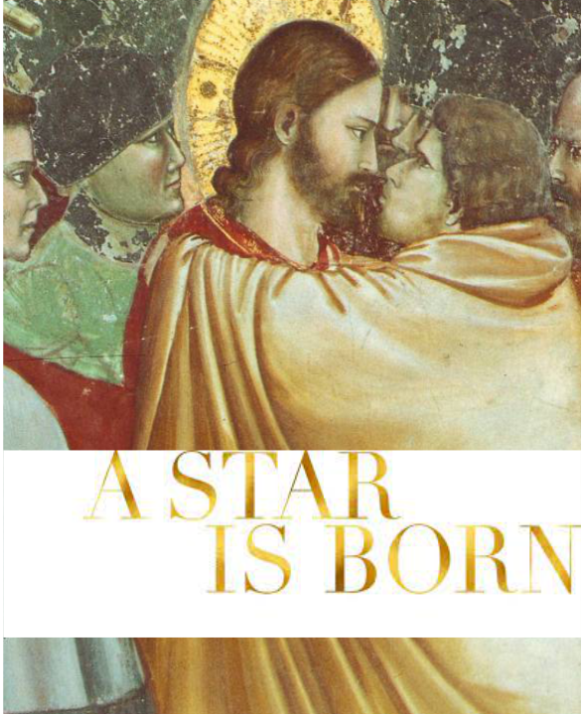
A Star Is Born

Did you know that the original, 1937 version of A Star Is Born may well have been based on a true story, first aired in an earlier, 1932 movie called What Price Hollywood? Yet every word of dialogue in the original Star Is Born was invented, all of its characters fictional, all of its scenes made up.

By the time of the 1954 remake, the female lead had gone from being an aspiring actress to an aspiring singer, played by Judy Garland, looking for her big break. Her mentor is still the addictive personality of the original film but this time he’s a has-been singer, not an actor, and crucially he doesn’t commit suicide before the film’s end (apologies for the spoiler.) Practically everything about this remake – its dialogue, characters, songs (songs? Where’d they come from?) settings and scenes – is different and, once again, is completely made up.

In the Barbra Streisand 1976 version, the female lead is once again a singer, her mentor a rock star whose career is on the slide. This film is about the perils of a rock’n’roll lifestyle and the passionate relationship between the two protagonists. It bears only the scantest relationship to its predecessors, never mind the original true-story that inspired the first film. Again, everything in it is pure invention.

Which brings us to the fourth version, starring Lady Gaga, that borrows a little something from all of the previous films. All the same, it alters the story, creating completely new scenarios, dialogue, songs and settings. It would be unrecognisable to the original audience of the first A Star Is Born, as different from that film as… well, as John’s gospel from Mark’s.

As the various versions of the film demonstrate, stories evolve. They are fluid and in their telling and retelling they change. Their creators adapt them and ‘improve’ them to meet the evolving tastes of their intended audience. They happily invent new episodes, new scenarios and new dialogue.

And so it is with the gospels: Mark’s original based on the visions of a few people from 40 or so years earlier; Matthew and Luke’s based on Mark’s – with their own largely invented additions – and John’s (the Lady Gaga of the set) a wild reimagining of all three. Apart from the outline of the story (which they get from Mark), every one freely adapts everything else: dialogue, scenarios, pericopes and, yes, songs.

We’ll look in detail next time at the evidence, still apparent in today’s versions of the gospels, at how we know this to be the case. 

Tailor Made

So where did the stories of Jesus life on Earth come from? The traditional answers to this question are wholly inadequate. As we’ve seen, they didn’t seem to be around when Paul was writing; the hypothetical Q is an unconvincing way of explaining them while unreliable memory, coupled with the so-called oral tradition, don’t offer any means of conveying accurate verifiable information about Jesus.

The writers of the gospels, particularly Mark the creator of the first, would have known this. The gospels are not collections of the speculative tales that were doing the rounds. They might have made some incidental use of them, but all of the gospels are carefully constructed, designed to make theological points about their hero. Particular kinds of stories were required for this and the gospel writers thought nothing of making them up. It’s possible they made use of existing tales, but if they did, they almost certainly retooled them to suit their purposes. The stories we find in the gospels are tailor made to illustrate these purposes. None of the gospels is history: they are all carefully crafted literary creations.

What were the purposes and the agendas of the gospel writers? Propaganda, designed not so much to convert non-believers, but to explain to those who were already part of the cult, and their own sects in particular, what belief in Jesus entailed. To this end, they created allegories, symbolic stories about his life on Earth.

Mark began the process. He constructed his narrative by adapting Paul’s teaching ;and inventing stories based on ‘prophecies’ from the scriptures to create a symbolic narrative every part of which makes a theological point. He may also have retooled existing stories while borrowing features of existing myth that fellow cultists would expect to find in an account of a demi-god’s adventures.

Matthew and Luke then followed his lead, lifting what they thought was of relevance to their own agendas, dropping or amending the rest and inventing their own symbolic stories.

You think they didn’t? I’ll show you that they did, and how, using Mark, Matthew and Luke’s gospels, in a couple of posts time. But before that: a slight and relevant diversion.

In Search of the Lost Q

Where did the stories about Jesus that we find in the gospels come from?

2. Q

Q is a hypothetical document said to be a collection of Jesus’ sayings. It was first hypothesised in the late 19th century and developed by minister B. H. Streeter in 1924. it was intended to explain why Matthew and Luke’s gospels shared material that wasn’t plagiarised from Mark. Streeter speculated they must both have had access to an alternative source that he christened Q (after the German for source, Quelle.)

While the idea caught on and is still assumed by many scholars (including Bart Ehrman) there are numerous problems with it:

Q doesn’t exist and has never existed. There is absolutely no evidence for it, aside from the duplication of material in Matthew and Luke, the very context it was designed to explain. There are no surviving copies, nor even fragments of any written collection of Jesus’ sayings (unsurprisingly for a non-existent document.) Nor is a book of Jesus’ sayings referred to in any form by any New Testament writer (again, unsurprisingly.)

Q is unnecessary. As other scholars, including M. A. Farrer, Mark Goodacre and Richard Carrier, have pointed out, there is a far simpler explanation for Matthew and Luke’s sharing of material they didn’t get from Mark. Either Matthew or Luke had access to the other. It is generally accepted that Matthew’s gospel predated Luke’s by a few years. It is likely therefore that Luke took certain stories from Matthew, as he had others from Mark, and made them his own. Doesn’t he say at the start of his gospel that he intends to collate material about Jesus that was already in circulation? Occam’s Razor also leads to the conclusion that this is a far better explanation of the duplication than a hypothetical third document.

Q doesn’t answer the question of where the stories came from in the first place. Arguably, it moves the solution back a stage but that’s all. If for the sake of argument we assume Q did exist, we still don’t necessarily know where it got its material from. Q really gets us no further forward.

Q is conjectured to be a collection of sayings. They are not set in any context; Q lacks a narrative structure so cannot be where Matthew derived his accounts, for example, of the Temptation in the wilderness (4:1-11), the Sermon on the Mount (5:1-12) or the healing of the centurion’s servant (8:5-13) that Luke would later copy and adapt. These are stories, not mere sayings. Even if Matthew got the sayings they include from some now lost written source from where did he get their context? Eyewitnesses? Unlikely, given he was writing 50 years after the purported events when most eyewitnesses would be dead. He was certainly not an eyewitness himself; he would not have needed to copy large swathes of Mark if he was. Nor does Matthew claim to be using eyewitness testimony. Like all the gospel writers he comes nowhere close to citing his sources.

Matthew is, however, notorious at making up stories he thinks make Jesus fit prophecy. He invents still others to make theological points. It’s quite possible he invented these particular accounts too.

Or perhaps, as apologists like to claim, Matthew and the other gospel writers got at least some of their stories from the so-called oral tradition, a grand name for the tales about Jesus that circulated for the 40-70 years before the gospels were written.

We’ll take a look next time.

Stories about Jesus

Our resident Christian implied recently that I disputed that stories about Jesus existed prior to the gospels being written. I don’t – this was another of Don’s straw man arguments – and told him that of course there were earlier stories about Jesus. But then I got to thinking: where exactly are those stories? How do we know they existed? How can we distinguish them from later embellishments?

Let’s take a look at the evidence*, starting with the earliest Christian writing that we have:

Paul

Paul doesn’t refer to a single event from Jesus’ life outside a barebone account of the crucifixion and resurrection. He doesn’t mention, for example, the nativity, the virgin birth, Jesus’ time in the wilderness, his chat with the devil, his baptism, John the Baptist, the miracles, the amazing things Jesus is reputed to have said, the parables, the Sermon on the Mount and Beatitudes, the I Am sayings, the healings, Lazarus, the arrival in Jerusalem, the cleansing of the Temple, the agony in the Garden of Gethsemane, the arrest, Judas, Pontius Pilate, Jesus’ trial, the mockery of the soldiers, Peter’s denial, the words Jesus spoke on the cross, Joseph of Arimathea, the rolled away stone, the empty tomb, Mary Magdalene, Doubting Thomas or the physical Ascension. Neither does he refer to any incidents or episodes from stories that didn’t eventually make it into the gospels. Not one of them. (He does create a narrative of his own that later finds its way there: the ritual of sharing bread and wine which Paul lifts from Pagan ceremonies. We’ll return to it in a later post.)

Apologists like to say that these serious omissions are no more than Paul’s assumption that his readers would already know the stories about Jesus.  He does not need to reiterate them. But no-one is suggesting he should or would have recounted them in full. What is odd and awkward is that Paul doesn’t even allude to them in his teaching. He could clinch many an argument by referring to a particular saying or miracle of Jesus’, but he never does.

When talking about obeying the (Roman) authorities, for example, in 1 Corinthians 15:12 &13, he could have said, ‘Recall that the Lord told us we should render unto Caesar that which is Caesar’s,’ but he doesn’t. He could have alluded to Thomas when explaining the importance of having faith without evidence; talked about the empty tomb when discussing Jesus’ resurrection; mentioned the raising of Lazarus as an example of the dead being resurrected; commented on Jesus turning water into wine when arguing that the Law had been superseded by a new covenant. He might even have quoted something Jesus said from a story in circulation that didn’t later end up in one of the gospels.

He doesn’t. Ever.

Paul claims he received none of his information about Jesus from any human being. He insists he received all he knew through revelation – the Lord speaking to him from heaven. Apparently, the Lord neglected to convey any of the details of his life on Earth. The apostles kept equally schtum. Paul was no more knowledgeable about the life of Jesus once he’d he met them than he had been before. Was he not inquisitive? Did he not ask the right questions? Did they dislike him so much they withheld every detail of Jesus’ activities on Earth? Did they not in fact have that kind of information? Whichever it was, Paul seems not have known any of the stories about Jesus that predated the gospels or even that later appeared in them. It’s possible, I would say likely, he did not know of them because they had yet to be created. Many of the stories about Jesus were ten or more years away.

But we mustn’t jump to conclusions. Next time we’ll take a look at other possible sources of these elusive stories.


*I read Bart Ehrman’s Jesus Before The Gospels a few years back. I hope I’m not merely reiterating what he says there. While there were some points I found less persuasive than others, Ehrman nevertheless does a good job of showing how stories about Jesus changed and evolved over the years.

Inventing Jesus

What do we know about the gospels?

  • The stories they tell aren’t history; none of the gospel writers cites their sources, none refers to other independent accounts of Jesus’ life.
  • None of the versions of the story are eyewitness accounts; none of the writers claims to be an eyewitness; the gospels are anonymous despite the names that were attributed to them in the second century.
  • The gospels were created decades after the events they purport to relate; there is no evidence of an oral tradition that preceded them, no guarantee such a tradition would, if it existed, be reliable.
  • None of the gospels are independent; all of them are based to one extent or another on ‘Mark’. There really is only one story with three, sometimes markedly different versions.
  • The gospels are frequently contradictory where the later writers altered or embellished Mark’s story. They are often geographically and historically incorrect, and include anachronisms.
  • Each writer presents a different Jesus, the fourth radically so; there is no way of knowing which, if any, is the most historically reliable.
  • It is unlikely the actual words of Jesus would have been preserved accurately for 40 years or more; the fact the different authors freely alter them whenever it suits their purpose tells us they did not.
  • None of the gospel writers could possibly have known exactly what was done and said in private, for example, when Jesus communed with Satan in the desert, when he was hauled off to be flogged; when he was interviewed by Pilate.
  • The authors evidently invented episodes and events; the wandering star; Herod’s massacre of Innocents; zombie ‘saints’ wandering around Jerusalem; angels at Jesus’ tomb; the resurrection itself.
  • The gospels are literary creationsstories – as their structure, editing, use of myth, tropes, symbolism, metaphor and aphorisms attest.

This is what we’re working with. So, just where did the details of Jesus’ life, as we have them in the gospels, come from? We know Matthew, Luke and John found them to differing extents in Mark’s story. Other details they invented or took from Paul. Matthew in particular followed Mark’s lead and drew even more heavily on the Jewish scriptures, the Old Testament (OT). Both Mark and Matthew rewrote sections of the OT to create most of their Jesus stories. Next time, we’ll take look at Mark 15, relating, for the very first time, Jesus’ trial, crucifixion and burial to see how it was done.